Progress Report: What It Is and How to Write One Clearly

Jump to section
Think about the last time a friend asked how your road trip was going. You didn't hand them the whole itinerary. You gave a quick update: where you are, what's working, and what still needs fixing. That's the spirit of a progress report.
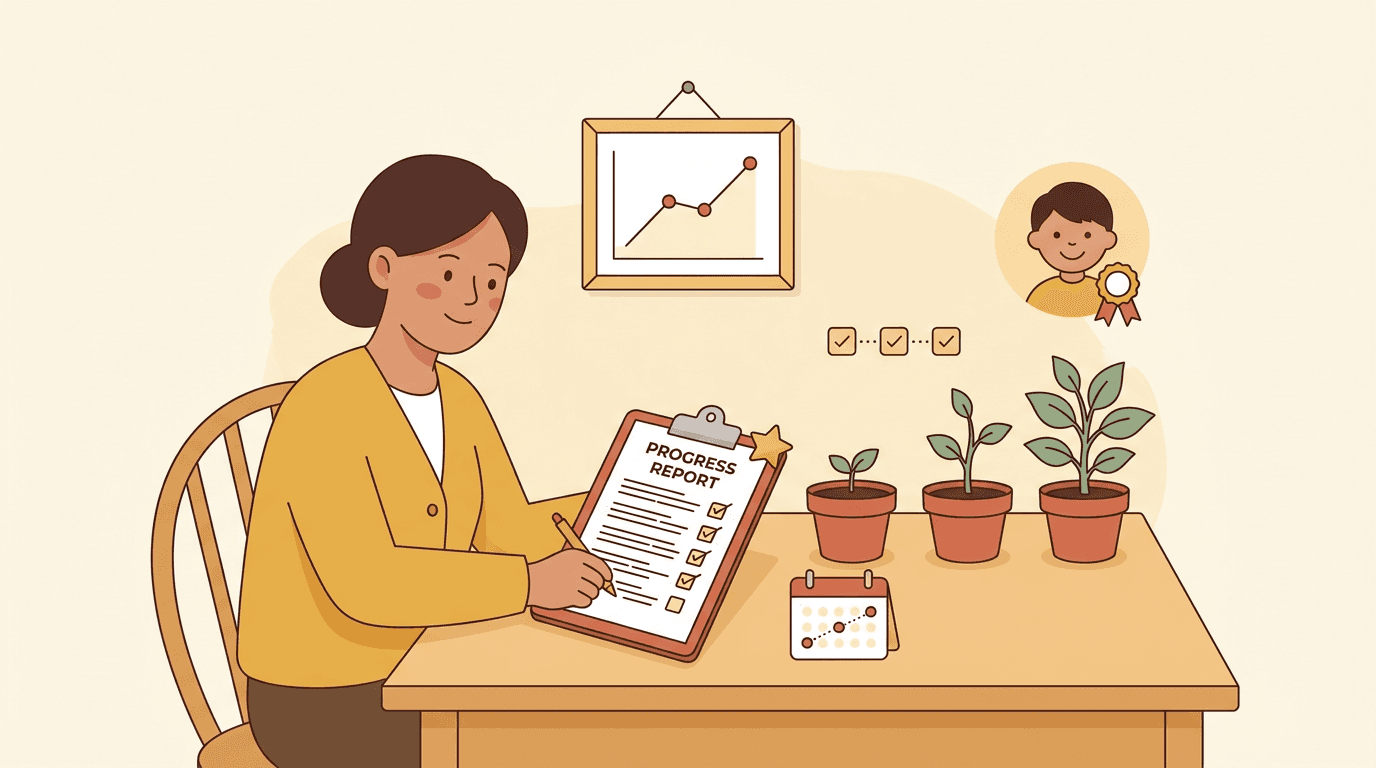
A progress report is a snapshot of a student's learning at a specific point in time, shared with families, students, and sometimes administrators.
In this post, we'll cover what these reports are for, how they're structured, how often to send them, and how to write them clearly. We'll also share templates you can adapt.

What a Progress Report Is For
A progress report answers one simple question: where do things stand right now? Here's what the term means, who relies on it, and how it touches your students' grades.
What does a progress report mean?
A progress report is an update on how work is moving toward a goal. It supports project monitoring, the regular checking that keeps a plan on track, and accountability, which makes clear who owns each piece.
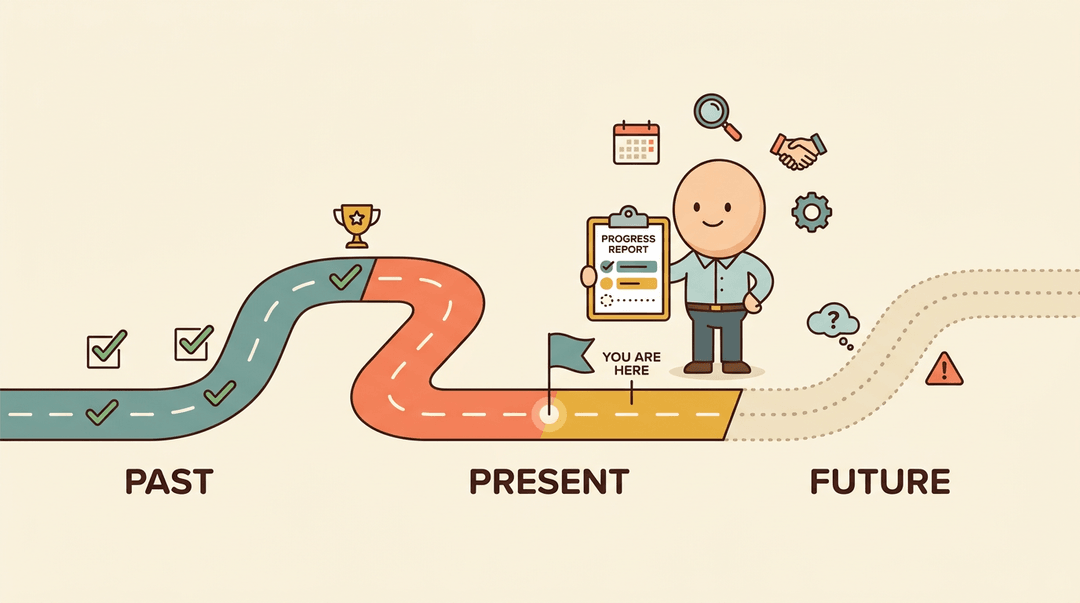
It's less about what happened and more about where things stand. A good report tracks the past, present, and future:
- Past: what's already been completed
- Present: where things stand today
- Future: what comes next and what might slow it down
Common synonyms include status report, which stresses the current state, and progress update, a lighter, more informal version. They all mean roughly the same thing.
Who writes and reads progress reports
Consultants send them to sponsors, research organizations report to funders, and internal staff update their managers. Teams also report to managers or employees so everyone knows what's moving.
Consider a high school science teacher who sends a weekly update to the department head. A delayed unit gets flagged in week three, not discovered at the end of the term.
Where progress reports get used
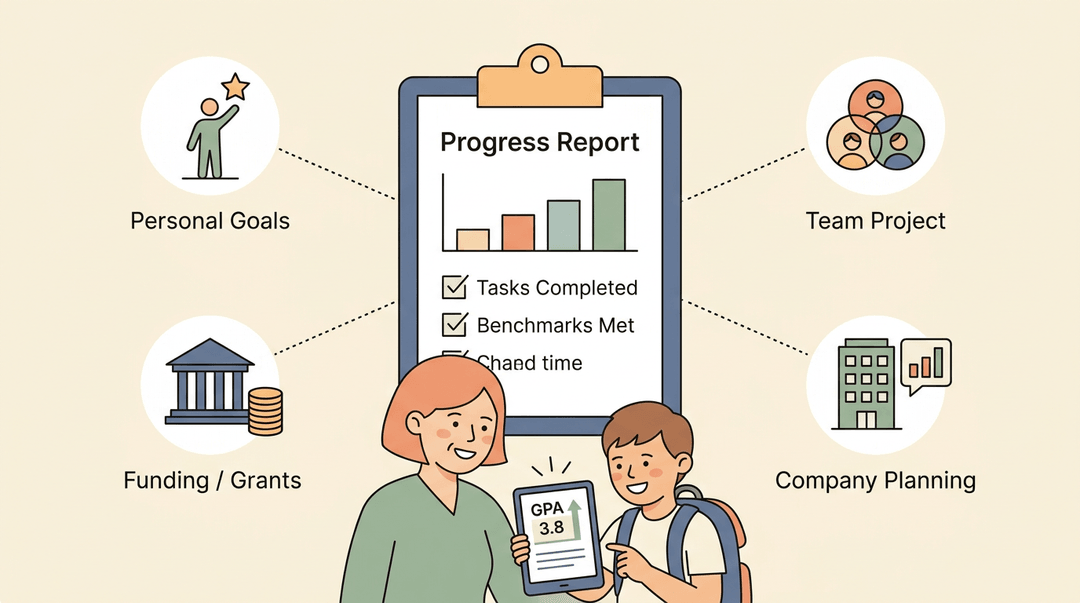
Progress reports serve personal goals, team projects, company-wide planning, and government or commercial funding, where funders often require them.
In schools, a student progress report shows families how a learner is doing in each course before the final grade arrives.
Progress reports can affect students' grade point averages (GPAs). A school district's grading procedure explains that GPA is the sum of the point values for all marks received, divided by the sum of credits for all courses attempted.
Every course you take counts toward that number, so keep an eye on your reports.
How These Reports Are Structured
Progress reports come in a few shapes, and the right one depends less on what you tracked and more on who is reading it. Start with the most detailed version and work down. Simple usually wins.
What goes into a formal report
A formal report has three parts:
- The front matter holds the title, funding details, and dates, so anyone can tell what it covers and when.
- The body does the heavy lifting with a summary, the progress made, the problems encountered, and future work.
- The end matter closes with references and attachments for readers who want to dig deeper.
A simpler Progress, Plans, Problems format
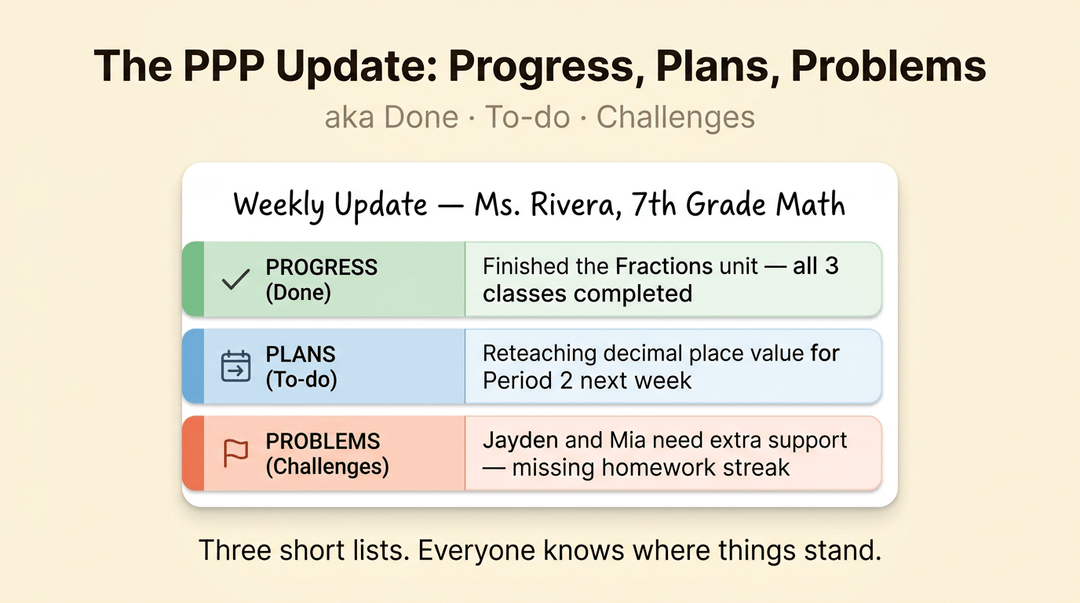
Many teams use a lighter version with three sections: Progress, Plans, and Problems. Some rename them Done, To-do, and Challenges for a quicker read. Consider a middle school math teacher sending a weekly team update.
Under Done she lists the unit she finished, under To-do the reteaching she's planned, and under Challenges the two students who need extra support. Three short lists, and everyone knows where things stand.
Tailoring sections to your department
The three-part format is a starting point, not a rule. Sales often adds sections for leads and meetings, marketing adds campaigns, and development adds feature ideas. Extra categories let each department track what it actually does.
A Teacher's Checklist for Progress Reports
Use this guide when a progress report is due and you want it written in one sitting, not pieced together from memory. We'll move through three moves: gather, write, deliver.
Before you write
Confirm these three things are in front of you:
- Grades and attendance pulled. Current averages and absences, side by side, since the two often explain each other.
- Recent assessments reviewed. Look for the pattern across them, not one score.
- Missing work checked. Separate "late" from "never turned in," because the next step differs.
Build the report
Every report needs four parts. Think of them as slots to fill:
| Slot | What goes in it |
|---|---|
| Academic performance summary | Current grade, direction of travel, what it's based on |
| Behavior and effort notes | Participation, focus, work habits you've actually observed |
| Strengths and growth areas | One or two of each, strengths first |
| Next steps for improvement | One or two actions, for school and for home |
The first slot changes with the setting. Lead with the evidence that fits your students:
| Setting | Lead with | Sample line |
|---|---|---|
| Elementary | Skill mastery notes | "Counts to 100 by tens; still practicing fives." |
| Middle/high | Grade trends | "Quiz scores climbed all unit; the essay is the gap." |
| Homeschool | Portfolio highlights | "The river-model project shows strong science reasoning." |
Example: A seventh-grade math teacher opens with the trend ("steady improvement on quizzes"), names one growth area (showing work on multi-step problems), and ends with a next step: "Ask Sam to explain one problem aloud each night."
The example works because every claim is specific, and the next step is small enough for a family to actually do.
Deliver it well
- Keep the tone positive. Name what's working before what isn't, and frame gaps as "not yet."
- Use parent-friendly language. Swap jargon for plain words: "reads smoothly" beats "fluency benchmark."
- Set a consistent schedule. Send reports on the same rhythm every term so nothing arrives as a surprise.
Say: "Here's where Jordan is thriving, and here's one thing we'll work on together."
⚠️ Watch out: Don't tuck missing work into the last line. If it's affecting the grade, say so in the academic summary, with the next step right beside it.
Generate progress reports straight from your gradebook data in EMStudio, no manual compiling needed.
How Often to Send These Reports
How often you send a progress report matters as much as what it says. The real question is less about how often you can send one and more about how often your student needs one. Start with your school calendar and any commitments already in place.
Choosing your reporting interval
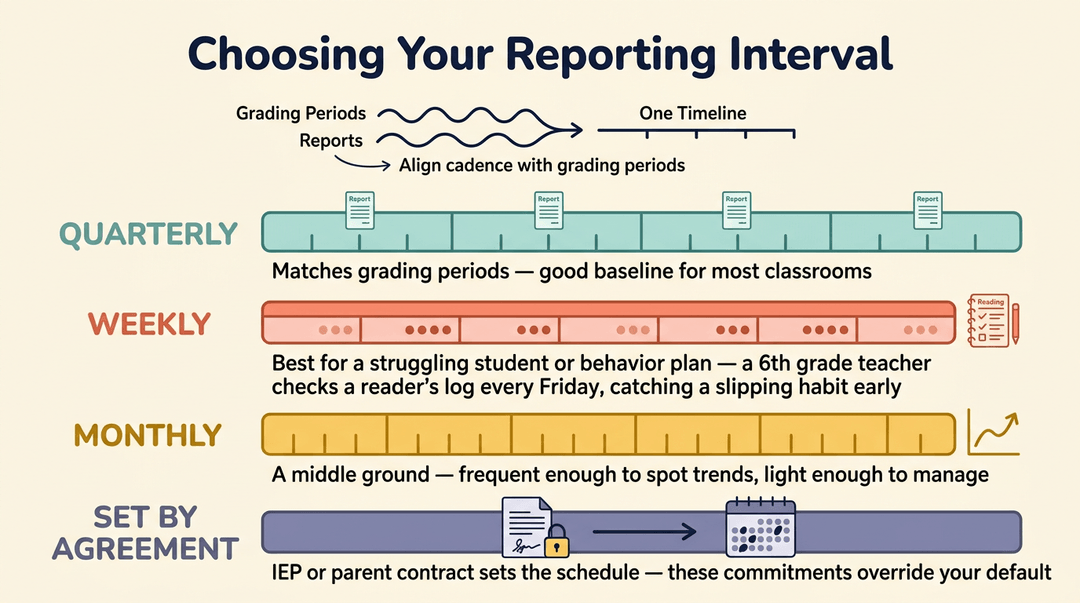
Your reporting interval is the gap between one report and the next. Quarterly reports line up with the grading periods your school already uses, so families see the report alongside the grade they're already watching.
Aligning cadence with grading periods gives you one timeline instead of two.
Here are the common options:
- Quarterly. Matches your grading periods and works well as a baseline for most classrooms.
- Weekly. Best for a student who is struggling or is on a behavior plan. Consider a sixth-grade teacher who checks in every Friday on a reader's log, catching a slipping habit before it becomes a missed assignment.
- Monthly. A middle ground. It's frequent enough to spot trends and light enough to keep your prep manageable.
- Set by an agreement. If an individualized education program (IEP) or a written contract with a parent or outside program sets the interval, follow it. Those commitments override your default.
Tips for Writing These Reports Clearly
A progress report only works if the reader can act on it, so clarity matters as much as content. Here's how to keep yours easy to follow.
How long each section should be
Aim for 5-7 items per section. That's enough to show real growth without burying the reader. Avoid overly long reports: if a section runs past a screen of text, trim it.
Consider a fourth-grade teacher who turns six vague sentences into three specific ones. The parent reads it in one sitting, and the teacher saves an evening of rewriting.
Writing so your reader understands
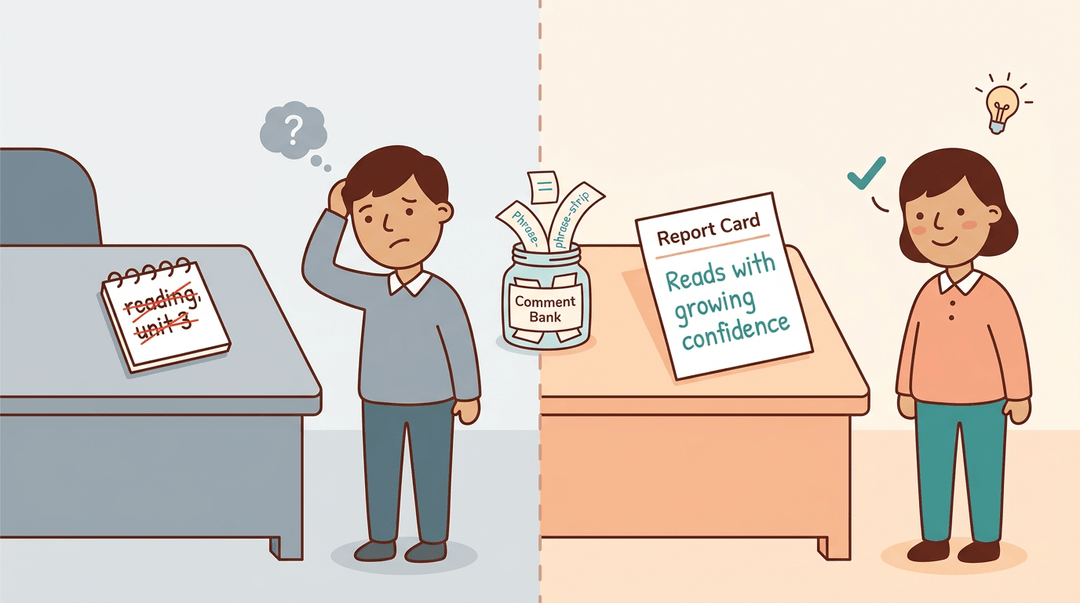
Write for the reader, not yourself. Your shorthand makes sense to you because you were in the room, but a parent or manager wasn't. Use full sentences, not task fragments: "Reads with growing confidence" beats "reading, unit 3."
Add context and commentary so a score explains what a skill means, not just what it is. Ensure the manager understands where the student stands without needing a follow-up question. Say what the student can do, not what you covered.
The seven steps of report writing follow the same logic: work through them in order, and each one makes the next easier. Keep a comment bank of phrases you can adapt, so you're never starting from a blank box. Clarity wins.
Examples and Templates to Use
Seeing a progress report on the page makes the idea far easier to picture. Here's a sample to model yours on, plus templates to speed things up.
A sample progress report
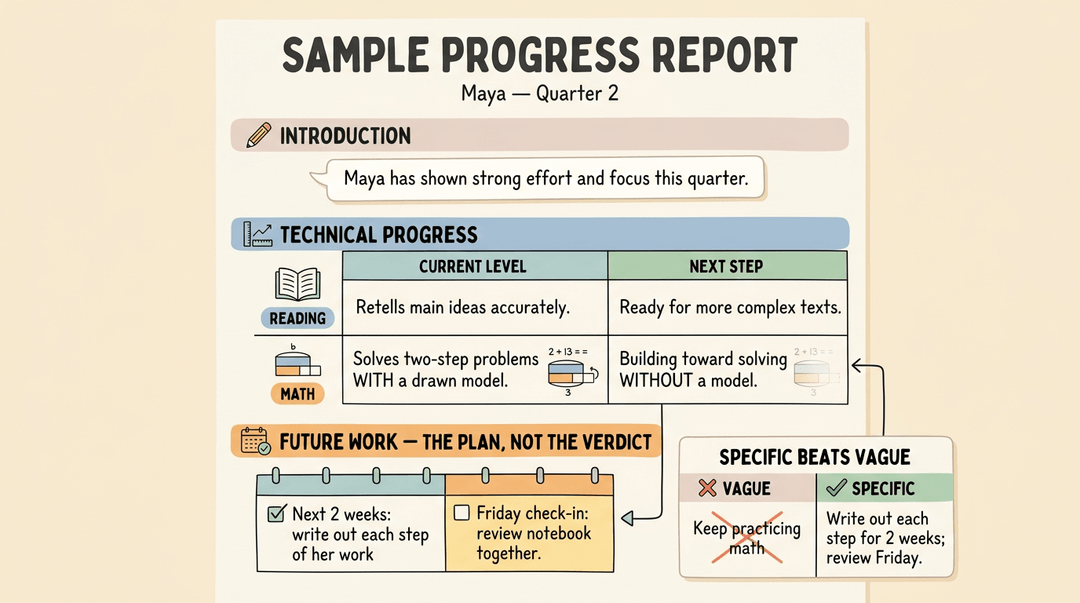
Picture a fifth-grade teacher writing a sample student progress report for Maya, who reads well above grade level but still struggles with multi-step math. Start with a short introduction that names the grading period and her overall effort.
Then move to the technical progress section, where each skill gets its current level and a clear next step:
- Reading: Maya retells main ideas accurately and is ready for more complex texts.
- Math: She solves two-step word problems when she draws a model first, and she's building toward doing it without one.
The future work section closes the loop. It's the plan rather than the verdict. For example, Maya will write out each step of her work for the next two weeks, and you'll review her notebook together at Friday's check-in. Specific beats vague.
Templates you can download
Downloadable template files give you a starting layout you can edit for each student, so you're not facing a blank page every grading period.
The simple three-word template (PPP) keeps things lean: one short statement per section, so you can finish a report during a planning period.
An example weekly team report shows how the same format scales. When a grade-level team posts a short weekly update, a substitute or new colleague can pick up any student's story in minutes.
Progress reports work best when they're clear, timely, and honest about where a student stands. Keep the focus on growth, and keep the process manageable so it doesn't eat your weekends. Ready to make grades easier to track?
Check out our online gradebook, which records and organizes grades with automatic calculation so your reports start from accurate numbers.
References
- Procedure — resources.finalsite.net
Frequently asked questions
What are the 7 steps of report writing?
The seven steps of report writing are usually: define the purpose and audience, gather information, organize the material, analyze the findings, draft the report, revise and edit it, and proofread and finalize it. Following these steps helps make the report clear, accurate, and useful.
What does a progress report mean?
A progress report is an update on how work is moving toward a goal. It explains what has been completed, where things stand now, and what comes next, including any problems or delays.
What's another word for progress report?
Another word for a progress report is a status report. “Progress update” is also commonly used, especially for a less formal report.
Does a progress report affect your GPA?
Yes, a progress report can affect your GPA if it includes grades or marks that count toward your courses. A report that only provides feedback or a temporary update may not directly change your GPA, depending on your school’s grading policy.