What Is STEM Education? A Complete Guide to How It Works

Jump to section
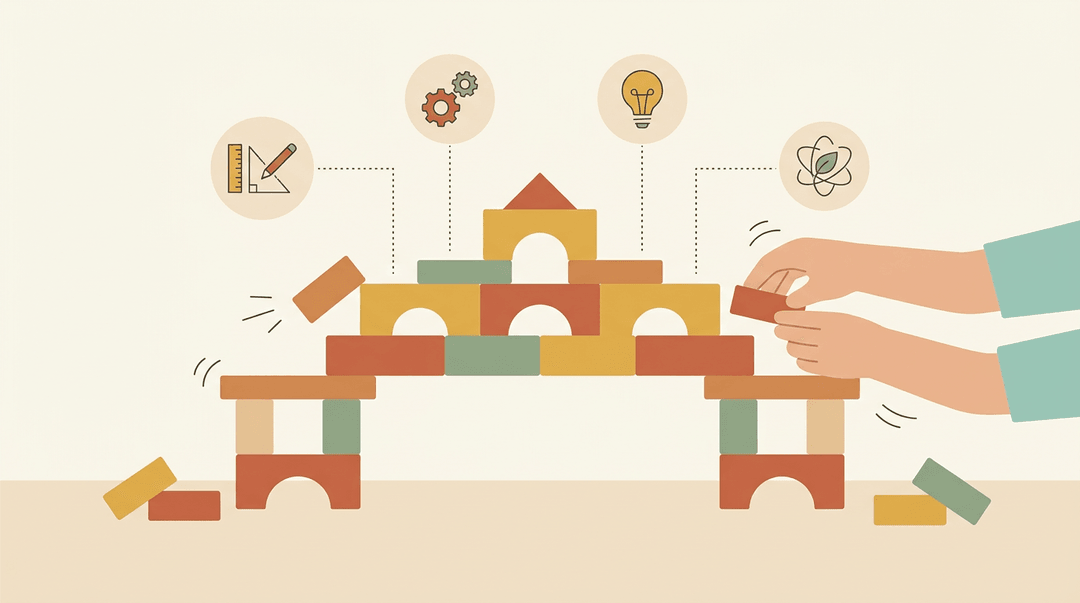
Think about building a bridge out of blocks: you need a plan, some math to make it balance, and a bit of trial and error before it stands on its own. STEM education works the same way.
It's the intentional blending of science, technology, engineering, and math into learning that mirrors how the real world actually solves problems.
In this post, we'll unpack what STEM really means, where it came from, and how to bring it into your classroom starting Monday.
What Is STEM Education?
Ask five teachers what STEM education means and you'll likely get five different answers.
Here's the through-line: it treats science, technology, engineering, and math as one connected discipline instead of four separate subjects, with STEM literacy (the ability to apply these ideas to real problems) as the goal.
What STEM stands for
STEM stands for science, technology, engineering, and math. The acronym traces back to the U.S. National Science Foundation in the 1990s, when researchers needed shorthand for programs that blended these fields rather than teaching them in isolation. That blending is the point: an interdisciplinary approach where a single lesson might ask students to use math to test an engineering design, or apply the scientific method to a coding problem. Any student working through that kind of task counts as a STEM student, not just the ones already headed for a science career.
STEM is a teaching approach
STEM isn't a subject you'll find on a report card next to reading or history. It's a way of organizing instruction: an experiential learning pedagogy built on hands-on projects rather than lectures. Instead of memorizing formulas, students apply them. Consider a fifth-grade class designing a water filtration system: they use science to understand contamination, math to measure flow rates, and engineering to build a working prototype, all in one unit tied to a real-world problem.
The four disciplines inside STEM
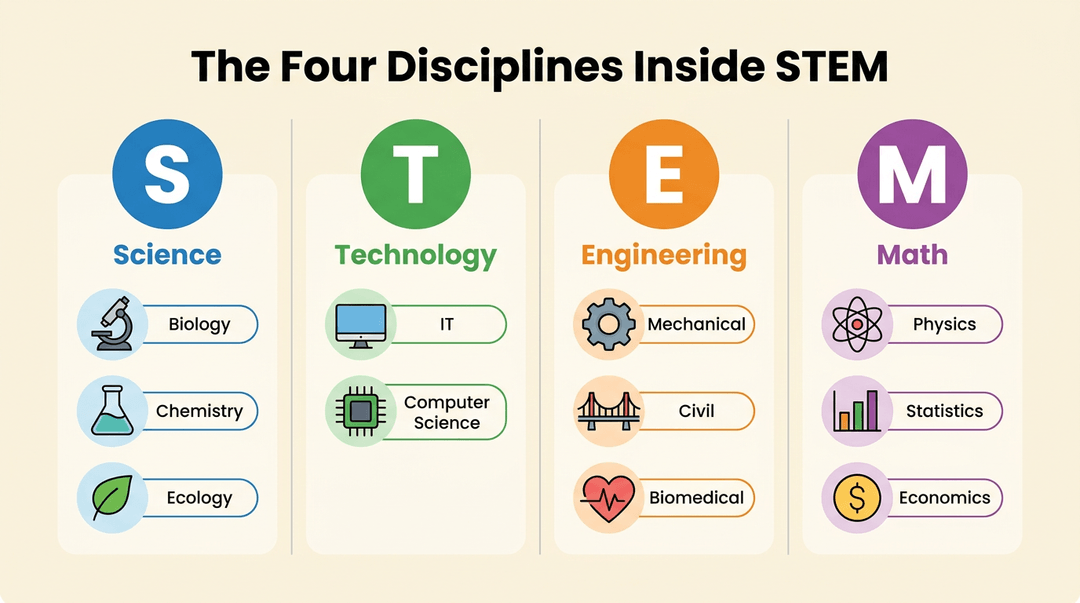
Each letter covers real ground:
- Science includes biology, chemistry, and ecology.
- Technology includes information technology (IT) and computer science.
- Engineering includes civil, mechanical, and biomedical engineering.
- Math includes physics, statistics, and economics.
How to Start Teaching STEM
You don't need a lab, a grant, or a robotics kit to begin. Pick the moves below for your grade band, start with one, and build from there.
Elementary: build curiosity with your hands
At this age, STEM is structured play with a question attached.
- Set up exploration stations. Small rotating tables students visit in groups.
- Magnets and paper clips, ramps and marbles, a sink-or-float tub.
- Run simple design challenges. One constraint, one goal, cheap materials.
- Try: "Build a bridge from 20 straws that holds this toy car."
- Teach cross-subject theme units. One theme carries science, math, and reading together.
Example: A second-grade weather unit: students measure rainfall in a homemade gauge (math), read a storm story (literacy), and design a "roof" that keeps a paper house dry (engineering). One theme, three subjects, zero new materials.
Middle school: make the process explicit
Now name the thinking. Post the engineering design process on the wall and run every project through it:
- Ask: define the problem and its constraints.
- Imagine: brainstorm solutions without judging them yet.
- Plan: sketch one design and list materials.
- Create: build a first version fast.
- Improve: test, then ask "What would make version two better?"
With that cycle in place, layer in the content:
- Intro robotics or coding. Block-based coding or a shared class robot works fine.
- Real-world problem projects. Anchor the cycle in something local.
- Redesign the lunch line, reduce classroom waste, map a safer bike route to school.
⚠️ Watch out: Don't grade the first build. If failure costs points, students stop iterating, and iteration is the whole lesson. Grade the improvement between versions instead.
High school: connect to what comes next
By high school, STEM should point somewhere. Match each option to what it gives students:
| Offer this... | Students get... |
|---|---|
| Capstone research projects | A yearlong question they own, presented publicly |
| Industry mentor partnerships | A real professional reviewing their work |
| AP or dual-enrollment options | College credit and a transcript signal |
Start small: one mentor from a local business, one capstone cohort, one dual-enrollment course. Each success makes the next partnership easier to recruit.
Whichever band you teach, the sequencing work is the same: map each STEM unit to standards and pacing with EMStudio's curriculum planner.
How STEM Education Got Its Start
STEM didn't spring up overnight. It grew out of a series of federal efforts to keep American students competitive in science and math, and the story starts with one agency.
How the National Science Foundation shaped STEM
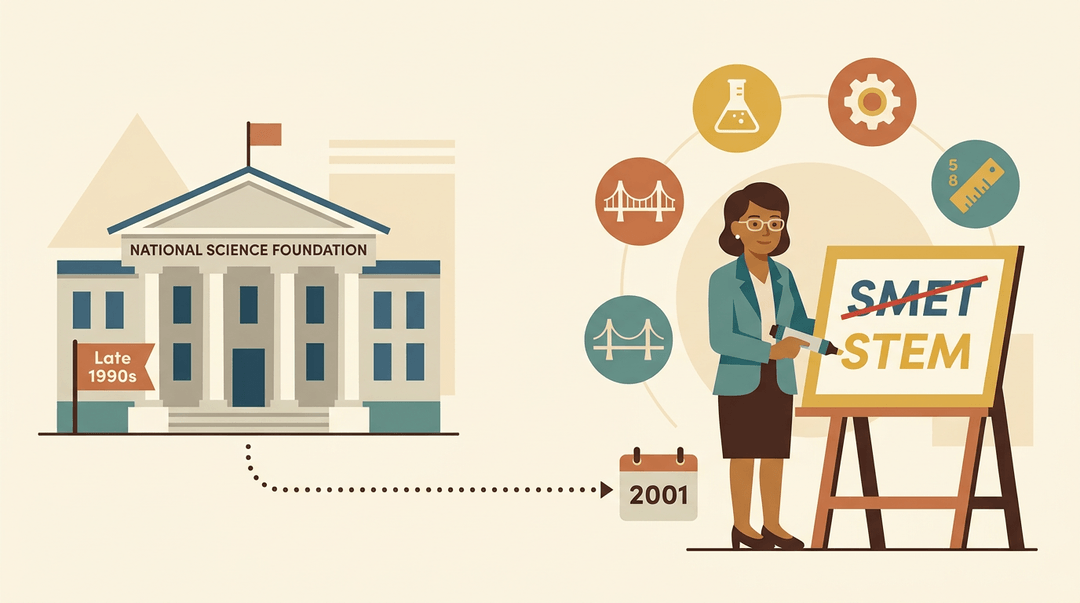
The National Science Foundation launched STEM-related initiatives in the late 1990s, aiming to strengthen how schools taught science and technology.
By 2001, the agency had revamped those efforts, and that's when Judith A. Ramaley of the National Science Foundation coined the term STEM, replacing the older acronym SMET.
Key policies and campaigns that shaped STEM
The momentum kept building. The STEM Education Coalition formed in 2007 to push for stronger federal support, and by 2013, national science benchmarks were issued as part of a federal STEM strategic plan.
Around the same time, President Obama's Educate to Innovate campaign and the development of the Next Generation Science Standards pushed STEM further into everyday classrooms.
How STEM has expanded over time
STEM hasn't stood still.
Over 25 years, it's evolved well beyond its original four disciplines, growing to include computer science, robotics, and what researchers call designed-world integration: understanding the human-made systems students live alongside every day.
STEM vs STEAM
You've probably seen both acronyms floating around, and it's fair to ask: are they the same thing with a different label? Not quite. STEAM takes the STEM framework and folds in the arts, changing not just what students study but how they get there.
What STEAM adds to STEM
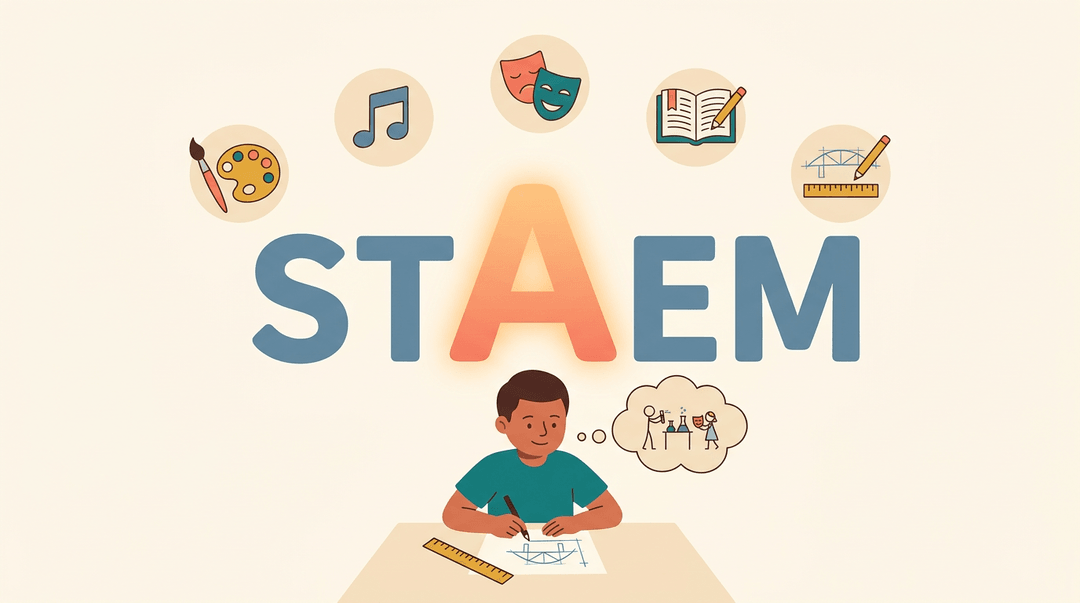
STEAM keeps the four STEM disciplines intact and adds the arts, a broad category that stretches well beyond painting and drawing. Think:
- Visual arts and music
- Drama and performance
- Language arts and design
A student sketching a bridge design before building it, or writing a short script to explain a science concept, is working inside that expanded frame.
Key differences between STEM and STEAM
STEM tends to center on hands-on investigation:
- Run the experiment
- Collect the data
- Draw the conclusion
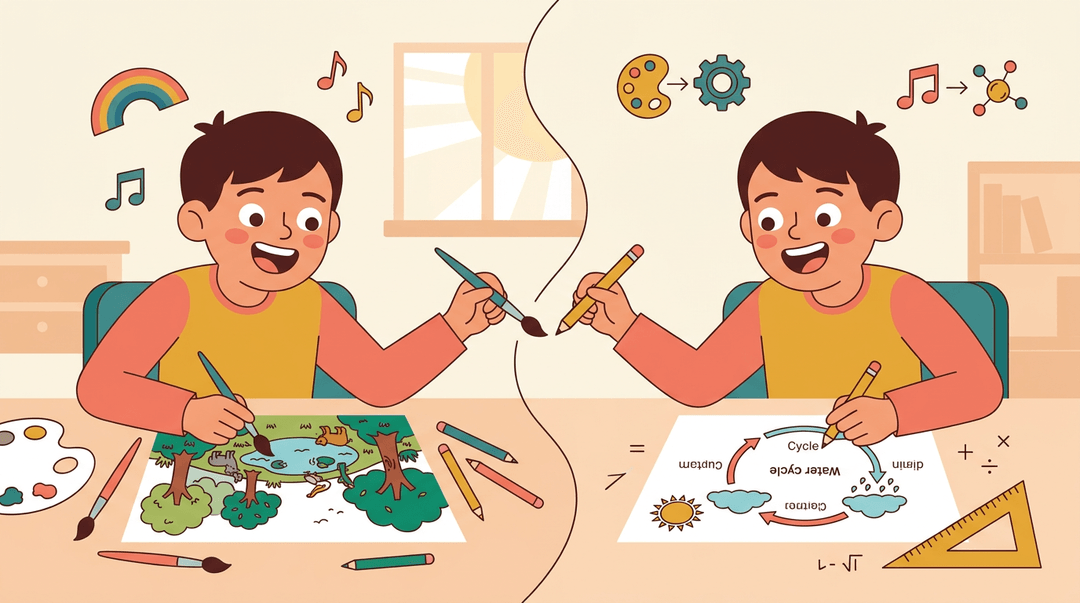
STEAM keeps that rigor but layers in process-driven inquiry, where the how of getting to an answer matters as much as the answer itself. It also leans harder on soft skills like communication and teamwork.
The clearest split: STEM often rewards individual analysis, while STEAM pushes toward collaborative design, several students building one shared solution together.
Why adding arts to STEM helps
Pairing creative expression with technical mastery keeps students invested.
A middle schooler who'll tune out a worksheet might light up when asked to illustrate a habitat or compose a jingle about the water cycle, and that improved engagement often translates to sharper motivation.
It also mirrors the real world: engineers sketch, designers calculate, and most careers now demand both communication and creativity, not one or the other.
The Skills and Benefits STEM Builds
Good STEM (science, technology, engineering, and math) teaching does more than cover content. It builds habits of mind students carry into every subject, and eventually, every job.
How STEM builds critical thinking skills
A student debugging a robot or redesigning a bridge that collapsed under too much weight is practicing critical thinking: testing an idea, watching it fail, and figuring out why.
That cycle sharpens analytical reasoning, the skill of breaking a messy problem into smaller, checkable parts.
Over time, students move from simply following steps to inferring design choices: noticing why one solution holds up and another doesn't, which is higher-order thinking in action.
What are the 4 C's of STEM education?
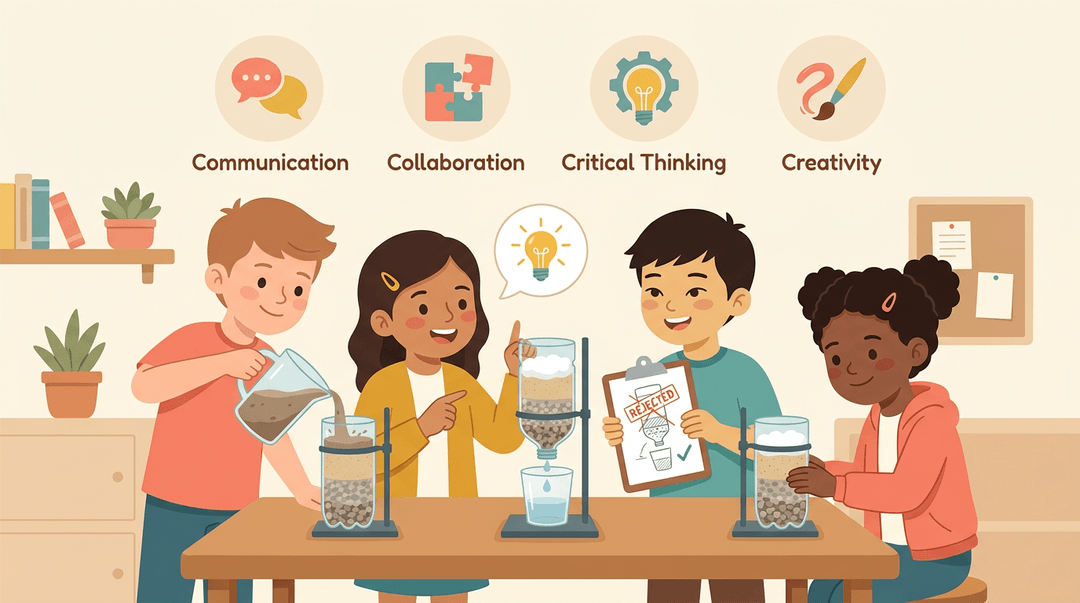
Ask any STEM teacher what students really practice, and you'll hear some version of the 4 C's:
- collaboration
- communication
- critical thinking
- creativity
A group building a water filter has to divide roles, explain their reasoning to teammates, and adapt when the first design leaks.
That mix of perseverance and organized teamwork does as much for a student's growth as the science content itself, and it teaches responsibility in a way a worksheet never could.
How STEM prepares students for careers
These same skills map directly onto high-demand careers in engineering, health care, and technology. Employers consistently need workers who can reason through problems and work in teams, not just recall facts.
That's why strong STEM programs support economic growth: they help close the skills gap between what industry needs and what graduates bring with them on day one.
STEM Careers and the Workforce
A strong STEM education doesn't just build curious minds. It opens doors to real careers, and the numbers back that up.
Popular STEM career fields and jobs
STEM careers span far more than lab coats and calculators.
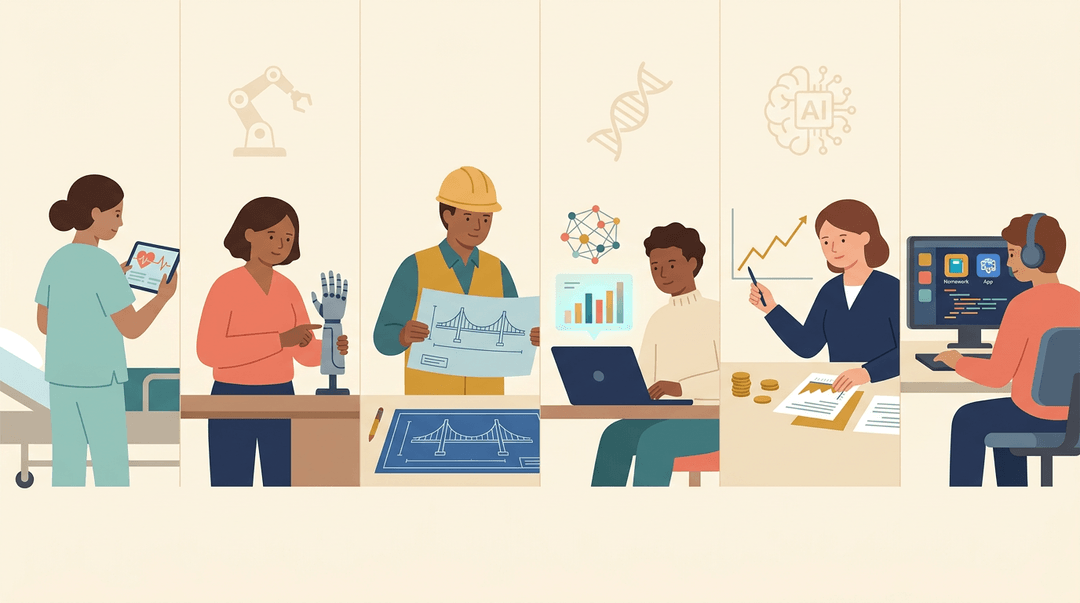
Think of a hospital's biomedical engineer designing better prosthetics, a software developer building the app your students use for homework, or a financial analyst crunching data to guide investment decisions. Popular roles include:
- registered nurses
- civil engineers
- actuaries
- data scientists
Emerging fields like artificial intelligence, biotechnology, and robotics are creating entirely new job titles that didn't exist a decade ago, from machine learning engineers to genomic researchers.
How fast STEM jobs are growing
STEM careers aren't just plentiful, they're multiplying. According to the Bureau of Labor Statistics' 2023 to 2033 employment projections, STEM employment is set to grow 10.4 percent, compared with just 3.6 percent for non-STEM work.
That tracks with longer trends: a U.S. Department of Commerce report found that in 2010, 7.6 million people, or 1 in 18 workers, held STEM jobs, and over the past decade, STEM job growth ran three times as fast as non-STEM growth.
What is the highest paid STEM job?
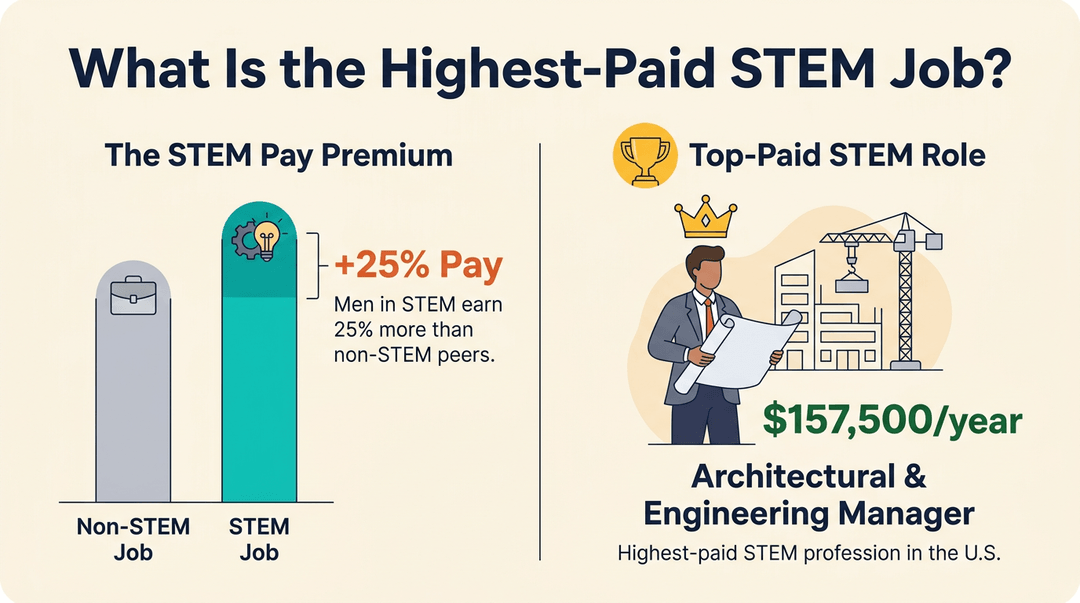
STEM work tends to pay well, and that's part of its pull. Men in STEM roles earn a 25 percent wage premium over their non-STEM peers, a gap that fuels arguments about the field's economic competitiveness.
Among specific roles, architectural and engineering managers top the pay scale at $157,500 a year, making them the highest-paid STEM professionals in the country.
Strategies for Teaching STEM Effectively
Knowing what STEM stands for is one thing. Knowing what it looks like on a Tuesday morning is another. The strategies below turn the definition into something you can actually run in your classroom, club, or community partnership.
What are examples of STEM education?
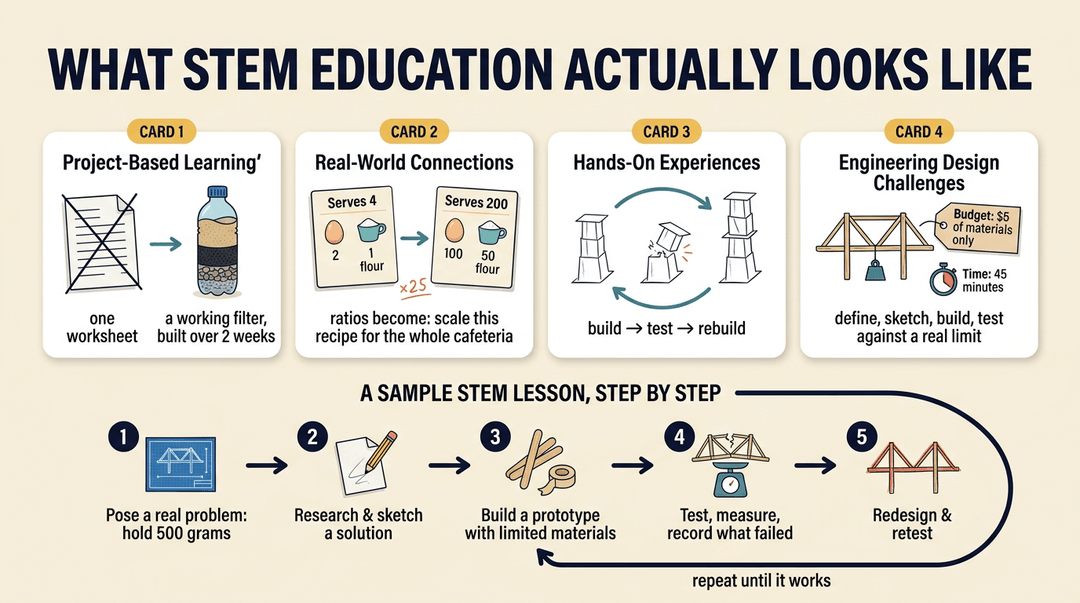
Ask ten teachers what STEM education looks like and you'll get ten different, all-correct answers. Concrete STEM education examples tend to share a few traits though: they hand students a real problem, then get out of the way.
- Project-based learning curricula. Students spend days or weeks building toward one product, like a working water filter, instead of a single worksheet.
- Real-world problem connections. A math lesson on ratios becomes a lesson on scaling a recipe for the whole cafeteria.
- Hands-on experiences. Kids build, test, and rebuild rather than just read about how something works.
- Engineering design challenges. Students define a problem, sketch a solution, build a prototype, and test it against a limit like budget, materials, or time.
A sample STEM lesson often follows the same shape:
- Pose a real problem (design a bridge that holds 500 grams).
- Let students research and sketch a solution.
- Build a prototype with limited materials.
- Test, measure, and record what failed.
- Redesign and retest.
Tech tools that power STEM learning
Think of a middle school science teacher who can't afford a field trip to a volcano.
- A virtual reality headset can put students inside one anyway, letting them walk the crater without leaving the room.
- Artificial intelligence (AI) personalized learning platforms adjust practice problems in real time, giving a struggling student more scaffolding and a student who's racing ahead a harder challenge, in the same class period.
- Robotics kits add the hands: students program a small robot to navigate a maze, and every failed run teaches troubleshooting and persistence.
STEM clubs, camps, and competitions
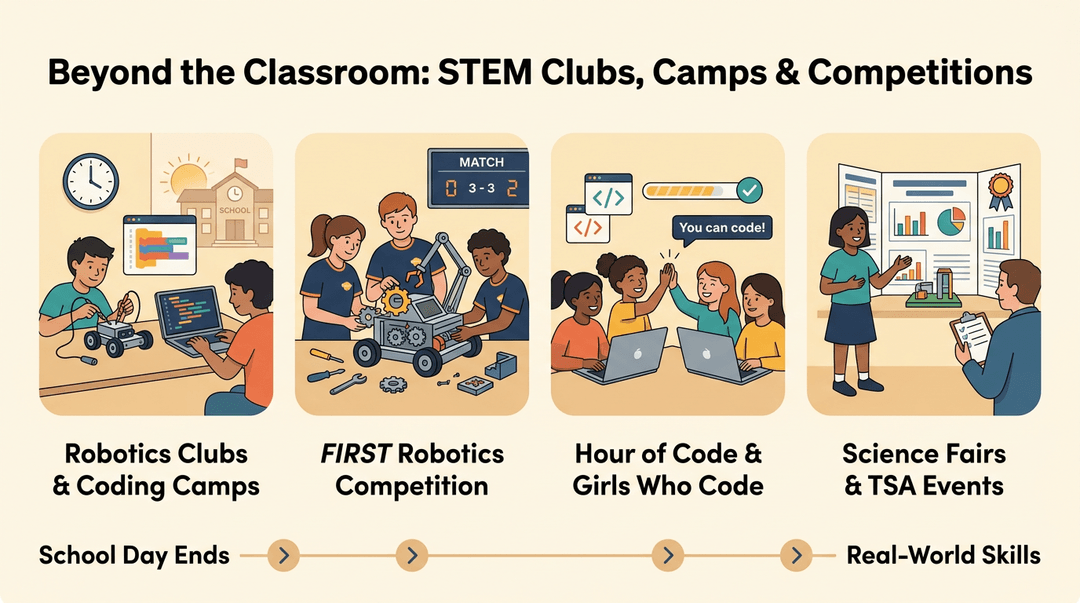
For students who want more STEM outside the school day, there's plenty on offer:
- Robotics clubs and coding camps that meet after school or over the summer
- The FIRST Robotics Competition, where teams design, build, and program a competition robot
- Hour of Code and Girls Who Code, aimed at building coding confidence, especially among girls who might otherwise opt out
- Science fairs and Technology Student Association (TSA) events, which give students a stage for original work
Getting the community involved in STEM
STEM rarely thrives in isolation.
- Partnerships with local businesses and universities can supply mentors, guest speakers, and lab space that a single classroom budget can't.
- Corporate sponsorship often funds the equipment behind a robotics challenge or a science fair prize table.
- And parents and policymakers who show up, whether at a demo night or a school board meeting, help keep STEM funded and visible long after the grant runs out.
Who Gets Left Out of STEM
STEM's promise only holds if every student gets a real shot at it. Right now, that promise breaks down along lines of gender, race, and income.
The gender gap in STEM fields
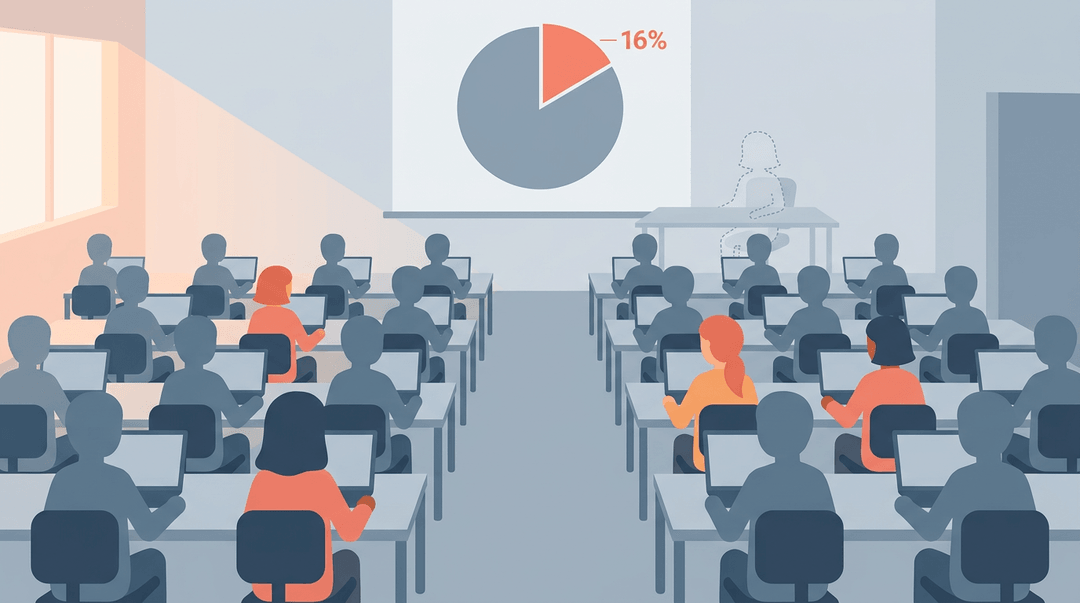
Walk into most engineering programs and computer science classrooms, and women are still the minority.
According to NCSES data from the National Science Foundation, "representation of women is the lowest in engineering (16%) among the major occupational categories in S&E."
Stereotypes about who belongs in a lab or behind a keyboard, plus a shortage of visible role models, push many girls away from these paths before high school even ends.
The trend isn't improving, either: Eurostat reports that the women's share of the computing workforce actually fell, dropping "from 17.9%" the year before.
Racial and income gaps in STEM
Race and income create their own barriers. NCSES finds that "Hispanic or Latino and Black or African American workers are underrepresented in STEM," a gap that's even wider among those holding a bachelor's degree or higher.
Layer on low-income families' limited access to lab equipment, technology, and enrichment programs, plus schools stretched thin on funding, and the gap widens before students ever reach college.
Ways to make STEM more inclusive
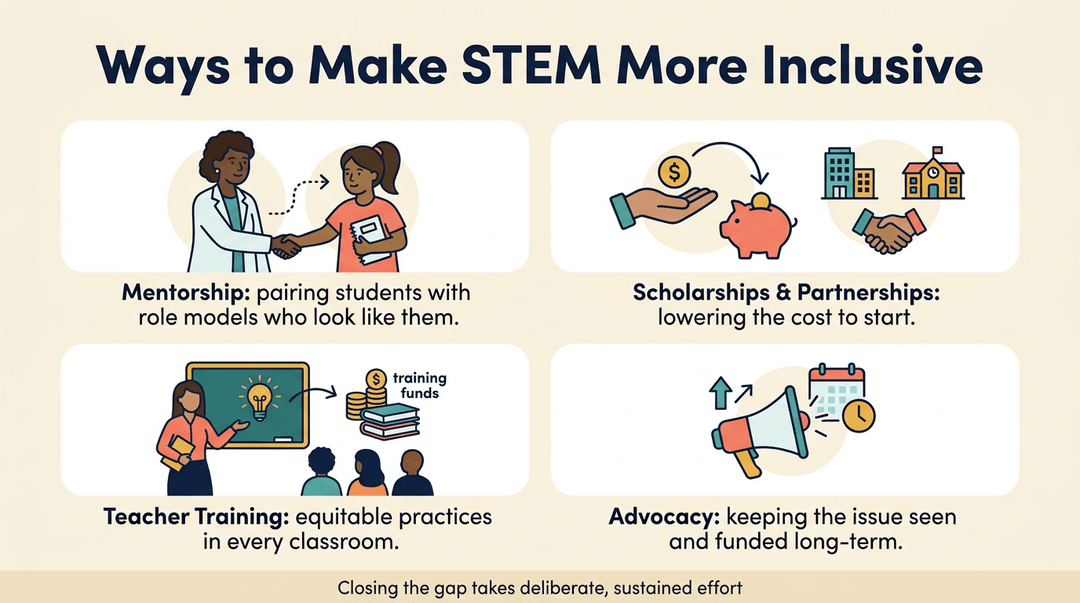
Closing these gaps takes deliberate, sustained effort:
- Mentorship programs that pair students with professionals who reflect their own backgrounds.
- Scholarships and community partnerships that lower the cost of getting started.
- Teacher training funding so educators can bring equitable practices into every classroom.
- Diversity promotion advocacy that keeps the issue visible, and funded, over the long haul.
STEM Learning at Every Age
STEM isn't a phase that starts in middle school and ends at graduation. It's a thread that can run from a preschool sandbox to a college lab to a Tuesday night class an adult takes after work.
STEM from preschool through college
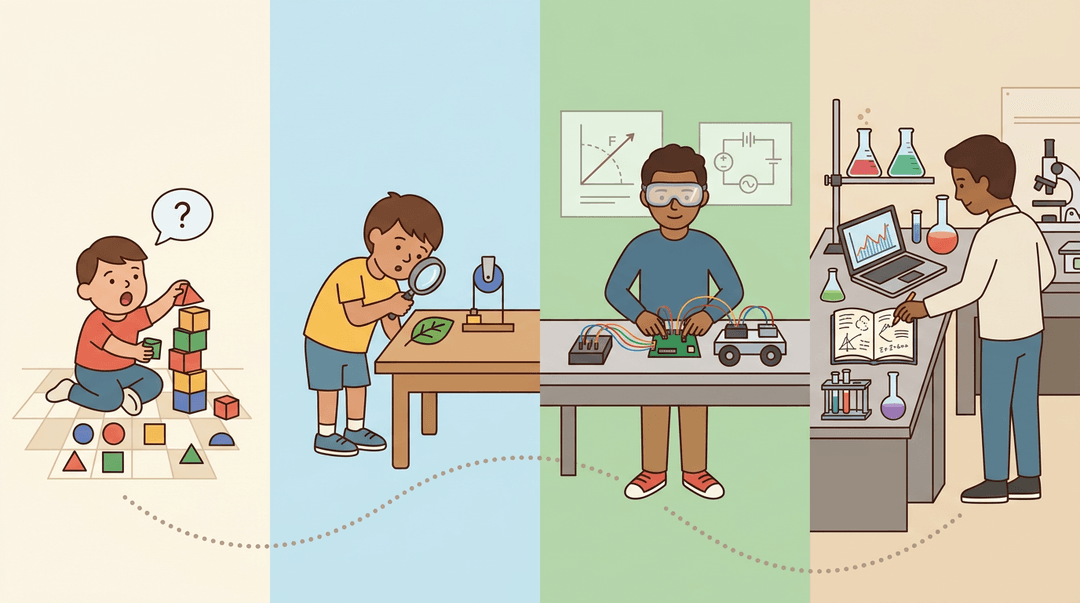
Early childhood classrooms build the foundation through hands-on play: stacking blocks, sorting shapes, asking the "why" questions a curious four-year-old already knows to ask. Those habits of observation and problem-solving carry into middle and high school, where students move into specialized courses like physics, computer science, and engineering design. By college, that groundwork pays off in genuinely rigorous coursework: upper-level labs, research projects, and classes that assume students can already think like scientists and engineers.
The PreK-16 STEM learning path
Educators often describe this as the PreK-16 pipeline: a learning path that begins as early as preschool and continues well past high school, into associate's and bachelor's degree programs. The point isn't to rush students toward a career decision. It's to keep the path open and accessible across the full spectrum, so a student who falls in love with robotics in third grade still has a clear next step in tenth grade, and again at nineteen.
STEM learning for working adults
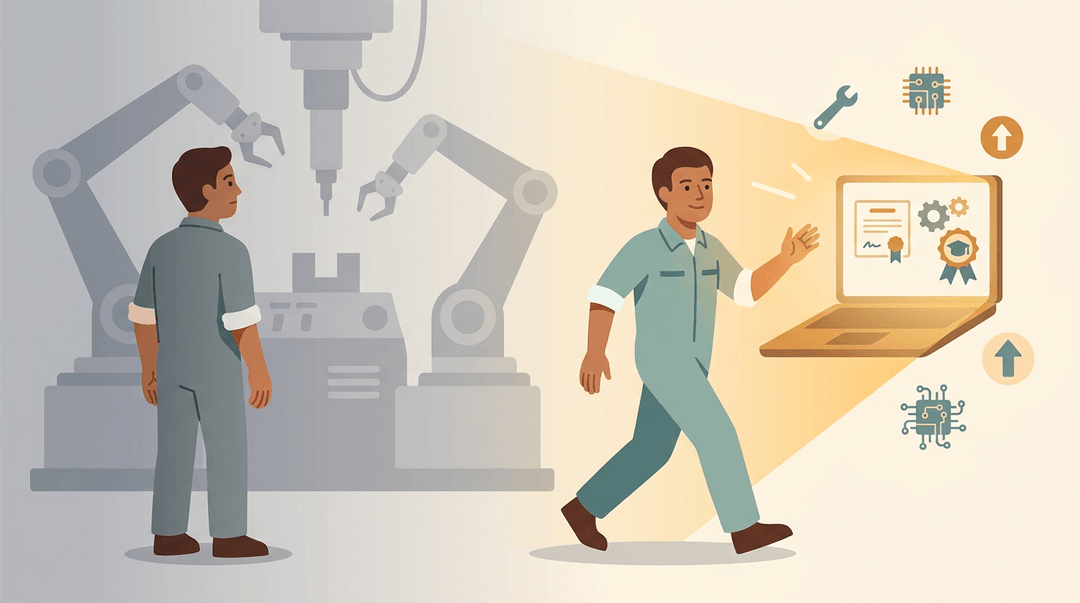
STEM learning doesn't stop at a diploma. Working adults now have online courses and certifications that let them build new skills without returning to school full-time. For a mid-career employee whose plant just automated a process, upskilling or reskilling through a short certification can be the difference between falling behind and moving up. It's a lifelong learning opportunity, not a one-time stop.
How Different Countries Approach STEM
STEM education isn't one fixed formula. It bends to fit each country's culture, resources, and priorities, so what happens in a classroom in Ohio can look nothing like what happens in one in São Paulo.
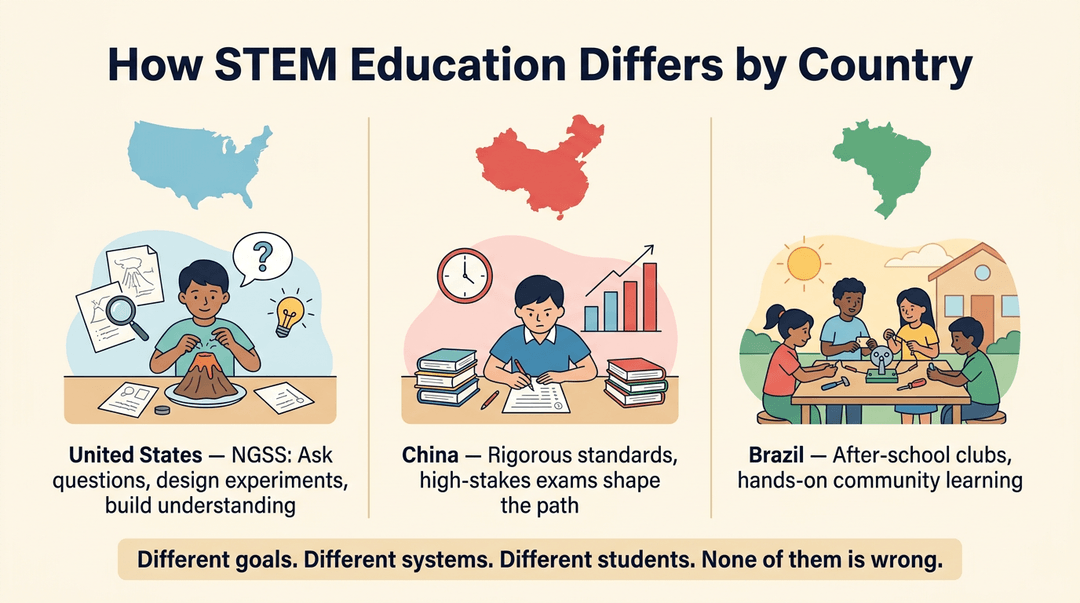
How STEM education differs by country
A few examples show just how wide that range is:
- The United States builds STEM around the Next Generation Science Standards (NGSS), an inquiry-based framework where students ask questions, design their own experiments, and build explanations instead of memorizing facts from a textbook.
- China takes a more rigorous, testing-focused route: STEM subjects are taught to demanding academic standards and measured through high-stakes exams that shape a student's whole trajectory.
- Brazil leans on hands-on community programs, weaving STEM into after-school clubs and local partnerships so students get real, practical exposure even when their school has limited resources.
None of these approaches is wrong. They're just built for different goals, different systems, and different students.
Global efforts to expand STEM access
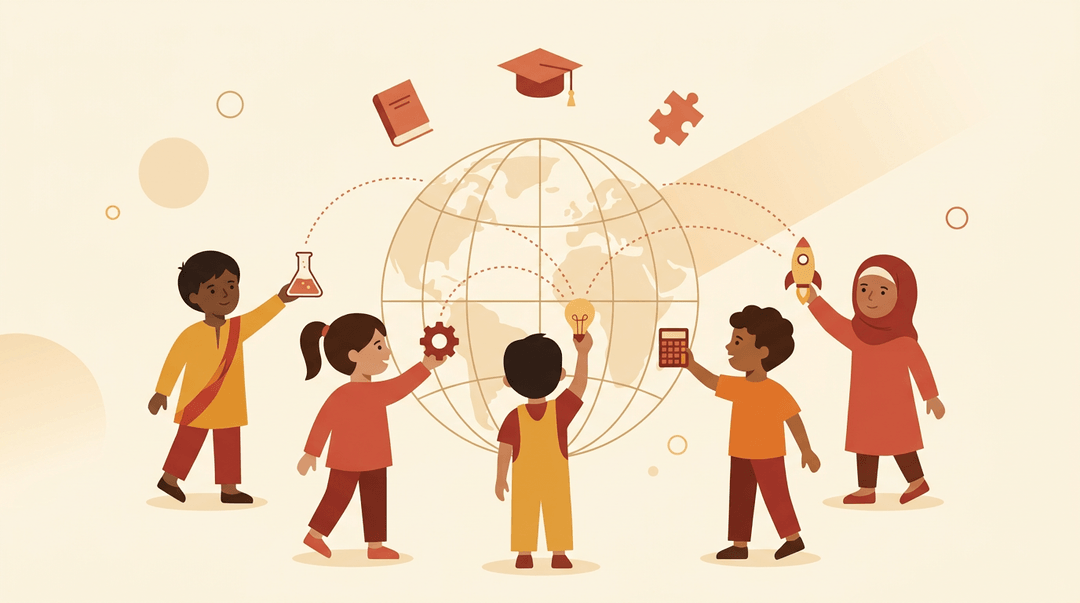
Not every country starts from the same place, and international groups are working to close that gap.
UNESCO's STEM for All initiative pushes for equitable access to quality STEM learning worldwide, with a particular focus on girls and students in low-income regions who've historically been left out.
Alongside that, countries are leaning into global best-practice sharing: comparing what actually works in classrooms from one nation to the next so a good idea doesn't stay stuck in just one country.
For teachers, that exchange eventually trickles down into new standards, new resources, and new ways to make STEM click for every student in the room.
STEM Programs in K-12 Schools
Walk into two different schools and ask what "STEM" means there, and you'll likely get two different answers.
The label covers a wide range, from a single elective to a school's entire identity, so it helps to break down what you'll actually find at each grade level and what separates a true STEM school from a school that just teaches science and math well.
STEM courses offered at each grade level
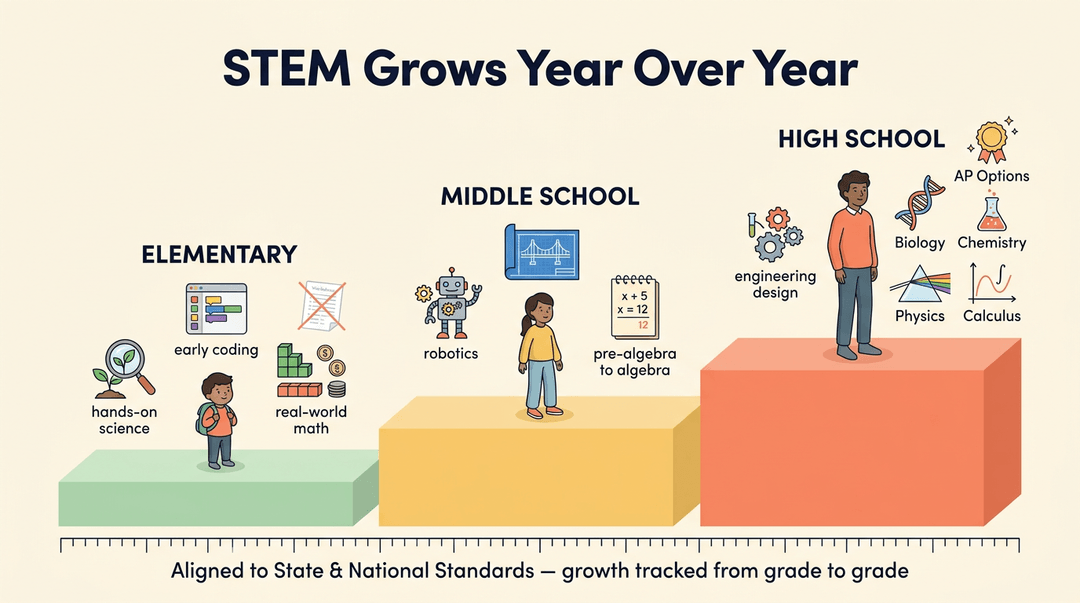
STEM programming builds year over year instead of appearing all at once:
- Elementary school: hands-on science, early coding, and math that leans on real problems instead of worksheets.
- Middle school: structured units in engineering design, robotics, and pre-algebra through algebra.
- High school: a full run of biology, chemistry, physics, and calculus, often paired with Advanced Placement (AP) options like AP Biology, AP Chemistry, AP Physics, and AP Calculus for students ready to work at college pace.
The strongest programs align every one of these courses to state and national standards, so a student's growth is tracked and comparable no matter which grade they're in.
What makes a STEM school different?
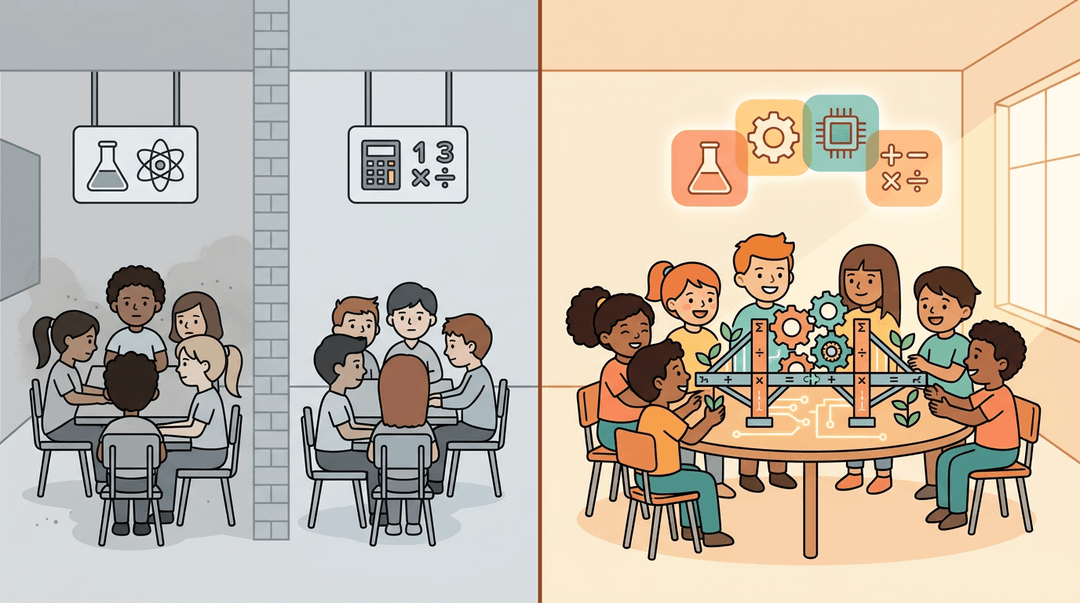
So, what's the real difference between a STEM school and a regular school? A regular school teaches science and math as separate subjects.
A STEM school weaves them together with technology and engineering into shared projects, and builds its schedule, staffing, and culture around that integration rather than treating it as an add-on.
If you're a family trying to sort that out, a school finder tool can narrow down which nearby schools carry a genuine STEM designation, a blog resource library can explain what to expect once enrolled, and clear enrollment guidance saves parents from guessing at deadlines and requirements.
STEM education isn't a buzzword or a poster on the wall. It's a way of teaching that builds curious, capable problem-solvers, and it works best when it's planned with intention across grade levels and subjects.
Getting there takes more than good intentions. Ready to build STEM into your lessons without the scramble? Check out our Curriculum Planning feature to map units, lessons, and standards across the whole year.
References
- From building robots to cultivating robotics literacy? A systematic review of educational robotics research and its future directions — repository.eduhk.hk (2026)
- Building the STEM Workforce of the Future - NSF Impacts | NSF — nsf.gov
- The STEM Wage Premium Across the OECD — files.eric.ed.gov
- Employment and wages for alternate definitions of science, technology, engineering, and mathematics (STEM) occupations : Beyond the Numbers : U.S. Bureau of Labor Statistics — bls.gov
- U.S. releases reports on STEM jobs | MRS Bulletin — cambridge.org
- Men remain the majority of ICT-educated employed people - News articles — ec.europa.eu (2026)
- Highest-Paying STEM Jobs in the U.S. — online.fit.edu (2026)
- The origin of STEM education – A PRACTICAL HANDBOOK ON EFFECTIVE DEVELOPMENT AND IMPLEMENTATION OF STEAM TEACHING AT SCHOOL — web.htk.tlu.ee
- President Obama Launches "Educate to Innovate" Campaign for Excellence in Science, Technology, Engineering & Math (Stem) Education — obamawhitehouse.archives.gov
- STEM: Good Jobs Now and for the Future — meteorology.rutgers.edu
- The STEM Labor Force: Scientists, Engineers, and Skilled Technical Workers | NCSES — ncses.nsf.gov
- The STEM Labor Force of Today: Scientists, Engineers, and Skilled Technical Workers | NCSES — ncses.nsf.gov
- Science and Culture in a Curriculum for Tribal Environmental Management: The TENRM Program at the Northwest Indian College — escholarship.org (2002)
Frequently asked questions
What is the difference between a STEM school and a regular school?
A STEM school intentionally integrates science, technology, engineering, and math through connected, hands-on projects. A regular school may teach these subjects separately, with less emphasis on interdisciplinary problem-solving and engineering design.
What is taught in a STEM class?
A STEM class teaches concepts from science, technology, engineering, and math through real-world problems and hands-on activities. Students may conduct experiments, code, analyze data, build prototypes, test designs, and improve their work.
What is the highest paid STEM job?
The highest-paid STEM job varies by location, experience, industry, and salary data source. In the United States, architectural and engineering managers are among the highest-paid STEM roles, with a listed annual salary of $157,500 in the supplied wage comparison.
What is considered a STEM student?
A STEM student is any student learning or applying science, technology, engineering, or math, especially through interdisciplinary, real-world tasks. Students do not need to be planning a STEM career to qualify.
What are 5 STEM careers?
Five STEM careers are software developer, civil engineer, data scientist, registered nurse, and actuary. Other examples include biomedical engineer, robotics engineer, and machine-learning engineer.
What are the examples of STEM education?
Examples include designing and testing a bridge, building a water filtration system, programming a robot to navigate a maze, measuring rainfall and designing a weatherproof roof, and using ratios to scale a cafeteria recipe. These activities combine content learning with research, building, testing, and redesign.
What does STEM education mean?
STEM education is an interdisciplinary approach that combines science, technology, engineering, and math to solve real-world problems. It emphasizes hands-on projects, experimentation, collaboration, critical thinking, creativity, communication, and iterative improvement.
What exactly is a STEM course?
A STEM course is a class organized around one or more STEM disciplines and their practical application. It may focus on subjects such as biology, computer science, engineering design, physics, statistics, or coding, often using projects, experiments, data analysis, and problem-solving rather than lectures alone.