What Is Rigor in Education? A Clear, Complete Guide

Jump to section
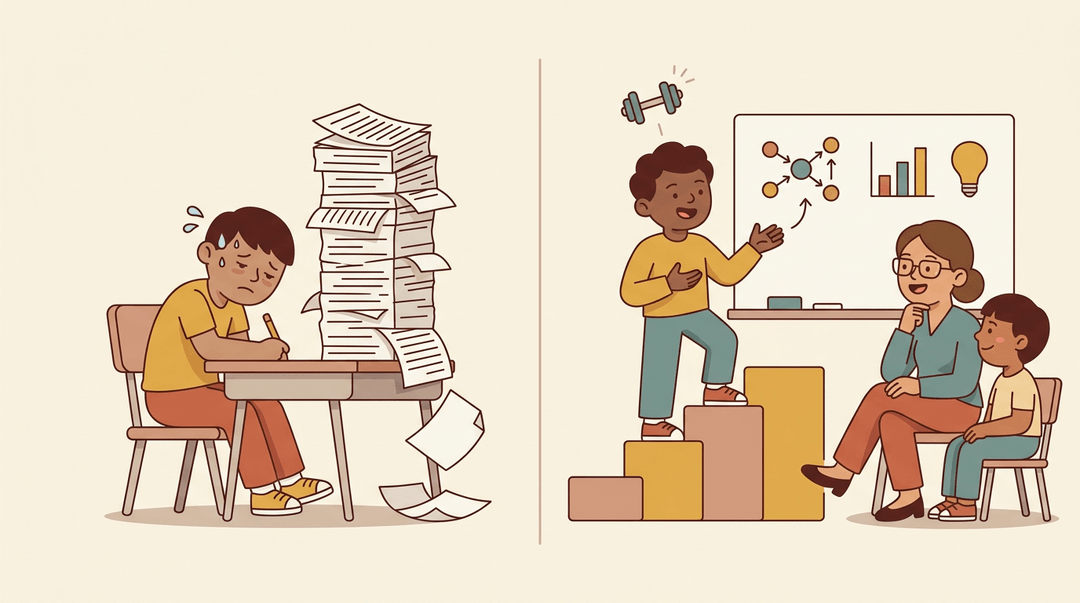
Think about the difference between a workout that keeps you busy and one that actually builds strength. Both leave you tired, but only one changes what you can do. Rigor in education works the same way.
Rigor isn't about piling on more homework or making tests harder. It means giving students challenging work that asks them to think deeply, apply what they know, and explain their reasoning.
We'll cover what rigor really means, where the idea came from, how to design tasks that demand more, and how to build it into standards-aligned lessons.
What Is Rigor in Education?
Rigor shows up in nearly every staff meeting, yet it means something different to each person. Here's what we mean by it, and what it doesn't.
Holding every student to high standards
At its core, rigor means raising expectations and holding every student to them, including the struggling reader. A college-preparatory curriculum gives every learner access to the coursework colleges expect.
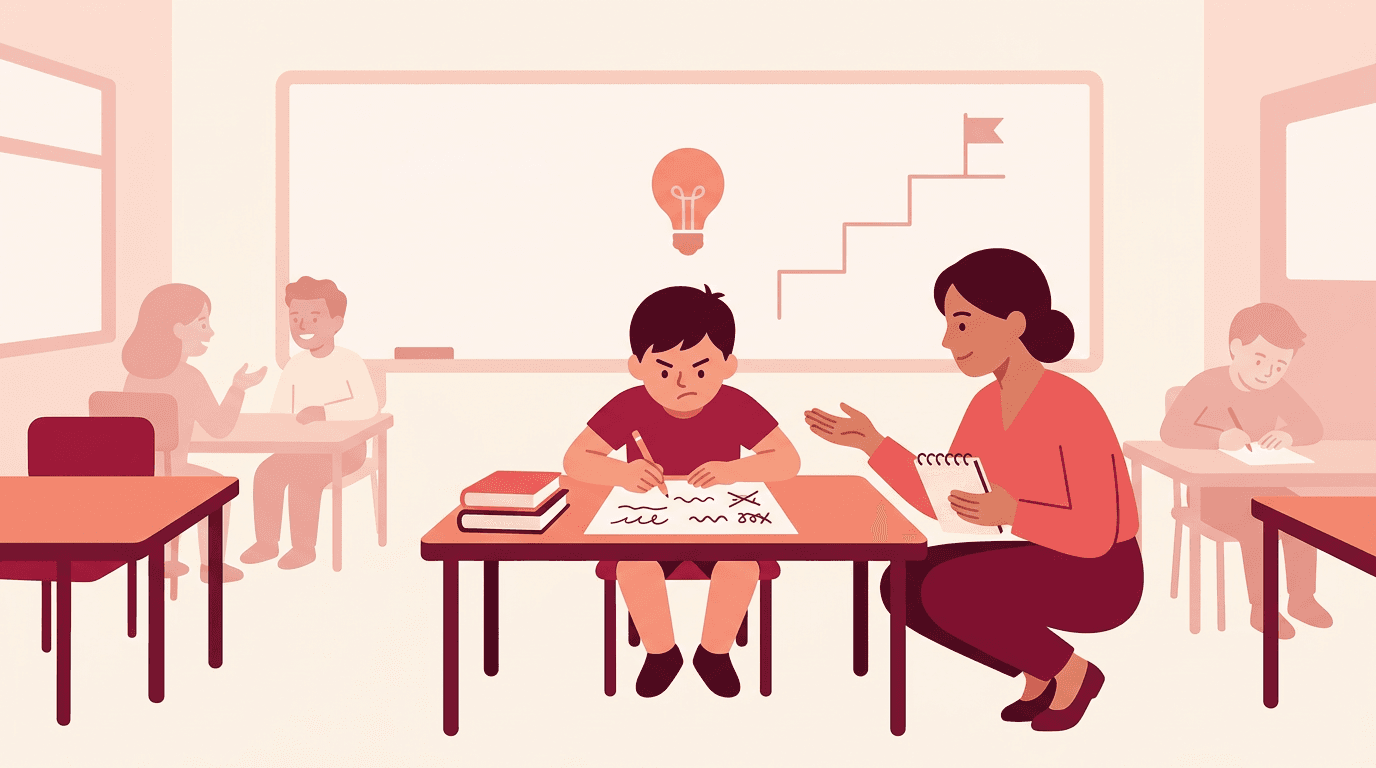
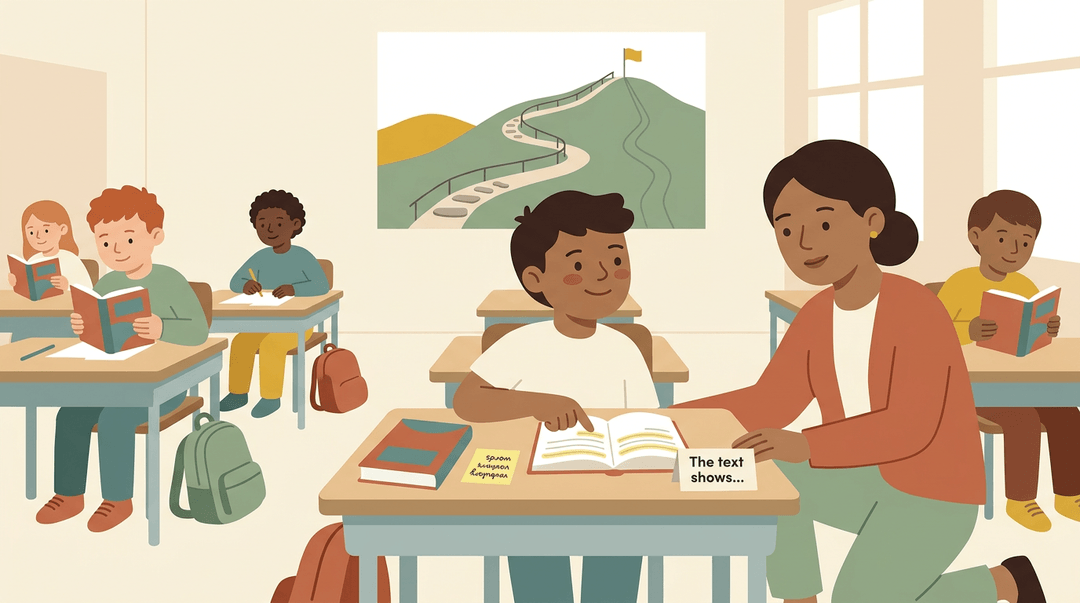
Consider a seventh-grade English teacher with a student reading two grade levels behind. Rigor doesn't mean an easier novel. It means keeping the analysis goal and adding temporary support, or scaffolding, until that student defends a claim with a quote.
Guard against lowered standards, like watering down the reading. Adjust the route, never the destination.
Challenging thinking matters more than difficulty
Rigor shows up when students apply what they've learned to new situations and demonstrate it, then reflect on and analyze their reasoning. Challenging work asks students to think differently.
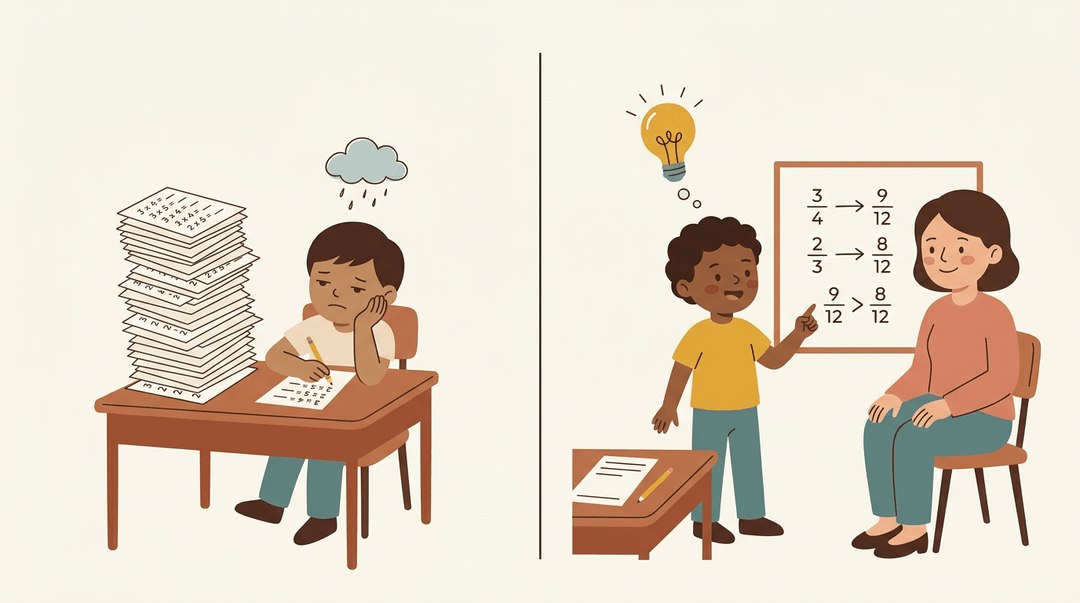
Merely hard work just adds volume, like twenty extra problems testing the same skill. Rigor is about how students think, not how much they produce.
Critical thinking sits at the center: students weigh evidence and justify their conclusions. Justification is what separates a lucky answer from real understanding.
In mathematics, rigor means precise reasoning behind every step, not just a correct answer. Ask a fourth grader whether three-fourths is larger than two-thirds, and a rigorous answer explains why, perhaps with a common denominator.
The work habits rigorous students build
Rigorous learners tend to be:
- industrious
- attentive
- disciplined
- engaged
They double-check their work, take care with each step, and stay with hard problems instead of quitting after one wrong try. Picture a fifth grader who checks each step of a long-division problem until she finds her mistake.
That focus carries into college-level work. Habits outlast any single unit.
Why rigor needs a clear, shared meaning
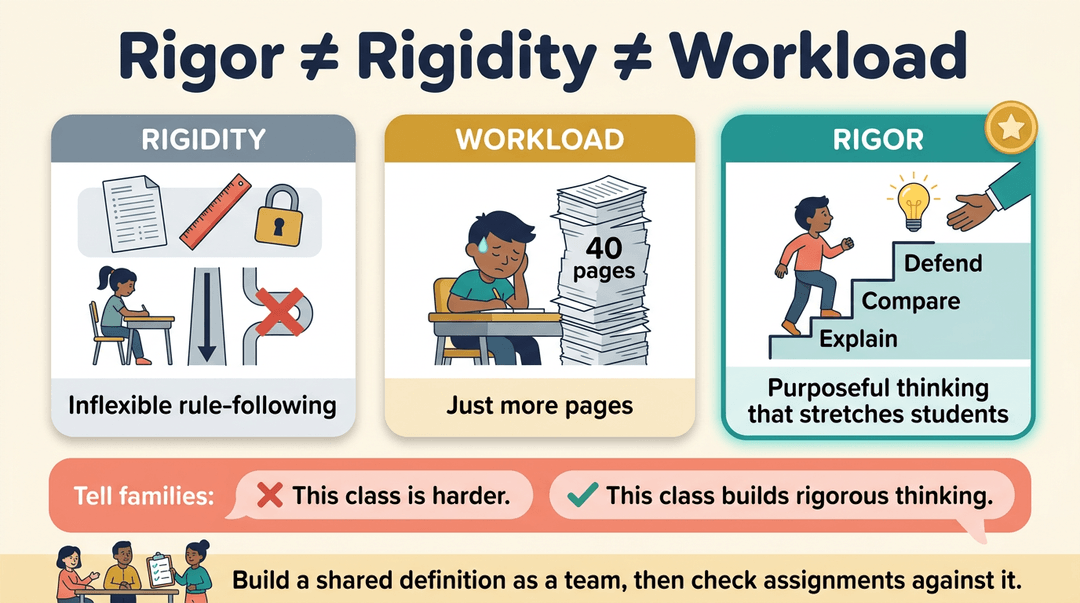
Rigor means different things to different people, and dictionary definitions often lean on harshness and severity. Keep three ideas apart:
- rigidity is inflexible rule-following
- workload is simply more pages
- rigor is purposeful thinking that stretches students
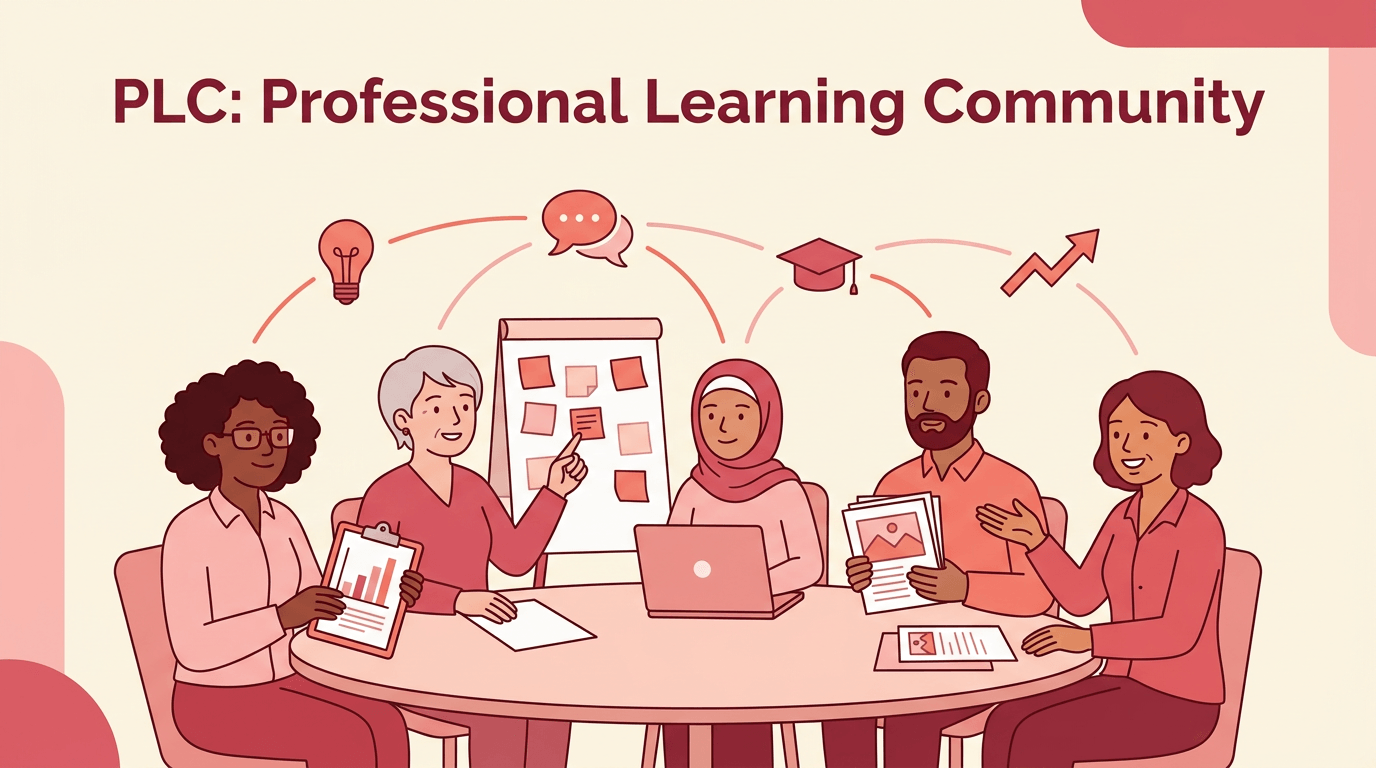
A grade-level team or whole staff can build a shared definition together, then check assignments against it. When you talk about rigor with families, qualify it: say rigorous thinking, not harder. Teams that want help organizing this work can explore PLC education meaning.
What Makes Questions and Tasks Rigorous
Rigor lives in the questions you ask and the tasks you assign. Here's how we build it:
What a rigorous question looks like
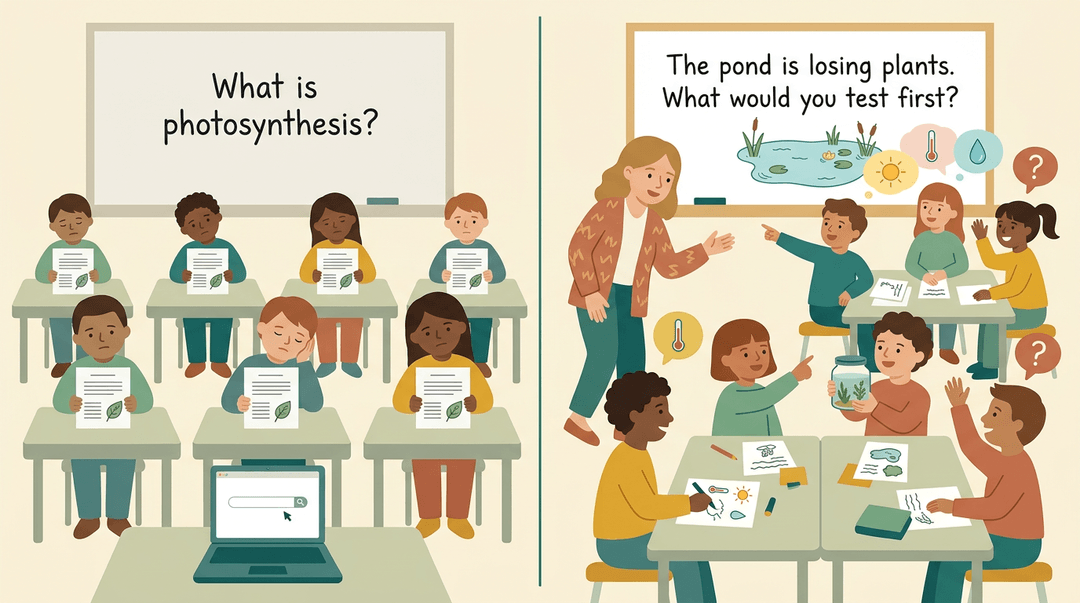
A rigorous question has no Googleable answer. It asks students to apply what they know to a new context, feels personal enough to care about, and requires judgment and justification. Its best answer often depends on context.
Consider a seventh-grade science teacher whose closed question, "What is photosynthesis?", gets identical textbook answers. She rewrites it: "The pond behind our school is losing plants. Which factor would you test first, and how would you prove it?"
Now students must reason rather than recall, and she sees exactly where their thinking stalls.
Habits that support deep thinking
Build a few habits of mind, the everyday thinking patterns strong readers share:
- Tolerance for ambiguity and paradox. Students can sit with questions that have several defensible answers.
- Willingness to change one's mind. Revising a claim after new evidence is a strength.
- Prolonged consideration. Some questions need days, not minutes.
- Literate readers' habits. They question authors and reread when something doesn't add up.
Building rigor through projects and performance tasks
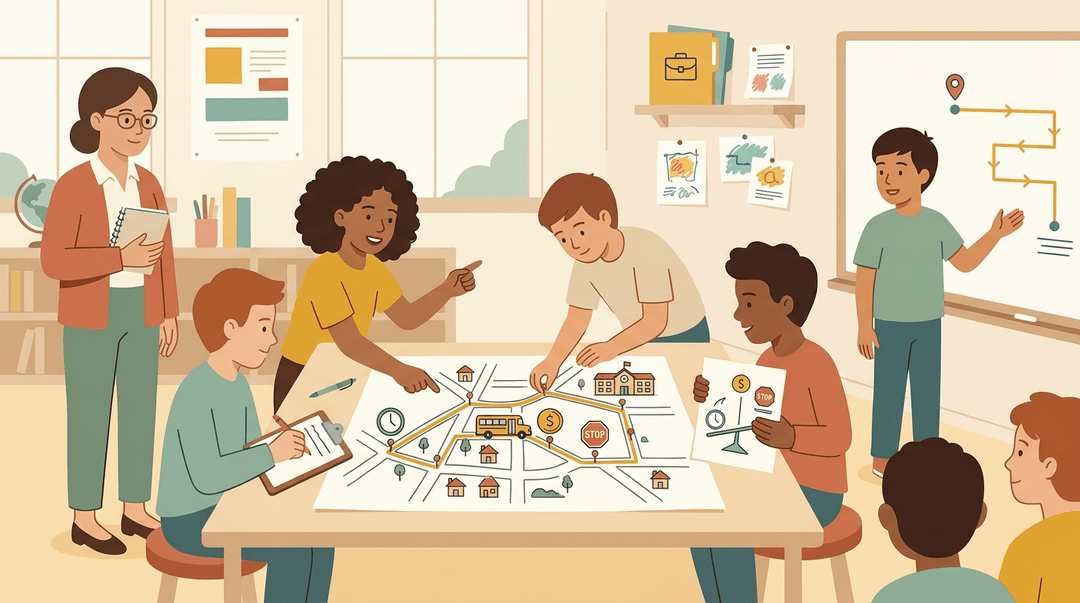
In a project learning curriculum, students tackle a real problem over time, and a portfolio performance assessment collects that work to show growth. Think of a sixth-grade teacher whose students design a school bus route.
They balance travel time, cost, and safety, then defend their plan. She sees who can weigh tradeoffs and who needs more practice.
These tasks also build twenty-first-century skills like collaboration and communication. Student-centered teaching practices keep students making choices while you coach from the side. Projects make rigor visible.
Build Rigor into Your Lesson
Use this guide when you're planning a standards-aligned lesson and want to make sure students are thinking hard, not just working hard. It runs from planning, to examples, to a final check.
Plan it in four steps
Work through these in order. Each one narrows the lesson toward a task that demands real thinking.
- Unpack the standard
- Circle the verb (what students do) and the noun (what they do it to).
- Analyze + two accounts of one event tells you the thinking level and the content.
- Set a learning target
- Turn the standard into a student-friendly sentence, written on the board.
- Try: "I can compare two sources and explain which is more reliable."
- Raise the thinking demand
- Move the task up from recall toward analysis, evaluation, or creation.
- ❌ "List three causes of the war." ✅ "Rank the three causes and defend your ranking." The difference: the second can't be answered by copying.
- Add a justification task
- Students must show why their answer holds, in words, writing, or a diagram.
- Say: "What evidence tells you that? How would you convince a skeptic?"
See it at each level
Same four steps, different grade bands. Lift the task, then adapt the content.
| Level | Rigorous task | Students must... |
|---|---|---|
| Elementary | Explain your strategy | Say how they solved it and why it works |
| Middle | Compare two sources | Weigh both accounts and choose using evidence |
| High school | Defend an argument | Build a claim, address a counterclaim, rebut |
| Math | Solve, explain, apply | Get the answer, justify the method, use it in a new problem |
Example: A seventh-grade social studies teacher hands out two accounts of the same event. Instead of asking for a summary, she asks which account is more reliable and why. Students must quote both texts to answer.
Check it before you teach
Run the finished lesson through these four checks.
- No Googleable answer. A quick search can't hand students the response.
- Requires evidence and reasoning. Students have to show what they know and how they know it.
- Supports every student. Each learner has a way into the task and a way to stretch.
- Scaffolds, doesn't lower expectations. Support helps students reach the same demanding task.
⚠️ Watch out: If your scaffold gives away the thinking (a filled-in sentence, a pre-made list), you've lowered the task. Offer sentence starters or a graphic organizer instead, and keep the question the same.
Map standards to units and track rigor in EMStudio's Curriculum Planner.
Putting Rigor into Practice Across Schools
Rigor only counts when it shows up in everyday practice.
Teacher workshops and tools to try
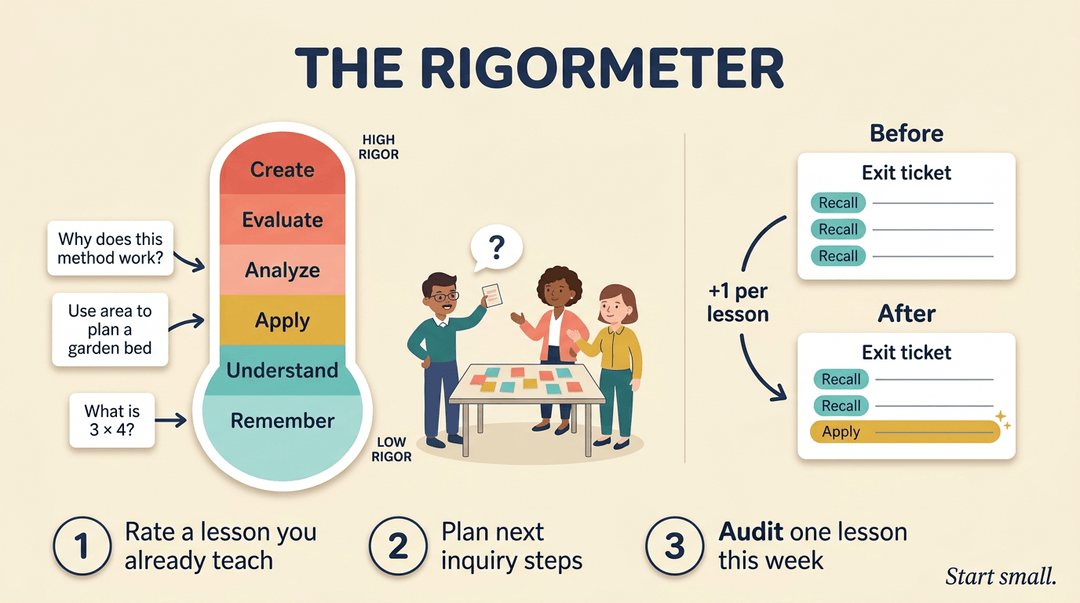
A rigormeter based on Bloom's Taxonomy helps teachers rate how demanding a question is. In a question-sorting workshop, mixed teacher groups debate where real questions belong.
Consider a math teacher whose exit tickets mostly ask students to recall rather than apply. She adds one application question per lesson.
You'll apply the criteria to a lesson you already teach, plan your next inquiry steps, and audit one lesson this week. Start small.
Giving every student access, without tracking
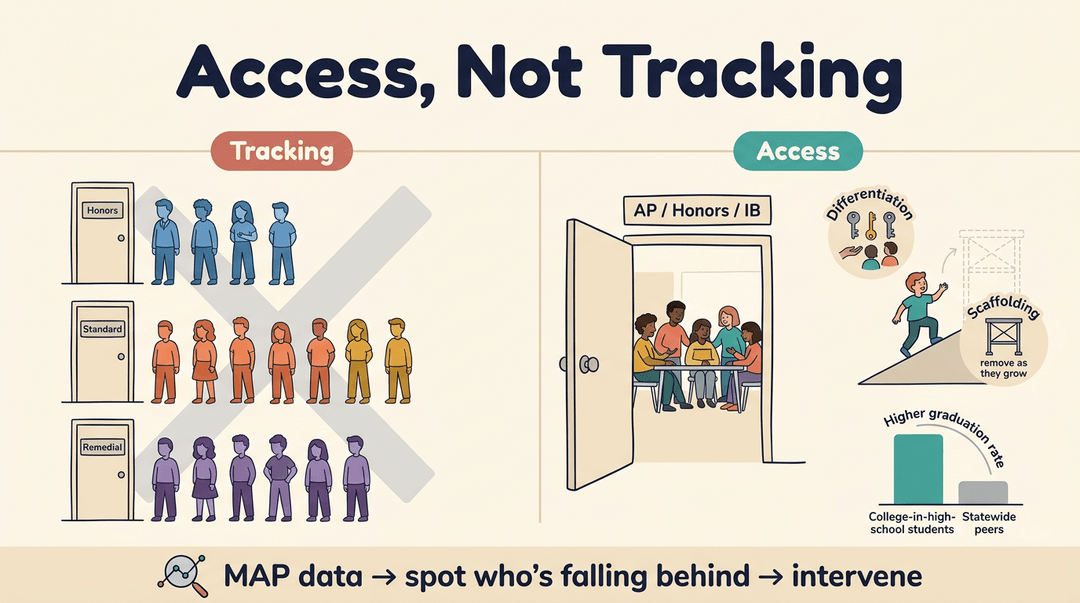
Rigor courses are advanced classes, such as AP (Advanced Placement), honors, and IB (International Baccalaureate), that challenge students beyond the standard course.
The aim is access rather than sorting: we want every student taking college-prep courses.
Heterogeneous (mixed-ability) classrooms make that work with differentiation (tailoring tasks to each learner) and scaffolding (temporary supports you remove as students grow).
Graduation rates matter here: a new report from The Education Trust-New York found that students in state-funded college in high school programs graduate at higher rates than their peers statewide.
Use MAP (Measures of Academic Progress) data to plan interventions when students fall behind.
Measuring student skills and results
Rely on multiple indicators of learning, not a single test score. Assess skills and knowledge, using Depth of Knowledge (DOK) levels to see whether tasks demand recall or deeper thinking.
Anchor each task to its standard, since rigor starts with alignment. Have students explain their strategies, since metacognition (thinking about one's own thinking) shows whether they can apply learning.
Some worry rigor overwhelms struggling learners, but scaffolding lets it challenge them instead.
Why the Word Rigor Can Sound Harsh
Plenty of teachers hear the word rigor and picture silent rows. Before we use it well, it helps to see why it sounds so harsh.
When rigor turns harsh and rigid
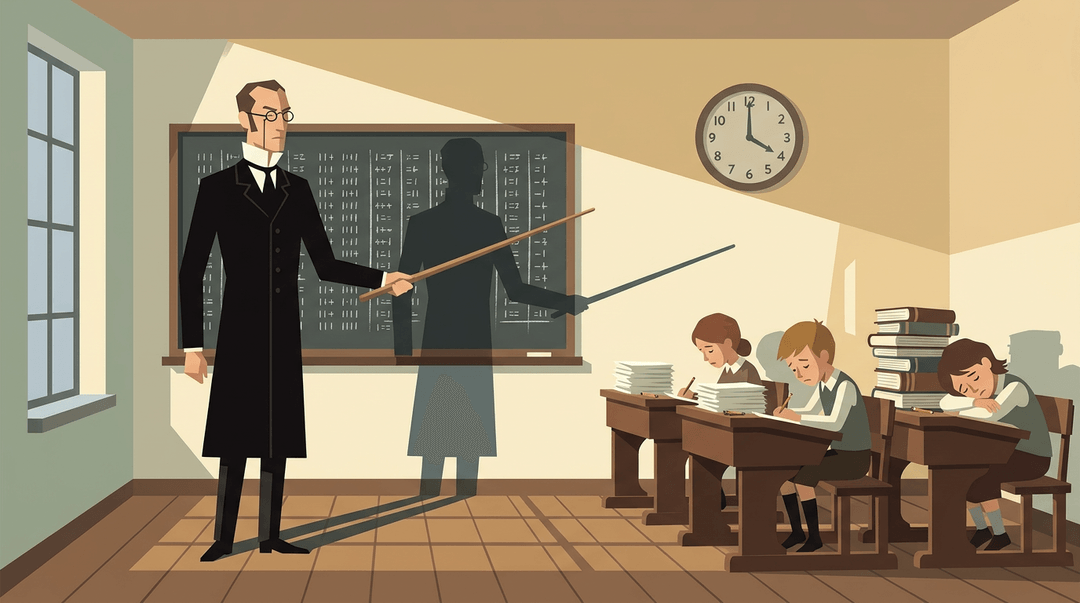
Dictionaries define rigor as severity or strictness, and that edge still clings to the word. Pushed too far, it can mean working to excess until you're exhausted. The stern Victorian schoolmaster is the classic picture of this kind of rigor.
The word even shares a root with rigor mortis, the stiffening of the body after death, which is one reason it can feel so cold.
Latin roots and other words to use
The English word comes from Latin, where it means stiffness or severity. Swap in words that carry the energy you want:
- Vigor. Energy and liveliness, the opposite of stiffness.
- Diligence. Steady, careful effort.
- Constancy. Staying with a task when it's hard.
- Industry. Purposeful, productive work.
- Discipline. Steady self-control that keeps you on course.
Balancing hard work with play and wonder
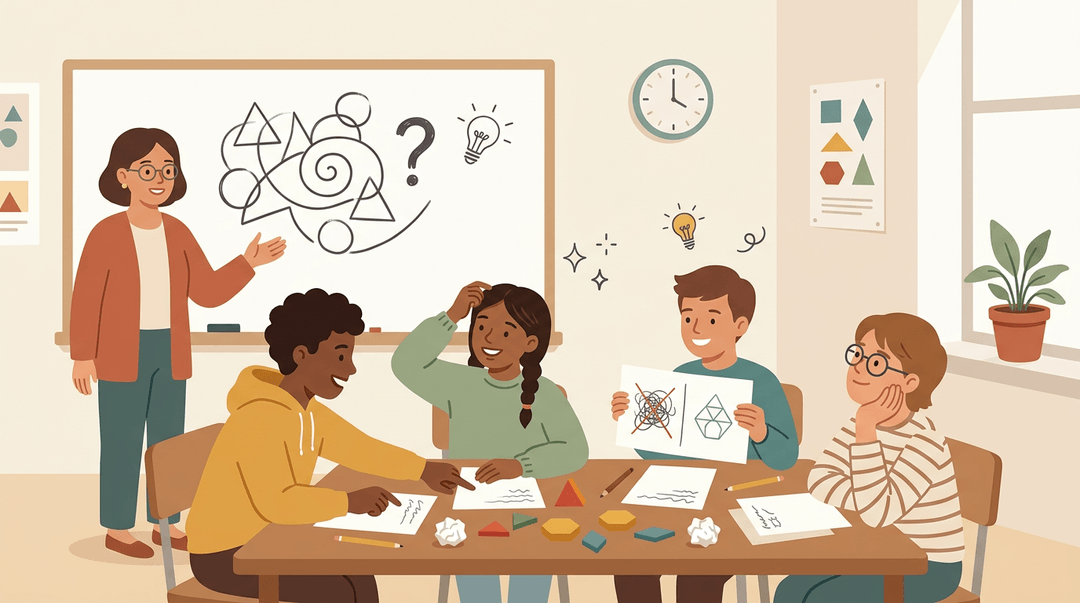
Real rigor avoids both laziness and excess. It asks students to think hard without grinding them down, and it leaves room for wonder and curiosity.
Consider a middle school math teacher who tells her class that a hard problem is supposed to take a while. Students stop quitting after one try and start asking each other how they got unstuck. Now the hard problem is a puzzle.
Leisurely, reflective study matters too. Giving students time to pause and ask what they noticed and why it matters is rigor, even when it looks slow. Educators who want the thinking behind reflective learning can explore John Dewey philosophy of education.
Rigor is less about how much students suffer and more about how deeply they think. Industry and play aren't opposites, either. Hard work and wonder can share a room.
Where Rigor Fits in Wider Frameworks
Rigor doesn't work alone. It sits beside other priorities, and seeing how they connect helps you apply it well.
Where rigor fits among the four Rs
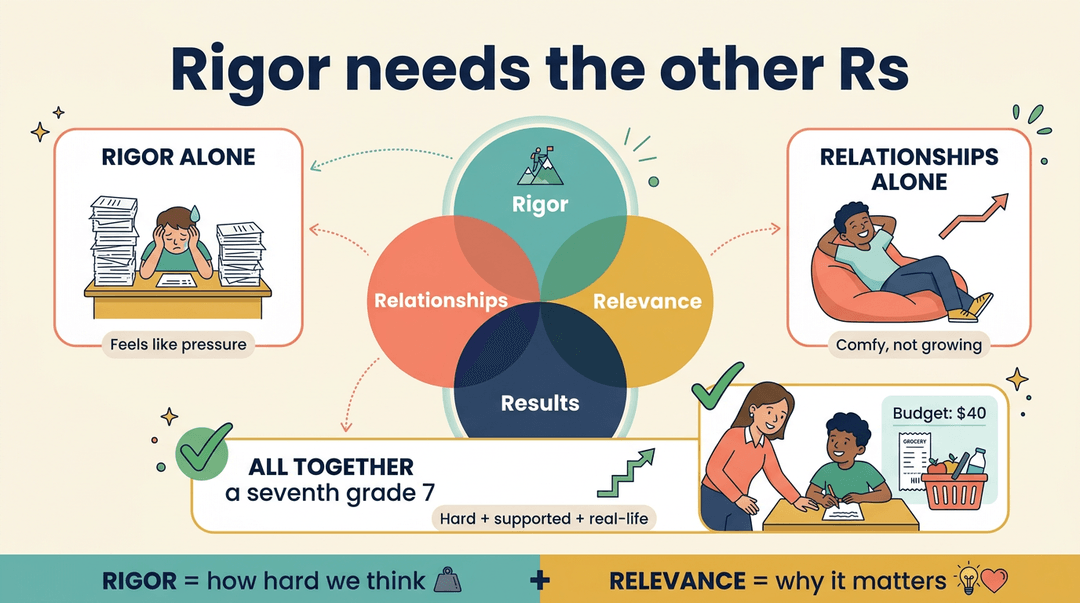
Many educators think in terms of the four Rs: rigor, relationships, relevance, and results. Rigor without relationships can feel like pressure. Relationships without rigor can leave students comfortable but not growing.
Consider a seventh-grade math teacher whose quiet student stalls on multi-step word problems. She keeps the challenge high, nudges him at just the right moment, and uses a grocery budget like the ones his family handles. He stays with the hard work.
Small personalized learning environments make this easier. When you see each student's gaps up close, you can tune challenge to each learner.
Relevant, meaningful curriculum closes the loop. Rigor asks how hard students think, while relevance answers why the effort matters.
How classical education approaches rigor
The classical approach to rigor is debated. Supporters praise demanding texts and sustained effort, while critics question whether older models fit today's classrooms.
Classical schools also speak of virtue, the character traits that make hard learning possible. Two terms stand out:
- Fortitude. The steadiness to keep working when a task gets uncomfortable.
- Prudence. The judgment to choose the right next step.
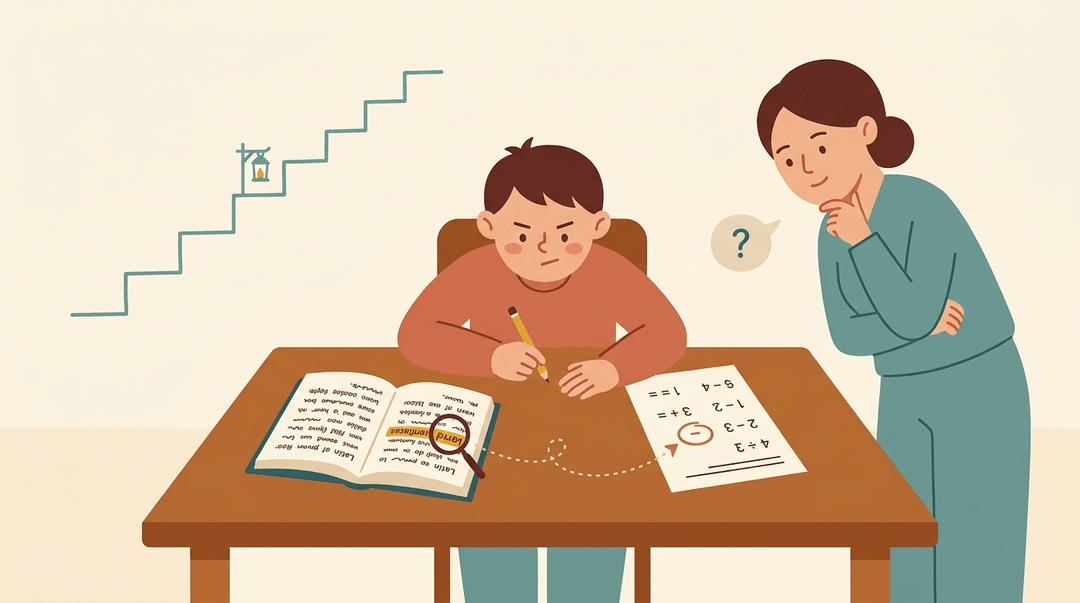
Many classical programs include Latin translation, where one word choice can change a sentence's meaning. That precision carries into math, where a dropped negative sign matters just as much. Small details carry big weight.
Rigor is challenge with purpose. It asks students to think deeply, apply what they know, and explain their reasoning. When it's part of your lessons, students stop chasing right answers and start building understanding that lasts.
Rigor grows from the questions you ask and the tasks you assign, right inside the standards you already teach. Small shifts add up over a school year.
Ready to map that work across your year? Check out our Curriculum & Standards page to plan units, lessons, and standards.
References
Frequently asked questions
What is academically rigorous?
Academically rigorous learning challenges students to think deeply, apply knowledge to new situations, and explain their reasoning while maintaining high expectations. It emphasizes purposeful thinking, not simply more homework or harder tests.
What is another word for academic rigor?
Another way to say academic rigor is intellectual challenge or demanding academic work. In education, “rigorous thinking” is often clearer because it emphasizes reasoning rather than workload or harshness.
What is rigor in mathematics?
Rigor in mathematics means showing precise reasoning, explaining why a method works, and applying mathematical knowledge to new problems, not just getting the correct answer. For example, a student might justify which fraction is larger by using a common denominator.
What are rigor courses?
Rigor courses are advanced classes, such as Advanced Placement (AP), honors, and International Baccalaureate (IB), that challenge students beyond standard coursework. They are intended to provide access to demanding, college-preparatory learning.
What does rigorous learning mean?
Rigorous learning means engaging with challenging work that requires students to apply what they know, analyze ideas, justify conclusions, and reflect on their reasoning. Appropriate scaffolds can help students meet high expectations without lowering the learning goal.