Perennialism in Education Explained, From Origins to Modern Use


Jump to section
Think about the books that never seem to leave the shelf: Shakespeare, Plato, the kind of stories every generation keeps handing to the next. Perennialism is built on that same instinct.
It's an educational philosophy that says some ideas are timeless, and school's real job is teaching students to grapple with them through great works and disciplined thinking rather than trends or test prep.
That question matters more than ever as classrooms chase the newest tool. Here, we'll unpack where perennialism comes from, what it looks like in a real lesson, and how you can use pieces of it today.

Perennialism in Education Explained
Perennialism is one of the oldest philosophies you'll find in education, and its core claim is refreshingly simple: some truths never go out of style. Here's what that actually means once you break it down.
Why enduring truths matter most
Perennialism rests on the belief in everlasting universal truths: ideas about goodness, reason, and human nature that hold up across centuries, not just the current school year.
That's why the focus stays on enduring ideas rather than passing trends, and on principles rather than isolated facts. It's less about what a student can recite and more about why it matters.
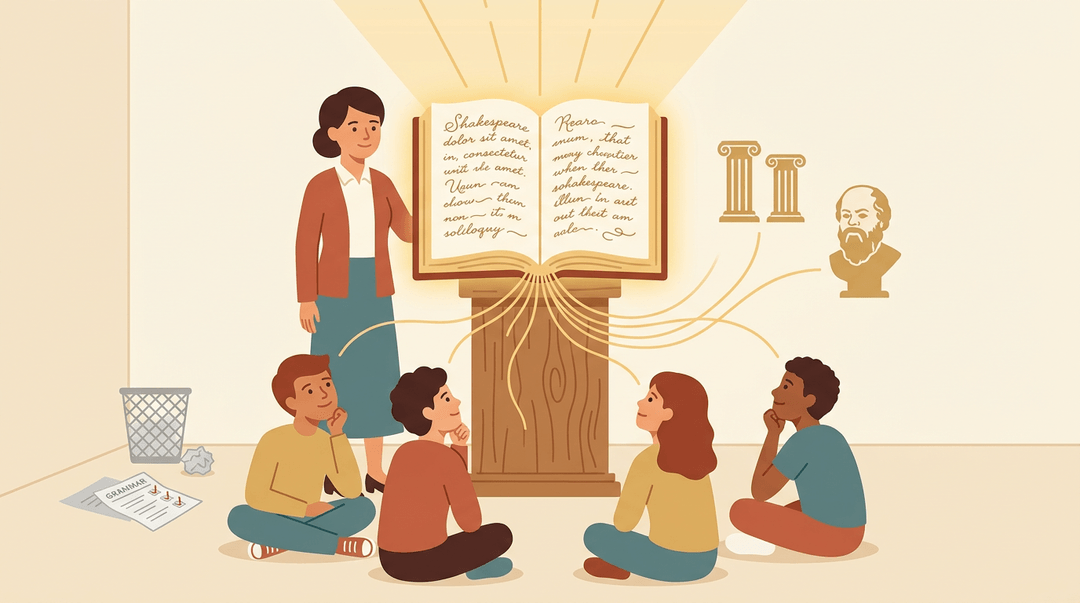
Think of a high school English teacher who spends a week on a Shakespeare soliloquy about mortality instead of a grammar worksheet: the goal is to grow a thinking person, not train a machine to complete a task.
Roots in idealism, realism, and faith
The philosophy is rooted in idealism and realism, blending Plato's belief in unchanging truths with Aristotle's grounding in observable reality. That combination is the philosophical backbone of the whole approach.
Many perennialists also lean on neo-Thomism, a revival of Thomas Aquinas's thinking that reconciles faith and reason, treating rigorous logic and religious truth as partners rather than opponents.
A conservative, teacher-centered philosophy
Perennialism is a conservative educational theory: it looks backward to time-tested ideas rather than forward to whatever's new. It's teacher-centered, not student-centered.
The teacher acts as the expert, guiding students through the great works and big questions rather than letting the lesson follow student interest.
That puts it squarely at odds with progressivism, which favors choice, hands-on discovery, and a curriculum that bends toward the learner.

How perennialism differs from essentialism
Perennialism and essentialism are both teacher-centered philosophies, but they're headed to different destinations. Essentialism focuses on skills: it's more vocational and fact-based, built to get students ready for a job or a test.
Perennialism cares more about personal development.
Picture a perennialist teacher assigning Plato's Republic to spark a debate about justice, while the essentialist teacher next door drills the same students on the data literacy they'll need for a certification exam.
Same room, same age group, very different aim.
Religious Versus Secular Perennialism
Ask ten educators to define perennialism and you'll likely get two different answers, because the philosophy actually splits into two branches. Both agree that some truths never change.
They just disagree on where those truths come from: divine revelation or human reason.
Do Perennialists believe in God?
Some do, some don't, depending on the branch. The ecclesiastical branch answers yes, and it's built entirely on Christian doctrine. St. Thomas Aquinas, a 13th-century philosopher and the patron saint of Catholic schools, is credited as its founder.
His work treats faith and reason as partners rather than rivals: reason can take a student far, but scripture and catechism fill in the truths reason alone can't reach.
In a classroom shaped by this view, a lesson on ethics might sit right alongside a lesson from a religious text, with both treated as equally valid paths to understanding.

Its secular branch, led by Hutchins and Adler
The other branch drops God from the equation entirely. Its lay, or secular, branch took shape in the 20th century, led by Robert Hutchins and Mortimer Adler.
Instead of scripture, they anchored truth in a shared human nature: the idea that people everywhere reason, feel, and grow in fundamentally the same ways, no matter the era.
That's why their model leans so heavily on the liberal arts: literature, history, and philosophy, the subjects that reveal what's constant in human experience regardless of when or where a student lives.
What Perennialist Curriculum Looks Like
Strip away the jargon, and perennialist curriculum comes down to one question: what has stood the test of time? That question shapes everything from the reading list to the seminar room.
Reading the great books of the West
At the center sits the Great Books: a curated set of roughly 100 classic works spanning philosophy, literature, and science, drawn almost entirely from the Western canon.
A Great Books program from the University of Melbourne's Faculty of Arts followed that same structure for a decade: one hundred works, one seminar at a time, before it wrapped up in 2023.
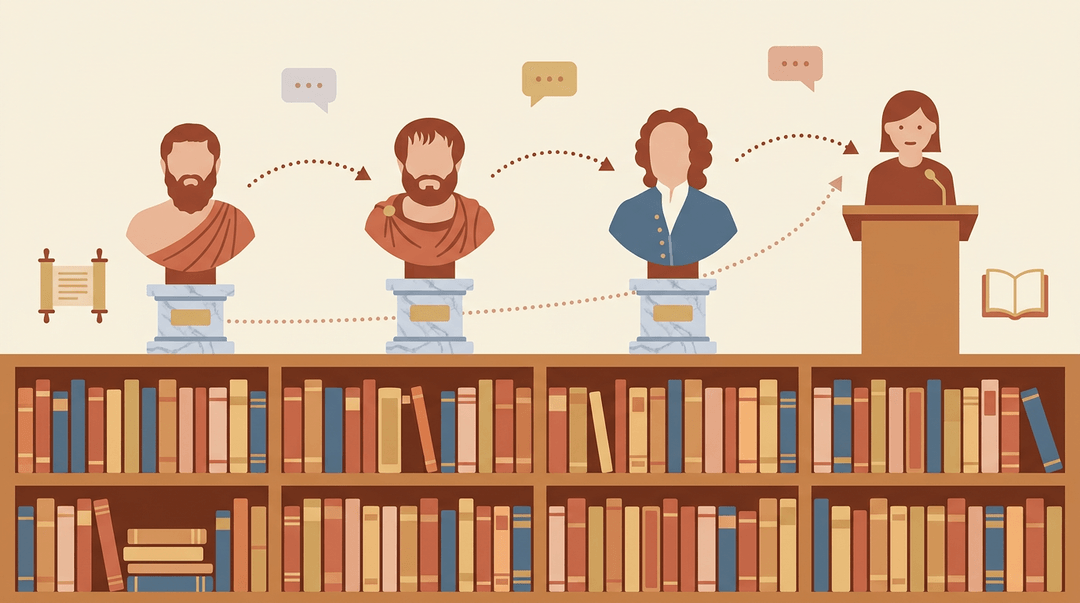
Perennialists call the ongoing dialogue among these authors the Great Conversation: Aristotle answering Plato, Locke answering Aristotle, and so on across centuries. That conversation isn't frozen.
Each generation adds its own voice, even as the earliest texts stay central.
Core subjects in the liberal arts
Perennialist classrooms build outward from a familiar core:
- philosophy
- history
- mathematics
- language
- literature
- natural science
- the fine arts
Underneath all of it sits the three R's: reading, writing, and arithmetic, the tools students need before they can tackle Aristotle or algebra.
The same curriculum for every student
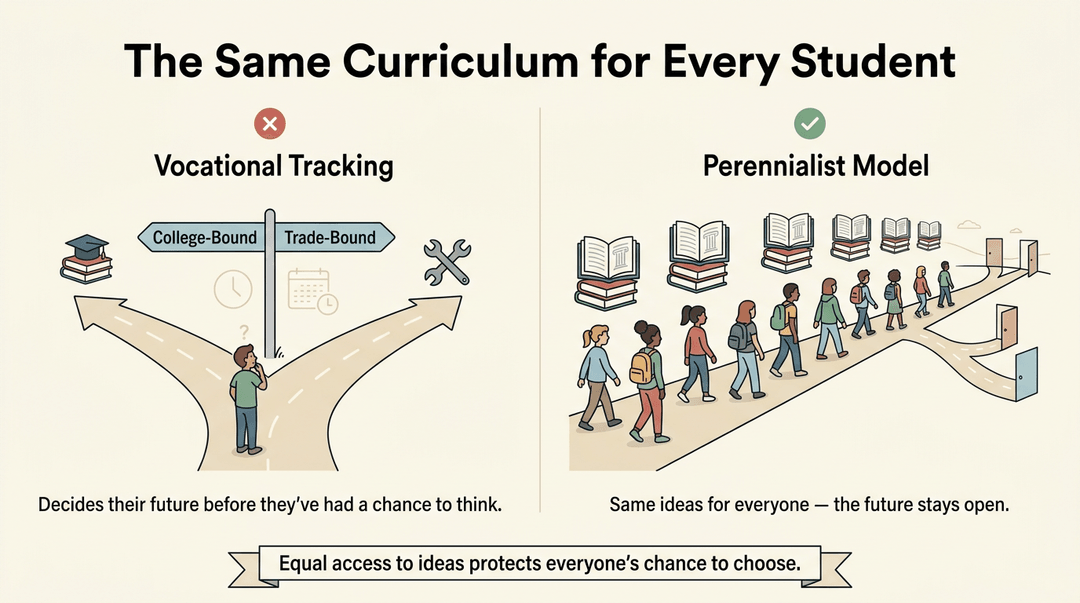
Every student works through the same course of study, regardless of background or career plans.
Perennialists reject vocational tracking on principle: sorting students early into "college-bound" and "trade-bound" tracks, they argue, decides a student's future before that student has had a real chance to think.
Give every student the same access to the same ideas, the reasoning goes, and you protect something genuinely democratic.
What are some examples of perennialism?
A handful of colleges built entire programs around this model. St. John's College runs its whole curriculum on the Great Books list, with no electives and no majors.
The University of Chicago's core curriculum and Reed College's humanities sequence both echo the same approach, and a wider network of Great Books colleges have adopted versions of it for undergraduates who'd rather read Homer than a textbook.
How to Use Perennialism in the Classroom
Bringing perennialism into a real classroom means pairing timeless texts with methods that get students talking, thinking, and arguing well. The Paideia Program, built by Mortimer Adler, organizes lessons around a three-column structure:
- didactic instruction
- coaching
- seminar discussion
Using Socratic seminars and discussion
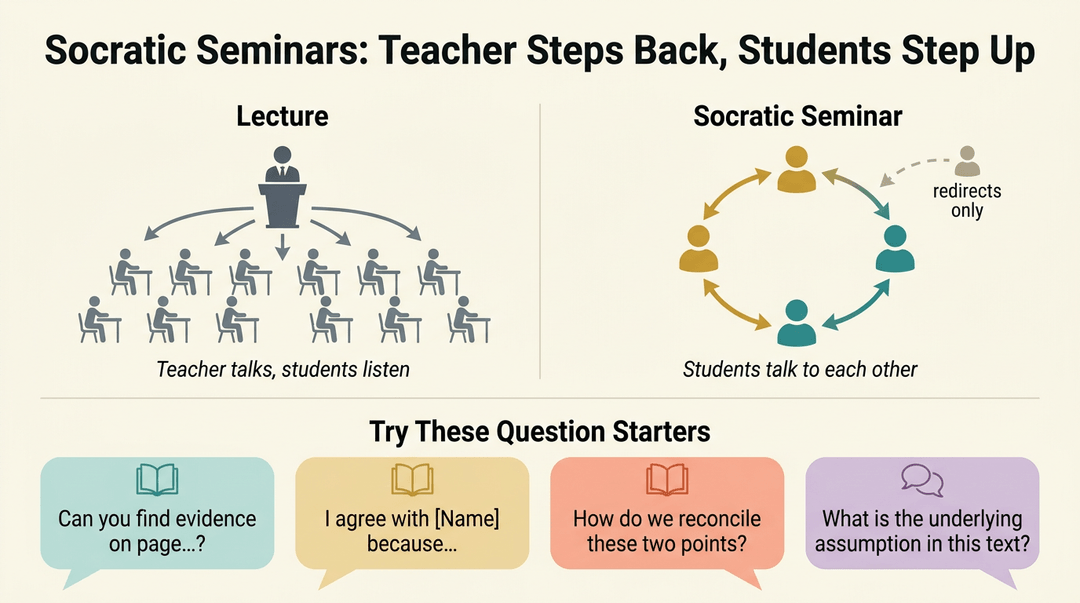
The seminar column relies on dialogue-based discussion rather than lecture. You pose open-ended questions, then step back and let students investigate a text together, testing ideas and pushing back on each other's reasoning.
Consider a high school English teacher running a Socratic circle on Antigone: students sit facing one another, and the teacher only steps in to redirect, never to answer. A few reliable question starters:
- "What does the author mean by...?"
- "Do you agree with [classmate]'s point? Why or why not?"
- "What evidence in the text supports that?"
- "How does this connect to what we read last week?"
Coaching and direct instruction methods
Mortimer Adler identified three methods for the Paideia approach:
- didactic instruction
- coaching
- seminar discussion
Didactic instruction covers lectures, textbooks, and direct explanation of facts and concepts, the groundwork students need before they can argue about it.
Coaching looks different: think of a teacher circulating during a writing workshop, giving one student feedback on thesis clarity while another gets help citing evidence, each moving at their own pace toward mastery.
Building critical thinking through debate
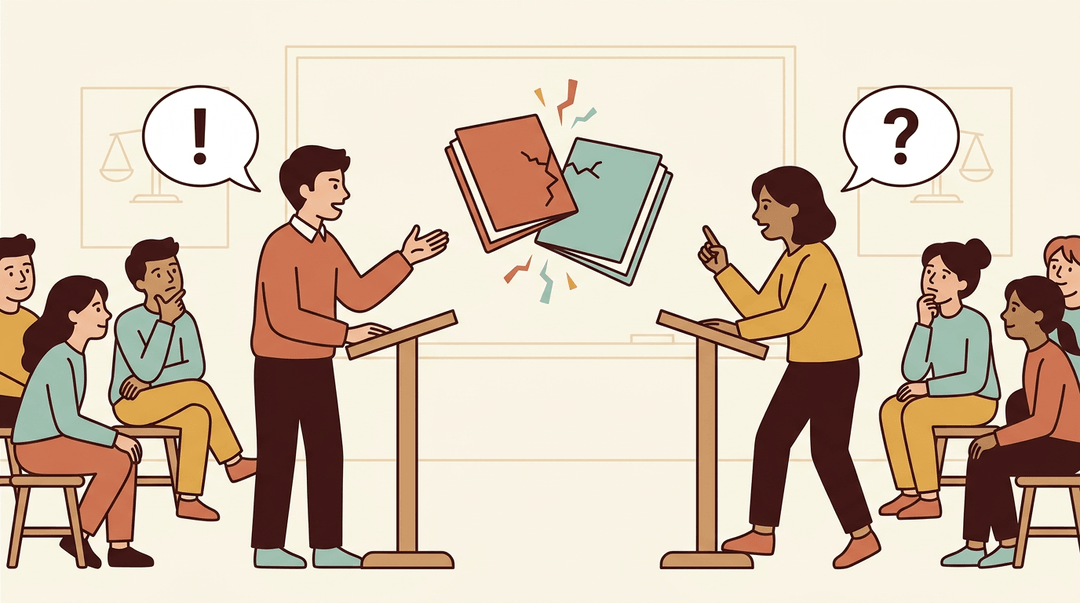
Perennialist classrooms encourage thoughtful debate, not just discussion.
Structured argument pushes students toward reflective thought: they have to defend a position, spot the weak points in a classmate's logic, and recognize where two texts (or two characters) genuinely disagree.
That's where reasoning skills actually develop: through practice, not worksheets.
The Roles Teachers and Students Play
Perennialism gives teacher and student very different jobs. One holds the truth; the other is there to absorb it.
The teacher as guide and authority
In a perennialist classroom, the teacher acts as an authority who disseminates truth, not a facilitator who lets students construct their own meaning.
Think of a high school teacher leading a seminar on The Republic: less a coach cheering from the sideline, more a guide who's walked the path before and knows exactly where it leads.
That guide has to be well-versed in the classics, from Aristotle to Shakespeare, because the whole approach rests on knowing the great works cold. The teacher's job isn't just to relay facts.
It's to model intellectual capacity: the habits of careful reasoning and rigorous questioning students are meant to develop themselves.

Students as receivers of fixed truths
Students, meanwhile, are there to learn fixed truths that have held up across centuries, not to chase whatever topic happens to interest them that week.
A student's curiosity about video games or pop culture simply isn't the point; personal interest takes a back seat to the enduring text in front of them.
The payoff is meant to be developing rational powers: the ability to reason, analyze, and argue well, skills perennialists see as timeless.
Because the curriculum centers on universal truths, individual difference and diversity aren't a central concern here. Every student reads the same texts and wrestles with the same fundamental questions.

Applying Perennialism in Your Classroom Today
You don't need to overhaul your curriculum to teach perennially. Find your setting below and start with one move this week: the method scales from a read-aloud rug to a seminar table to your own kitchen.
Key principle: A perennialist question has no expiration date. If the question would have made sense to a student 500 years ago, it belongs in your lesson.
Elementary: timeless themes through read-alouds
- Read a classic fable aloud. Aesop fits in ten minutes.
- Ask a universal-truth question first, before any comprehension check.
- ❌ "What did the fox do?" (recall)
- ✅ "Was the fox right to do it?" (judgment)
- The difference: one has an answer in the book, the other doesn't.
- Name the shared human theme on the board.
- As you'd write it: "People in every time and place struggle with envy."
Example: After The Boy Who Cried Wolf, a second-grade teacher asks, "Is it ever okay to lie, even to be kind?" Hands stay up for fifteen minutes. That argument, not the plot, is the lesson.
Secondary: Great Books circles and debate
- Run a discussion circle. Students face each other; you ask one question, then stay quiet.
- Try: "Does Antigone owe more to her family or to the law?"
- Debate enduring questions, not plot points. Assign sides before students pick their own.
- Say: "Half of you defend Creon. Convince us he's not the villain."
- Coach analytical essays that take a position on the seminar question.
- ❌ "This essay explains what Plato said about censorship."
- ✅ "Plato is wrong that censorship protects the young, because..."
- The difference: summary reports a text, analysis argues with it.
At home: one-on-one Socratic teaching
- Hold a weekly Socratic dialogue. Twenty minutes, one question, and answer their answers with more questions.
- Build a personalized classics list. Chain from their current obsession toward the canon.
- As you'd jot it: dinosaurs → Greek monster myths → a children's Odyssey.
- Track reasoning growth, not pages read. Keep a running note of these moves:
| Watch for | It sounds like |
|---|---|
| Giving reasons | "I think that because..." |
| Weighing the other side | "But someone could say..." |
| Revising a view | "I changed my mind when..." |
When two of the three show up unprompted, the dialogues are working.
However you start, the hard part isn't the first discussion; it's sequencing the next forty. Map your Great Books scope, sequence, and pacing easily with EMStudio's Curriculum Planner.
Key Thinkers Behind Perennialism
Perennialism didn't come from one founder handing down a finished philosophy. It grew across centuries, picked up and reshaped by thinkers who kept returning to the same conviction: some truths and some texts are worth teaching in every generation.
Who was the father of perennialism?
If you're looking for one "father," you won't find a clean answer, and that's part of the point.
The roots trace back to Plato and Aristotle, who argued that human nature and reason don't change from age to age, so education should aim at timeless truths rather than passing trends.
Centuries later, Thomas Aquinas folded that classical reasoning into Christian theology, insisting faith and reason could grow together in the same curriculum.
John Henry Newman carried the tradition forward through his writings on teaching universal knowledge and cultivating the intellect, defending a liberal education built on lasting ideas rather than narrow job training.
And St. Thomas Aquinas and Jacques Maritain greatly influenced the development of perennialism as it moved into the modern era.

20th-century leaders like Hutchins and Adler
The secular branch of perennialism has clearer names attached. As president of the University of Chicago, Robert Hutchins championed the Great Books curriculum, pushing students toward primary texts instead of watered-down summaries.
Mortimer Adler picked up that torch: Adler and other educators built the Paideia Program in 1982 to make a liberal, Great Books education accessible to every student, not just the elite.
Allan Bloom later warned that skipping these texts breeds cultural illiteracy in a generation cut off from its own tradition. And Stringfellow Barr and Buchanan stand alongside Hutchins and Adler as 20th-century secular proponents of perennialism.
What Are the 4 Educational Philosophies?
Perennialism doesn't stand alone. It's one voice in a small chorus of educational philosophies that shape how teachers teach and schools run, and each one answers the same question differently: what's school actually for?
One of four major philosophies
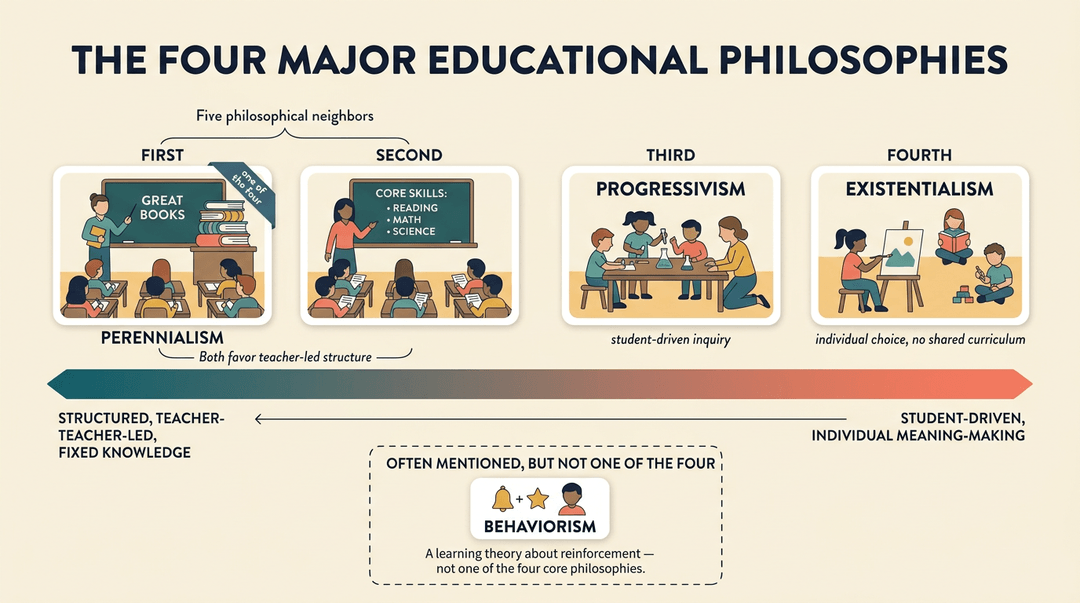
Ask any philosophy-of-education course and you'll get the same answer: there are four major educational philosophies, and perennialism is one of them. The other three are:
- Essentialism
- Progressivism
- Existentialism
Behaviorism often gets mentioned in the same conversation, but it's usually treated as a separate learning theory rather than one of the core four.
Perennialism and essentialism sit close together: both favor a structured, teacher-led approach built around a fixed body of knowledge. Progressivism pulls the other way, favoring student-driven inquiry over inherited truths.
Existentialism goes further still, centering the individual student's choices and meaning-making over any shared curriculum at all.
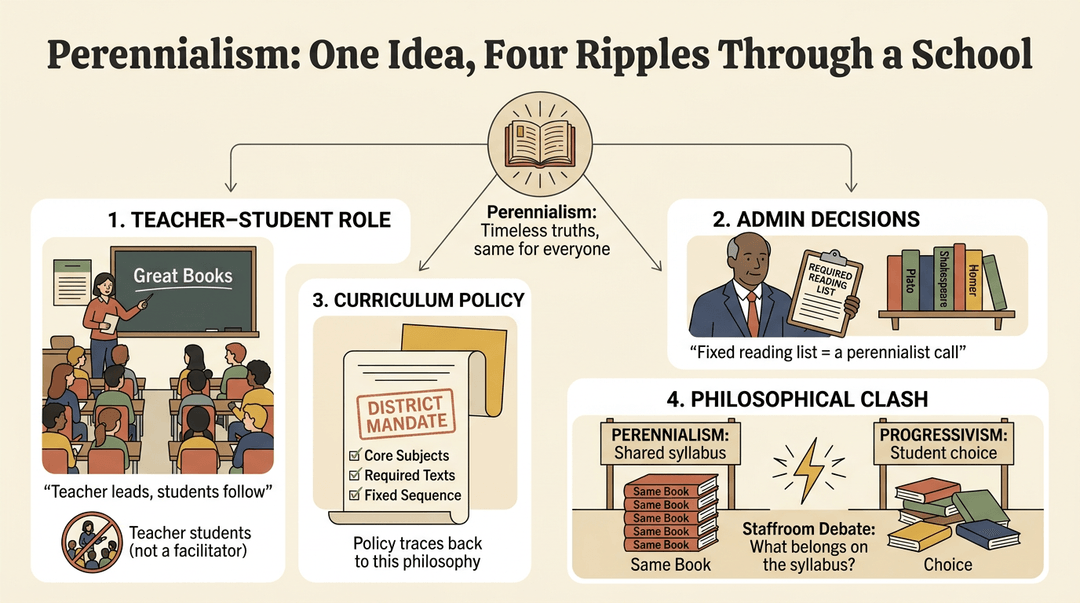
How it shapes classrooms and schools
Which philosophy a teacher (or a school) leans on quietly shapes almost everything downstream.
- Teacher-student relationships. A perennialist classroom casts the teacher as the authority guiding students toward enduring ideas, not a facilitator following their interests.
- Administrator decisions. Principals building a classics-heavy curriculum or defending a fixed reading list are often making a perennialist call, whether they name it or not.
- Curriculum policy. District mandates around required texts, core subjects, and sequencing frequently trace back to this philosophy's influence.
- Philosophical conflict. Perennialism's insistence on a shared, timeless curriculum regularly clashes with progressivism's push for student choice, and that tension shows up in real staff-room debates over what belongs on the syllabus.
Common Criticisms of Perennialism Today
Perennialism has plenty of admirers, but it also draws real pushback from teachers working in today's classrooms. Most of the criticism runs along two lines: whether the approach actually fits a modern room, and whether its philosophy even holds together.
Why it's hard to implement today
Critics see the Socratic seminar, perennialism's signature method, as a relic built for a slower era.
Consider a high school teacher trying to run a 45-minute Great Books discussion while also prepping for a state exam and managing five different reading levels in one room.
That single-text, discussion-heavy model leaves little space for differentiation, and it can struggle to meet the needs of English language learners or students with an IEP who need more scaffolding than a Socratic circle offers.
Add in AI-driven, adaptive tools that promise personalized pacing for every student, and perennialism's fixed canon can look like it's clashing head-on with modern mandates for differentiated, data-informed instruction.

Its complicated philosophical underpinnings
Perennialism isn't one tidy philosophy either. It splits into an idealistic wing, rooted in Plato's world of forms, and a realistic wing, grounded in Aristotle's reasoned observation of the world.
Within that split, some perennialists lean toward fideism, treating faith as the source of enduring truth, while others hold to strict rationalism, trusting reason alone to get there.
These aren't just academic distinctions: they shape whether a teacher presents a classic text as settled moral authority or as a puzzle worth questioning, and that choice changes how discussion actually plays out in the classroom.
Perennialism won't fit every classroom wholesale, and it doesn't need to. What it offers is a reminder that some skills, like reasoning through a hard text and wrestling with big ideas, never go out of style.
Pull even one piece into your week and you're building something that lasts longer than a single unit.
Ready to put those timeless ideas into an actual lesson plan? Check out our Curriculum Planning feature to map units, lessons, and standards across your whole year.

References
- Great Books bite size — arts.unimelb.edu.au (2025)
- Chapter 5: Perennialism — kstatelibraries.pressbooks.pub
- ED365394.pdf — files.eric.ed.gov
- Paideia Training - Paideia Program — augsburg.edu
- Towards a Philosophy of Liberal Education: John Henry Newman on Teaching Universal Knowledge, the Cultivation of the Intellect, and the Enlargement of Mind — doi.org (2020)
- Hutchins, Adler, and the University of Chicago: A Critical Juncture — doi.org (1990)
- Using Mortimer Adler’s Education Manifesto: The Paideia Proposal in an Australian Context — classicaleducation.org.au (2026)
- THE CRISIS OF AMERICAN EDUCATION AND REFORMS ... — gilsonsociety.com
Frequently asked questions
What is perennialism in education?
Perennialism in education is the philosophy that schools should teach enduring truths, universal ideas, and timeless works rather than temporary trends. It emphasizes disciplined thinking, liberal arts, classic texts, and the development of students’ reasoning abilities.
What is perennialism in simple words?
In simple words, perennialism means teaching ideas that remain important across generations. Students study classic works and discuss lasting questions about truth, justice, goodness, reason, and human nature.
What are criticisms of perennialism?
Critics argue that perennialism can be too teacher-centered, rigid, and focused on a predominantly Western canon. It may give limited attention to student interests, cultural diversity, differentiation, English language learners, and students with disabilities, while its discussion-heavy approach can be difficult to fit into modern classrooms.
How to use perennialism in the classroom?
Use perennialism by selecting classic texts and connecting them to enduring questions. Combine direct instruction with coaching, Socratic seminars, structured debates, and analytical writing, while having students support their views with evidence and reason.
What are some examples of perennialism?
Examples include studying Plato’s Republic to debate justice, reading Shakespeare to discuss mortality, holding a Socratic seminar on Antigone, and using Aesop’s fables to explore honesty or envy. Schools such as St. John’s College and parts of the University of Chicago and Reed College also use Great Books-oriented programs.
Who was the father of perennialism?
There is no single universally accepted father of perennialism. Its roots are commonly traced to Plato and Aristotle, while Thomas Aquinas is often credited as the founder of its ecclesiastical or Christian branch.
Do Perennialists believe in God?
Some perennialists believe in God and some do not. Ecclesiastical perennialism is based on Christian doctrine, while secular perennialism, associated with Robert Hutchins and Mortimer Adler, grounds enduring truths in shared human nature and reason.
Who is called the father of perennialism?
Thomas Aquinas is often called the father or founder of Christian, ecclesiastical perennialism. More broadly, perennialism draws on the earlier philosophical work of Plato and Aristotle, so the title depends on which branch or historical account is intended.