NGSS Explained: What It Is and How It Works

Jump to section
Think about assembling furniture with instructions that only show the finished picture, no steps in between. You'd get there eventually, but you'd waste a lot of screws along the way. Science teaching used to feel a bit like that.
NGSS, the Next Generation Science Standards, gives teachers the steps. It blends content, practices, and concepts into one coherent framework for K-12 science.
In this post, we'll unpack where NGSS came from, how it's built, and how to turn it into a lesson plan that actually works.

What Is NGSS and Why It Matters
Ask any veteran teacher what's changed in science class over the past decade, and NGSS usually comes up.
The Next Generation Science Standards reshaped how science gets taught, and knowing the story behind them makes the standards themselves a lot less intimidating.
How is NGSS different from previous standards?
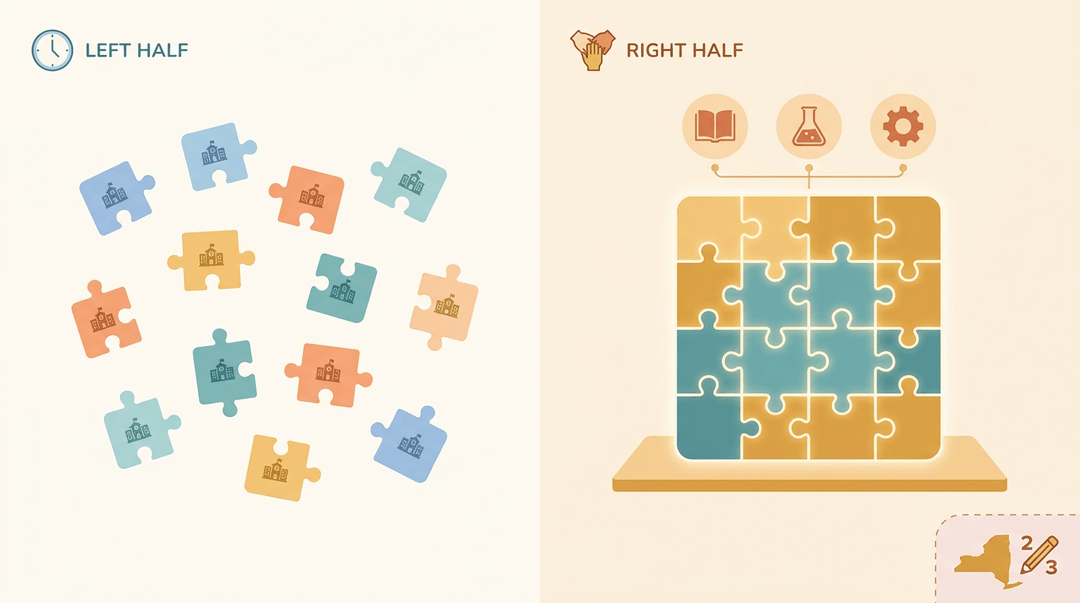
Unlike older state-written science standards, NGSS are K-12 science content standards built through a multi-state effort rather than one state or district going it alone.
According to a National Academies review, the standards took shape over a two-year process led by 26 lead states under the guidance of Achieve, Inc., and were grounded in the Framework for K-12 Science Education, developed by the National Research Council to set the scientific consensus new standards should follow.
The writing itself brought together the National Science Teachers Association, the American Association for the Advancement of Science, and Achieve.
That collaboration is the real departure from before: instead of each state building its own patchwork, NGSS gave states one shared foundation to build from.
It's also worth clearing up a common mix-up: New York's own Next Generation Learning Standards cover English language arts and math, not science, and shouldn't be confused with NGSS despite the similar name.
What NGSS aims to achieve
NGSS was written to raise scientific literacy and get students genuinely ready for college and careers, not just the next test.
It's research-based, drawing on how students actually build understanding over time, and it's designed to spark curiosity in STEM (science, technology, engineering, and math) rather than deliver facts to memorize.
The standards are also internationally benchmarked, built to hold up against what top-performing countries expect from their science students.
States that have adopted NGSS
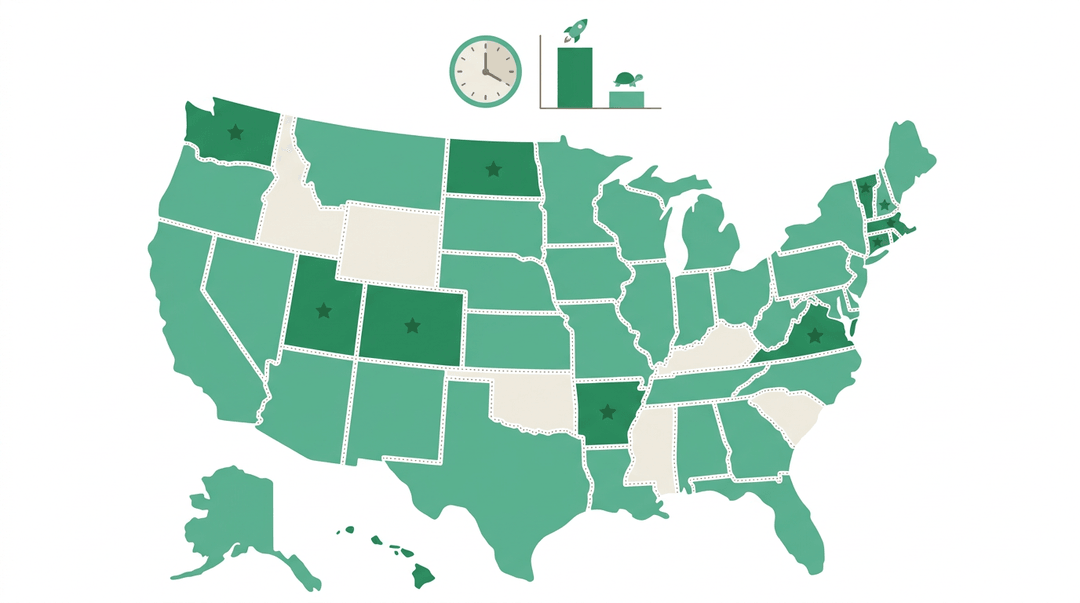
Of the 26 lead state partners who helped write NGSS, 20 states plus the District of Columbia have formally adopted it, while 44 states now use NGSS or a closely related framework.
With no federal funding tied to adoption, states have moved at their own pace, and that pace has been noticeably slower than Common Core's rollout.
The Three Dimensions of NGSS
Rather than teaching facts in isolation, NGSS asks students to build understanding the way scientists actually work: by weaving three dimensions into every lesson and every assessment.
Think of them as three lenses on the same phenomenon, not three separate units to check off:
How crosscutting concepts connect science ideas
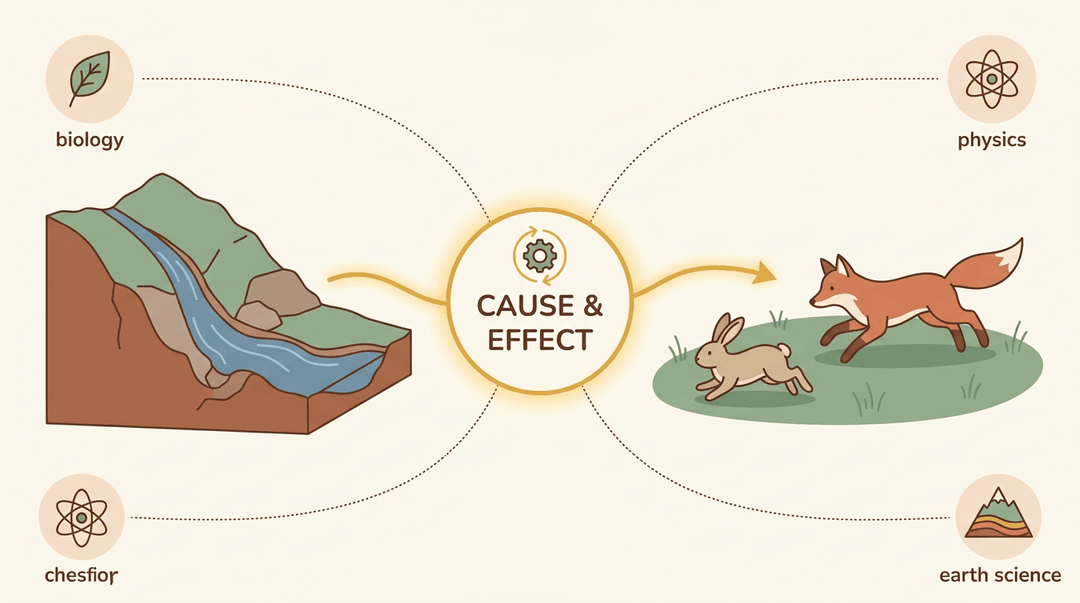
Crosscutting concepts are the ideas that show up again and again across biology, chemistry, physics, and earth science, giving students a shared vocabulary for spotting connections other students miss. A lesson on erosion and a lesson on predator-prey dynamics both lean on cause and effect: change one variable, and watch what happens downstream. As Edutopia notes, there are seven crosscutting concepts, including patterns, systems and system models, and energy and matter. Used deliberately, they help students build one coherent worldview instead of a pile of disconnected facts.
What scientists and engineers actually do
This dimension extends what "inquiry" used to mean into something more concrete: the actual moves scientists and engineers make on the job. Appendix F lists eight science and engineering practices, each with its own progression from kindergarten through grade 12. Asking questions, developing models, and constructing arguments from evidence aren't add-ons. They're how students build and apply the core ideas below.
Core ideas across science disciplines
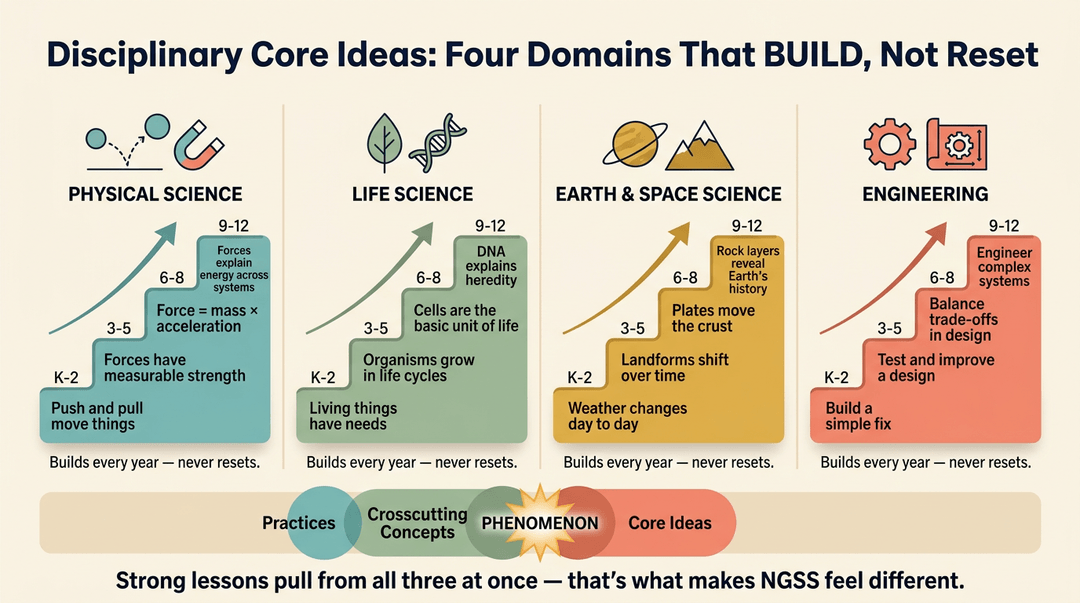
Disciplinary core ideas are the essential content, organized into four domains:
- physical science
- life science
- earth and space science
- engineering
Each idea builds in complexity from grade to grade rather than resetting every year, and together they form the central content you're actually responsible for teaching.
Strong phenomena-driven lessons and three-dimensional assessments pull from all three dimensions at once, and that's what makes NGSS feel different in practice.
How NGSS Standards Are Structured
Open any NGSS standard for the first time and it can look like a lot: boxes, codes, small print everywhere. Once you know what each part does, though, the layout actually makes lesson planning faster, not slower.
What students should know and do
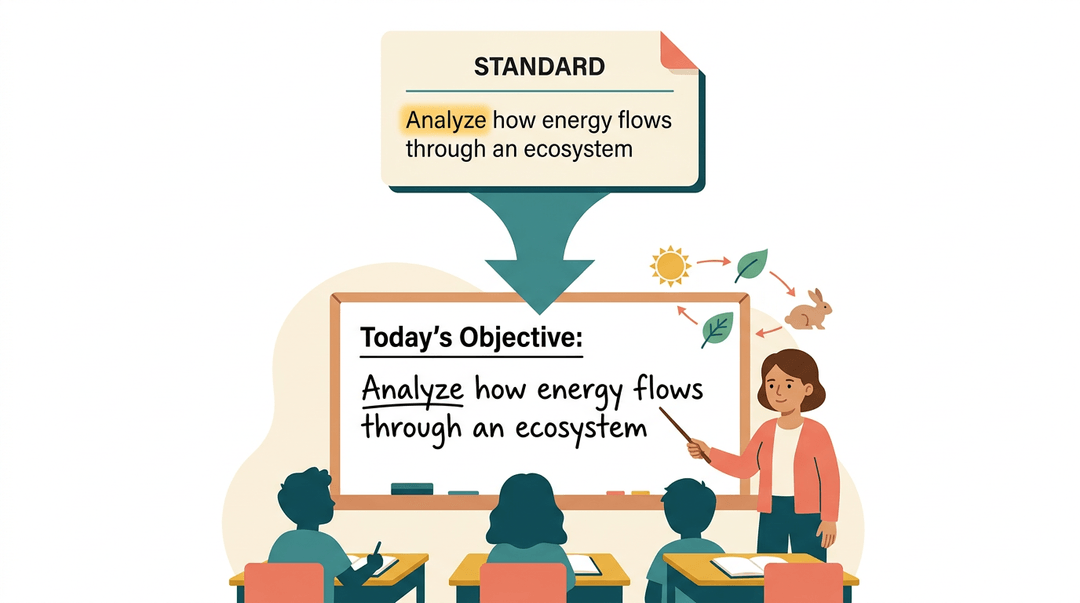
At the top of every standard sits the performance expectation (PE): a single statement of what students should know and be able to do by the end of a unit.
It's a condensed version of everything below it, and it's the part teachers actually plan from day to day.
Each PE defines a specific competency, often starting with an action verb like "construct" or "analyze," which makes it easy to turn straight into a learning target.
For example, a middle school teacher building a unit on ecosystems can lift the PE almost word for word into a daily objective students see on the board.
The three color-coded foundation boxes
Below the PE, you'll find three color-coded boxes that show what it's built from:
- Science and Engineering Practices
- Disciplinary Core Ideas (DCIs)
- Crosscutting Concepts
They surround the performance expectation because that's literally where they came from: blend the three together and you get the standard above them.
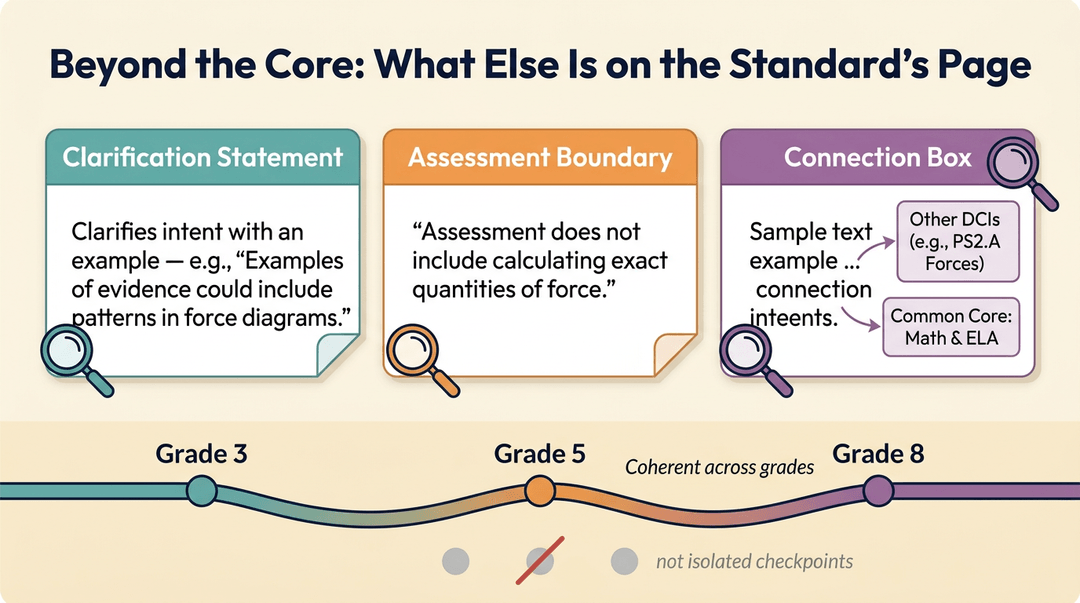
Other key parts of each standard
A few smaller pieces round out the page:
- Clarification statements explain the PE's intent with an example.
- Assessment boundaries mark what's out of scope for a given grade.
- Connection boxes link the standard to other DCIs and to Common Core in math and English.
Together, they keep the standards coherent across grades instead of feeling like isolated checkpoints.
How to Plan an NGSS-aligned Lesson
An NGSS lesson isn't built around a topic; it's built around a phenomenon students work to explain. This guide walks you through the full cycle: map the lesson, run it, then use what you see to adjust.
Before class: map the lesson
- Select an anchoring phenomenon. Pick something observable and puzzling that students can't yet explain.
- Example: "The puddle in the parking lot vanished by lunch. Where did it go?"
- Identify the target performance expectation. Copy the code and its verb into your plan; the verb tells you what students must do, not recall.
- Map the three dimensions for that expectation: the science and engineering practice (SEP), disciplinary core idea (DCI), and crosscutting concept (CCC).
Your map can be three lines at the top of the lesson plan:
SEP: Developing and using models · DCI: Water cycling on Earth · CCC: Energy and matter
⚠️ Watch out: A phenomenon is not a hook or a flashy demo. It's the thing the entire lesson exists to explain, so every activity should trace back to it.
During class: run the sequence
- Open with the phenomenon, not the vocabulary.
- Say: "What do you notice? What do you wonder?" Collect questions on the board.
- Guide the investigation. Students gather evidence through the mapped practice.
- For the puddle: measure water in open dishes over a class period, then model where it went.
- Facilitate an argumentation discussion. Students defend explanations with evidence, not opinions.
- Try: "What's your claim, and what evidence from today backs it up?"
After class: assess and adjust
Assess all three dimensions, not vocabulary recall. The prompt should require the practice, the core idea, and the crosscutting concept together.
- ❌ "Define evaporation." (Tests one dimension: recall of the DCI.)
- ✅ "Use your model to explain where the puddle's water went and what drove it there." (Requires the model, the core idea, and matter-and-energy thinking.)
Then use what the assessment shows to revisit the learning progression and adjust your pacing:
| When you see... | Try... |
|---|---|
| Explanations using all three dimensions | Move ahead as planned in your pacing guide |
| Correct facts but weak evidence use | Re-teach the practice; drop back a step on the progression |
| Gaps in the core idea itself | Revisit the earlier grade-band idea it builds on |
| The lesson ran long | Update the pacing guide now, while you remember why |
At a glance: map the phenomenon to a performance expectation, run engage → investigate → argue, then assess in three dimensions and adjust. Map NGSS performance expectations to units and track proficiency scales right in EMStudio's Curriculum Planner.
Subjects Covered by NGSS Standards
NGSS groups content into four core areas, and within each one, the disciplinary core ideas (DCIs, the fundamental concepts students build toward) grow more sophisticated as students move through grade bands. Here's what that looks like subject by subject.
Physical science topics you'll teach
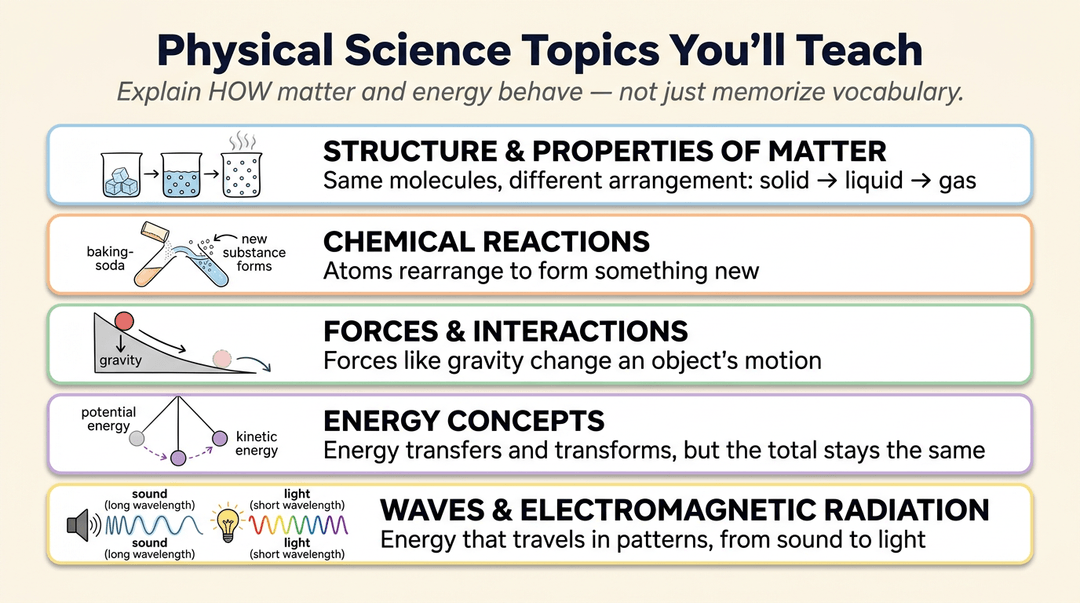
Physical science standards ask students to explain how matter and energy behave, not just memorize vocabulary. You'll cover:
- Structure and properties of matter, from states of matter to atomic-level models
- Chemical reactions, including how substances combine and change
- Forces and interactions, like gravity and motion
- Energy concepts, including transfer and conservation
- Waves and electromagnetic radiation, from sound to light
Life science topics you'll teach
Life science threads a single idea through every grade: living systems depend on each other. Students explore:
- Structure and function of cells, the building blocks of life
- Matter and energy in ecosystems, tracing how both move through food webs
- Interdependent relationships among organisms and their environment
- Inheritance and variation of traits across generations
- Natural selection and evolution, how populations change over time
Earth and space science topics
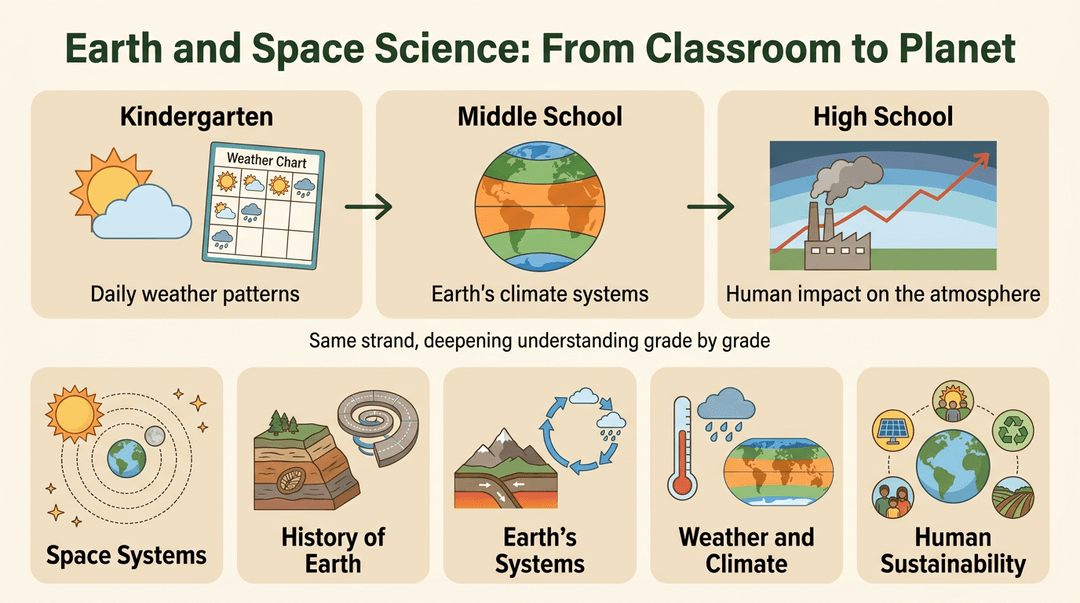
This strand connects the classroom to the planet and beyond. A kindergarten unit on daily weather patterns builds toward a middle school look at Earth's climate systems, then a high school investigation of human impact on the atmosphere: the DCI progression in action. Topics include:
- Space systems, like the sun, moon, and stars
- History of Earth, including geologic time
- Earth's systems, from plate tectonics to the water cycle
- Weather and climate patterns
- Human sustainability, or how people affect and depend on Earth's resources
Engineering design topics and skills
Engineering isn't tacked on as an afterthought. It's woven through every strand above, and it asks students to think like problem-solvers:
- Defining a problem clearly enough to design toward it
- Developing possible solutions and weighing tradeoffs
- Improving designs through testing and revision
- Real-world problem solving, applying science content to genuine challenges
Together, these four strands give you a full year's map, not a scattered list of topics to cover and forget.
Putting NGSS into Practice
Knowing what NGSS covers is one thing. Turning it into Monday's lesson plan is another, and that's where adoption actually gets tested.
Shifting to three-dimensional instruction
The biggest lift is the 3D instruction shift: blending disciplinary core ideas, science and engineering practices, and crosscutting concepts into one lesson instead of teaching content, then skills, then "big ideas" separately.
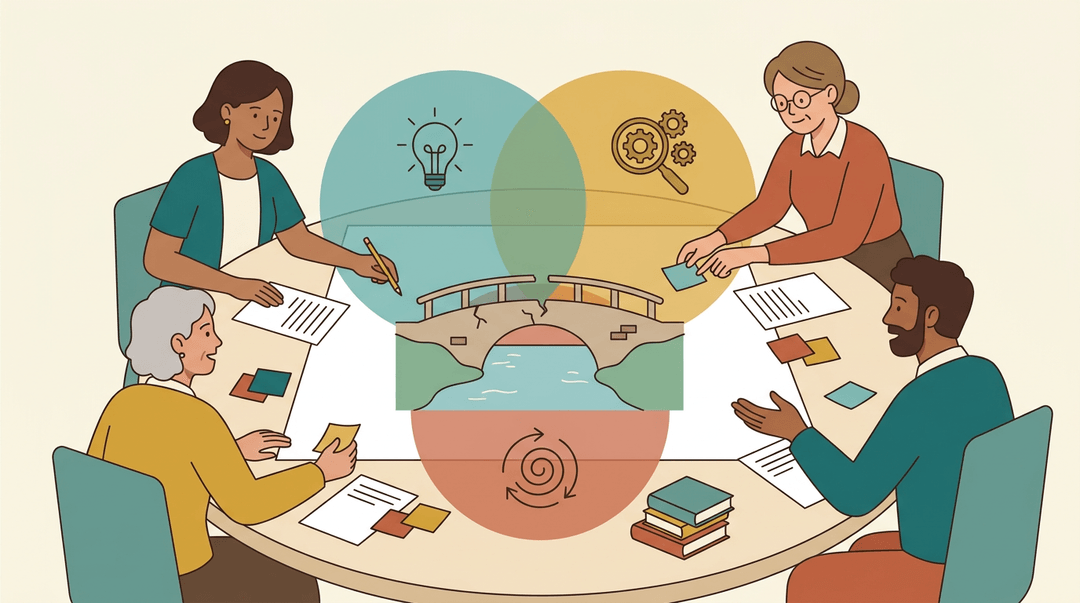
That kind of planning rarely works alone. It requires collaboration among teachers, curriculum coordinators, and administrators to map out where ideas connect across grade levels.
One common approach is the case-study method: anchoring a unit in a single real-world phenomenon (a local flood, a failing bridge design) rather than marching through isolated courses like a standalone biology unit and a standalone physics unit.
The goal is genuine integration of content and practice, not content followed by practice. That's a real change in habit, so teacher professional development matters here.
Many educators trained under older, content-first pacing guides need dedicated support to plan three-dimensionally with confidence.
Curriculum flexibility for teachers
NGSS sets outcomes, not a script: there's no prescribed curriculum attached.
That gives educators real flexibility in choosing materials and methods, and a growing market of NGSS-aligned products, some carrying digital badges that signal verified alignment, has emerged to fill the gap.
Homeschool families use the same standards as a benchmark for building their own science curriculum.
Building skills beyond science content
NGSS also pushes communication and collaboration skills, since students regularly work in teams and present findings.
The emphasis on critical thinking, plus analytical and evaluative thinking, aims past the classroom entirely: preparing students to weigh evidence and make informed decisions as citizens.
Controversy and Pushback Around NGSS
Not every state welcomed NGSS with open arms. Since its release, the standards have drawn real pushback, some of it political, some of it practical, and you've probably felt echoes of that debate in your own district.
What are the criticisms of NGSS?
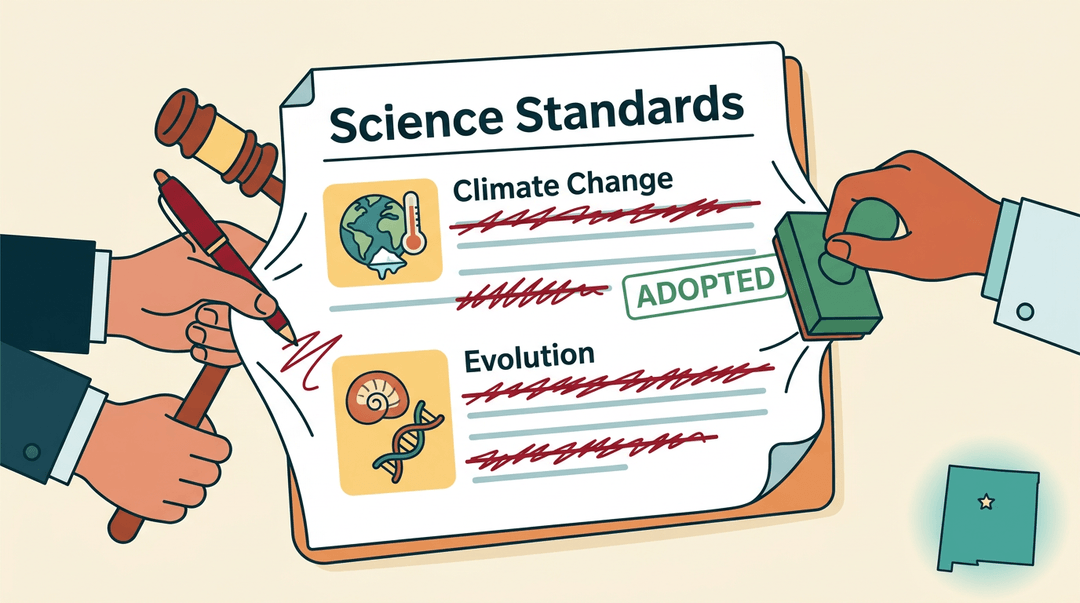
Much of the resistance has come from conservative lawmakers and advocacy groups objecting to two specific topics: climate change and evolution.
NGSS treats both as settled science, and that framing has collided with political and religious objections in several state legislatures.
New Mexico is the clearest example. The state's Public Education Department initially rewrote key passages on climate change and evolution before facing backlash.
According to a report on New Mexico's science standards revisions, the department agreed to eliminate its most controversial edits, though many opponents said the walk-back still didn't go far enough.
Public pressure pushed the state further still: the LANL Foundation's statement on New Mexico's adoption commended the department's decision to adopt NGSS in its entirety, crediting sustained advocacy from educators and scientists.
Beyond politics, other critics raise pedagogical and practical concerns: NGSS demands new instructional materials, deeper teacher training, and assessments that don't fully exist yet in every state.
For a teacher already stretched thin, that's a heavy lift, not a light one.
NGSS isn't just a list of facts to cover. It's a structure that connects what students learn to how they think and why it matters, three dimensions working together instead of in isolation.
Once you see that structure, planning around it gets a lot less intimidating.
Ready to turn standards into ready-to-teach lessons? Check out our Curriculum Planning feature to plan your units, lessons, and standards across the whole year.
References
- Read "Next Generation Science Standards: For States, By States" at NAP.edu — nationalacademies.org
- Implementation of New Mexico STEM-Ready Science ... — nmlegis.gov
- Science and Engineering Practices in the NGSS — csmgeo.csm.jmu.edu
- K-12 Engineering and the Next Generation Science Standards: A Network Visualization and Analysis (Resource Exchange) — doi.org (2020)
- Lead State Partners — nextgenscience.org
- Transforming Science Assessment: Challenges and Recommendations for States — nextgenscience.org
- LANL Foundation’s Support of PED’s Decision to Adopt NGSS in Its Entirety — lanlfoundation.org (2026)
- Will The Next Generation Science Standards Be The Common Core For Science? — cbsnews.com
- Common Science Standards Slow to Catch On in States — edweek.org
- Crosscutting Concepts in Elementary Science — edutopia.org
- New Mexico PED to eliminate controversial science standards revisions — lcsun-news.com
Frequently asked questions
What is the NGSS standard for?
The NGSS standard is a framework for K-12 science education that blends content, practices, and concepts. It provides a shared foundation for states to build their science education from, replacing individual state-written standards.
What is the meaning of Ngss standards?
The Next Generation Science Standards (NGSS) are K-12 science content standards developed through a multi-state effort. They aim to raise scientific literacy and prepare students for college and careers by integrating three dimensions in learning: disciplinary core ideas, science and engineering practices, and crosscutting concepts.
What is the purpose of the NGSS?
The purpose of NGSS is to raise scientific literacy among K-12 students and to prepare them for college and careers in STEM fields. It is designed to spark curiosity and build understanding of scientific concepts over time, rather than relying on memorization of facts.
What are the 4 domains of NGSS?
The NGSS framework is built upon three dimensions: Disciplinary Core Ideas, Science and Engineering Practices, and Crosscutting Concepts. However, there are four domains for the Disciplinary Core Ideas which are physical science, life science, earth and space science, and engineering.
What are the NGSS science standards?
The NGSS are K-12 science content standards designed to revolutionize how science is taught. They emphasize integrating disciplinary core ideas, science and engineering practices, and crosscutting concepts to foster a deeper, more cohesive understanding of science.
What are the NYS next generation learning standards?
The New York State Next Generation Learning Standards cover English language arts and mathematics. Despite having a similar name, they are distinct from the Next Generation Science Standards (NGSS), which specifically address science education.
What does NGSS mean?
NGSS stands for Next Generation Science Standards. This initiative reshaped how science is taught to K-12 students by providing a comprehensive framework that integrates scientific content with practices and overarching concepts.
Is NGSS a curriculum?
No, NGSS is not a curriculum. It sets the learning outcomes and expectations for what students should know and be able to do in science, but it does not prescribe specific instructional materials, methods, or a detailed day-to-day teaching plan. This gives educators flexibility to choose their own resources.