Smart Goals Examples for Students: A Complete Guide

Jump to section
Think of a road trip with no destination. You'll drive plenty of miles, but you won't know whether you've arrived. Student goals work the same way.
Without a clear target, even hardworking students can drift through a semester without knowing what success looks like.
SMART goals give that target a shape. A SMART goal is Specific, Measurable, Achievable, Relevant, and Time-bound, so students know what they're working toward and how they'll know they got there.
It's a simple framework, and it works across every grade band and subject.
In this guide, we'll cover what SMART goals are, why they matter, how to write them, and plenty of examples by context. You'll also find practical steps for teaching and tracking them in your classroom.

What SMART Goals Are for Students
SMART goals give students a clear target, so effort turns into progress.
What each letter in SMART stands for
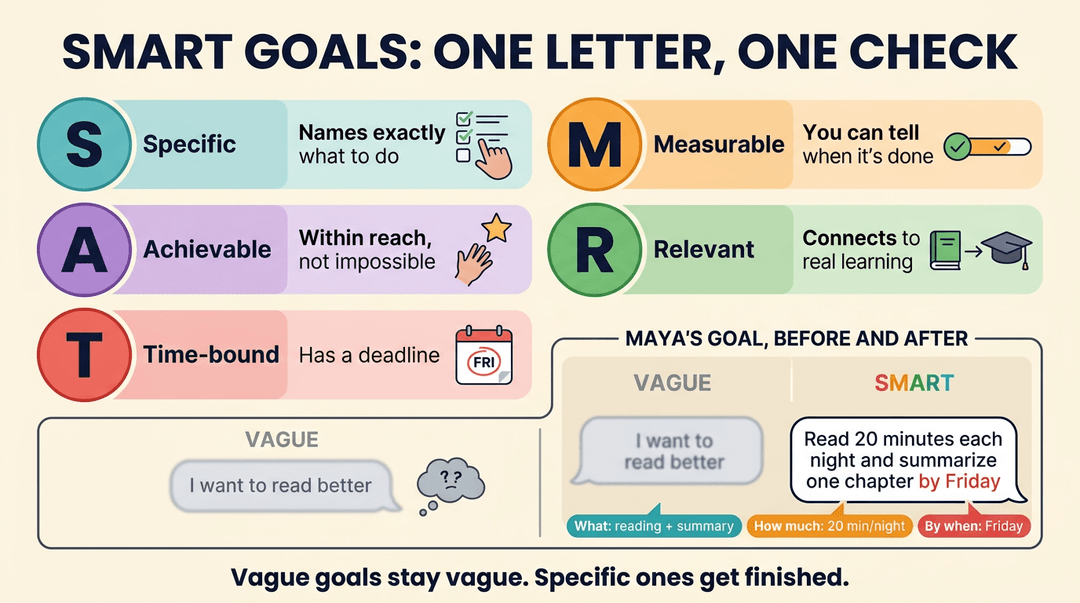
SMART is an acronym, and each letter checks one part of a goal:
- Specific names exactly what the student will do.
- Measurable means you can tell when it's done.
- Achievable (or Attainable) asks whether the goal is within reach.
- Relevant (or Realistic) ties it to the learning that matters.
- Time-bound sets a deadline.
Take fifth grader Maya, who wants to read better. Rewritten as "Read 20 minutes each night and summarize one chapter by Friday," her goal is SMART. She knows what to do, how to track it, and when it's due.
Vague goals stay vague. Specific ones get finished.
Where the SMART goals idea came from
The roots are in business. A 2012 paper in the International Journal of Strategic Change Management notes that Peter Drucker first outlined management by objectives (MBO) in 1954.
A 2021 study in the Journal of Occupational and Organizational Psychology credits George Doran with a 1981 paper that described the SMART approach.
Over time, the framework spread across fields, and educators adapted it to help students set goals they can actually reach.
Why the SMART framework works
The framework reduces overwhelm, because a big goal broken into one specific step gives students a clear next move. It creates clarity and focus: students stop wondering whether they're doing enough and start knowing what to do next.
It turns vague goals into actionable ones, which supports productivity, since time goes to the work that counts.
Why Goal Setting Matters for Students
Goals give students a destination, and that changes how they approach the school day. Here's what goal setting does for learners and who gains the most from it.
The benefits of setting goals
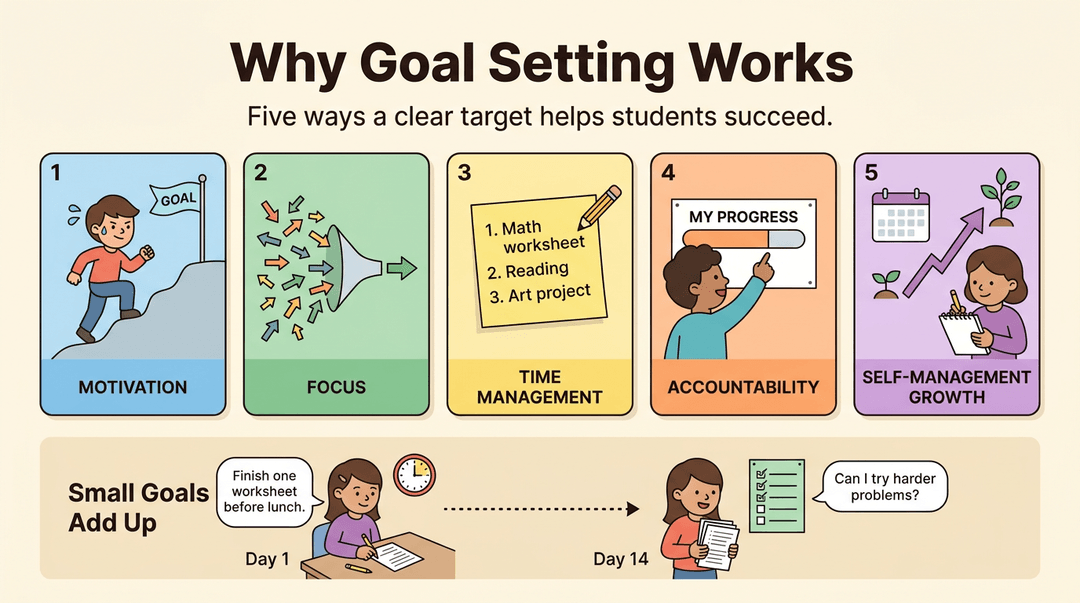
Goal setting pays off in five key ways:
- Motivation: A clear target gives students a reason to keep going when the work gets tough.
- Focus: Students know what to pay attention to, so less energy gets scattered.
- Time management: Goals help students decide what to tackle first.
- Accountability: When progress is visible, students own their results.
- Self-management growth: Students learn to plan, track, and adjust on their own.
Consider a sixth grader who sets a goal of finishing one math worksheet before lunch. Within two weeks, she's tracking her own progress and asking for harder problems. Small goals add up.
Connecting goals to your future
Goals also keep school from becoming a string of days you simply get through. When a student sees how a goal links to a career dream, purpose rather than compliance starts driving the effort. Try connecting goals to what comes next:
- Avoid drifting through school without a direction.
- Connect everyday assignments to career dreams.
- Align classroom goals with bigger objectives, like graduation or a college plan.
- Build a professional development habit that carries into adulthood.
Which students this helps most
Almost every learner benefits, but the impact looks different at each stage. College students use goals to manage heavy workloads. Medical and nursing students use them to track skills step by step.
K-12 teachers and students can make progress visible in every grade. Middle schoolers, who are building independence, often respond well to short, specific targets. Homeschool families can write goal examples that fit their own pace and subjects.
How to Write a SMART Goal
A SMART goal is easier to write than it sounds. Start with the need, then let the wording take shape.
Steps to writing a SMART goal
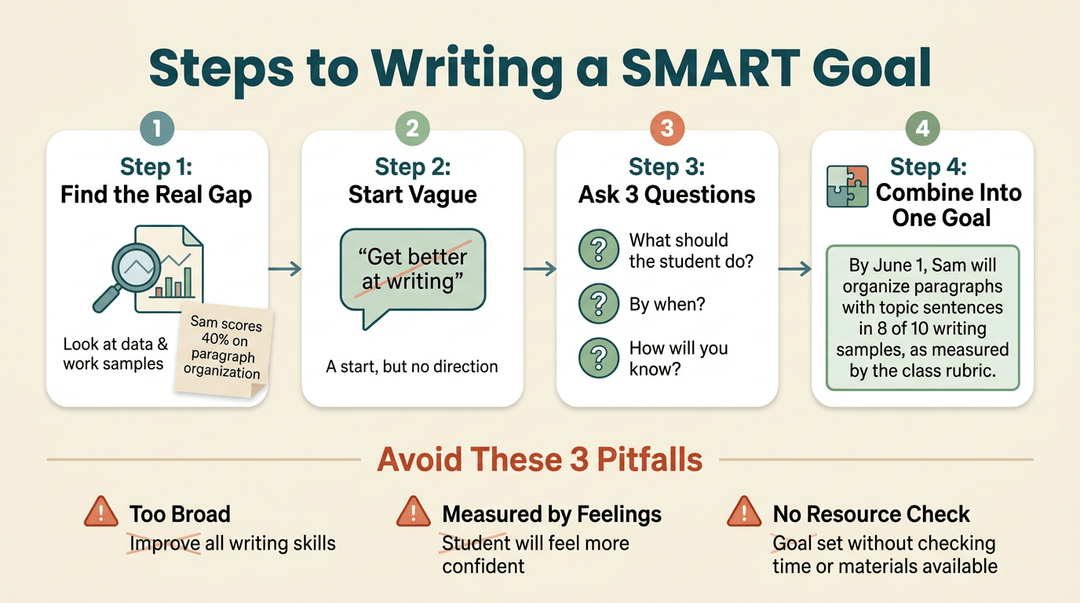
Most strong goals start vague, then get refined. “Get better at writing” is a fine start, but it gives no Monday-morning direction. Ask guidance questions (What should the student do? By when?
How will you know?) and combine the answers into one statement. Identify the need first, using data or work samples, so the goal targets a real gap.
Watch for pitfalls: goals that are too broad, goals measured by feelings instead of evidence, or goals set without checking resources.
Templates to fill in your own
Use this time-audience-verb format to keep goals consistent:
By [time], [audience] will [verb] [target], as measured by [evidence].
For example: By Friday, Marcus will solve two-step equations correctly on three exit tickets. Print a blank version as a classroom goal worksheet students can complete themselves.
Turning a vague goal into SMART
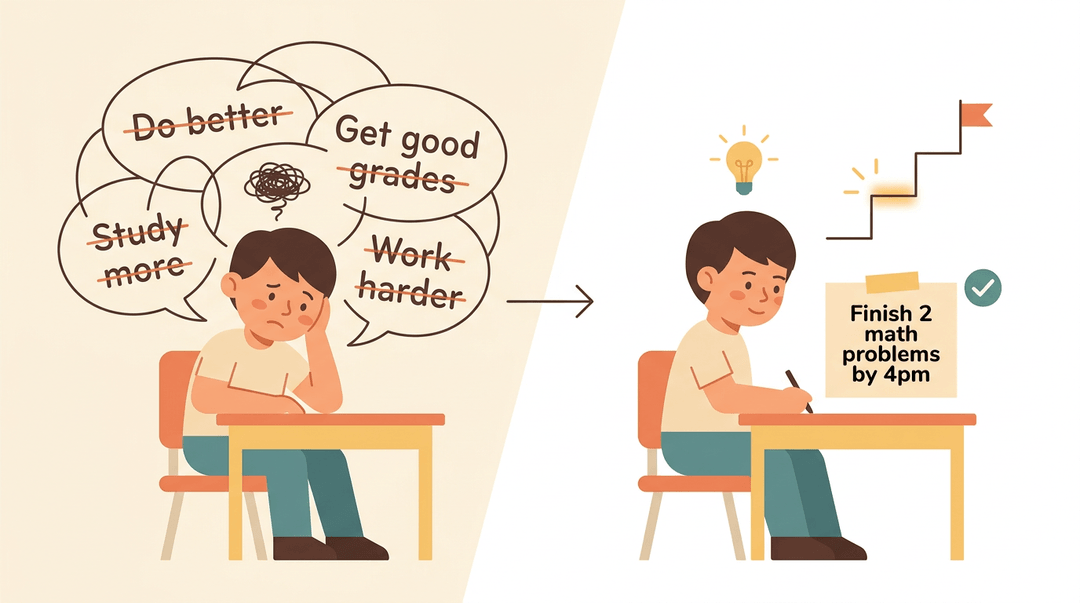
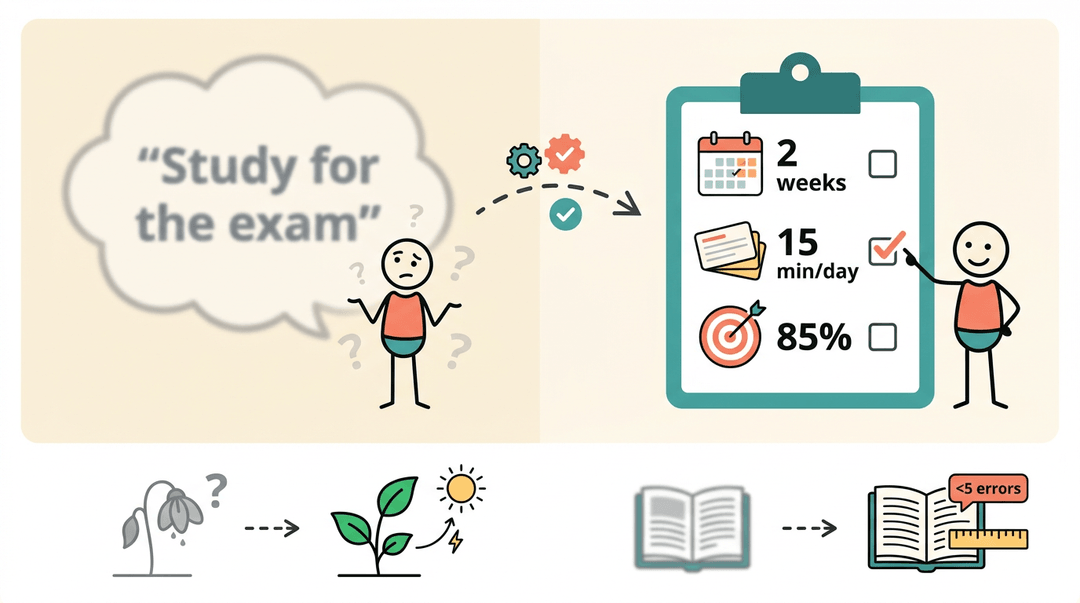
“Study for the exam” has intent but no finish line. Rewritten: “Over two weeks, Jordan will review vocabulary cards 15 minutes each school day and score at least 85 percent on the unit quiz.” Broader goals follow the same move.
“Improve reading outcomes” becomes “By quarter’s end, Ms. Patel’s reading group will read a grade-level passage aloud with fewer than five errors per page.”
For concepts, “Explain photosynthesis” becomes “Priya will explain how plants turn light into chemical energy, not just name the process.”
Each letter explained with an example
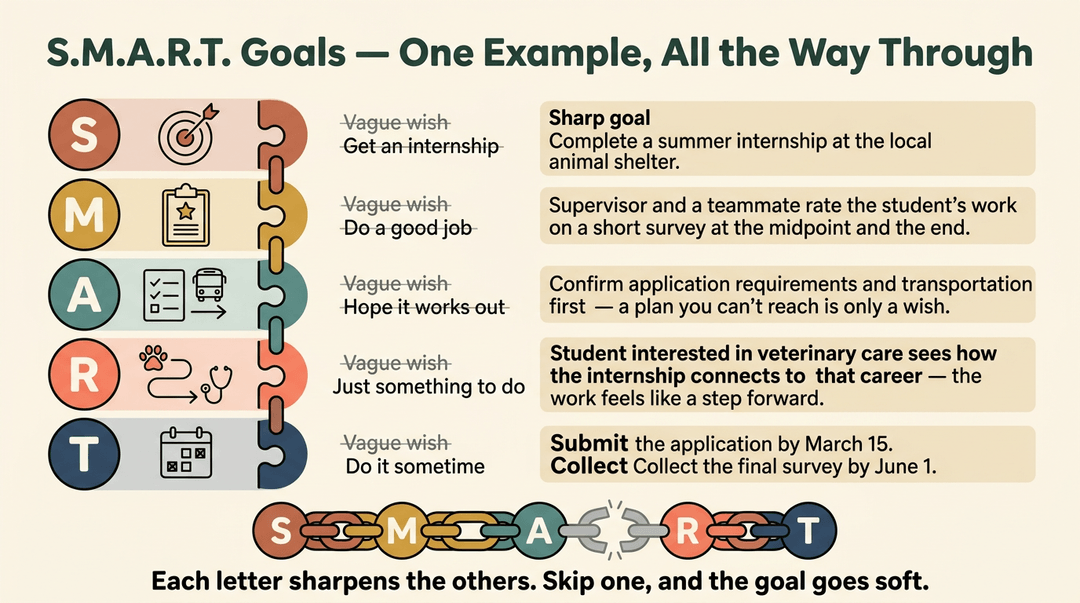
- Specific. Name the action, not just the wish. “Get an internship” becomes “complete a summer internship at the local animal shelter.”
- Measurable. Have the supervisor and a teammate rate the student’s work on a short survey at the midpoint and the end.
- Achievable. Confirm application requirements and transportation first, because a plan you can’t reach is only a wish.
- Relevant. A student interested in veterinary care sees how the internship connects to that career, so the work feels like a step forward.
- Time-bound. Submit the application by March 15, and collect the final survey by June 1.
Each letter sharpens the others. Skip one, and the goal goes soft.
Teaching SMART Goals in the Classroom
SMART goals (Specific, Measurable, Achievable, Relevant, Time-bound) stick when students practice them as a routine, not a one-time worksheet. Find your grade band below, borrow the moves, then run the launch checklist.
Elementary: keep it concrete
Young students need the idea in their own words and something they can see. Swap the acronym for three questions: "What exactly will I do? How will I count it? Can I finish by Friday?"
Fill-in template. Post it on the board and let students copy it onto a card:
By Friday, I will read 3 books so I can read faster. I'll know I did it when my chart has 3 stars.
Visual tracker. Give each child a star chart or paper thermometer.
- Students color one box each time they work on the goal.
- The full chart is the success criterion, so no one has to guess.
Middle school: add partners and rhythm
Middle schoolers work harder for peers than for you. Build the structure around that.
| Move | What it looks like |
|---|---|
| Accountability partners | Pairs swap goal cards and ask, "How's it going?" |
| Academic + behavior goals | One of each: "80% on Friday's quiz," "Homework in 4 of 5 days" |
| Weekly check-ins | Five minutes on Friday: rate progress 1 to 3, adjust one step |
Example: A seventh-grade teacher pairs students on Monday. Each writes one academic and one behavior goal. On Fridays partners rate progress and name one change for next week. Students start fixing their own plans before you step in.
High school: connect to what comes next
Older students commit when a goal points past the semester. Ask, "What does your target program or job expect from you?" Then have them map backward.
Long-term goal map. Written as a chain, from the far goal down to this week:
Apply to a nursing program ← earn a B+ or better in chemistry this semester ← complete two practice sets every week
Self-directed tracking. Students own the data.
- They log progress in a spreadsheet or journal.
- You review it at set points, not daily.
⚠️ Watch out: Start with one goal per student. Three goals at once usually means none get tracked.
Before you launch, confirm
Run this at any grade band.
- You modeled one goal together. Write a class goal on the board and think aloud through each letter.
- Success criteria are co-created. Ask, "What would it look like if we nailed this?" and record their answers.
- Review dates are on the calendar. Put them in before the goals go home, so check-ins don't slide.
- Milestones get celebrated. Mark the halfway point and the finish with a shout-out, a sticker, or a note home.
Set, track, and revisit student goals right alongside your lesson plans in EMStudio.
SMART Goals Examples for Students by Context
Goals work best when they fit the learner. Here's how SMART goals (Specific, Measurable, Achievable, Relevant, Time-bound) look across school, work, and life.
What are some examples of intellectual goals?
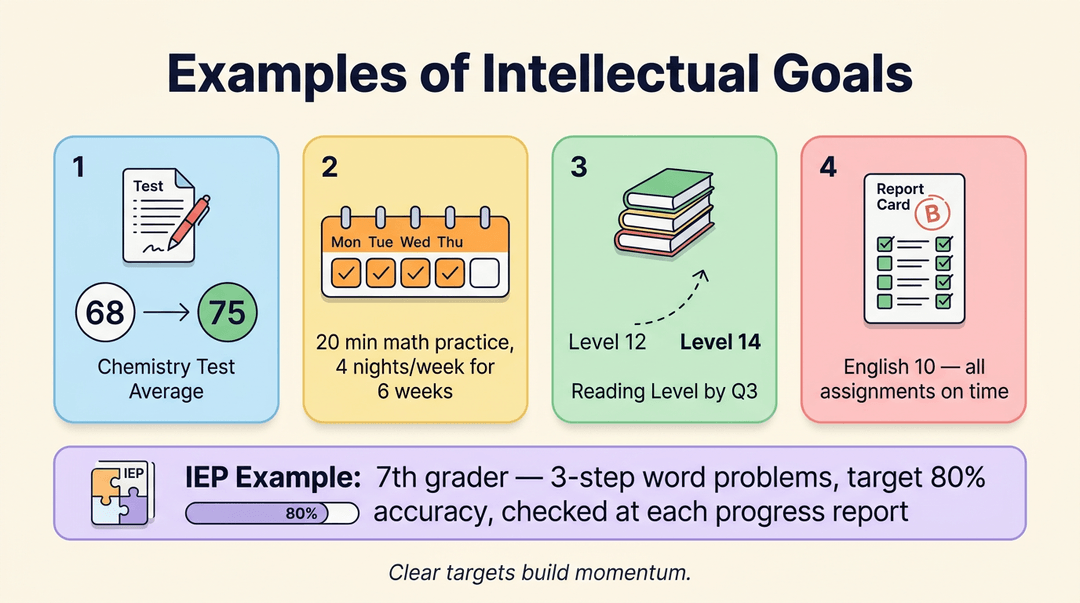
Intellectual goals focus on what a student knows and can do academically:
- Exam score targets: Raise the chemistry unit test average from 68 to 75 by semester's end.
- Study schedule goals: Complete 20 minutes of math practice four nights a week for six weeks.
- Reading level improvement: Move up two reading levels by the end of the third quarter.
- GPA and grade goals: Earn a B or higher in English 10 by turning in every assignment on time.
For students with an Individualized Education Program (IEP), goals follow the same structure.
A seventh grader who struggles with multi-step word problems might aim for 80 percent accuracy on three-step problems, reviewed at each progress report. Clear targets build momentum.
More SMART goal examples for students
Middle schoolers need goals that feel reachable:
- Organization habits: Update the planner daily and check it with a teacher each Friday.
- Attendance goals: Arrive on time to first period on 90 percent of school days this quarter.
- Skill mastery goals: Pass all five multiplication quizzes with 90 percent accuracy by October.
- Extracurricular involvement: Join one club and attend at least three meetings before winter break.
Grade-level anchor charts help students see what specific looks like at their level.
Career and professional goal examples
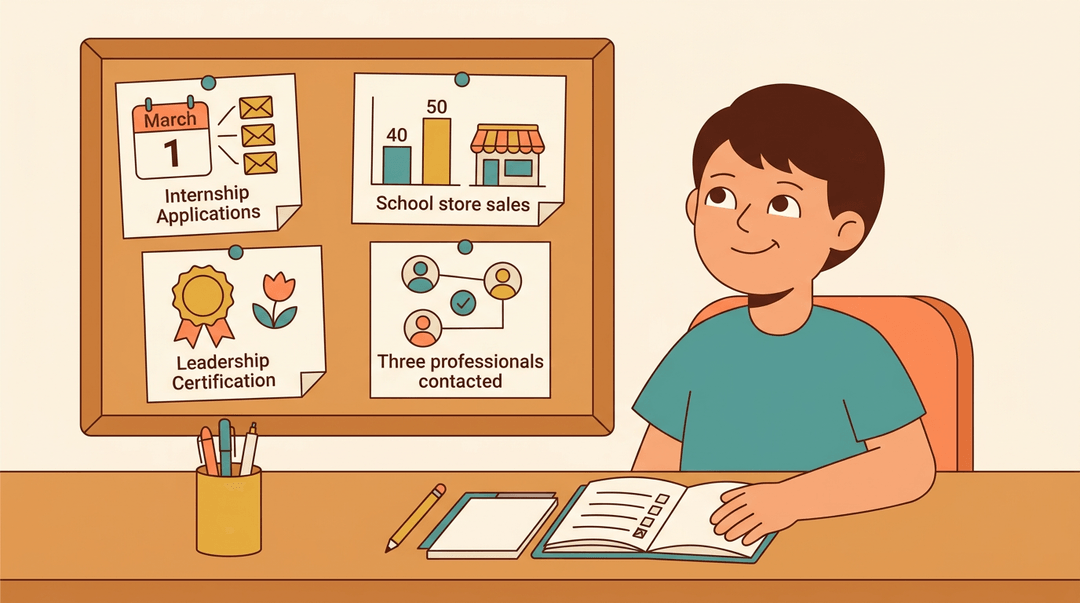
A high school junior might submit three summer internship applications by March 1. A student working in a school store could raise weekly sales from 40 to 50 items within 60 days. Other targets include:
- earning a leadership certification by spring
- contacting three professionals in a field of interest before month's end
Personal, health, and relationship goals
- Marathon training: Run three times a week for eight weeks, building toward a 5K.
- Writing a book: Draft 500 words every weekday for twelve weeks.
- Relationship building: Have one meaningful conversation each week with a classmate you don't usually sit with.
- Sleep and wellness: Be in bed by 9:30 on school nights for two weeks.
Rest counts as a goal too.
SMART goal examples for educators
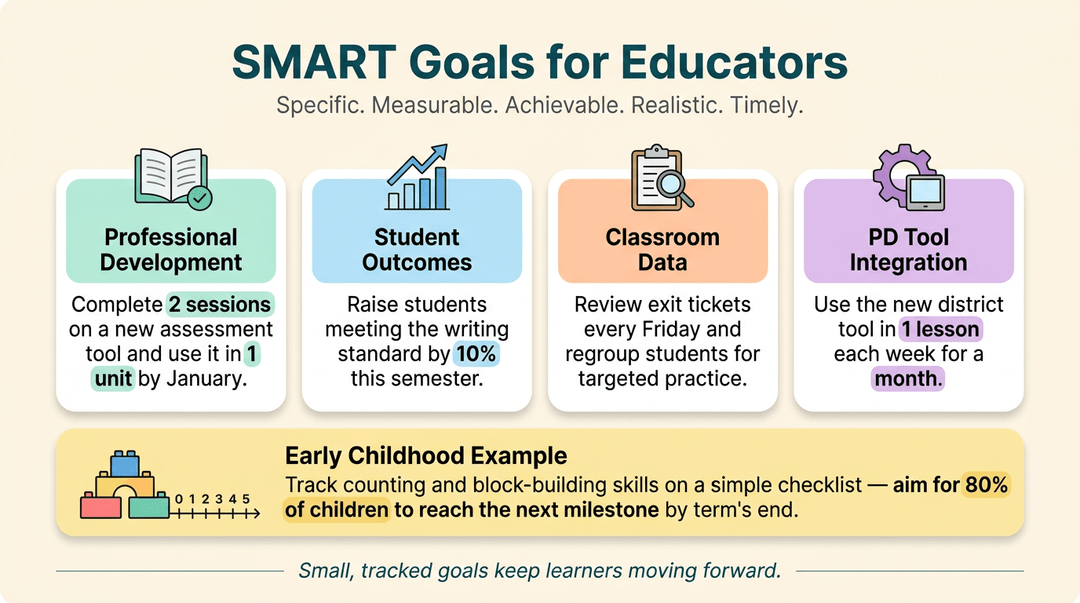
Teachers benefit from SMART goals too:
- Professional development goals: Finish two sessions on a new assessment tool and use it in one unit by January.
- Student outcome goals: Raise the share of students meeting the writing standard by 10 percent this semester.
- Classroom data-based goals: Review exit ticket results every Friday and regroup students for targeted practice.
- PD tool integration: Use the new district tool in one lesson each week for a month.
Early childhood educators can follow the same pattern. Consider a preschool teacher who tracks counting and block-building skills on a simple checklist, aiming for 80 percent of children to reach the next milestone by term's end.
Small, tracked goals keep young learners moving forward.
Tracking, Reviewing, and Adjusting Your Goals
A goal you set and forget won't get far. Regular check-ins are where a SMART goal turns into real progress.
Checking in on your progress
Set a rhythm. A weekly review asks what moved forward and what's next. A monthly review zooms out for the bigger picture.
Break larger goals into sub-goals so progress is visible. A seventh grader aiming to read 25 books by June can check off about three a month instead of staring at the full total in February.
Each quarter, do a quarterly re-evaluation: is this still the right goal?
When and how to adjust a goal
A goal that's too hard is useful information, not failure. Scale back to a target you can reach, then build up again. If your schedule changed, update the timeframe.
If the measure isn't telling you much, change it: counting minutes read might show effort that pages miss.
When a goal is met, set the natural progression to the next step. The question isn't just whether you adjust, but how.

Sharing your goals for accountability
Share your goals with a mentor, a trusted peer, or family, and ask for feedback. Brief team check-ins keep everyone accountable, and celebrating each milestone builds momentum.
Try a goal bulletin board in class. When Maria, a fourth grader, moves her sticky note from "in progress" to "done," the whole class sees the win and cheers it on.
Apps and tools for tracking goals
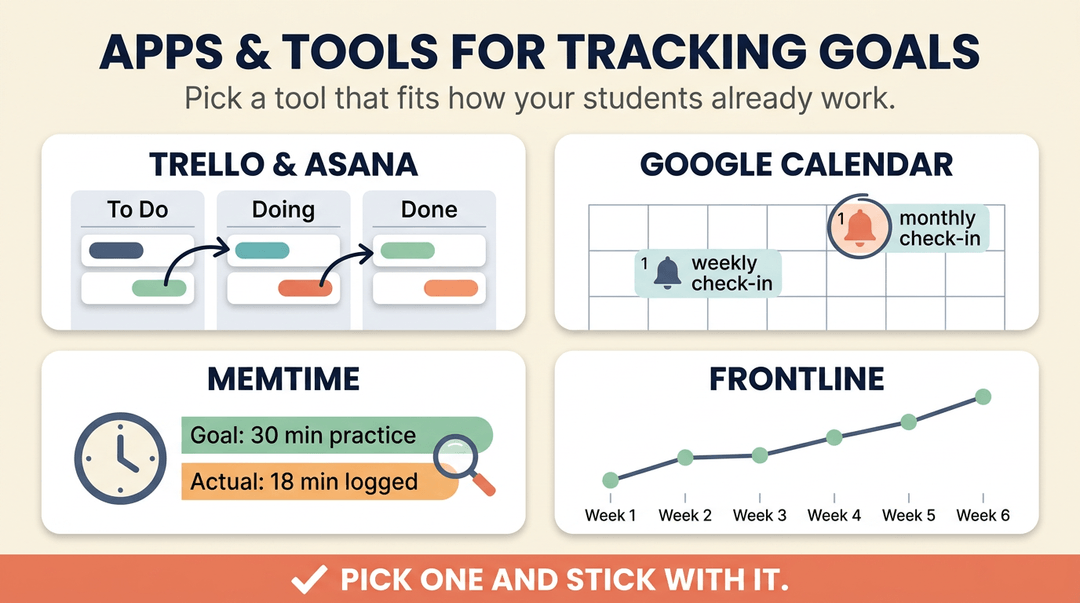
Pick a tool that fits how your students already work.
- Trello and Asana: board-style tools for moving tasks from to-do to done.
- Google Calendar: reminders for weekly and monthly check-ins.
- Memtime: tracks how time gets spent, so students can see if practice time matches the goal.
- Frontline: a tracking platform for logging progress over time.
Pick one and stick with it.
Writing SMART Learning Objectives for Lessons
Every lesson needs a clear target before students can aim for it. Here's how to write objectives you can teach to and measure against.
Matching objectives to Bloom's Taxonomy
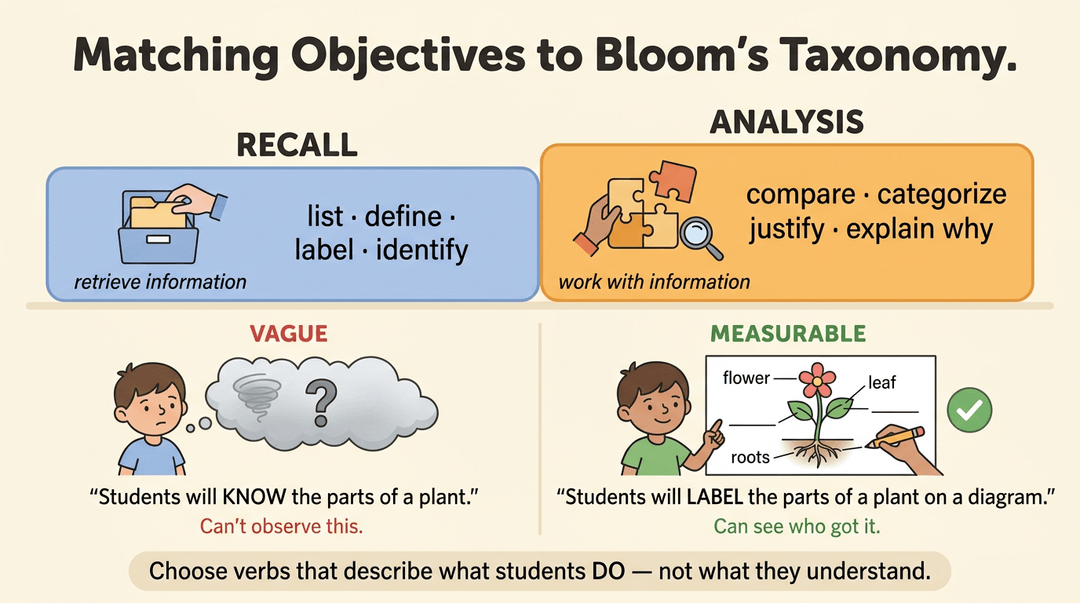
Bloom's Taxonomy sorts thinking into levels, from recalling facts up to creating something new. The verb in your objective signals which level you're targeting.
- Recall verbs (list, define, label, identify) ask students to retrieve information.
- Analysis verbs (compare, categorize, justify, explain why) ask students to work with information.
Consider a fourth-grade teacher whose objective says "students will know the parts of a plant." Knowing is hard to see. Swap in "label the parts of a plant on a diagram," and suddenly you can tell who got it.
Match the verb to the mastery level you want. Introducing a concept? Recall verbs work fine. Expecting students to apply it on a test? Choose analysis verbs so the objective matches the task.
Choose verbs that describe what students do, not what they understand.
Building a clear objective statement
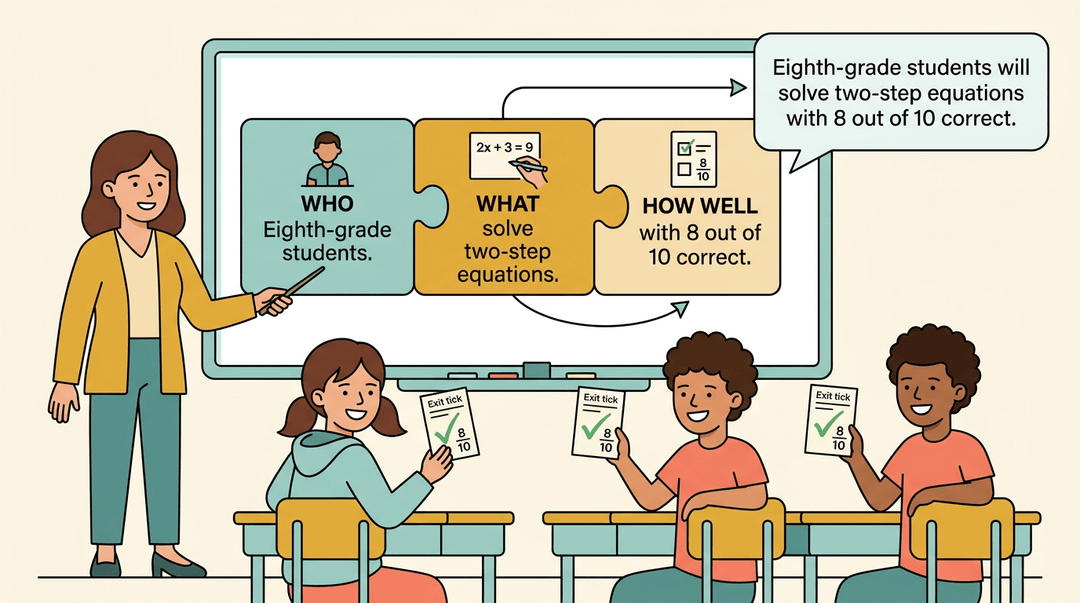
Use the audience-performance-measure template. Audience is who learns, performance is the observable action, and measure is how you'll know it happened.
- Audience: Eighth-grade students
- Performance: solve two-step equations
- Measure: with 8 out of 10 problems correct on an exit ticket
Put together: "Eighth-grade students will solve two-step equations with 8 out of 10 problems correct on an exit ticket."
Here's a quick rewrite. Before: "Understand fractions." After: "Fourth graders will compare two fractions with unlike denominators, correctly identifying the larger one in 4 of 5 problems."
The second version takes no more time to write, and it shows you exactly what success looks like.
Course-level objectives are broad and span weeks. Lesson-level objectives are narrow and feed into them. Ask yourself, "Which single lesson moves students closer to this course goal?" Big goals, small steps.
When students know exactly what they're aiming for, they can build the habits to get there. SMART goals turn vague wishes like "do better in math" into steps they can actually take, check, and celebrate.
Ready to build goal setting into your lessons all year long? Check out our Curriculum Planning feature page to plan units, lessons, and standards in one place.
References
- Article: The management by objectives in modern organisations and enterprises Journal: International Journal of Strategic Change Management (IJSCM) 2012 Vol.4 No.1 pp.68 - 79 Abstract: The paper discusses the managerial philosophy and system known as Management by Objectives or MBO. MBO is a systematic and organised approach that allows management to focus on achievable goals and to attain the best possible results from available resources. It aims to increase organisational performance by aligning goals and subordinate objectives throughout the organisation. MBO includes ongoing tracking and feedback in the process to reach objectives. MBO was first outlined by Peter Drucker in 1954. In the 1990s, Peter Drucker himself decreased the significance of this organisation management method, when he said: "It's just another tool. It is not the great cure for management inefficiency... Management by Objectives works if you know the objectives, 90% of the time you don't." Finally the complete MBO system is to get managers and empowered employees acting to implement and achieve their plans, which automatically achieve those of the organisation. Inderscience Publishers — inderscience.com
- Nudging flow through ‘SMART’ goal setting to decrease stress, increase engagement, and increase performance at work - Weintraub - 2021 - Journal of Occupational and Organizational Psychology — bpspsychub.onlinelibrary.wiley.com (2021)
Frequently asked questions
How to do SMART goals examples?
To create a SMART goal, state exactly what you will do, how you will measure success, why it is realistic and relevant, and when it must be completed. For example: “Over two weeks, I will review vocabulary cards for 15 minutes each school day and score at least 85% on the unit quiz.”
What are some examples of intellectual goals?
Examples of intellectual goals include raising a chemistry test average from 68% to 75% by semester’s end, completing 20 minutes of math practice four nights a week for six weeks, moving up two reading levels by the end of the third quarter, or earning a B or higher in English by submitting every assignment on time.
Can you provide some examples of professional goals for teachers?
Professional goals for teachers can include completing two professional-development sessions on a new assessment tool and using it in one unit by January, increasing the percentage of students meeting a writing standard by 10% this semester, reviewing exit-ticket data every Friday to plan targeted practice, or using a new district tool in one lesson each week for a month.