What Is Latent Learning? A Psychology Definition Explained

Jump to section
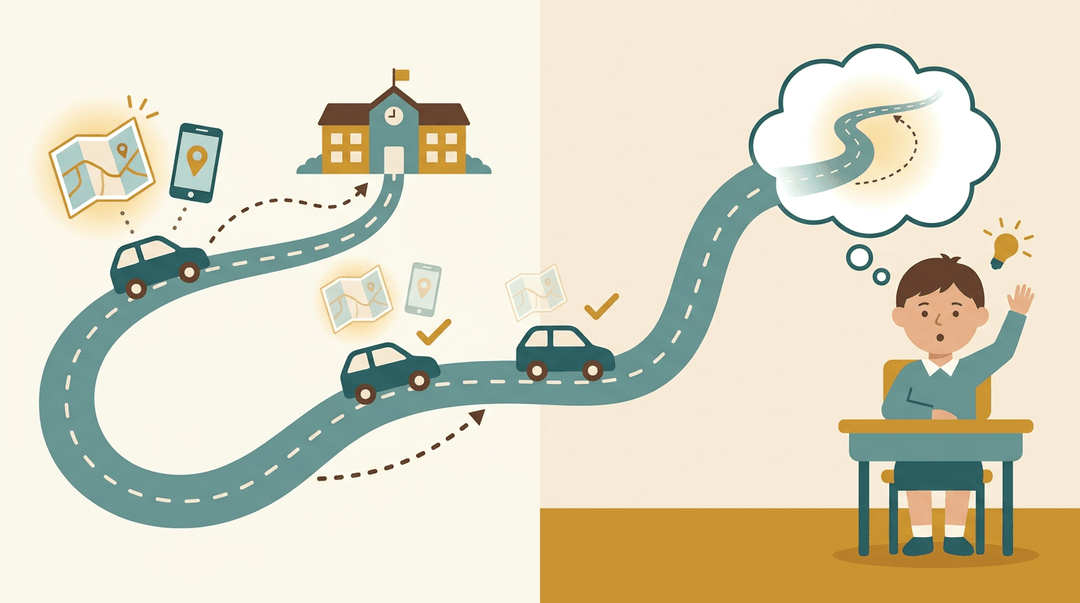
Think about the drive to a new school. The first few times, you probably checked a map or followed a navigation app. After a while, you could make the trip without thinking, and you knew the shortcuts too. You learned the route long before you needed it.
That's the heart of latent learning: knowledge that is absorbed quietly and only shows up when there's a reason to use it. For teachers, that means students may know more than their quick answers suggest.
In this post, we'll cover the definition and origins of latent learning, how it compares to other learning theories, and practical ways to spot and design for delayed learning in your classroom.
The Psychology Definition of Latent Learning
Latent learning is easiest to understand once you see it in action. Here's what it means, and why it matters for your classroom.
Learning that stays hidden until needed
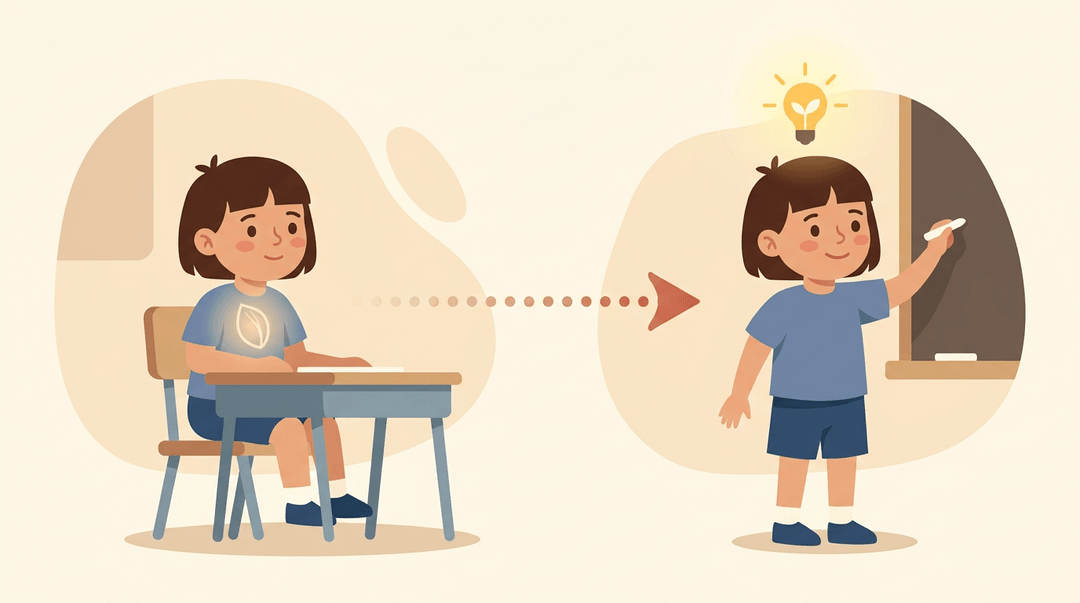
Latent learning is a behavior change that shows up later, not right away. De Houwer's functional definition describes it this way: the learning isn't immediately demonstrated, so it stays hidden until it's needed.
Students can absorb far more than they show in the moment. Nothing is missing. It's simply waiting.
Measuring it comes down to checking for that later change in behavior, not for what students show during the lesson itself.
How latent learning fits among learning theories
Latent learning is a type of observational learning, grouped under cognitive learning. It's often contrasted with reinforcement-based learning, where a reward or punishment drives the behavior. Latent learning has no clear reward or punishment behind it.
The learning happens quietly and surfaces when a reason appears.
Why motivation reveals hidden learning
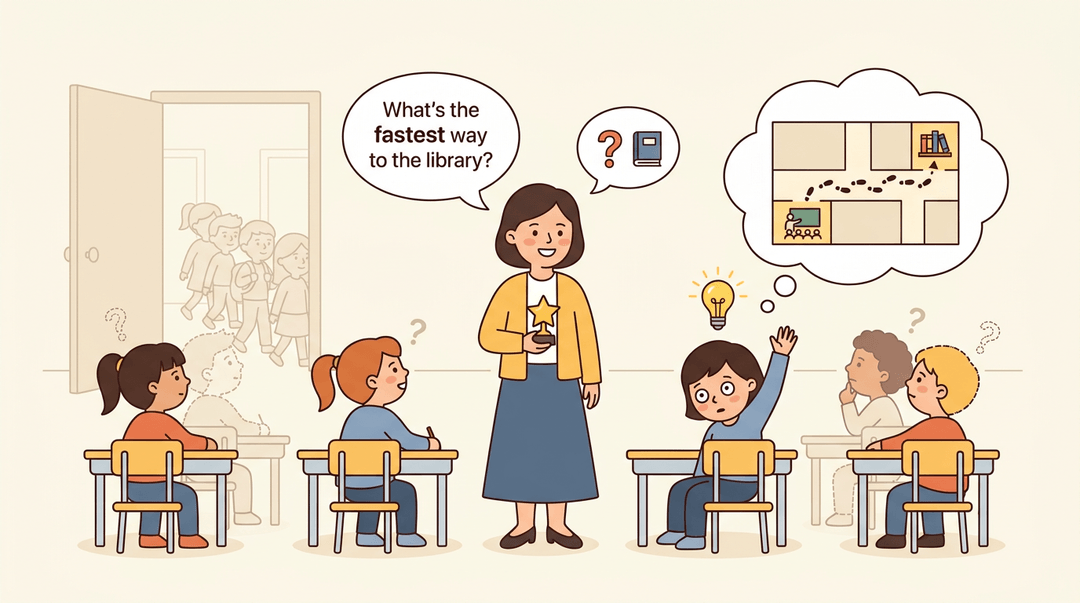
Motivation is often what brings latent learning into view. Consider a fourth-grade teacher whose class spent weeks walking the school's hallways during transitions. Nobody was asked to memorize the route.
Then the teacher offers a small prize to the first student who can name the fastest way to the library, and several quiet students suddenly give the right answer. The learning was there all along. The reward simply revealed it.
Look for these signs of latent learning in your students:
- A student who stays quiet during a lesson but answers correctly once a reason to participate appears.
- Knowledge that resurfaces weeks later during an unrelated activity.
The Researchers Who Discovered Latent Learning
Latent learning didn't arrive fully formed. It grew out of a few researchers who noticed that animals were learning things they never showed. Here's how that story unfolded.
Blodgett's maze experiments that started it all
In 1929, H.C. Blodgett reported the results of a seminal maze learning experiment using rats. In his setup, hungry rats explored a maze that held a goal box but no food, so they got no reward on those trials.
Blodgett coined the term latent learning for learning that stays hidden until a reason to show it appears.
Tolman's cognitive maps and reward experiments
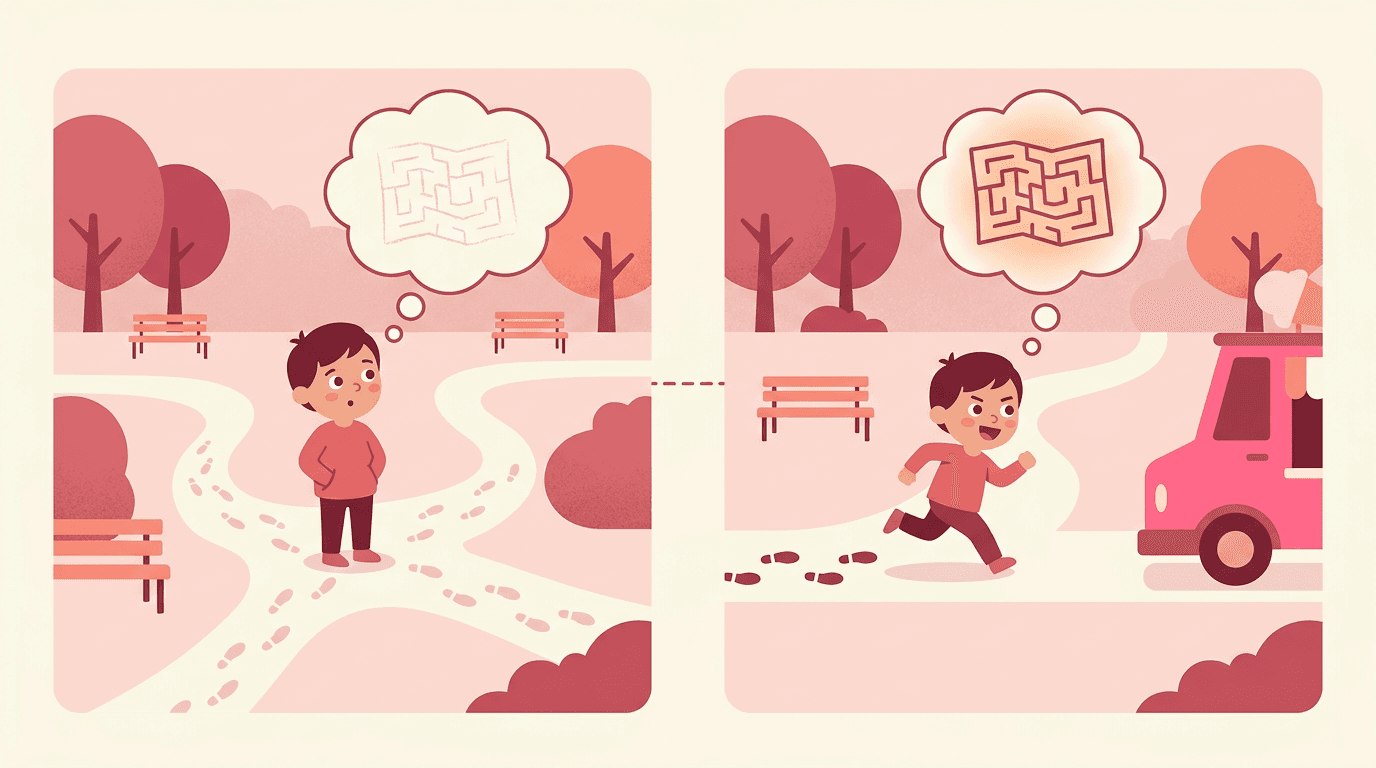
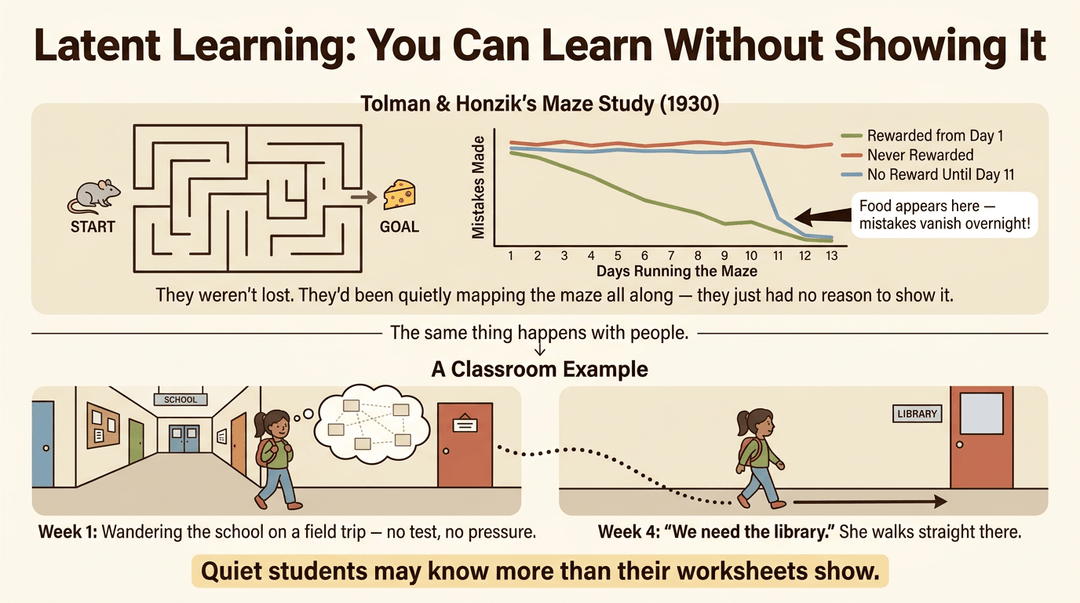
Edward Tolman built on this work. Tolman and Honzik published a 1930 study on latent learning in rats, in which three groups ran a difficult maze under different conditions.
One comparison group was rewarded with food at the end of the maze, while the other ran with no reward. Once food was introduced, the unrewarded rats improved suddenly, as if they had already mapped the maze.
In his 1948 paper on cognitive maps in rats and men, Tolman noted that Honzik repeated the experiments with larger groups and got similar results, and that he got some of the credit.
Think of a student who quietly learns the layout of the school during a field trip without being asked. Weeks later, when the class needs the library, she walks there with no trouble.
That's latent learning in action, and it's why a quiet student may know more than her worksheets show.
How latent learning challenged behaviorism
Behaviorists such as Watson and Skinner held that learning shows up as a change in behavior driven by reinforcement. Latent learning pushed back.
The rats had learned the maze before any reward appeared, which pointed to a cognitive side of learning, where the mind builds an internal map. Reinforcement wasn't required for that learning to happen.
Reward revealed the learning. It didn't create it.
How Your Brain Builds Cognitive Maps
Ever walked into an unfamiliar building and somehow known which hallway led to the cafeteria? That sense of direction comes from your brain, and it's the foundation of cognitive maps, a core idea in latent learning.
What a cognitive map actually is
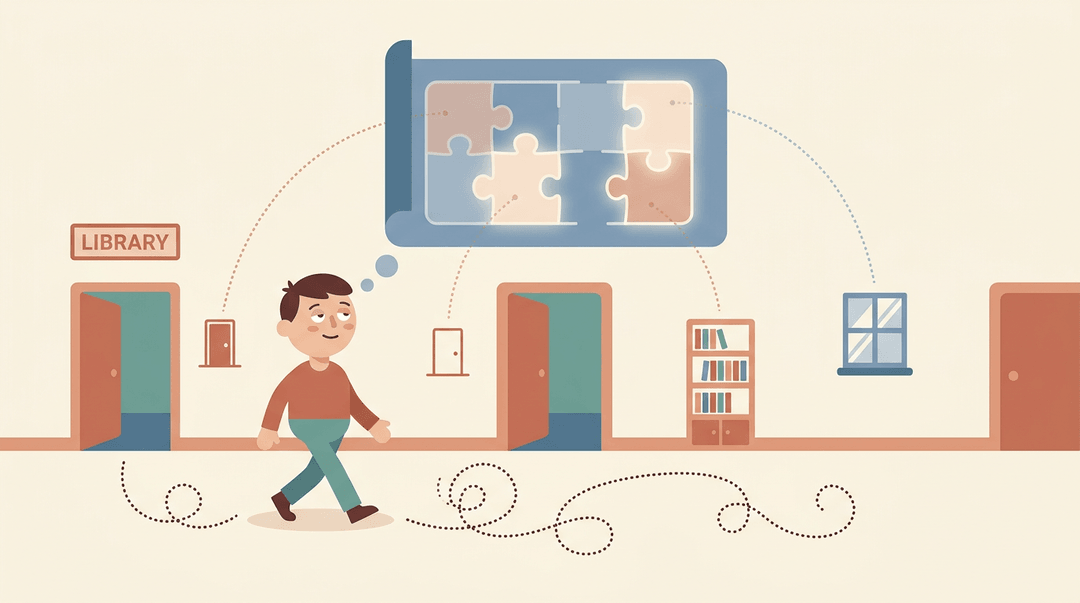
A cognitive map is a mental picture of an environment: the layout of rooms, streets, or hallways stored in your head. You don't build one by memorizing directions.
You build it through exploration, with each wander adding a piece to the picture even when you aren't trying to learn anything.
Remember that a cognitive map is an internal representation rather than a behavior. You can know where the library is without ever walking there on purpose. That knowledge sits quietly until you need it.
Using mental maps to navigate spaces
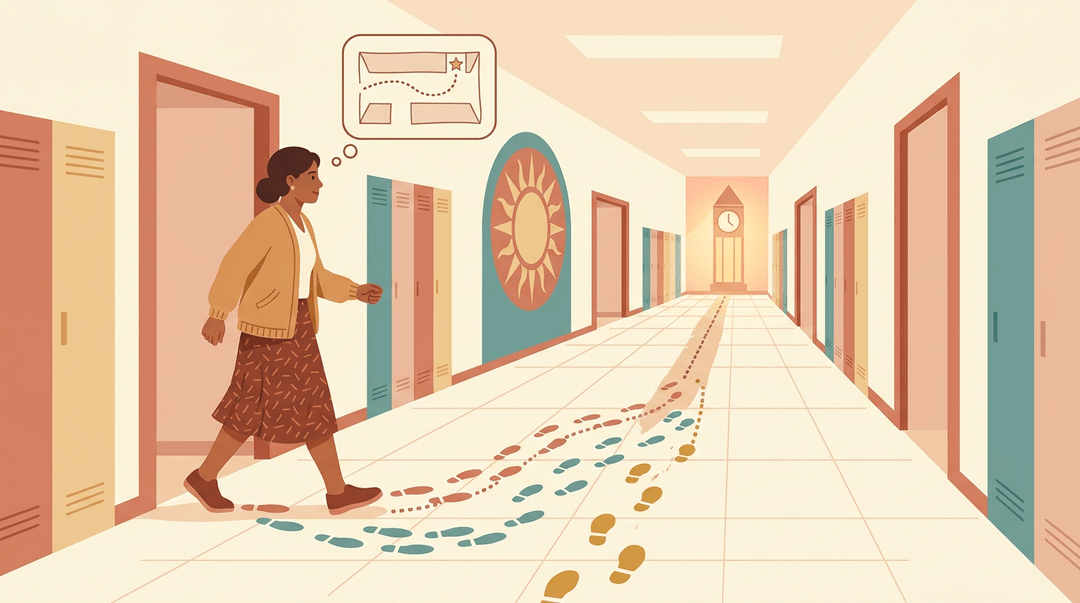
Picture a new teacher on her first day at a large school. She wanders the halls between periods, and by Friday she cuts through the science wing to reach the gym without a second thought. Nobody gave her a tour. Her map simply formed through movement.
Museums work the same way. Visitors who stroll without a plan often remember more of the layout than they expected, and that map helps them plan the return trip.
Research by Carlson, published in a study on selecting landmarks in novel environments, found that people use salient landmarks when learning a route through an unfamiliar space. A distinctive mural or clock tower gives the map something to hang on.
Video game levels offer a useful comparison. Early on, you wander, bump into a tower or painted archway, and soon you're finding the exit without checking the minimap.
Your brain builds that kind of map in a school building too, one exploration at a time. Exploration does the heavy lifting.
Bringing Latent Learning into Your Classroom
Latent learning is knowledge students hold quietly until something gives them a reason to show it. Use this guide to notice it when it surfaces and to build lessons that give it room to appear.
Spot it: three look-fors
Confirm these before you decide a student "just picked it up."
- No visible practice. You never saw drills, questions, or drafts on this skill.
- A skill appears later. It shows up days or weeks after the lesson, often without warning.
- A new motivation triggers it. A game, a real task, or a reward gives the student a reason to perform.
When it happens, try asking: "Where did you pick that up?" The answer often points back to a lesson you'd written off.
Design for it: three moves
You can't force hidden learning out, but you can schedule chances for it to surface.
- Add a delayed recall quiz.
- Try three short questions a week after the unit ends.
- Keep stakes low so you're measuring, not punishing.
- Space out skill checks.
- Revisit the skill briefly across several weeks, not just at unit end.
- Use a warm-up problem, a quick task, or a one-line prompt.
- Reward sudden mastery moments.
- Say: "Nobody drilled that with you. Show us how you did it."
- Praise the result and let the student explain how they got there.
⚠️ Watch out: A weak score right after teaching doesn't prove nothing was learned. Check again later before you reteach everything.
See it by grade level
| Grade band | What it can look like | What triggers it |
|---|---|---|
| Elementary: reading pickup | A child who never practiced aloud reads a new book unprompted | A classmate's challenge or a fun book |
| Middle: lab safety habits | Goggles on and hair tied back with no reminder | Their own hands-on turn in a new lab |
| High school: civic behavior | Using class-meeting procedures in a real school vote | A real decision that matters to them |
Example: A seventh-grade teacher demonstrates lab safety during one station rotation, and students only watch. Two weeks later, in a new experiment, several students gear up correctly before she says a word. The knowledge was there all along. Doing the lab themselves gave them a reason to use it.
Map these delayed mastery checkpoints into your unit sequence with EMStudio's curriculum planner.
How Latent Learning Compares to Other Theories
Latent learning sits beside several related ideas, so the differences matter when you plan a lesson.
What is the difference between latent learning and observational learning?
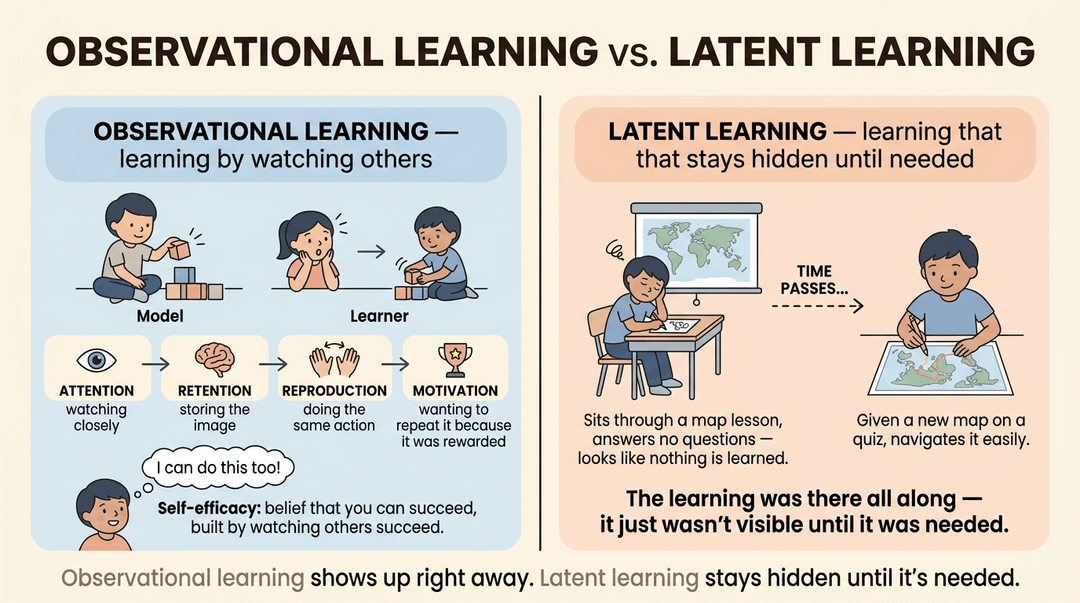
Observational learning is picking up behavior by watching others. In Albert Bandura's Bobo doll experiment, children could learn behavior simply by observing a model. Bandura's vicarious conditioning unfolds in four steps:
- attention
- retention
- reproduction
- motivation
Watching a peer succeed also builds self-efficacy, a student's belief that they can do the task.
When the learning shows up is what sets latent learning apart. Picture a student who sits through a map-reading lesson without answering a single question. On a quiz with an unfamiliar map, they navigate it easily. The learning was there all along.
What is insight learning in psychology?
Insight learning is the sudden 'aha' moment when a solution clicks. Köhler's insight-learning research involved chimpanzees stacking boxes to solve a problem, and Chim's success was strikingly sudden.
Latent learning, by contrast, builds gradually and stays hidden until it's needed.
How latent learning differs from conditioning
Conditioning depends on clear reward or punishment. Latent learning lacks that clear reinforcement, since students learn without being rewarded in the moment.
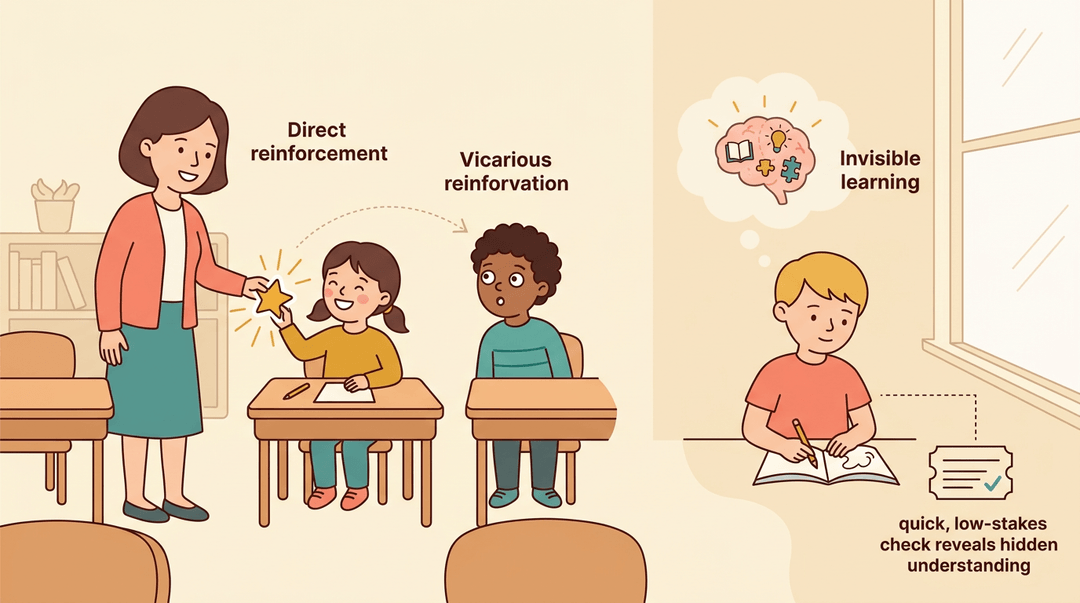
Direct reinforcement hits the learner, while vicarious reinforcement comes from watching others get rewarded or corrected. Latent learning needs neither to be visible. So don't assume silence means nothing stuck.
Use quick, low-stakes checks to see what students picked up along the way.
The Brain Science Behind Latent Learning
Latent learning is easy to miss from the front of the room. Here's what's happening underneath.
How your brain rewires itself to learn
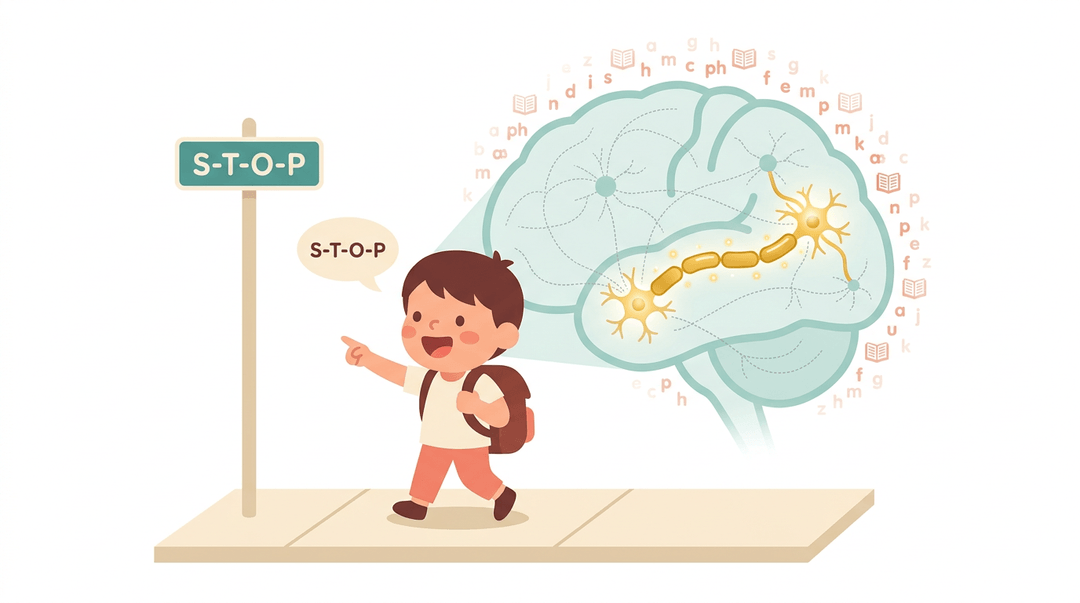
Every time a student uses an idea, the connections carrying it get stronger. This is long-term potentiation, and it's why repetition matters.
Synaptic pruning does the opposite, trimming connections that go unused so the brain keeps the pathways it relies on. Myelination wraps those pathways in a fatty coating that speeds signals between neurons.
Add sensitive periods, windows when skills develop most readily, and timing starts to matter as much as content.
Think of a second grader who sits through a week of phonics looking lost, then suddenly starts reading street signs on the walk to school. The learning was building the whole time. Nothing on the surface showed it.
How memory systems store hidden learning
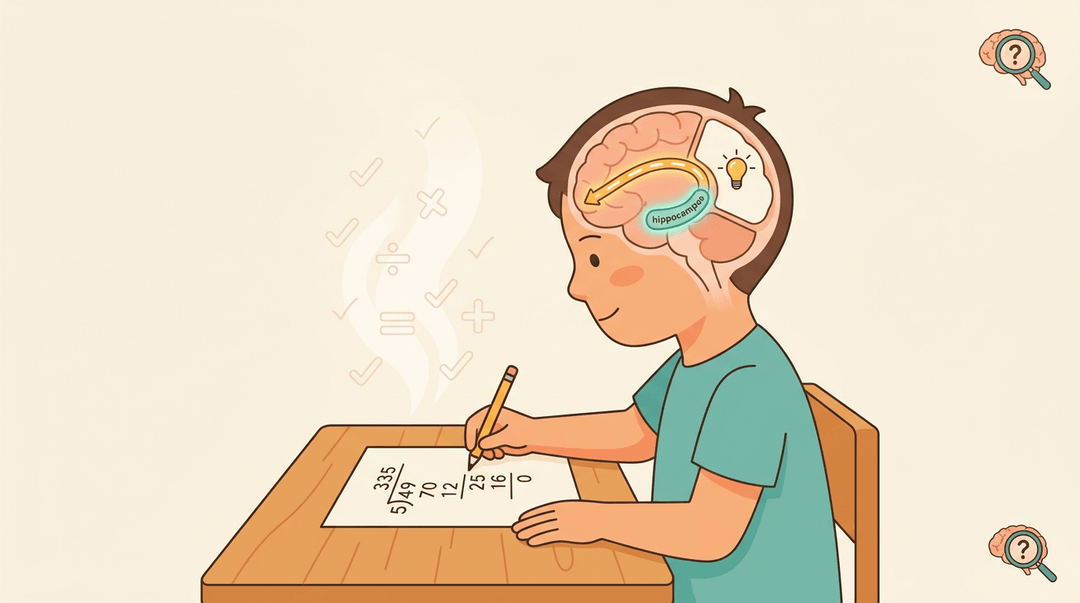
Much of what students pick up never gets announced. That's implicit memory, knowledge used without conscious recall, and it's a common home for latent learning. It's less about what students say and more about what they can do later.
The hippocampus helps form and organize these memories.
Skills become automatic through myelination too. A student practicing long division until the steps feel effortless isn't just memorizing. Their brain is physically speeding up the process, freeing working memory for harder thinking.
Be cautious with brain-science headlines, though. Much of the detailed evidence comes from laboratory research, and brain imaging can show activity changes without revealing what a student knows. Check the biology against what you see in your students.
Latent Learning Examples in Everyday Life
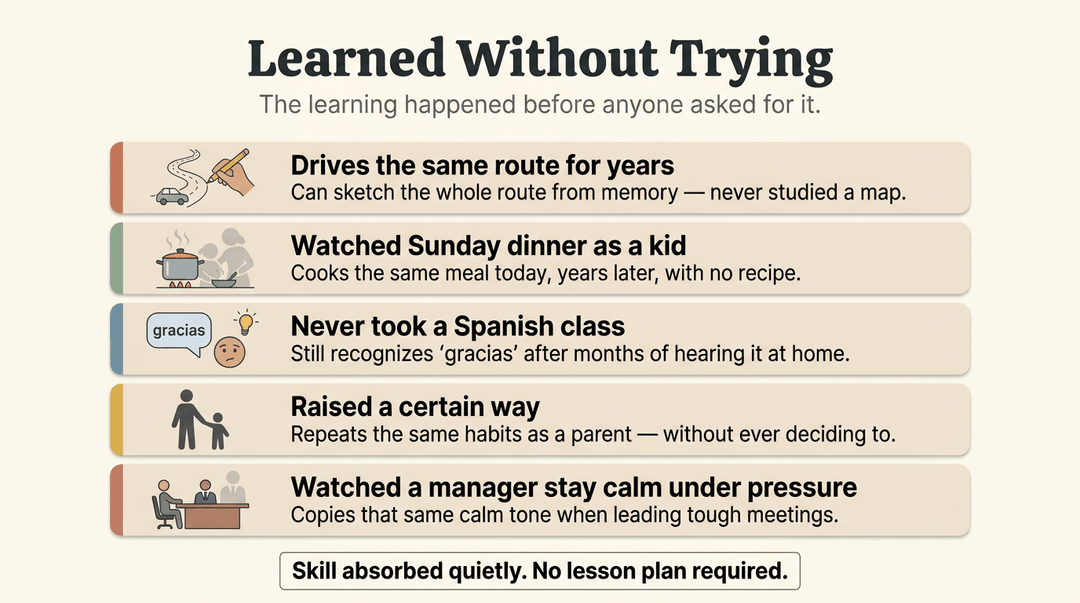
Latent learning happens quietly, in the background. Here's where it shows up:
Everyday skills you pick up without trying
- Driving routes. A teacher who drives the same route for years can sketch it without ever studying a map.
- Cooking. Someone who watched a parent cook Sunday dinner can make it years later without a recipe.
- Vocabulary surprises. A student who never took Spanish may recognize gracias after months of hearing it at home.
- Parenting habits. Many adults repeat how they were raised, without deciding to.
- Workplace leadership. A new team lead may copy a manager's calm tone in tough meetings.
The learning happened before anyone asked for it.
How kids learn without even trying
- Routes. A child in the back seat can later map the neighborhood.
- Overheard language. A child who hears swearing may repeat it at school, which is a chance to talk about words.
- Tech skills. A child who watches a parent swipe a phone may open the same app.
- Reading. Kids who hear bedtime stories pick up rhythm and new words.
Delayed recall matters here. When a student repeats a phrase from last week's review game, latent learning is at work. A quick quiz a few days after a lesson shows what really stuck.
Latent learning in animals beyond rats
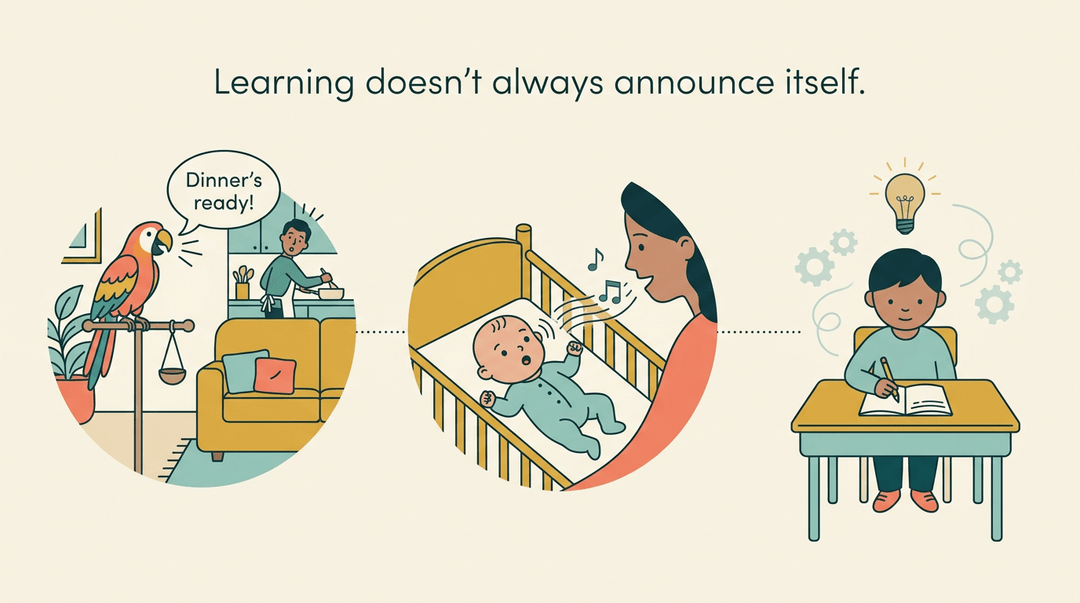
- Parrot mimicry. A parrot repeats household phrases at unexpected moments.
- Infant sound detection. Babies tune into their language's sounds long before they speak.
Learning doesn't always announce itself.
Latent learning reminds us that learning doesn't always show up on schedule. Students may be building understanding long before they can demonstrate it, so patience and well-designed practice both matter.
When you plan with that in mind, you give hidden learning room to surface. Ready to map out units that leave space for it?
Check out our Curriculum Planning feature, an all-in-one online teacher planner for mapping lessons and standards across the school year.
References
- app.nova.edu
- Remembering and forgetting as context discrimination — pubmed.ncbi.nlm.nih.gov (1995)
- Albert Bandura's experiments on aggression modeling in children: A psychoanalytic critique — pmc.ncbi.nlm.nih.gov (2022)
- The Effect of Unrewarded Exploration Upon Maze Learning in Rats — digitalcommons.cwu.edu
- COGNITIVE MAPS IN RATS AND MEN — home.csulb.edu
- Psychology, Learning, Operant Conditioning — oertx.highered.texas.gov
- Latent Learning: Definition, Tolman's Experiment, Examples — apa.nefarius.co
- The irreconcilability of insight — pmc.ncbi.nlm.nih.gov
- What is cognition? A functional-cognitive perspective — biblio.ugent.be (2017)
- Selecting landmarks in novel environments — doi.org (2010)
Frequently asked questions
What is insight learning in psychology?
Insight learning is the sudden realization of how to solve a problem, often described as an “aha” moment. Wolfgang Köhler’s chimpanzee studies showed animals solving problems abruptly, such as stacking boxes to reach a goal.
What is the difference between latent learning and observational learning?
Latent learning is knowledge acquired without being immediately demonstrated and revealed later when there is a reason to use it. Observational learning is acquiring behavior or knowledge by watching others, and it can be demonstrated immediately or later. Latent learning emphasizes delayed expression, while observational learning emphasizes learning through observation.
Which of the following best defines latent learning?
Latent learning is learning that occurs without an immediate reward or visible performance, then appears later when motivation or a practical need prompts its use. For example, a student may learn a route by repeatedly walking through a school and use that knowledge weeks later.
Who founded latent learning?
H.C. Blodgett is credited with founding the study of latent learning and coining the term in 1929 through maze experiments with rats. Edward Tolman later expanded the idea through research on cognitive maps and reward.