Learning Observation: What It Is and How to Do It Well

Jump to section
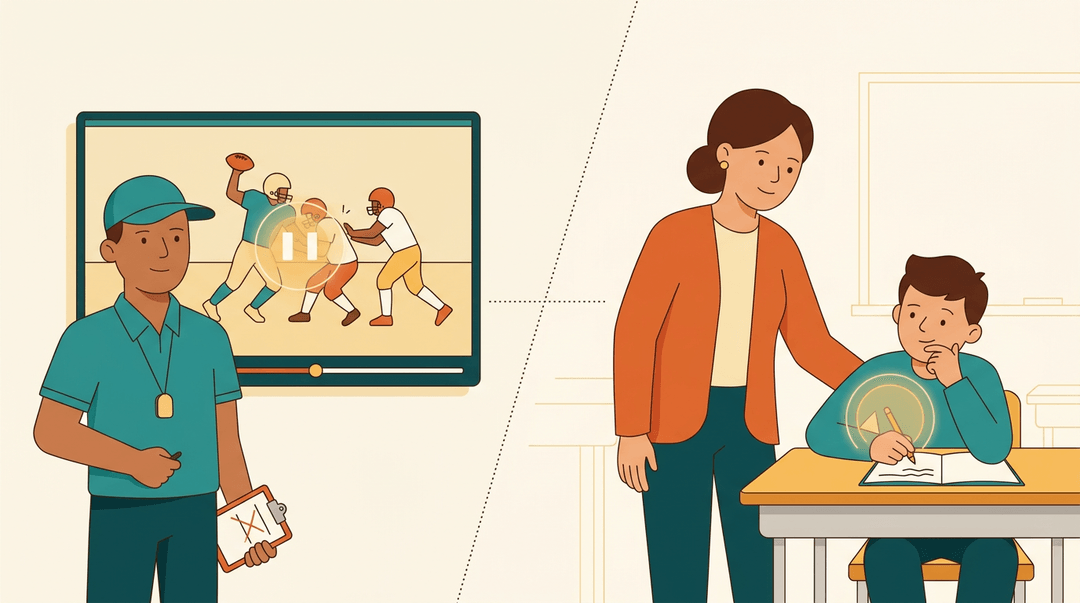
Think of a coach reviewing game film. They spot the exact moment a play breaks down, then plan the next practice around it.
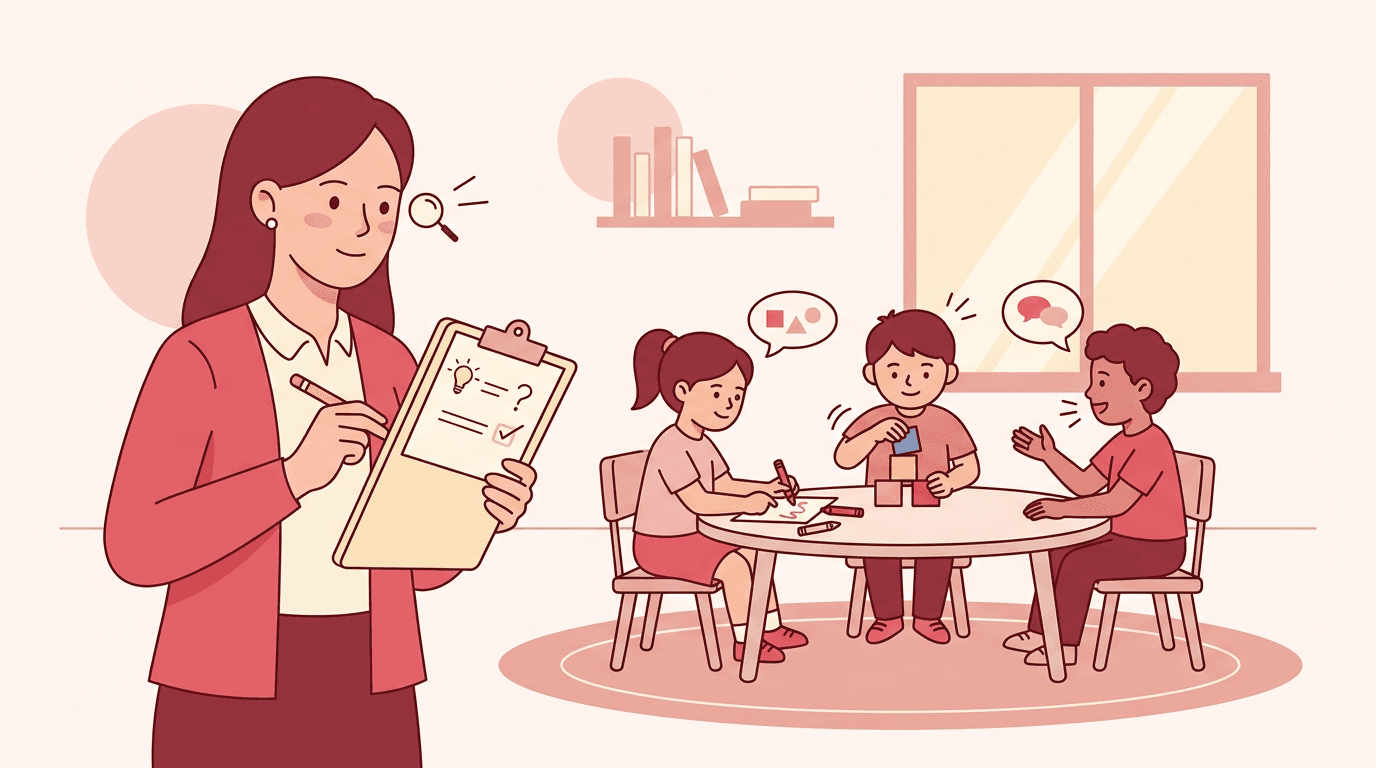
Learning observation works the same way: it's the habit of watching students closely to see what they truly understand, not just what their work looks like on the surface.
This guide covers every sense of the term, from classroom observation methods and objectivity to data use and observational learning, the psychology of picking up skills by watching others. You'll also get a step-by-step protocol you can use right away.
Why Learning Observation Matters
Learning is happening all around you, if you know where to look. Observation gives you that view.
What is observation learning?
In classrooms, learning observation means watching students closely to see what they understand. It informs instruction, tracks development progress, reveals learning styles, and supports personalized teaching.
It also offers non-evaluative professional growth when a colleague watches to help you, not to grade you.
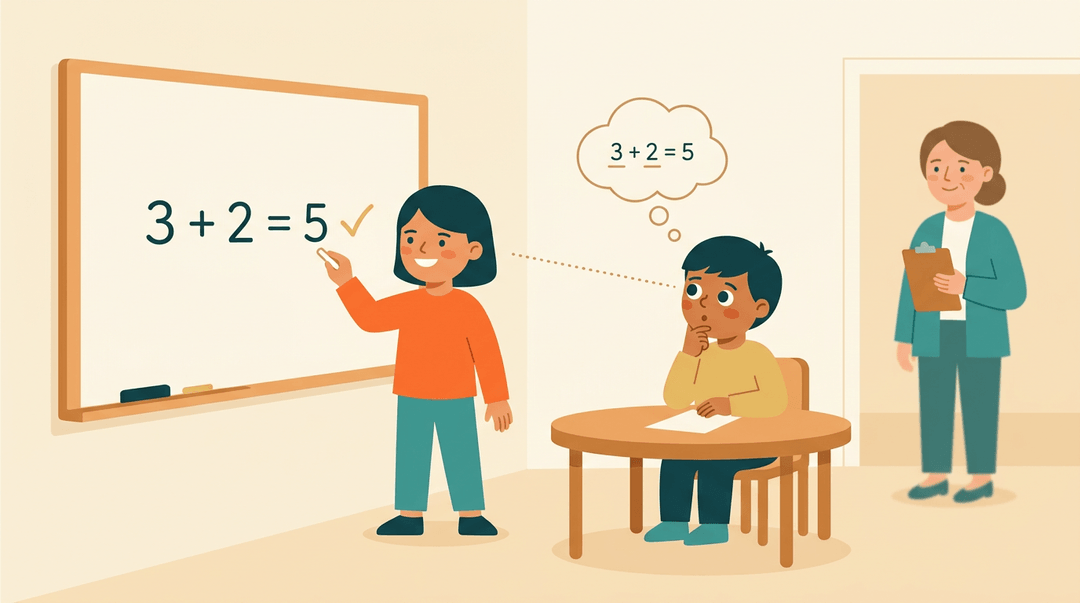
Albert Bandura's observational learning theory explains that people can learn simply by watching others, distinct from learning through direct experience. Psychologists call this modeling or vicarious learning.
Think of a student who watches a classmate solve a problem at the board, then solves the next one alone.
Observation focuses on learning, not teaching
Observation should center on learning rather than teaching. Traditional compliance evaluations check whether the teacher performed the right steps. Learning Walks, quick visits through several rooms, capture only a few minutes of each lesson.
Focus instead on student evidence: the work, the talk, and the thinking that show what's sticking.
How observation fits the assessment cycle
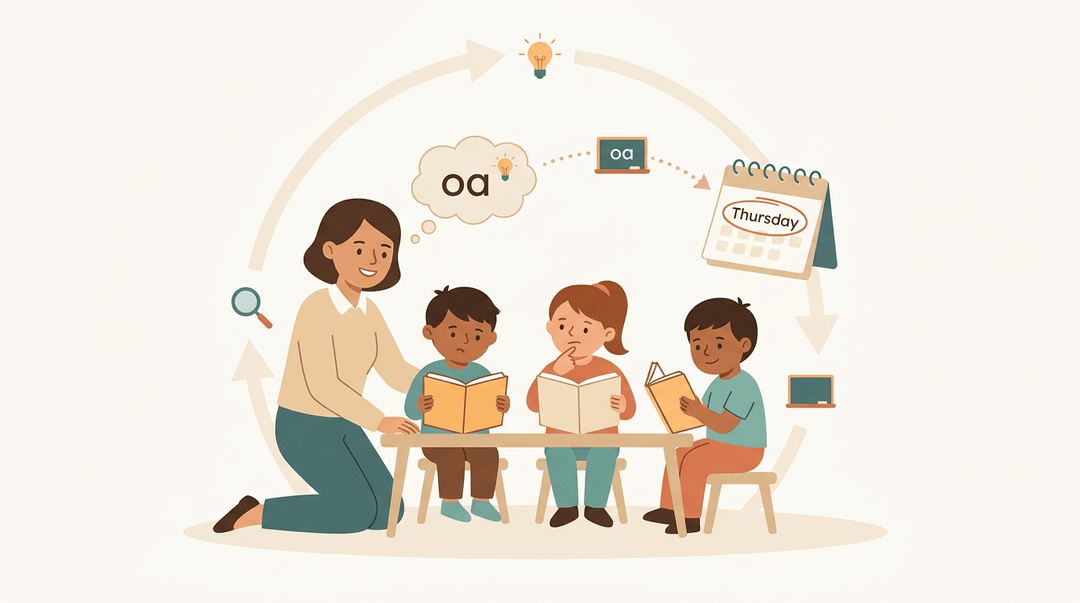
Observation is informal formative assessment: checks during learning that shape your next move. It differs from summative assessment, which judges learning at the end.
Consider a fourth-grade teacher who notices three students stumbling on the same vowel pattern during reading groups, then plans a mini-lesson for Thursday. That's the assessment-planning-teaching cycle at work.
Observe on a regular cadence, not once a semester, so the information stays useful.
Different Ways to Observe Learning
Good observation rests on five core skills:
- watching without interrupting
- describing what you see instead of judging it
- recording exact words and actions
- noticing patterns over time
- comparing your evidence against the lesson goal
The methods below put those skills to work.
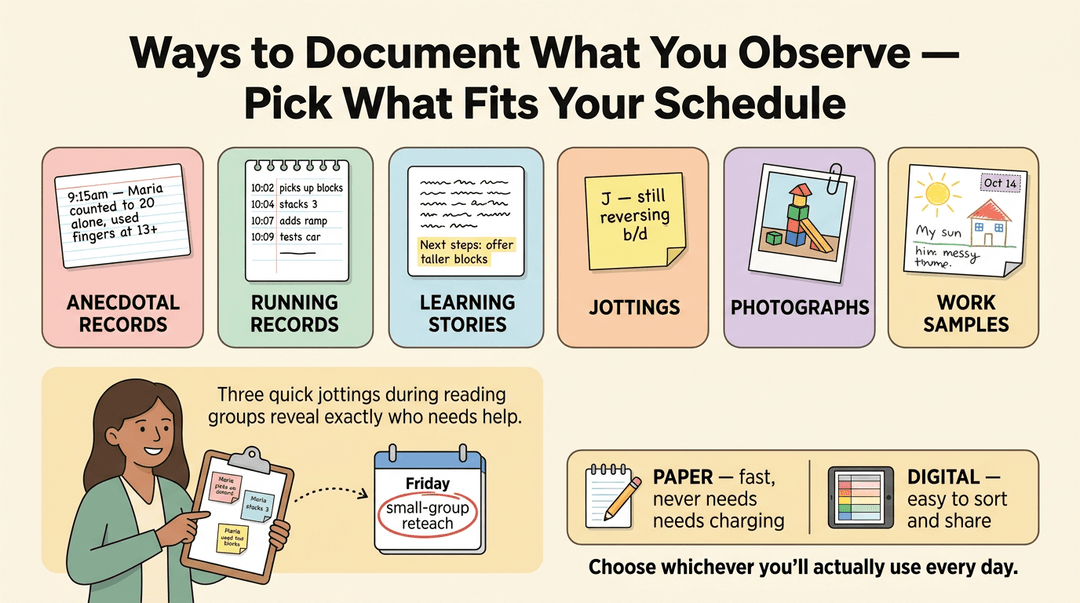
Ways to document what you observe
Pick the method that fits your schedule:
- Anecdotal records: short, factual notes on one student's behavior or words, written soon after the moment.
- Running records: a continuous account of what a student does during an activity.
- Learning stories: brief narratives that describe a learning moment and what it suggests for next steps.
- Jottings: quick sticky-note fragments you expand later.
- Photographs: snapshots of a block build, a science setup, or a whiteboard you can revisit.
- Work samples: the writing, math, or art a student produced, saved with a date.
Think of a second-grade teacher who keeps sticky notes on a clipboard during reading groups. Three quick jottings reveal exactly who needs a small-group reteach on Friday.
Digital vs paper tools: Paper is fast and never needs charging. Apps and shared spreadsheets make patterns easier to sort and share. Choose whichever you'll actually use every day.
Time and event sampling methods
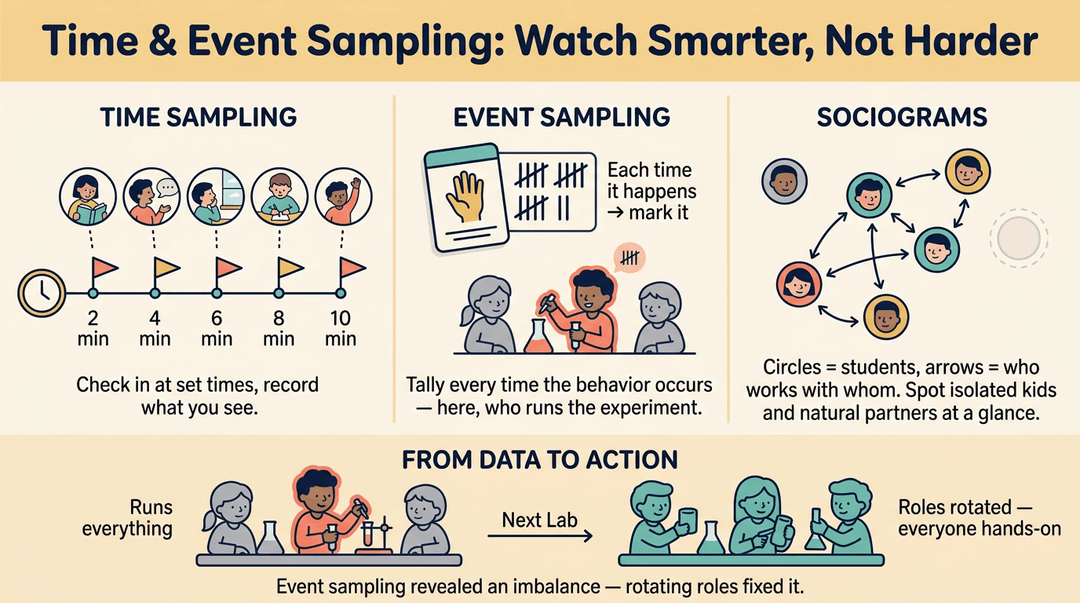
Sampling lets you observe without trying to catch everything. Time sampling means checking on a student or group at set intervals, such as every two minutes, and recording what you see.
Event sampling means recording each time a specific behavior happens, like a student asking for help.
Use sociograms for social mapping: draw each student as a circle and arrows to show who works with whom. You'll spot isolated students and natural partners at a glance.
A middle school science teacher using event sampling tallies how often one group member runs the experiment while the others watch. She rotates roles next lab, and everyone gets hands-on time.
Using rubrics to observe skills
Build an observation rubric by naming the skill and describing each performance level. Strong rubrics define measurable indicators, such as 'states a claim with one piece of evidence,' not 'shows understanding.'
Use rating scales for behaviors (never, sometimes, usually, always) so ratings stay consistent from student to student. Soft skills measurement, like teamwork or persistence, is harder but doable when you describe observable actions.
Rate what students do, not how you think they feel.
Running a formal classroom observation
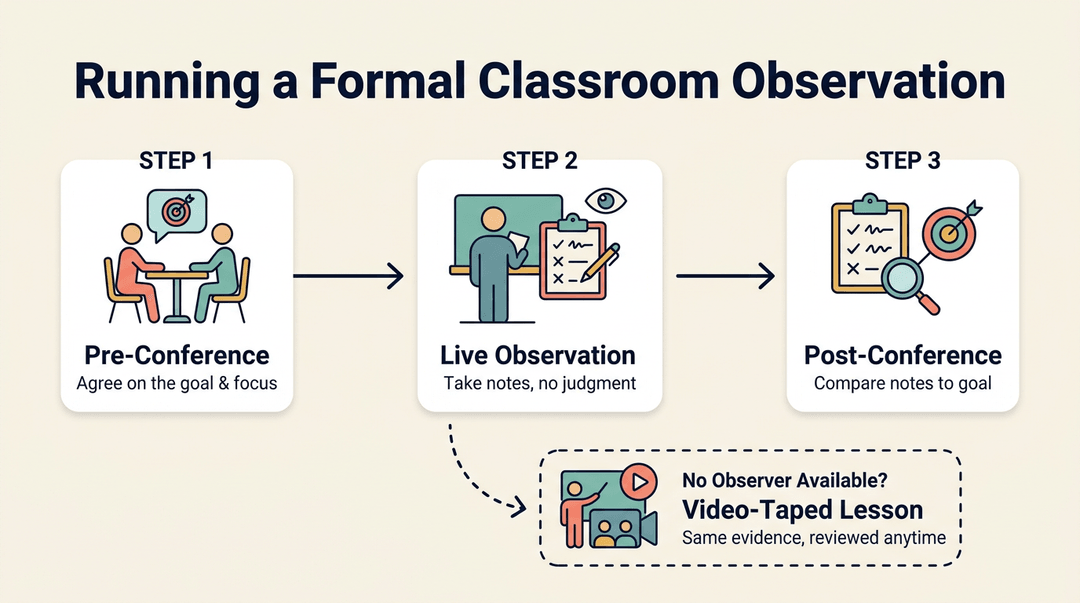
Start with a pre-conference to agree on the lesson goal and the focus. During the live classroom observation, the observer takes note-taking during lesson records without judging in the moment.
Afterward, a post-conference reflection compares those notes against the goal.
If you can't have someone in the room, a video-taped lesson gives you the same evidence to review at your own pace.
Quick, evidence-based observation windows
A 10-20 minute observation window is a short, focused look at one part of a lesson. Look for tangible evidence of learning: a finished exit ticket, a student explaining a step aloud, an error that gets corrected.
Start with no predetermined focus checklist, and let what you see guide your notes. Ten minutes is enough.
A homeroom teacher watching math centers for 15 minutes notices three students solved problems but only one explained the strategy. Tomorrow's plan? A quick think-aloud for the whole group.
How to Conduct a Classroom Learning Observation
Use this guide when you want a short, focused look at how students are learning, without turning it into an evaluation. One 10 to 20 minute window is enough.
Before you walk in
Confirm these four things and you're ready:
- One clear focus: a single question, not "how's the class going?"
- Try: "How do students use the word bank during independent writing?"
- A method and tool that fit: a tally sheet, a timed log, or open-ended notes.
- Counting hands-up? Tally. Tracking one pair's thinking? Notes.
- A 10 to 20 minute window: block it on your calendar like any meeting.
- Co-teachers in the loop: a quick heads-up if you share the room.
While you're watching
Record what happened, not what you made of it. A simple three-column grid keeps time and context attached to every note:
| Time | Context | What you saw or heard |
|---|---|---|
| 10:42 | Pairs, fraction strips | Maya: "Wait, the halves don't match." Re-folded her strip. |
| 10:47 | Same task | Two pairs checked strips against the ruler without being asked. |
Quotes and actions are your best evidence. Judgment words sneak in fast, so here's the difference:
✅ "Maya re-folded her strip after saying the halves didn't match."
❌ "Maya was careless at first, then figured it out."
The first is something anyone in the room could have seen or heard. The second is your opinion of Maya.
⚠️ Watch out: Words like "lazy," "distracted," and "struggled" are conclusions. If you catch one, replace it with the behavior that made you think it.
After the observation
- Reflect on next steps
- Ask: "What will I try tomorrow because of this?"
- Tag notes to standards or goals
- Write the standard code or learning target beside each note.
- Share with the student and family
- Lead with what you saw, in plain words: "I noticed you re-folded when the halves didn't match."
- Store it securely for the portfolio
- Date it and keep it somewhere private and organized.
Example: A fourth-grade teacher sets her focus as "how students check their own work during fractions." She logs 15 minutes with a timed grid, tags two notes to the equivalent-fractions standard, and sends one quote home. Her next-day move is a mini-lesson on checking against a ruler.
EMStudio's curriculum planner lets you attach these observation notes directly to the standards and learning targets you're already tracking.
How Mentors and Evaluators Observe
Observation isn't just one visit with a clipboard. Mentors, evaluators, and colleagues each bring a different lens.
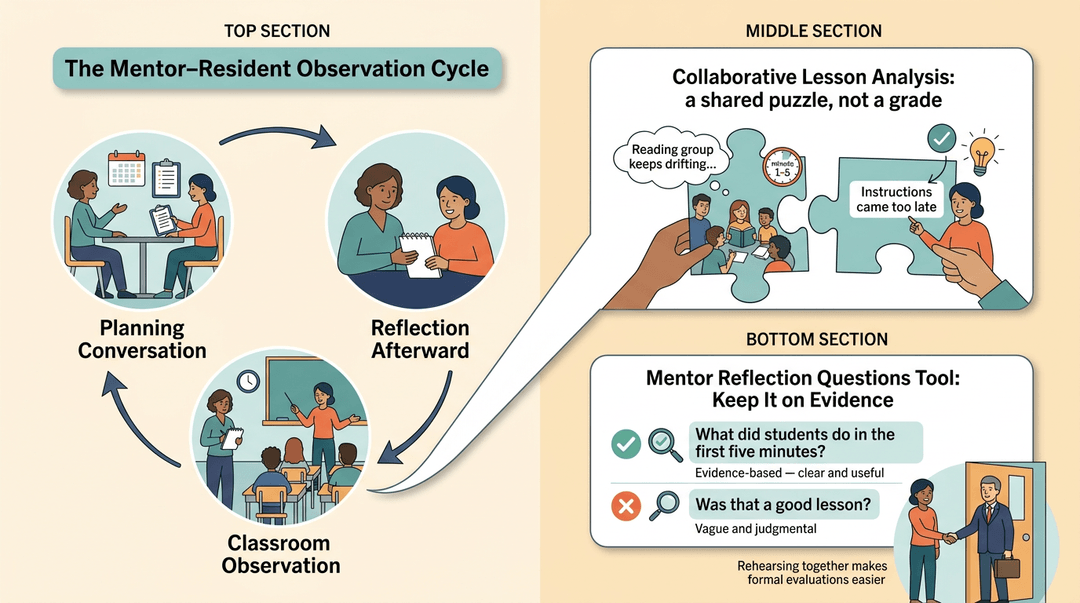
The mentor-resident observation cycle
The cycle has three parts:
- a planning conversation
- a classroom observation
- a reflection afterward
Collaborative lesson analysis happens in that middle step: mentor and resident review the lesson together as a shared puzzle, not a grade. Consider a first-year resident whose reading group keeps drifting.
Together they spot that instructions came too late.
A mentor reflection questions tool keeps the talk on evidence. Questions like 'What did students do in the first five minutes?' work well. Preparing for formal evaluation gets easier when residents have already rehearsed their lesson together.
Team-based observation and debriefing
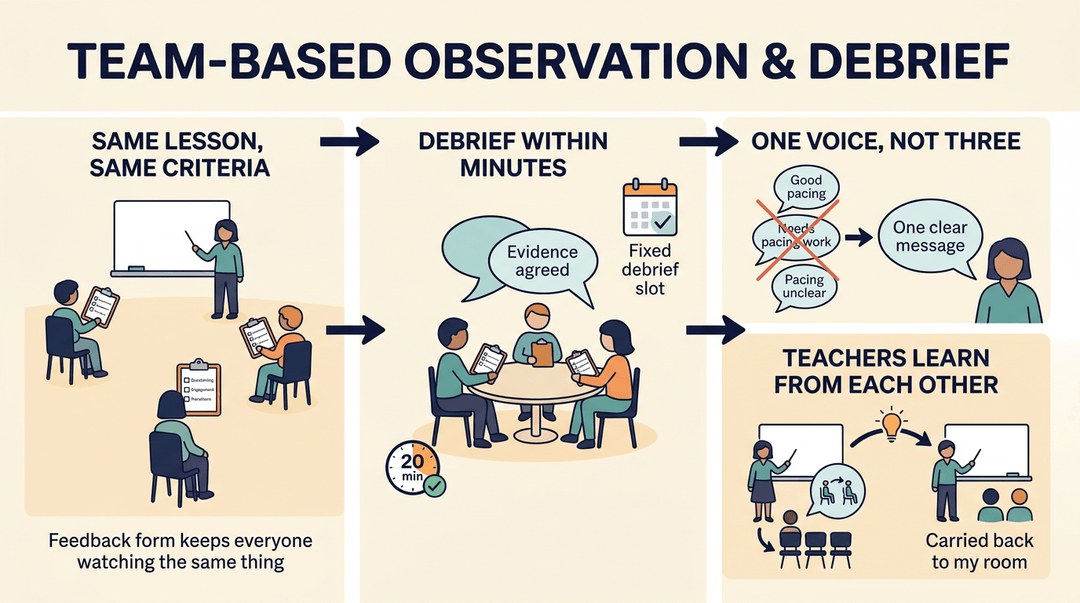
Some schools use a team of observers instead of one evaluator. The observer team debrief is the heart of it: observers compare notes right away, while details are fresh, and agree on what the evidence shows before anyone talks to the teacher.
Preparation and scheduling make it workable. A team that agrees on focus areas ahead of time and books a fixed debrief slot can finish in twenty minutes.
A short feedback form, filled out during the lesson, keeps every observer looking at the same criteria, so the teacher hears one clear message instead of three.
The payoff is a learning culture where teachers learn from each other, not only from evaluators. Watch a colleague handle a tough transition, and you carry that move back to your own room.
Keeping Observations Objective and Accurate
An observation is only useful if it captures what really happened, not what you expected. Here's how to keep your notes fair and worth acting on.
Reducing bias in your observations
Bias pulls both ways: you might excuse a usually strong student's off-task moment, or read every fidget from a struggling learner as a problem. Record what you see, not what you assume.
Use a wide-angle lens by scanning the whole room before zooming in, and adopt a videotape mentality: write only what a camera would capture, saving interpretations for later. Agree on a shared focus with colleagues who observe the same classes.
Making sure observations are reliable
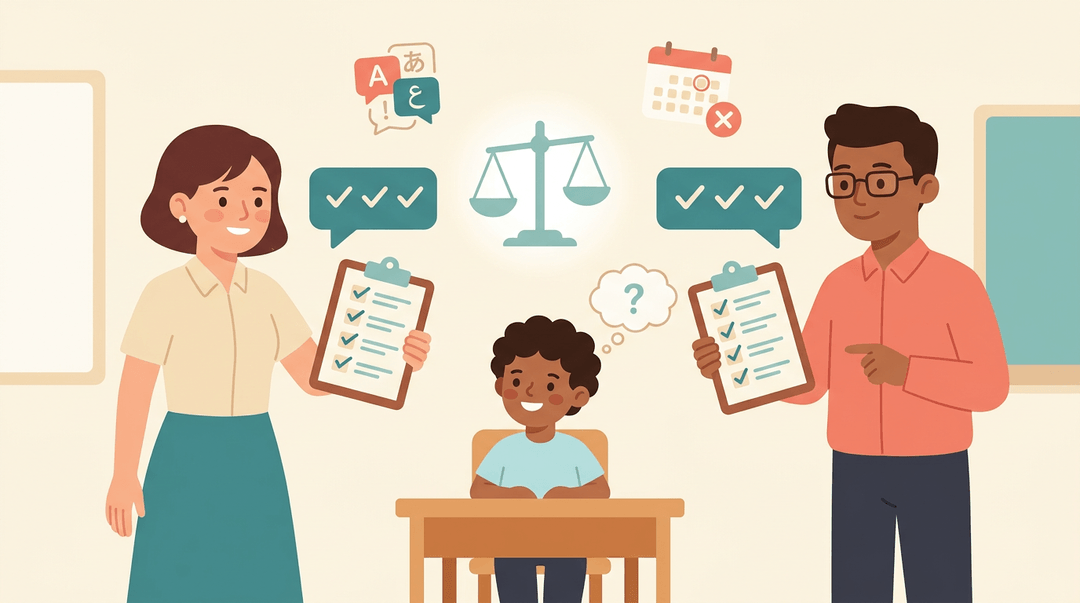
A second-grade teacher handed an unfamiliar checklist needs proof that it measures what it claims. That's where standardized assessment validity comes in: the same rubric should produce consistent results across observers and visits.
Check that the wording works for every learner, applying culturally and linguistically responsive criteria for multilingual students and families.
Keep observations away from high-stakes decisions, since one visit shouldn't determine a rating or placement. Finally, ask yourself, "Would you write this same note about a different student?"
Giving consistent, structured feedback
Feedback lands best when it follows one structure. Run a structured debrief process:
- what the observer saw
- what it might mean
- then one next step
Build consensus among observers before sharing results so the teacher hears one clear message. Keep concise feedback delivery to two or three specific points. Specific beats vague every time.
Store records securely, and tell teachers in advance what's recorded and who can see it.
Turning Observation Data into Growth
Observation notes only matter when they change what happens next. Use them to sharpen your teaching, strengthen family partnerships, and grow your own practice.
Using observations to adjust teaching
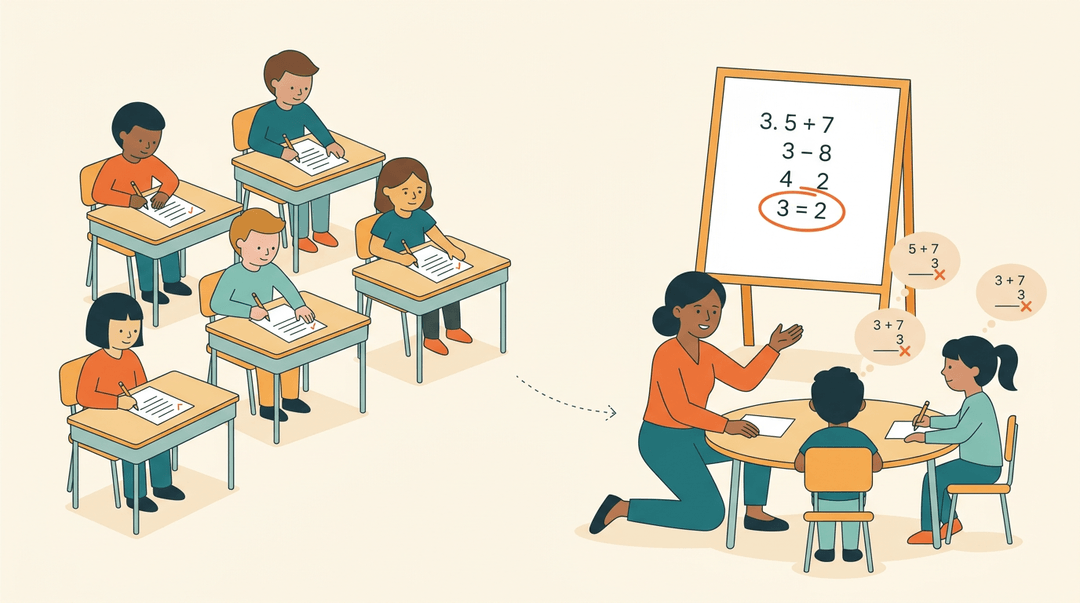
Let what you see drive your next move. If a lesson stalled, change the strategy: swap a whole-group worksheet for partner work, or add a visual before the text. Picture a fourth-grade teacher who notices three students stuck on the same step.
That's a group need, so she reteaches the step in a small group while the rest of the class keeps working.
Individual needs follow the same logic. A student who rushes may need a stretch task, while one who freezes may need a shorter first step. End each cycle with one specific next step per learner. Small, targeted goals beat vague ones.
Sharing observations with families
Families want to know how their child is doing, and your observations give you concrete evidence. Share results in plain language: what you saw, what it means, and what you'll try next.
Consult families before major decisions, since a parent may know their child tenses up during oral reading.
Learning stories are a powerful format. A short note about a kindergartner who tried three approaches to a block problem shows growth a score might miss.
Reflecting on your own teaching
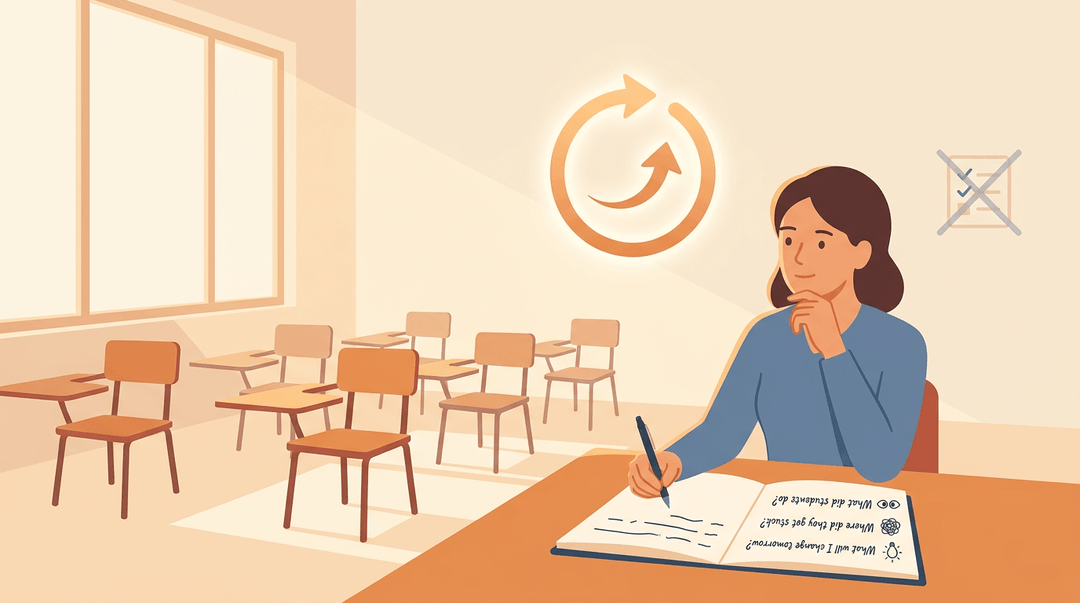
Observation applies to your teaching, too. After each lesson, run a quick post-conference reflection: What did students actually do? Where did they get stuck? What will you change tomorrow?
Over time, these habits build a continuous improvement culture, where the goal is improving a lesson rather than just finishing it.
Tracking developmental milestones and signs
Track developmental milestones across:
- social-emotional behavior
- attention span and focus
- language development
- physical coordination
Watch for a student who struggles to take turns, stay on task for a few minutes, or follow multi-step directions.
Also note signs of stress, such as withdrawal or sudden drops in participation. Treat these as reasons to check in with your support team, not as diagnoses.
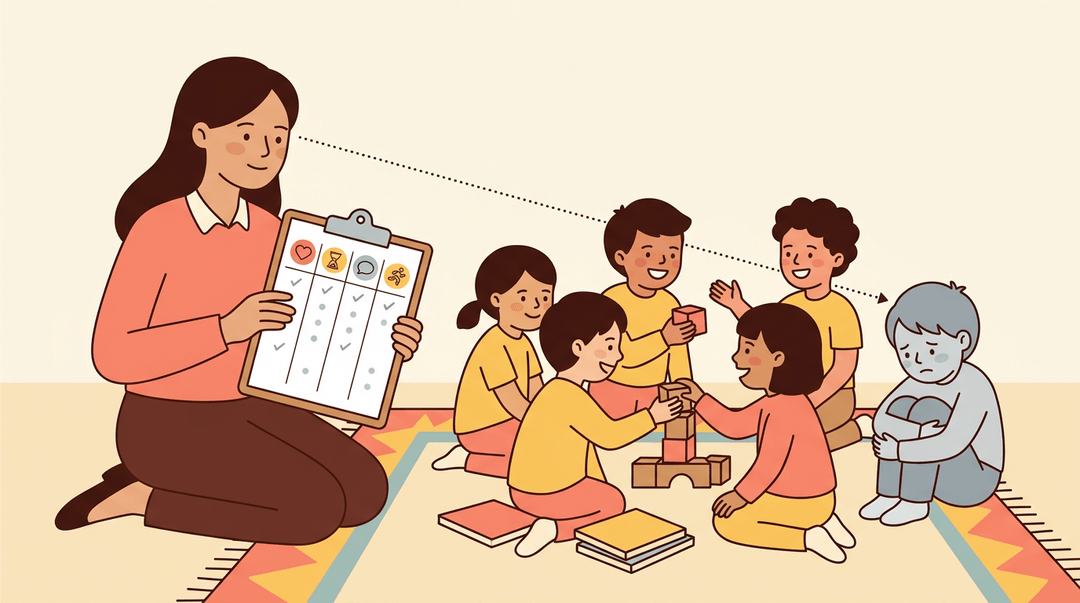
Keep a printable milestone tracking chart in your planning binder so you can record these patterns consistently all year.
Learning observation is really about paying attention on purpose.
When you watch with a clear method, keep your notes objective, and use what you see to guide your next move, your students get more targeted help and you get a clearer picture of their growth.
Ready to put those observations into your next unit? Check out our Curriculum Planner to plan lessons and standards across the whole school year.
References
- How Social Learning Theory Works — hr.berkeley.edu
Frequently asked questions
What is observation learning?
Observation learning can mean closely watching students to identify what they understand, how they are developing, and what support they need. It can also mean learning by watching other people, as in Bandura’s theory of observational learning.
What is it called when you learn by observation?
Learning by observation is called observational learning. It is also known as modeling or vicarious learning, because a person can acquire knowledge or skills by watching someone else rather than through direct experience.
What are the five observation skills?
The five observation skills are watching without interrupting, describing what you see instead of judging it, recording exact words and actions, noticing patterns over time, and comparing evidence with the lesson goal.