Crosscutting Concepts in NGSS: A Complete Guide to Each One

Jump to section
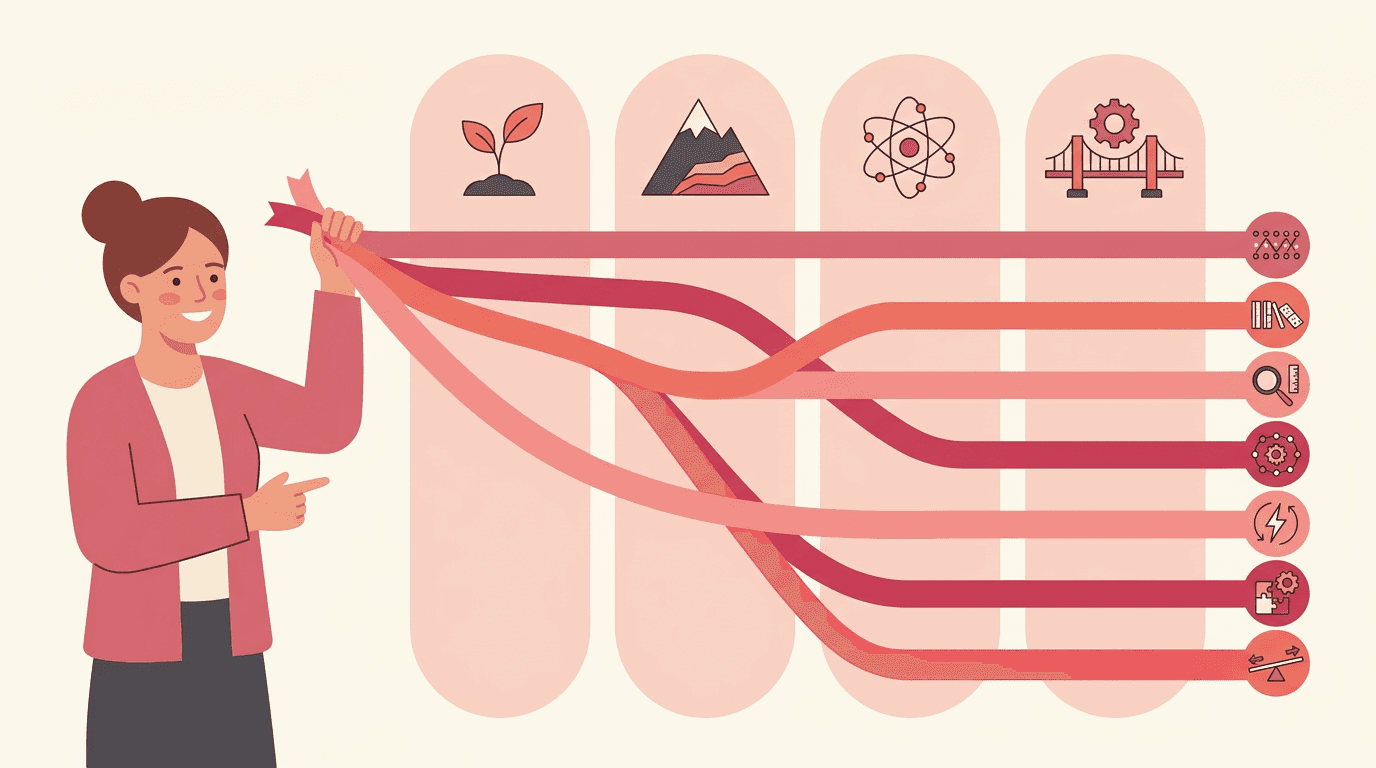
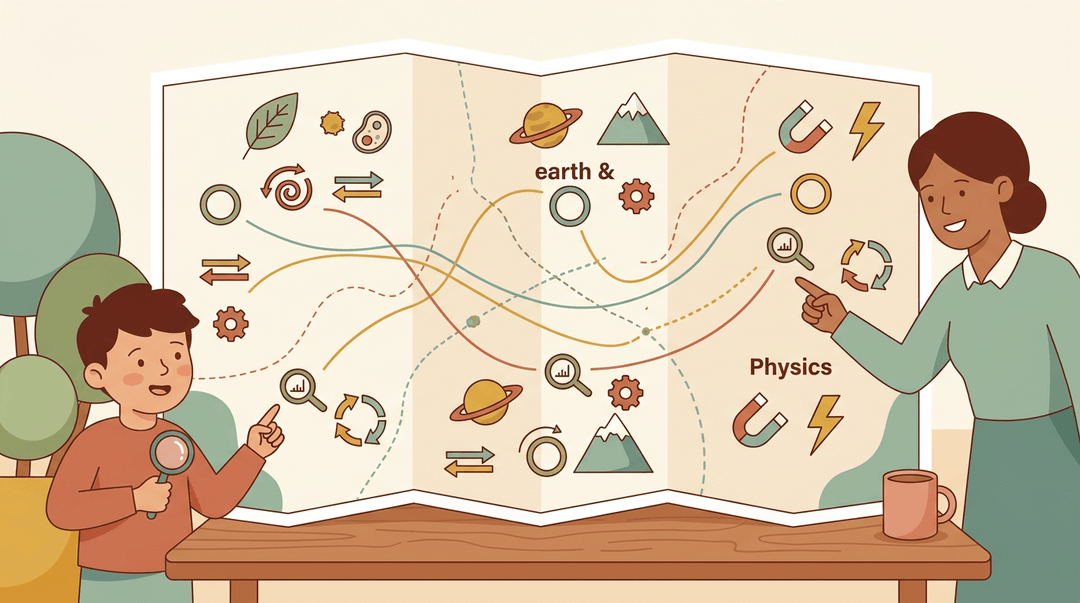
Think about a road map. Once you know the symbols mean the same thing in every city, you can read a map of anywhere new.
Science has its own version of that idea: crosscutting concepts are big ideas that appear across every science field, from life science to physics.
The Next Generation Science Standards (NGSS) weave these concepts into three-dimensional learning, so students meet them in every unit. Here's what each concept means, how it grows across grade bands, and a practical plan for tracking it all year.
Crosscutting Concepts NGSS and Where They Fit
Ever notice how the best science lessons connect ideas from one unit to the next? The Next Generation Science Standards (NGSS) call that thread crosscutting concepts. Let's see where they fit.
The three parts of the framework
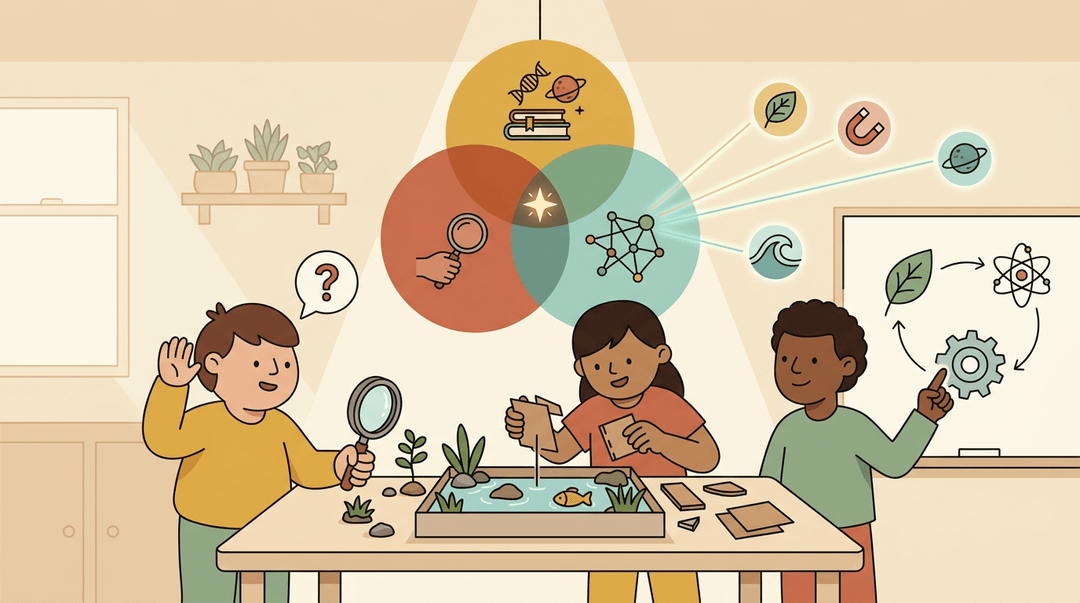
NGSS builds on three-dimensional learning, where each lesson draws on three parts at once:
- Science and engineering practices: what students do, like asking questions and building models.
- Disciplinary core ideas: the major content within each science field.
- Crosscutting concepts: big ideas that span every field, from biology to physics.
- Performance Expectations alignment: the standards that tie all three parts together.
The standards name seven crosscutting concepts, and they build across grade bands from kindergarten through 12th grade. Because they aren't tied to one subject, they're easy to overlook.
The dimension lessons tend to overlook
Crosscutting concepts are often under-addressed. A New England study of teacher perceptions and practices found they appeared less intentionally addressed, with most teachers treating them as implicit outcomes rather than explicit instructional goals.
You're probably already teaching these ideas, just implicitly. The next step is naming them out loud so students know what to look for.
Authentic incorporation is the hard part. Slapping a concept label on an unchanged worksheet doesn't count. The lesson has to genuinely need the concept.
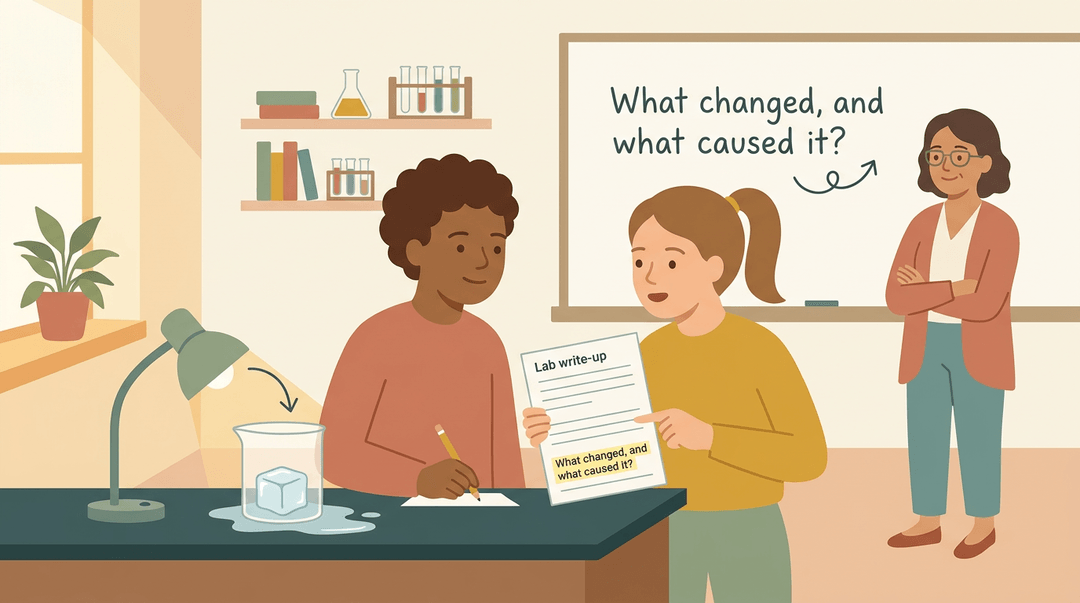
Think of a middle school science teacher whose students describe what happens in a lab but never explain why. She adds one question to every write-up: What changed, and what caused it? Soon, her students are asking it themselves.
Documents and research behind the ideas
Three key sources stand behind these ideas:
- Framework for K-12 Science Education
- NGSS Appendix G
- Learning sciences research on how students build understanding
Plan Crosscutting Concepts Across Your School Year
Use this guide to see which crosscutting concepts (CCCs) your units already touch, then to teach one on purpose in each lesson. Do the mapping once in August, then run the lesson routine all year.
Map concepts to your units
Start with a simple grid. It takes about twenty minutes and shows you the whole year at once.
- List your units and their PEs.
- One row per unit, with its performance expectations beside it.
- Tag one primary and one secondary CCC.
- Primary is the one students need to make sense of the phenomenon.
- Spot the under-used concepts.
- Count the tags down each column. Any concept with zero or one tag is a gap.
| Unit | Primary CCC | Secondary CCC |
|---|---|---|
| Weather and seasons | Patterns | Cause and effect |
| Pond ecosystems | Cause and effect | Systems |
| Human body | Systems | Structure and function |
| Food and energy | Energy and matter | Stability and change |
When you find a gap, don't add a new unit. Look for an existing unit where that concept could move from secondary to primary.
Run each lesson in four steps
This is the routine card. It adds about five minutes to a lesson, and the concept shows up in every phase.
- Name the focus CCC.
- Say: "Today we're looking through the lens of patterns."
- Pose a CCC prompt.
- Try: "What repeats here, and what might cause it?"
- Have students cite phenomenon evidence.
- Sentence starter: "I noticed ___ in the data, which shows ___."
- Close with an exit ticket reflection.
- Ask: "How did thinking about patterns change what you understood today?"
💡 Tip: Reuse the same exit ticket stem all week. Students answer faster, and you can compare responses at a glance.
Try it by grade band
| Grade band | Focus CCC and context | Sample prompt |
|---|---|---|
| K-2 | Patterns in weather | "What do you see happening every day this week?" |
| 3-5 | Cause and effect in ecosystems | "What happens to the pond if the insects disappear?" |
| 6-8 | Systems in body units | "Which parts work together when you run?" |
| 9-12 | Energy and matter flows | "Where does the energy in this food chain go?" |
Example: A second-grade teacher charts the sky and temperature every morning for two weeks. On day ten she asks, "What do you see happening every day?" Students point to the chart and say that cloudy days are cooler. They're citing evidence for a pattern, and the CCC did the work.
Confirm your plan
Before the year starts, check that each unit passes:
- CCC named in objectives. The concept appears in the written objective, not only in your head.
- Prompt tied to assessment. The exit ticket or unit task asks students to use the concept.
- Visible poster or icon. Students can see the concept's name and symbol on the wall.
- Revisit across units. Each concept returns at least once, ideally in a new context.
⚠️ Watch out: Tagging every concept to every unit makes the map useless. Stick to one primary and one secondary.
Tag NGSS crosscutting concepts to each unit in EMStudio's Curriculum Planner to see coverage across your whole year.
Make the Concepts Visible and Interactive
Crosscutting concepts (CCCs) run through most units, so they're easy to lose track of. Making them visible keeps them in view all year.
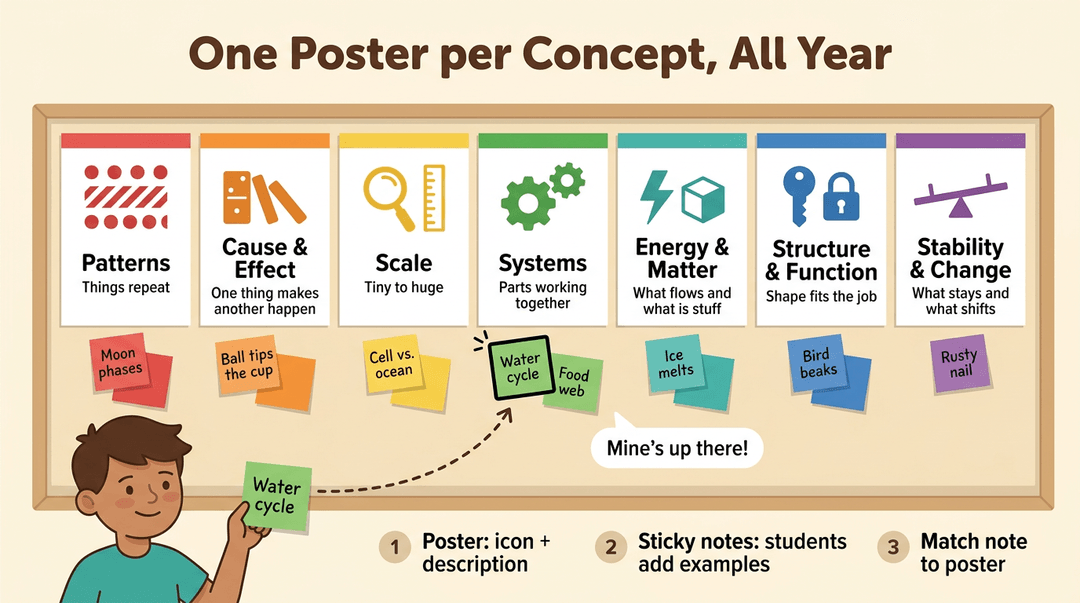
Seven color-coded posters for each concept
Post one poster per concept, each in its own color:
- Description and icon. Each poster gets a plain-language description and a simple icon.
- Sticky notes all year. Students add examples they spot in labs, readings, or games.
- Matching posters. Each note goes under the poster it fits, so the wall fills with student work.
Think of a fifth-grade teacher on a Friday, when a student's water cycle note lands under the matching poster. The class reads the wall together, and that student sees their idea beside everyone else's.
Weave the concepts into classwork
Print the icons as clipart on worksheets, each beside the question it supports. Students see the link right where they're working.
Choose one focus concept for each lesson and log it. A quick entry in your plan book turns vague coverage into a record you can check.
Using the concepts across many units
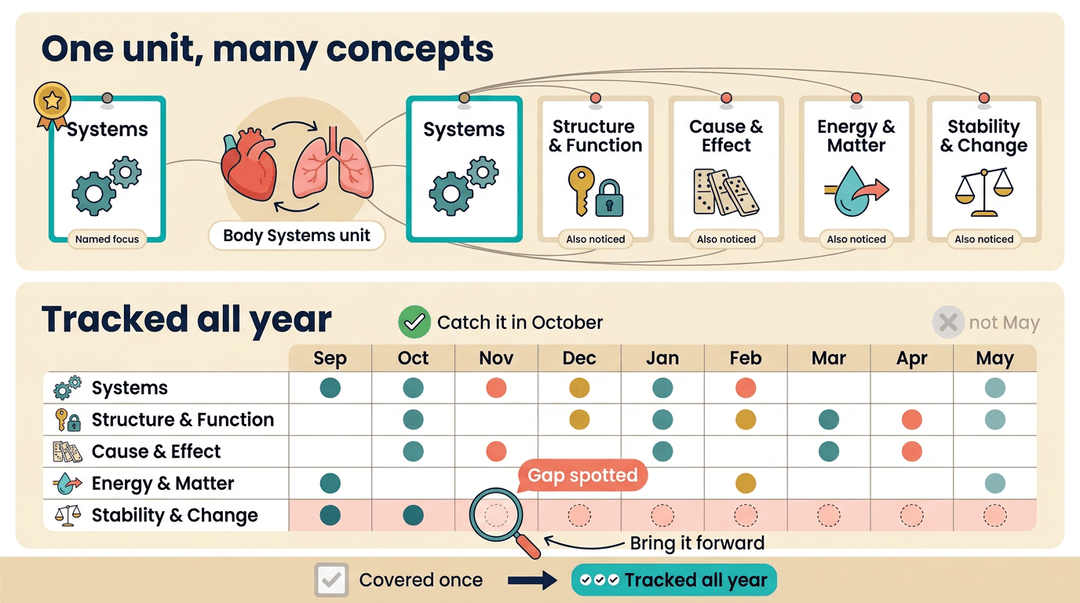
Most units touch many CCCs, even when the stated performance expectation names only one. Consider a middle school teacher whose body systems unit centers on how the heart and lungs work together.
Your log names one focus, but students also notice the body's parts depend on each other. That's several posters on the wall, not one.
Over the year, your log shows which concepts go quiet. We'd bring those forward early, so you catch a gap in October, not May. That's the shift from covering a concept once to tracking it all year. Spotting a gap that early calls for a regular check, such as curriculum based measurement.
Checking What Students Understand About Each Concept
It's one thing to name a crosscutting concept and another to watch a student use it. The right prompts close that gap.
Assessment prompts that reveal student thinking
Strong prompts elicit understanding, not recall. Ask a student to explain what happens and why, and you'll quickly see whether they grasp the idea or just recognize the word. That difference shows up fast.
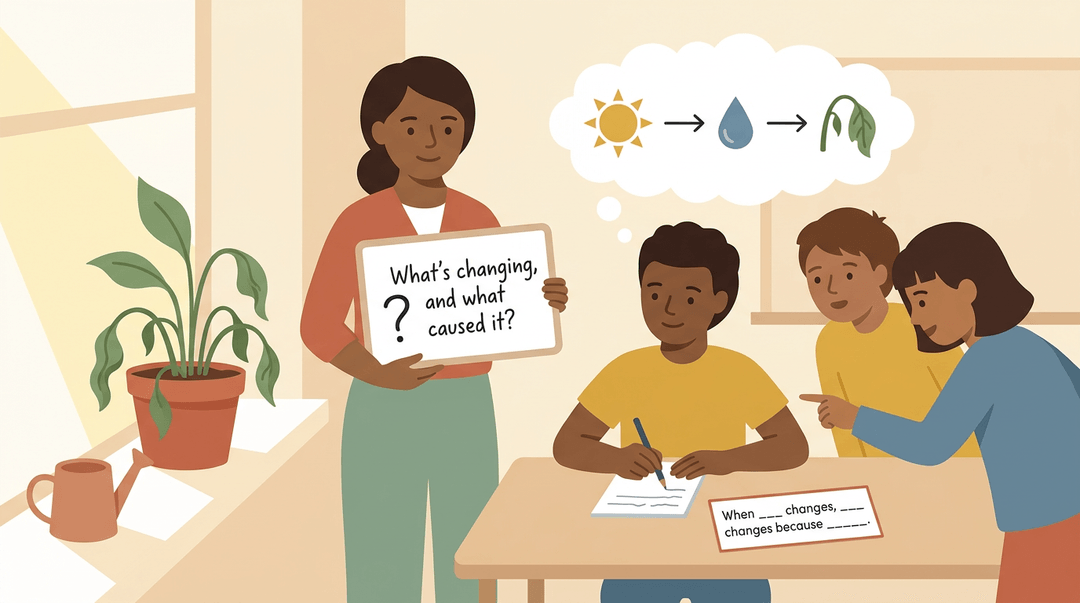
Anchor the prompt in a phenomenon, something students can observe, or a problem to solve. For example, a middle school science teacher sets a wilting plant on the windowsill and asks, "What's changing, and what caused it?"
A student who answers with cause and effect has shown the idea, not just repeated it. You'll know who's ready for the next step.
These prompts work best inside a multi-component extended task, alongside investigations and models. One question is a snapshot; a sequence gives the full picture. They also fit the classroom assessments you already run.
Give students sentence stems to start writing:
- Cause and effect: When ___ changes, ___ changes because ___.
- Patterns: One pattern here is ___, which tells us ___.
- What stays the same: In this system, ___ stays the same while ___ changes.
Other assessment resources worth a look
- Integrating practices into assessment tasks: Pair each crosscutting concept with a science and engineering practice, the things scientists and engineers actually do. Ask students to apply a concept while they plan an investigation, not after the quiz.
- 3D formative assessment short course: A short course on three-dimensional formative assessment, a good next step once these prompts feel familiar.
- Printable PDF download: A printable PDF to keep handy while you plan.
Tools and Materials You Can Use
Good materials save you prep time, but only when they fit the lesson in front of you. Here are four options to consider, each with its own purpose:
Materials you can download and share
- STEM Teaching Tools prompts. Ready-made questions for science, technology, engineering, and math classes that you can drop into a warm-up or class discussion without writing one from scratch.
- NSTA-vetted lesson resources. Lessons reviewed by the National Science Teachers Association (NSTA), so you can share them with a colleague or a substitute with more confidence.
- Purchasable poster and clipart bundles. Available for purchase, these give you ready-made visuals for your walls and slides when the free options don't cover what you need.
- SEP posters bundle. Posters on Science and Engineering Practices (SEP) so students can see those practices on the wall while they work.
Consider a middle school science teacher who needs a quick warm-up for Monday. A prompt from STEM Teaching Tools can get students talking within minutes, which leaves more of the period for the investigation itself.
Pick what fills a real gap in your lesson, not what simply looks nice on the wall. Less searching, more teaching.
Crosscutting concepts give students lenses they can use in any science class, and mapping them across the year makes those connections easy to see. Start small, track where each concept appears, and adjust as you go.
When students spot the same big ideas everywhere, science starts to click everywhere.
Ready to plan that sequence? Check out our Curriculum & Standards page to map units, lessons, and standards across your whole school year.