Language Arts Common Core Standards: A Complete Guide

Jump to section
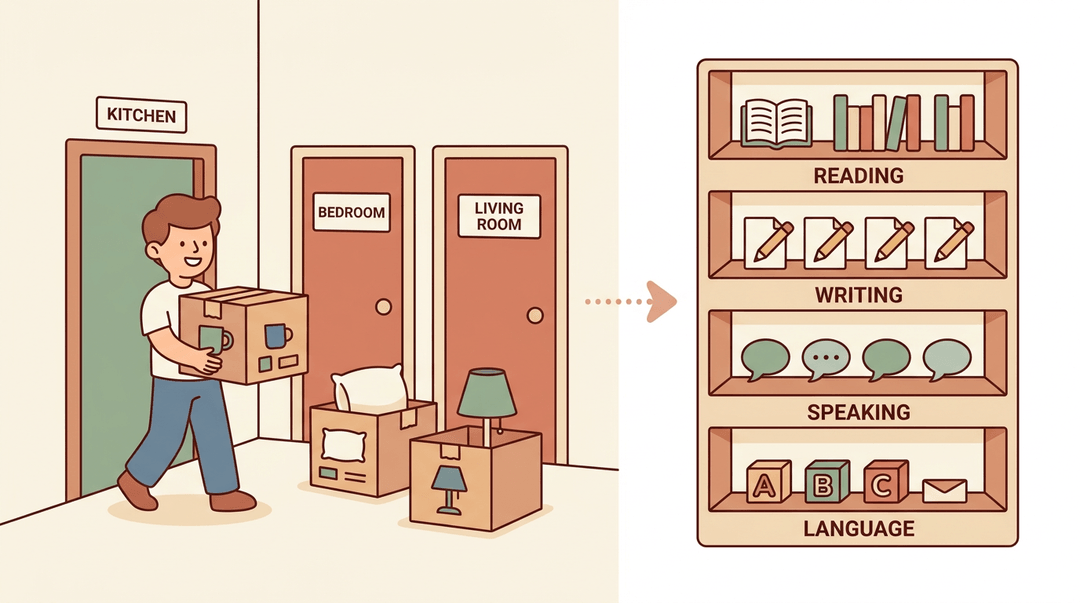
Think about moving into a new house. Before you unpack a single box, you sort by room: kitchen things here, bedroom things there, so everything has a place.
The Language Arts Common Core Standards work the same way for reading, writing, speaking, and language skills, organizing what students should know by grade and strand.
In this post, we'll walk through where they came from, how they're structured today, and how to put them to work in your own planning.
How the Language Arts Common Core Standards Began
Every set of standards starts somewhere, and this one grew out of a simple frustration: a third grader's "proficient" in one state didn't mean the same thing in the next.
States wanted a clearer, shared picture of what strong reading and writing should look like at every grade.
Who created the standards and why
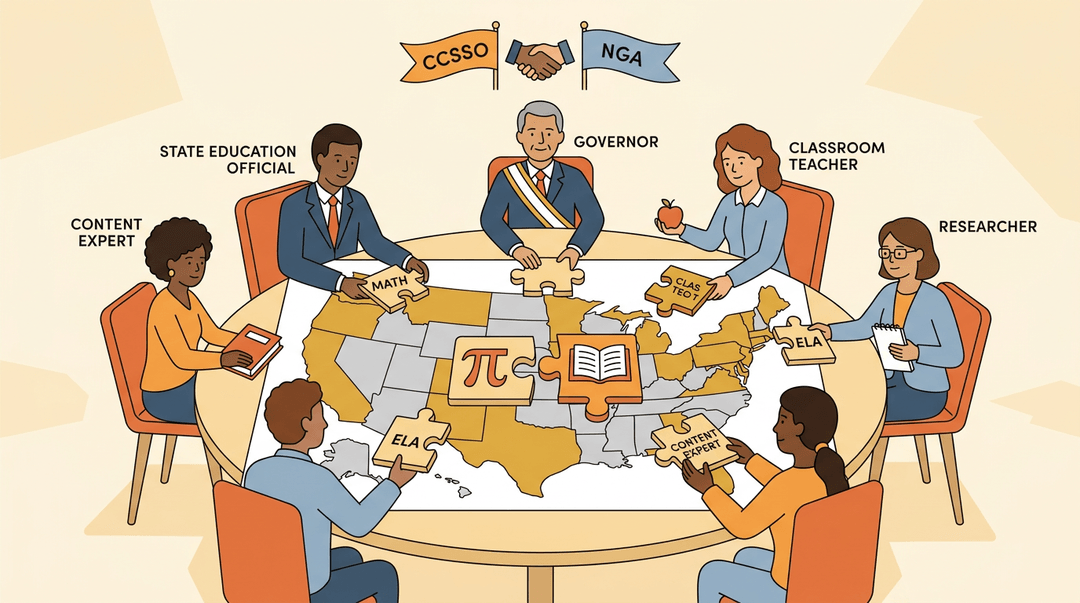
The Council of Chief State School Officers (CCSSO), the group representing state education leaders, teamed up with the National Governors Association (NGA) to lead the work.
Together they brought in classroom teachers, researchers, and content experts rather than handing the job to a single agency.
This was a voluntary effort, not a federal mandate. States opted in on their own, which is part of why adoption still looks different from state to state today.
The project focused on two subjects: math and English language arts (ELA), the two areas governors and state chiefs agreed needed the most consistency.
How states helped shape the standards
States weren't just asked to adopt a finished product. Early drafts went out for feedback, and state leaders flagged gaps, unclear language, and grade-level expectations that didn't match classroom reality.
Public drafts went through multiple rounds of review before anything was finalized.
The writing team also benchmarked the standards against research on what students in high-performing systems were expected to know and do.
That mix of state feedback and benchmarked research is what shaped the final standards, not a single committee working in isolation.
How ELA Standards Are Organized Today
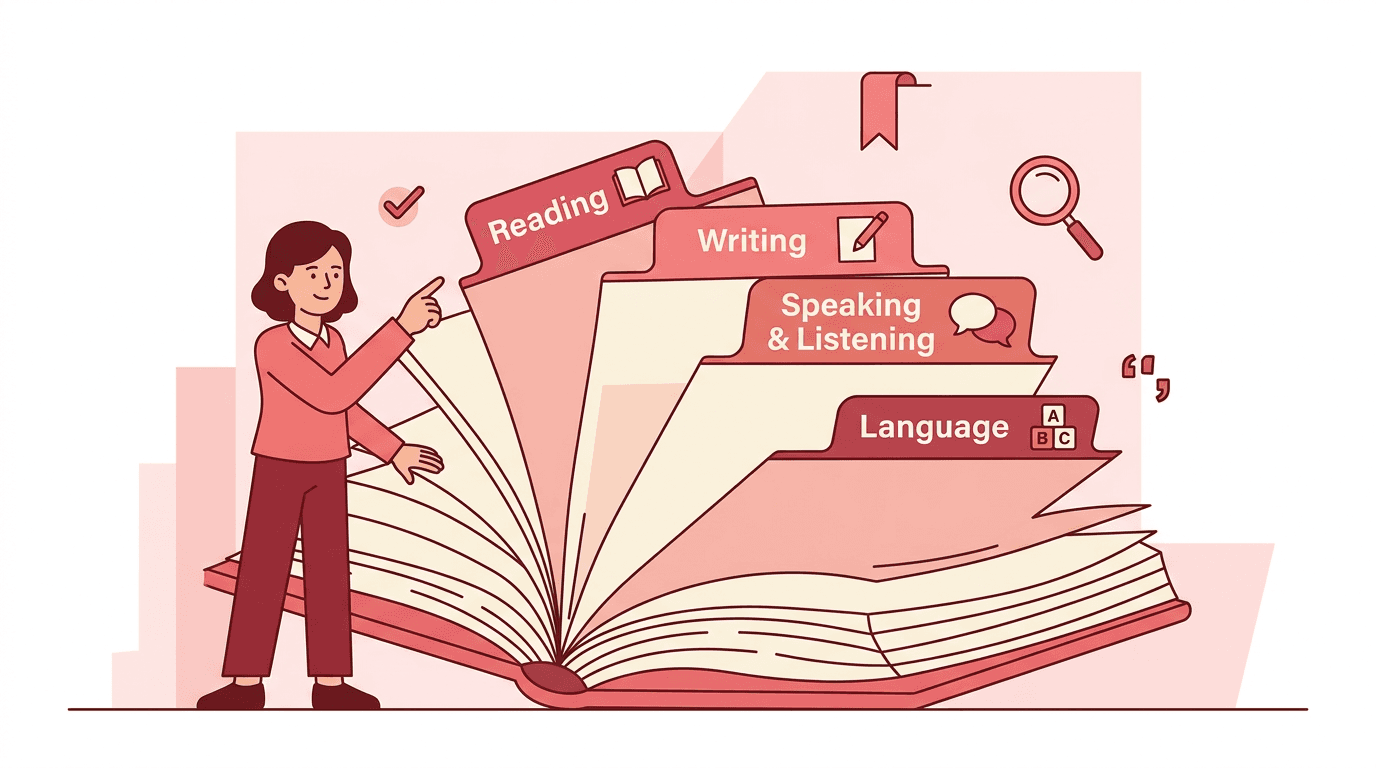
Picture the standards as a building with four load-bearing walls:
- Reading
- Writing
- Speaking and Listening
- Language
Every grade-level standard lives under one of these four strands, and all of them trace back to a shared set of College and Career Readiness (CCR) anchor standards: broad, grade-free goals describing what a student should be able to do by the time they finish high school.
How standards connect to grade-level goals
The CCR anchors are the what. Grade-level standards are the how, right now.
Each anchor gets translated into a specific expectation for every grade, kindergarten through 12th, so a skill builds in complexity year over year instead of showing up out of nowhere in ninth grade.
That ladder doesn't stand alone. It's part of a larger framework that includes essential literacy skills like phonics and fluency, and it connects directly to state literacy acts that require schools to screen and support struggling readers.
Together, they form the backbone of what you're expected to teach at each grade level.
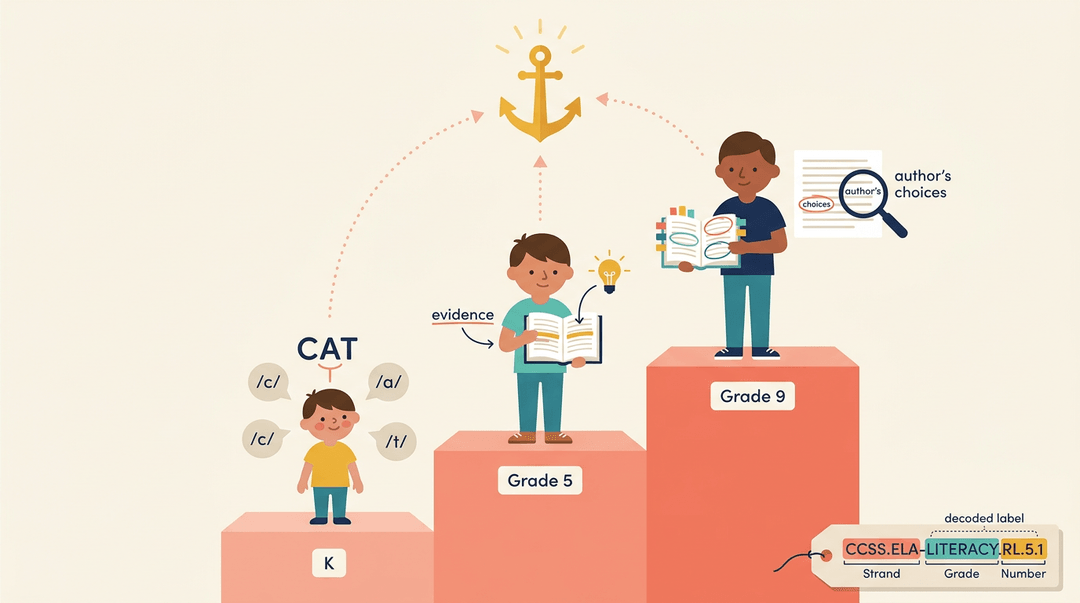
A kindergartner might work on noticing that words are made of individual sounds. A fifth grader might explain how an author uses evidence to support a point. A ninth grader might analyze how an author's choices shape meaning across a whole text.
Different grades, same four strands, same anchors underneath.
Standard codes follow a consistent format: strand, grade, and number. CCSS.ELA-LITERACY.RL.5.1 breaks down as Reading Literature, grade 5, standard 1. Once you know the pattern, any code becomes easy to read at a glance.
Using ELA Standards in Your Classroom
A standard is written for adults; your students need something they can aim at, and your calendar needs somewhere to put it. That's two moves: unpack the standard into a learning target, then map the targets across your year.
Turn one standard into a learning target
- Circle the verb; it names the skill.
- "Determine," "cite," "compare": the verb sets the level of thinking students must show.
- Rewrite it as an "I can" statement.
- Swap the standards language for words your students actually use.
- Attach the target to a proficiency scale.
- Define partial, proficient, and advanced before you teach, not while grading.
- Sample proficient row: "names the theme and supports it with two text details."
- Check the grade below and above.
- Jot the chain: central message (last year) → theme (this year) → theme development (next year).
- Now you know what to review quickly and what to leave for next year.
Example: A fourth-grade reading standard asks students to determine a story's theme and summarize the text. On the board, it becomes: "I can figure out the theme of a story and back it up with details from the text."
Map the standards across your year
Once every standard has a target, give each one a home on the calendar. Your year map is working when:
- Every standard sits in your pacing guide. Assign a unit and a rough week, never "sometime in spring."
- Skills build in a logical order. Teach citing evidence before you ask students to compare arguments.
- Complex standards spiral. Theme and inference return in three or four units with harder texts each time.
- Every assessment traces to a target. If a quiz question matches no "I can" statement, cut it or add the target.
⚠️ Watch out: One unit per standard feels tidy, but complex skills fade without revisits. Any standard that carries heavy thinking earns at least two spots on your calendar.
Mapping all this by hand works; it's just slow. Map every ELA standard to units and lessons automatically in EMStudio's Curriculum Planner.
How States Adopted and Merged the Standards
States didn't just copy and paste the Common Core into their classrooms. We can trace how each one moved from a formal adoption vote to a blended set of standards that fit its own classrooms and laws.
When states formally adopted the standards
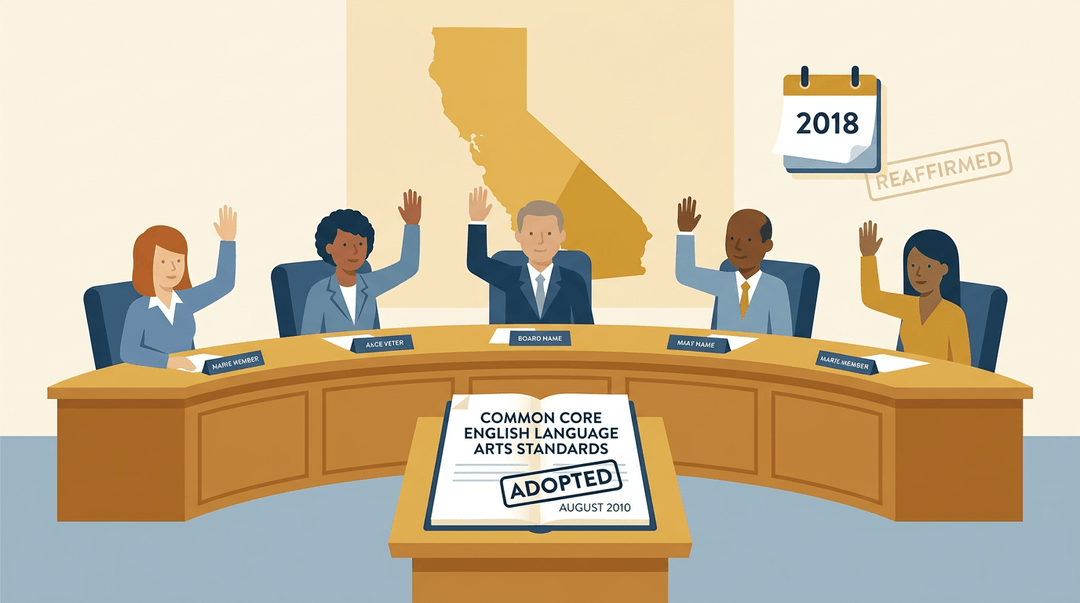
Most states adopted the Common Core English Language Arts standards in August 2010, typically through a formal state board of education decision.
California, for example, saw its State Board of Education adopt the standards unanimously in August 2010, replacing its prior English language arts and math content standards.
Many states reaffirmed that commitment in 2018, when later revisions refined grade-level expectations without changing the standards' core structure.
Finding gaps between old and new standards
Before full rollout, states leaned on groups like WestEd to run a gap analysis between the new standards and what teachers had used before.
A comparative analysis of prior state standards against the Common Core identified specific instructional gaps, places where old curriculum maps simply didn't cover a skill the new standards expected.
Those findings fed directly into state recommendations for reconciling the two, so districts weren't left guessing what to drop and what to keep.
Blending Common Core with state requirements
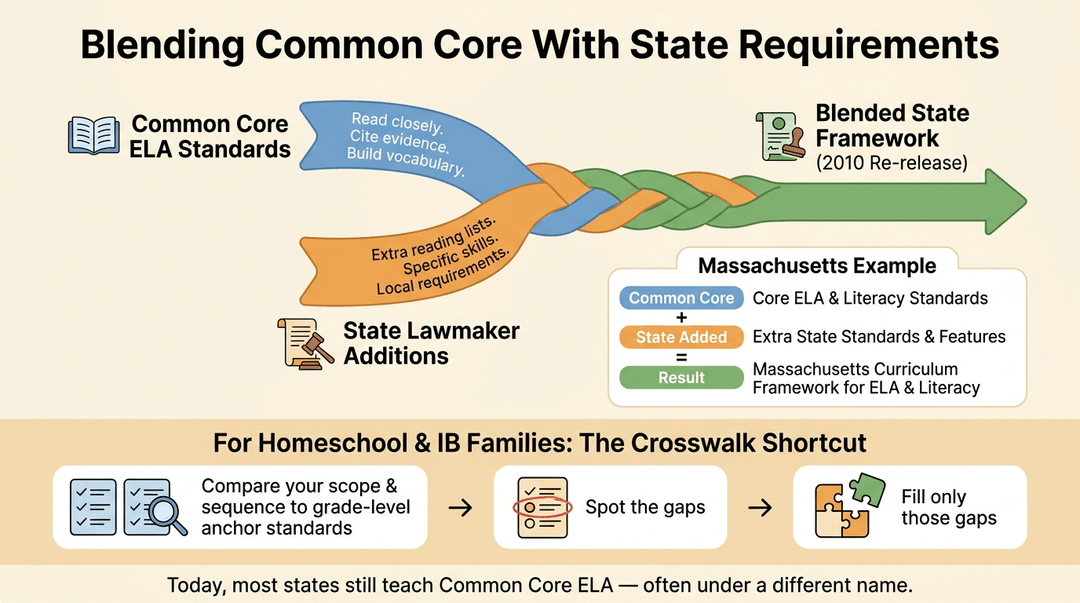
Once gaps were flagged, state subcommittees got to work. They weren't just swapping one set of standards for another, they were blending Common Core language with state-specific additions and legislated components lawmakers wouldn't let go of.
Massachusetts is a clear example: its revised framework merged Common Core English language arts and literacy standards with additional state standards and features. Many states issued a re-released version of the standards in 2010 reflecting this blend.
For homeschool families and IB (International Baccalaureate) programs, the practical move is a quick crosswalk: match your current scope and sequence to the strand and grade-level anchor standards, then fill only the gaps.
Today, the vast majority of states still use the Common Core ELA standards in some form, often under a state-specific name.
Helpful Resources for Learning the Standards
You don't have to decode the language arts standards on your own. A handful of trustworthy resources can save you hours of guesswork and get you straight to the practical work of planning.
Where to find official standards resources
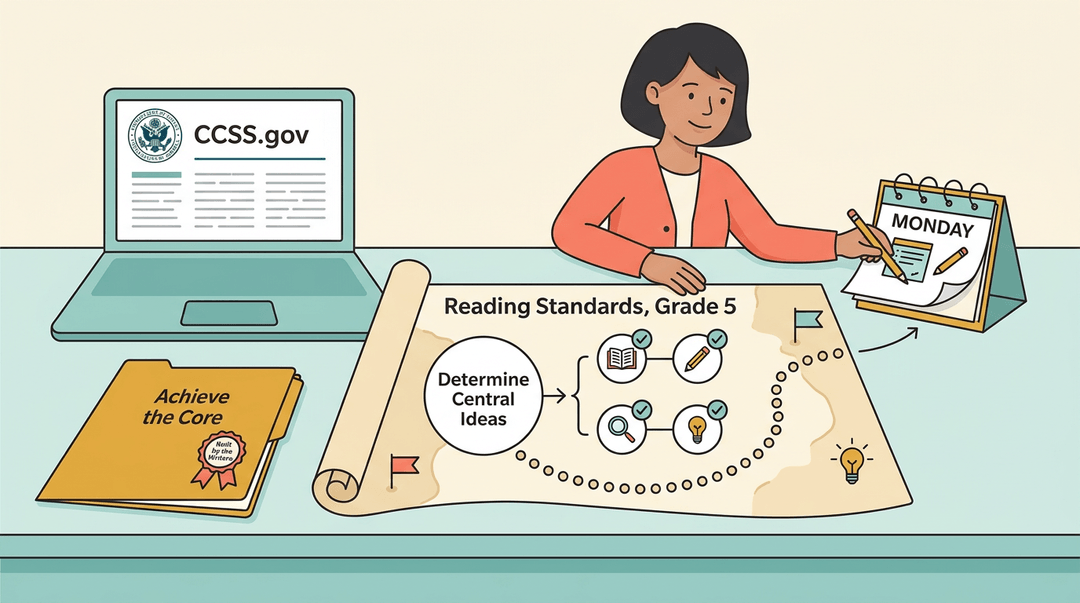
Start with the source itself: the official CCSS website lays out every strand and grade-level standard in full, free to browse anytime.
It's hosted by the Council of Chief State School Officers (CCSSO) and the National Governors Association (NGA), the two organizations that coordinated the standards' development, so you know you're looking at the real document and not someone's paraphrase of it.
For resources that go beyond the raw text, Achieve the Core is worth bookmarking.
It was founded by the lead writers of the Common Core standards and offers professional learning materials built specifically to help teachers put the standards into classroom practice.
As William McCallum, a lead writer of the CCSS, explains, "the coherence and focus of the Standards were designed to help teachers succeed in the classroom."
That's the resource we'd point you to first: built by the people who wrote the standards, for the people who teach them every day.
One of the most useful things these resources help with is unpacking standards into learning targets: breaking a broad standard like "determine central ideas" into the smaller, teachable skills students actually need along the way.
Think of a fifth-grade teacher turning one reading standard into three or four daily objectives, each a concrete step toward the bigger goal, rather than trying to teach the whole standard in a single lesson.
However you feel about standards in general, the ELA Common Core gives you a shared map: where students have been, and where they're headed next.
Knowing the strands, the anchor standards, and how your state adopted them turns that map into something you can actually use on Monday morning.
Ready to turn these standards into real lesson plans? Check out our Curriculum & Standards feature to plan units and lessons aligned to standards across your whole school year.
References
- Why the Common Core State Standards in California? — cde.ca.gov
- Common Mathematics Standards in the United States — exa.ai (2013)
- Massachusetts curriculum framework for English language arts and literacy: grades pre-kindergarten to 12: incorporating the Common core state standards for English language arts and literacy in history/social studies, science, and technical subjects — exa.ai (2011)
- The Common Core State Standards Shifts in Mathematics — achievethecore.org