Types of Note-Taking Strategies and How to Use Them

Jump to section
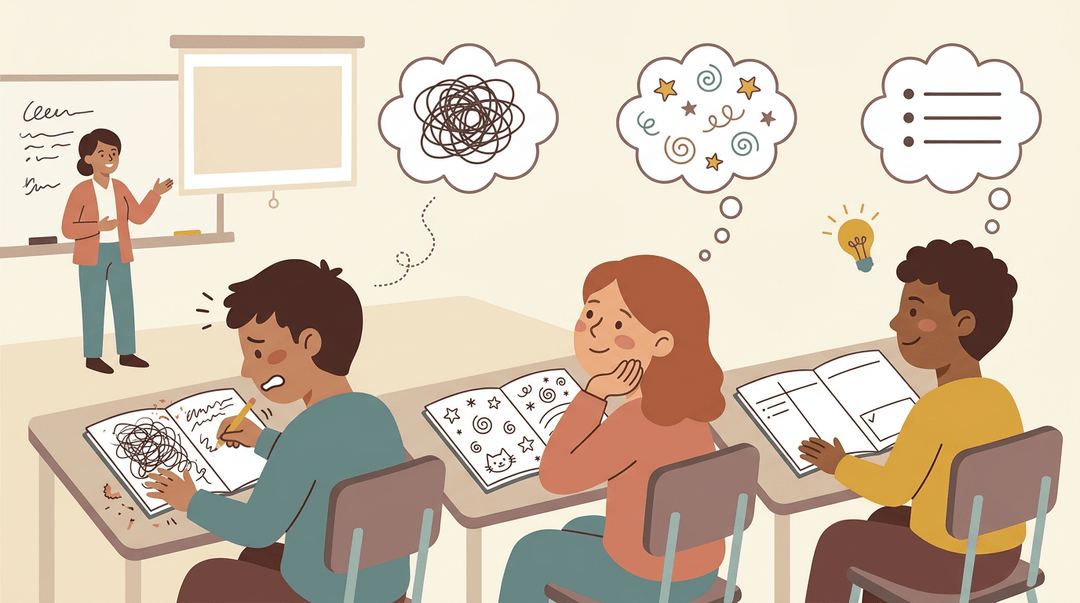
Think about the last time you sat through a long lecture. Some students scribbled every word, others doodled, and a few walked out with a clear summary. The difference often came down to strategy.
A note-taking strategy is a repeatable method for capturing, organizing, and reviewing information so it sticks.
In this post, we'll break down the major methods, answer your questions about the 5-method, 7-method, and 5 R's approaches, and help you pick the right fit. We'll close with a classroom routine you can use to teach these skills.
Why and When to Use Note-taking Strategies
Good notes are less about what students write down and more about how they think with it. Here's why that matters, and when it pays off most for you.
How good notes help you learn
Taking notes keeps students mentally engaged. Deciding what matters keeps attention on the lesson instead of drifting, which is the heart of active note-taking.
Rephrasing ideas in their own words also supports comprehension and retention, because that's the thinking that makes information stick.
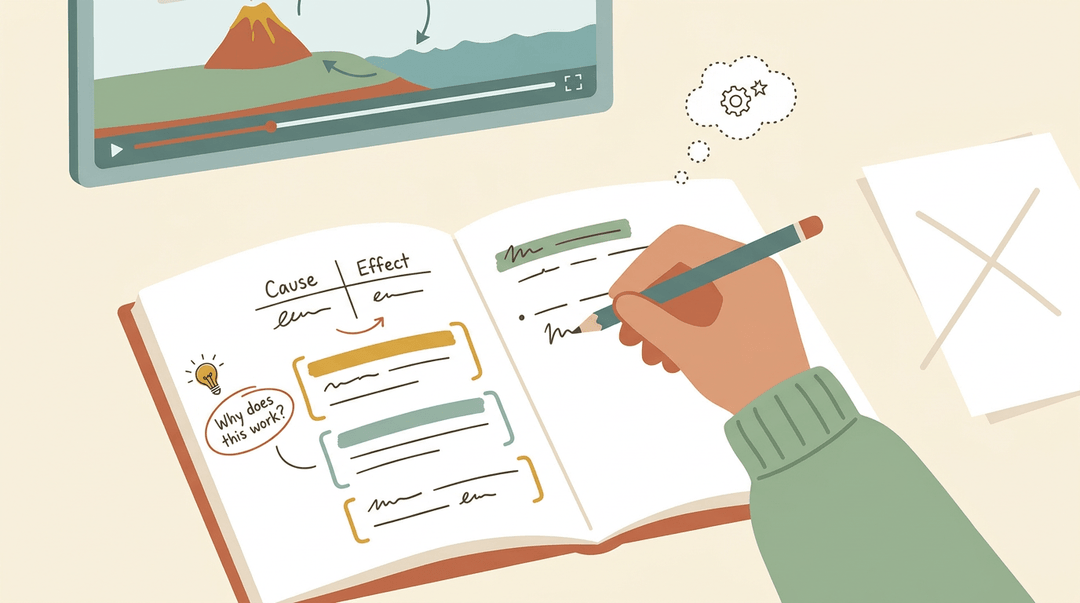
Consider a seventh-grade science teacher who asks students to jot one cause and one effect after each video segment. On test day, those notes give students a starting point for review, not a blank page.
Notes also build critical thinking and organization. Sorting ideas into categories, connecting them, or asking "Why does this work?" in the margin turns copying into analysis. That's thinking, not transcription.
When taking notes helps most
The source shapes the strategy, so we'll look at three common settings:
- Lectures and online videos: Students can't always keep up with a speaker, so notes capture key points as they arrive. Online videos let students pause and rewind, so jotting notes after each segment works well.
- Reading books or papers: Students set their own pace, so notes can track each section's main idea along with questions to revisit.
- Group discussions: Notes record who said what, which claims had evidence, and which questions stayed open, giving the group a shared record.
What Are the 5 Different Note-taking Strategies?
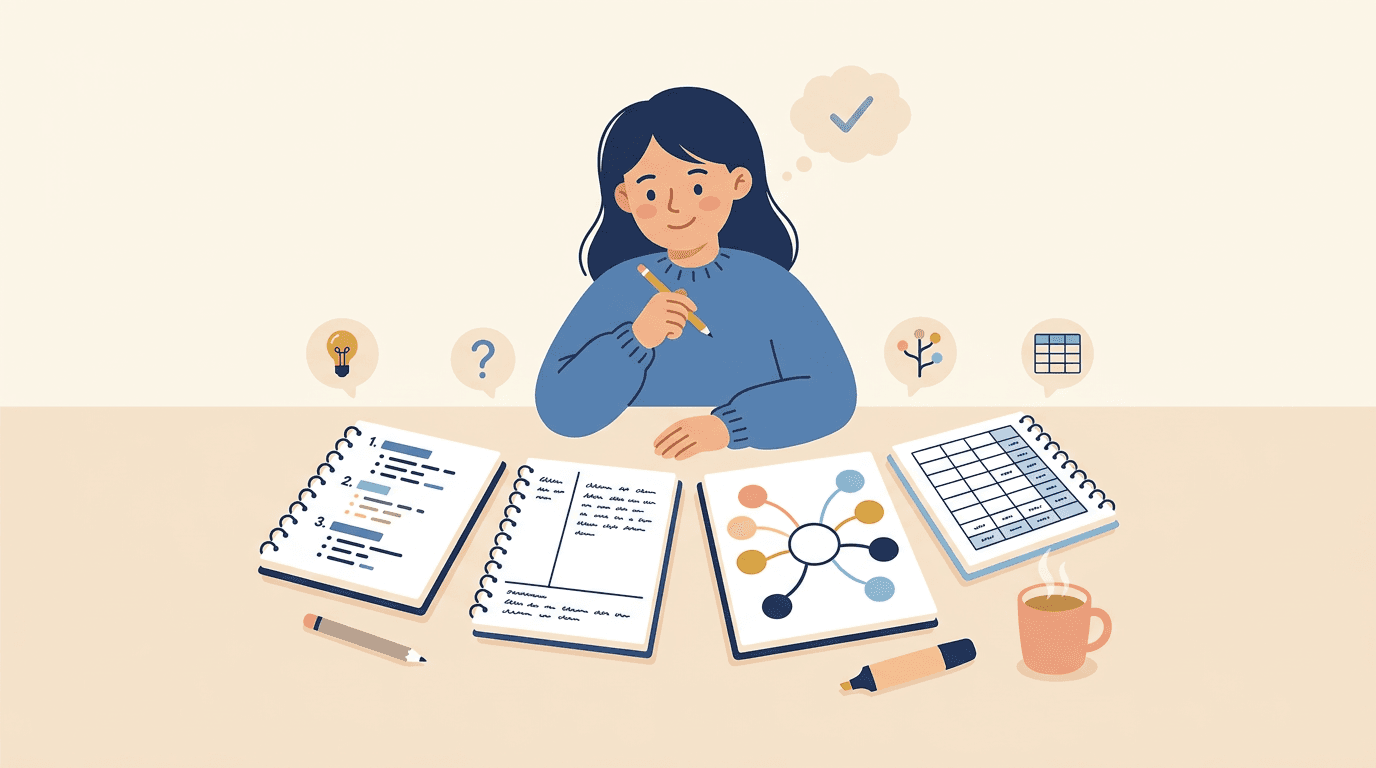
The five core strategies are the Cornell split page, the nested outline, columns and rows, visual mapping, and one idea per numbered line. The sections below add boxes and newer systems, for seven methods in all.
Matching the method to the material matters more than picking a favorite.
Split your page the Cornell way
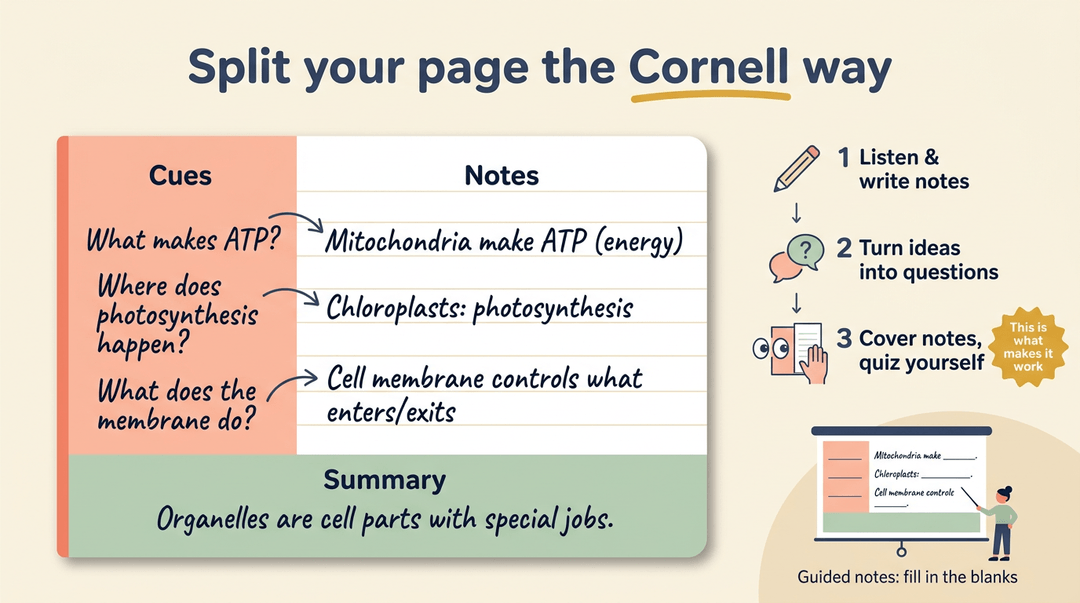
The Cornell method splits each page into a narrow cue column for keywords or questions, a wide notes area, and a summary at the bottom.
Students listen actively, writing notes in the wide column and turning main ideas into cue-column questions, so they're thinking while they listen, not just copying.
After class, they cover the notes and quiz themselves using only the cues. That self-testing step is what makes the page work, and a ready-made template keeps the layout consistent from one lesson to the next.
Consider a high school biology teacher who models Cornell with guided notes, projecting a partly filled page during the first unit. Students fill in the blanks, so no one stares at an empty page on the first day. Modeling a method first is one of many teaching strategies every educator can use.
Build notes as a nested outline
A nested outline uses hierarchical bullets or indents: main topics sit at the left margin, and supporting details step in beneath them.
It suits linear thinkers who like order, and review is easy because students scan the top-level headings and check what sits under each. The structure does the organizing, so students follow it rather than building it from scratch.
Sort facts into columns and rows
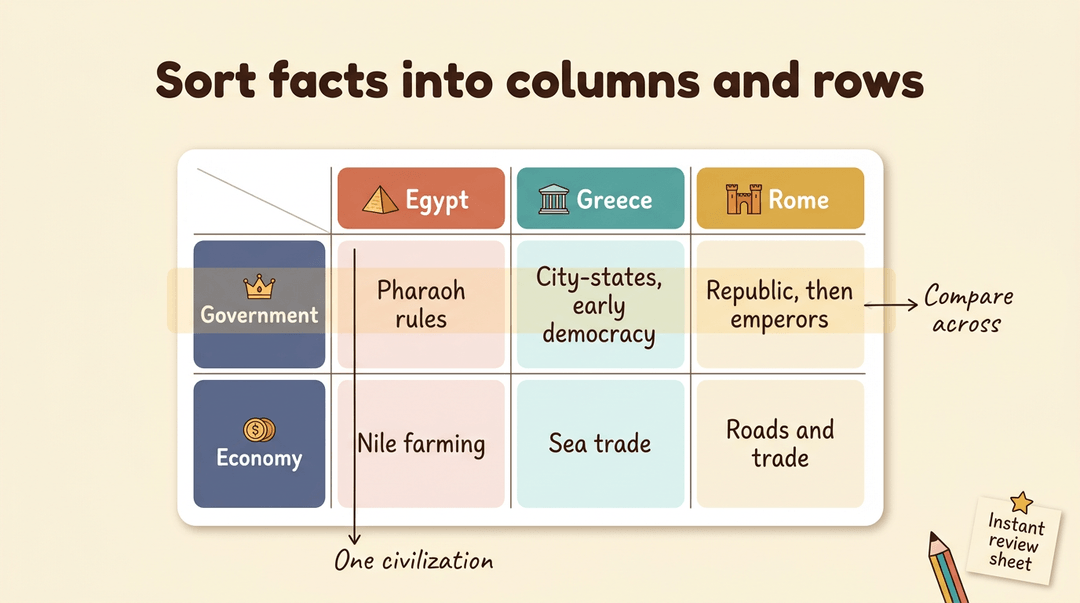
Columns and rows let students line up facts side by side, which makes comparing facts and categories straightforward.
A middle school history class comparing three early civilizations might list categories like government and economy down the rows, with one civilization per column.
The finished grid doubles as a quick-review sheet, which makes this method a strong fit for fact-heavy content.
Map ideas visually with branches and flows
Mapping places a central topic in the middle of the page, with branches reaching out to subtopics and arrows showing how they link. Its strength is the visual relationships: students see connections a list might hide.
It suits visual learners and brainstorming, especially when the goal is to connect ideas rather than record them in sequence.
Write one idea per numbered line
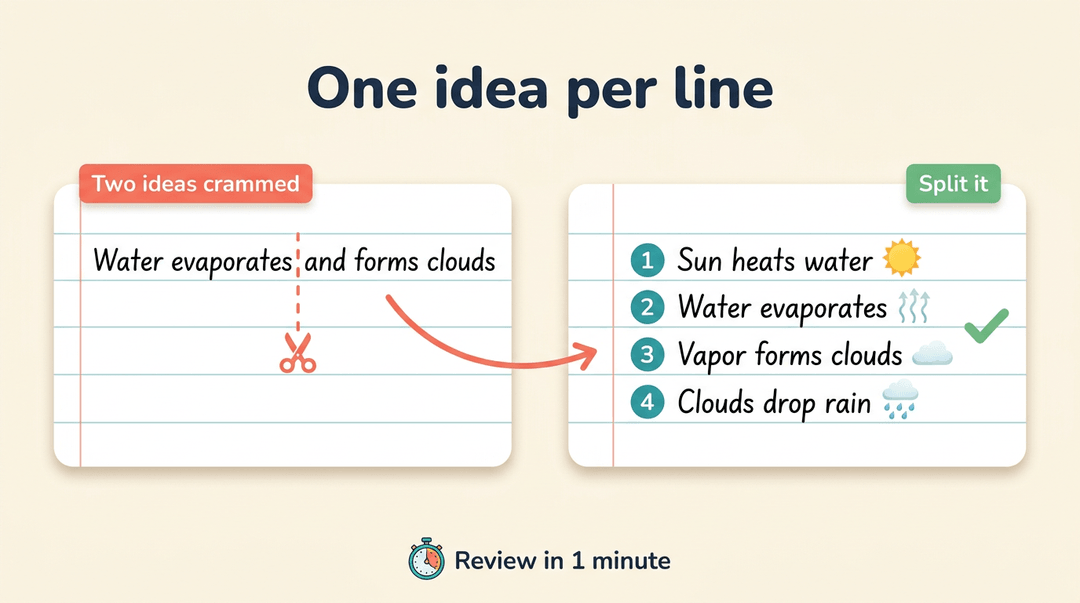
Students write one idea per line and number each point as it arrives, which suits fast-paced lectures. If a line holds two ideas, split it.
A fifth-grade teacher racing through the water cycle might end up with a short numbered list students can review in a minute. Simple and quick wins.
Group topics into boxes for quick review
Give each topic its own box to create a visual, at-a-glance summary that's especially useful for revision. Color-coding adds another layer: one color per unit makes related boxes stand out.
A seventh-grade math teacher might use that so students can spot the whole term's pattern before the test.
Newer systems like Zettelkasten and AI tools
Newer approaches go beyond the single page. A Zettelkasten is a card system where each note holds one idea and links to related cards. Progressive summarization revisits notes in layers, condensing them so the most important ideas rise to the top.
AI-assisted note-taking can help capture and organize material, but students still need to check what it produces. A hybrid approach blends methods, such as a Cornell page for the lecture and a map for connections afterward.
You may also hear the Harvard method mentioned. It's worth recognizing the name, though this section doesn't walk through its steps.
What Are the Best Note-taking Strategies?
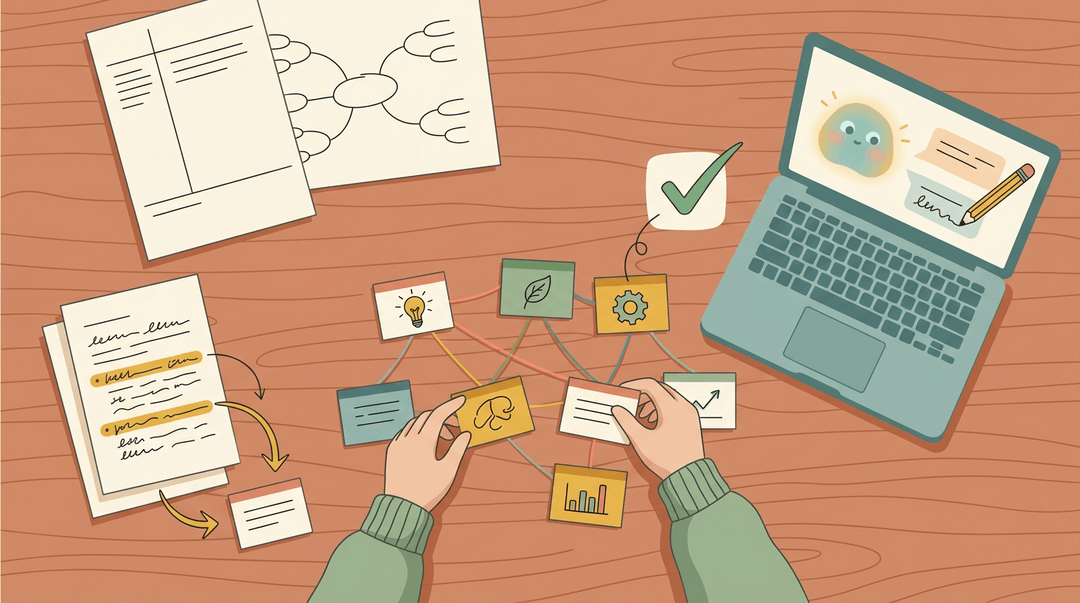
For most classrooms, the strongest all-around note-taking strategies are Cornell notes, outlining, and mapping. The right fit depends on the learner, the lecture, and the goal.
Suit the method to learner and goal
Visual thinkers often do well with maps, auditory learners with fuller notes they can read back, and hands-on learners with notes they can rearrange.
Notes meant for retention, like quiz terms, differ from notes meant for understanding, like a cause-and-effect map.
No method is universally best, so let trial and error decide. Students test two on the same lesson, then keep the one they can study from. Their own results beat any rule.
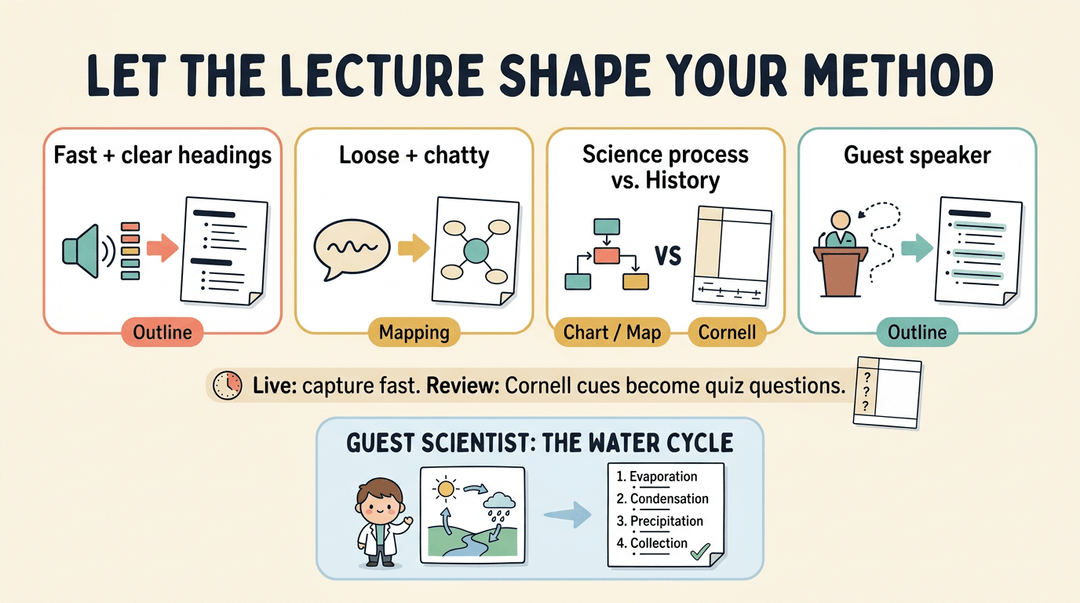
Let the lecture shape your method
Here's how the lecture should guide you:
- Speed and organization. Fast lectures with clear headings suit an outline; loose, conversational ones suit mapping.
- Subject. Science processes suit charting or mapping, while history's dates and causes suit Cornell notes.
- Live lecture vs. revision. Capture fast in class; when reviewing, Cornell's cue column becomes quiz prompts.
- Guest lecturers. Unfamiliar speakers may wander, so an outline keeps the main points clear.
Picture a science teacher whose class hosts a guest scientist on the water cycle. Students using an outline, with a heading for each stage, end up with a clean study sheet.
Weigh each method's pros and cons
Visual methods like mapping use space and images, structured ones like Cornell notes use headings and order, and hybrids blend the two.
| Method | Advantages | Disadvantages | Best use case |
|---|---|---|---|
| Cornell notes | Built-in review | Slow to set up | Studying for tests |
| Outline | Quick and easy to follow | Can hide connections | Organized lectures |
| Mapping | Shows relationships | Messy when fast | Grasping concepts |
| Charting | Side-by-side comparison | Needs a clear pattern | Comparing categories |
Teach Note-taking Strategies in Your Classroom
Use this playbook to teach one note-taking method at a time, then turn it into a habit. Stay with a single method for a few lessons before you add another.
Introduce one method at a time
- Model with a think-aloud
- Say: "I'm skipping the full sentence. I'll write 'plants make food from light' in my own words."
- Write on the board as you speak, so students see what you keep and cut.
- Hand out a partially filled template
- Fill in the headings and the first entry. Leave the rest blank.
- Practice on a short mini-lecture
- Teach for a few minutes, stop, and let students finish their notes.
Example: A seventh-grade science teacher models Cornell notes on a five-minute talk about the water cycle. She hands out a page with the cue column started, then students complete it after a second mini-lecture on clouds.
Resist adding a second method until students can use the first without the template.
Adjust for each grade level
| Grade band | Method to teach | Your first move |
|---|---|---|
| Elementary | Simple graphic organizers | Use a main-idea box with three detail boxes |
| Middle school | Cornell basics | Draw the cue column and summary space together |
| High school | Choose-your-method | Offer two or three methods; students pick one |
For high schoolers, ask them to justify the pick. Say: "Why does this method fit today's material?"
Make it a regular habit
Quick notes check. Walk the room for one minute and look at one thing only, such as "Does every page have a date and a heading?"
Pair-share comparisons. Students swap notes with a partner.
- Try: "What did your partner catch that you missed?"
Weekly self-testing. Once a week, students cover the main column and answer their own cue questions from memory.
- Anything they miss goes on next week's review list.
💡 Tip: Keep the notes check ungraded. Students then write for themselves, not for a score.
Your checklist for every lesson
Before class, confirm you've planned to:
- Pause for note-taking: stop after each chunk so students can write.
- Post key terms visibly: keep them on the board so students spell and use them correctly.
- Share a summary after class: students compare their notes against yours and fix gaps.
Plan note-taking routines into your lessons and share templates with students using EMStudio's lesson planning tools.
Capturing Notes During Class
Good notes start while the lesson is still happening. Here's how to help students catch what matters without losing the thread.
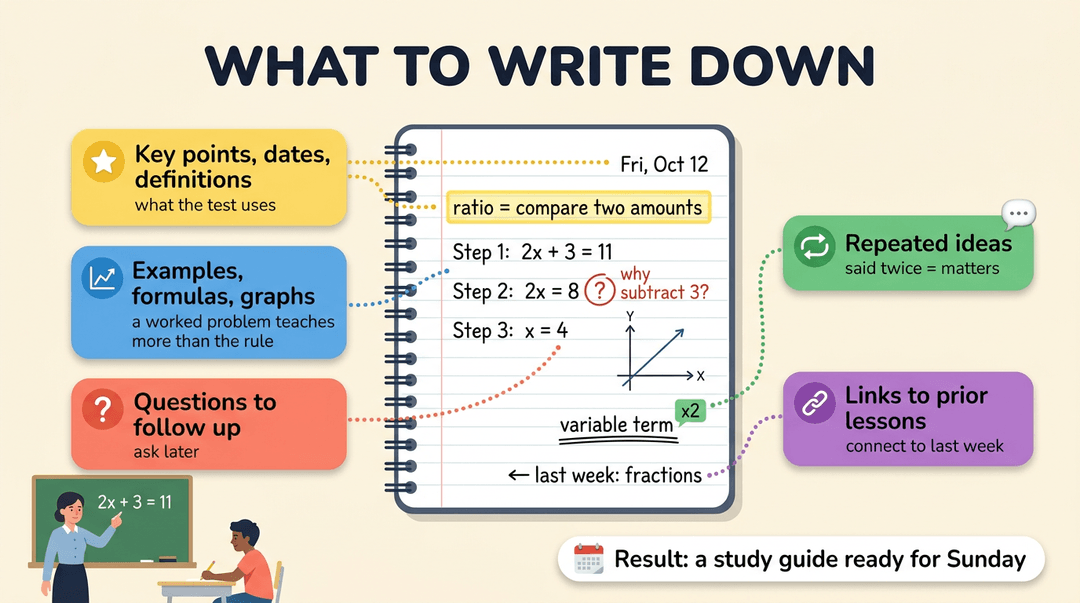
What to write down
Students can't capture everything. Teach them to record:
- Key points, dates, and definitions: the facts a test will rely on.
- Examples, formulas, and graphs: a worked problem often teaches more than the rule.
- Questions to follow up: anything unclear, so it can be answered later.
- Repeated ideas: if the teacher says it twice, it probably matters.
- Links to prior lessons: a quick connection to last week.
Consider a seventh-grade math teacher solving a problem on the board. A student who notes each step and marks the confusing one has a study guide ready for Sunday.
Write quickly with shorthand and phrases
Students don't need polished sentences.
- Abbreviations and symbols: “w/” for “with,” “=” for “equals,” and “→” for “leads to.”
- Phrases, not sentences: keep the key words and drop the filler.
- Bullets and shorthand: nest details under one main point.
- Avoid copying everything: copying every word is a common mistake that leaves no room to think. Notes are a tool, not a transcript.
Think of a high school biology student who writes “Photosynthesis: sunlight → plant food” instead of a full sentence. She's ready for the next point in seconds.
Notice the signals that mark key ideas
Signals help students hear why a point matters, not just what was said.
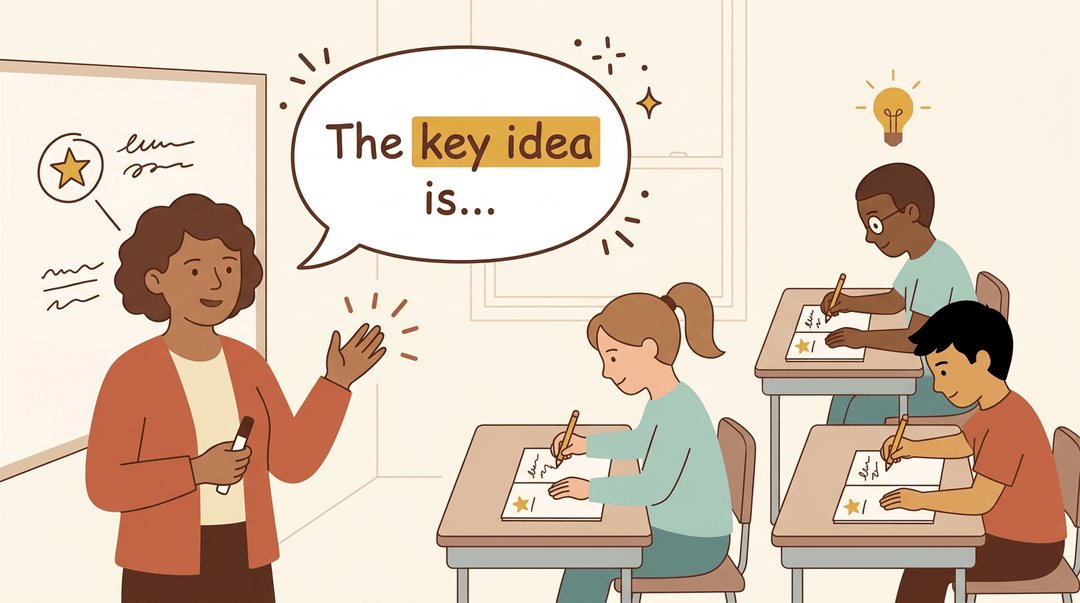
- Signal phrases: “The key idea here is” or “Remember that.”
- Introductions and summaries: the opening and closing minutes preview and recap key ideas.
- Repetition: a point you return to is worth writing down.
- Non-verbal cues: a pause, a change in pitch, or a teacher walking to the board.
Teach students your signal phrases by naming them on day one. Then point them out whenever you use them.
Taking notes from online lectures
Online lectures take away easy fixes, like raising a hand, so students need a plan.
- Watch in real time first: watch once straight through, without pausing, for the big picture.
- Timestamp notes: write the video time beside each idea.
- Rewind to fill gaps: rewind to a missed spot instead of guessing.
Picture a student watching a recorded chemistry lecture. She writes “14:30: balancing equations” and returns to that spot later, instead of replaying the whole video.
Handwritten or Digital Notes, Compared
Both options capture a lecture, but they shape thinking differently. Here's how we'd weigh them and choose a tool that fits your students.
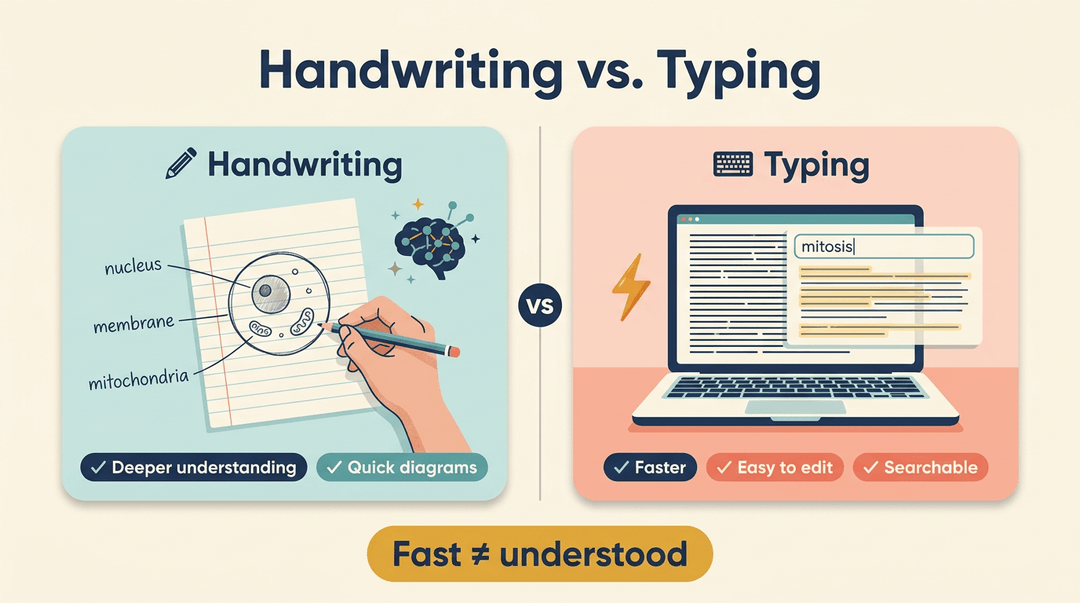
Weighing handwriting against typing
A high-density EEG study published in Frontiers of 12-year-olds and young adults points to handwriting as an aid to conceptual learning. It's less about how much gets written and more about how students process it.
Typing is faster, though. A student who types can keep up with a fast-moving lecture. Speed is useful, but it isn't the same as understanding.
Diagrams are easier by hand, too. Consider a high school biology teacher who asks students to sketch a cell during the lesson. A quick drawing with labels takes a minute, while fiddling with a drawing tool slows everyone down.
Digital notes are easier to edit and search. Students can reorganize a messy page, then find every mention of mitosis across a semester in seconds. That's a real help when test day arrives.
Pick a digital app for your notes
Going digital doesn't mean giving up your method. Most of the strategies in this article can be rebuilt in a digital app, so students keep the structure they already learned.
Many apps offer a free version alongside a paid upgrade. Test the free option with your class before asking families to pay for anything.
Syncing keeps notes in step across devices, so the page a student started in class is waiting on their phone at home.
Students can mark up a PDF handout or slide deck directly, highlighting key points and adding their own questions instead of copying everything onto a fresh page. That's one less page to lose.

Prepare and Organize Your Notes
Good notes start before class, and they stay useful only when students can find them later. You can build both habits from day one.
Getting ready before class
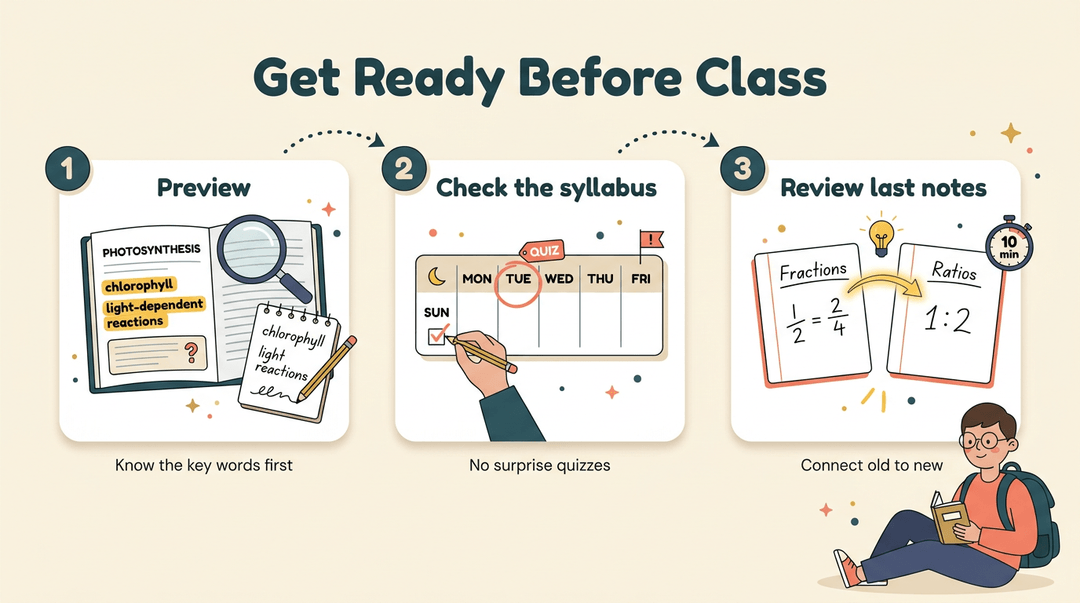
Before a lesson, students can skim what's coming. Previewing means scanning headings, bolded terms, and end-of-chapter questions so new material has a place to land.
A student who previews a chapter on photosynthesis listens for “chlorophyll” and “light-dependent reactions” and jots them down without scrambling.
Next, students should check the syllabus for due dates, quizzes, and upcoming units. It's the roadmap for the week ahead. A quick look on Sunday night means no surprise Tuesday quiz.
Finally, review previous notes before each class. Ten minutes with yesterday's page connects today's lesson to what students already know. Consider a seventh grader who rereads last week's fraction notes before a lesson on ratios.
She spots the link right away and builds on it in class.
Keep your notes tidy and consistent
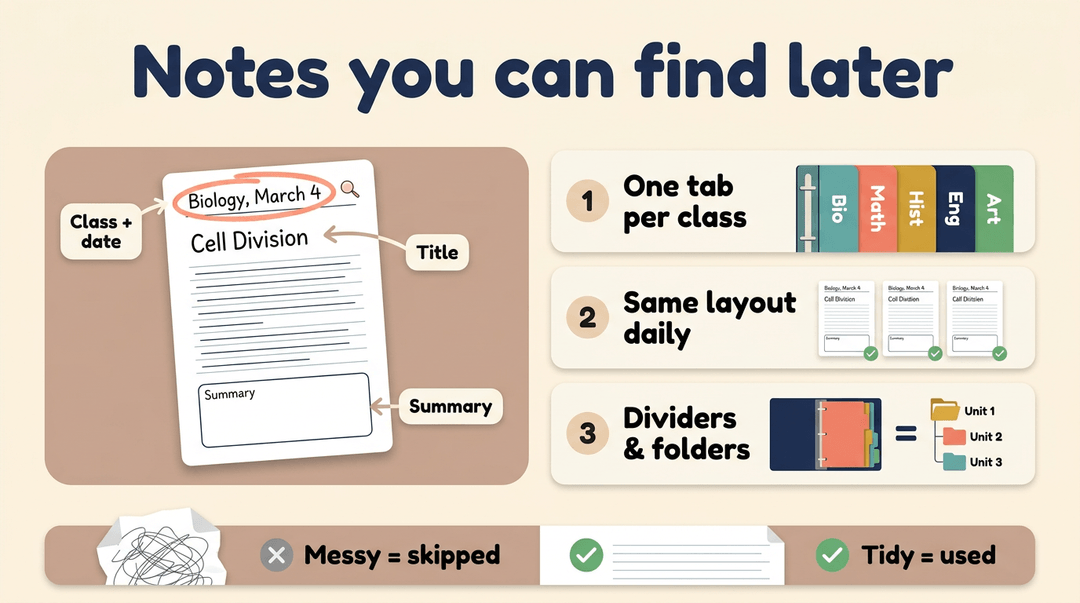
Start every page with a title that includes the class and date, so “Biology, March 4” is findable in seconds. The goal is notes students can find later, not notes that look perfect today. Messy notes get skipped. Tidy ones get used.
Three habits keep the system running:
- Separate sections per subject. Give each class its own notebook tab or digital folder so nothing bleeds into the next period.
- Use a consistent structure. Pick one layout (date, title, then a summary space) and use it every day.
- Add dividers or folders. Physical dividers separate units in a binder, and digital folders do the same on a shared drive.
Reviewing and Following Up
Taking notes is only half the job. What you do with them afterward makes them useful, so here's how to review, fill gaps, summarize, and test yourself.
Review your notes within a day or two
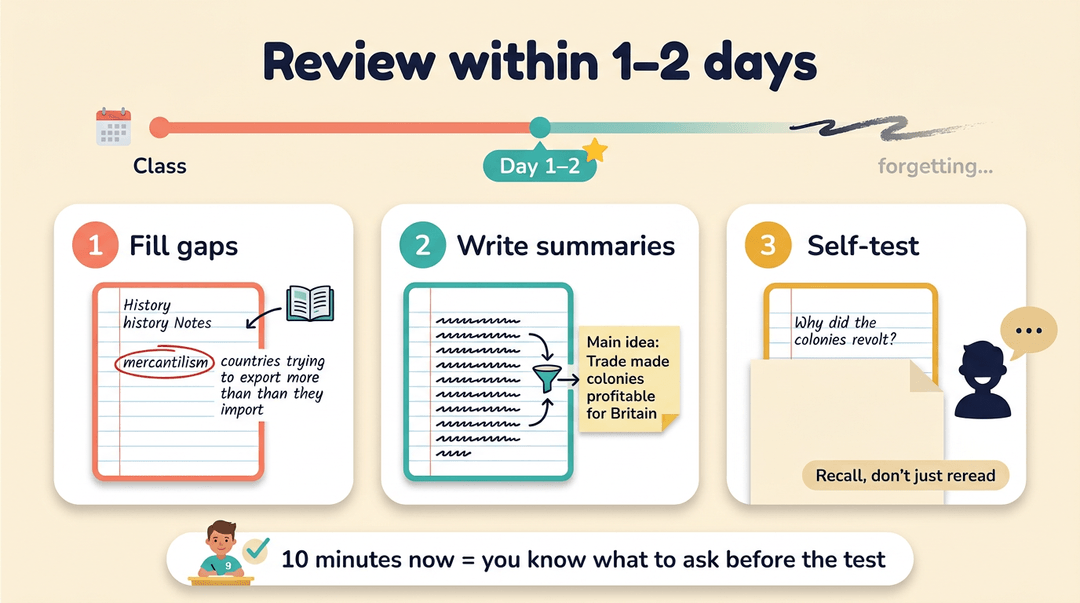
Look over your notes within a day or two, while the lesson is still fresh. Consider a ninth-grade student who spends ten minutes after history class marking anything she can't explain. When the unit test arrives, she already knows which questions to ask.
Use that pass to fill gaps. Circle anything unclear, then check your textbook and write a plain-language definition beside each unfamiliar term.
Next, write summaries. Sum up each page's main idea in a sentence or two. Deciding what matters most takes effort, and that effort is the point.
Finish with self-testing. Cover your notes and explain each idea out loud, or turn headings into questions. The goal is to recall the material, not just recognize it on the page.
What are the 5 R's of note-taking?
The 5 R's are a five-step routine: record, reduce, recite, reflect, and review.
- Record: capture the main ideas during the lesson.
- Reduce: condense them into key points and questions.
- Recite: say the key ideas out loud or write them from memory.
- Reflect: connect each idea to something you already know.
- Review: return to your notes regularly.
Each step builds on the one before it. If a note stays fuzzy, bring it to your teacher's office hours and ask one specific question.
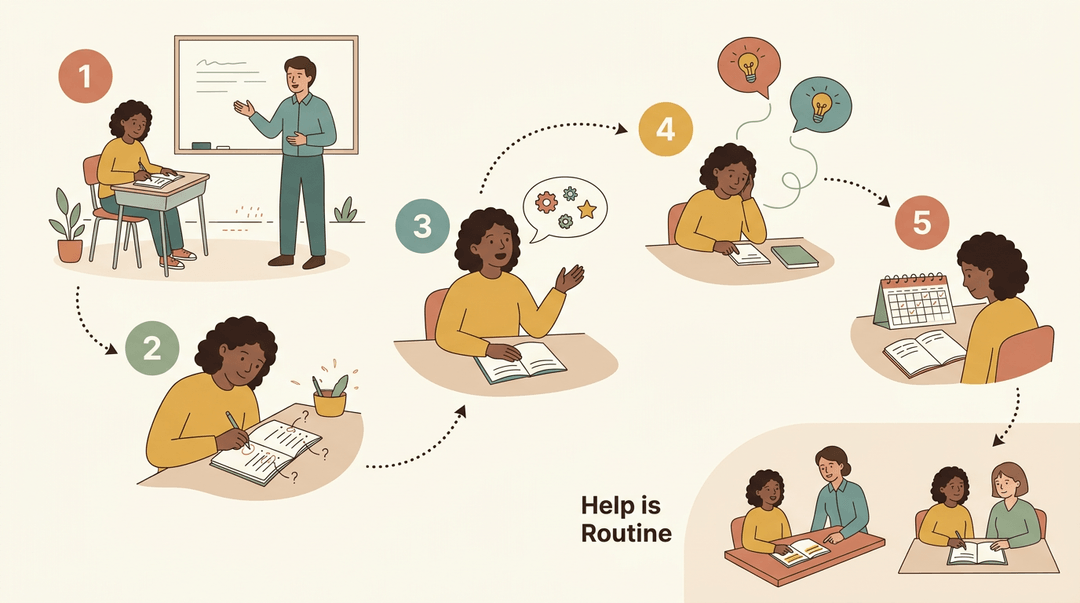
Students who get stuck across several topics can also meet with an academic coach, who can work through the notes step by step. Help is part of the routine.
The best note-taking strategy is the one your students actually use. Whether they choose a structured format, a simple outline, or a digital tool, the goal is the same: capture the key ideas, make them their own, and come back to them later.
Teaching these skills explicitly, with a routine you can repeat, turns note-taking from a guessing game into a habit.
Ready to bring that same structure to your whole school day? Check out our Classroom Management page to organize your classes, sections, rosters, and timetables in one workspace.
Frequently asked questions
What are the 5 different note-taking strategies?
The five core note-taking strategies are the Cornell method, a nested outline, columns and rows, visual mapping, and one idea per numbered line. Choose based on the material and whether you need to capture sequence, compare facts, or show connections.
What are the 7 effective note-taking methods?
Seven useful methods are Cornell notes, nested outlining, columns and rows (charting), visual mapping, one idea per numbered line, topic boxes, and a hybrid approach that combines methods. Each has different strengths, so choose one that fits the subject, lecture, and study goal.
What are the best strategies for note-taking?
Cornell notes, outlining, and mapping are strong all-around choices. Use outlining for organized or fast-paced lectures, Cornell notes for structured review and self-testing, and mapping to show relationships between ideas. The best choice depends on the learner, material, and goal, so try different methods and keep the one that is useful to study from.