Mind Mapping for Visual Learners: A Complete Guide


Jump to section
Think about the last time you untangled a string of holiday lights. You didn't trace one wire from end to end. You spotted the knots, followed the branches, and made sense of the whole tangle at a glance. That's how a mind map works too.
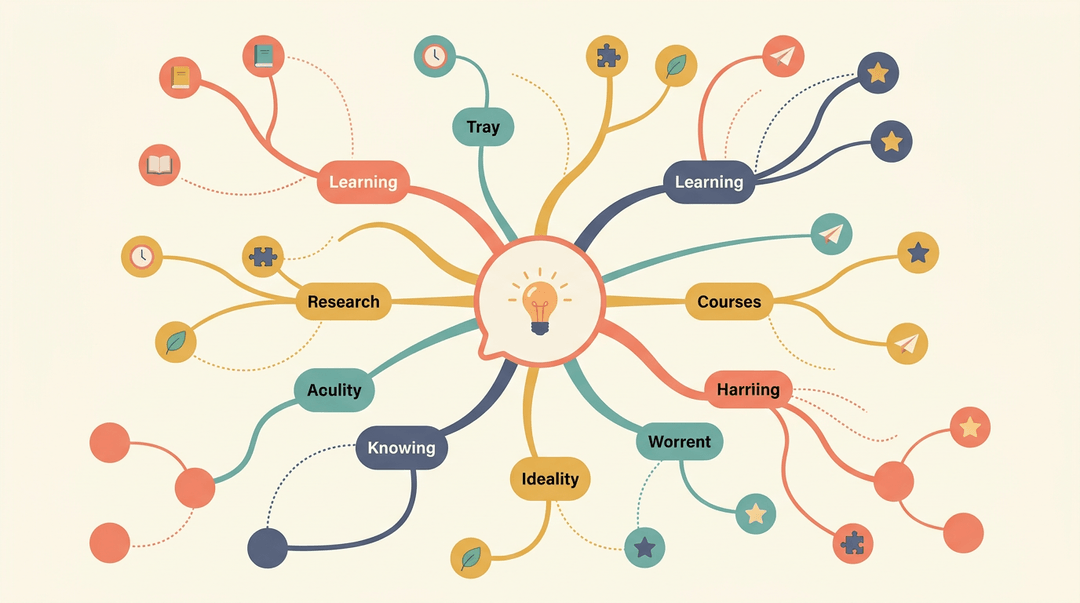
A mind map takes a central idea and branches it into related concepts, using color, shape, and space instead of straight lines of text. For visual learners, that layout isn't a nice extra. It's how ideas actually stick.
Here's what mind mapping looks like in your classroom, step by step.

What Mind Mapping Means for Visual Learners
Picture a spider web spreading out from its center: that's roughly how a mind map works for a visual learner's brain. It lets students see how ideas connect instead of just reading them in order.
How mind maps branch from one idea
A mind map starts with a central idea sitting in the middle of the page, then branches outward in every direction. Unlike a list marching top to bottom, this non-linear visual diagram radiates outward the way a network of neurons fires and connects.
Each branch carries a keyword or small image rather than a full sentence, so a glance at the page catches the idea, not just the words.
The theory and history behind mind maps
British author Tony Buzan popularized the technique and trademarked the term, though branching diagrams predate him.
His claims lean on Sperry's hemisphere research, which found that the brain's cortex splits into two hemispheres handling different intellectual, or "cortical," tasks, giving mind maps their reputation for engaging both sides of the brain at once.
Buzan compared a mind map to a city map: both let you see the whole layout, then choose your own route through it. He outlined five essential characteristics:
- a central image
- branching themes
- connecting lines
- keywords or images on each branch
- an organic, flowing structure
How mind maps differ from linear notes
Traditional notes move top-down, one thought following another. A mind map skips that lockstep order and mirrors how the brain actually stores information: through association, not sequence. That doesn't make linear notes obsolete.
Plenty of teachers use a mind map to plan a unit, then switch to linear notes for the fine details, letting each method do what it does best.

Why Mind Mapping Boosts Learning
Mind mapping isn't just a prettier way to take notes. It works with how your brain actually stores and retrieves information, and that pays off in your classroom in five distinct ways.
Boosting memory and recall
Mind maps beat plain note-taking when it comes to remembering what you learned.
A systematic review published in Frontiers points to earlier studies by Farrand and by researchers at Johns Hopkins, noting: "It found that mind mapping could improve long-term factual recall of written information."
Separately, a review of mind map research on PMC found that mind maps "significantly improved knowledge retention and recall" compared with note-taking.
Part of the reason is multi-sensory engagement: color, spatial layout, and imagery all give the brain more hooks to hang information on.
Mind maps also naturally chunk information into related clusters, so students remember a handful of connected ideas instead of a wall of disconnected facts.
Sparking creativity and new ideas
Because a mind map has no fixed starting point or straight line to follow, it invites the brain to wander productively. That non-linear layout overcomes the blank-page freeze that stops a lot of writing before it starts.
For example, a student stuck on an essay topic can scribble a central idea and branch outward, often landing on an angle they'd never have found in a bulleted outline.
Ideas placed side by side this way tend to spark connections the student didn't know were there.
Building critical thinking and understanding
Mind maps force you to break a complex topic into its parts before you can draw it, which is exactly the kind of thinking that builds real understanding.
Once those parts are on the page, patterns and relationships that were hiding in dense text suddenly become visible.
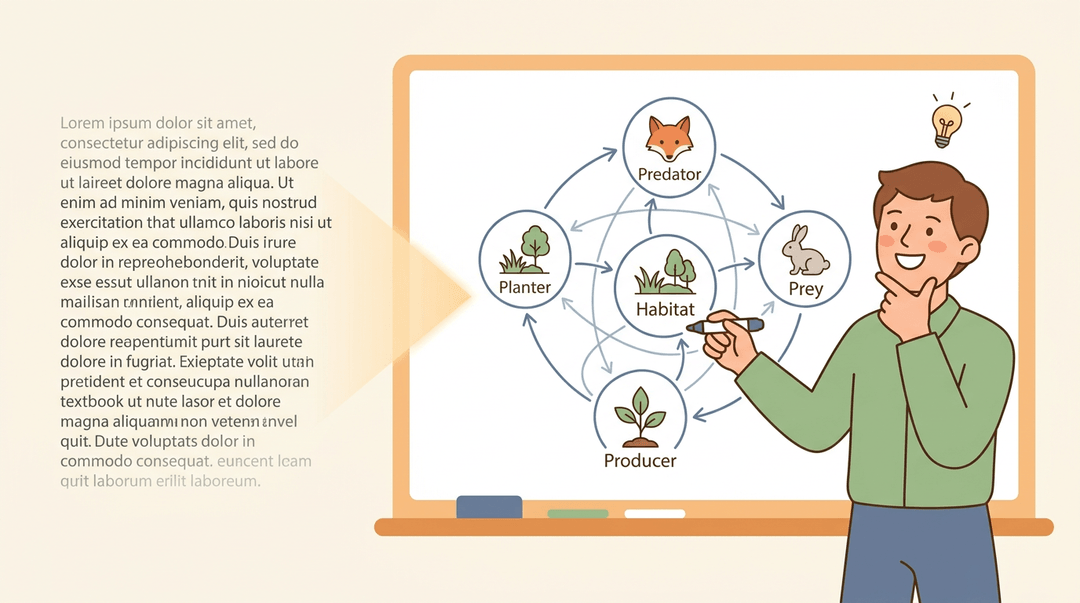
Think of a science teacher mapping out a food web: predator, prey, and habitat all connect on one page, and suddenly the problem-solving question (
How to Create a Mind Map
Knowing the theory behind mind maps is one thing. Actually building one with a class full of students is another. Here's a simple sequence that works whether you're demonstrating on a whiteboard or handing students a blank page.
What are the 7 steps to mind mapping?
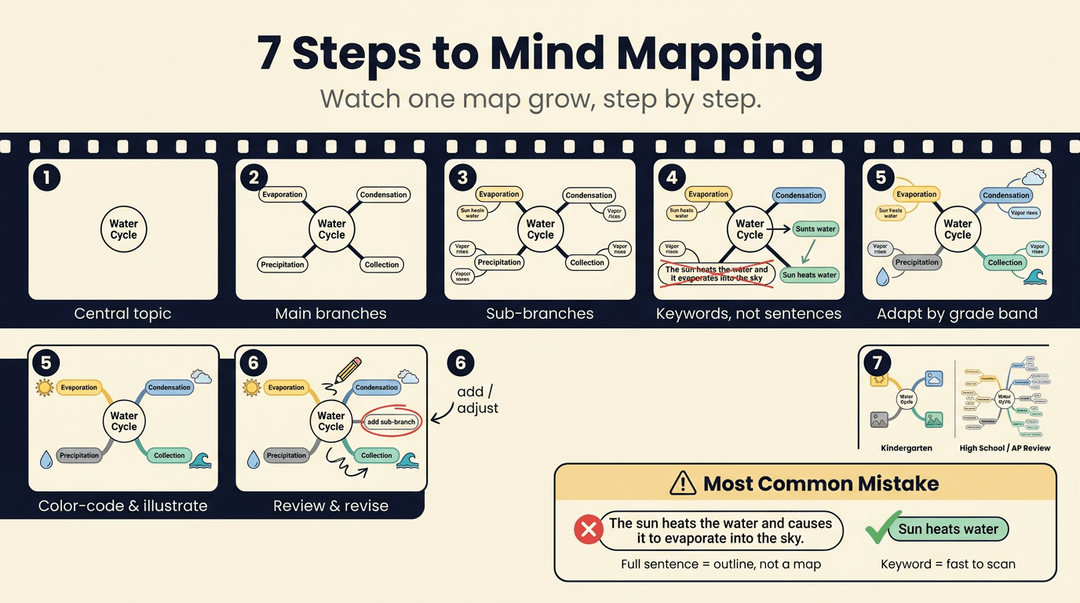
A mind map earns its shape through a repeatable seven-step framework:
- Start with a central topic. Write or draw it in the middle of the page: this is the anchor everything else branches from.
- Add main branches. These are the big subtopics, like chapter headings.
- Add sub-branches and details. Each main branch gets its own smaller offshoots for supporting facts.
- Use keywords, not sentences. A single word or short phrase per branch keeps the map scannable.
- Color-code and illustrate each branch (more on this below).
- Review and revise as understanding grows.
- Adapt the steps by grade band. A kindergarten teacher might cap a map at three thick branches with picture icons, while a high schooler builds a dozen sub-branches for an AP exam review.
The most common mistake is skipping step 4 and writing full sentences anyway, which turns a map back into an outline and erases the speed that makes mind mapping work.
Using color and images to boost recall
Color and imagery aren't decoration. Color-coding categories helps students sort ideas at a glance, and adding small icons or pictures next to keywords gives the brain a second hook to hang the memory on.
Studies summarized by UBC's Learning Commons found that mind maps using colors, pictures, and lines to show relationships between ideas significantly improve recall compared with plain note-taking.
Because every student colors and sketches their map differently, the map also becomes personal: two students can cover the same content and end up with two maps that only they would recognize.
Reviewing and revising your mind map
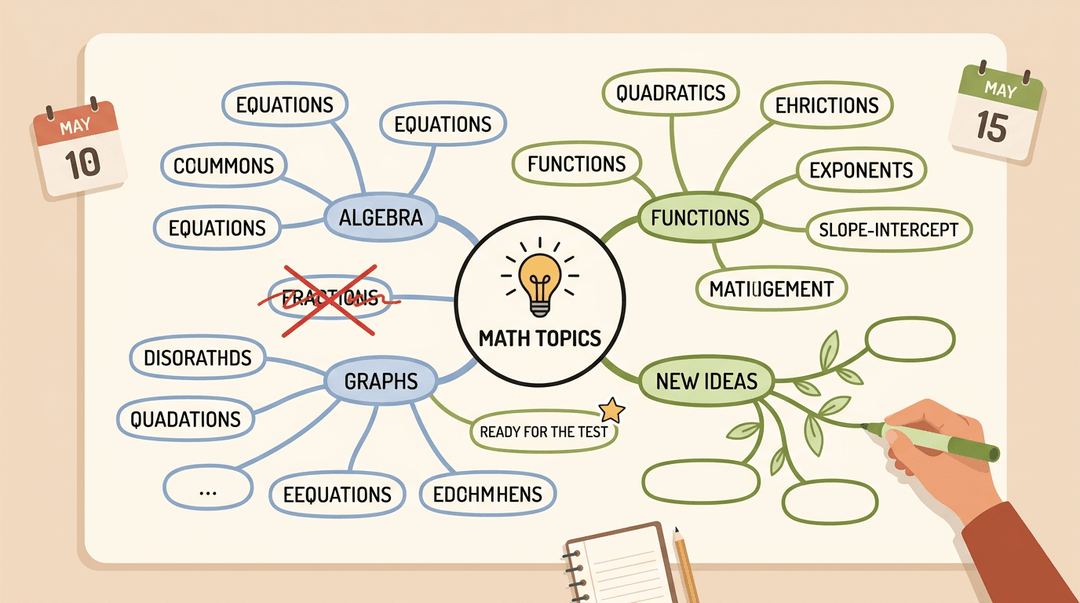
A mind map isn't finished once it's drawn. Encourage students to revisit it days later, add new branches as they learn more, and cross out anything that turns out to be wrong.
That revisiting is the whole point: it turns mind mapping into an iterative learning process rather than a one-time worksheet, and a well-revised map doubles as a ready-made test prep summary the night before an exam.
Drawing by hand or going digital
Both paper and screen work. Pen and paper offer a tactile, unhurried feel that some students focus better with, while digital tools add convenience:
- easy reordering
- unlimited space
- quick sharing
Neither beats the other. What matters is letting students choose the version that fits how they think.
Building a Mind-mapping Lesson Plan
Here's a plug-and-play lesson you can run in one class period: pick the right map type for your grade, follow four moves, then grade with a quick checklist.
Pick the map type for your grade
Match the map's complexity to what your students can hold in their heads:
| Grade band | Map type | Example center |
|---|---|---|
| Elementary | Simple picture map: drawings, few words | "My Community" with drawn helpers |
| Middle school | Subject summary map | "The Water Cycle" after the unit |
| High school | Essay or argument map | Thesis center, claims as branches |
Run the activity: four moves
- Model one live on the board. Think aloud as you draw, mistakes included.
- Say: "I'm putting 'Photosynthesis' in the middle because everything connects back to it."
- Cross out and move a branch on purpose: students need to see maps are revisable.
- Say: "I'm putting 'Photosynthesis' in the middle because everything connects back to it."
- Students draft individually. Give 7 to 10 quiet minutes.
- Require the center plus at least three branches before anyone compares.
- Pair-share to expand branches. Partners swap maps and add one branch each.
- Prompt: "Find something your partner missed and add it in a different color."
- Discuss patterns as a class. Project two or three maps side by side.
- Ask: "Which branch showed up on almost every map? Which appeared only once?"
💡 Tip: Model imperfectly on purpose. A too-polished teacher map makes students freeze; a messy one gives them permission to start.
Grade with a four-point checklist
Scan each map against these criteria (one point each works fine for a quick grade):
- Central idea is clear. One topic in the middle, visually dominant, instantly identifiable.
- Branches are logically grouped. Related ideas sit on the same limb, not scattered.
- Keywords, not sentences. Single words or short phrases on every branch.
- Visuals aid recall. Icons, colors, or sketches connect to meaning, not just decoration.
The keyword criterion trips students up most, so show them the difference:
✅ Branch reads: "causes → deforestation" ❌ Branch reads: "One of the causes is that people cut down trees."
The one-liner forces compression, and compression is where the learning happens.
Once this lesson works, make it a habit: plan and schedule mind-mapping lessons alongside your units in EMStudio's Curriculum Planner.
How Mind Mapping Supports Visual Learners
Mind maps aren't just colorful notes. For a big chunk of your class, they're a bridge between a jumble of ideas and something the brain can actually hold onto.
What makes someone a visual learner
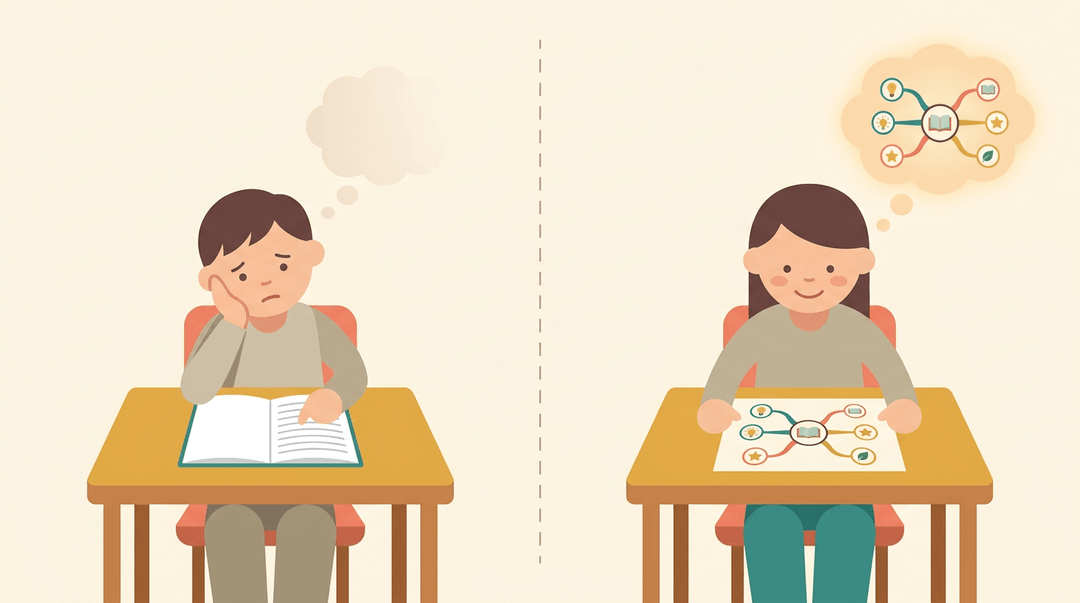
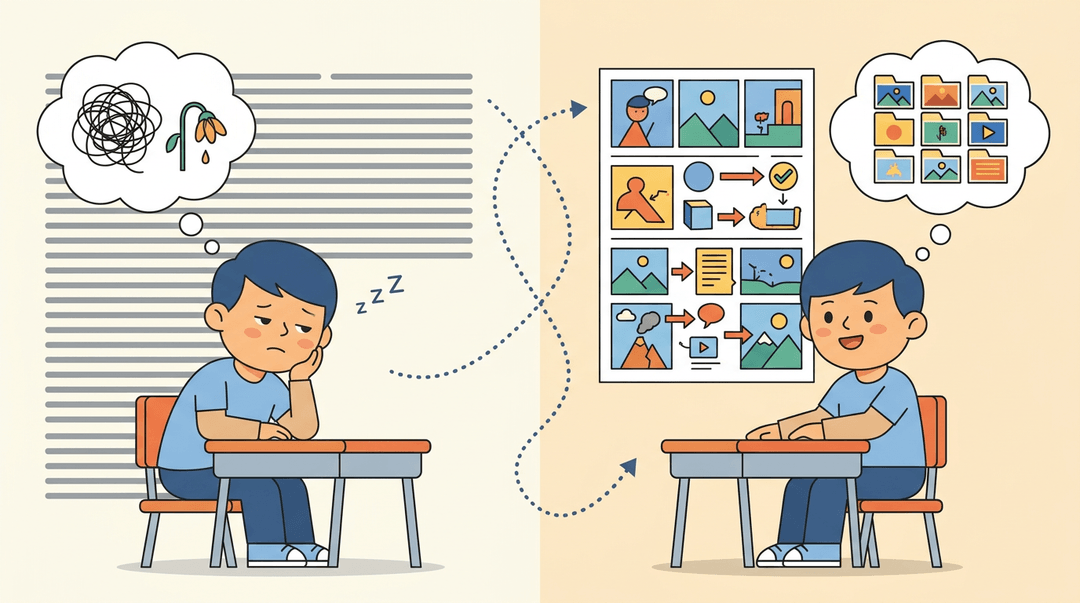
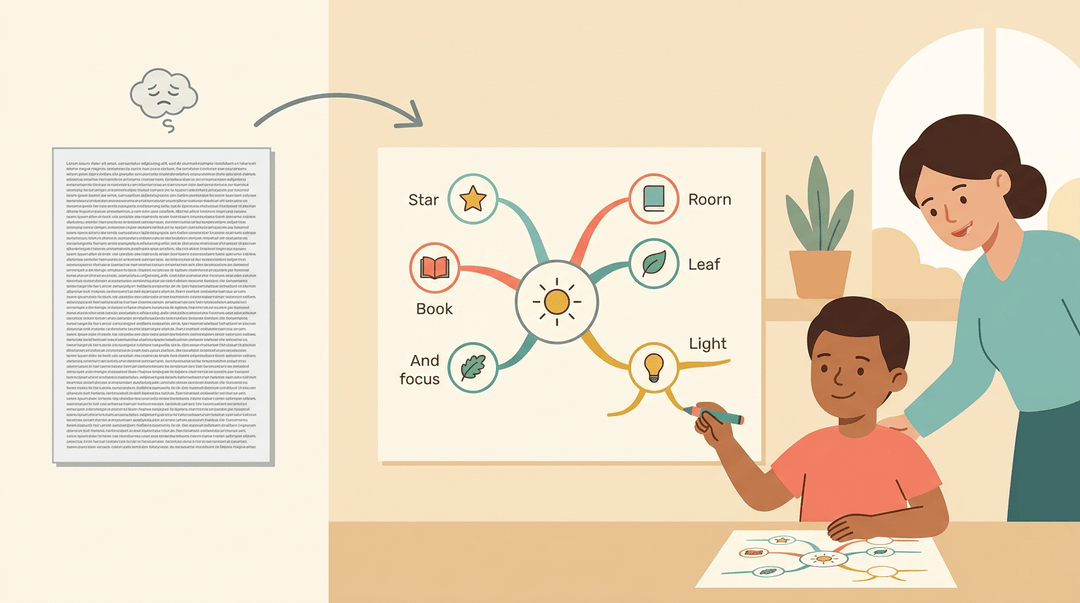
Some students think in pictures before they think in words. Ask them to describe a story and they'll sketch the plot in their head like a storyboard.
These learners tend to prefer diagrams over blocks of text, and they often carry a strong spatial memory: they'll remember where a fact sat on the page long after they've forgotten the sentence itself.
Hand them a dense paragraph or a lecture with no visual anchor, and you'll watch attention drift. That's not defiance. It's a mismatch between how the material arrives and how their brain wants to sort it.
The debate over learning styles
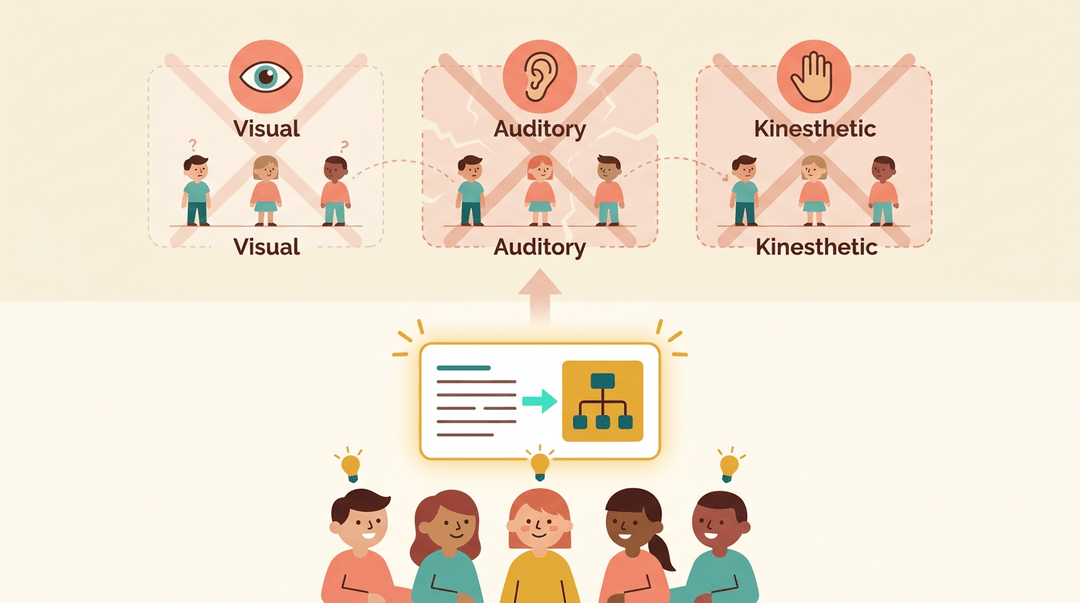
Here's where it gets interesting: the idea that students fall into fixed "visual," "auditory," or "kinesthetic" categories is contested.
Research reviewed by the Poorvu Center for Teaching and Learning found little evidence that matching instruction to a student's supposed style improves learning. What does hold up is dual coding: pairing words with visuals.
The Learning Scientists point out that combining verbal and visual representations helps nearly everyone learn better, not just self-described visual learners. In other words, being a visual learner isn't a fixed personality trait.
It's more like a preference that, backed by a genuinely visual tool, helps most students.
Using mind maps to differentiate instruction
A well-built mind map does double duty.
- The branches and images serve visual learners
- reading the labels aloud serves auditory learners
- building the map by hand serves kinesthetic ones
That makes it a natural differentiation strategy: one activity, several entry points, and a more personalized experience for every desk in the room.
Everyday Uses for Mind Mapping
Once you've built one mind map, you'll start seeing places to use another. The same branching structure that untangles a tough concept in class works just as well at the kitchen table or in a staff meeting.
Using mind maps for schoolwork
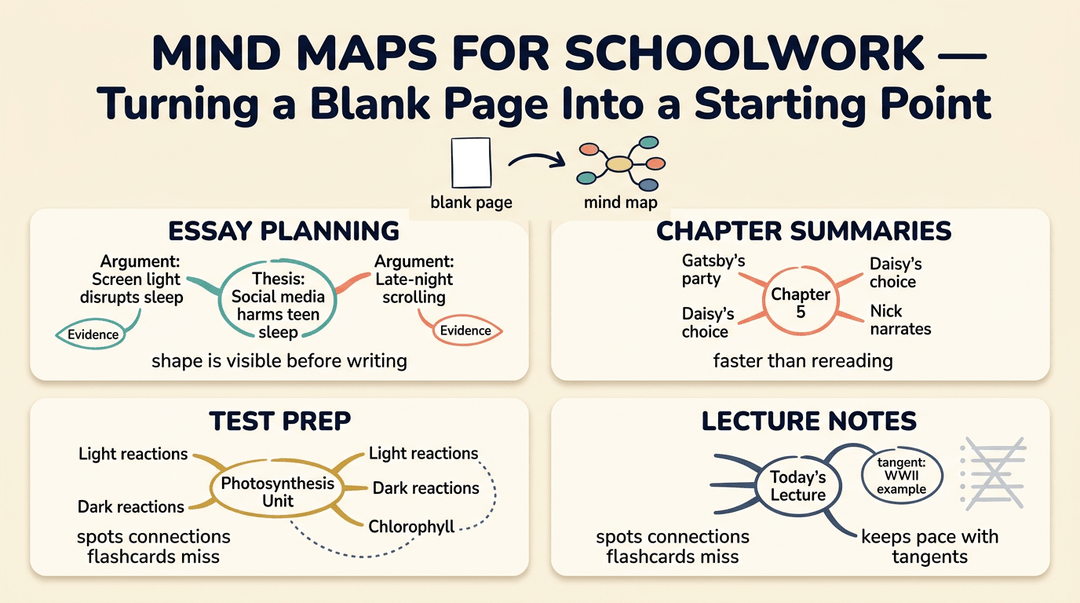
For students, a mind map turns a blank page into a starting point.
- Essay planning. A central thesis branches into supporting arguments, then evidence, so the whole essay's shape is visible before a single paragraph gets written.
- Chapter and book summaries. Key events or ideas radiate out from the title, making review far faster than rereading.
- Test prep. Condensing a unit onto one page helps students spot connections that flashcards miss.
- Lecture note-taking. Branches keep pace with a teacher's tangents better than a linear list does.
Mind mapping in homeschool and classrooms
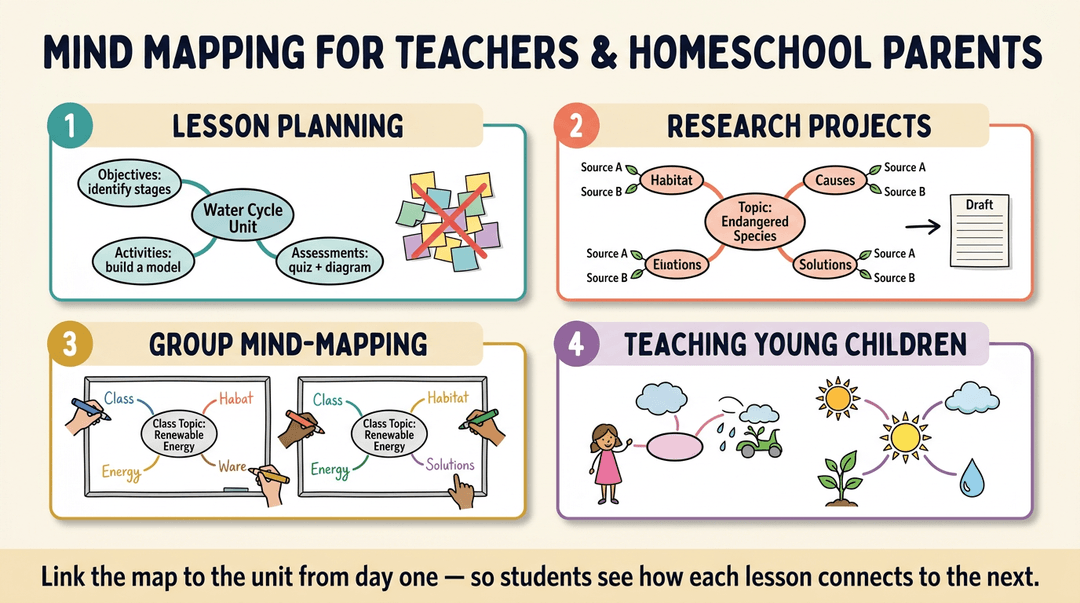
Teachers and homeschool parents get just as much mileage out of the method.
- Lesson planning. A unit's objectives, activities, and assessments all live on one map, so nothing gets lost in a stack of sticky notes.
- Research projects. Students branch out sources and subtopics before drafting, which keeps a big project from feeling overwhelming.
- Group mind-mapping activities. A shared poster or whiteboard map turns brainstorming into something every student can see and add to.
- Teaching young children. Pictures and color stand in for words, so even early readers can map a story or a science idea.
- Linking a map to a curriculum unit up front helps students see how one lesson connects to the next.
Mind mapping at work and in life
The habit travels well beyond school.
- Goal setting and to-do lists. A map splits a big goal into manageable branches instead of one intimidating list.
- Meeting planning. An agenda mapped out ahead of time keeps discussion on track.
- Resume and skills organization. Mapping experience by skill, not just by job, makes strengths easier to spot.
- Business strategy. Teams map a goal alongside the resources, risks, and steps needed to reach it.
Supporting students with special needs
Mind mapping isn't just convenient here: it's genuinely supportive. As OpenLearn from the Open University notes, "this is a creative tool that works well with the dyslexic brain (Buzan, 2006)."
The same visual, low-text format also suits many autistic learners, who often process images and structure more comfortably than dense paragraphs.
It's a big part of why the method carries a British Dyslexia Association endorsement as a classroom accommodation worth trying.
Mind Mapping as a Group
Mind mapping doesn't have to be a solo activity. Put a shared map in front of a group, and something shifts: ideas start bouncing off each other instead of staying locked in one student's head.
Brainstorming together with shared mind maps
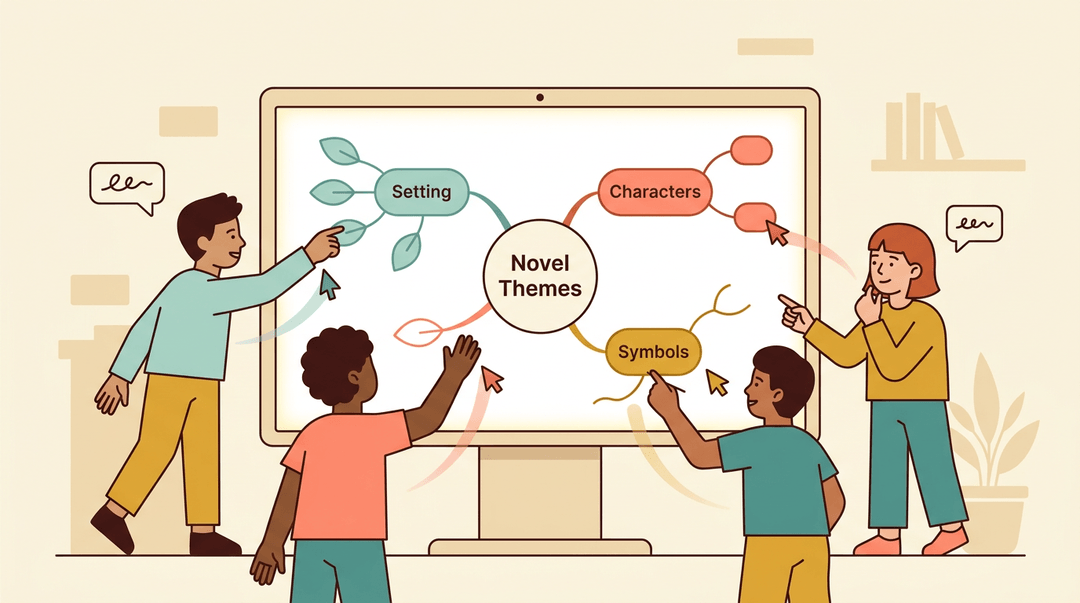
Most digital mind mapping tools now support real-time shared editing, meaning several students can add branches, drag ideas around, and reshape the map at the same time, on the same screen.
For visual learners especially, watching connections form live makes brainstorming feel less like waiting your turn and more like building something together.
Consider a middle school class tackling group projects on a novel's central themes. Instead of one student scribbling notes while the rest wait, each group member adds a branch: one covers setting, another characters, another symbols.
Everyone sees the whole map grow in real time, and gaps become obvious fast. Nobody's idea gets lost in a notebook nobody else reads.
That visibility does double duty. It's not just a brainstorming boost, it's a quiet lesson in team communication skills.
Students have to explain why an idea belongs on a certain branch, listen when a peer nudges their placement, and negotiate how the map should be organized. Those are the same skills they'll need in any group project, mind map or not.
For peer brainstorming specifically, a shared map keeps the session focused: everyone can see what's already been suggested, so the group builds outward instead of circling the same three ideas.
Tools for Building Mind Maps
Pencil and paper still work, but digital tools add color, drag-and-drop ease, and one-click sharing with a whole class. Here's where to look.
Popular digital mind-mapping tools
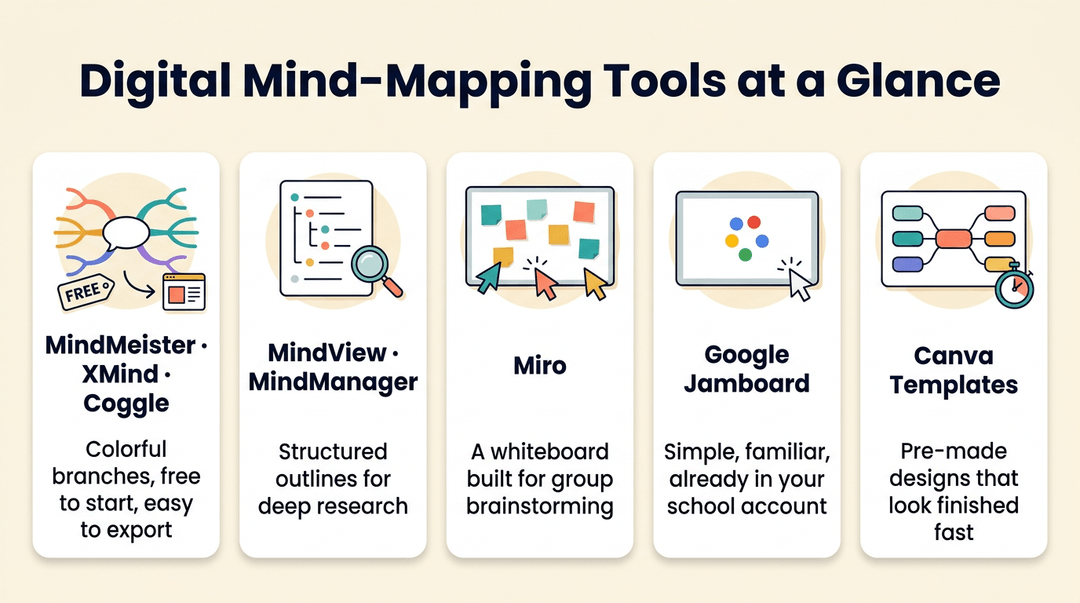
A handful of platforms show up again and again in classrooms:
- MindMeister, XMind, and Coggle. All three offer free tiers, colorful branching layouts, and easy exporting for handouts or slides.
- MindView and MindManager. Built with more robust outlining features, useful for older students tackling research projects.
- Miro. A flexible digital whiteboard that works well for group brainstorming, not just mind maps.
- Google Jamboard. Simple, familiar, and already inside most school Google accounts, which makes it an easy first choice.
- Canva templates. Pre-designed mind map templates that add visual polish fast, handy for students who want something that looks finished without much fuss.
What is the best mind mapping tool for students?
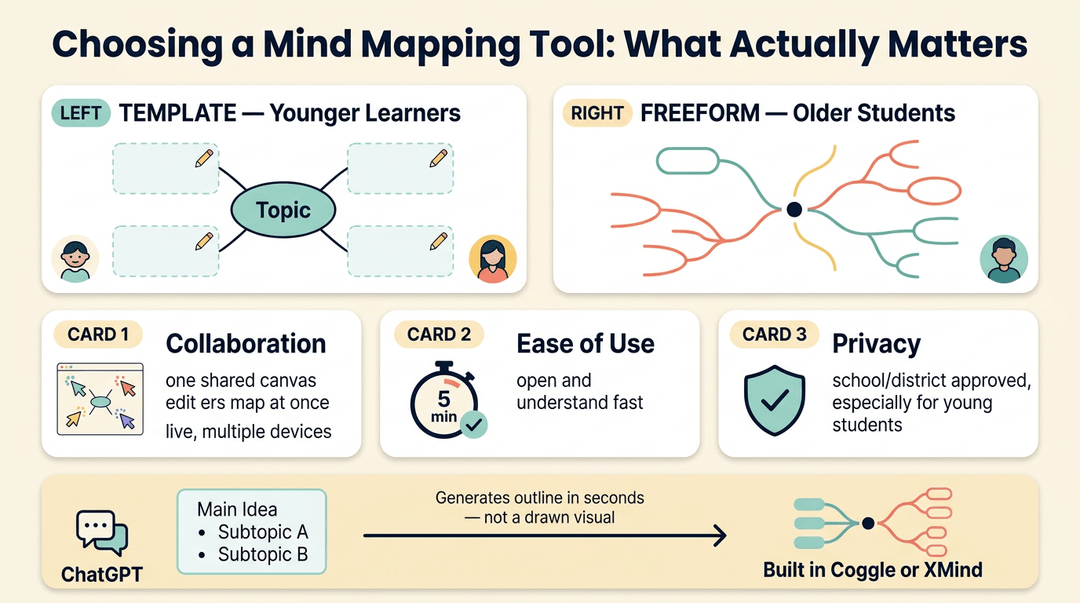
The honest answer: it depends on the student. Younger learners usually do better starting from a template, since a blank canvas can stall momentum. Older students often prefer freeform tools that let ideas branch wherever the thinking goes.
Beyond that, weigh a few practical things:
- Collaboration features. Can two or three students edit the same map at once, live, from different devices?
- Ease of use. A tool students can open and understand in under five minutes wins over one with a learning curve.
- Privacy considerations. Check what data a tool collects, especially for younger students, and favor options approved by your school or district.
AI-assisted options are worth a mention too. Can ChatGPT do mind maps? Not as a drawn visual, but it can generate a structured outline of main ideas and subtopics in seconds, which a student then drops into Coggle or XMind to build the actual map.
Tips for Teaching with Mind Maps
A great tool only works if students know how to use it. A little upfront teaching turns mind mapping from a novelty into a habit your class actually reaches for.
Tips for introducing mind maps in class
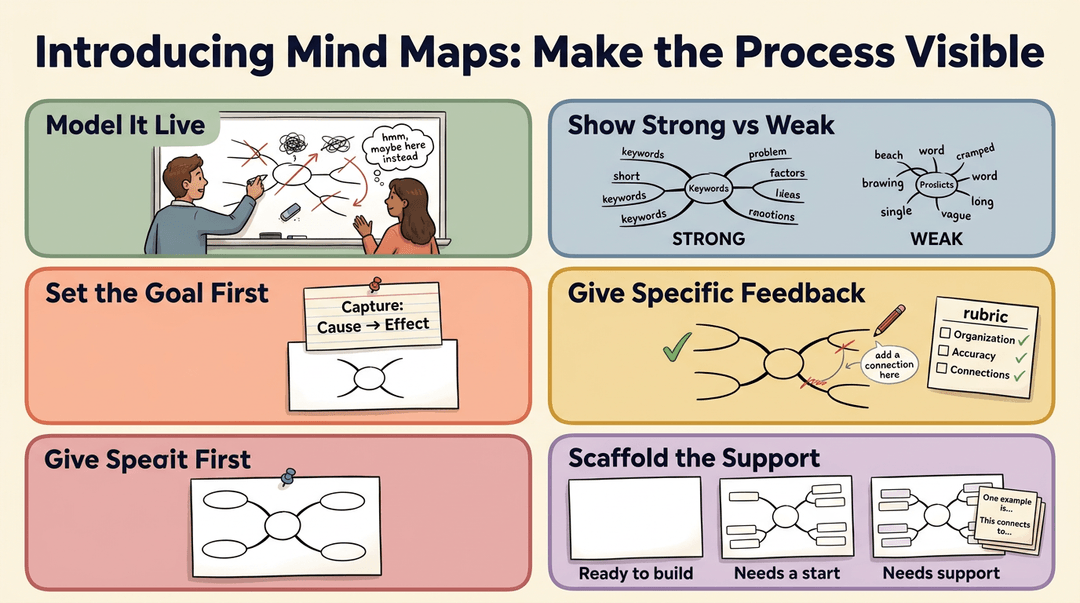
Start by making the process visible, not just the finished product:
- Model the process live. Draw a map on the board while you think out loud, so students see the messy middle, not just the tidy result.
- Provide example maps. Show a strong one and a weak one side by side so students can spot the difference themselves.
- Set clear objectives. Tell students exactly what the map should capture before they start, whether that's cause and effect or main idea and details.
- Give constructive feedback. Point to specific branches that work and specific ones that need another pass. A simple rubric for evaluating student mind maps (checking organization, accuracy, and connections between ideas) keeps that feedback consistent from student to student.
- Scaffold for differentiation. Offer sentence starters or partial maps for students who need support, and blank pages for those ready to build from scratch.
Using mind maps across subjects
Mind mapping isn't a one-subject tool. A science teacher can map a food web, a history teacher can map the causes of a war, and an English teacher can map a character's relationships, all with the same skill underneath.
- Use mind maps across subjects so students transfer the strategy instead of relearning it each time.
- Introduce mind mapping early in the year, before the content gets heavy, so it's already familiar when students need it most.
- Use maps as an assessment tool: a quick map at the end of a unit shows you who's connecting ideas and who's still collecting facts.
- Invest in professional development for teachers so staff share what's working across grade levels, not just within one classroom.
Mind mapping gives visual learners what a page of notes never quite can: a picture of how ideas connect.
Build that picture together as a class, hand students the tools to build their own, and watch abstract topics turn into something they can actually see and remember.
Ready to build mind-mapping right into your unit plans? Check out our Curriculum & Standards feature to plan it alongside every lesson across your school year.

References
- Frontiers | The effectiveness of mind mapping versus lecture-based learning in medical education of China’s standardized residency training: a systematic review and meta-analysis of randomized controlled studies — frontiersin.org (2026)
- Efficacy of mind maps and concept maps in enhancing ... — pmc.ncbi.nlm.nih.gov
- Learning Styles as a Myth — poorvucenter.yale.edu
- Understanding dyslexia: 3 | OpenLearn — open.edu
- Using Mind Maps: Visualizing Your Mind — learningcommons.ubc.ca
- Mind Mapping: an active visual, non-linear tool for augmenting student-learning strategy, underutilized in Sudanese Medical education — doi.org (2016)
- Dual Coding and Learning Styles — learningscientists.org
Frequently asked questions
What is the best mind mapping tool for students?
There is no single best mind-mapping tool for every student. Younger learners often benefit from template-based tools, while older students may prefer freeform options such as MindMeister, XMind, Coggle, MindView, MindManager, Miro, or Canva. Choose based on ease of use, collaboration features, available templates, and your school’s privacy requirements.
What are the 7 steps to mind mapping?
The seven steps are: start with a central topic, add main branches, add sub-branches and details, use keywords instead of sentences, add colors and illustrations, review and revise the map, and adapt its complexity to the student’s grade level.
What are some effective mind mapping techniques for students?
Effective techniques include placing one clear central idea in the middle, organizing related concepts into branches, using short keywords, and adding color codes, icons, and images. Students should also revisit the map over time, add new connections, correct errors, and use it for activities such as essay planning, chapter summaries, lecture notes, and test review.
Can ChatGPT do MindMaps?
ChatGPT can generate a structured mind-map outline with a central topic, main branches, and subtopics. It generally does not create the finished drawn visual map by itself, but you can copy its outline into a tool such as Coggle or XMind and turn it into a visual map.