Character Traits Examples: Complete Lists and Definitions

Jump to section
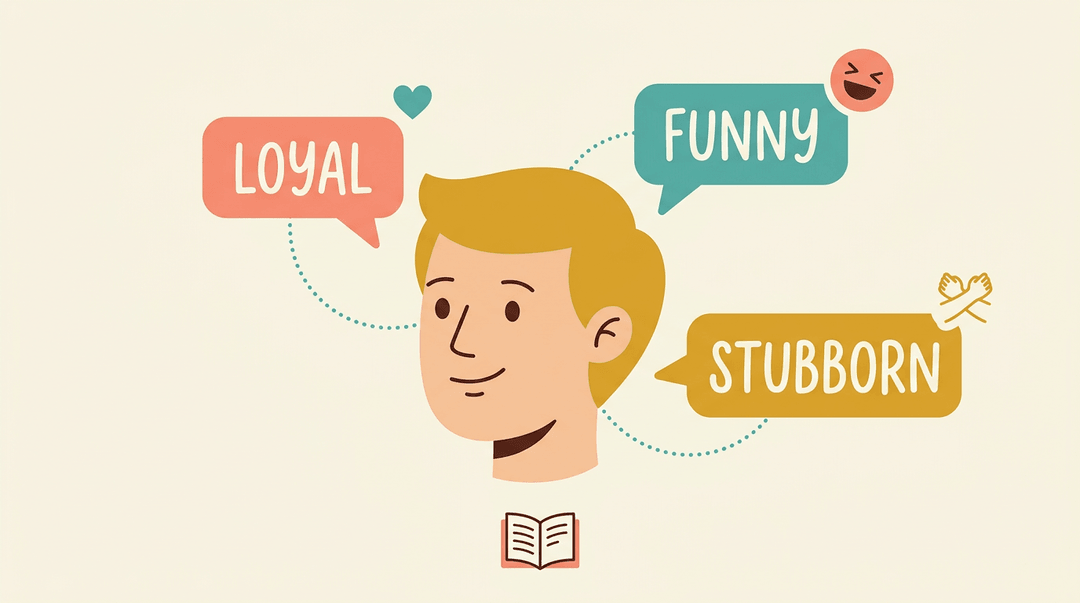
Think about the friend you'd describe in three words. You'd probably say loyal, funny, or stubborn without much thought. That's a character trait: a consistent quality that shapes how someone thinks, feels, and acts.
Traits are also a powerful thing to teach, whether you're helping students analyze a novel or build believable characters of their own. In this post, we'll define traits, share master lists with examples, and walk through why they matter.
You'll also get a ready-to-use classroom lesson.
Character Traits Explained with Examples
Ever tried describing a favorite book character and reached for words like "brave" or "loyal"? Those are character traits, and naming them is the fastest way to understand who a character really is.
What makes something a character trait
A character trait is an enduring quality that describes how a character behaves. It shows up repeatedly across a story and is usually rooted in morals or values. One brave moment isn't a trait.
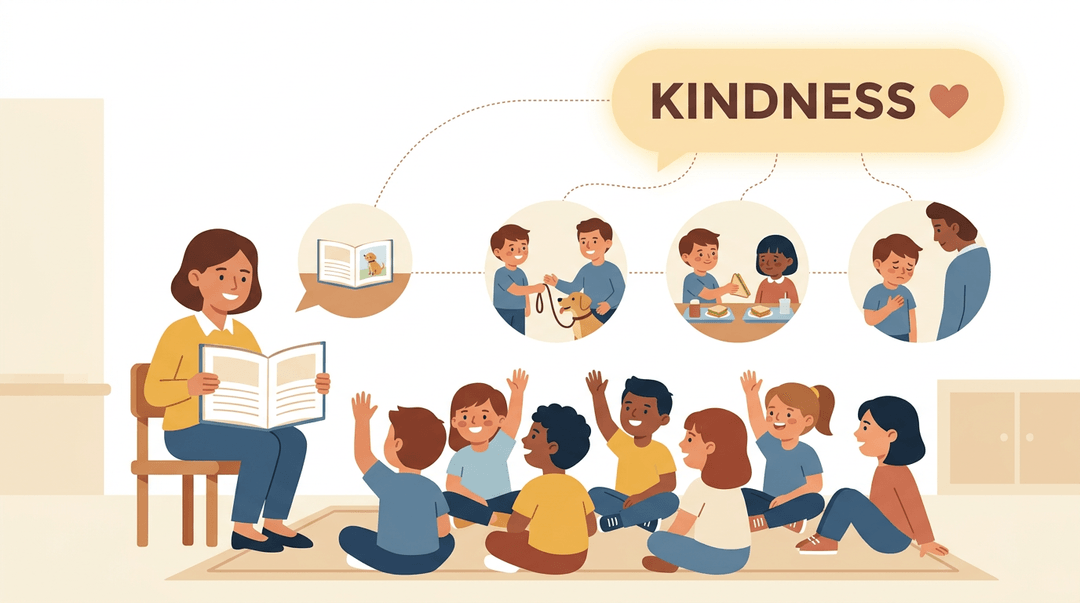
A character who keeps stepping up when it counts has bravery as a trait. Picture a fourth-grade teacher reading aloud a story where the main character returns a lost dog, shares lunch with a new student, and owns up to a mistake.
The class can confidently name the trait: kindness.
How traits differ from feelings and personality
A trait isn't a feeling. "Angry" describes a moment, while "hot-tempered" describes a pattern. Personality is the broad mix of qualities a character shows, while character is about what a character stands for.
A motive explains why someone acts, so a character who helps for a reward differs from one who helps out of genuine care. Traits are revealed through action, not just belief.
A character who claims to be honest but lies under pressure doesn't truly have that trait.
Sorting traits into positive, negative, and neutral
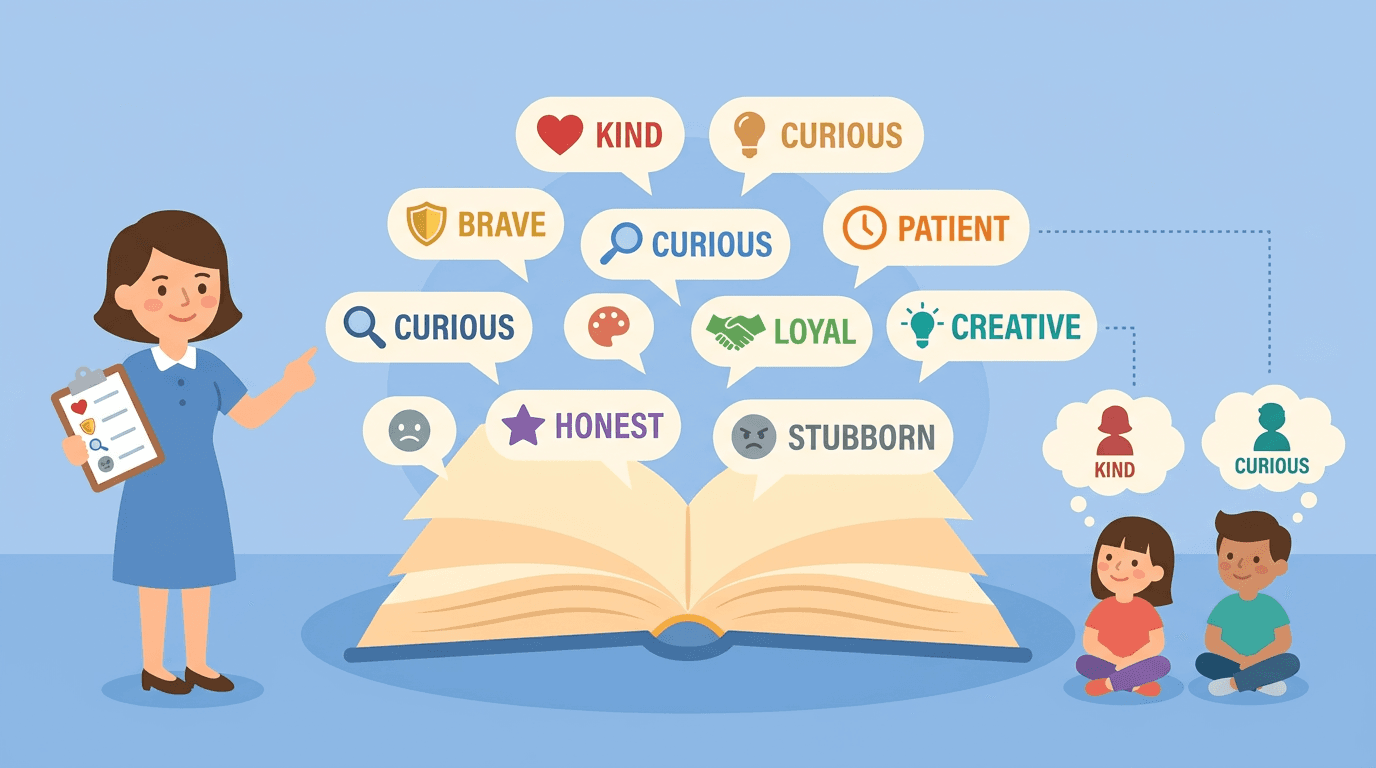
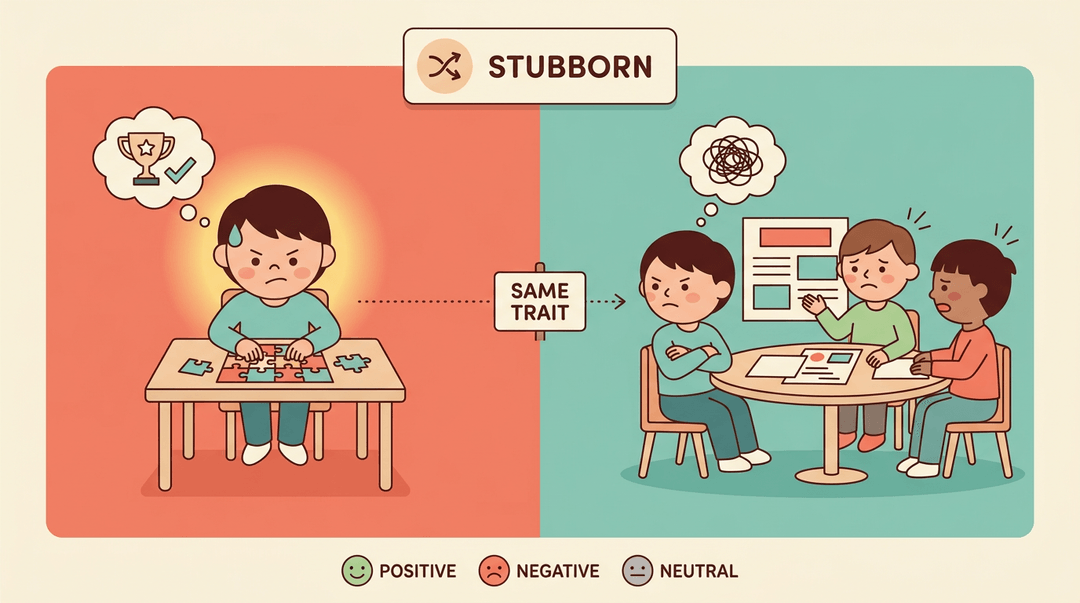
Traits are often grouped by valence, meaning whether they read as positive, negative, or neutral. Generosity and selfishness are clear cases, but traits like curiosity or stubbornness can go either way. Context decides the reading.
A stubborn student who refuses to quit a hard puzzle looks determined, but the same stubbornness during a group project may look difficult. That's why strong characters mix flaws and strengths.
Only virtues make a character flat. Context changes everything.
Lists of Character Traits and Examples
Stuck on a blank character sheet? These lists give you somewhere to start, but the trait matters less than what it does on the page.
What are the 100 character traits?
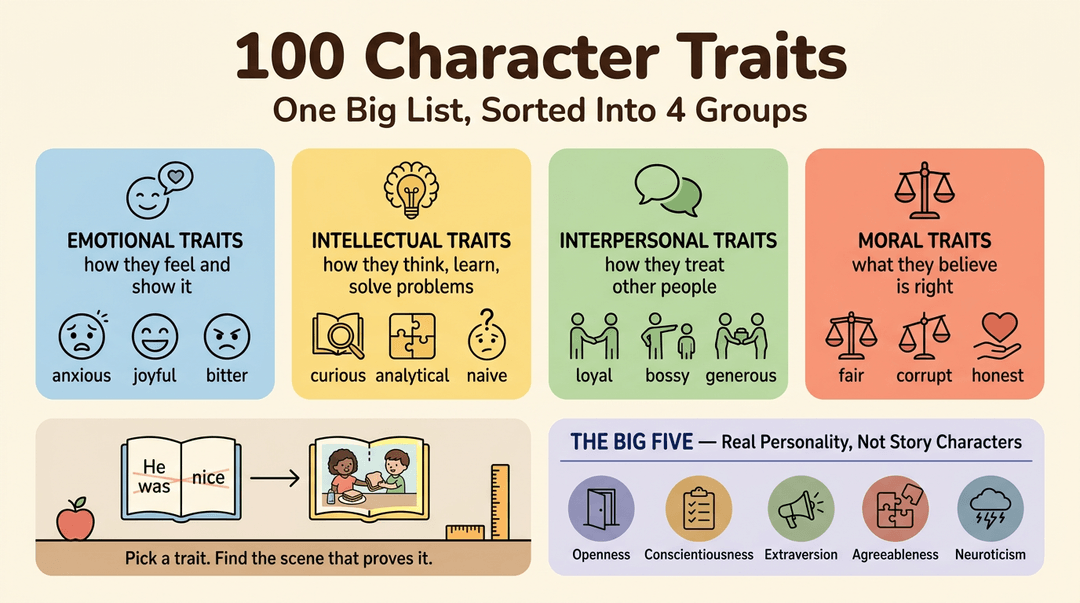
The 100 character traits master list is the big catalog, and shorter cuts like the 7 character traits list pull out the most common ones. It's sorted into groups:
- Emotional traits: how a character feels and shows it.
- Intellectual traits: how they think, learn, and solve problems.
- Interpersonal traits: how they treat and handle other people.
- Moral traits: what they believe is right and how they act on it.
Printable and downloadable versions let you keep the list at your elbow while you plan.
A fifth-grade teacher hands out the emotional traits list before a reading unit. Students pick three traits for the main character and find a scene that proves each one, so 'he was nice' turns into evidence.
If you're looking at real personality rather than story, the Big Five are the five main personality traits psychologists use: openness, conscientiousness, extraversion, agreeableness, and neuroticism.
Lists of character quirks
Quirks are the specific habits that make a character feel real:
- Physical quirks: a crooked smile or a habit of cracking knuckles.
- Personality quirks: insisting on arranging pencils just so before class.
- Strengths and talents: what they do well.
- Weaknesses and fears: where they struggle.
- Miscellaneous idiosyncrasies: the odd details nobody else would think to add.
Small details do the heavy lifting.
Famous characters that show these traits
- A Man Called Ove: a grumpy routine that hides a generous heart.
- Harry Potter's scar: a single physical mark that carries the story's identity.
- Katniss' hunting skill: a strength that shapes how she survives and how others see her.
- Literary trait mix analysis: how pairing courage with a weakness makes a character feel complicated, not flat.
The best characters aren't built from one trait. They're built from a mix.

Why Character Traits Matter
Character traits do far more work than most readers notice. They decide what happens in a story and why readers care.
How traits drive plot and conflict
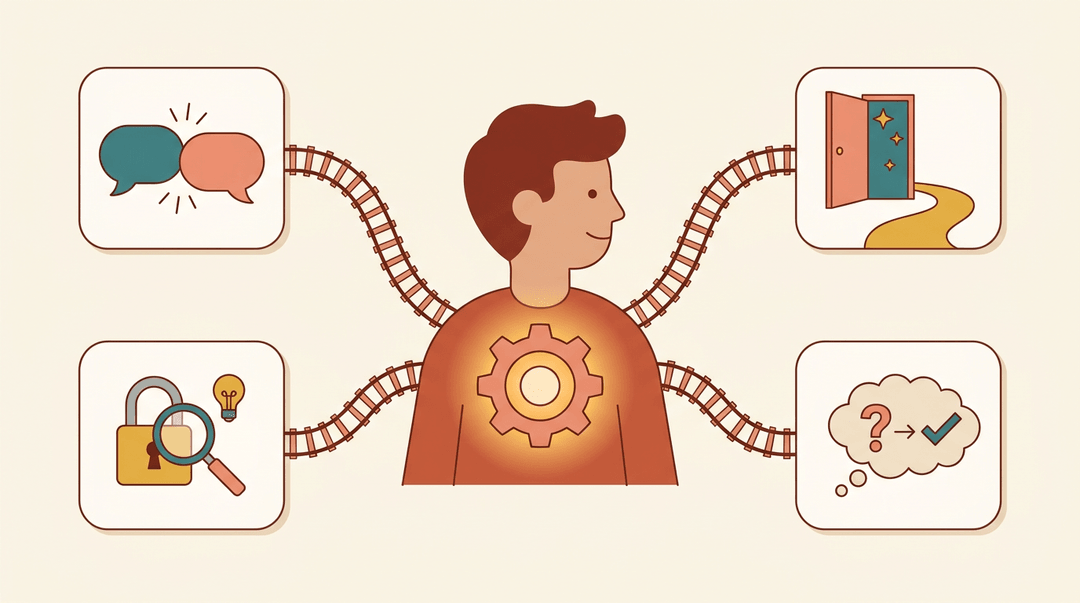
Traits are the engine of plot. Each one pushes the story in a specific direction:
- Stubbornness refuses to back down, so every disagreement turns into a conflict.
- Curiosity opens the door, triggering adventure as the character chases the unknown.
- Quirks can aid plot resolution when an odd habit, like re-checking every lock, uncovers the key clue.
- Traits predict actions. Once you know a character is cautious, you can guess how they'll react when danger shows up.
A middle school teacher might pause a novel and ask, "What would this stubborn character do next?" Students then predict using evidence from the text.
How traits build connection and trust
Readers connect with characters who feel real, and real people are rarely one thing.
- Vulnerability bonds readers to a character, because admitting fear makes them feel human.
- Balance makes characters believable. A brave hero who sometimes panics feels more real than one who never flinches.
- Complexity beats one-note characters. A villain with a reason is far more memorable than one who's simply mean.
- Character strengths build trust in life as well as on the page, and the same honesty that wins a reader can help a student on a resume, in an interview, or in self-reflection.
Choosing and Developing Traits for Characters
Traits make characters feel real, so choose them on purpose. Here's how.
How to choose a character's traits
Start with the character's goals: which qualities help or hurt what they want? Consider reader sympathy, since readers forgive flaws they understand. Layer flaws over time instead of stacking them on page one.
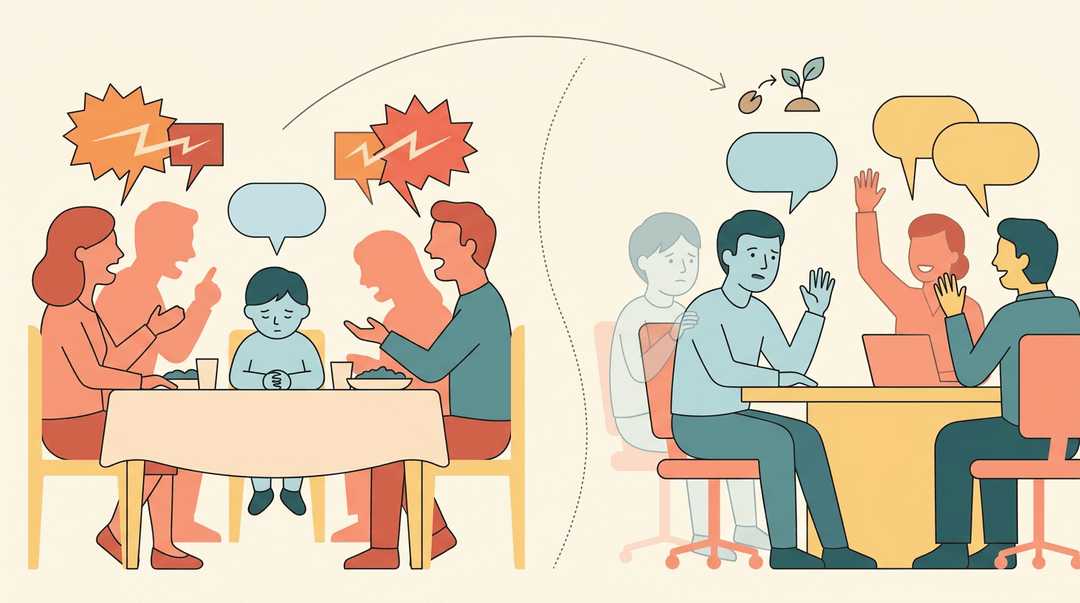
Explore backstory for trait origin: a kid who stayed silent at a loud dinner table may grow into an adult who hesitates to speak up at work.
Finding traits from text evidence
Use the say/do/think/others framework: what a character says, does, thinks, and what others say about them. A seventh-grade teacher might have students chart a short story this way.
One student notes that a character keeps apologizing (says), returns a lost wallet (does), worries about being judged (thinks), and is called the reliable one (others). Students stop guessing and start proving.
Next, write each trait as a claim plus evidence, like 'She is honest, because she returns the wallet.' A trait is an inference drawn from proof, not a label.
Using character quirks the right way
Tie each quirk (a small, distinctive habit) to the plot so it does real work. Use one or two memorable quirks, not ten. Keep them consistent: a character who hums when nervous shouldn't hum at a funeral unless that's the point.
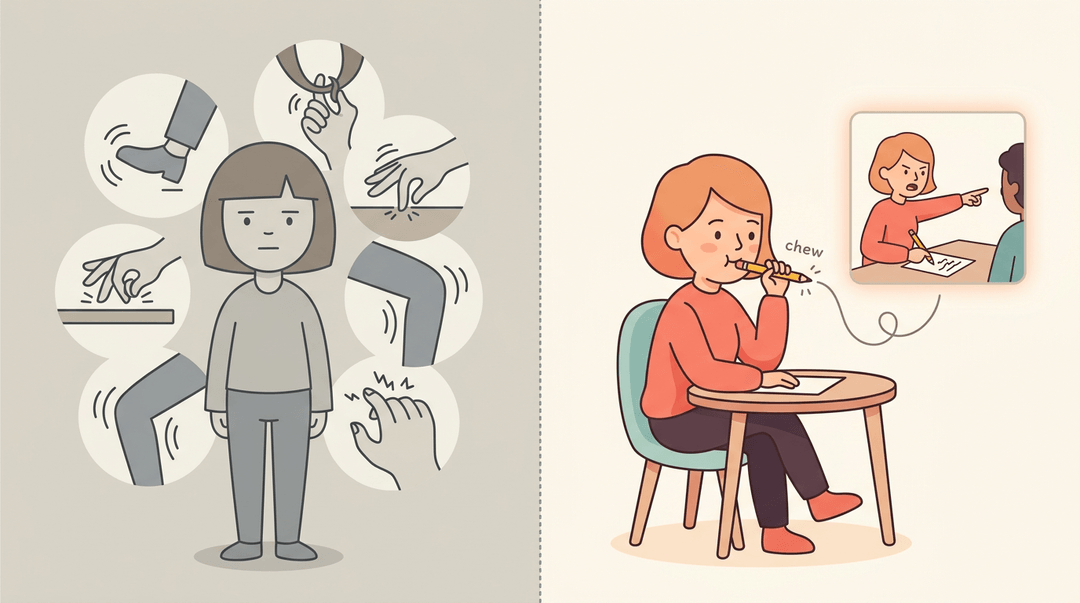
Stay original, since the nervous tapping foot is everywhere. Keep descriptions brief. 'She chews her pen' lands harder than a paragraph of fidgeting.
Balancing traits so characters feel real
Mix virtues and flaws so readers see both. Allow occasional exceptions: a cautious character who takes one bold risk feels more alive. Reveal traits gradually, not in one info dump.
Watch for vague words like nice or mean, and swap them for specifics like patient or quick to snap at waiters. Traits also shape the arc. Static traits stay fixed from start to finish, while dynamic traits change as the character grows.
A Ready-made Lesson Plan for Teaching Traits
This is a four-part lesson you can run in one or two periods: a quick sort, a grade-matched word bank, evidence practice, and a checklist to assess it. Pick the parts you need and skip the rest.
Part 1: the 5-minute sort
Start here because students most often confuse traits with feelings. This sort fixes it before it shows up in their writing.
- Post the anchor chart definitions
- Trait: how someone usually is, across many situations.
- Feeling: how someone feels right now, and it changes.
- Hand out word cards to pairs
- Mix traits (kind, stubborn) with feelings (angry, nervous).
- Sort cards into two columns
- Set a 3-minute timer and have pairs sort in silence.
- Review the tricky cards together
- Say: "Would this be true tomorrow, or only right now?"
✅ Trait: "Maya is brave." She speaks up again and again. ❌ Feeling: "Maya is nervous." It's true today and may be gone by lunch.
The difference is repeated over time versus true in this moment.
Part 2: trait words by grade
Give students the column that matches their level, then let them borrow from the next one up.
| Grade band | Sample trait words | Focus |
|---|---|---|
| K-2 | kind, brave, helpful, funny, shy | Words they can picture |
| 3-5 | honest, curious, stubborn, generous, determined | Wider vocabulary, close synonyms |
| 6-8 | resourceful, arrogant, compassionate, impulsive, cynical | Nuance and abstract traits |
Part 3: practice finding evidence
Traits are claims, so students need proof. Teach them to look in three places.
| Evidence type | Ask yourself | Looks like |
|---|---|---|
| Says | What words reveal this? | "I'll carry it for you." |
| Does | What action shows it? | Returns a lost wallet |
| Thinks | What's going on inside? | Worries about a friend first |
Then run the practice in this order:
- Model one chart aloud
- Pick a short passage and fill in all three rows.
- Have students write a trait statement
- Use the frame: "[Character] is ___ because ___."
- Swap with a partner
- Partners ask: "Which words show that?"
Example: A fourth-grade class reads a scene where a boy returns a lost wallet. One student writes, "Sam is honest because he gave back the wallet even though no one saw him." Her partner points to "gave back" as the proof.
Part 4: quick checklist to assess understanding
Use this on exit tickets or short paragraphs. Check each statement against the four points:
- Names a trait, not a feeling: "responsible," not "worried."
- Cites textual evidence: a quote or an action from the text.
- Avoids vague words: swaps "nice" or "good" for generous or honest.
- Shows balanced traits: notes at least one strength and one flaw.
💡 Tip: Students who miss the fourth point can often fix it by asking, "What does this character struggle with?"
Organize and schedule these trait lessons by class and section with EMStudio's classroom management tools.
Teaching Character Traits to Kids
Kids spot personality long before they can name it. These routines build that skill.
Lesson sequences and classroom activities
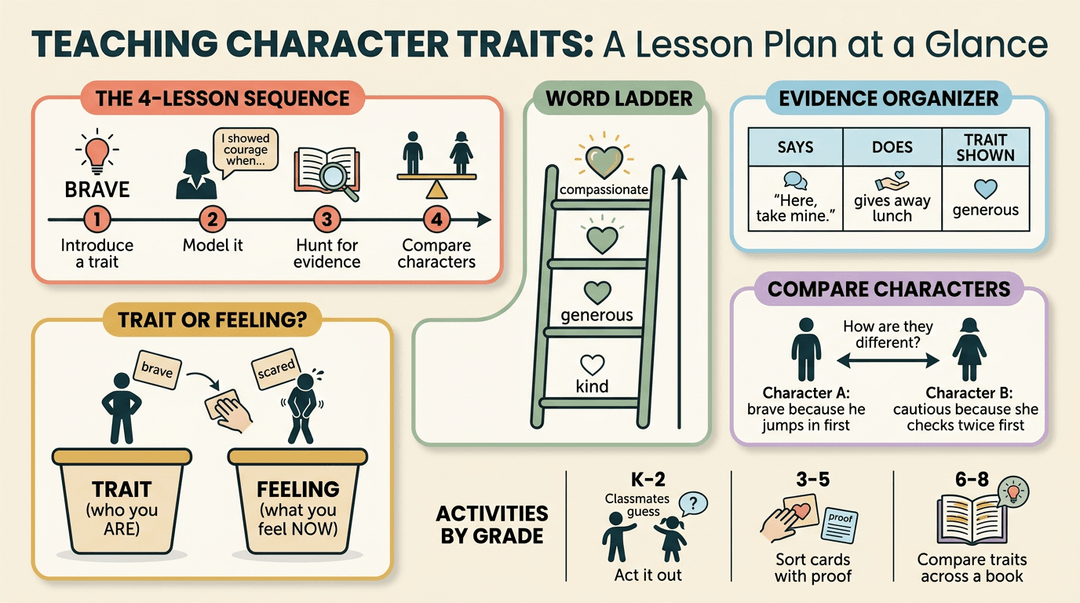
Try a four-lesson sequence:
- introduce a trait
- model it
- hunt for evidence
- compare characters
A trait-or-feeling sorting activity helps kids separate brave (a trait) from scared (a feeling). Word ladders climb from kind to generous to compassionate. An evidence organizer tracks what a character does, says, and how it shows the trait.
Character comparison tasks ask how two characters differ. By grade, K-2 act out traits for classmates to guess, 3-5 sort trait cards with proof, and 6-8 compare traits across a whole book.
Common mistakes when teaching traits
Watch for four traps:
- Kids often name a feeling rather than a trait, writing “sad” when they mean persistent.
- Vague words like “nice” tell no story.
- Describing appearance, like “tall,” isn't personality.
- And one piece of evidence is weak, since one scene rarely proves a trait.
Picture a fourth-grade teacher whose class wrote “Maya is nice” for every story. After adding an evidence organizer, students wrote “Maya shares her lunch even when she's hungry,” and discussions sharpened.
Helping kids build strong character traits
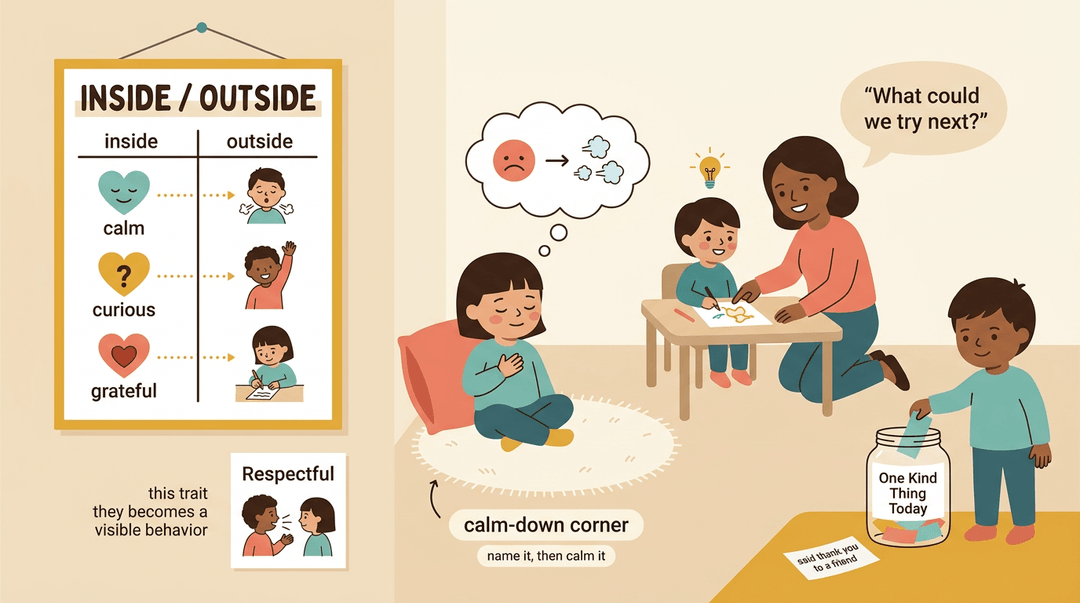
Teach self-regulation by naming the feeling, then choosing a calm-down step. Build hope and curiosity by asking, “What could we try next?” Start a gratitude practice where kids note one kind act each day.
Post an inside/outside anchor chart pairing traits we feel with behaviors we see. Finally, link traits to behavior expectations: “respectful” becomes “listen while others talk.”
The Psychology Behind Character Traits
Why do some students bounce back while others spiral? Psychology offers several answers.
Different theories of character development
- The psychodynamic view ties character to the superego, the inner voice that absorbs right and wrong.
- The humanistic view centers self-actualization, the drive to grow into your fullest self.
- The social-cognitive view says we learn character by watching others and reasoning through fair choices.
- The positive psychology view focuses on strengths rather than deficits.
How traits link to well-being
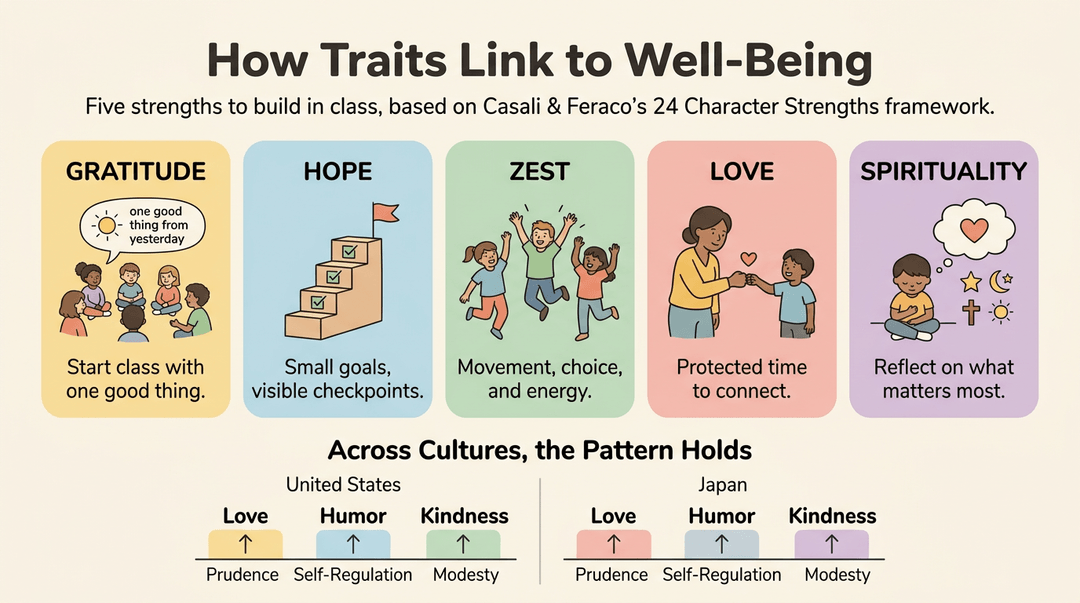
Spirituality, gratitude, zest, hope, and love are among the strengths tied to how people feel about their lives.
Casali and Feraco's 2025 meta-analysis describes 24 morally valued traits linked to well-being and mental health, the core of the 24 character strengths framework. To foster them:
- Gratitude: Start class with one good thing from yesterday.
- Hope: Set small goals with visible checkpoints.
- Zest: Build in movement, choice, and energetic group work.
- Love: Protect time for connection, like a morning check-in.
- Spirituality: Reflect on what matters most, respecting every family's beliefs.
Across cultures, the pattern holds. In a study of American and Japanese young adults, love, humor, and kindness ranked higher than prudence, self-regulation, and modesty.
Managing traits that get out of balance
Every strength can tip too far. Excessive humility can keep students from owning good work, and unchecked open-mindedness can drift into never finishing. Impatience, stubbornness, and jealousy follow the same pattern. A student strengths and weaknesses list can help you notice when a strong quality starts to tip into a problem.
Consider a sixth-grade teacher whose strongest writer won't revise because a draft is "already good enough." She asks for one specific change per draft, and the revisions sharpen. Aim for balance rather than less of any trait. Balance wins.
- Procrastination: Break the task into a first step that takes five minutes.
- Pessimism: Ask for one thing that went well before naming what didn't.
Character traits give characters, and the students who read and write about them, real depth. When you can name a trait, you can explain it, spot it in a text, and show it through action in your own writing.
Keep the routine simple: name the trait, find the evidence, and connect it to a choice. Practiced one trait at a time, it makes reading and writing feel far more concrete.
Ready to bring this into your own planning? Explore Classroom Management to organize your classes, rosters, and timetables in one structured workspace.

Frequently asked questions
What are the 7 character traits?
There is no single universally accepted set of seven character traits. A commonly used list includes kindness, honesty, bravery, responsibility, perseverance, respect, and empathy. These traits describe consistent patterns in how a person behaves and treats others.
What are the 5 main personality traits?
The five main personality traits are known as the Big Five: openness, conscientiousness, extraversion, agreeableness, and neuroticism. Together, they describe broad patterns in how people think, feel, and behave.
Can you give me some examples of quirks?
Examples of quirks include cracking your knuckles, having a crooked smile, arranging pencils in a particular order, chewing on a pen, humming when nervous, or repeatedly checking locks. A good quirk is small, distinctive, consistent, and may reveal personality or help move the plot forward.