Student Friendly Definitions: A Complete Guide

Jump to section
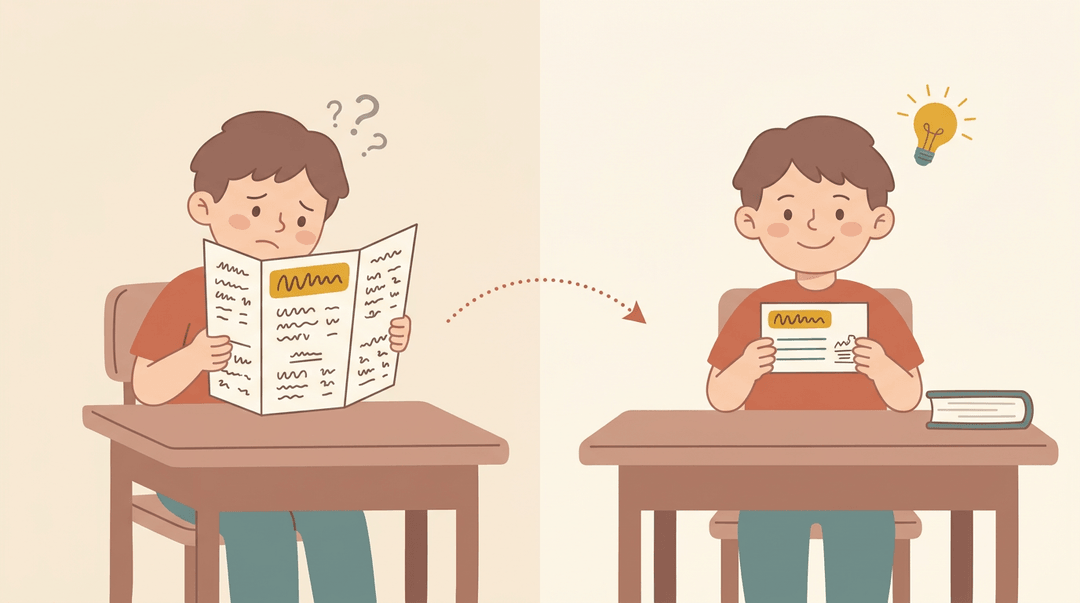
Picture a student staring at a vocabulary word the way you'd stare at a menu written in a language you barely read. The words are right there, but the meaning isn't.
A student-friendly definition is a short, plain explanation that a learner can read, understand, and use without reaching for a dictionary.
In this post, we'll cover what makes a definition easy to follow, worked examples you can adapt, how to write your own, and the best tools for showing words visually. We'll wrap up with a simple classroom routine for vocabulary.
Why Student-friendly Definitions Matter
A student-friendly definition explains a word in plain language a learner can use. Here's why that matters, and how pictures help the meaning stick.
Where standard dictionaries fall short
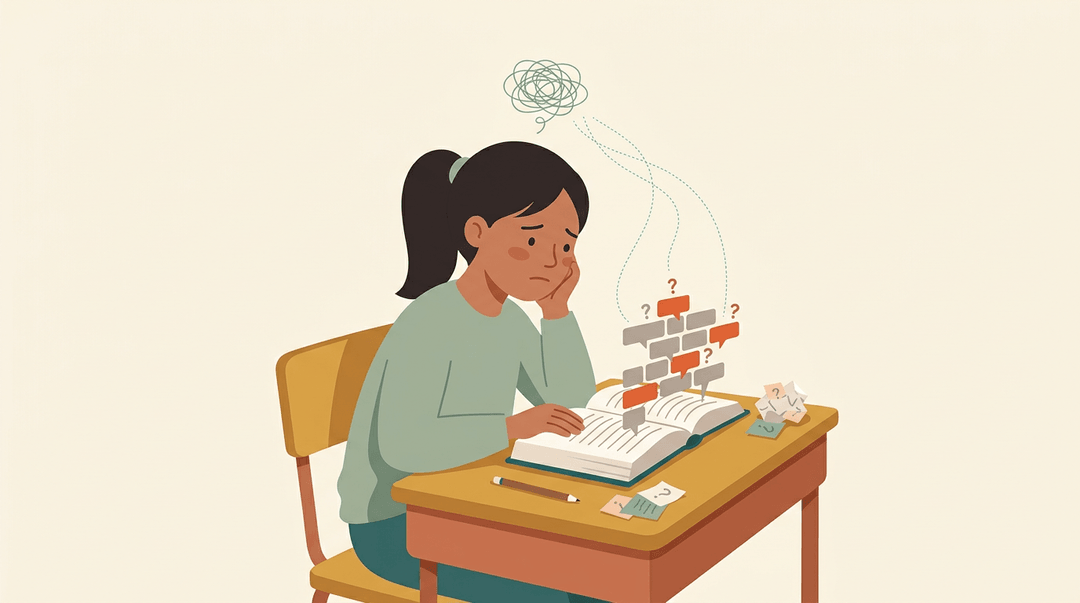
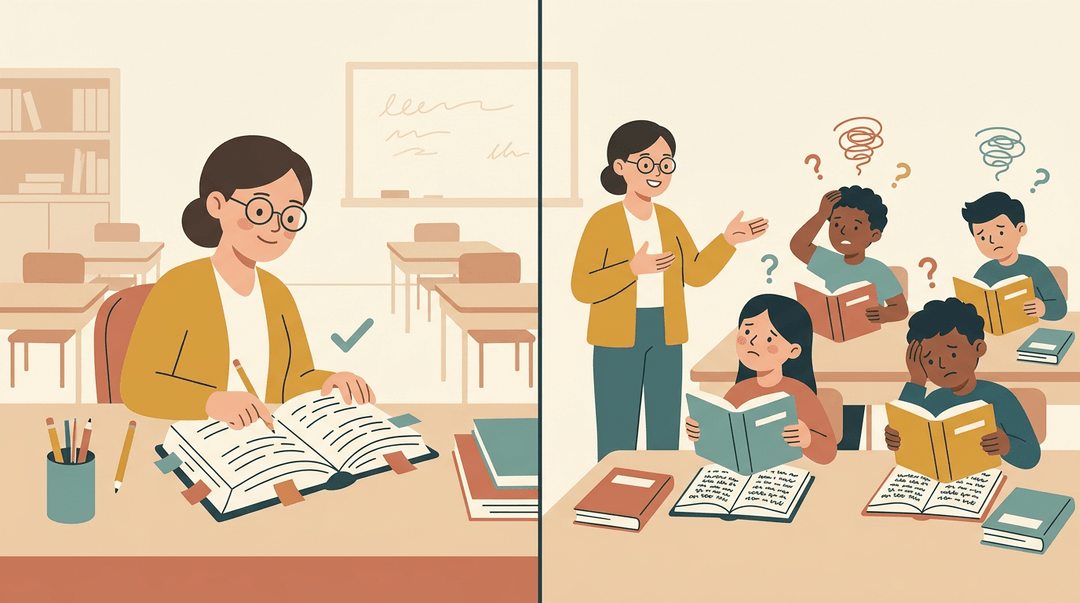
Dictionaries weren't written with a struggling reader in mind. A fifth grader who looks up an unfamiliar word may find a definition packed with words she doesn't know, leaving her just as confused.
The reason is simple: dictionaries are written for accuracy rather than understanding.
Every unknown word inside a definition is another hurdle, and the words students most need help with are often the ones the dictionary assumes they already know. That's a gap worth closing.
When a look-up goes nowhere, students stop trying. Frustration builds, and the next unfamiliar word gets skipped. Struggling language learners feel this most, and those skipped words quietly pile up.
How pictures help word meaning stick
Visuals aid comprehension and fluency, and a study of multimodal vocabulary learning found that learners recalled significantly more foreign language words after a week's delay when a picture had accompanied them.
Pictures offer three practical benefits:
- Quick reference. A picture dictionary lets students check a word at a glance.
- Clearer connections. A labeled photo ties a new word to what students have already seen.
- Fewer mix-ups. Pictures help separate look-alike terms.
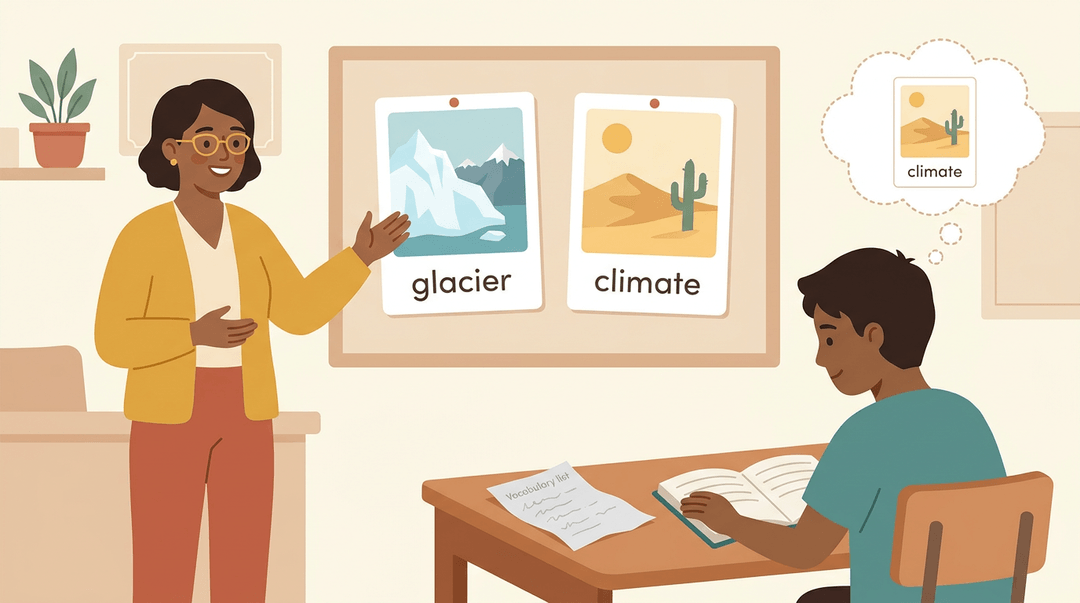
Consider a middle school science teacher who posts a photo of a glacier beside glacier and a desert beside climate. Later, when a student meets climate in a reading, the picture is already waiting.
That's the difference between a word on a list and a word a student can see.
What Makes a Definition Easy for Students?
A student-friendly definition tells learners what a word means and how it's used, in words they already know.
Core rules for clear explanations
Strong definitions capture a word's essence and usage, not just its dictionary wording, in everyday, familiar language. Beck, McKeown, and Kucan's approach is the basis, and Anita Archer advocates the same rules.
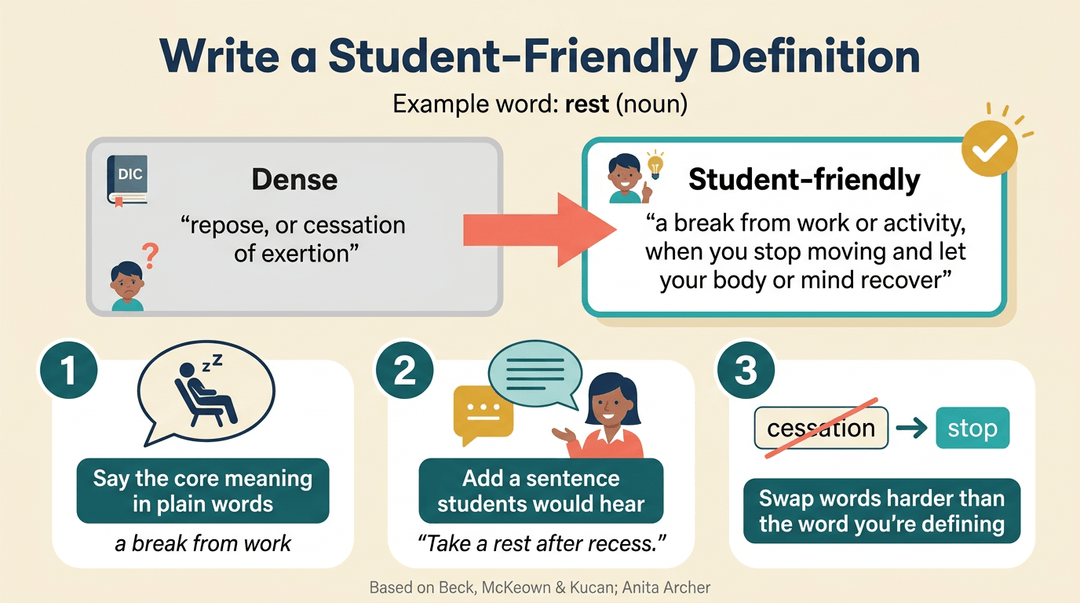
Take rest as a noun. A dense entry reads "repose, or cessation of exertion." A student-friendly version says "a break from work or activity, when you stop moving and let your body or mind recover."
When a fourth-grade teacher's class stalls on a passage using rest this way, that plain version gets them reading again.
To write your own, follow three steps:
- Name the core meaning in plain words.
- Add a sentence students would actually hear.
- Swap any word harder than the one you're defining.
Comparing dictionaries side by side
Learner dictionaries are built for clarity. A review of the Longman Dictionary of Contemporary English (6th edition) in Lexicography makes the case for examples: "it would be more helpful if examples were provided." Four points stand out:
- Efficacy. Compare Merriam-Webster and Longman on how well each entry helps readers.
- Archaic senses. One entry lists five archaic (old-fashioned) definitions where the other lists three.
- Examples and synonyms. Entries with both offer a second route to meaning.
- Understandability. Learner dictionaries read more easily for students.
Picking the right dictionary for kids
Learner dictionaries suit school-age children well, but check before you send anyone to one. Read two or three entries yourself and confirm the wording fits your students' level.
Picture a sixth-grade teacher who skips this step and sends the class to an entry harder than their text. Check first, then send them.
Using These Definitions in Your Classroom
This is a routine card for teaching a new word in about five minutes, with a grade-band adjustment and a quick test for whether your definition is doing its job. We'll run it with the word habitat.
The five-minute routine
- Say the word together.
- Say: "Say it with me: habitat. Again."
- Clap the syllables once so the sound sticks.
- Give the kid-friendly definition.
- Write it on the board: "habitat: the place where a plant or animal lives."
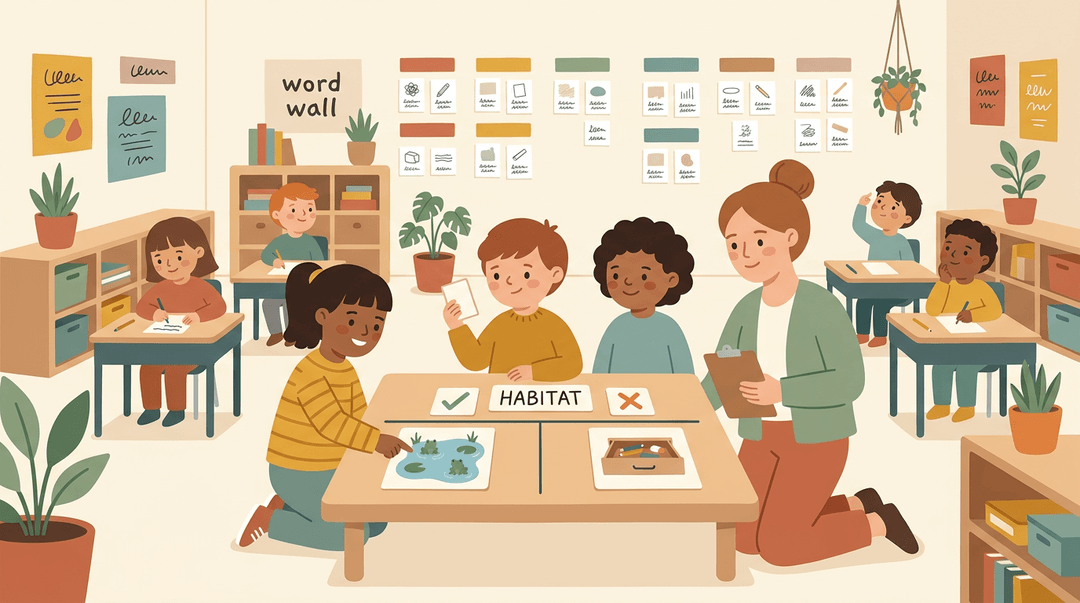
- Show an example and a non-example.
- ✅ A pond is a frog's habitat.
- ❌ A bicycle is not a frog's habitat.
- The difference to name: a habitat is where a living thing lives, so a bicycle doesn't count.
- Have students use it in a sentence.
- Say: "Turn to your partner and use habitat in a sentence."
- Listen in. A wrong sentence tells you what to fix next.
Adjusting by grade band
The four steps stay the same. What changes is how students make the meaning their own.
| Grades | Add this move | What it looks like |
|---|---|---|
| K-2 | Picture plus gesture | Draw a tree with a bird; cup hands like a roof |
| 3-5 | Define in own words | Frame: "A habitat is where ___ lives because ___." |
| 6-8 | Compare dictionary versions | Two entries side by side; students pick the clearer one and say why |
For grades 6-8, the comparison also shows students what makes a definition easy to use, which sets up the check below.
Does the definition work?
Run any definition through these four checks before you teach it.
- Uses familiar words. Students already know every word in the definition.
- Explains how the word is used. It shows the word in action, not just a synonym.
- Includes an example. A concrete case is attached, like "a pond for a frog."
- Passes the student restate test. A student can say it back without looking.
⚠️ Watch out: If students can't restate the definition, don't reteach the same words louder. Rewrite the definition with simpler words and an example, then try again.
Save vocabulary lists and definitions right inside your EMStudio lesson plans so they are ready for every class.
Online Tools That Show Words Visually
These tools pair words with pictures, motion, sound, and connections, so students can see what a word means before they use it.
Illustrated dictionaries written for kids
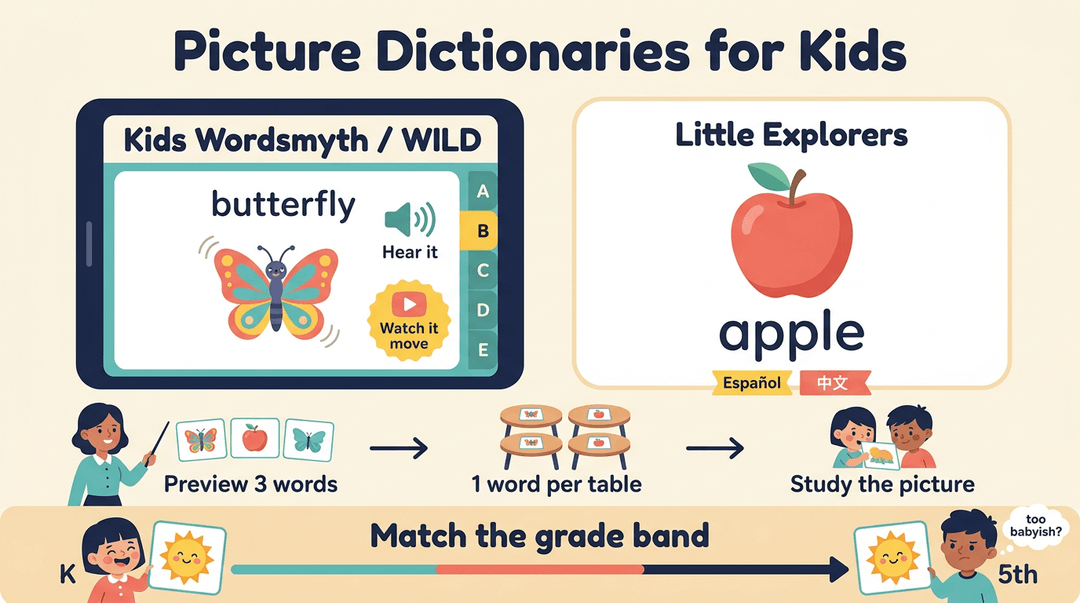
Start with Kids Wordsmyth / WILD, which pairs entries with animated images and pronunciation, so students can hear a word and watch it move. Alphabet tabs let them browse like a print dictionary.
The Little Explorers picture dictionary leads with pictures, so early readers start with what they can see. For multilingual learners, check for the Spanish and Chinese versions.
Consider a second-grade teacher who previews three entries, then assigns one word per table each day. Students study the picture instead of hunting for the page.
Before you pick, match the tool to your grade band. A picture that delights a kindergartener can look babyish to a fifth grader.
Short videos and multilingual word tools
Vidtionary shows words in short video scenes. Video lets students watch a word in action, and motion gives it a memory hook.
Opdome offers vocabulary sets that match the unit you're teaching. English, Spanish, and Chinese options let a newcomer connect each word to a language they already know.
Word webs and visual thesauruses
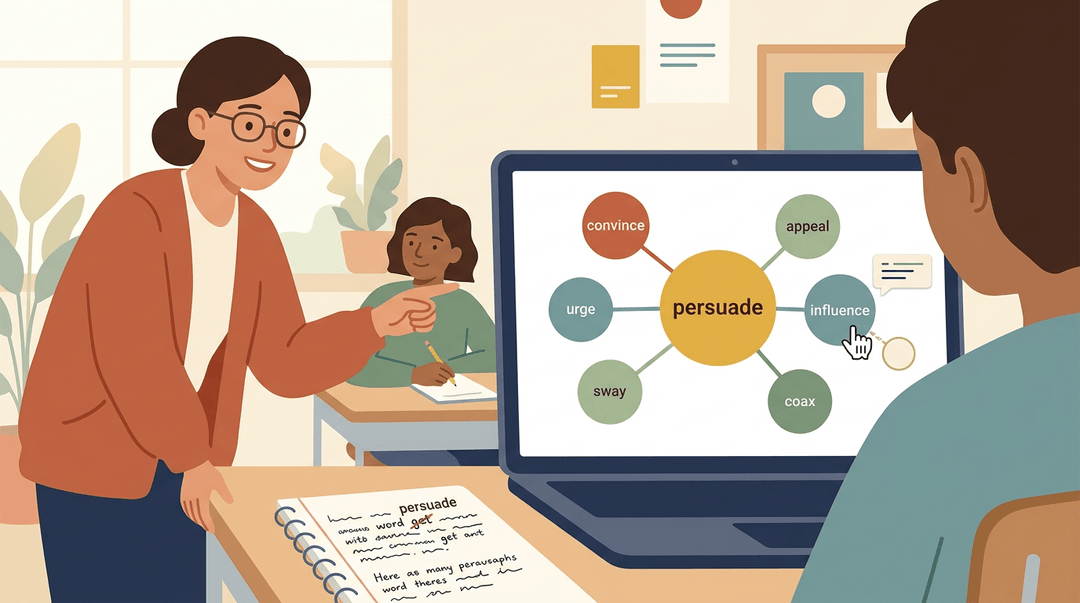
Visuwords builds a word web, where a central word branches out into related words. Snappy Words combines a dictionary and a thesaurus in one place.
Across these tools, students can:
- Hover to see definitions
- Follow color-coded word connections
- Drag and expand nodes to grow the web as they explore
The goal isn't one memorized meaning. It's seeing how a word connects to its neighbors.
Picture a high school English teacher who asks students to build a word web for the word persuade before they draft an argument essay. Stronger verbs replace the same tired word in every paragraph.
Where students can look up math terms
Math vocabulary is where many students get stuck, and a text-only definition can leave them guessing. A Maths Dictionary for Kids and the Math is Fun visual dictionary pair simple definitions with diagrams.
The Wili the Word Wizard glossary gives students a friendly place to look up terms. Some of these sites also add interactive examples and calculators, so students can test a term instead of just reading about it.
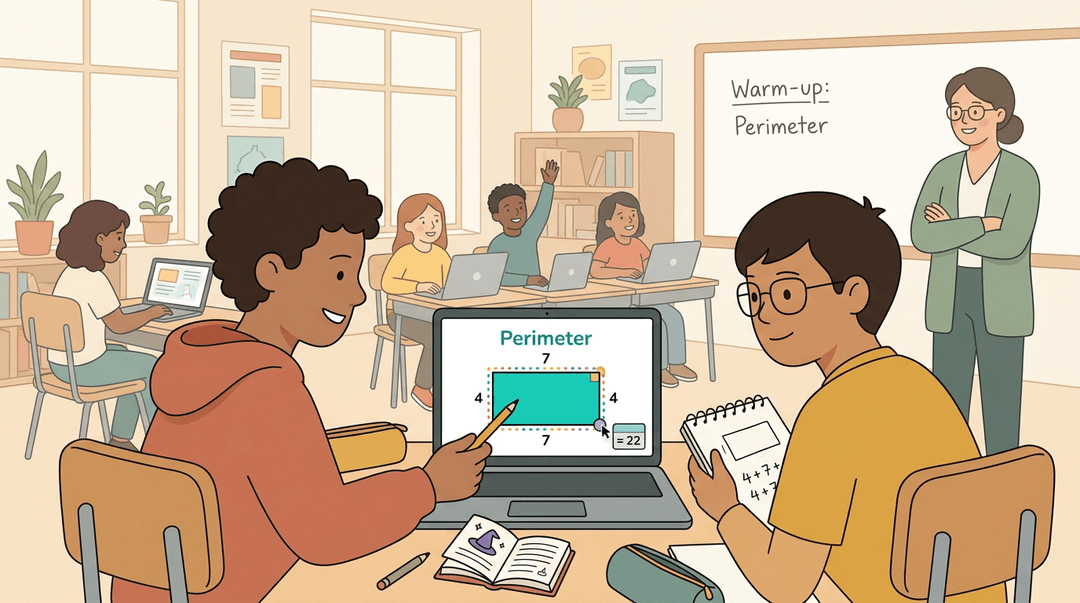
A sixth-grade math teacher sends students to a diagram of perimeter during a warm-up, then they check their thinking with an interactive example. Fewer hands go up asking the same question.
Picture dictionaries for specific subjects
A general dictionary can leave gaps in a science unit. The NASA Picture Dictionary covers space terms for grades 3 to 8, so it fits a planets or solar system unit.
A fourth-grade teacher can project one entry, ask what students notice, and build the definition together. Let the picture do the first explaining.
How Teachers and Parents Can Use Them
Once you have student-friendly definitions, here's where we'd start putting them to work.
Free options that run on your devices
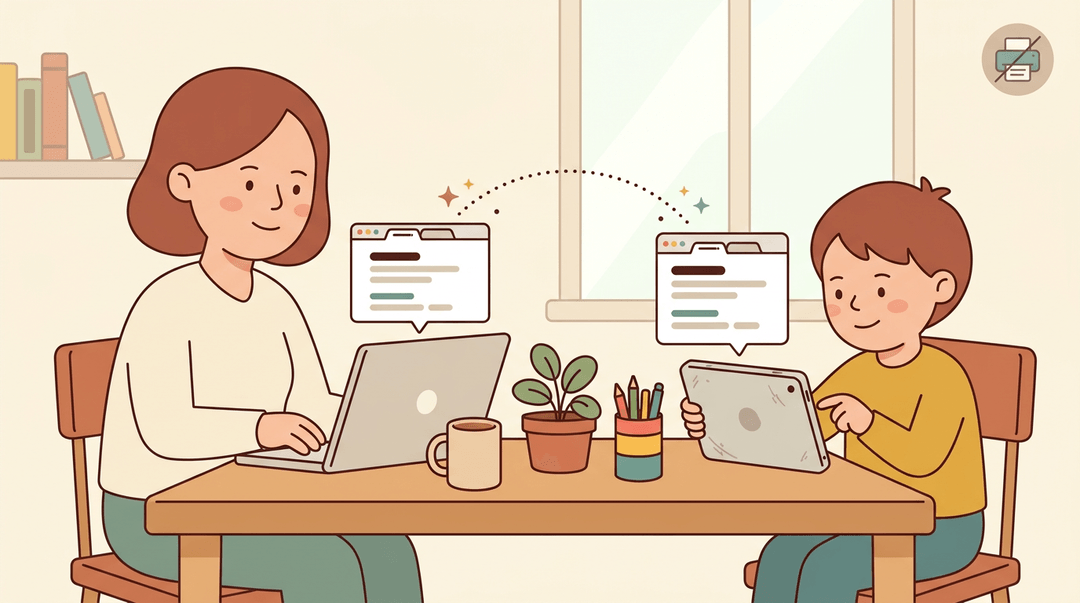
Free online alternatives to print let students browse definitions and examples on screen, with no copying or cutting.
- Works on available devices. Most free tools run on the laptops and tablets your students already use.
- Device-friendly HTML versions. HTML, short for HyperText Markup Language, is the standard format for web pages, so these open in any browser on a Chromebook or phone.
Consider a homeschool parent with one old tablet and a shared laptop. A free online version opens on both, so practice happens at the kitchen table. Same list. No printer.
Ways to support vocabulary growth
Definitions alone won't grow vocabulary. Students need to use words, not just see them. These routines help:
- Selecting tools for age group. Early readers need picture support and short sentences; older students can handle more.
- Teaching with examples and non-examples. For habitat, a pond with frogs is an example and a desk drawer is a non-example. Think of a third-grade teacher who has students sort five words this way before reading. In ten minutes, she knows who needs one more pass.
- Related vocabulary activity products. Choose ready-made activities that pair each word with a definition and an example, so they reinforce meaning, not just fill time.
- Further vocabulary webinar resource. For more depth, look for a vocabulary webinar on teaching word meaning, and pause it to try the routine with your own words.
- Word wall display ideas. Post each word with its definition and a quick sketch, grouped by unit. Students glance at it during writing time, so it becomes a reference they actually use.
Student-friendly definitions come down to one habit: writing for the learner who's seeing the word for the first time. Keep the language plain, connect the meaning to what students already know, and let a visual carry some of the load.
Your students will spend less time decoding and more time using their new words.
Ready to keep your vocabulary routine organized from unit to unit? Check out our Classroom Management page to see how you can organize classes, sections, rosters, and timetables in one structured workspace.
References
- A review of Longman Dictionary of Contemporary English (6th edition) | Lexicography — link.springer.com
- The role of verbal and pictorial information in multimodal incidental acquisition of foreign language vocabulary — pmc.ncbi.nlm.nih.gov (2014)
Frequently asked questions
What is a student-friendly definition of the word rest as a noun?
As a noun, **rest** means a break from work or activity when you stop moving and let your body or mind recover.
What is a child-friendly definition?
A child-friendly definition uses simple, familiar words to explain a word’s meaning. For example, **rest** means taking a break so your body or mind can feel better.
What are student-friendly definitions?
Student-friendly definitions are short, plain explanations that learners can understand and use. They use familiar words, show how a word is used, and may include an example.
Is there a dictionary with kid-friendly definitions?
Yes. Kids Wordsmyth / WILD and the Little Explorers picture dictionary offer kid-friendly entries, and learner dictionaries are often clearer than standard dictionaries. Check a few entries first to make sure their wording suits the child’s age and reading level.