Brain Breaks: The Complete Guide to Types and Timing

Jump to section
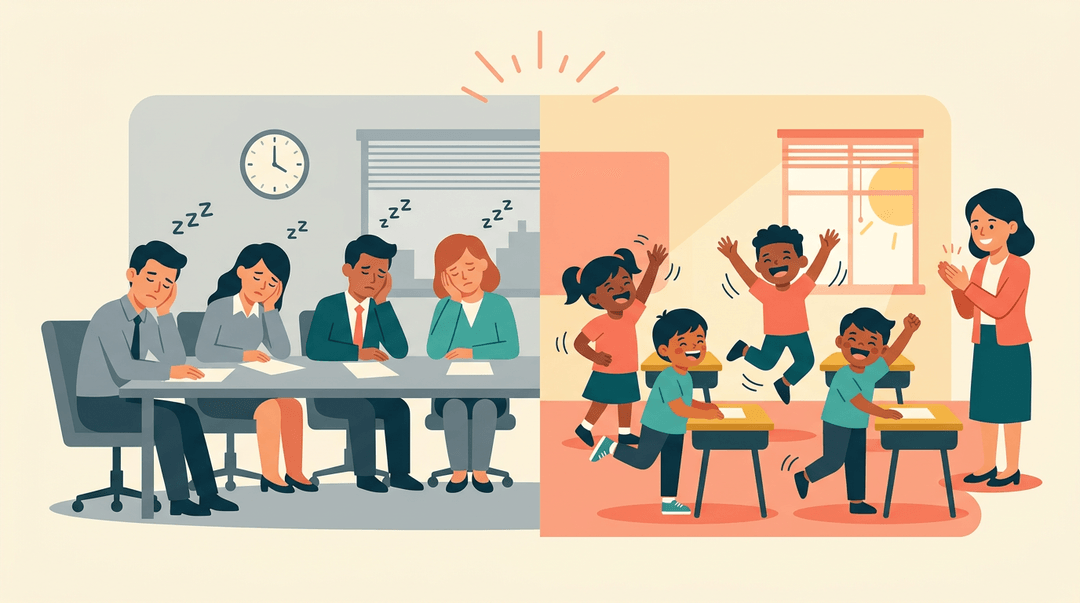
Think about the last time you sat through a long meeting. Somewhere around the forty-minute mark, your attention started to drift, and no amount of willpower could drag it back until you got up and moved. Kids hit that same wall, just faster.
Brain breaks are short, structured pauses that reset attention and energy before it collapses. They matter more than ever in classrooms packed with content and short on downtime.
Here's the full picture: what they do, the types worth trying, and how to actually schedule them.
What Brain Breaks Actually Do
Ask any teacher what a brain break is, and you'll probably hear "a chance for kids to wiggle."
That's not wrong, but a brain break is really a short, purposeful pause built into instruction, not the same thing as recess, which is unstructured time outside the lesson altogether.
Why brain breaks aren't just filler
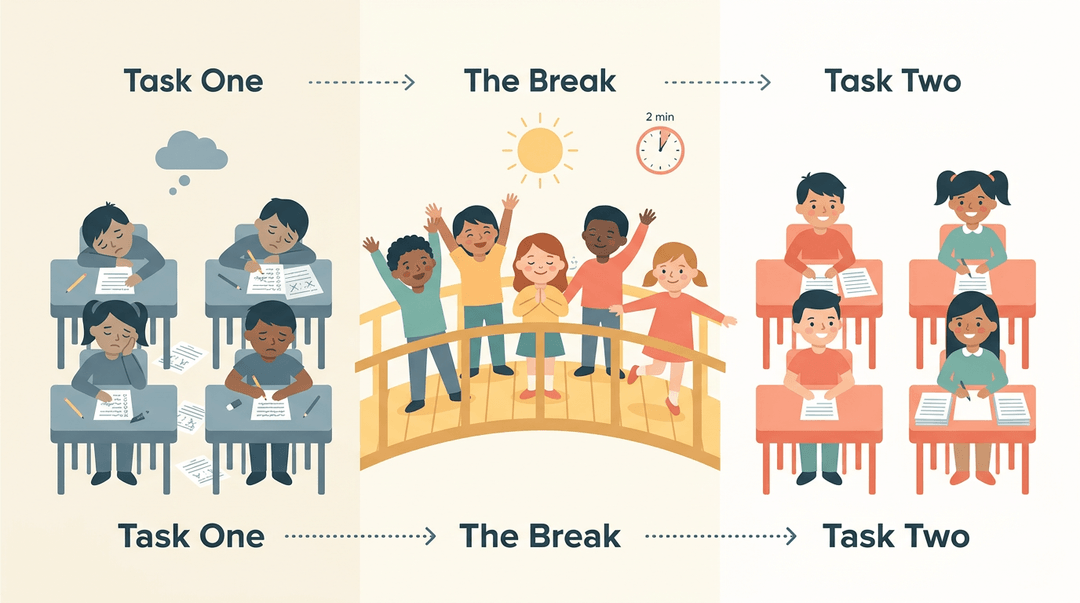
A brain break gives students a short reset from whatever task they were grinding through, so they can re-focus and re-group before the next chunk of instruction. Think of it as the gap between one task and the next, a breath before the plunge.
It's not a reward for good behavior or dead time to kill: it's a deliberate tool for making the next lesson land.
How your brain resets during a break
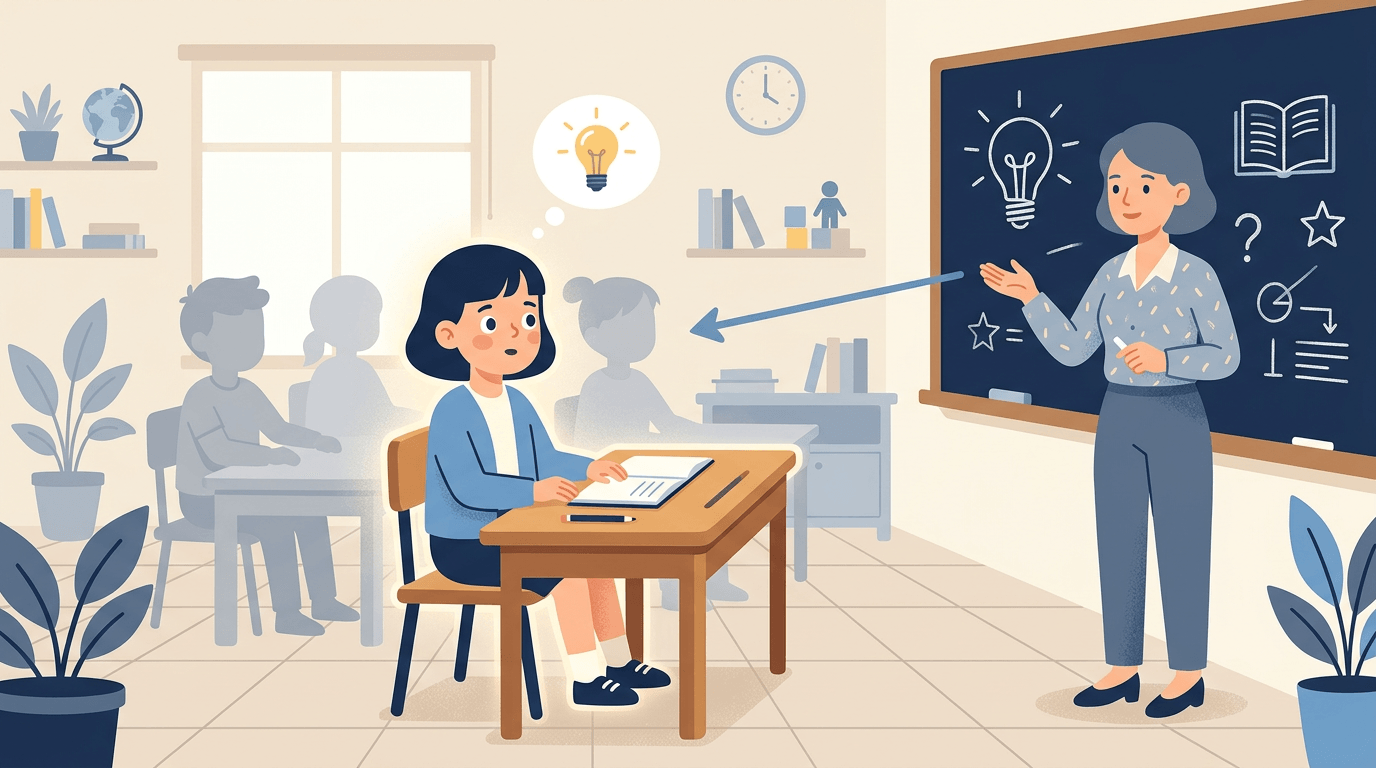
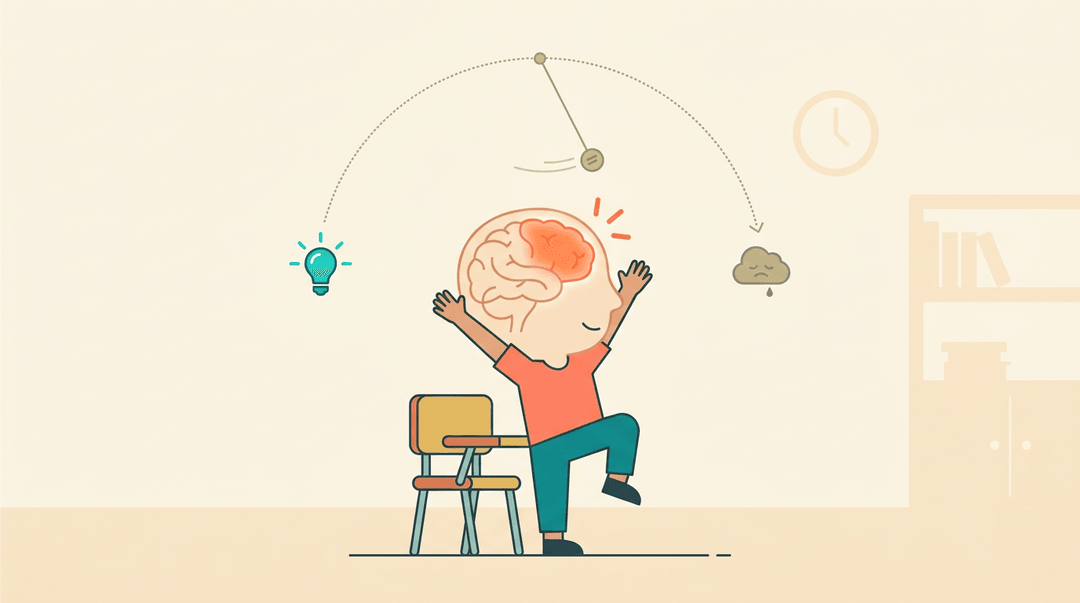
During a break, the prefrontal cortex, the brain region behind attention and self-control, gets a jolt of activity.
A study published in Scientific Reports found that this activity rises with physical movement, which helps explain why brain breaks support both attention and emotion control.
Maher's study of fourth-grade students found that short physical activity videos measurably improved on-task behavior and attentional control.
Regulation isn't a switch, it's more like a pendulum: students swing between focus and fatigue all day, and a break nudges them back toward center. Skip it, and a review of micro-breaks found mental fatigue builds fast, overloading working memory.
What research says about short breaks
Robert Marzano's research on classroom movement ties physical activity directly to stronger student engagement, and Weslake and Christian's typology takes that further, sorting breaks by purpose and intensity rather than treating them as one-size-fits-all.
Maher's findings back both up, and a systematic review of classroom-based physical activity found that brief bursts of movement reduce off-task behavior almost immediately afterward.
Different Kinds of Quick Breaks
Brain breaks aren't one-size-fits-all. Some moments call for energy, others call for calm, and a few just call for a laugh. Here's how the main types break down.
Getting up and moving
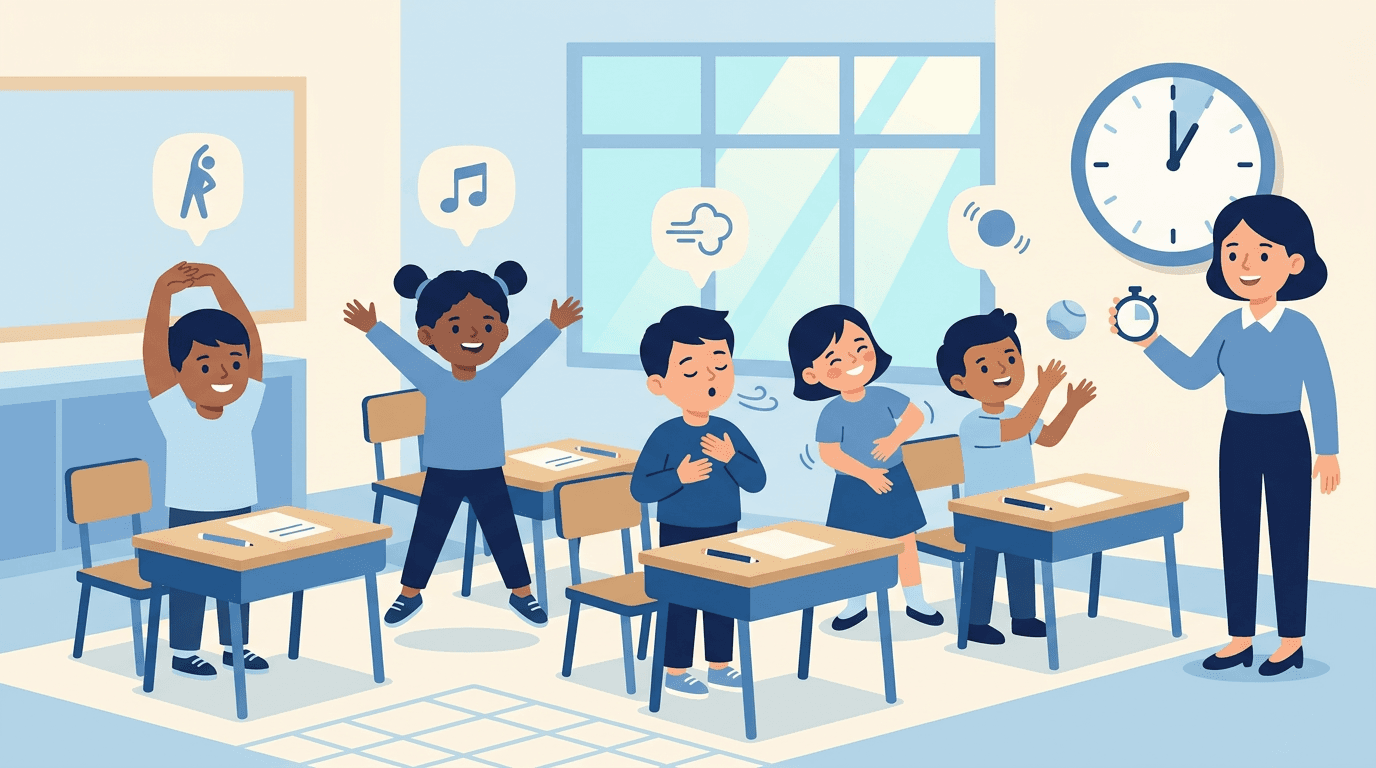
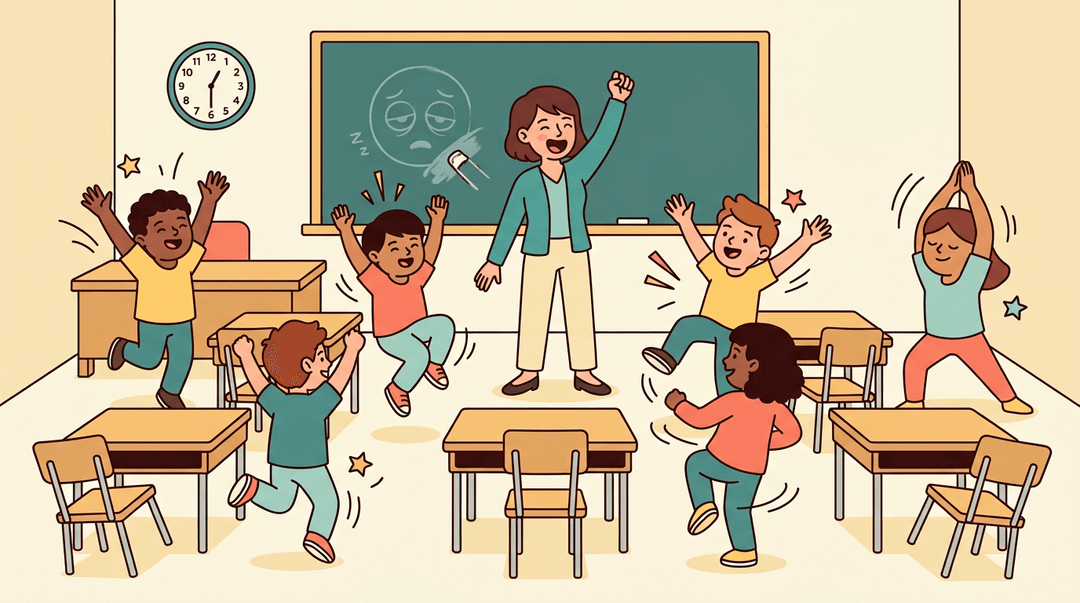
Vigorous movement tasks like jumping jacks, a quick yoga stretch, or a thirty-second dance burst increase cardiovascular activity and wake up a sluggish room fast.
Think of a fourth-grade teacher who calls "dance break" right after lunch, when eyelids start to droop. The physical jolt does what a lecture never could: it resets attention through the body first.
Breathing and mindfulness resets
Not every class needs more energy. Sometimes it needs less. Deep breathing exercises and simple visualization techniques (picture a calm lake, a favorite place) help students re-center emotionally after a tense quiz or a heated disagreement at recess.
A middle school teacher facing a class buzzing with pre-assembly nerves might lead three slow breaths before moving on: quick, quiet, effective.
What is a brain break for adults?
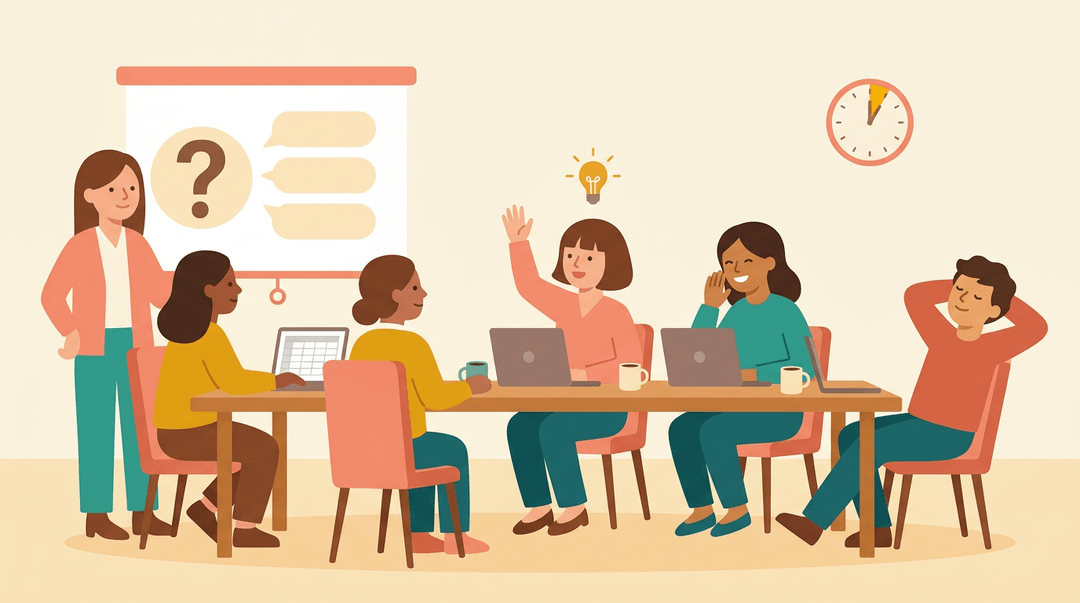
Brain breaks designed for adults run on the same principle but look different in practice. Instead of jumping jacks, an adult brain break usually means a low-concentration switch task:
- a round of trivia
- a quick joke
- a two-minute game
The goal isn't to burn energy, it's a quick focus change that pulls attention away from a spreadsheet or a lesson plan long enough to reset it.
An instructional coach opening a staff meeting with a one-question trivia round before diving into data is giving tired brains exactly that kind of palate cleanser.
Using sensory input to calm or energize
Sensory input can nudge a nervous system in either direction.
Proprioceptive input, like pushing against a wall or squeezing a stress ball, and vestibular input, like spinning or gentle rocking, can either calm or alert a student depending on how they're used.
A slow, rhythmic sensory task tends to calm; a fast, unpredictable one tends to energize. Knowing the difference lets you match the break to the moment: something soothing before a quiet reading block, something livelier before a group project.
How to Fit Breaks into Your Day
You don't need a new lesson plan to make brain breaks work: you need a repeatable routine. Run the five steps below on a loop, and breaks become as automatic as taking attendance.
The five-step loop
- Set a timer for 15 to 20 minutes of focused work.
- A visible countdown (projected or on your desk) keeps you honest too.
- Match the break to the room's energy.
- Wiggly, chatty room: pick a calming break (deep breathing, slow stretch).
- Drowsy, glazed-over room: pick a movement break (jumping jacks, desk push-ups).
- Use the same start signal every time.
- Say: "Brains up!" or ring a chime; one consistent cue, so no explaining is needed.
- Run the activity for 1 to 3 minutes. Then stop, even mid-giggle.
- Refocus with a quick prompt before diving back in.
- Say: "Eyes on me. In one word, what were we working on?"
⚠️ Watch out: the routine dies at step 4. A break that stretches to ten minutes trains students to expect recess, not a reset. Ending on time is what keeps breaks earning their place.
Quick picks by grade
Find your row when you're deciding on the fly:
| Grade band | Reach for... | Looks like... |
|---|---|---|
| Preschool | Imitation games | "Copy me!" with animal moves |
| Elementary | Movement + games | Freeze dance, Simon Says |
| Middle/high | Subtle stretch resets | Seated shoulder rolls, wrist stretches |
Older students will roll their eyes at freeze dance, so keep their resets low-key: 60 seconds of stretching at desks still does the neurological job without anyone feeling babied.
Substitute and virtual days
Breaks are easiest to skip on exactly the days students need them most. Before a sub day or a remote session, confirm:
- No-prep games are ready. A card in your sub folder listing three games needing zero materials, e.g. "Simon Says, 20 questions, silent stretch."
- Screen-friendly video breaks are bookmarked. Two or three links a sub or remote class can play in one click.
- The transition signal is written down. Your exact cue, in quotes, so the routine survives without you: "Brains up!"
At a glance: timer on, read the room, signal, 1 to 3 minutes, refocus prompt. That's the whole system, and it runs itself once students learn the rhythm.
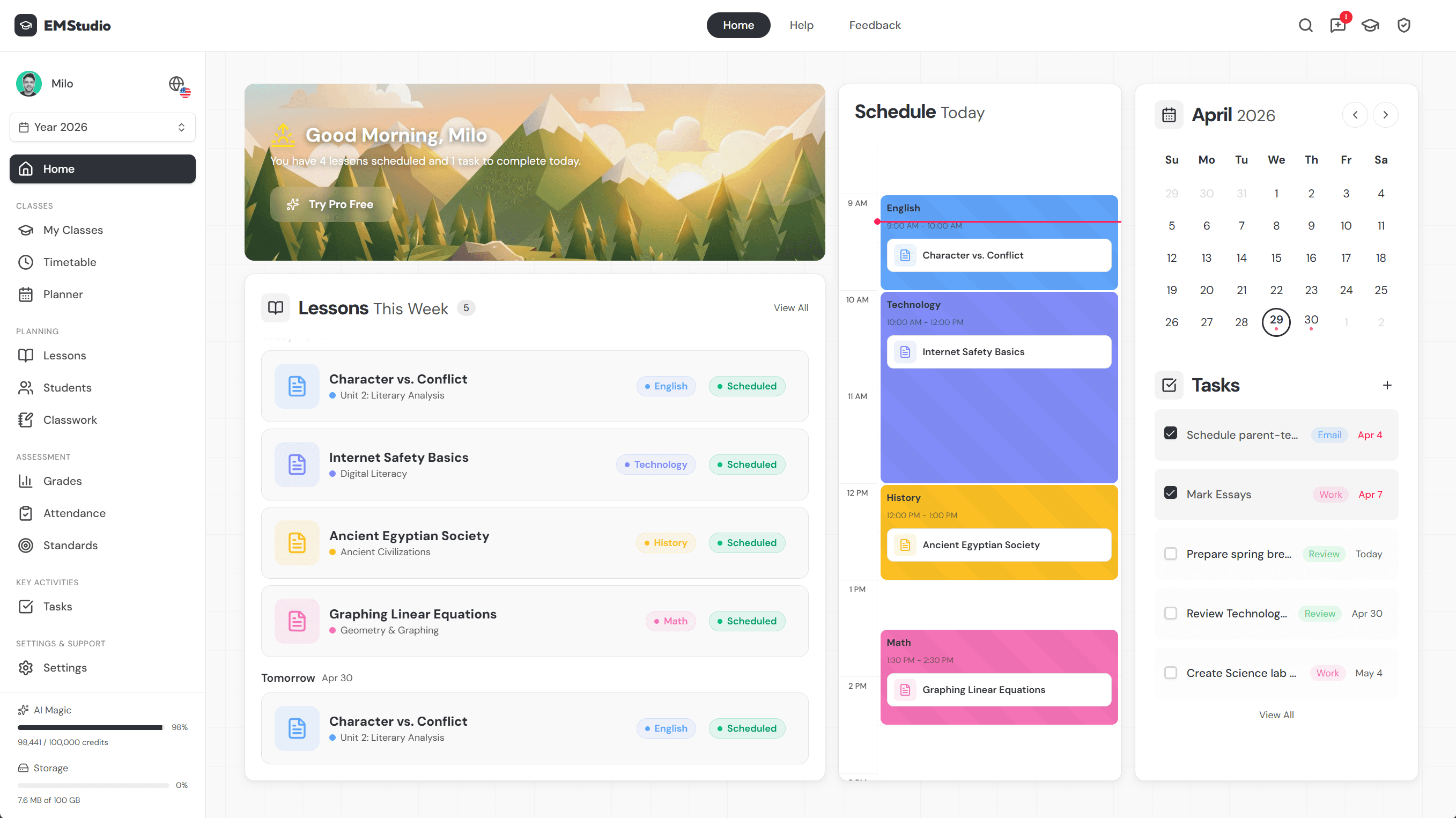
To make the timing automatic, slot recurring brain-break checkpoints right into your weekly timetable with EMStudio's classroom management tools.
Movement and Sensory Activities to Try
Not every brain break needs to be a dance video on a screen. Some of the best ones tap into the body's need for pressure, balance, and stretch: input that calms a jittery classroom just as easily as it wakes up a sluggish one.
Here are five categories worth building into your routine.
Heavy work tasks that build strength
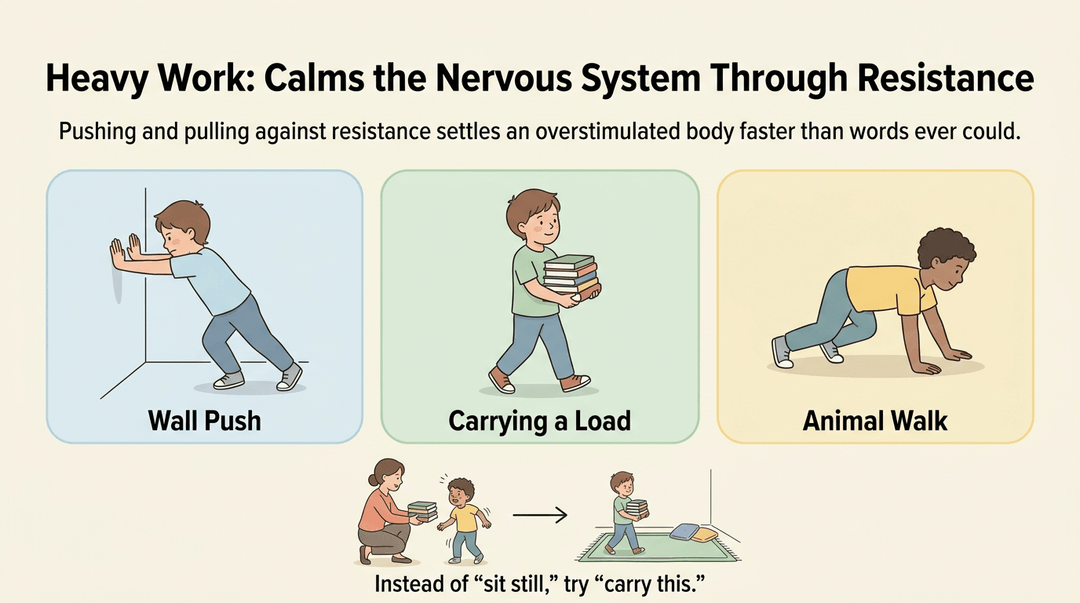
Heavy work means pushing or pulling against resistance, and it's one of the most reliable ways to settle an overstimulated nervous system. A few easy options:
- Push-ups or wall pushes, right at a desk or against a wall
- Carrying, pushing, or pulling a load, like stacking chairs or moving a bin of books
- Animal walks: bear crawls, crab walks, and similar moves
For example, a kindergarten teacher might send a wound-up student to carry a stack of books to the reading corner before circle time, which does more to settle them than a reminder to sit still ever could.
Movement that challenges balance
Balance work engages the vestibular system, the sense that tells the brain where the body is in space.
Try spinning in place or a few minutes on a mini trampoline, crawling or tiptoe walking across the room, or any other balance-based motion, like walking a taped line on the floor. These moves take barely a minute but leave students noticeably more alert.
Stretching and yoga poses
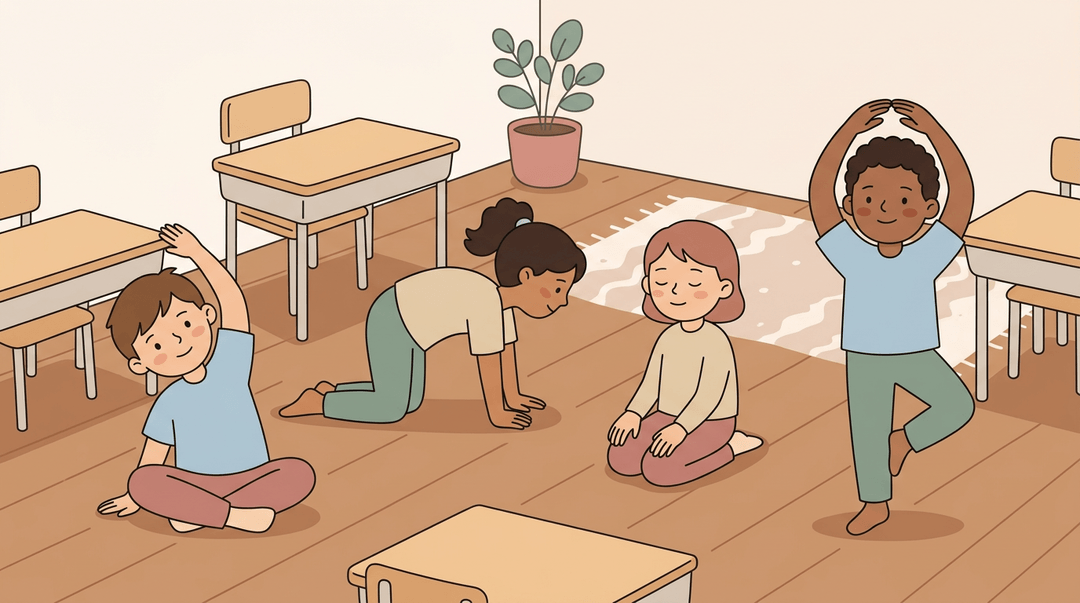
Slower stretches work best when energy needs to come down rather than up. Simple yoga poses for kids, side stretches, and a cat/cow pose sequence (arching and rounding the back on hands and knees) all fit here, and none require a mat or much space.
Exercises that cross the midline
Crossing the midline means moving a limb across the body's center, which forces both sides of the brain to work together.
A cross crawl march (opposite hand to opposite knee), elbow-to-knee touches, and the ear-nose switcheroo (one hand to the opposite ear, the other to your nose, then switch) are quick enough to run between subjects.
Quick bursts of cardio
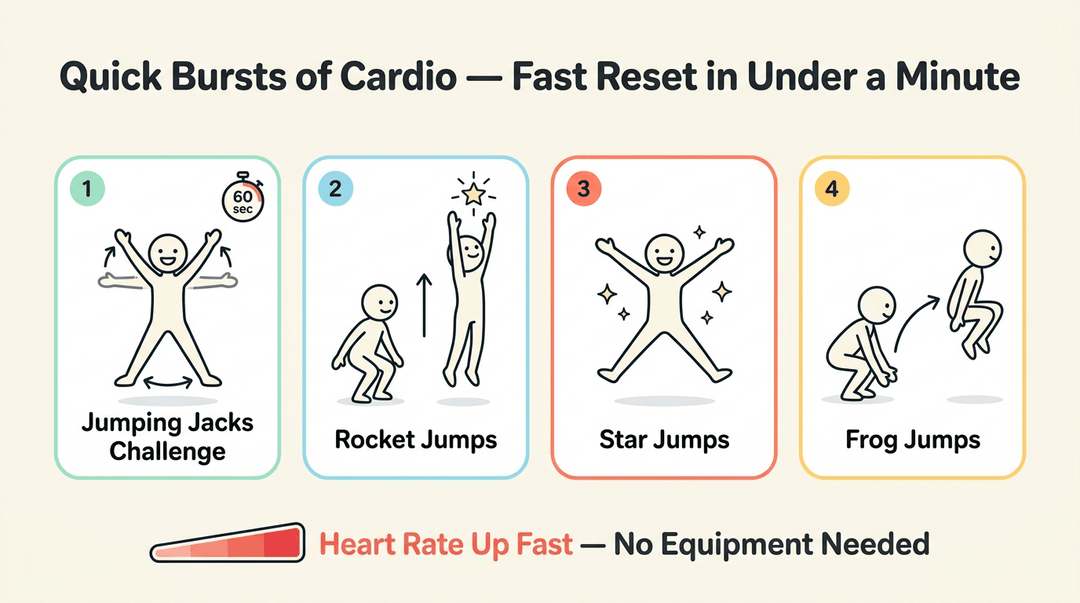
When the goal is a fast reset, cardio does the job. A jumping jacks challenge, rocket jumps (crouch low, then jump straight up reaching for the sky), and star jumps or frog jumps all raise the heart rate in under a minute, no equipment needed.
Mindful and Calming Techniques
Not every brain break needs to get hearts racing. Sometimes the most useful reset is the opposite: slowing everything down so students can find their center again before the next lesson.
Breathing exercises to try
Breath work is the fastest route to a calmer room, and it takes almost no setup:
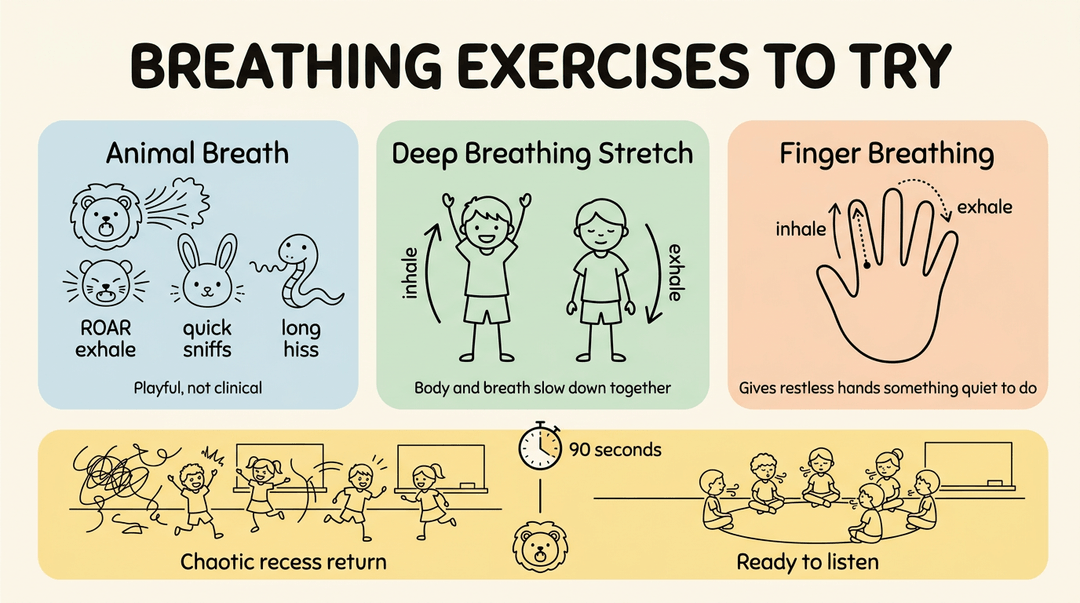
- Animal breath imitation. Students breathe like a lion (big roar exhale), a bunny (quick sniffs), or a snake (long hiss) to make the exercise playful instead of clinical.
- Deep breathing stretch. Pair a slow inhale with arms reaching overhead, then exhale as arms lower, so the body and breath slow down together.
- Finger breathing technique. Students trace one hand's fingers with the other, inhaling up each finger and exhaling down, which gives restless hands something quiet to do.
Consider a kindergarten teacher pulling a class in from a chaotic recess: ninety seconds of animal breaths and the room is ready to listen again.
Guided meditation and visualization
Guided video meditations walk students through a short script without any prep on your part. Pair one with ocean or nature imagery on the screen and soft calming background music, and even a squirrelly class tends to settle into it within a minute or two.
Coloring and art for calm
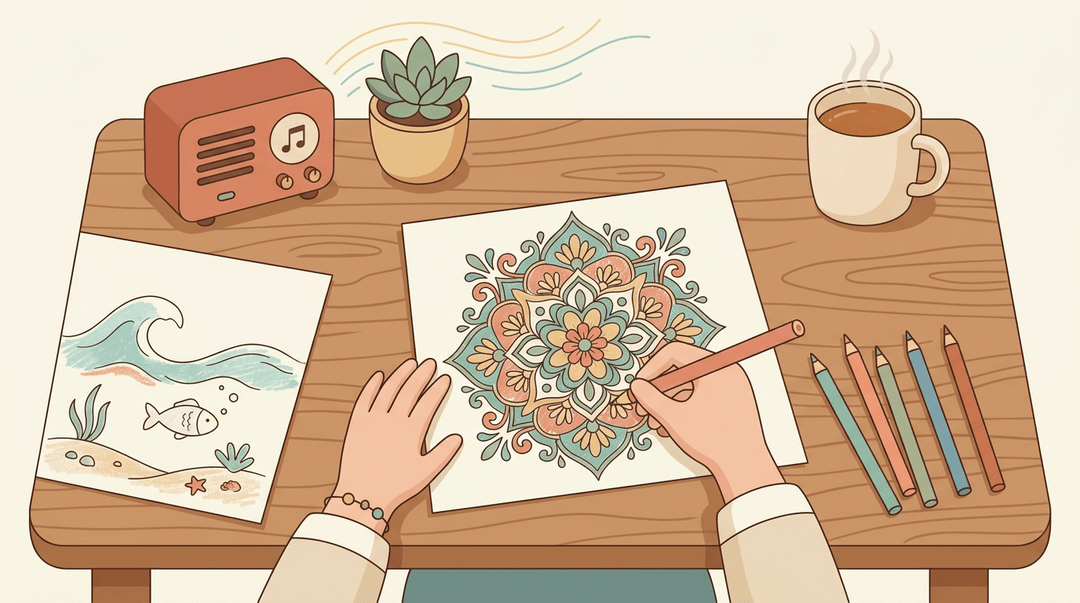
Coloring works because it's repetitive and low-stakes: there's no right answer, just a pattern to fill in.
- Mandala coloring pages give students a symmetrical, absorbing pattern to lose themselves in.
- Ocean-themed coloring sheets tie in naturally with the visualization break above.
- Calming music pairing turns a few quiet minutes of coloring into a genuine mental reset, not just busywork.
Calming with sound
Sound-based breaks ask for almost nothing from students but their attention.
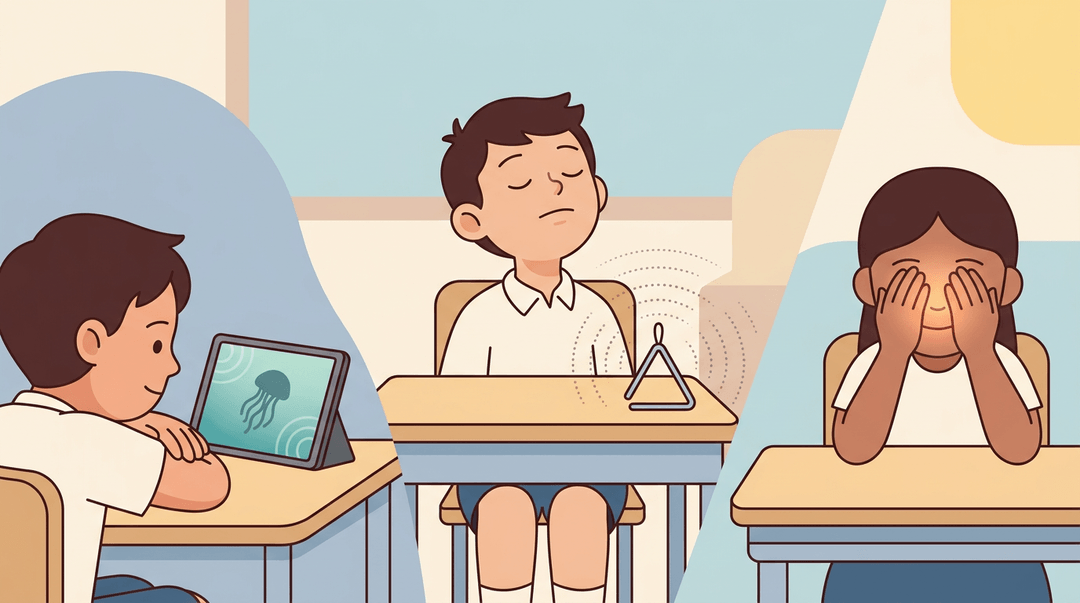
- Chime or gong focus: ring it once and have students listen until the sound fades completely.
- Jellyfish aquarium video: the slow, drifting movement is oddly hypnotic and easy to watch for a minute or two.
- Warm hands over eyes: students rub their palms together for warmth, then cup them gently over closed eyes for a few breaths of total dark and quiet.
Each of these takes under three minutes and asks for zero materials beyond what's already on hand, which makes them easy to reach for on the hardest afternoons.
Brain Breaks That Boost Thinking
Not every brain break needs to be silly or purely physical. Some sharpen the exact thinking skills a lesson calls for: vocabulary, logic, and quick reasoning. These breaks give students a mental reset that still counts as a workout for the brain.
Word and language games
Language games warm up vocabulary and pattern recognition without feeling like a worksheet.
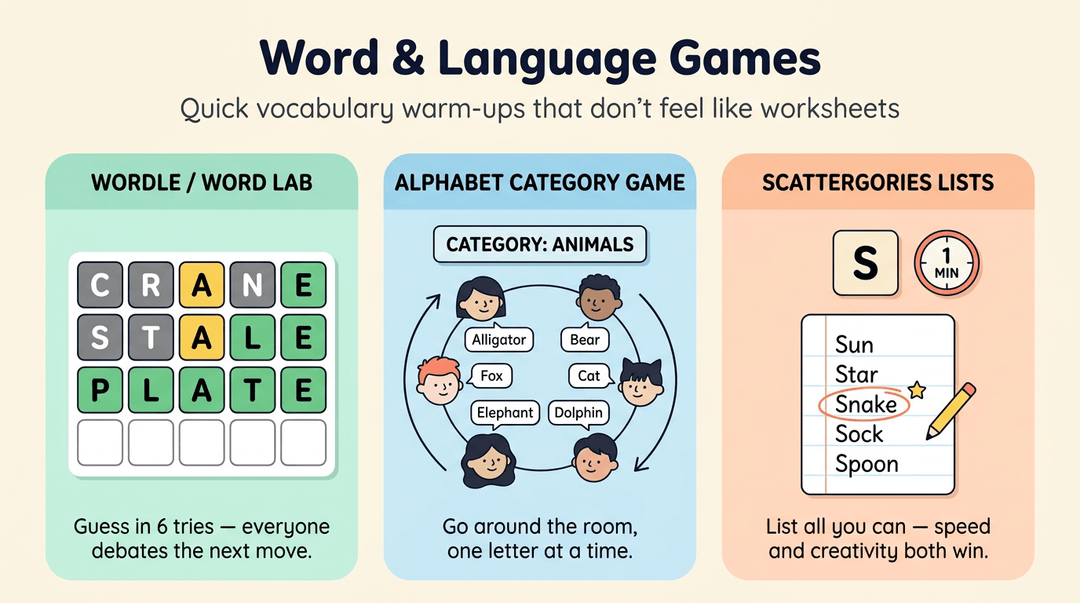
- Wordle or Word Lab. A quick daily word-guessing puzzle gets the whole class buzzing over strategy: which letters to try first, what the clues rule out.
- Alphabet category game. Call out a category (animals, countries, snacks) and go around the room naming one item per letter. It's fast, low-prep, and works for any grade level.
- Scattergories-style lists. Give students a letter and a minute to list as many words as they can in a category. It rewards speed and creativity.
Puzzles and brainteasers
Brainteasers ask students to think sideways instead of straight ahead.
- Rebus puzzles. Pictures and symbols standing in for words or phrases turn decoding into a game.
- Math brainteasers. A quick riddle or logic problem, no calculator needed, flexes number sense without touching the day's actual math content.
- Which one doesn't belong. Show four images or terms and ask students to defend their pick. There's often more than one right answer, which is exactly the point: it's about reasoning, not a single correct response.
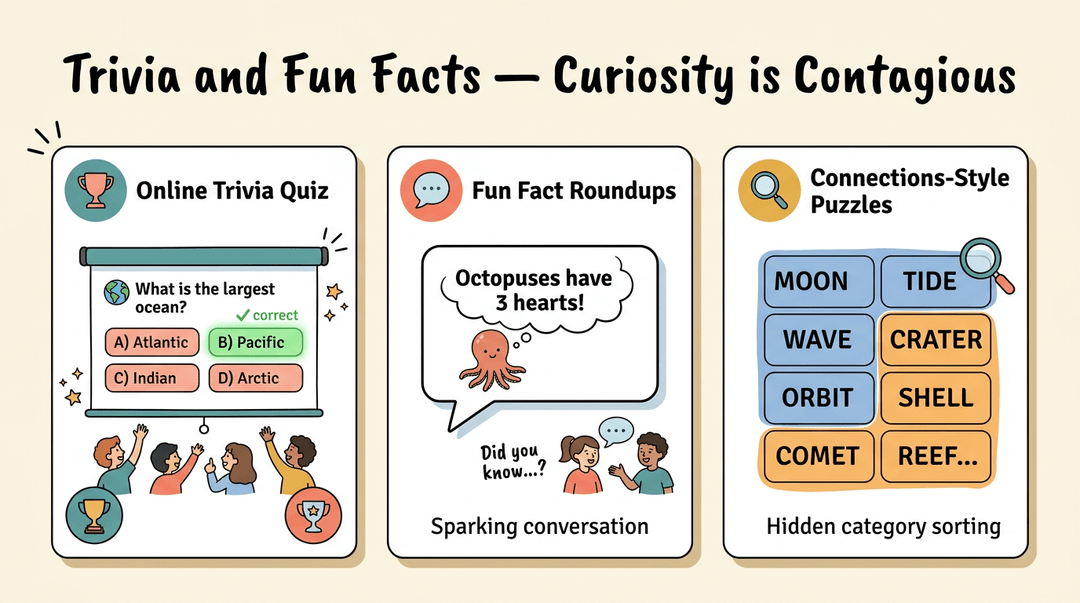
Trivia and fun facts
Curiosity is contagious, and a minute of trivia can spark a whole class's attention.
- Online trivia quiz. A quick multiple-choice round, projected or played on a shared screen, turns downtime into a friendly competition.
- Fun fact roundups. A single surprising fact (about space, animals, history) gives students something to talk about at lunch, not just during class.
- Connections-style puzzles. Sorting words or clues into hidden groups builds the same pattern-spotting muscle as the word games above, just with a twist.
Drawing and creative expression
A pencil and a minute of quiet can do as much for focus as a full stretch break.
- Directed drawing activities. Following step-by-step drawing prompts (a house, an animal, a simple scene) is calming and builds fine motor confidence.
- 60-second concept drawing. Give students a word (like "freedom" or "friction") and one minute to sketch it. A middle school science teacher might use this to check, in a glance, who's still picturing the concept correctly.
- Journaling or creative writing. A two-minute free write, no grading attached, lets students unload a thought before moving on.
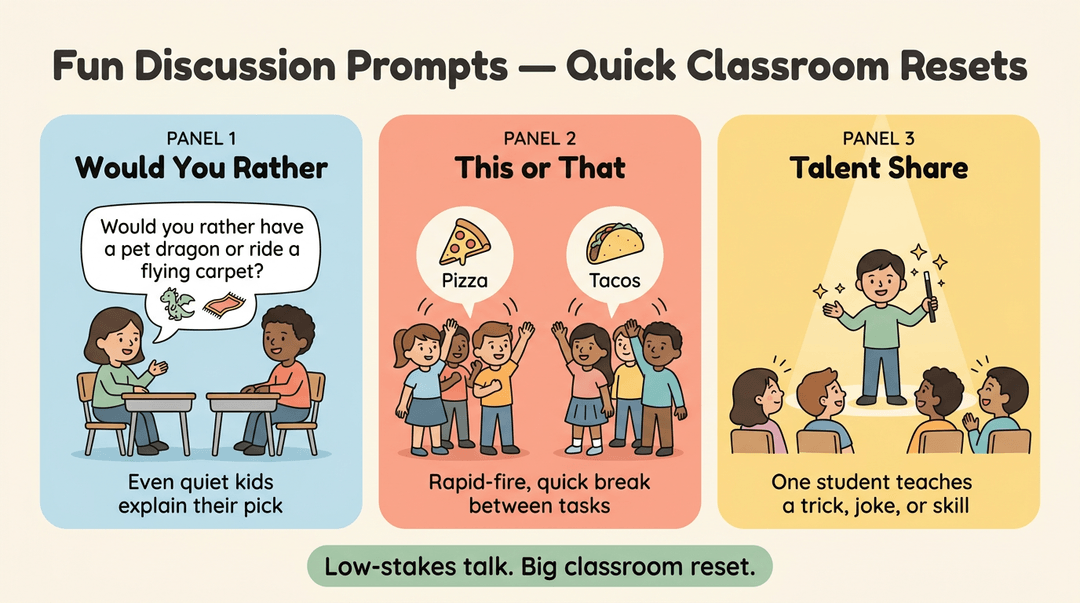
Fun discussion prompts
Sometimes the best reset is just talking to a neighbor about something low-stakes.
- Would you rather questions. Silly dilemmas get even quiet students turning to a partner to explain their pick.
- This or that choices. A rapid-fire version of the same idea works well for a quick show-of-hands break between tasks.
- Talent-share moments. Let a student teach the class a quick trick, joke, or skill. It's a small spotlight that builds classroom community and gives everyone else a breather.
Group Games for Classroom Management
Group games do double duty: they burn off restless energy and give you a built-in structure for putting that energy back to work. Used well, they're less a break from classroom management and more a tool for it.
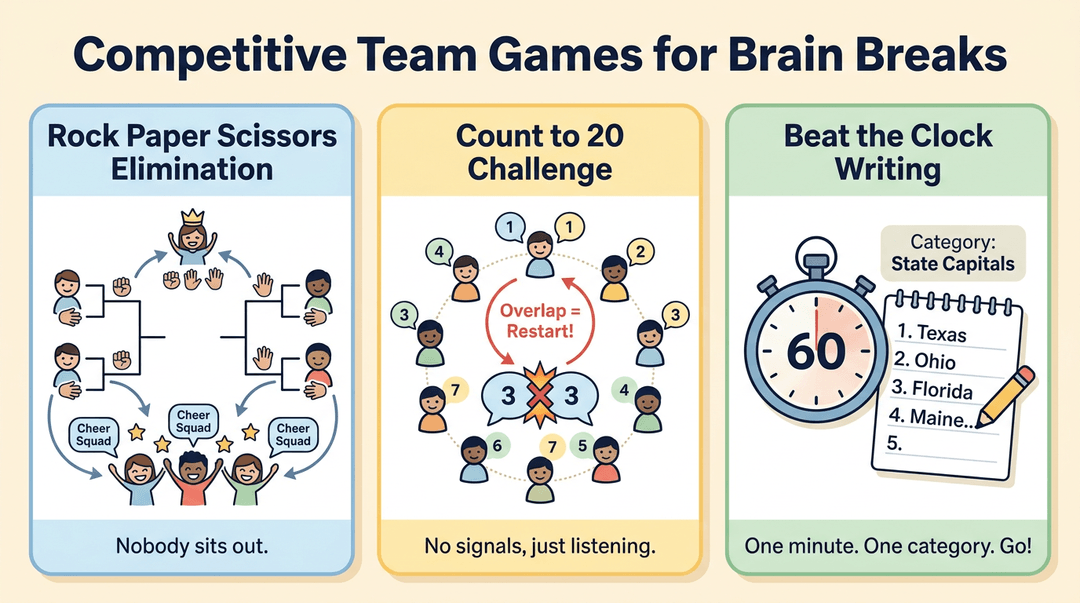
Competitive team games
A little friendly rivalry keeps a brain break lively without tipping into chaos. Rock paper scissors elimination turns the whole class into a single-elimination bracket: losers become the winner's cheer squad, so nobody actually sits out. The count to 20 challenge has students count aloud as a group, one number per person, with no signals: if two people speak at once, the count restarts, which quietly demands teamwork and listening. Beat the clock writing gives students 60 seconds to list everything they can think of in a category (state capitals, animals, vocabulary words), turning a transition into a quick mental sprint.
Silent games that build focus
Not every reset needs noise. Silent ball has students toss a ball around the room under one rule: no talking, no bad throws, or you're out. It rebuilds focus fast. Heads up seven up channels stillness into anticipation: heads down, thumbs up, and a few "it" students tap thumbs before the guessing begins. Pop-up freeze mixes movement and control: students pop up and freeze on a cue, training the same impulse control they'll need once instruction resumes.
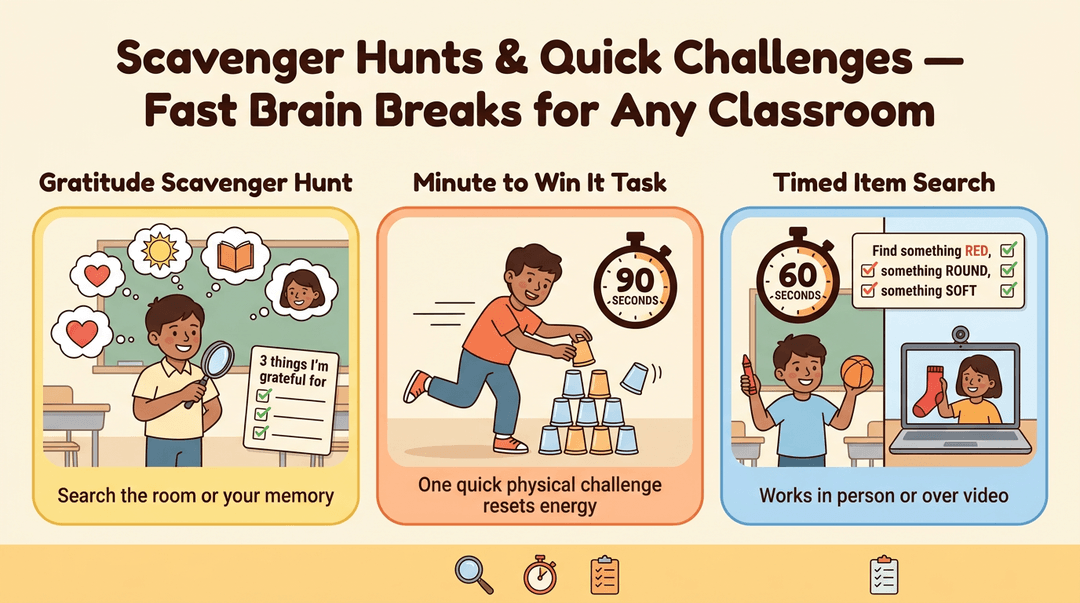
Scavenger hunts and quick challenges
A gratitude scavenger hunt sends students searching the room, or their memory, for things they're thankful for, folding a social-emotional check-in into movement. Minute to win it tasks borrow the show's format: one simple, timed physical challenge, like stacking cups or balancing a book, that resets energy in under 90 seconds. Timed item searches ask students to find a set number of objects matching a category before time's up, which works equally well in a physical classroom or over video.
Board and card games
For a slower reset, keep a stack of brain break card decks on hand: each card names a 30 to 60 second activity, so you never have to invent one on the spot. Seated board games, quick rounds of checkers or a simple strategy game, give students a calm, social option that doesn't require standing. And heavy work game options, like a round of chair push-ups or carrying a stack of books to a station, use physical resistance to help students who need pressure and effort to settle.
Putting Brain Breaks into Practice
Knowing brain breaks work is one thing. Running them well, at the right moment, for the right length, in a room full of different learners, is where most teachers actually get stuck.
How long should a brain break be?
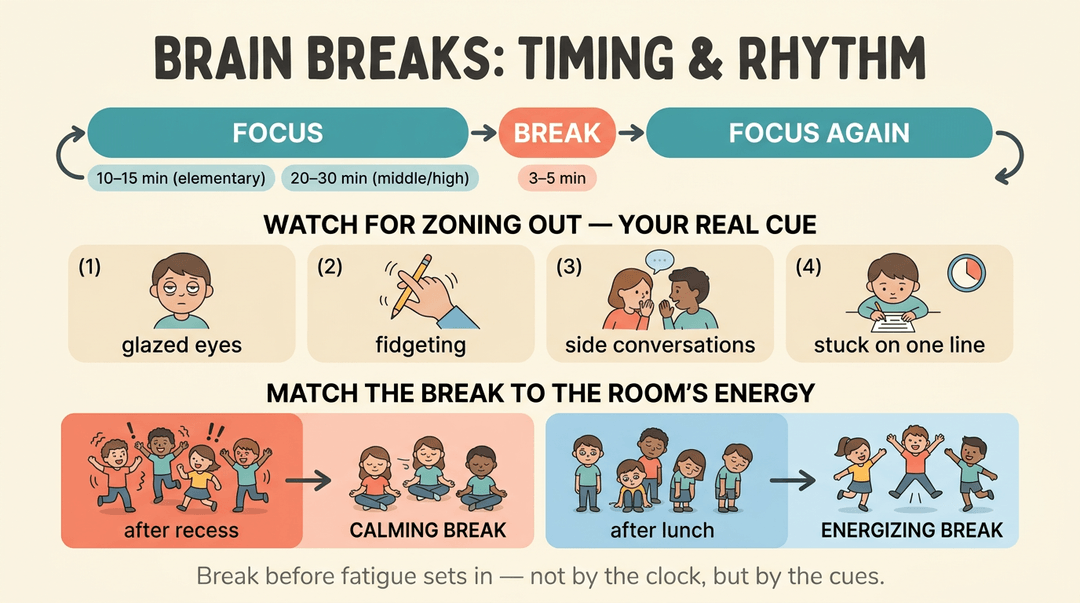
How long should you take a brain break? Shorter than you'd think. According to Edutopia, "concentrated study of 10 to 15 minutes for elementary school and 20 to 30 minutes for middle and high school students calls for a three- to five-minute break."
That's the rhythm to build around: focus, then a short reset, then focus again.
Timing matters more than the clock, though. Watch for zoning out:
- glazed eyes
- fidgeting
- side conversations
- a student staring at the same worksheet line for a minute too long
Those are your cue, not the timer. As Edutopia puts it, breaks should land "before fatigue, boredom, distraction, and inattention set in." A wired-up class after recess needs a calming break; a sluggish class after lunch needs an energizing one.
Match the break to the energy in the room, not a fixed script.
Seated and standing alternatives
Not every break needs students out of their seats. Flexible seating (floor cushions, wobble stools, a rug corner) lets kids shift position without leaving the lesson.
Standing desks work the same way: a student who stands to stretch for thirty seconds resets blood flow without disrupting anyone.
Even a small postural change, rolling shoulders, uncrossing legs, sitting up tall, counts as a break for a body that's been still too long.
Using breaks during transitions
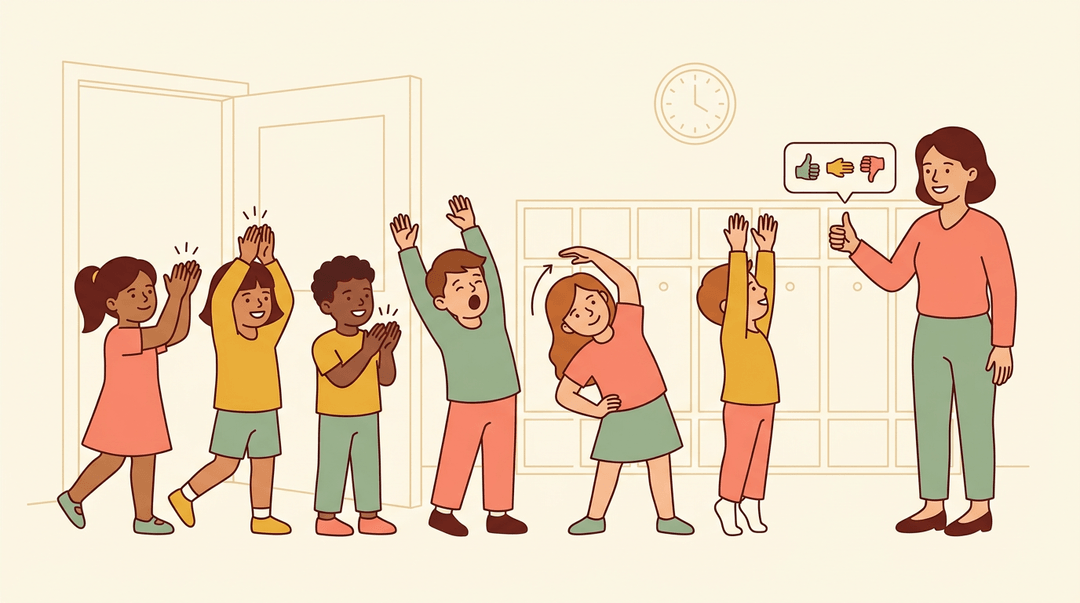
Transitions are free real estate for brain breaks. Line-up time can double as a quick clapping pattern or a riddle. Between tasks, a thirty-second stretch resets attention before the next direction is even given.
In a virtual classroom, ask students to mute, stand, and stretch on camera before moving to the next activity.
These moments are also a natural spot for a mental health check-in: a quick "thumbs up, sideways, or down" gives you a read on the room without singling anyone out.
Strategies by age group
- Preschool: imitation games ("do what I do") build attention through play.
- Middle school: short yoga poses or stretches that don't feel babyish.
- High school: subtle resets, like a silent stretch or a one-minute doodle, that respect teens' self-consciousness.
Grade-band cue cards (a stack of ready-to-grab prompts sorted by age) keep this simple; you flip to the right band and go.
What are brain breaks for ADHD?
For students with ADHD (attention-deficit/hyperactivity disorder) or sensory processing differences, including many autistic students, brain breaks matter even more, but they need to be chosen carefully.
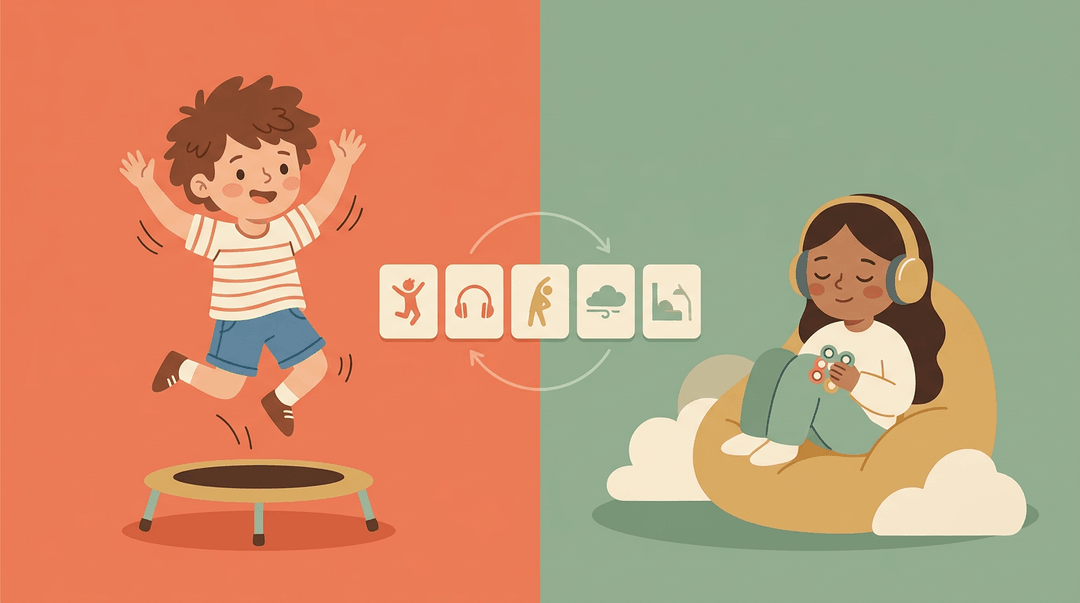
Some students need movement to regulate; others, especially those with sensory processing sensitivities, get overwhelmed by loud, chaotic breaks and need something calmer instead.
There's no single ADHD-specific brain break: an individualized approach works best, built with input from the student when possible.
Rotate a small set of go-to breaks rather than reaching for something new every time. Novelty fades fast, and an overstimulating break can undo the very reset it's supposed to provide.
Resources and Themed Collections
You don't have to build every brain break from scratch. A ready-made library saves you prep time, and once you've got a handful of favorites, you can schedule them right into your weekly plan so they happen as reliably as attendance.
Video resources to use
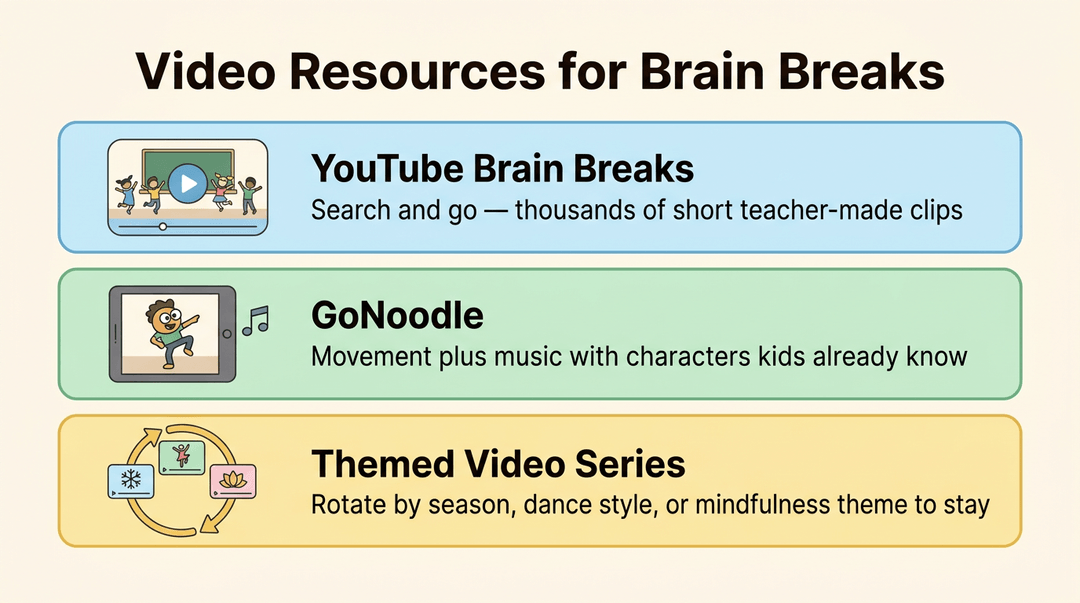
- YouTube brain break videos are the easiest starting point: search the term and you'll find thousands of short, teacher-made clips ready to project and follow along with.
- GoNoodle takes that idea further with digital breaks built specifically for classrooms, pairing movement with music and characters kids recognize, so there's less explaining and more doing.
- For variety, look for themed video series: a set built around a season, a dance style, or a mindfulness theme that you can rotate through so the same three videos don't wear thin by October.
Themed activity sets
Tying a break to the calendar or the curriculum makes it feel less like a detour and more like part of the day.
- Seasonal themed breaks (a snowball toss in winter, a "harvest stretch" in fall) give you an easy refresh every few months.
- Animal and book-tied activities connect a break to whatever you're reading or studying: think of a first-grade class hopping like the rabbit from today's read-aloud.
- Printable activity cards round things out: grab-and-go prompts you can keep in a bin by your desk for the moments a video isn't practical.
Curated lists by grade level
Age-tailored collections matter because what lands with kindergartners falls flat with fifth graders.
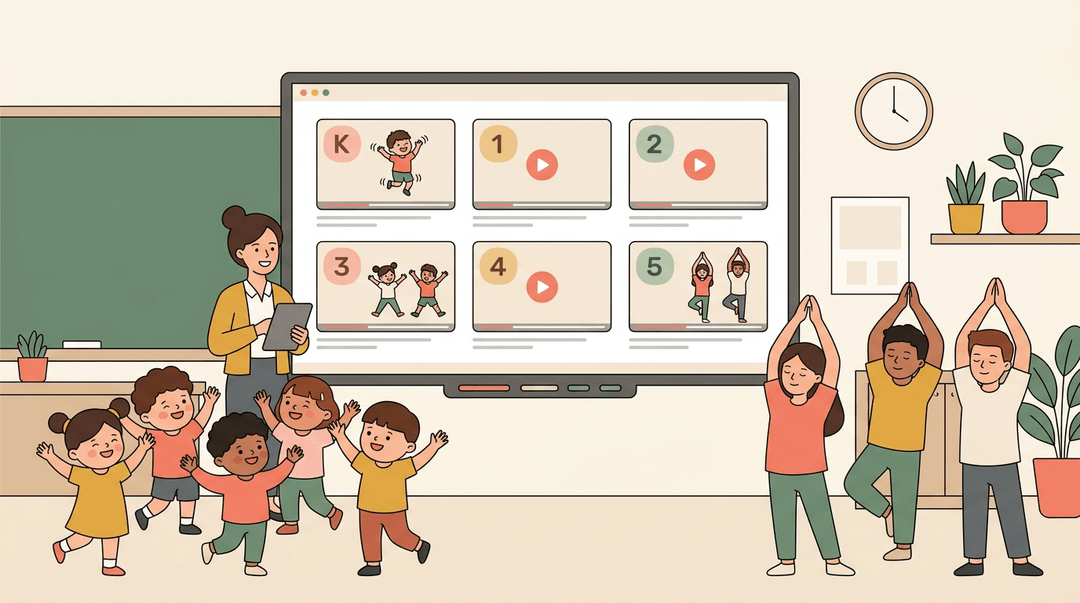
Look for kindergarten through fifth grade lists that sort options by developmental stage, often with 25 videos per grade so you've got enough to rotate through a full semester without repeating yourself too often.
Brain breaks aren't a detour from learning, they're what makes the rest of the lesson land. Used well, they hand you calmer transitions, sharper focus, and a classroom that runs smoother because everyone's brain got the reset it needed.
Ready to build that rhythm into your week without the guesswork? Check out our Classroom Management feature to organize your classes, timetables, and routines in one place.
References
- The Effect of the Brain Breaks Physical Activity Program on Task Focus, Attentional Control, and Academic Achievement in 4th Grade Elementary School Students — doi.org (2026)
- Effects of different exercise intensities on prefrontal activity during a dual task — nature.com
- "Give me a break!" A systematic review and meta-analysis on the efficacy of micro-breaks for increasing well-being and performance — pmc.ncbi.nlm.nih.gov
- Effect of classroom-based physical activity interventions on academic and physical activity outcomes: a systematic review and meta-analysis — pmc.ncbi.nlm.nih.gov
- Brain Breaks and Movement Breaks Kids Love — theottoolbox.com
- Using Brain Breaks to Restore Students’ Focus — edutopia.org
Frequently asked questions
What is a brain break for adults?
A brain break for adults is a short, purposeful pause that shifts attention away from a demanding task and helps reset focus. It might include a trivia question, a quick joke, or a two-minute game rather than vigorous exercise.
What is a good brain break dance for kids?
Freeze dance is a good brain break dance for kids. Play music while children dance, then have them freeze when the music stops. It combines movement, listening, and impulse control.
What are some brain breaks?
Brain breaks can include jumping jacks, stretching, yoga, a short dance, deep breathing, visualization, wall pushes, animal walks, cross-crawl marching, trivia, drawing, or a quick word game. Most work best when they last about 1 to 3 minutes and match the room’s energy.
What are brain breaks for ADHD?
Brain breaks for ADHD can include brief movement, heavy-work activities, sensory input, and calming exercises. Wall pushes, animal walks, desk push-ups, stretching, cross-crawl marching, breathing exercises, and short dance breaks can help redirect energy and support attention. Choose activities based on whether the person needs alerting movement or calming input.
What are some exercises that can help rewire the brain?
Exercises that may support brain rewiring include aerobic activity such as brisk walking, running, cycling, or dancing, along with strength training, balance exercises, yoga, and coordinated movements. Learning new skills, practicing mindfulness, and challenging the brain with music, language, or puzzles can also support neuroplasticity. Progress is usually strongest with regular practice and adequate sleep.
What are some good body breaks for kids?
Good body breaks for kids include jumping jacks, animal walks, wall pushes, desk push-ups, stretching, yoga poses, cross-crawl marches, balance walks, and freeze dance. Keep them short, structured, and appropriate for the available space and the group’s energy level.
What are some fun icebreakers for 3rd grade students?
Fun icebreakers for third graders include Would You Rather, This or That, Simon Says, Two Truths and a Lie, partner interviews, silent line-ups, classroom scavenger hunts, Count to 20, and quick drawing challenges. Activities that involve simple choices, movement, or sharing a favorite thing are usually easy for this age group to follow.
What do first graders struggle with the most?
First graders commonly struggle with sustaining attention, following multi-step directions, managing emotions and impulses, developing reading and writing skills, and building number sense. They are also learning classroom routines, cooperation, fine-motor control, and independence. The specific difficulty varies by child and development.