Trauma Informed Teaching Explained, From Theory to Practice

Jump to section
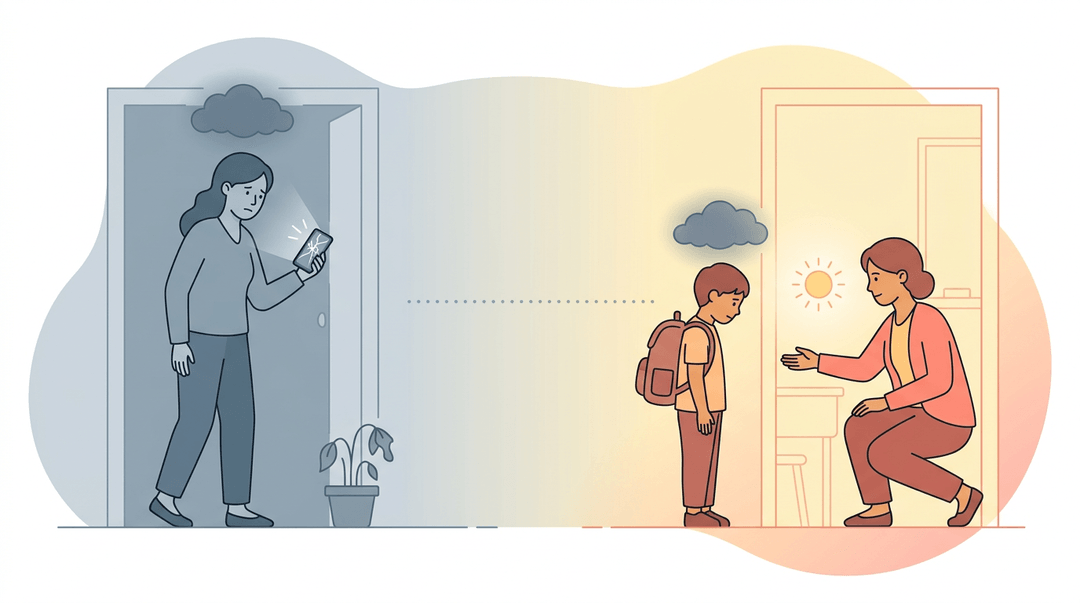
Think about the last time you walked into a room already on edge, maybe after a rough commute or a hard phone call. You weren't lazy or defiant that day. You were carrying something invisible, and it shaped how you showed up.
Students carry the same kind of weight into your classroom every day. Trauma-informed teaching means recognizing that weight and responding to it with structure and care instead of frustration.
In this post, we'll unpack what it really means, how trauma shows up in behavior, and what you can start doing tomorrow.
Understanding Trauma in Trauma Informed Teaching
Before any classroom strategy makes sense, you need a shared, accurate definition of trauma, one that goes well beyond the images that word usually conjures.
What actually counts as trauma
Trauma isn't defined by the event itself. It's defined by what that event does to a person's ability to cope.
SAMHSA frames it through three elements: an event, a series of events, or a set of circumstances experienced as physically or emotionally harmful, one that leaves lasting effects on a person's functioning and well-being.
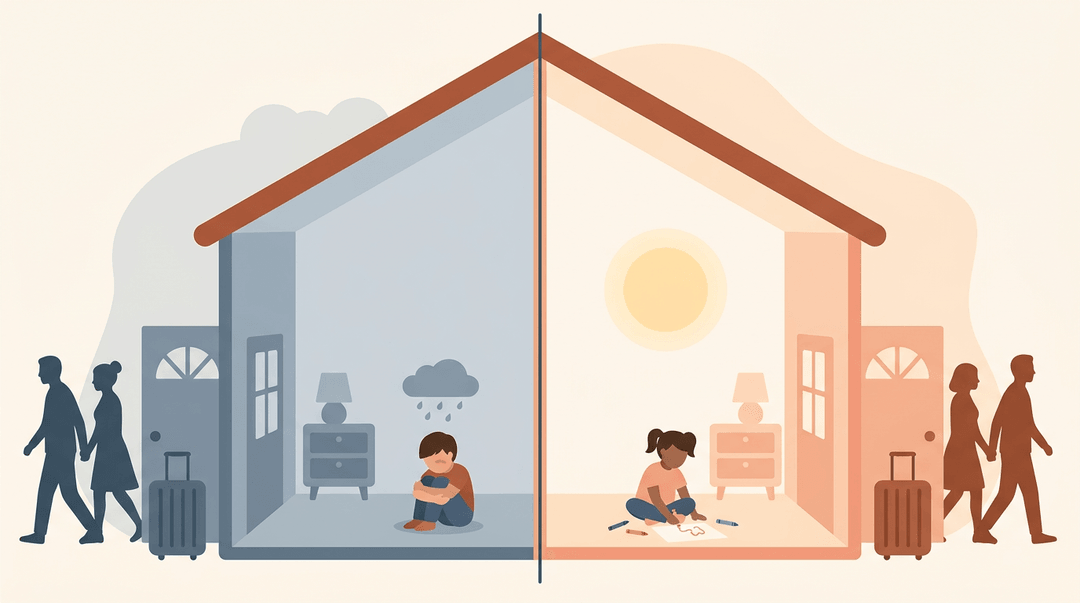
That definition doesn't require violence. A divorce, a hospitalization, or a sudden move can overwhelm a child's coping capacity just as thoroughly as abuse can.
And because coping capacity varies from child to child, the same event can leave one student shaken for years and barely touch another.
How common childhood trauma really is
Childhood trauma doesn't discriminate by race or income, though poverty adds its own layer of chronic stress on top of it.
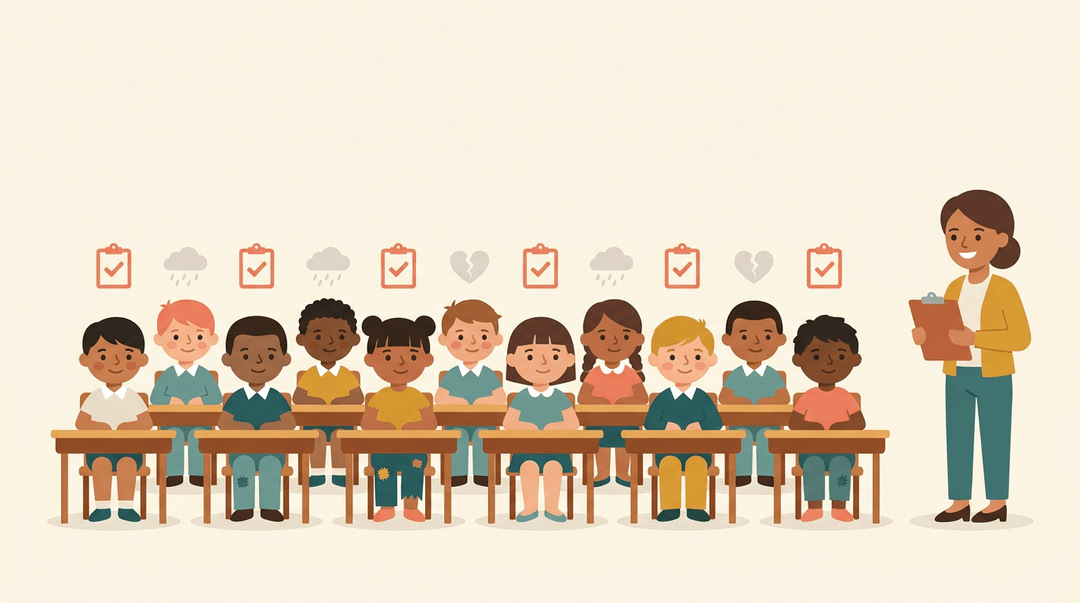
More than two-thirds of kids report at least one traumatic event by age 16, and a study from SUNY University at Buffalo found that 66% of newly arrived college first-years had already been exposed to trauma before ever setting foot in a lecture hall.
That's part of why more schools now rely on ACEs (Adverse Childhood Experiences) questionnaires, screening tools that assess a student's exposure to potentially traumatic experiences.
Ongoing research into these tools is pushing toward universal screening: checking in with every student, not just the ones already flagged as struggling.
Trauma that spans generations and communities
Some trauma doesn't start with the student in front of you at all. Historical trauma travels through generations, carried in family stories, community memory, and collective experience.
African American students may carry the weight of a history rooted in slavery and systemic racism, while Native American students often inherit the trauma of forced relocation and boarding schools.
Large-scale events, like a pandemic, can traumatize an entire community at once, students and teachers together.
How Trauma Affects the Brain and Behavior
Before you can respond to a student's outburst, it helps to know what's happening underneath it. Trauma doesn't just live in a child's memory: it rewires how their brain reacts to everyday classroom moments.
How the brain responds to stress
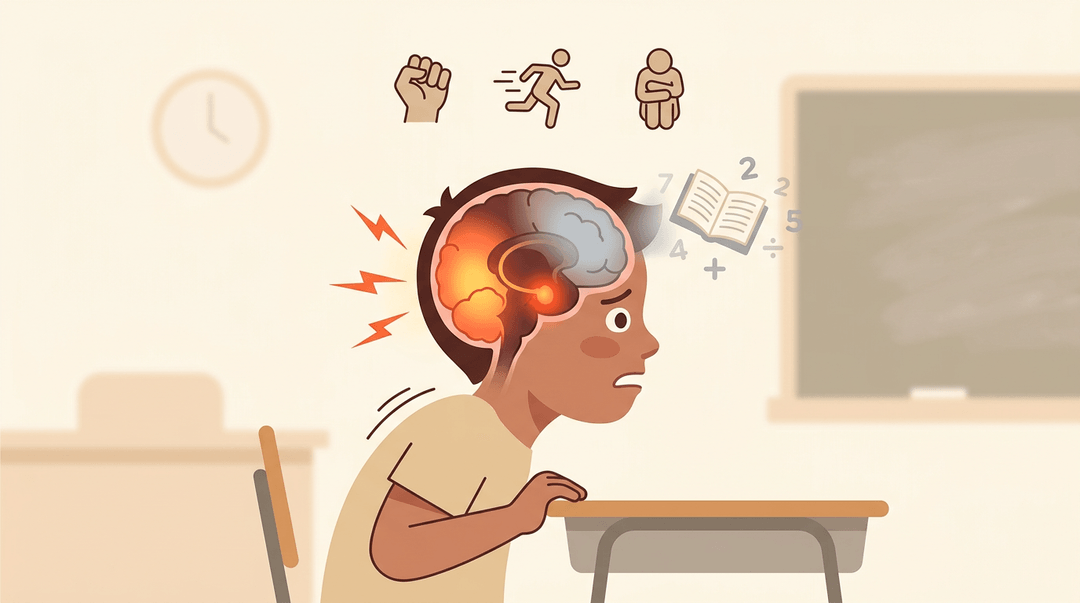
When a student feels threatened, real or perceived, their brain triggers the fight, flight, or freeze response:
- fighting back
- fleeing the situation
- shutting down completely
That's a survival mechanism, not a choice. For students who've experienced chronic trauma, stress hormones like cortisol stay elevated long after the danger passes, keeping the nervous system on high alert.
Over time, this makes it harder for the brain to handle abstract thinking, the kind reading comprehension and math reasoning require. Essentially, the survival brain takes over, and the learning brain goes offline.
How trauma shows up as behavior
For example, a student who slams a book shut and stares out the window isn't necessarily defiant: they might be frozen. Trauma acts like a negativity amplifier, turning a minor correction into a perceived attack.
That's why the same student can seem calm one day and combustible the next: their emotional reactions are unpredictable because they haven't yet learned to regulate them.
Why learning stops without safety
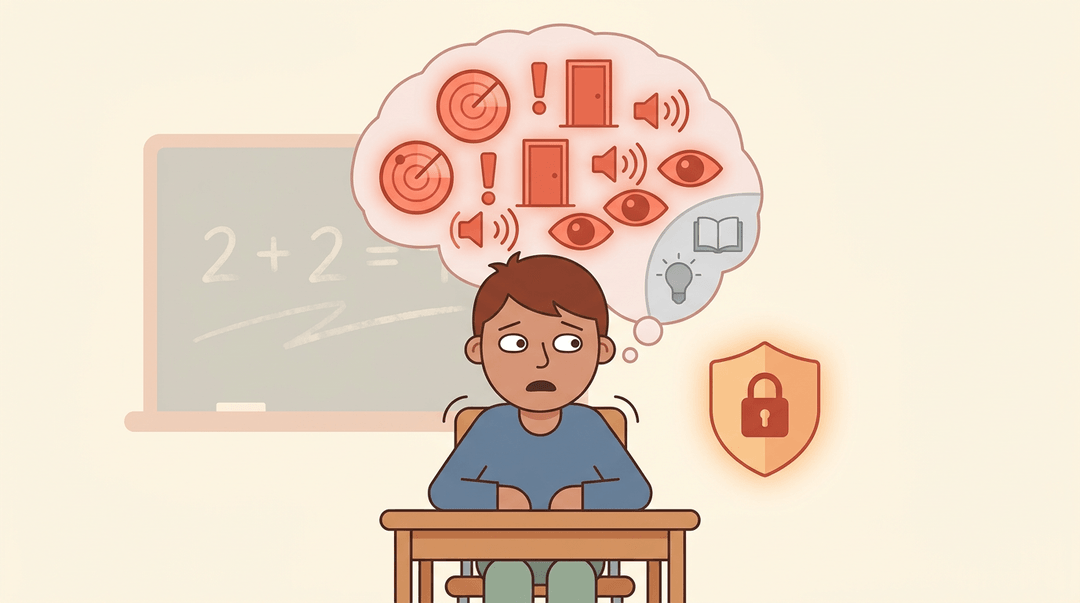
Here's the part every teacher needs to internalize: a trauma response isn't misbehavior, it's a physiological, automatic reaction the student can't simply think their way out of.
When a student's brain is scanning the room for threats, there's no bandwidth left for curiosity. Hypervigilance and learning can't occupy the same moment. Safety isn't a nice extra; it's the prerequisite for everything else you're trying to teach.
What Is a Trauma-Informed School?
A trauma-informed school doesn't leave trauma support to one counselor down the hall. It's a whole-school model: the front office, the cafeteria staff, the bus driver, and every teacher share the same lens on student behavior.
That shared lens rests on a few core beliefs.
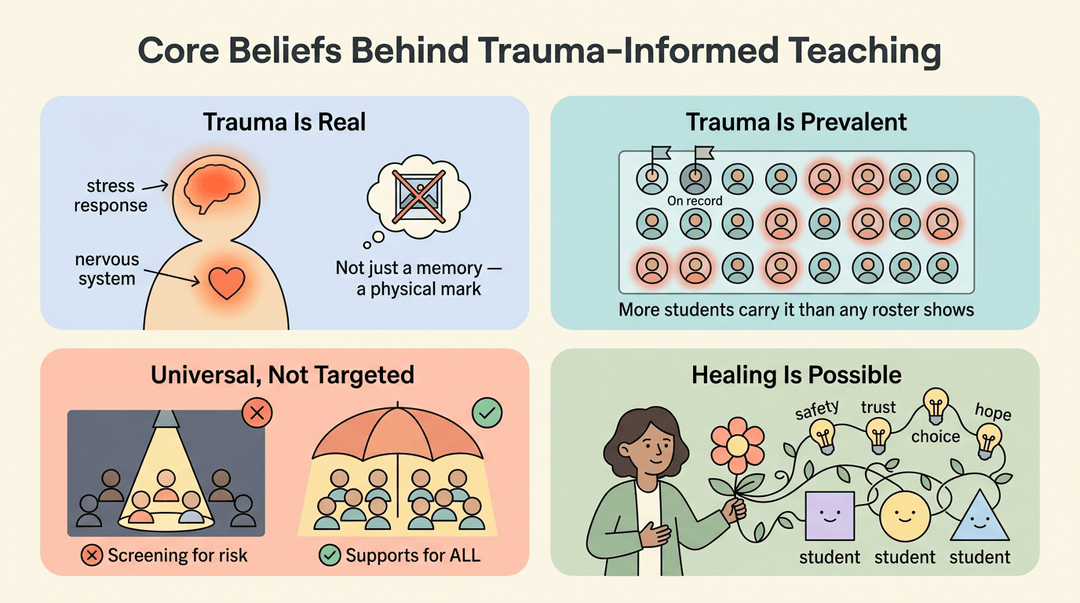
The core beliefs behind trauma informed teaching
- Trauma is real. It leaves a physical and emotional mark, not just a bad memory.
- Trauma is prevalent. Far more students carry it than any classroom roster reveals.
- A universal approach, not a targeted one. Instead of screening for "the kids with trauma," you build supports every student benefits from.
- Resilience over pathology. You look for what a student can build on, not just what's broken.
What are the 5 Rs of trauma-informed care?
SAMHSA's trauma-informed framework describes a system that "realizes the widespread impact of trauma," recognizes its signs, responds by weaving that knowledge into everyday policy and practice, and resists retraumatizing the people it serves.
In a school, that plays out through a few guiding principles:
- Safety, trustworthiness, and transparency. Students know what to expect and trust the adults around them.
- Voice and choice. Students have some say in how their day unfolds.
- Collaboration and mutuality. Decisions get made with students, not just to them.
- Social justice awareness. Equity shapes how support gets distributed.
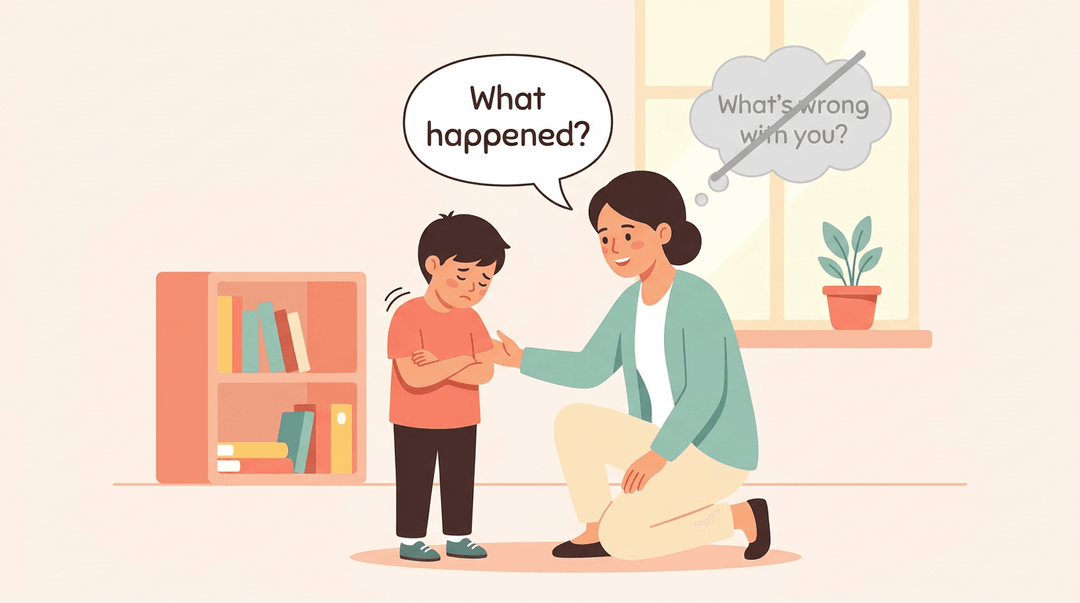
Ask what happened, not what's wrong
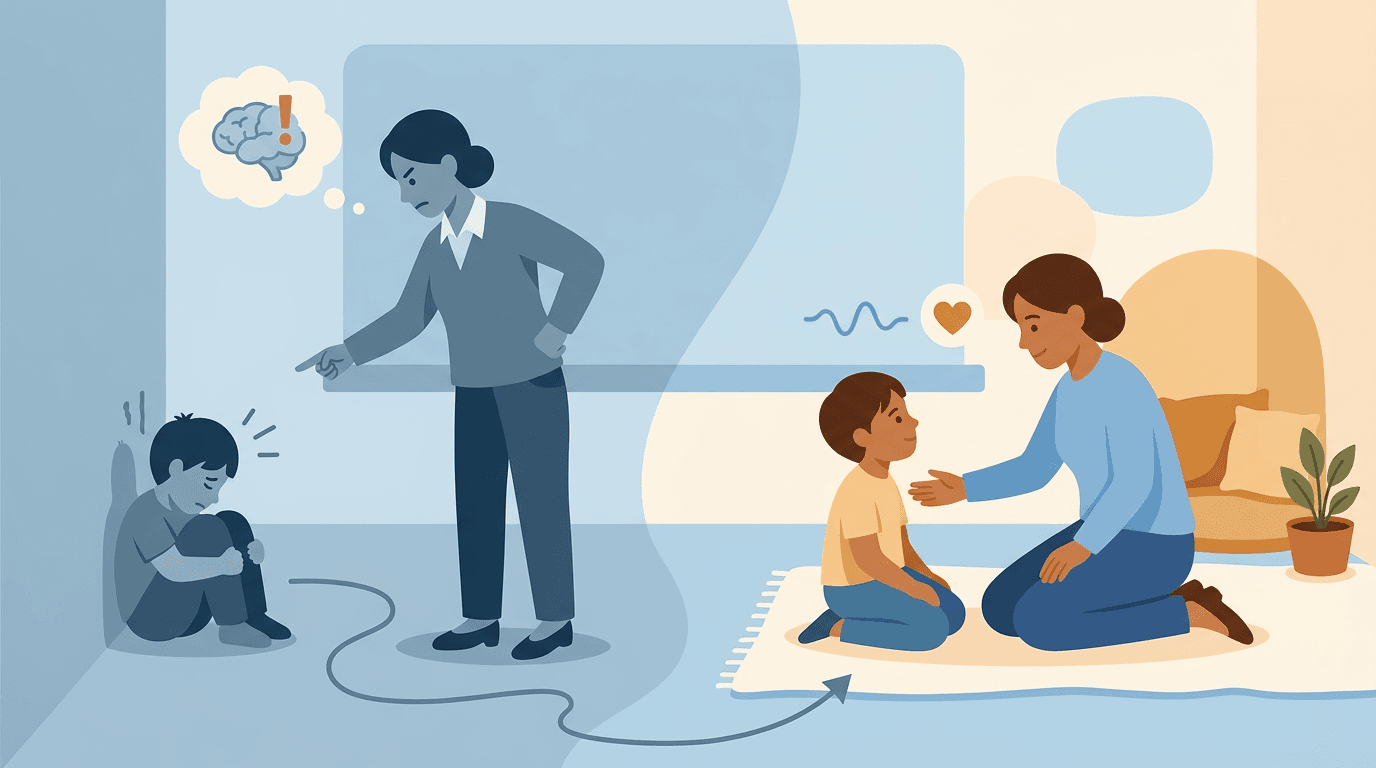
A student who shuts down or lashes out isn't broken; they're communicating. Trauma-informed teachers ask what happened, not what's wrong, resisting the urge to personalize a hard moment.
Seeing behavior as communication, not defiance, changes how you respond, and it's the shift the rest of this guide builds on.
Building Safety, Trust, and Relationships
A lesson plan can't do its job if a student doesn't feel safe in the room.
Safety, trust, and relationships are the foundation trauma-informed teaching rests on, and they're built less through grand gestures than through small, repeatable moments day after day.
Why routine and predictability matter
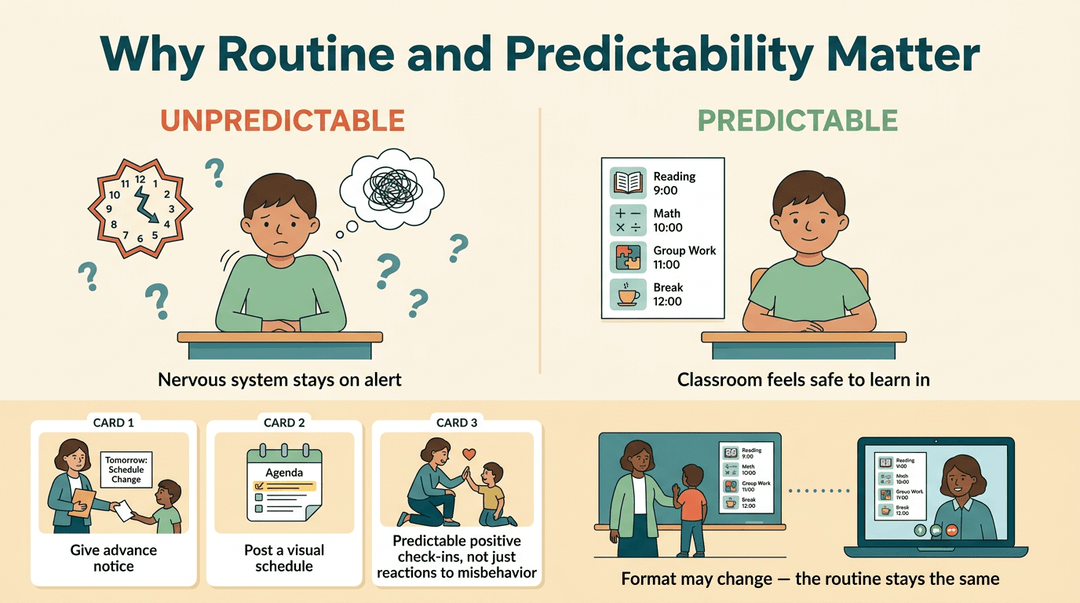
Unpredictability keeps a nervous system on alert. Consistent, structured schedules signal that the classroom is a place where a student can relax into learning instead of bracing for what's next.
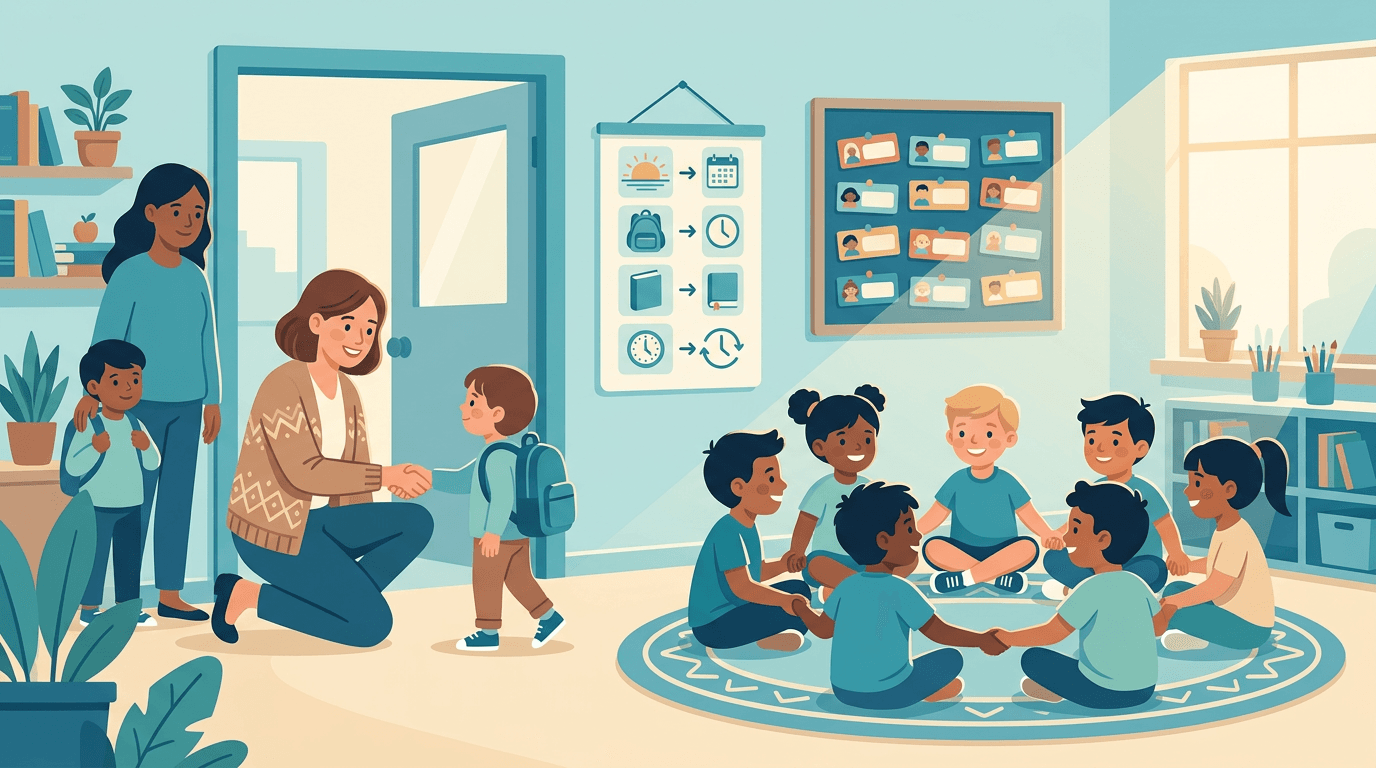
Give advance notice before changes to the routine, and post a visual schedule or agenda so students can see the day laid out rather than guess at it.
Predictable positive attention (a regular check-in, not just a reaction to misbehavior) reinforces that same sense of safety.
For substitutes or virtual classes, keep the visual schedule visible and the routine as close to normal as possible: the format may shift, but the predictability shouldn't.
Build trust through transparency
Students trust adults who don't leave them guessing. Share expectations clearly, and explain why behind a direction instead of issuing it flat.
Being a consistent, reliable adult, showing up the same way whether the day is smooth or chaotic, matters as much as any single lesson. The same goes for grading: transparent criteria shared up front removes the sense that outcomes are arbitrary.
Simple ways to build relationships
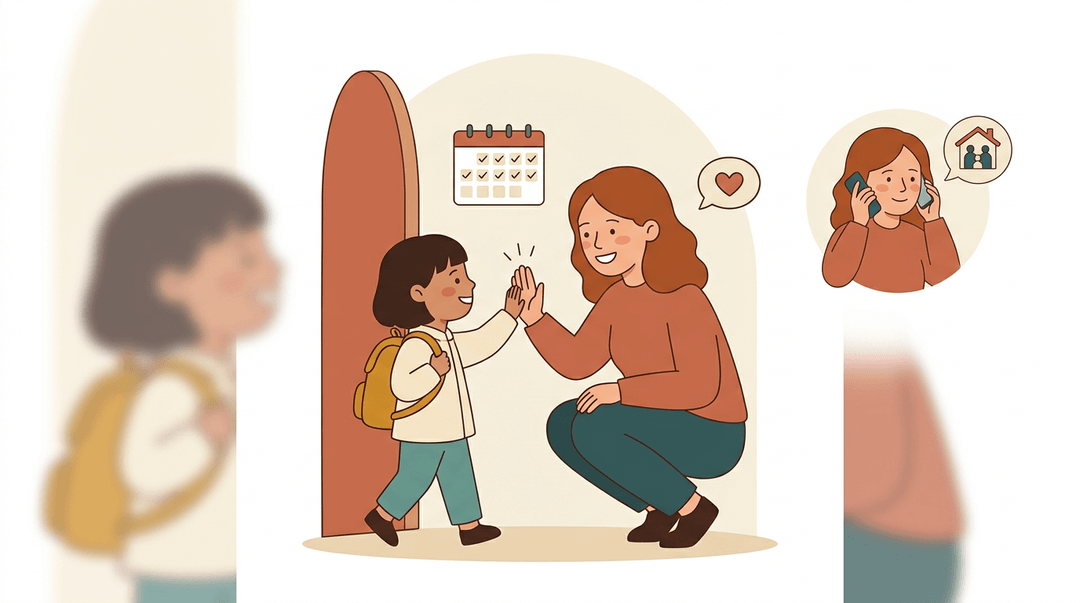
Relationships often start smaller than teachers expect. The two-by-ten rule asks a teacher to spend two minutes a day for ten straight school days talking with a student about anything other than discipline or academics.
Greeting students by name at the door, learning what they're into outside class, and staying emotionally present rather than distracted all send the same message: you matter here, not just your output.
Extending that same warmth to families and caregivers, through a call home or a shared update, builds trust that carries back into the classroom.
Making your classroom feel physically safe
Physical space matters too.
- Keep exit and entrance routes clear and visible
- Set aside a quiet area a student can retreat to
- Stock a few sensory or calming materials nearby
A room that feels safe to move through is easier to feel safe learning in.
What Do Trauma-informed Practices Look Like?
Trauma-informed teaching isn't one big overhaul: it's a collection of small, consistent moves that add up over a school year. Here's a quick-reference look at what those moves tend to include:
- Choice and voice. Letting students pick how or what they work on.
- Trigger awareness. Flagging tough content before it lands.
- Discipline that connects, not isolates. Correcting privately instead of publicly.
- Simple cognitive resets. Quick redirection and strength-based feedback.
- Grounding exercises. Breathing and body-awareness breaks that calm a nervous system.
Giving students choice and voice
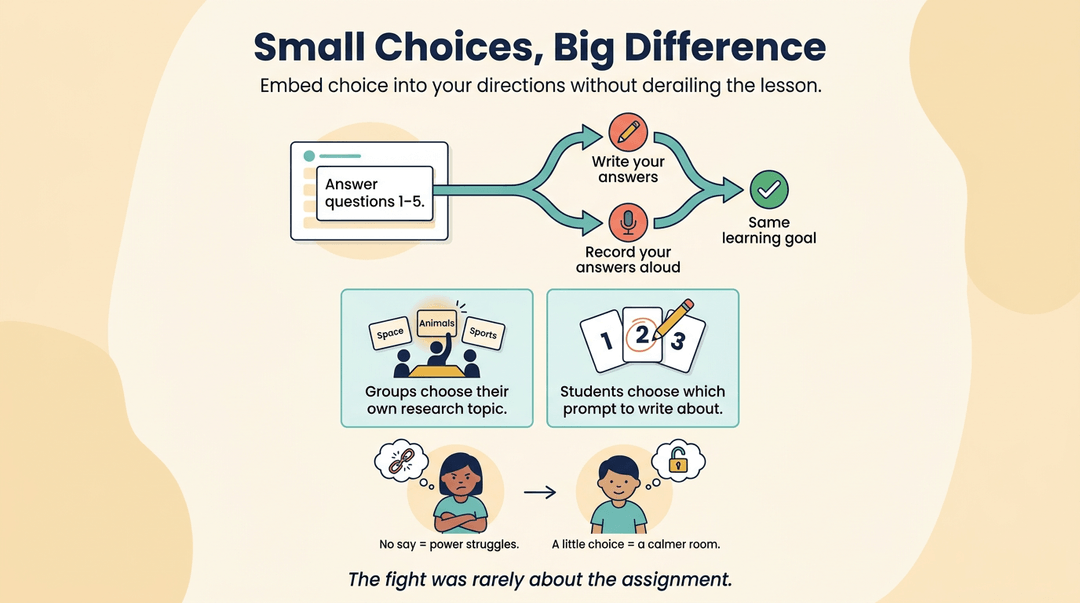
Even small choices matter. Embed options directly into your directions: "Answer questions 1 through 5 in writing or record your answers aloud" gives a student control without derailing the lesson.
This kind of voice and choice design might mean letting a group pick their own topic for a research assignment, or choosing which of three prompts to write about.
For a student who's used to feeling powerless outside of school, that small agency reduces the power struggles that often erupt in class, because the fight was rarely about the assignment in the first place.
Watching for and managing triggers
Some triggers are obvious: a lesson on violence, a discussion of loss. Others are innocuous to you but loaded for a student, a slammed door, a raised voice, a story about a parent leaving.
Give advance warning before covering heavy material with a simple content warning, and offer an alternative assignment for a student who needs to opt out.
For example, a middle school English teacher previewing a novel with a death in it might say a week ahead, "This book includes loss. If you need a different option, come see me."
Rethinking discipline and power dynamics
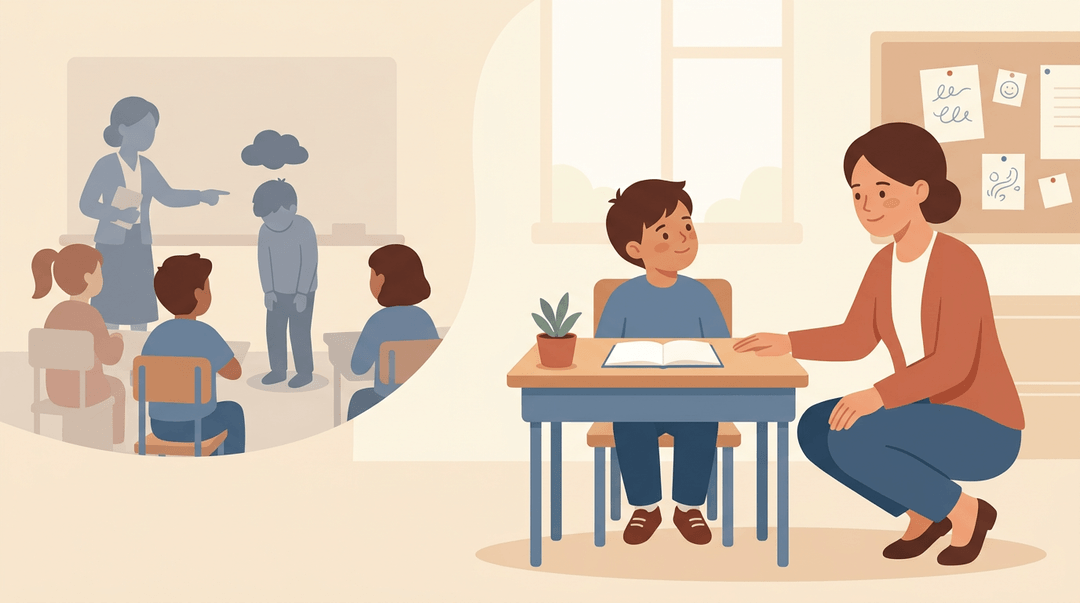
Trauma-informed discipline avoids exclusionary punishment (suspensions, public call-outs) because it tends to confirm a student's worst belief: that they don't belong.
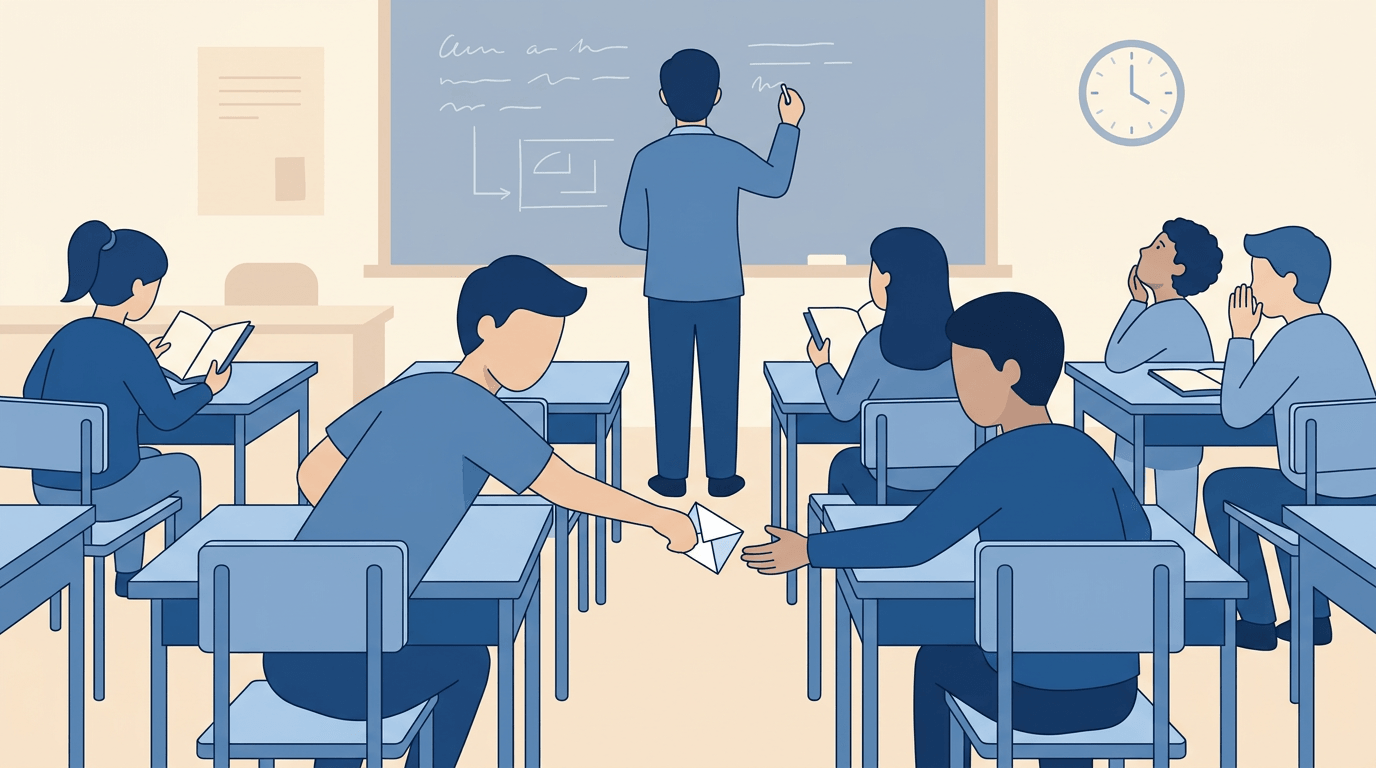
Instead of leaning on punitive structures, try a private, nonverbal correction, a tap on the desk, a quiet glance, that redirects without an audience.
Pair that with non-contingent attention: check in with a student sometimes just because, not only after they've done something wrong. That alone can dismantle a power struggle before it starts.
Simple cognitive and behavioral techniques
Sometimes the fastest fix is a change-the-channel moment: hand a frustrated student an errand, a stack of papers to sort, anything that shifts their focus for a minute.
When you do give feedback, try a positive sandwich: something the student did well, the correction, then another strength. Look for that student's islands of competence, the one thing they're genuinely good at, and build from there.
A growth mindset frame, "you haven't gotten this yet," keeps the door open instead of shutting it.
Grounding and body-based calming practices
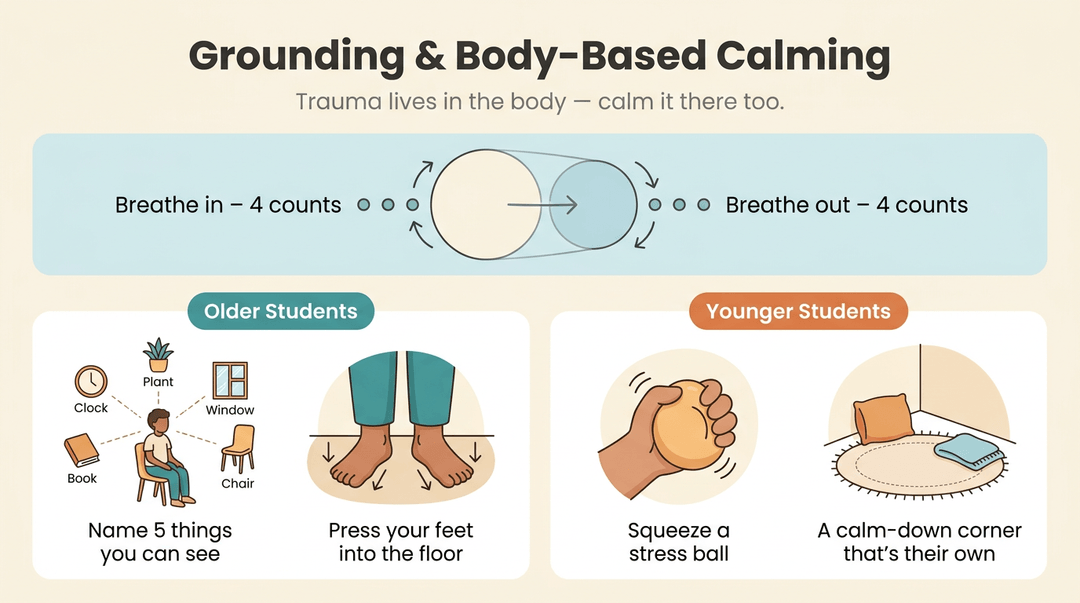
Trauma lives in the body, not just the mind, so embodiment belongs in the classroom too. A breathing exercise, in for four counts and out for four, can reset a student mid-meltdown.
Body awareness activities like naming five things you can see, or pressing your feet into the floor, work well for older students.
Younger students often respond better to a simple containment practice, like squeezing a stress ball or settling into a designated calm-down corner with a boundary they understand as their own space.
Your Trauma Informed Classroom Checklist
Everything above this point is the why; this is the do. Run the setup check each morning, pull the grade-level move when you need it, and follow the escalation steps when a pattern emerges.
Set up before students arrive
Confirm these four things before the door opens:
- Visual schedule posted. Times plus activities, visible from every seat.
- On the board: "8:15 meeting → 8:30 reading → 9:15 math → 10:00 break"
- Calm-down corner stocked. Restock daily: fidgets, headphones, a sand timer, a feelings chart.
- Greeting routine planned. Same words at the door, every single day.
- Say: "Good morning. I'm glad you're here."
- Seating arranged away from exits. Doorways mean noise, traffic, and startle triggers; keep vulnerable students clear of them.
Key principle: Predictability is the intervention. A student who knows what happens next spends less energy scanning for threats and more on learning.
Match the move to the grade
Each strategy below hands back a piece of control, which is exactly what trauma takes away. Find your band, read across.
| Grade band | Go-to strategy | What it looks like |
|---|---|---|
| Elementary | Sensory tools | Fidget bin, putty, weighted lap pad at the desk |
| Middle school | Choice boards | "Show your learning: poster, paragraph, or podcast" |
| High school | Flexible deadlines | A 48-hour grace window, no explanation required |
When to escalate a concern
You're not the last stop, and knowing when to hand off is part of the job. Work these in order:
- Watch for patterns, not one-offs. A rough Monday is a mood; three rough Mondays is a signal.
- Document every incident the same way. One line each: date, time, trigger, behavior, your response.
- Sample entry: "10/3, 9:40, transition to math, left room, returned after walk with me"
- Loop in your counselor or admin. Bring the log, not a hunch.
- Try: "I've tracked a three-week pattern and I'd like your read on it."
⚠️ Watch out: Document what you saw, never what you suspect. "Put head down and stopped responding" belongs in your notes; "seems traumatized" doesn't. Diagnosis is the counselor's lane.
Example: A middle school teacher notices a student shutting down every Tuesday. Her log shows each incident follows a schedule change for electives. She brings three dated entries to the counselor, who uncovers a conflict in that class, and the pattern stops within two weeks.
That teacher's log did the heavy lifting, which is easier when it isn't scattered across sticky notes: log routines, seating, and behavior notes in one place with EMStudio's classroom management tools.
Setting Boundaries and Caring for Yourself
Trauma-informed teaching asks a lot of you, but it shouldn't ask you to become something you're not. Knowing where your role ends is what keeps this work sustainable.
What's not your job as a teacher
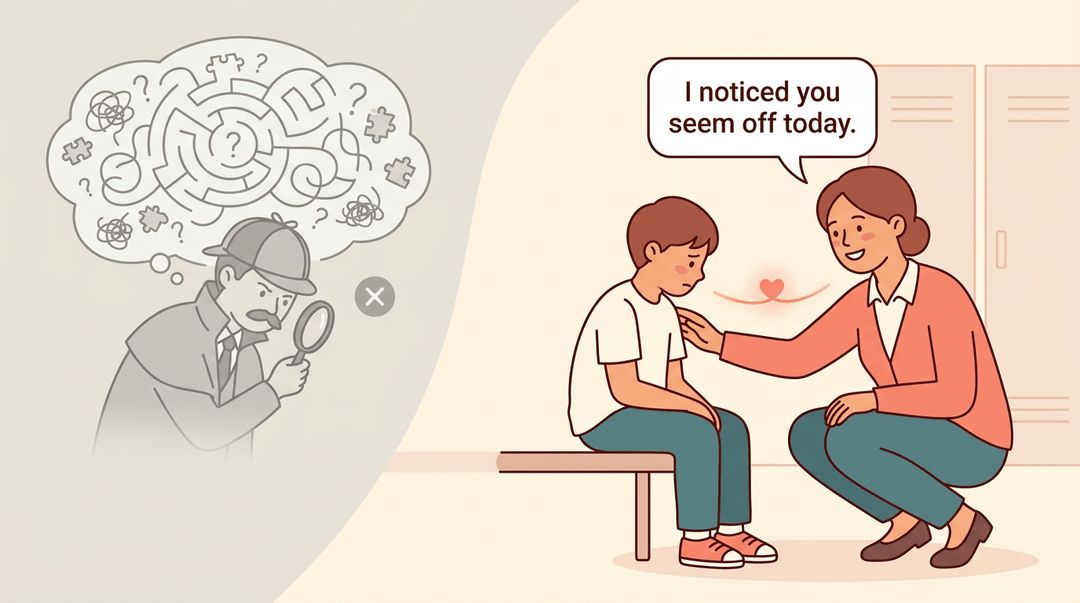
You're not a therapist, and you're not a fixer. It's not your job to dig up a student's trauma or piece together their history like a detective. Your job is simpler: be the steady adult who makes the connection.
Think of a middle school teacher who notices a student withdrawing and simply checks in, "I noticed you seem off today," rather than probing for a backstory.
That's a lovingly detached stance: caring deeply about the student without carrying their story as your own.
Avoid labeling students or assuming trauma
Don't assume you know who's carrying trauma and who isn't. It's rarely visible, and guessing gets it wrong more often than you'd think. Never advertise a student's trauma to other staff or classmates, and resist ranking whose pain is "worse."
Examine your own biases too: the assumptions you make about a "difficult" student may say more about you than about them.
Coping with secondary trauma and burnout
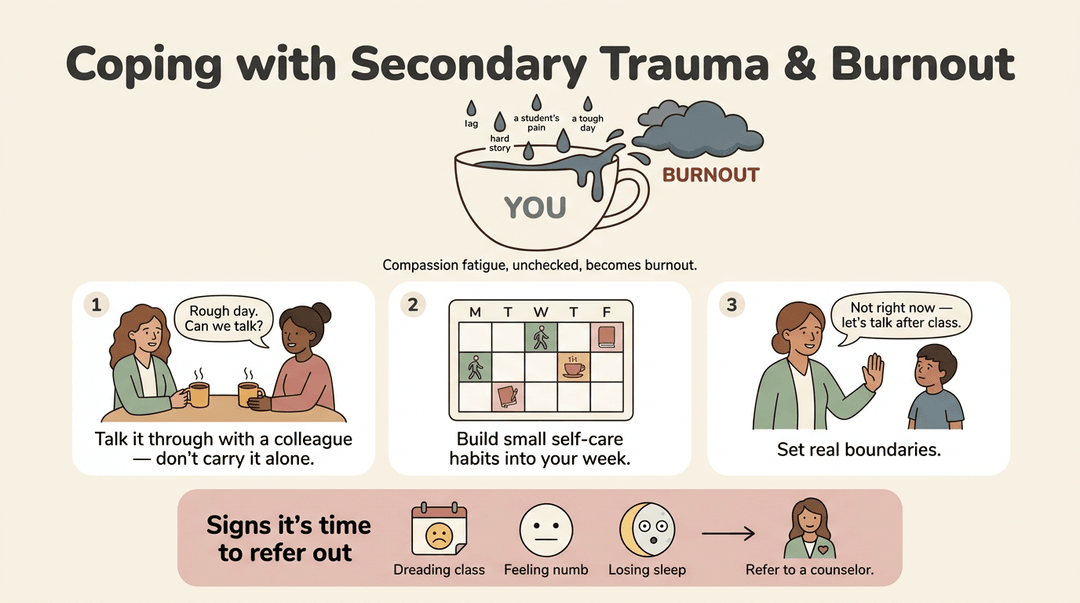
Absorbing other people's pain has a name: compassion fatigue. Left unchecked, it leads straight to burnout. Talk through hard days with a trusted colleague instead of carrying them alone.
Build small self-care habits into your week, and set real boundaries with students, including when to say "not right now."
If you notice you're dreading class, feeling numb, or losing sleep over a student's story, that's the signal to refer out to a counselor.
Trauma Informed Teaching in Higher Education
College courses bring their own version of this work. A history lecture on genocide or a literature seminar on abuse can hit a student without warning, and how a professor handles that moment matters as much as the material itself.
Handling sensitive or charged course content
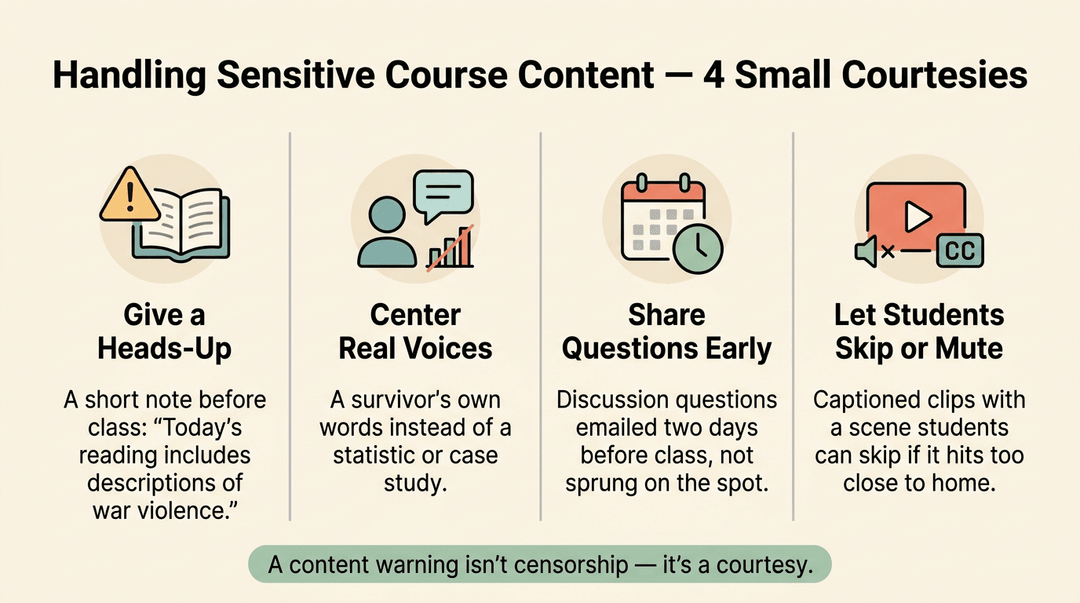
Before assigning tough material, give students a heads-up: a brief content warning isn't censorship, it's a courtesy that lets someone brace themselves or ask for support. Whenever possible, foreground the perspectives of people who actually lived the experience rather than reducing it to statistics or a case study. Share discussion questions early so students can process the material before class discussion puts them on the spot, and use captioned, modifiable media so a student can mute or skip a scene that hits too close to home.
Responding to shared or current trauma
When a tragedy touches the wider community (a shooting, a natural disaster, a public loss) acknowledge it in class rather than pretending the syllabus comes first. A brief, genuine line of care goes further than a long speech. Point students toward campus counseling or support services, and remember that the same event can land differently across a room: some students will need the material paused, others will barely register it.
Designing courses with more flexibility
Build room into the course itself:
- Flexible attendance policies that don't penalize a rough week.
- Non-penalized late submissions, at least within a reasonable window.
- Clear extension request mechanisms, so asking for more time doesn't feel like a confession.
- A well-being statement in the syllabus, naming support resources before anyone needs them.
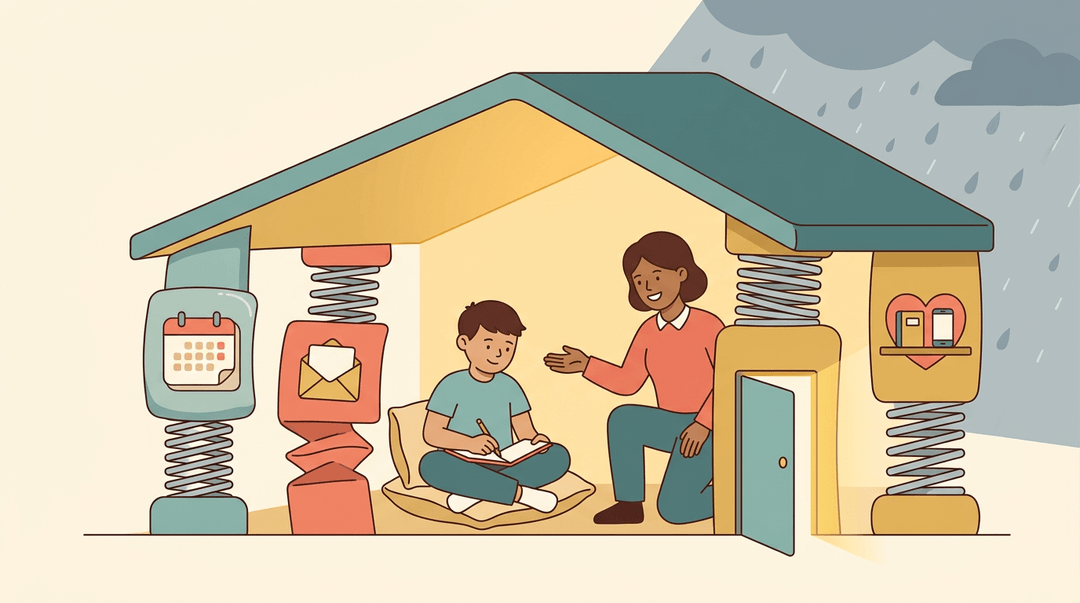
Trauma-informed teaching isn't a script or a program you finish once. It's a lens: safety first, relationships second, and learning built on both.
When you understand what's underneath a student's behavior, you respond differently, and that shift changes classrooms.
Ready to build a classroom structure that supports this kind of consistency? Check out our Classroom Management feature to organize your classes, rosters, and timetables so you can focus on the students in front of you.
References
- Rates of DSM-IV-TR trauma exposure and posttraumatic stress disorder among newly matriculated college students — researchconnect.buffalo.edu (2025)
- Pediatric ACEs and Related Life Events Screener (PEARLS v2): Adaptations and Acceptability | Journal of Child & Adolescent Trauma — link.springer.com (2025)
- Trauma and Violence: What Is Trauma and Its Effects? — samhsa.gov
- Trauma-Informed Approaches and Programs — samhsa.gov
- 2 X 10: Getting To Know A Student — ggie.berkeley.edu
- The Crisis Continues: Recent Trends in Childhood Trauma — parinc.com
Frequently asked questions
What are the 5 principles of trauma-informed practice?
The five commonly cited principles are safety; trustworthiness and transparency; peer support; collaboration and mutuality; and voice, choice, and empowerment. Some frameworks also emphasize cultural, historical, and gender issues as an additional principle. In schools, these principles mean creating predictable environments where students have agency and adults respond consistently.
What are some effective classroom strategies for supporting students with trauma?
Effective strategies include posting a predictable visual schedule, warning students about routine changes, greeting them by name, and building regular positive relationships. Offer choices in assignments, provide a quiet area and sensory tools, use private corrections instead of public discipline, and teach grounding practices such as paced breathing or sensory awareness.
What are trauma-informed schools?
Trauma-informed schools use a whole-school approach to recognize how trauma can affect behavior, relationships, and learning. All staff respond with safety, consistency, trust, collaboration, and respect rather than treating trauma support as the responsibility of one counselor. Supports are offered universally, with attention to resilience, equity, and student voice.
What are some trauma-informed strategies?
Trauma-informed strategies include predictable routines, visual schedules, advance notice of changes, content warnings, student choice, private redirection, strength-based feedback, and non-contingent positive attention. Calming options such as breathing exercises, sensory tools, a quiet space, and grounding activities can also help students regulate.
What are the 5 key trauma-informed principles?
The five key principles are safety; trustworthiness and transparency; peer support; collaboration and mutuality; and voice, choice, and empowerment. Cultural, historical, and gender awareness is also widely recognized as an important part of trauma-informed practice.
What are some effective strategies for teaching a child with trauma?
Teach with predictable routines, clear expectations, and frequent positive connection. Give the child manageable choices, allow appropriate breaks, provide a calm space or sensory tools, and avoid public correction or power struggles. Treat behavior as communication, document patterns, and involve counselors or caregivers when concerns persist.
How to deal with trauma in the classroom?
Start by making the classroom predictable and physically safe, then build trust through consistent greetings, check-ins, and transparent expectations. During distress, stay calm, reduce demands, offer limited choices or a brief break, and use grounding or breathing activities. Do not investigate the child’s trauma or diagnose them; document observable patterns and refer concerns to the appropriate school professionals.
What are examples of trauma-informed teaching?
Examples include giving a content warning before discussing loss or violence, offering alternative assignments, and letting students choose how to demonstrate learning. Other examples are using a visual agenda, greeting students at the door, correcting behavior privately, giving strength-based feedback, allowing flexible deadlines when appropriate, and providing a calm-down area with grounding materials.