Unlawful Absence Explained: Rules, Penalties, Next Steps


Jump to section
Every school day has a seat for each student, and every empty seat raises a question: was that absence allowed? That question sits at the heart of unlawful absence.
Put simply, it's a day a student misses school without a reason that the law or your school's policy recognizes.
What counts as unlawful depends on where you teach, so the details can feel slippery.
In this post, we'll cover the basics: excused versus unexcused rules, legal consequences, school responses, and a practical workflow for recording and following up on absences.

When Missed Days Become an Unlawful Absence
Most missed days are harmless. Trouble starts when they form a pattern, and that's where the law and your attendance policy take notice. Knowing where that line sits helps you act early.
When missing school becomes chronic
A student becomes chronically absent when they miss 10% of the school year, which works out to about two days per month.
The cumulative effect is what matters most: a day here and there barely registers in a given week, but over a year those lost lessons stack up. Small gaps compound.
Think of a fifth-grade teacher who notices one student missing every other Monday. Pulling the attendance report in October instead of May lets that teacher call home while the pattern is still small.

How truancy and repeat truancy are counted
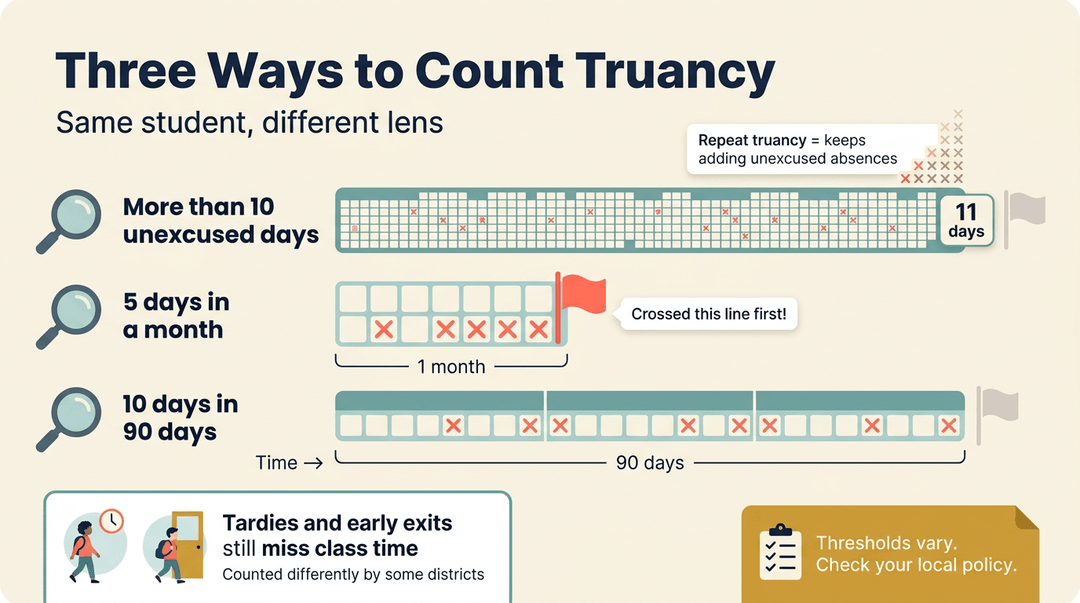
Truancy refers to unexcused absences. The question isn't only how many days a student misses but how often those days land. Your state or district may use thresholds like these:
- More than 10 unexcused days
- 5 days in a month
- 10 days in 90 days
Each threshold looks through a different lens, so a student can cross one line long before another. Repeat truancy describes a student who keeps piling up unexcused absences.
Thresholds vary by state or district, so treat these as examples and confirm your local policy.
Don't overlook tardies and partial-day absences. A student who arrives late or leaves early still misses instruction, and local rules may count those differently than full-day absences. Check your policy rather than assuming.
Which Absences Are Excused and Which Aren't
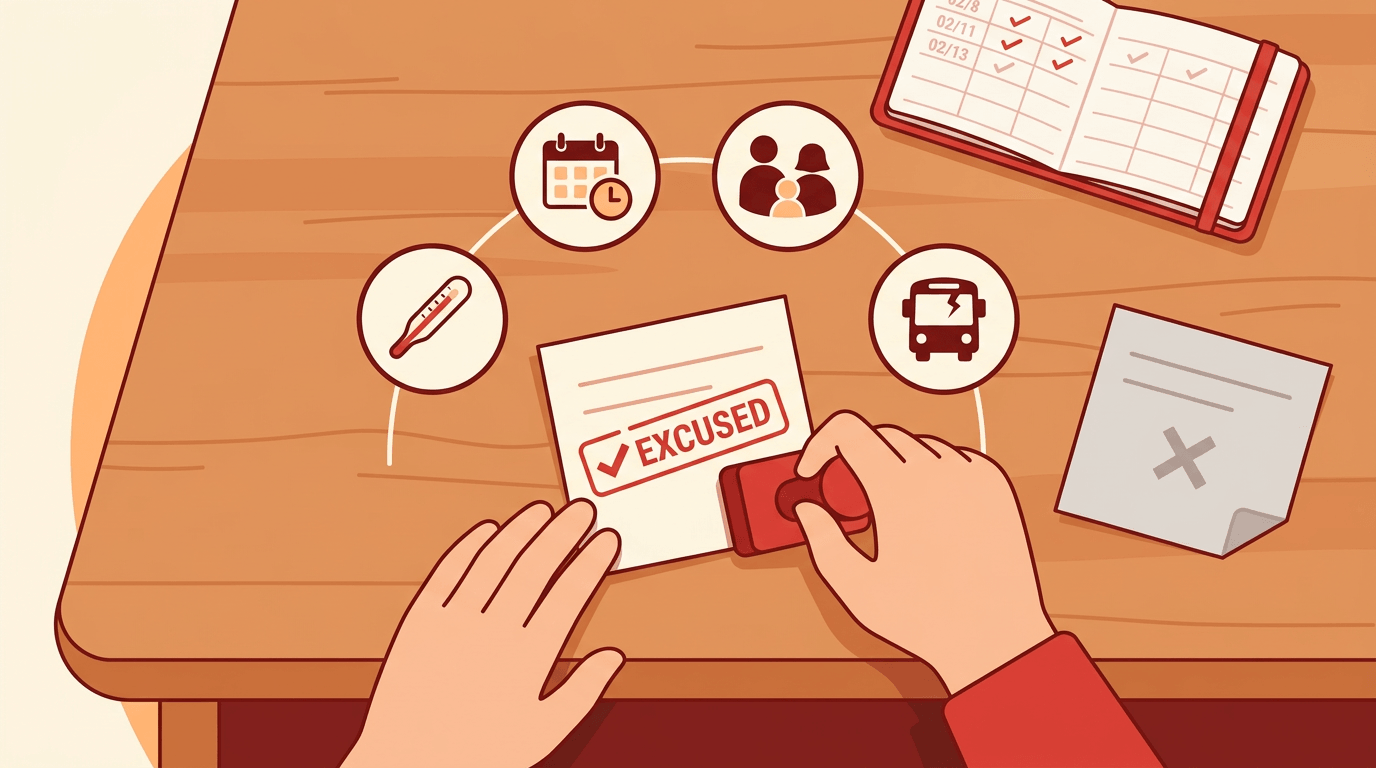
Not every missed day is treated the same way, and the difference shapes your records and follow-up. You'll see unlawful absence, unauthorised absence, and unexcused absence for time away that wasn't approved, so match the term your policy uses.
Common reasons an absence goes unexcused
- Vacations. Trips taken during school days are usually unexcused.
- Transportation issues. A missed bus or a broken-down car typically counts as unexcused.
- Tiredness. Needing a day to rest doesn't qualify.
- Family member illness. Keeping a student home to care for a sick relative is usually unexcused.
- Absence without valid justification. With no acceptable reason on file, the absence stays unexcused.
Reasons schools accept for missing class
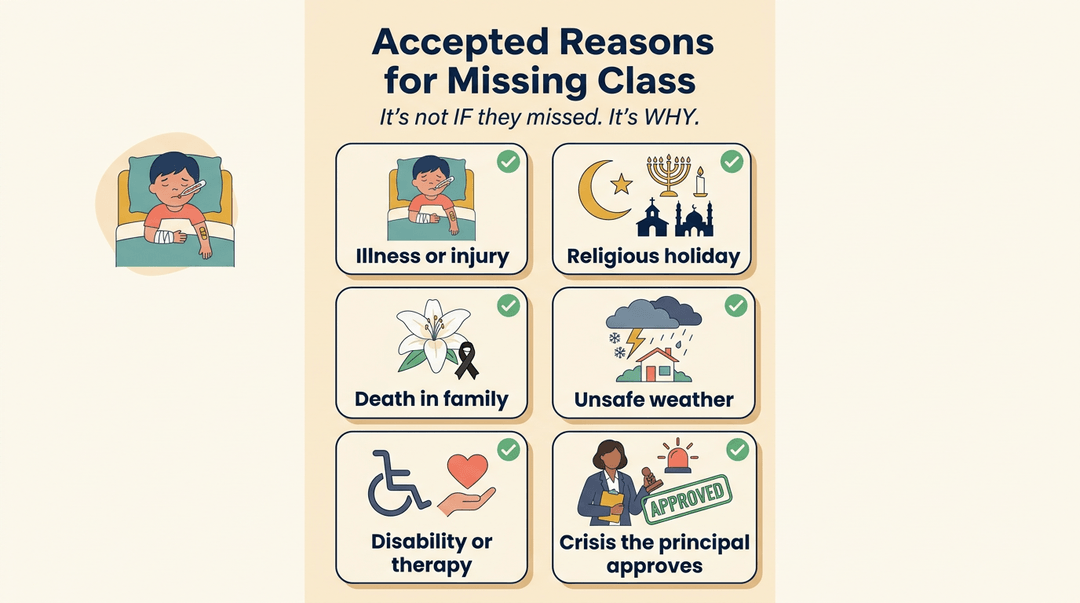
The question is less about whether a student missed class and more about why.
- Student illness or injury. A sick or hurt student has a clear, excused reason.
- Religious holidays. Observing one counts as an accepted reason.
- Death in family. A death in the family qualifies.
- Inclement weather. Unsafe weather that keeps students home is a valid reason.
- Disability or therapy. Absences for disability needs or therapy qualify.
- Crisis decided by principal. An emergency qualifies when the principal decides it does.
Proof you'll need to justify an absence
Excused status depends on proof, so gather it early.
- Written parent note. A note from a parent or guardian explains the absence.
- Note within five days. Submit it within five days of the absence.
- Doctor's note for longer illness. Ask for one when an illness stretches on.
- Death certificate verification. A death in the family may require a death certificate to verify it.
- Log notes and codes consistently. Use the same codes and notes every time so anyone can read the record.
Fixing an absence recorded as unexcused
A school may misreport absences, so check each entry against your own notes. Consider a middle school teacher whose office marks a student unexcused for a funeral.
She sent proof of the reason, a dated parent note and a death certificate, and the record was corrected. If an incorrect mark leads to a reduced benefit, appeal the reduction.
Keep dated records for any dispute, because a timestamp beats memory every time.

Track and Respond to Unlawful Absences
Use this workflow to record each absence accurately, spot trouble early, and reach families before a pattern hardens. It runs in four moves: log daily, review weekly, contact families, escalate when policy says so.
Daily: log every absence
- Mark excused or unexcused
- Use the reason the family gave, not a guess.
- No reason yet? Mark it unexcused and update it when you hear back.
- Use your school's absence codes
- Same code, same meaning, every time. Never invent your own.
- Log your notes the same day
- Write: "Maya, Mon 9/9: unexcused. No call or note. Message sent 3:15."
⚠️ Watch out: Don't go back and "fix" codes from memory on Friday. Same-day notes are what hold up in a later meeting.
Weekly: catch patterns early
Take ten minutes on Friday and review your weekly totals. Confirm you've checked for:
- Repeated Monday absences: the same student missing the start of the week more than once.
- Rising tardiness: late arrivals climbing week over week, which often come before full absences.
- Weekly totals: any student whose count is creeping up, even if each absence looks minor.
A pattern isn't proof of anything. It tells you who to contact first.
Same day: reach out to the family
Keep the message short and neutral. You're checking in, not accusing.
Say or send: "Hi, this is Ms. Rivera. Maya wasn't in class today, and I wanted to check in. Is everything okay? If anything is making it hard to get to school, I'd like to help."
Then follow through:
- Ask about barriers. Transportation, health, housing, and family needs are common reasons.
- Document every contact. Record the date, method, who you spoke with, and what they said.
As needed: know when to escalate
| When you see... | Do this... |
|---|---|
| Absences are below your school's thresholds | Keep logging, messaging, and reviewing weekly |
| Absences reach a threshold in your school's policy | Notify the counselor or administrator |
| Families don't respond, or barriers are beyond your reach | Share your contact log with the counselor |
| A referral may follow | Keep every record: codes, notes, and contact history |
Check your school's policy for the exact numbers. We don't want you guessing at a threshold.
Example: A sixth-grade teacher notices Devon missed three Mondays in a row and arrived late twice. She texts his guardian the neutral message above and learns the bus route changed. She logs the call, tells the counselor, and the family gets transportation help. Her notes show the pattern and what she tried.
EMStudio's attendance tracking helps you mark absences quickly, spot patterns, and keep a historical record in one place.
The Laws Behind Attendance and Penalties
Attendance isn't only a classroom matter. State laws set the rules, and those rules can reach families, benefits, and even prosecutors.
What state attendance laws require
State statutes require students to attend school, which makes attendance a legal obligation, not just a classroom expectation. Parents are held responsible for making sure their children get there.
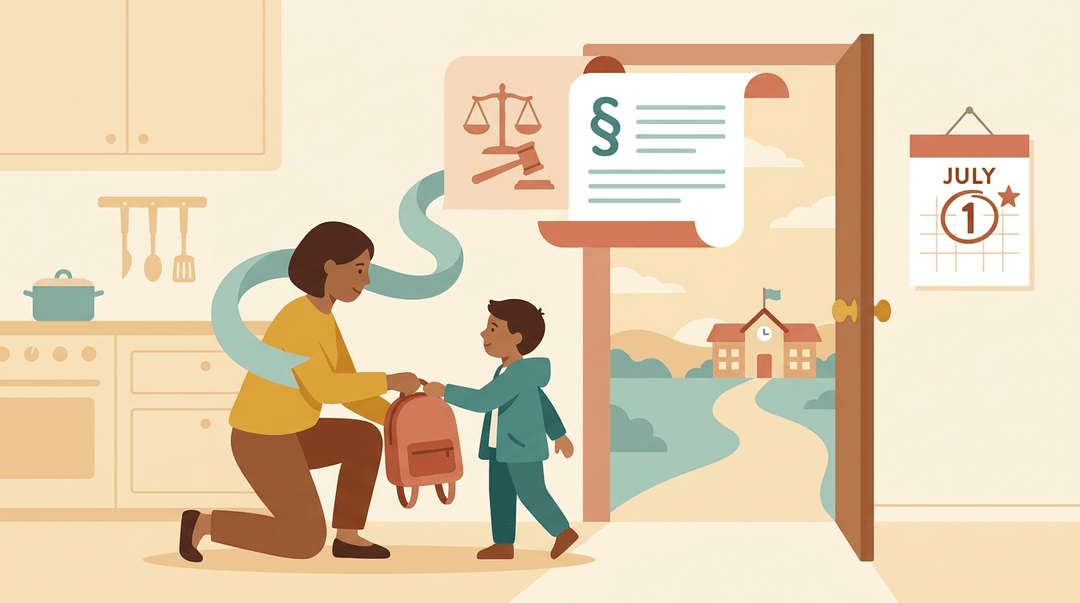
Indiana shows how these rules can change. A provision of the state's compulsory attendance law took effect in July 2025, and Indiana Public Radio reports that “Senate Enrolled Act 482 goes into effect on July 1, 2025.”
When a case goes to prosecutors
An unexcused absence doesn't automatically lead to legal action. Families are first notified, and only then might a case be referred to a prosecutor's office or a State Attorney's Office. The reasons behind each absence are part of that decision.
The real question is less about whether a student was absent and more about why.
Consider a homeroom teacher who logs each unexcused absence along with the date she called home. When a notice arrives, that record shows the family was reached early and gives everyone a clearer picture of what happened. Clear records protect everyone.
How missed school can cut Learnfare benefits
Learnfare is a program that links benefits to school attendance, so missed class can reach a family's budget. Too many absences can lead to probation, and sanctions can include grant reductions. Missed school can cost a family more than a grade.
Expelled students aren't exempt from these rules. Summer sanctions, though, are suspended. Reinstatement comes with verification, so records matter here too.

Proving attendance to keep benefits
When benefits are on the line, the state's benefits office (DTA) checks with the state education department (DESE). Picture a parent who needs proof her son attended school to keep the family's benefits.
A quick, accurate attendance report from you can settle that request quickly.
Private and home-schooled students need their own verification, and online students have attendance rules to check as well. Confirm what your state requires before you send anything.
If DTA gave the family no help, that can serve as a defense. Good records help a family prove attendance, not just explain a gap.
How Schools Step in and Help
Getting students back in their seats starts with support, not consequences.
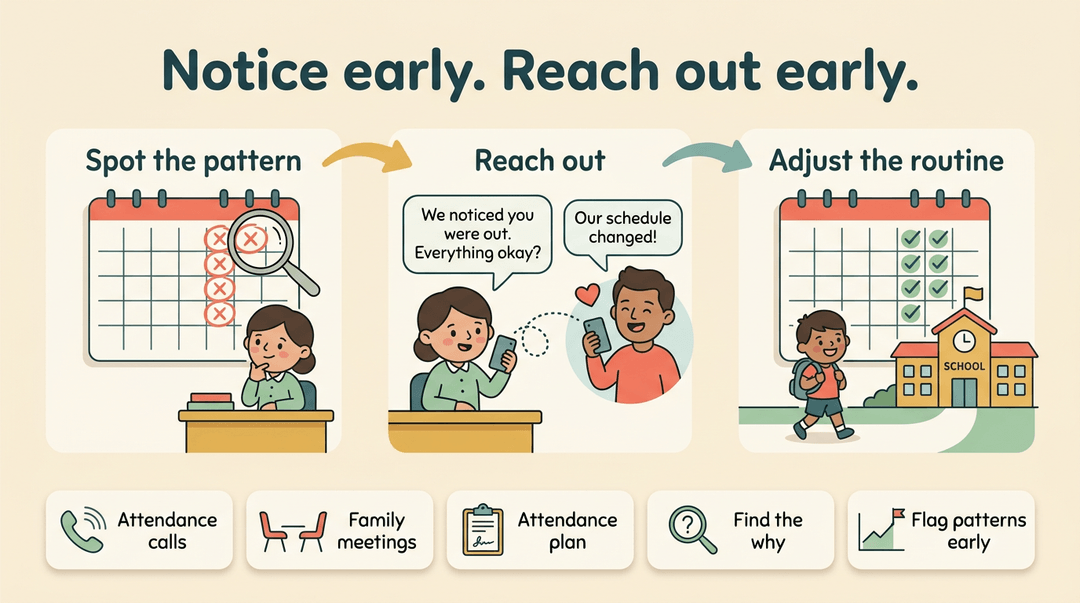
Reaching out early and tracking attendance
Think of a fourth-grade teacher who notices her student missing every other Friday. A quick call home reveals a family schedule change, and the routine adjusts before absences pile up.
Common early steps include:
- Attendance calls. A quick message home lets families know someone noticed.
- Meetings with families. Sitting down together lets parents and staff share what's happening.
- Attendance plans. A written agreement sets goals, check-ins, and supports.
- Address root causes early. Finding out why matters more than counting days.
- Flag attendance patterns early. Spotting a trend lets the team act sooner.
Clearing obstacles that keep students home
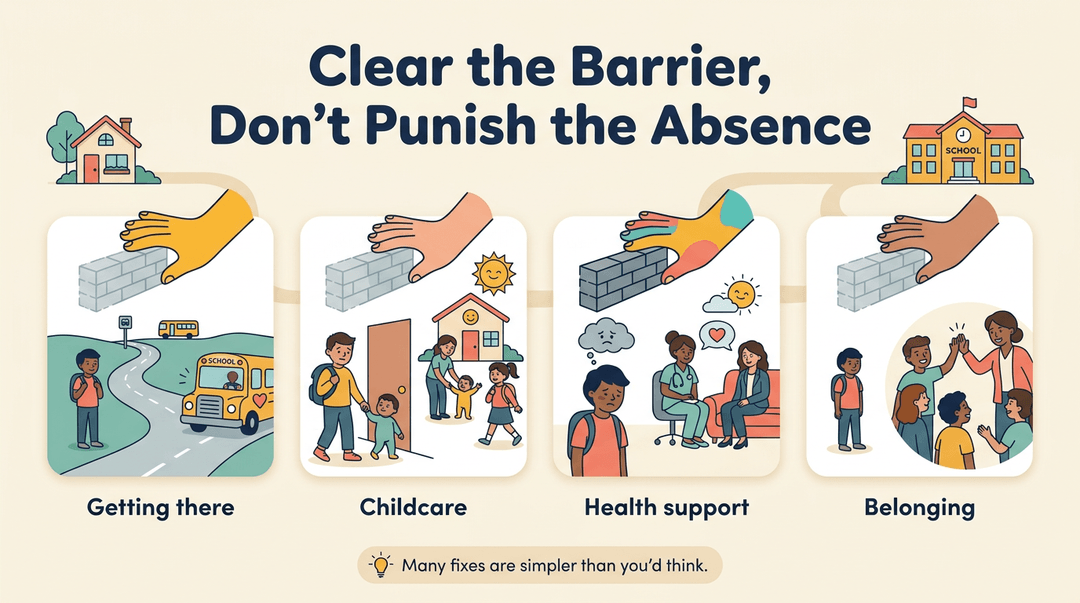
Sometimes the barrier isn't the student's choice, and fixing it beats punishing the absence.
- Transportation and housing. A long ride or unstable home can keep a student from class. Schools may connect families with resources.
- Childcare. A younger sibling with no one to watch can keep an older student home. Schools can help families find options.
- Health and mental health support. Illness, anxiety, or stress can keep students out. Nurses and counselors can connect families with help.
- Welcoming school environment. A student who feels left out may stop wanting to come. Schools build belonging through trusted adults.
Many fixes are simpler than you'd think.
Talking with school staff about absences
Counselors and administrators can fill in context you might miss.
- Ask about absences. Check what the front office already has on file.
- Meet with the counselor or administrator. Bring specific dates and observations.
- Check attendance regularly. A quick look every week or two prevents surprises.
- Privacy limits for non-guardians. If you're a mentor or relative rather than a parent or guardian, schools may limit what they share with you.
Consider a teacher who spots absences clustering around tests. With the counselor, she plans check-ins before each one, so the student has an adult waiting.
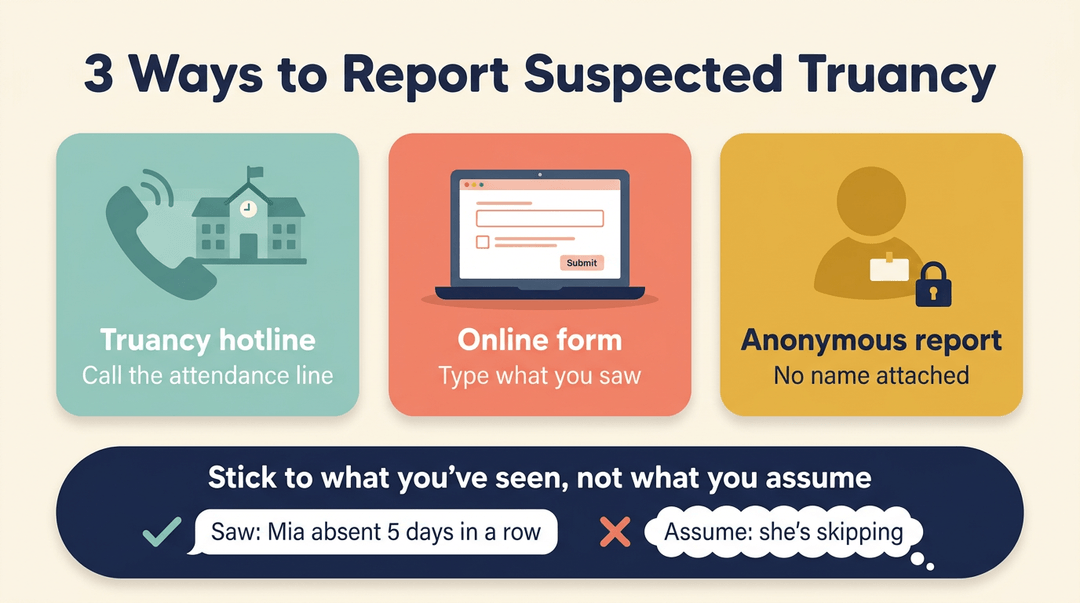
Ways to report suspected truancy
You have a few options:
- Truancy hotline. Some schools and districts offer a phone line for attendance concerns.
- Online report form. Submit what you've seen through a web form.
- Anonymous reporting. Some systems let you share a concern without attaching your name.
Stick to what you've seen, not what you assume.
What Missing School Does to Students
Occasional missed days are one thing. A pattern of them, known as chronic absenteeism, is another, and it can shape grades, core skills, and later options.
How absences hurt grades and core skills
Here's where it shows up first:
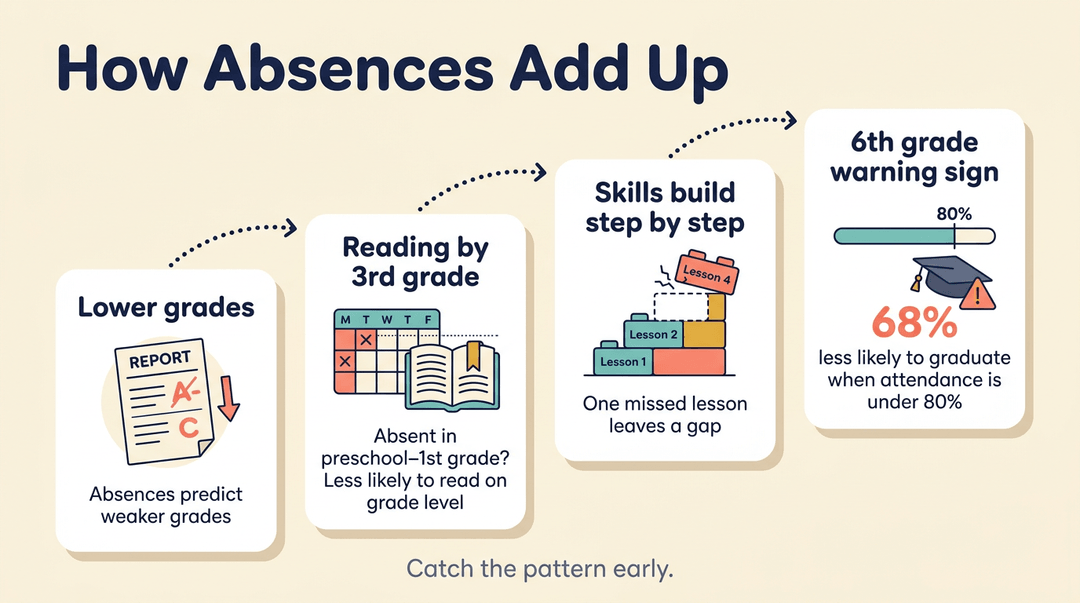
- Lower grades. A state-wide analysis of chronic absenteeism notes that absenteeism predicts poor academic performance.
- Reading proficiency by 3rd grade. Picture a first-grade teacher who notices the same two students missing every Monday. Catching that pattern early gives you time to step in. A DePaul University dissertation reports that chronically absent students in preschool, kindergarten, and first grade are less likely to be on grade level for reading by third grade.
- Missed math and reading skills. Math and reading skills build step by step, so one missed lesson can leave a hole that makes the next one harder to follow.
- Dropout warning sign by 6th grade. A Liberty University doctoral study found that sixth graders with attendance under 80% were 68% less likely to graduate. Sixth grade is an early warning.
What absences can cost later in life
Some costs reach well past the school years:
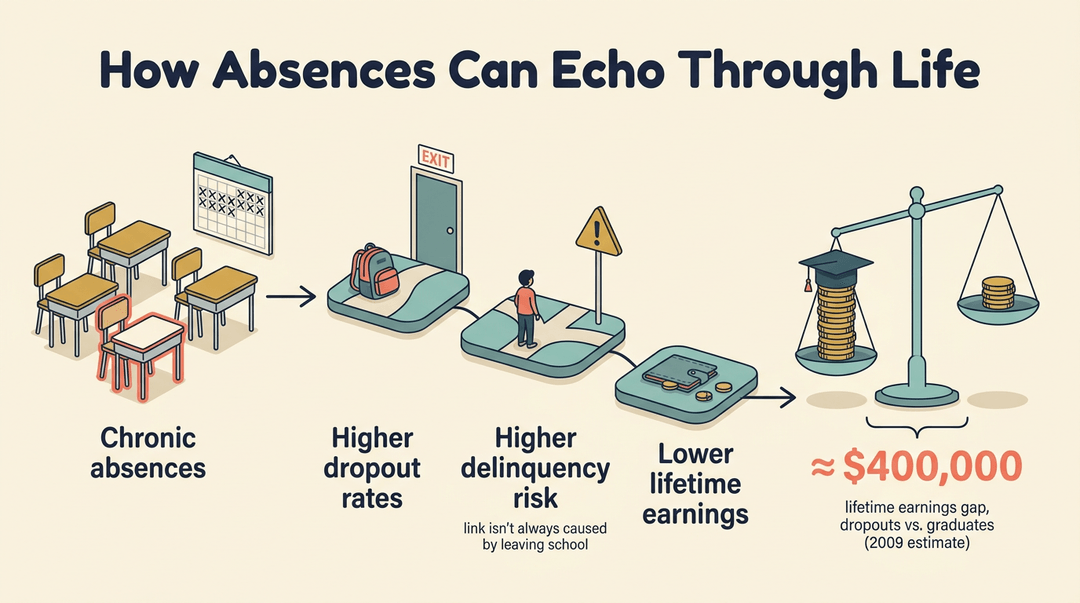
- Higher dropout rates. Students with chronic absenteeism have higher dropout rates than students who attend regularly.
- Juvenile delinquency risk. Juvenile delinquency is one risk associated with chronic absenteeism. A national study from the Office of Justice Programs found that dropouts were more likely to have higher levels of delinquency than graduates, though not always because they left school.
- Lower lifetime earnings. Over a working life, leaving school early tends to mean less income.
- About $400,000 earnings gap. A 2009 estimate from the Center for Labor Market Studies puts the gap between dropouts and graduates at about $400,000 over a lifetime. That's a lot of money.
Ways Families and Students Can Improve Attendance
Attendance rarely improves through one big move. It takes families, students, and neighbors doing small things well.
What parents and guardians can do
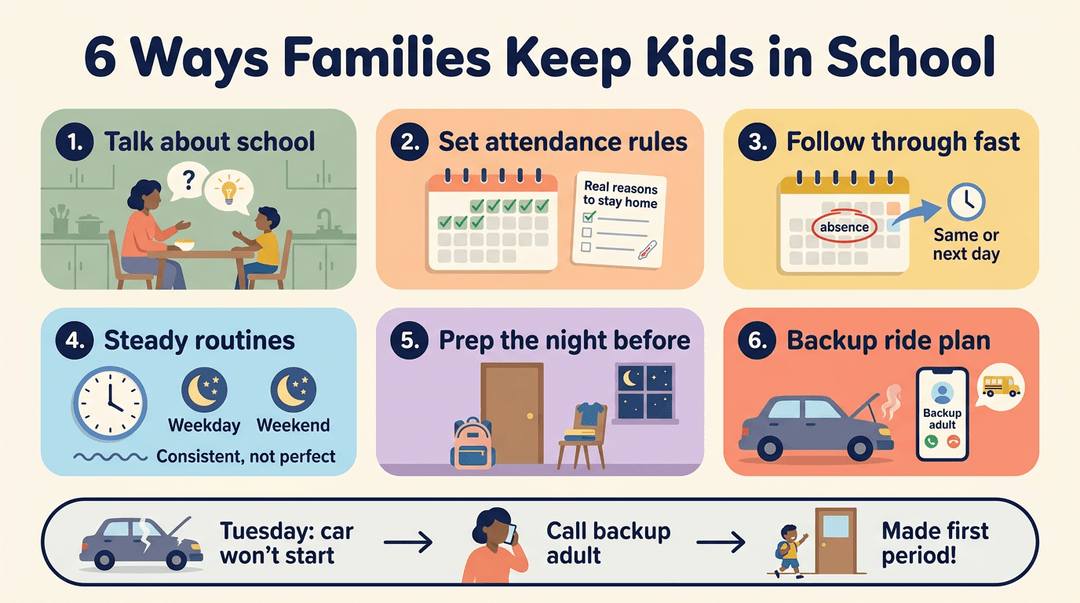
- Talk about schoolwork and importance. Ask what your child is learning and why it matters.
- Set attendance expectations. School days aren't optional. Agree in advance on what counts as a real reason to stay home.
- Enforce consequences promptly. Respond the same day or the next, while it still connects to the absence.
- Maintain routines. Keep bedtimes and wake times steady, even on weekends. Aim for consistency rather than perfection.
- Prepare the night before. Pack the bag and lay out clothes. Mornings go faster when the work is done.
- Arrange backup transportation. Have a second adult or bus plan ready for the day the car won't start.
Think of a parent whose car breaks down on a Tuesday. Because a backup adult is already on the list, the child still makes first period. Nobody has to scramble.
Keeping students involved in school
- Clubs and activities. A robotics team or band gives students a place where someone notices when they're gone.
- Career and technical classes. Hands-on courses give students something to look forward to.
- Counselor support. A counselor can help untangle a shaky grade or schedule conflict before missed days pile up.
- Check for bullying or discipline issues. Sometimes the real reason a student stays home is a hallway they dread. Ask gently, then involve the school.
How neighbors and relatives can help
- Offer transportation. A neighbor or grandparent who can drive on a rainy morning means a full day, not a missed one.
- Talk supportively with guardians. Frame the conversation around help, not blame. Ask what would make mornings easier.
- Report at-risk children. If you often see a child out during school hours, tell the school. Staff can follow up.
Support works best when it's with the family, not around them.

Habits students can build on their own
- Morning routine. Set a wake-up time and get dressed before your phone comes out.
- Go to school with a friend. Walking or riding together makes the trip easier to start and harder to skip.
- Talk to staff. If something makes school hard, tell a teacher, counselor, or coach early.
Unlawful absence comes down to the reason behind a missed day and the record that shows it. Know the rules, understand the response, and keep your records current, and you can act early instead of scrambling later.
Ready to spot patterns sooner? Check out Attendance & Records to mark attendance quickly and see trends across your classes over time.
References
- A school-based material needs intervention for chronic absenteeism: a state-wide staggered interrupted time series analysis — pmc.ncbi.nlm.nih.gov (2026)
- The Relationship between School Technology Expenditures and High School Graduation Rates: An Assessment of North Carolina Public Schools — hdl.handle.net (2020)
- Does Dropping out of School Enhance Delinquent Involvement? Results From a Large-Scale National Probability Sample — ojp.gov
- Chronic Absenteeism: The Problem, The Participants, The Panacea — via.library.depaul.edu (2020)
- Identifying Middle School Students at Risk for Dropping out of High School — digitalcommons.liberty.edu (2010)
- Indiana schools have new requirements when older students are truant — indianapublicradio.org (2025)