Chronic Absenteeism Definition, Causes, and How to Reduce It


Jump to section
Think about a puzzle missing a handful of pieces. You can still make out the picture, but the gaps keep pulling your eye. A classroom works the same way when students keep drifting in and out.
Chronic absenteeism is what happens when those gaps add up: missing 10% or more of the school year, for any reason, excused or not. It's more than an attendance stat. It shapes what a student learns and how a class runs.
This post breaks down what the term actually means, why it happens, and what you can do about it starting Monday.

Chronic Absenteeism Definition and How It's Measured
"Chronic absenteeism" sounds like education jargon, but the definition behind it is refreshingly simple once you see the math.
You'll also hear it called chronic absence, a term researchers and district reports use interchangeably with chronic absenteeism.
Missing 10% of School Days Is Chronic
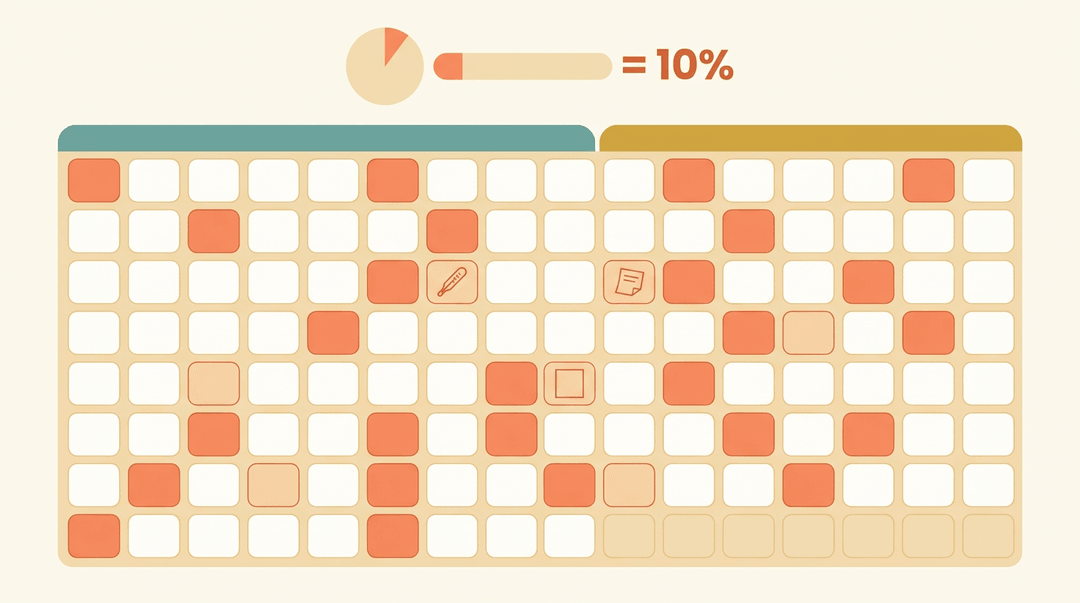
A student becomes chronically absent when they miss 10% or more of school days in a year, and it doesn't matter why they were out.
According to the U.S. Department of Education, chronic absenteeism is "typically defined as missing at least 10 percent of school days, or approximately 18 days in a year, for any reason, excused or unexcused."
A documented illness counts the same as a skipped day. That's the detail that trips up a lot of teachers and parents.
Is 20 Absences in a School Year Too Many?
Yes. Twenty absences sails past the chronic threshold. The Department of Education points to roughly 18 days a year as the tipping point, which breaks down to about two absences a month across a typical school year. So is 20 absences in a school year bad?
By this measure, it is: that's two days over the benchmark and squarely in chronic-absence territory.
That 18-day figure isn't fixed everywhere, though. Because school calendars vary in length, the exact day count that equals 10% shifts, landing anywhere from about 15 to 18 days depending on the district's calendar.
Is Chronic Absenteeism the Same Thing as Truancy?
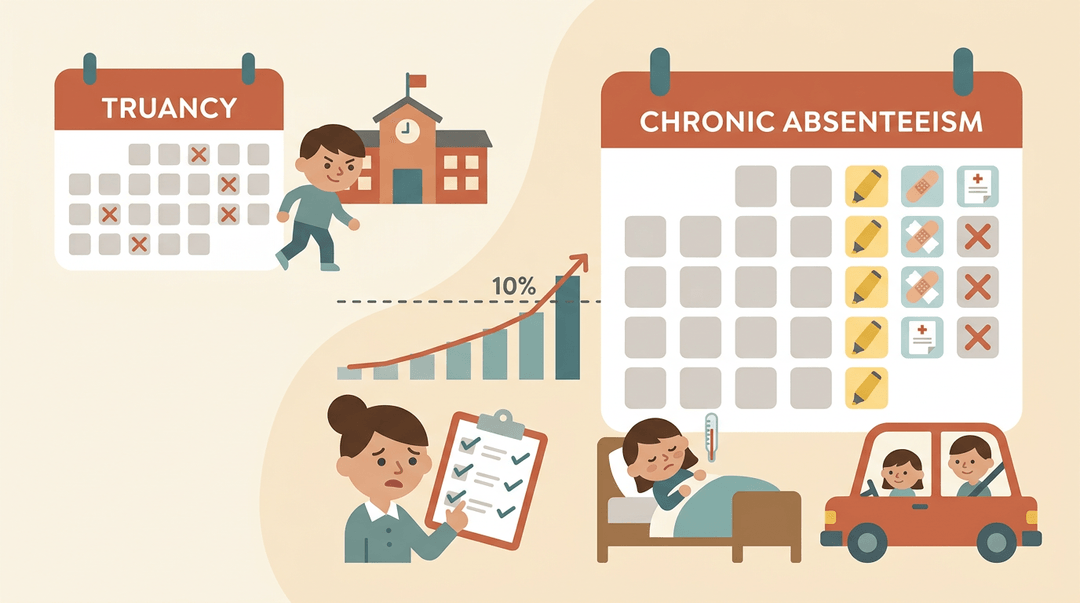
No, and mixing the two up hides real problems. Truancy usually refers only to unexcused absences, while chronic absenteeism counts every day missed, excused or not.
A student with a documented illness or a family emergency can still land in chronic-absence territory without ever being "truant."
That's also why daily attendance counts, which only flag whether a student showed up today, often miss chronic absenteeism completely: a student who's out every Friday can look fine day-to-day while quietly crossing the 10% line.
How Schools Measure and Track Absenteeism
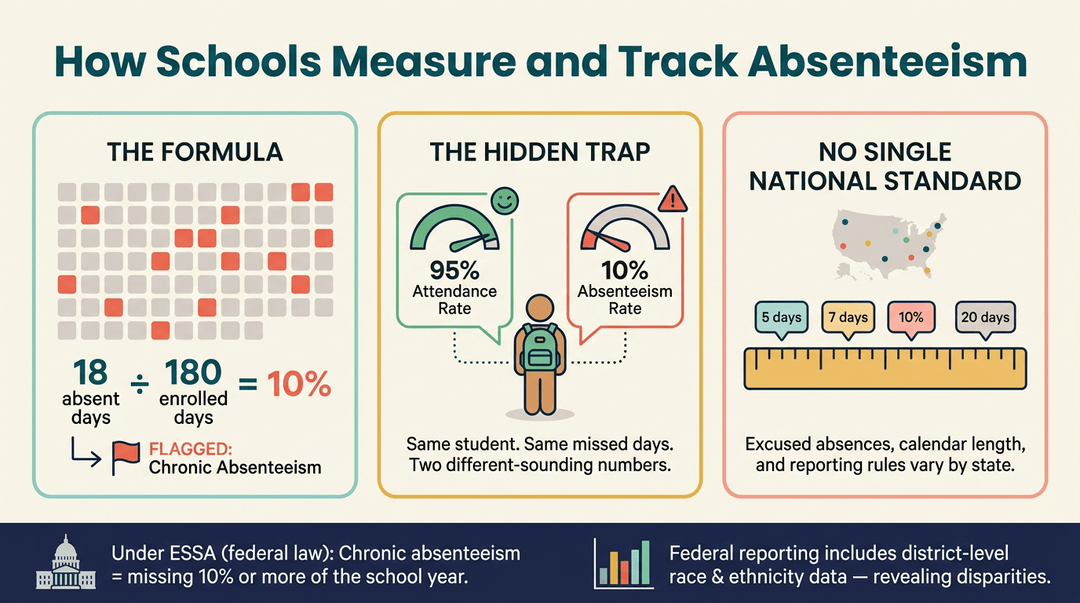
Districts calculate a chronic absenteeism rate by dividing total absent days by total enrolled days, then flagging any student at 10% or above.
Comparing that number across states gets messy fast, though, since definitions of "excused," calendar length, and reporting rules aren't consistent nationwide.
Congressional district-level data, including race and ethnicity breakdowns, is often available through federal reporting, which is part of what makes it possible to see disparities in the first place.
Other benchmarks like 5, 7, and 20 days show up across different reports too.
Per The Wide Read, under the Every Student Succeeds Act (ESSA), a federal education law, "chronic absenteeism is defined as a student missing 10% or more of the academic school year."
Worth keeping straight: an attendance rate (percent of days present) and an absenteeism rate (percent of days missed) don't always mirror each other exactly.
Rounding and reporting quirks mean a "95% attendance rate" can still hide a chronic-absence problem underneath.
Why Students Miss so Much School
No single reason explains why a student racks up absence after absence. Chronic absenteeism usually grows out of a tangle of health, money, safety, and system-level pressures that pile up on the same families.
What Illness Causes the Most School Absences?
Physical health issues are the most obvious driver, and they're also the most excusable in a parent's mind.
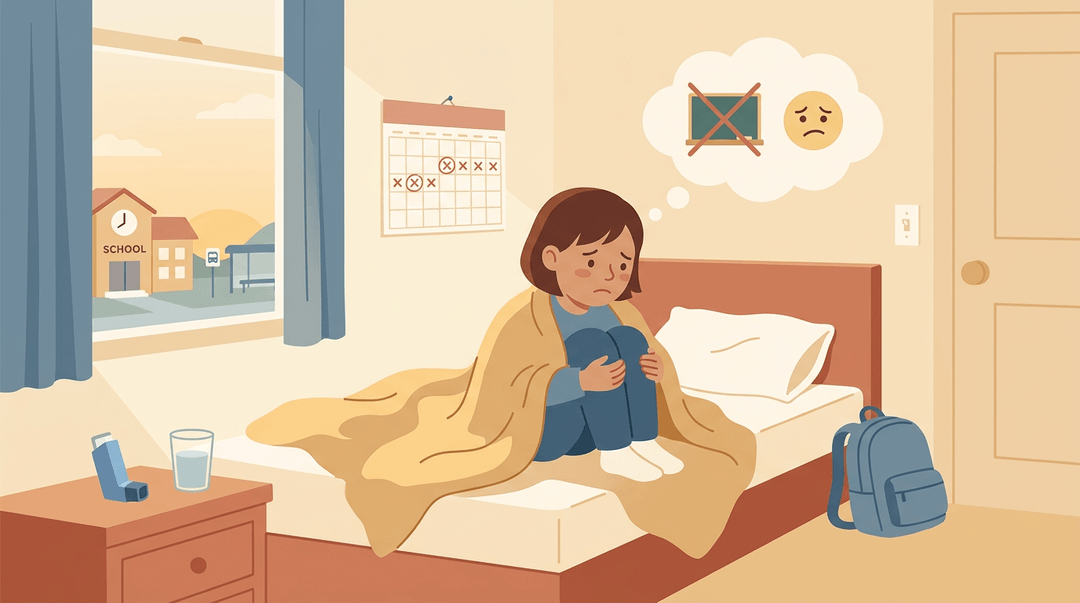
Asthma is the most common illness-related cause of chronic absenteeism, and it's easy to see why: a flare-up can mean an emergency inhaler, a trip to urgent care, or a full day at home recovering.
Diabetes creates a similar pattern, with blood sugar swings that make a classroom feel unsafe until things stabilize.
Mental health conditions matter just as much, even though they're less visible on an attendance report. Anxiety, depression, and school-related stress can keep a student home just as reliably as a fever.
For example, a middle schooler with untreated anxiety might dread a specific class enough to feign illness rather than face it, and that absence still shows up as excused.
Poverty and Housing Instability Keep Kids Out
Poverty strips away the small buffers that keep a minor problem from becoming a missed school day.
- Housing instability, moving between apartments, shelters, or relatives' homes, disrupts routines and enrollment alike.
- Food insecurity leaves kids too hungry or too sick to focus,
- and a lack of essential services (reliable water, heat, or medical care) turns ordinary illness into an extended absence.
Getting to School When Transportation Fails
Sometimes the barrier is simpler: there's no way to get there. A lack of school bus access, no safe route to walk, or a family without reliable transit can turn a five-minute trip into an impossible one.
Think of a family in a rural district where the nearest bus stop is miles away; a single missed pickup can cost a whole day.

When Kids Don't Feel Safe or Connected
Student disengagement grows fast when school doesn't feel like it belongs to them. Bullying and unsafe conditions push kids to avoid the building altogether, while cultural or language barriers can make a classroom feel foreign rather than welcoming.
Underneath all of it is a lack of connectedness: students who don't feel known by an adult at school are far more likely to stop showing up.
Bigger Systemic Barriers Behind Absenteeism
Some causes sit above any one family's control:
- Racial disparities in policies, where discipline and attendance rules land harder on some students than others.
- Justice system interactions, including court dates or detention that pull students out of class.
- Unpredictable work schedules, which make consistent drop-off and pickup nearly impossible for some parents.
- Segregation effects, concentrating under-resourced schools in the same neighborhoods facing every barrier above.
Taken together, these forces show why chronic absenteeism is rarely about a student simply choosing to skip.

How to Spot and Respond to Absenteeism
You don't need to wait for a report from the office to catch chronic absenteeism: the earliest warning signs show up in your own gradebook.
This guide walks you through a four-move routine you can run all year, plus a grade-level lens for reading what absences actually mean.
The four-move response ladder
1. Log attendance daily, first thing.
- Take attendance yourself every day; weekly summaries hide the pattern.
- Mark excused and unexcused separately, but track both: chronic absenteeism counts them all.
- Watch for anyone missing 2+ days a month: that pace alone reaches chronic by spring.
2. Flag anyone approaching the 10% line.
- Set your alert at 10% of days enrolled so far, not the year total.
- Twenty days in, that's just 2 absences. Flag it now, not in May.
- Compare each flagged student to the class average; an outlier deserves a closer look.
- Note recurring patterns: same weekday, post-weekend, or a specific class period.
3. Reach out to the family early and warmly.
- Send a short notice at the first flag, framed as concern, not accusation.
- Say: "We've missed Jordan a few days this month and we want to help. Is anything making mornings hard right now?"
- Ask about root causes: transportation, health, anxiety, work schedules, housing.
- Offer one concrete resource in the same conversation: the nurse, the counselor, a bus route, a morning check-in buddy.
4. Document each step and escalate when the pattern holds.
- Log every intervention with a date and outcome: "10/4: called home, mom cited asthma flares."
- Note any attendance contract: the goal, who signed, and the review date.
- If absences keep climbing, refer per your district's policy with your log attached.
- A dated paper trail is what turns your referral into fast action.
⚠️ Watch out: Don't dismiss excused absences as "fine." A student out 18 days with doctor's notes is just as far behind as one who skipped, and just as chronically absent.
What absenteeism looks like by grade
The response ladder stays the same, but the root cause usually doesn't. Find your grade band and read across before you make the call home.
| Grade band | What it often looks like | Where to aim your outreach |
|---|---|---|
| K-2 | Caregiver-driven: transportation gaps, "it's just kindergarten" | The adult's logistics and beliefs, not the child |
| Middle school | Disengagement: Monday absences, skipped periods, social withdrawal | Belonging: one adult who checks in daily |
| High school | Work shifts and family caregiving conflicts | Flexibility: schedule adjustments, counselor referral |
Example: A second-grade teacher notices a student missing most Mondays. Instead of logging it and moving on, she calls home and learns Mondays follow a custody exchange across town. She loops in the counselor, the family shifts the exchange to Sunday evenings, and the Monday absences stop. No contract, no referral: just an early call aimed at the real cause.
At a glance: log daily, flag at 10%, call home early, document and escalate. The whole routine costs minutes a week, and it's the difference between catching a pattern in October and discovering it in a June report.
The logging and flagging steps get even lighter when you track patterns automatically as you take daily attendance in EMStudio.
National and Local Absenteeism Trends
Numbers tell the story that anecdotes can't: how many students are missing school, and how sharply that's shifted since 2020. Here's what the national and local data show, down to a rate you can compare against your own classroom.
How National Rates Have Changed
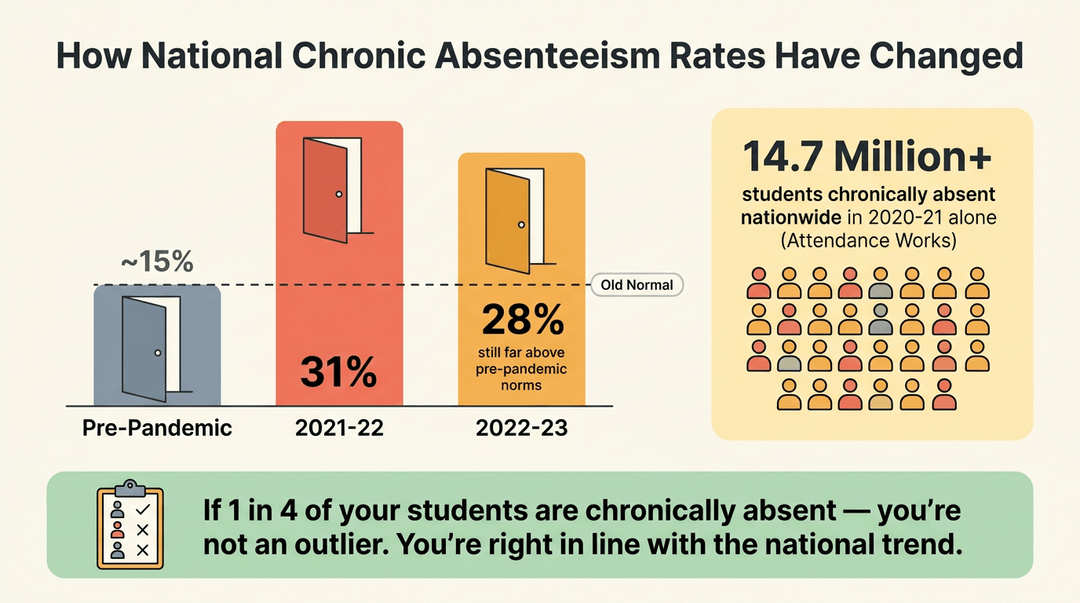
Chronic absenteeism climbed to 31% in the 2021-22 school year, then eased slightly to 28% in 2022-23, still far above pre-pandemic norms. In 2020-21 alone, at least 14.7 million students nationwide were chronically absent, according to Attendance Works.
Put those numbers beside your own roster: if a quarter or more of your students are hitting the chronic threshold, you're not an outlier. You're right in line with the national trend.
Why the Pandemic Made Things Worse
Before Covid-19, roughly 8 million students nationwide were chronically absent each year. That baseline more than doubled once schools reopened.
The American Enterprise Institute reports a rate that "more than doubled compared with pre-pandemic levels," and research published in PNAS found the share of chronically absent students grew by 13.5 percentage points between 2018-19 and 2021-22, adding roughly 6.5 million more chronically absent students.
What began as a temporary disruption has emerged as a pandemic-era challenge schools are still working through.
How Your State and County Compare
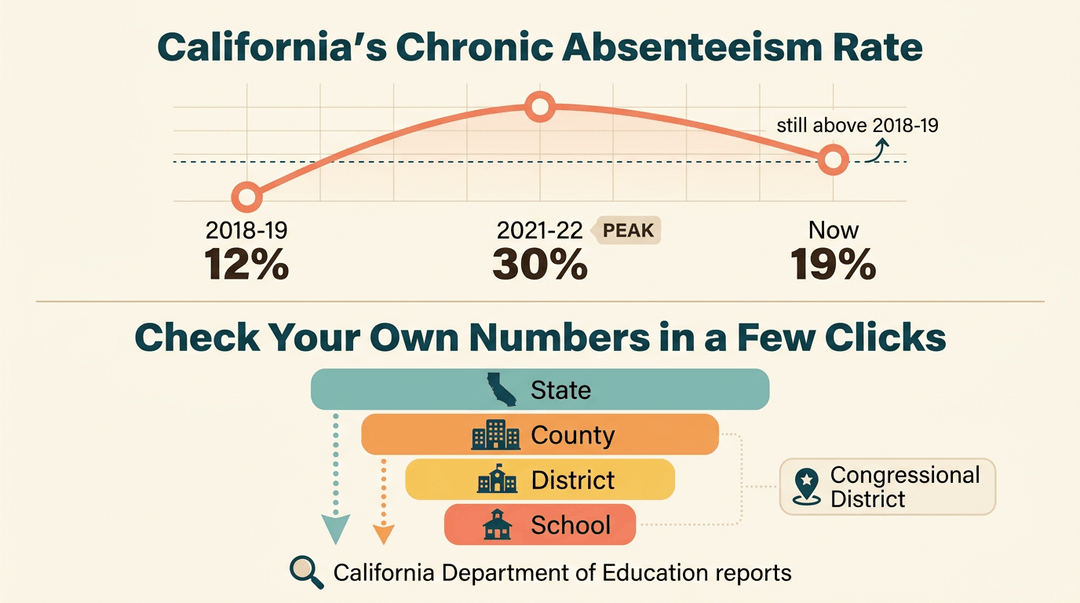
California traces the same arc. Its statewide rate peaked at 30% in 2021-22 and has since fallen to 19%, according to the Public Policy Institute of California, though that's still above the 2018-19 rate of 12%.
San Diego County's numbers move within that same band, and you don't have to guess where your own community stands. The California Department of Education publishes reports by:
- county
- district
- school
- even congressional district
so you can check your local rate against the state average in a few clicks.
Why Chronic Absenteeism Matters
A missed day here or there rarely changes much. But once absences pile up into a pattern, the fallout ripples out: to a child's reading level, a classroom's rhythm, and a school's bottom line.
How Missing School Hurts Early Reading
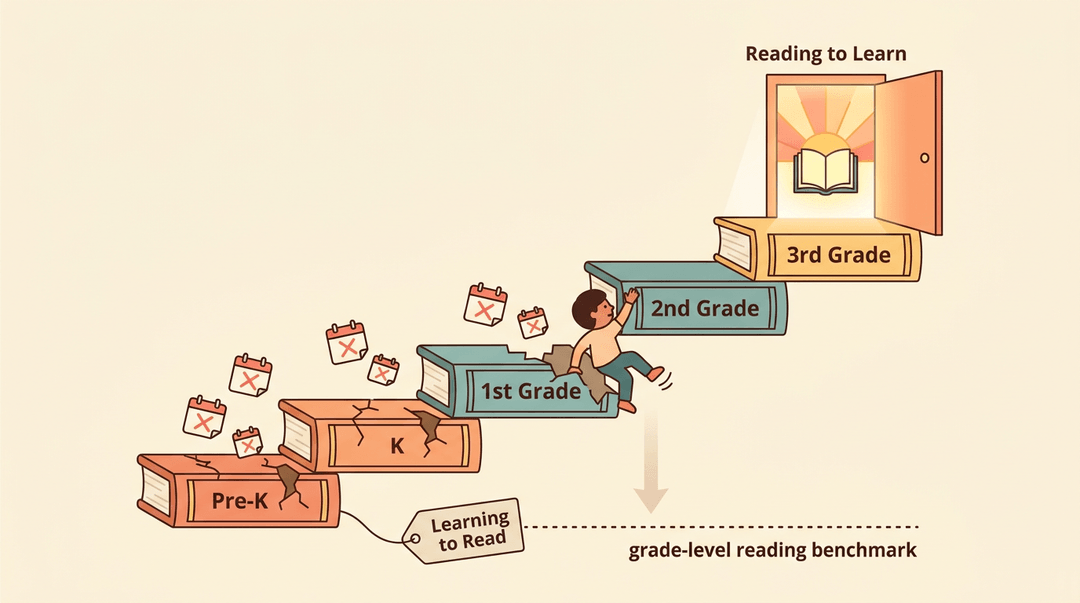
The early grades are where the damage starts. Kids who rack up too many absences between preschool and second grade often arrive at third grade behind on reading, and third grade is the year reading shifts from learning to read to reading to learn.
Miss enough of those foundational years, and a student can fall below grade-level reading benchmarks before they've even hit double digits in age.
Can Too Many Absences Hold Kids Back?
Yes, and often literally. According to a research review from NC DPI, chronic absence is linked to a higher risk of course failure, grade retention, and dropping out altogether.
That's how a lot of kids end up held back: not because they can't grasp the material, but because they simply weren't in the room enough to learn it.
Add it up over years, and chronically absent students become up to four times less likely to graduate on time than their steadily attending peers.
The gap doesn't stay flat, either: it widens, turning a small early setback into a wide achievement gap by high school.

Effects That Follow Kids Into Adulthood
The consequences don't stop at graduation, or at dropout.
Adults who were chronically absent as students face steeper climbs into steady employment, and the health and social struggles tied to inconsistent schooling tend to follow them well past their school years.
Attendance in childhood turns out to be a surprisingly strong predictor of life-long success.
How It Disrupts the Whole Classroom
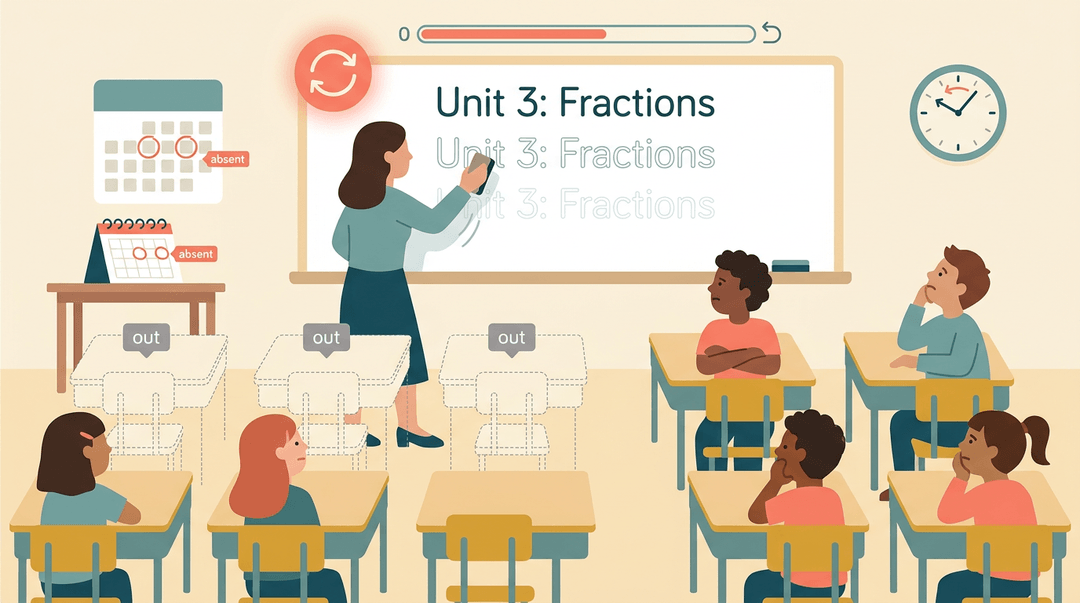
Chronic absenteeism isn't just an individual problem: it drags on the whole room. Think of a teacher who has to pause a new unit three times in a week to re-teach students who missed the last lesson.
That's classroom churn, and it eats into instructional time for everyone, not just the student who was out.
Consistent attendance sets the pace for a class; chronic absence forces the teacher to keep resetting it, slowing down the students who showed up every day.
The Funding and Community Fallout
The fallout reaches past the classroom door.
Researcher Corabelle Esmailian's analysis of attendance funding found that when a student is absent, their school loses a portion of potential Average Daily Attendance funding for that day, and multiplied across a building full of chronically absent students, that's real money gone.
Zoom out further and the pattern shows up in workforce development, too: a community with high rates of chronic absenteeism tends to produce fewer work-ready graduates, which strains local employers and, over time, the community's economic health.
Who Chronic Absenteeism Affects Most
Chronic absenteeism doesn't land evenly across a school, a district, or a state. Some students carry a far heavier share of the risk than others, and the gaps show up along lines of:
- race
- income
- disability
- housing stability
- geography
It also tends to spike at the edges of a K-12 career, showing up more in kindergarten and high school than in the grades between.
Racial and Ethnic Gaps in Absenteeism
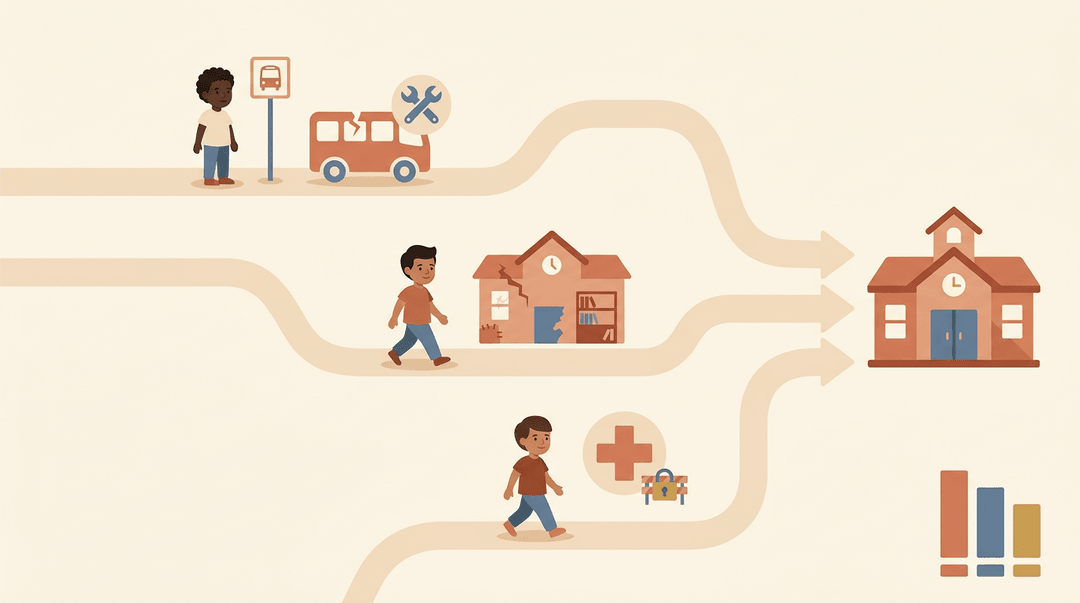
Students of color are chronically absent at disproportionately higher rates than their white peers in many districts, and Black and Hispanic students in particular carry a heavier share of that burden.
The gap often traces back to structural factors families can't simply opt out of:
- unreliable transportation
- under-resourced schools
- unequal access to healthcare
Demographic breakdowns of attendance data surface these same patterns year after year, which is why any plan that ignores subgroup data only sees part of the picture.
Poverty's Link to Missing School
Income is one of the strongest predictors of chronic absence.
According to the Evidence-to-Impact Collaborative at Penn State, chronic absenteeism rates are highest in schools serving low-income communities, where families face bigger barriers like housing instability and limited transportation.
Socioeconomically disadvantaged students, in other words, face a steeper climb just to get through the classroom door, and it shows up in the data district after district.
Students With Disabilities Face Higher Rates
Students with disabilities and chronic health conditions also miss school more often than their peers.
A population-based study on school absence found that students with health conditions or disabilities are more likely to report absences than students without them.
Subgroup comparisons like this one matter for teachers: a student with a chronic illness or an individualized education program (IEP) may need a different attendance plan, not just a stricter one.

Foster, Homeless, and Migrant Students at Risk
Few groups face steeper odds than students without a stable home.
Foster youth post some of the highest chronic absenteeism rates of any subgroup: Policy Analysis for California Education found that more than one in three foster youth in California missed 10 percent or more of the 2024-25 school year.
Homeless students aren't far behind. A Michigan policy brief found they had the highest chronic absenteeism rate of any group with available data in the state.
Migrant students, who often move mid-year for seasonal work, face similar disruption: every move risks lost records and lost days.
How Rates Vary by State and County
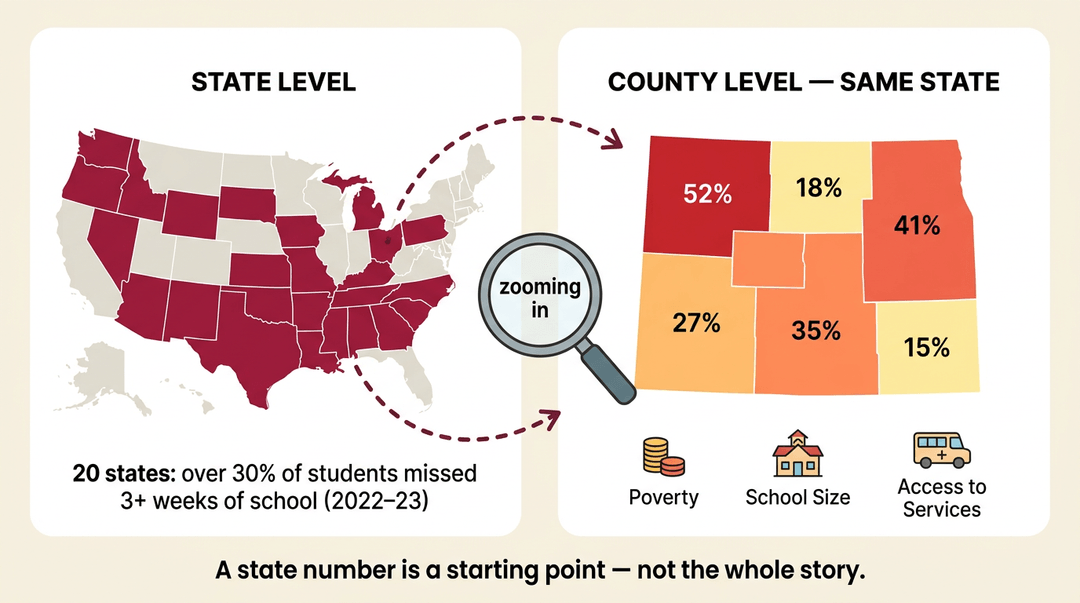
Geography matters too. According to the U.S. Department of Education, 20 states reported that more than 30% of their students missed at least three weeks of school in the 2022-23 school year.
Zoom into any one of those states, though, and county-level rates can swing far above or below the state average, shaped by local poverty, school size, and access to services. A statewide number is a useful starting point. It's rarely the whole story.
What Actually Helps Reduce Absenteeism
Defining chronic absenteeism is one thing.
Fixing it is another, and the research points to a few strategies that actually work: catching warning signs early, bringing families in as partners, and building systems that reward showing up instead of only punishing its absence.
Using Data to Catch Problems Early
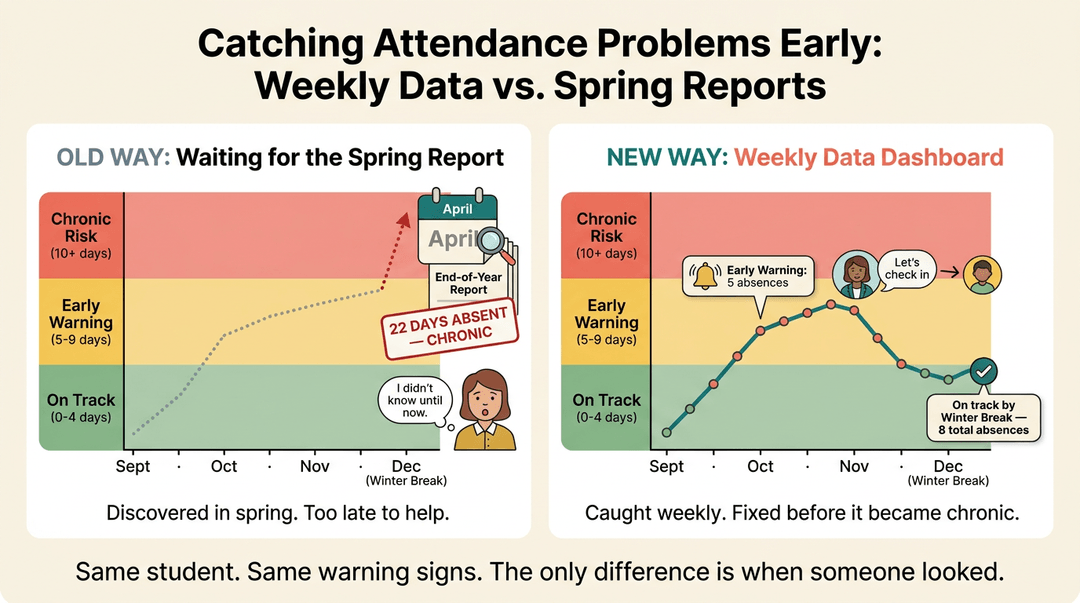
Many states have built statewide data systems that track attendance in real time, not just at report card time.
These systems rely on early warning indicators: a student's absences creeping past a handful of days signals trouble long before "chronic" applies.
The goal is actionable attendance data, information a teacher or counselor can use this week, not a statistic buried in a spring report.
For example, a middle school attendance team that reviews weekly numbers can spot a student sliding from occasional to chronic absence and step in before winter break, not after.
Engaging Families and Communities
Some of the most effective schools use a community schools approach: wrapping a campus in health, counseling, and family support services so that showing up gets easier.
Partnerships with families matter just as much: a quick call home from a teacher who knows the student's name carries more weight than a form letter.
Positive messaging campaigns reinforce the same idea, framing attendance around opportunity ("every day counts") rather than blame.
Reward Programs That Boost Attendance
Attendance reward programs are one common intervention.
Researchers analyzing 88 public school districts along the Texas-Mexico border found that offering incentives for student attendance was among the district-level policies studied for its effect on absenteeism.
AttenDANCE is one such program built around celebrating consistent attendance.
Count Me In! is another incentive-based program, and the American Federation of Teachers notes it has been implemented in some California schools, rewarding showing up rather than only flagging when students don't.

Policy Steps That Actually Work
At the federal level, the Every Student Succeeds Act (ESEA) now folds chronic absenteeism into school accountability, so districts can't quietly look away from it.
States and districts can take concrete action steps: setting attendance targets, funding attendance teams, and drawing on federal toolkit resources built specifically to help schools design their own plans instead of starting from scratch.
Do Schools Call CPS Over Truancy?
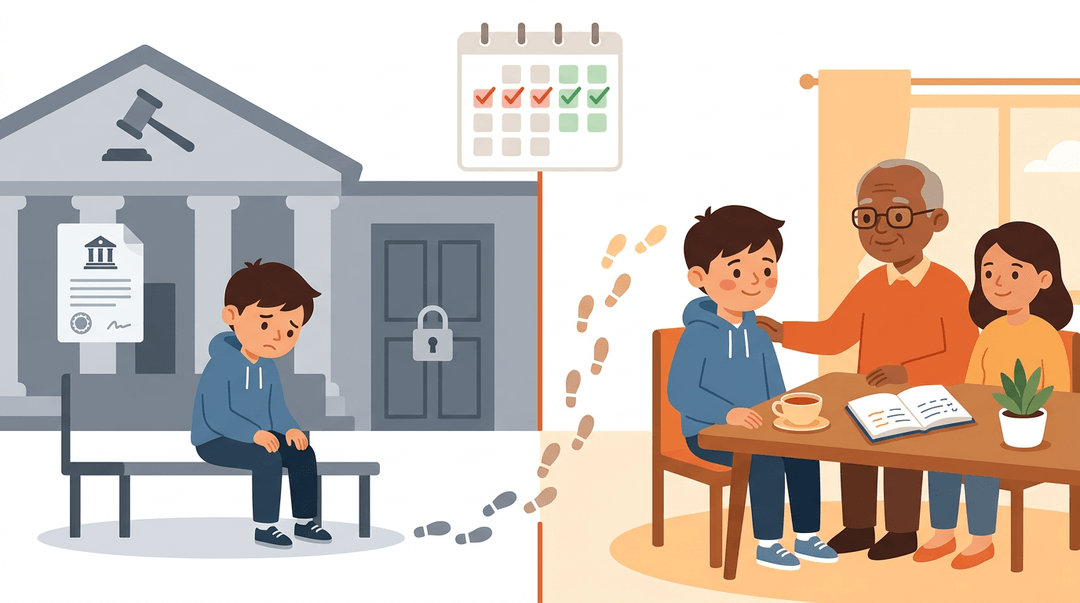
Sometimes, yes: a CPS (Child Protective Services) or truancy court referral still happens in some districts once absences pile up. But the trend is moving away from that.
More schools now work to reduce suspensions and expulsions tied to attendance, since punishing a student with more time out of class rarely brings them back.
Non-punitive interventions, like mentoring, home visits, and family support, tend to work better, and many schools now try to refrain from law enforcement referrals altogether, saving CPS or court involvement for a true last resort rather than a first response.
Chronic absenteeism isn't just a number on a spreadsheet. It's a signal, one that points to what's happening at home, in the hallway, or in your classroom before a student ever falls behind.
Catching it early, and responding with support instead of punishment, is what turns that signal into real change.
Ready to spot the pattern before it becomes a problem? Check out our Attendance Tracking feature to mark attendance quickly and catch chronic absenteeism before it snowballs.
References
- Chronic Absenteeism — ed.gov
- School Absence Among High School Students With Disabilities and Health Conditions: A Population-Based Study — doi.org (2026)
- Chronic Absenteeism — ed.gov
- Higher chronic absenteeism threatens academic recovery from the COVID-19 pandemic — doi.org (2024)
- Analyzing the Relationships between State School Policies and Absenteeism Rates for 9-12th Grade Students in Texas-Mexico Border Districts — doi.org (2024)
- Chronic Absenteeism: A Review of the Research — dpi.nc.gov
- "The effects of chronic absenteeism on average daily attendance funding" by Corabelle A. Esmailian — digitalcommons.humboldt.edu
- Understanding & Addressing the Root Causes of Chronic Absence Among U.S. Students - Evidence-to-Impact Collaborative — evidence2impact.psu.edu
- How Changes in Foster Youth Classification Status Relate to Student Absenteeism and Discipline — edpolicyinca.org
- The Link Between Chronic Absenteeism, Economic ... — poverty.umich.edu
- Absenteeism Data — cde.ca.gov
- Truancy vs Chronic Absenteeism: ESSA's Academic Indicator — thewideread.com (2026)
- Everyone Is Missing More School: How Student Attendance Patterns Have Shifted over Time | American Enterprise Institute — aei.org (2025)
- Chronic Absenteeism in California — ppic.org (2026)
- Chronic absenteeism — nationalequityatlas.org
- The Problem — attendanceworks.org
- Chronic absenteeism — aft.org
Frequently asked questions
What is the difference between chronic absenteeism and truancy?
Chronic absenteeism means missing at least 10% of school days for any reason, including excused and unexcused absences. Truancy usually refers specifically to unexcused absences and may violate attendance laws or school policies.
What is considered chronic absenteeism?
A student is generally considered chronically absent after missing 10% or more of the school year. In a typical 180-day school year, that is about 18 days, although the exact number varies with the school calendar.
What is another word for chronic absenteeism?
Another word for chronic absenteeism is chronic absence. The two terms are commonly used interchangeably.
How many absences in a month are considered chronic?
There is no universal monthly cutoff because chronic absenteeism is measured across the school year. Missing about two days per month in a typical school year can put a student on pace to miss 10% or more of school days.
How to fix chronic absenteeism?
Start by identifying the cause, such as illness, anxiety, transportation problems, housing instability, bullying, or family responsibilities. Contact the school early, involve the appropriate counselor, nurse, or attendance team, create a practical plan, and track attendance regularly. Schools may also provide transportation help, health services, tutoring, schedule adjustments, or check-ins.
Is being chronically absent bad?
Yes, chronic absenteeism can seriously affect learning, reading development, course completion, graduation, and classroom instruction. It can also increase the risk of being held back or dropping out, even when many absences are excused.
What happens when you get held back in school?
Being held back, or retained, means repeating the same grade instead of advancing to the next one. The student may repeat classes, receive additional support, and follow an intervention plan, although policies vary by school and state. Attendance alone does not always determine retention, and schools generally consider academic performance and other circumstances.
Is 20 absences in a school year bad?
Yes. Twenty absences are above the typical chronic-absence benchmark of about 18 days in a 180-day school year, so they generally count as chronic absenteeism. The exact threshold can vary because school calendars differ, and both excused and unexcused absences usually count.