Tardiness Meaning: Definition, Synonyms, and Forms Explained

Jump to section
Picture settling into a movie seat just as the opening credits roll. You missed the start, and you're not quite sure what you missed. That feeling is the heart of tardiness, which describes arriving after the time something was supposed to begin.
Tardiness is the noun form of tardy, meaning late or delayed, and it shows up everywhere from the school bell to the office.
In this post, we'll unpack its core meaning, grammar, synonyms, and translations, then move into a practical section that helps you track and respond to student tardiness in your own classroom.

What Tardiness Meaning Really Covers
You'll hear tardiness in hallways, handbooks, and attendance reports, and its meaning goes beyond simply being late. Its Latin root, tardus, meaning slow, hints at why.
Is tardiness the same as lateness?
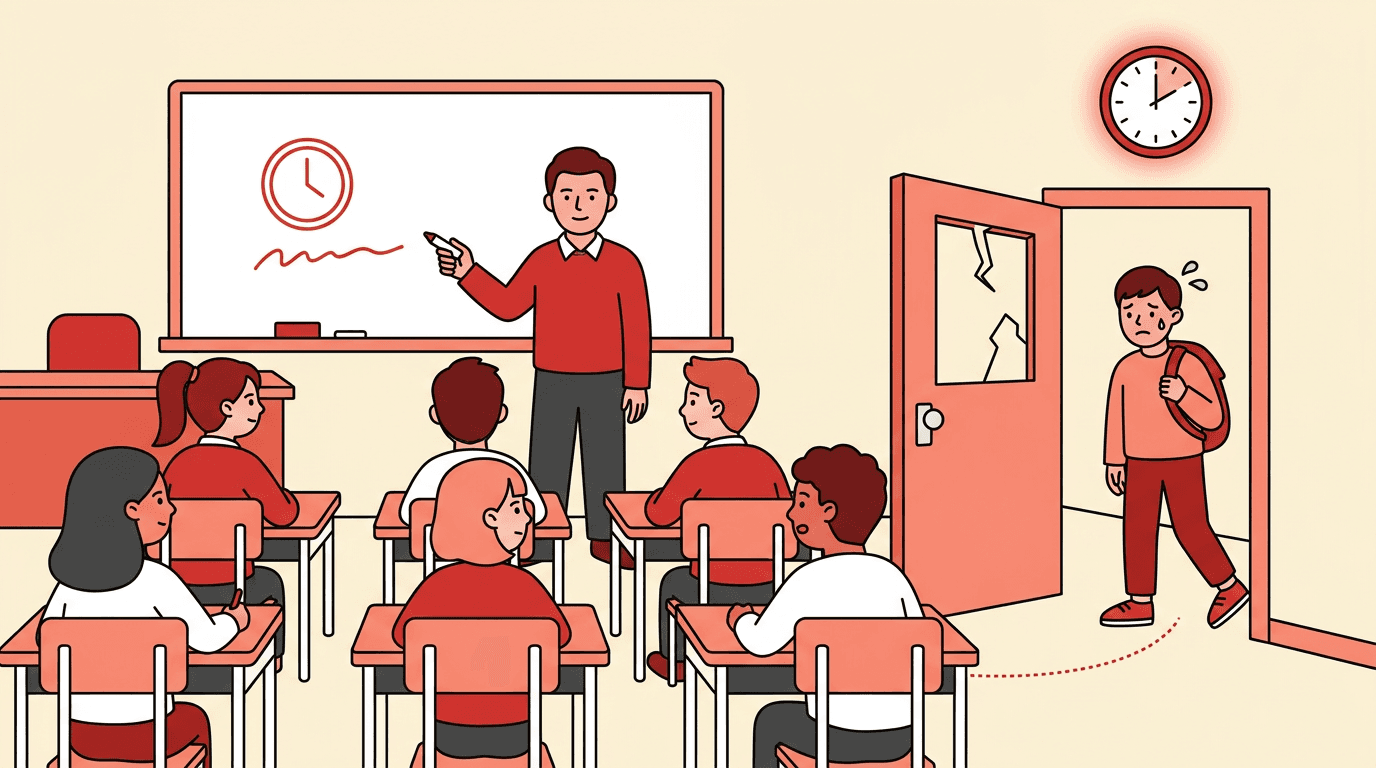
Mostly, yes. Tardiness is the quality of being late, or the failure to arrive on time. As a formal, uncountable noun, you'd say "tardiness is a problem," not "a tardiness." Consider a student who slips into your room after the bell.
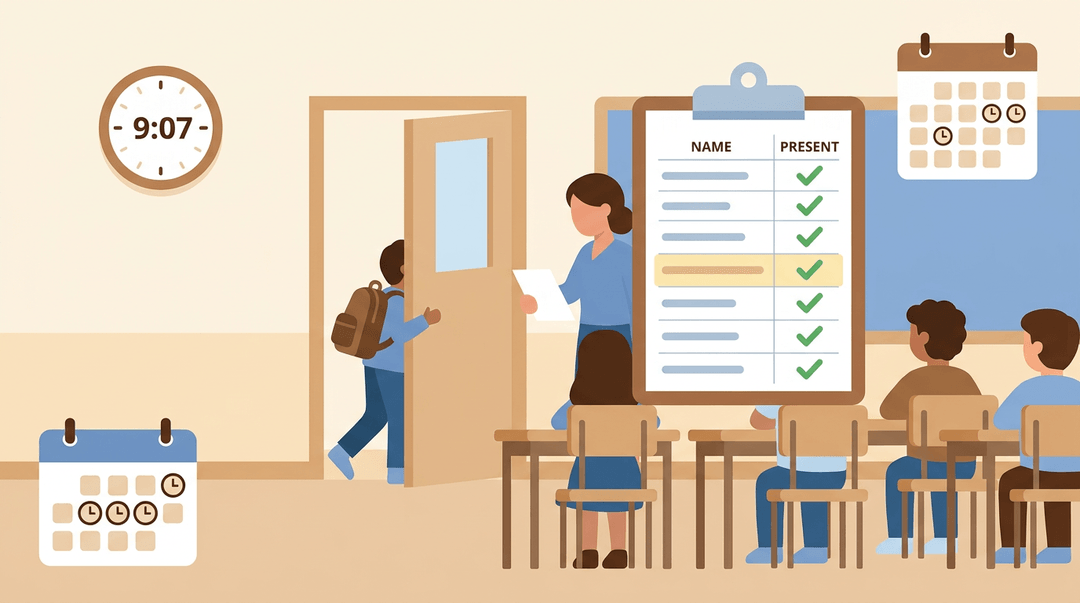
That student is tardy, but many schools still mark them present rather than absent, so your records may hide the pattern unless you track it.
What counts as excessive tardiness? Policies set their own line. One Thomas More University policy defines it as "three or more instances of lateness in a calendar month," and that pattern is subject to corrective discipline.
It can also mean sluggishness or laziness
Tardiness can also describe slowness in movement or progress. In its shiftlessness sense, it points to a lack of drive, and it's often linked with sluggishness and procrastination.
Picture a student who keeps putting off a project until the night before it's due. It's less about when the work arrives and more about how the student moves through it. Breaking the task into checkpoints gives them a clear path.
How to pronounce tardiness correctly
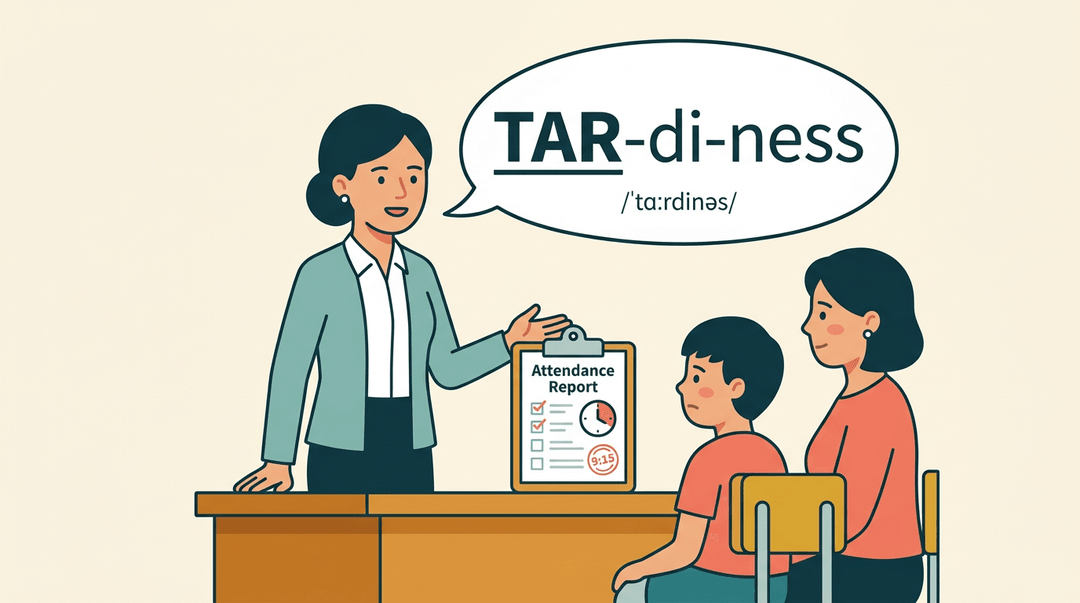
Say it as a three-syllable formal word with stress on the first syllable. The UK IPA is /ˈtɑːdinəs/, and the US IPA is /ˈtɑrdinəs/.
Expect to see it most in policies and reports, so it's worth saying clearly when you discuss attendance with students and families.
How to Track and Address Tardiness
Use this guide to set a clear tardy policy, log arrivals in under a minute, and step in before late becomes a habit. Work through it top to bottom once, then run the daily and weekly parts from memory.
Write the policy first
A policy only works if students can't argue about it. Settle three things before the first bell.
- Define the threshold. Say exactly when "late" starts and when late becomes absent.
- Separate excused from unexcused. Name the reasons you'll accept, and what proof you need.
- Put it in the syllabus. Students and families should see it in writing.
Sample syllabus line (adjust to your school's rules): You're tardy if you arrive after the bell but within 10 minutes. After that, you're marked absent for the period. Tardies for the nurse, counselor, or a late bus with a pass are excused. All others are unexcused.
Log it every day
Keep this to a few seconds per student, using the roster you already have.
- Record the arrival time.
- Jot "8:07" beside the name as the student walks in.
- Mark tardy or absent.
- Apply your written threshold, not your mood that day.
- Note the reason in a few words.
- Try "bus late," "nurse pass," or "none given."
| Date | Student | Arrived | Status | Reason |
|---|---|---|---|---|
| Mon | J. Lee | 8:07 | Tardy | Bus late |
| Mon | A. Cruz | 8:22 | Absent | None given |
Review it every week
Set aside five minutes on Friday. Tardiness is hard to see one day at a time, but a week of notes makes it obvious.
Weekly look-fors:
- Tardy counts per student. Total each name from your log.
- Repeat latecomers. Circle any name that keeps showing up, and flag it.
- Differences across periods. Compare the student's other classes if you can.
💡 Tip: A student who's late only to first period often has a transport or schedule problem, not an attitude problem. Ask before you assume.
Respond in steps
Match your response to what the log shows. Move down the table only if the row above hasn't worked.
| When you see... | Try... |
|---|---|
| First unexcused tardies | A private, calm check-in |
| Lateness continues after the check-in | A parent notice listing dates and times |
| Pattern still holds | A tardy contract the student helps write |
| No change after the contract | Escalate to the counselor, with your log |
The check-in. Say: "I've noticed you're missing the start of class. What's getting in the way?"
The parent notice. Keep it factual: the dates, the arrival times, and your policy.
The tardy contract. One goal, in the student's words, checked weekly:
I will be in my seat when the bell rings 4 out of 5 days. If I'm going to be late, I'll tell my teacher why.
Example: A ninth-grade teacher sees Dana flagged three Fridays running, always in first period. The check-in reveals a bus transfer. They agree on a contract, and the counselor gets the log when the bus schedule can't be fixed.
See how EMStudio's attendance tracker flags tardiness patterns automatically.
Words That Mean the Same as Tardiness
Tardiness has plenty of company. Knowing a few close matches helps you pick the exact word your students need, whether you're writing a feedback note or building a vocabulary list.
Other words for being late
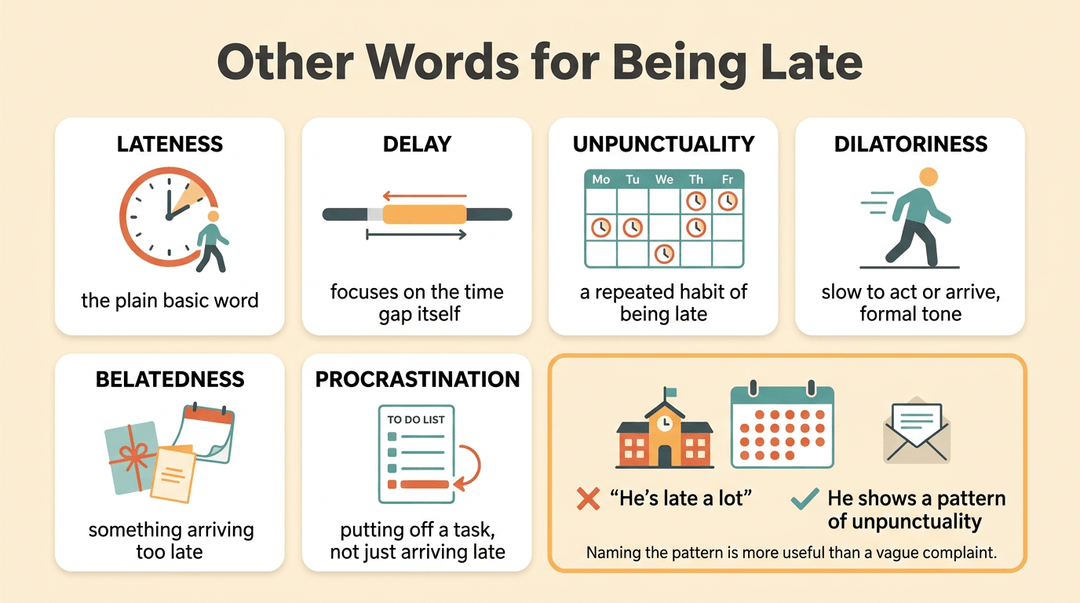
Several words cover arriving or acting after the expected time. Lateness is the plainest choice. Delay stresses the gap in time itself, while unpunctuality describes a habit of not keeping to schedules.
Dilatoriness is a more formal word for being slow to act or arrive, and belatedness describes something that comes too late. Procrastination is the closest cousin, but it means putting off a task, not just showing up late.
Consider a fourth-grade teacher who notices a student missing the morning bell most days. Writing about the pattern of unpunctuality in a parent email is more useful than a vague complaint about lateness.
Words for laziness and inactivity
These words describe a lack of effort or movement rather than a missed time. Idleness means doing nothing when you could be working. Sloth is an older, stronger word, and indolence adds a sense of settled, habitual laziness.
Sluggishness and lethargy describe low energy, with lethargy suggesting tiredness. Inertia is the tendency to stay still, which is often why a stuck student stays stuck.
Words for slow movement
These words focus on speed. Slowness is the general term. Lag describes falling behind a group or a schedule. Ponderousness suggests heavy, awkward slowness, and sluggardliness is an old-fashioned word for someone who is habitually slow to act.
A student who finishes every worksheet last is lagging, not necessarily lazy. Pick the word that fits the problem.

What does latecomer mean?
A latecomer is a person who arrives after the expected time. The word names a person, while tardiness describes the behavior, so the two are linked but not true synonyms.
You'd say 'Tardiness is disrupting our lessons' but 'The latecomer slipped into the back row.'
Vocabulary learning lists work well when you group these words by meaning, such as timing, effort, and speed. Ask students to write one classroom sentence for each word, and the list becomes a working tool rather than a memorization chore.
Different Forms of the Word Tardiness
Tardiness belongs to a small word family, and each member does a different job in a sentence. Here's how the pieces fit together, plus a quick answer to a question students often ask.
Other forms like tardy and tardily
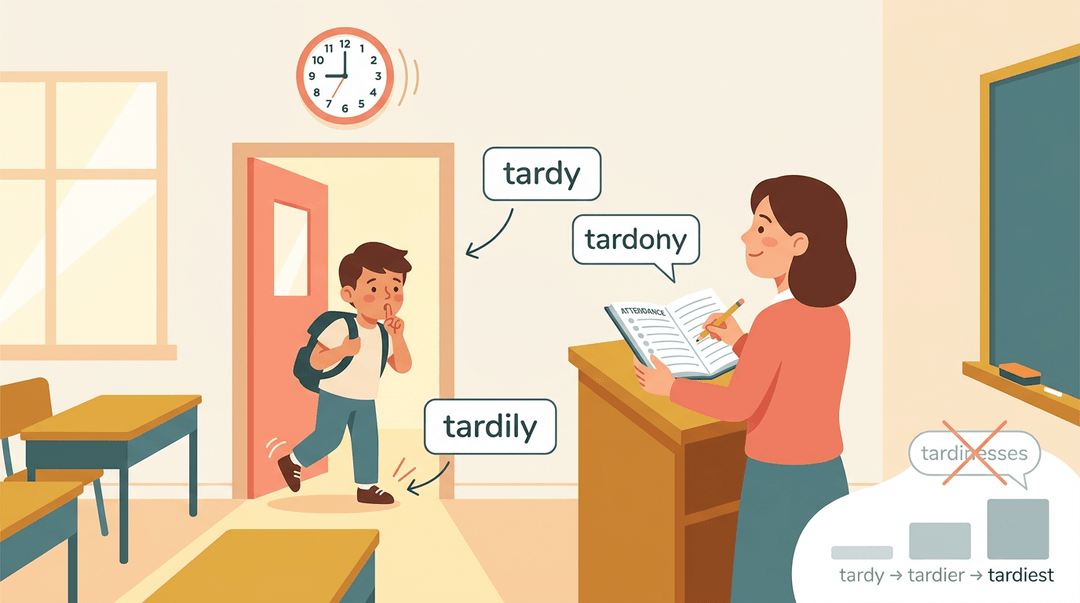
Picture a homeroom teacher marking attendance on a Monday morning. She writes that one student was tardy, an adjective describing the student himself.
When that same student slipped in quietly, she might note that he arrived tardily, an adverb describing how he came in. The adjective names the condition, and the adverb describes the action.
Tardy also has comparative and superlative forms: tardier and tardiest. They're less common in everyday classroom talk, but they follow the usual pattern. The plural, tardinesses, is rare.
Can late be an adjective?
Yes.
Late works as an adjective when it describes a noun, as in the late bus, or when it follows a linking verb, as in The students were late. The noun form is lateness, and late also works as an adverb: She arrived late. The most useful antonym to know is punctual, or simply on time.
Tardy describes the person, but late can describe nearly anything. Context decides which part of speech you're looking at.
Tardiness in Real Sentences
Sentences show how tardiness plays out in daily life. Here's where the word shows up most.
Tardiness at school
Schools usually treat tardiness as a pattern rather than a single slip. A late arrival can earn a detention, a short after-school stay.
A doctor's note can explain a late arrival, and repeated lateness can lead to repeating a class when a student misses too much instruction. Tardy policies vary by grade level, so a kindergartner and a high schooler may face very different responses.
Consider a sixth-grade teacher who notices Marcus arriving late three mornings in a row. Instead of jumping to a consequence, she checks in and learns his bus is running behind. The payoff: a quick schedule change, and Marcus is back on time.

How to address tardiness at work
Workplace tardiness can cost money and trust. When staff arrive late, an agency may face penalty fees or missed service windows. A clear tardiness policy tells everyone what happens next, and the response should fit the cause.
Lateness can also signal that a team needs to adapt to new needs, such as a changed commute.
Here are steps to address workplace tardiness:
- Define in writing what counts as late.
- Track patterns, not one-off moments.
- Talk privately with the employee about causes.
- Apply the policy consistently, and revisit it as needs change.
Tardiness in sports and fiction
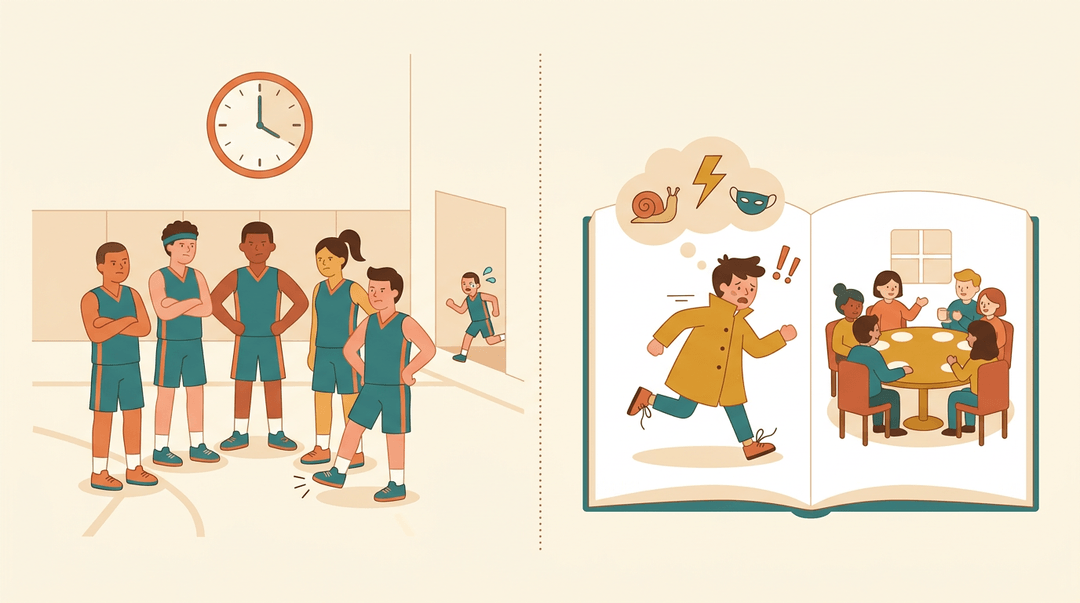
On a team, one athlete's tardiness affects everyone. A late arrival to practice means the whole group waits.
In fiction, a character's tardiness can reveal personality: a chronically late character may be carefree, anxious, or avoiding something. Tardiness is rarely just tardiness.
Tardiness in formal and historical writing
Formal records show the word in careful use. Parliamentary reports such as Hansard show it in formal debate, and Cambridge English Corpus citations give you a sense of how it's used.
Recording technology offers a practical angle too: in a studio, a late cue can waste an entire take, so tardiness has a real cost.
How to Say Tardiness in Other Languages
Tardiness has equivalents in other languages, and some of your families may find those terms easier to read than English. Here's what to know for two of them.
Tardiness in Portuguese and Chinese
In Portuguese, tardiness translates as atraso, which means being late or delayed. Think of a teacher who writes a weekly family newsletter in both English and Portuguese.
Using atraso alongside "late" helps Portuguese-speaking parents recognize the concern right away, so the message reaches everyone who needs it.
Chinese uses two writing systems: traditional characters and simplified characters. The same idea can look quite different on the page depending on which version a family reads.
Before you send a note home, ask a bilingual colleague or family member to confirm the wording. Clarity beats guesswork, and a quick check saves a confusing message.
Tardiness is more than a word on a vocabulary list. It describes the gap between when something should start and when it actually does, and that gap matters in your classroom.
With a clear picture of the meaning and a simple tracking habit, you can spot patterns early and respond with fairness instead of frustration.
Ready to make attendance easier? Check out our Attendance Tracking feature to mark attendance quickly and spot patterns across classes over time.

References
Frequently asked questions
What is considered excessive lateness?
Excessive lateness means repeated or unusually frequent late arrivals, but the exact threshold depends on the applicable policy. For example, one policy defines it as three or more instances of lateness in a calendar month.
What is considered excessive tardiness?
Excessive tardiness is a repeated pattern of arriving after the expected time. Its formal definition varies by organization, though one example is three or more late arrivals within a calendar month.
What is the meaning of latecomer?
A latecomer is a person who arrives after the expected or scheduled time. The word describes the person, while tardiness describes the behavior of arriving late.
How to address tardiness at work?
Address workplace tardiness by defining lateness in writing, tracking patterns rather than isolated incidents, and discussing the cause privately with the employee. Apply the policy consistently, while considering practical issues such as transportation or changed commuting needs.
How do I write an explanation letter for tardiness at work?
Begin with the date, recipient, and a clear subject such as “Explanation of Tardiness.” State when you arrived, briefly explain the reason, acknowledge the impact, and describe steps you will take to prevent a repeat, keeping the tone factual and respectful.
What does tardy mean?
Tardy means late or delayed, especially in arriving at a scheduled time. It is an adjective, as in “The student was tardy.”
Is tardiness the same as lateness?
Yes. Tardiness and lateness both refer to failing to arrive or act on time, although tardiness is somewhat more formal. Tardiness can also refer to slowness or delay in progress.
Can late be an adjective?
Yes. Late is an adjective when it describes a noun or follows a linking verb, as in “the late bus” or “The students were late.” It can also be an adverb, as in “She arrived late.”