How Do You Plan a Lesson for Teaching Synonyms Effectively?

Jump to section
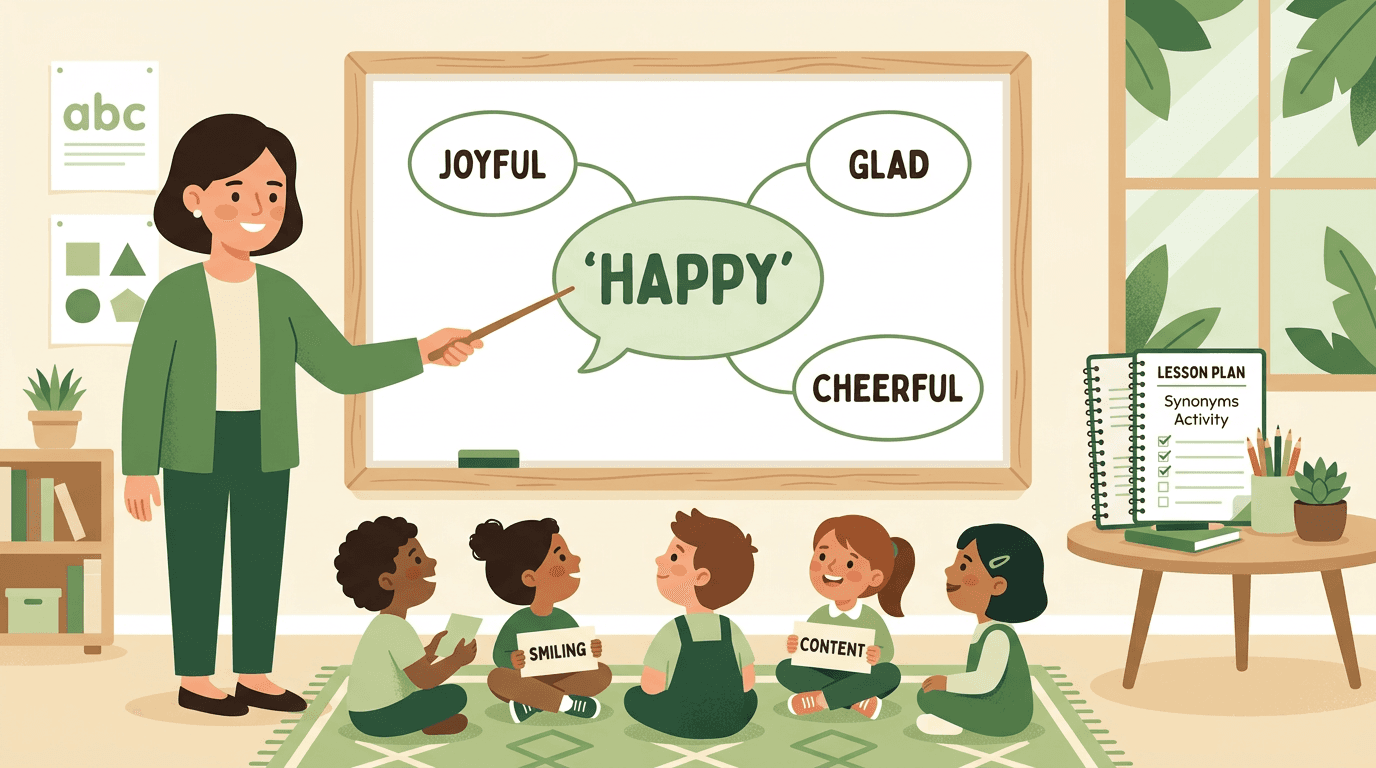
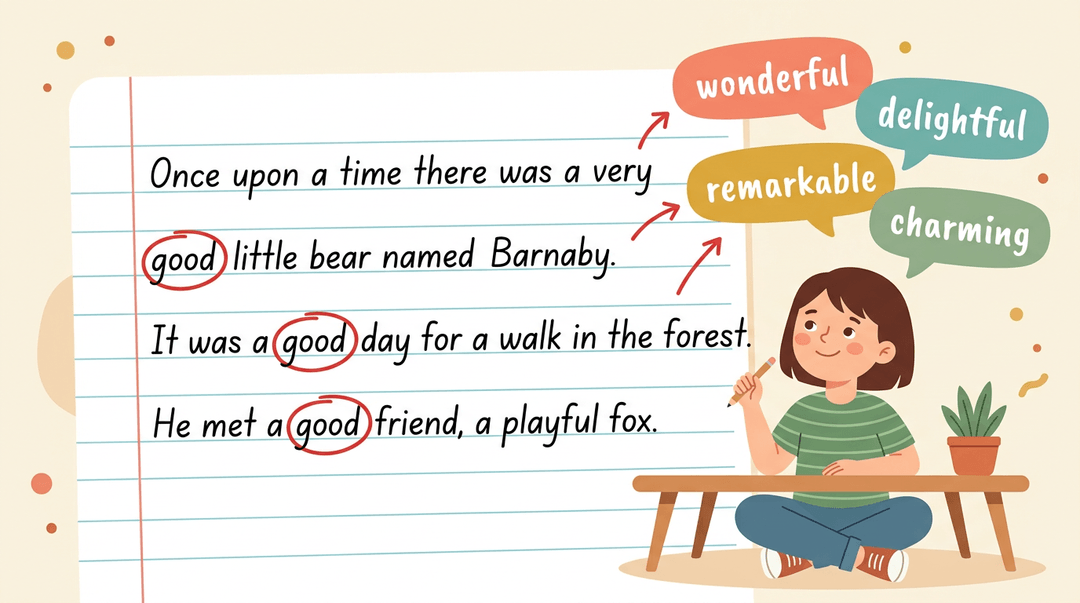
Picture a student who calls a story 'good' three times on one page. The idea is right, but the word is doing very little work. That's where synonyms come in.
Synonyms are words with similar meanings, and teaching them helps students choose the word that fits the moment.
Here, we'll cover what the term really means, share synonym and antonym lists you can use right away, explain why it matters, and walk through a lesson framework and classroom activities that make it stick.
What Teaching Synonyms Really Mean
Before you can teach synonyms, it helps to see how the word teaching stretches across everyday English. Some meanings live in your classroom, and others reach much further.
Teaching as the act of instructing
At its core, teaching means educating or instructing: imparting knowledge or skill to someone else. When a first-year teacher walks sixth graders through a new vocabulary word, that's teaching in its most basic form.
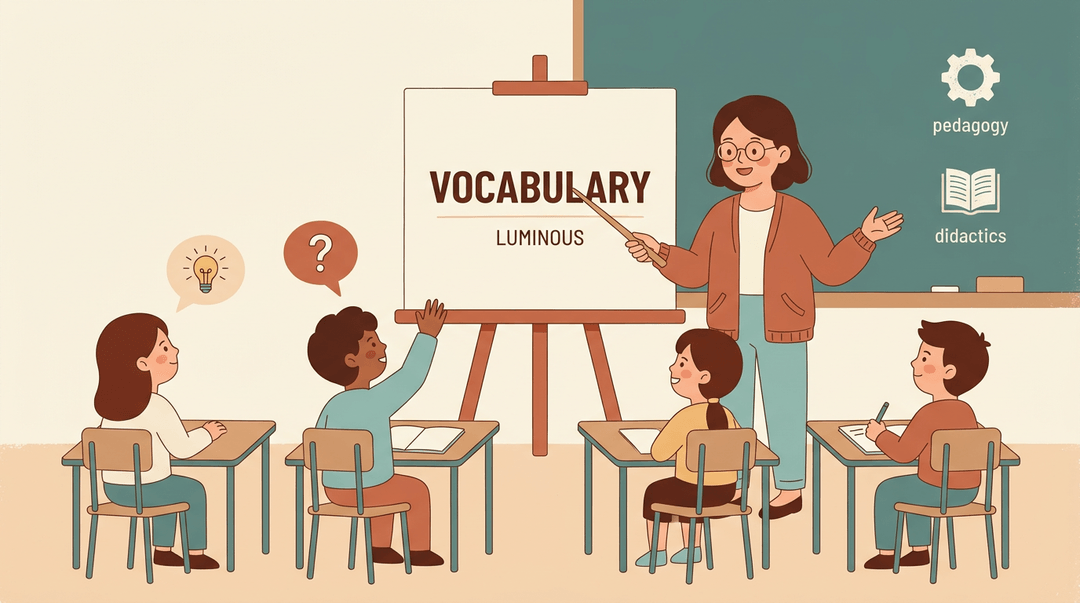
Educators also use two formal terms: pedagogy (the method and practice of teaching) and didactics (the study of instruction itself).
When teaching means a career
Teaching can also name the profession itself, the career in education that a teacher chooses. For many people it's a vocation, a calling that goes beyond a job title.
Picture a veteran science teacher who stays after school to help one student finally make sense of lab data. That's the vocation showing up in daily work.
When teachings mean doctrine
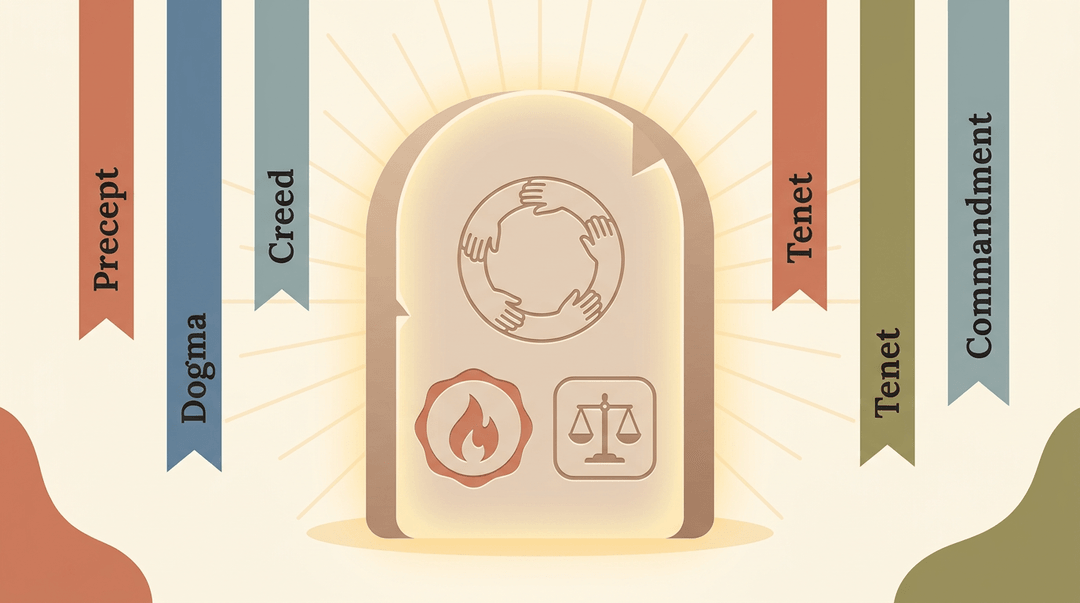
The plural teachings often points to doctrine: the principles a religious or philosophical tradition passes on. Here, the key words are:
- Precept: a religious or philosophical rule
- Dogma, creed, tenet: firmly held beliefs at the core of a tradition
- Commandment: a direct instruction, such as the Golden Rule, a familiar moral teaching
Other meanings of teachings
The plural form also covers several everyday senses:
- Guidance or advice a mentor offers
- A body of knowledge or experience passed down
- A sermon or talk
- An exercise or practice
- An explanation that clarifies
- Strict rules or discipline
Same word, many jobs. The meaning depends less on the spelling and more on context. Listen for the clues around it, and you'll know which sense you're dealing with.
Synonym Lists for Teaching and Teachings
Teaching has more synonyms than most people expect, and they don't carry equal weight. Here's how to sort them.
Synonyms for the teaching process
Instruction and pedagogy are the closest matches: instruction is the everyday word, while pedagogy is the formal study of teaching. Schooling and tutelage suggest guided learning. Training and coaching build skills, with coaching feeling more personal.
Indoctrination and inculcation mean pressing beliefs into someone, a negative connotation to avoid in a lesson plan.
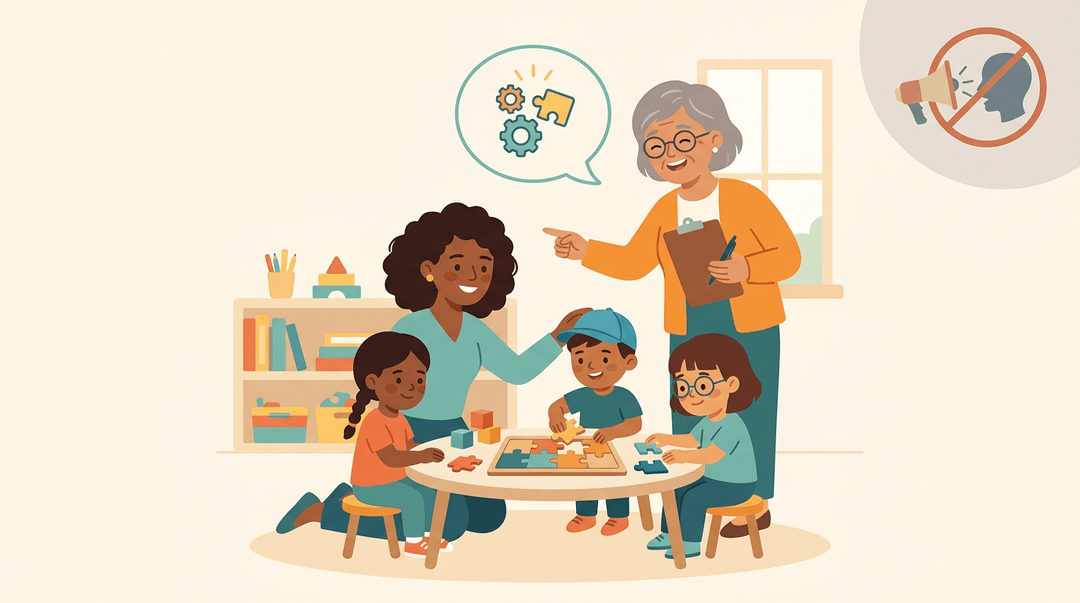
Think of a new teacher who asks a veteran to watch her small-group lesson. She's getting coaching, not indoctrination: the feedback helps her grow without telling her what to believe. The contrast is teaching skills rather than beliefs.
Synonyms for doctrine and belief
Dogma, creed, and credo all describe fixed beliefs, but dogma sounds rigid because it can't be questioned. Ideology and philosophy describe broader systems of thought, with philosophy the more neutral choice.
A tenet or precept is a single guiding principle, like "every student can grow." Gospel and orthodoxy name accepted truth.
Different kinds of teaching
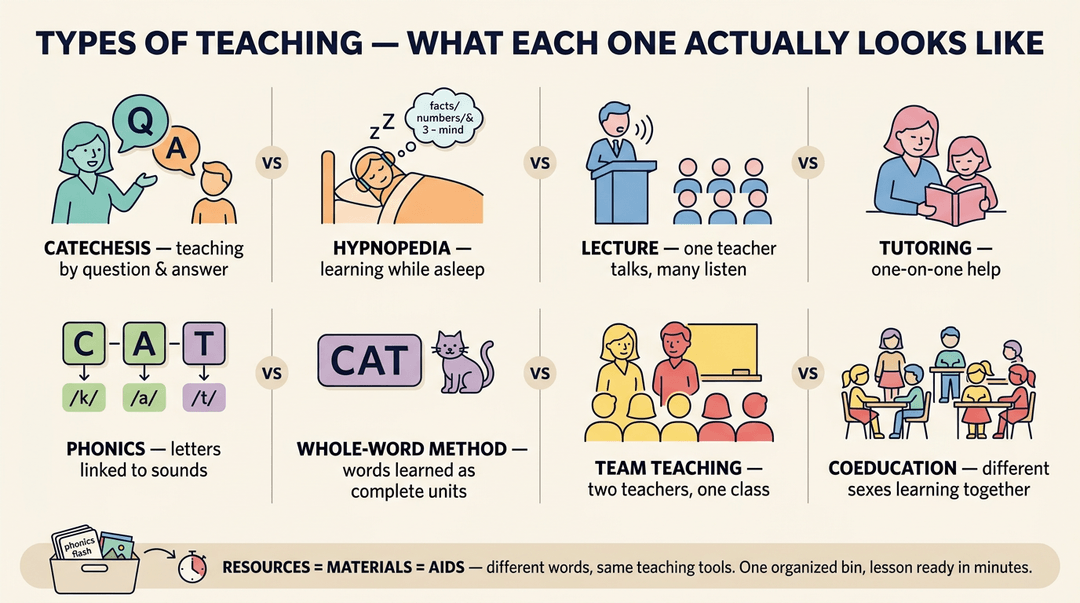
- Catechesis is religious instruction through questions and answers. Hypnopedia is learning during sleep.
- Lecture is direct, talk-led instruction, while tutoring is one-on-one help.
- Phonics links letters to sounds, while the whole-word method teaches words as complete units.
- Team teaching has two teachers sharing one class. Coeducation means students of different sexes learn together.
Teaching tools also go by resources, materials, and aids. A fourth-grade teacher who keeps phonics cards and picture books in one bin can pull the lesson together in minutes.
What is a fancier word for teacher?
Try educator, pedagogue, instructor, or mentor, depending on the setting.
In the word family, teach is the verb, teacher is the person, teachable describes someone open to learning, teacherly describes a teacher's manner, and teachability is the quality of being teachable.
For "taught me," try showed me, trained me, or guided me. "Guided me" feels warmer, while "instructed me" feels more formal.
The opposite of teach is learn: teaching is what you do, and learning is what they do. Unteach means undoing what was learned, though it's less common.
Why Teach Synonyms to Students
Teaching synonyms (words with similar meanings, like big and large) gives students more ways to say what they mean. That payoff shows up in reading, writing, and speaking.
How synonyms boost vocabulary and writing
Ever read a paragraph where the same word shows up five times? Synonyms fix that. When students know happy, delighted, and thrilled, their writing gains variety without losing clarity.
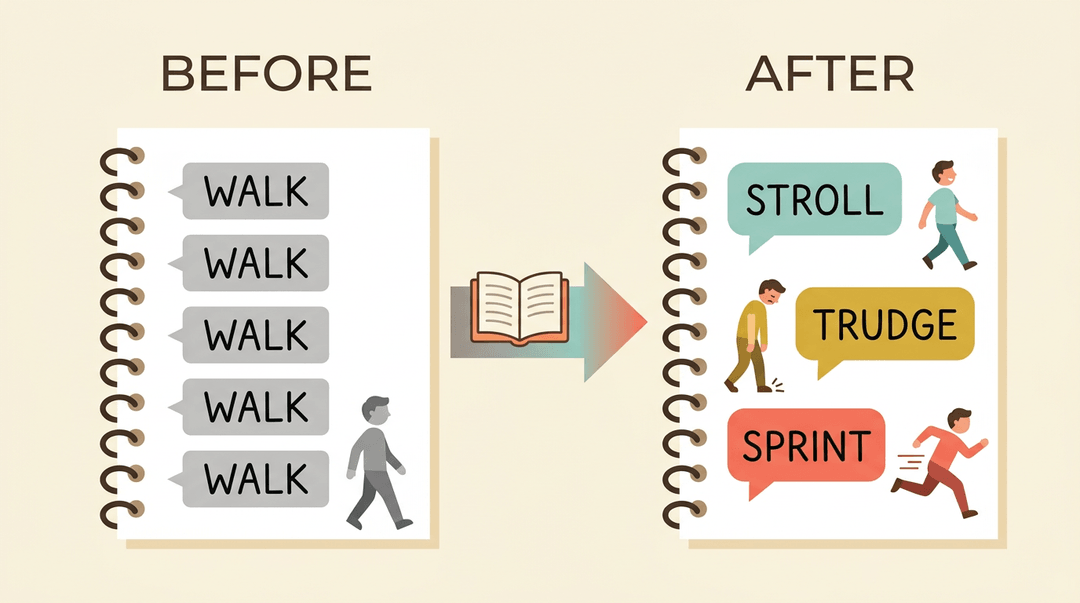
Synonyms also build vocabulary. A student who knows stroll, trudge, and sprint describes a scene far more precisely than one who only knows walk.
Students also practice spelling and pronunciation with each new word. Swapping words even shows grammar at work.
Tie every vocabulary goal to a lesson objective. A fifth-grade teacher whose objective is students will revise a paragraph for word choice can hand out a synonym bank, then compare before-and-after drafts. Less repetition, more precision.
Synonyms build communication confidence
Confidence grows when students have options. A student who can say frustrated instead of mad sounds more sure of themselves in class discussions.
Choosing the right word for the audience is an effective communication skill. A student might say tired to a friend and exhausted in a science report, and both work.
Students already use synonyms without realizing it. A child who says big at recess and enormous at dinner is switching words to suit the moment. Your job is to name that skill.
How to Plan a Synonym Lesson
This guide helps you build one synonym lesson from objective to exit ticket, then adjust it by grade. Reach for it when you're planning a vocabulary lesson, or when students keep writing "good" and "nice" in every sentence.
Set the objective
Fill in three slots before you plan anything else.
| Slot | Example entry |
|---|---|
| Vocabulary target | Precise synonyms for good, said, big |
| Bloom's level | Apply (use words in new sentences) |
| Measurable outcome | Replace 3 of 5 overused words and explain each choice |
Then put it on the board in student language:
Objective: I can swap an overused word for a more precise synonym and explain how the meaning changes.
Run the lesson
- Open with a synonym-pair bell ringer
- Post big/enormous and happy/thrilled.
- Say: "Which word feels stronger, and why?"
- Model guided thesaurus practice
- Look up said together and test two options in one sentence.
- Say: "Does this word fit our sentence? What does it add?"
- Assign the independent writing task
- Students revise five sentences from their own drafts, one word each.
- They write a short reason beside every swap.
- Finish with an exit ticket
- Try: "Replace good in this sentence and tell me why your word fits."
⚠️ Watch out: Students often grab the first thesaurus entry. Require a reason for each swap, or they'll trade one weak word for a wrong one.
Differentiate by grade
| Grade band | Focus | Try |
|---|---|---|
| K-2 | Picture matching | Match picture cards to big and huge |
| 3-5 | Thesaurus skills | Test each option in the sentence before choosing |
| 6-12 | Connotation analysis | Sort slim, thin, skinny, scrawny from positive to negative |
Check understanding fast
Scan exit tickets and drafts for three things:
- Correct synonym usage: the new word means what the student thinks it means.
- Context appropriateness: the word fits the sentence, tone, and audience.
- Variety in writing: the same word doesn't repeat across a paragraph.
Here's what a pass and a miss look like when connotation is the issue:
- ✅ "He's a slim athlete."
- ❌ "He's a scrawny athlete."
The difference: scrawny carries a negative feeling, so it doesn't fit a sentence meant as praise.
Example: A fourth-grade teacher projects "The dog was big" and asks for three replacements. Students test huge, gigantic, and tall in the sentence. They decide tall doesn't fit and say why. That reasoning is your evidence of understanding.
At a glance:
| Phase | Key move | What you get |
|---|---|---|
| Objective | Name target, Bloom's level, outcome | A measurable goal |
| Flow | Bell ringer to exit ticket | Practice with a reason |
| Differentiate | Match task to grade band | Right-sized challenge |
| Check | Usage, context, variety | Quick, clear data |
Build and reuse this synonym lesson plan in EMStudio's lesson planner.
Fun Methods for Teaching Synonyms
Synonyms stick best when students meet them in stories, games, and their own writing. Here's a set of approaches you can mix and match based on your grade level and your time.
Teach synonyms through reading
Books are the best teacher here. When students read widely, they run into words like big, huge, and enormous in context and start to sense the differences on their own.
Children's literature is especially useful because the vocabulary is rich while the sentences stay clear.
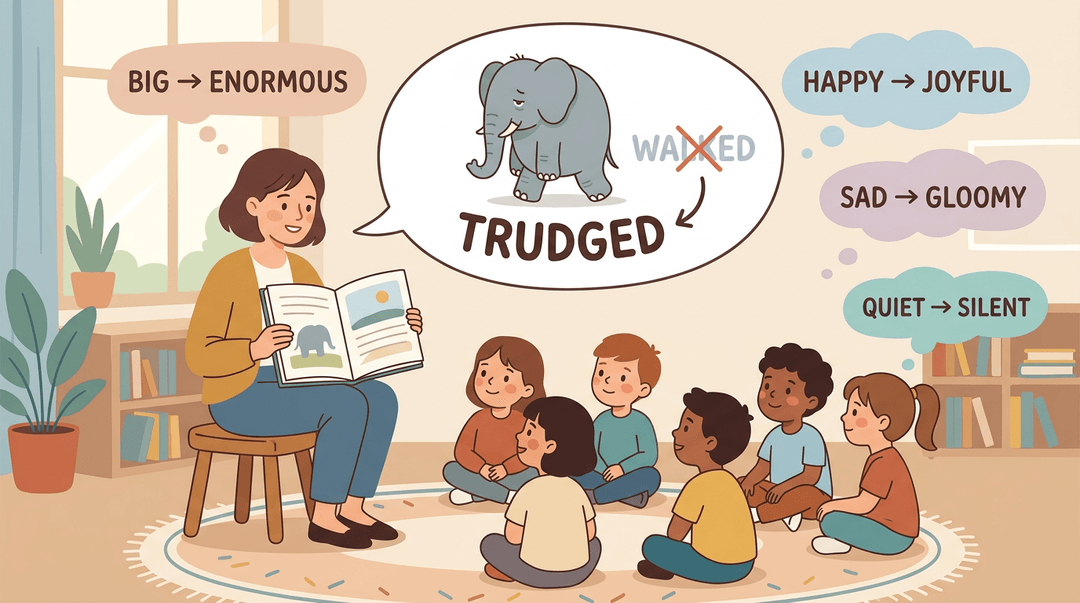
Try a read-aloud, then discuss word choice. Pause on a vivid word, ask students what the author could have written instead, and talk about why that choice works.
For example, a second-grade teacher reading a picture book might ask why the author chose trudged instead of walked. The payoff is a class that begins noticing word choice in its own reading.
Build dictionary and thesaurus skills
Students need to know how to find a synonym, not just recognize one. Model how to look up a word in a thesaurus, then have students note new words in a vocabulary diary with the word, its meaning, and one synonym.
Partner thesaurus exercises work well: one student names a word, and the partner finds two synonyms and checks them against a dictionary.
Games that make synonyms fun
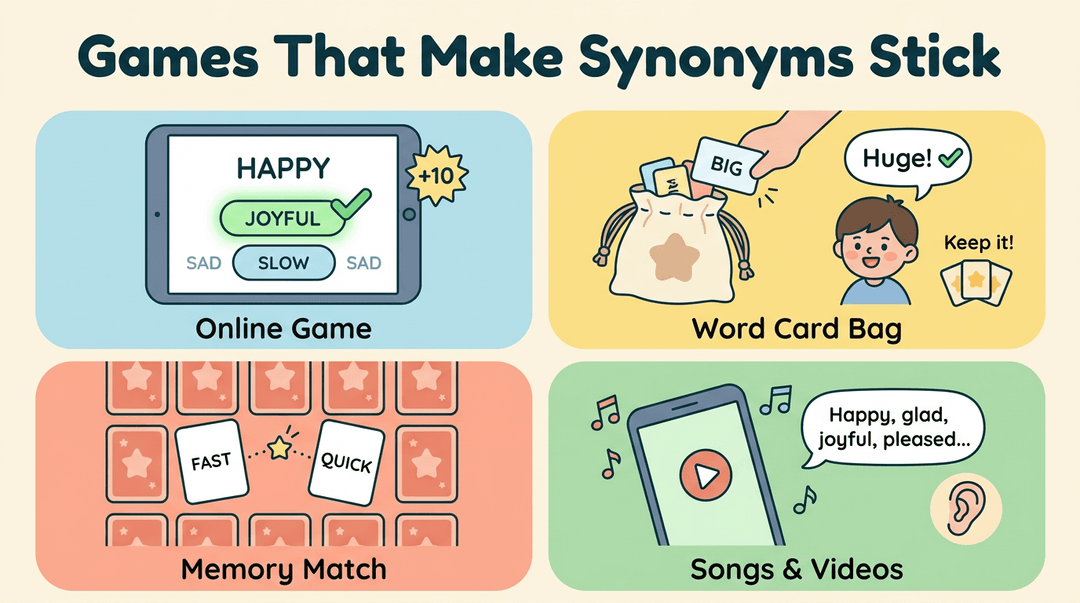
Practice sticks better when it feels like play. Online synonym games give quick feedback, while a word card bag works offline: students draw a card, say a synonym, and keep the card if they're right.
A synonym memory matching game, where pairs are matched by meaning, reinforces the same idea. Songs and videos about synonyms can help the words stick, especially for students who learn by ear.
Writing exercises that practice synonyms
Writing is where synonyms do real work. Try a paragraph replacer activity: students swap a repeated word in a paragraph for a synonym, then rewrite the text with several replacements. Next, discuss the effect on meaning.
Does shouted feel different from said? Students quickly learn that a synonym is close in meaning but rarely identical in feel.
To check understanding, use an exit ticket. Ask students to write one sentence using a target synonym. In two minutes, you'll know who got it.
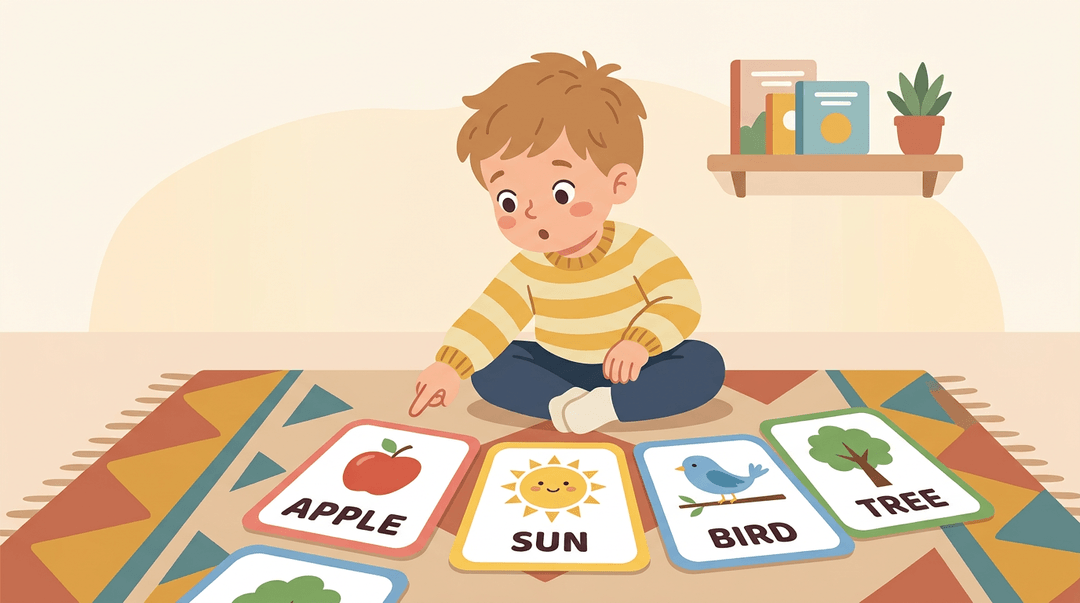
Picture cards for young learners
Younger students need a visual anchor before they can handle words on a page. Picture or flash cards that pair words with images help, and color and image association can strengthen the link between similar words.
This builds a foundation before formal reading begins.
Helpful programs and resources
Several programs can supplement your lessons. Reading Eggs is a reading curriculum you can pair with class instruction, and age-tiered reading programs let you match materials to each learner's level.
External resources such as YouTube and BrainPOP can add video support, so preview any clips before sharing them with your class.
Where Teaching Fits in Education
Teaching happens at every stage of life, and the setting shapes how you plan. Here's what you'll likely run into.
Different levels of education
Elementary and secondary education cover kindergarten through twelfth grade, where students build foundations and then tackle more specialized subjects.
Higher education brings teaching into colleges and universities, often through large lectures paired with smaller discussion sections.
Adult and continuing education serves people returning to school or building new skills. Extension courses offer focused classes, often tied to a local community or university.
Work-study programs blend classroom learning with paid work, so a student might study accounting in the morning and apply it on the job that afternoon.
Consider a community college instructor whose evening students are working parents. She keeps each session tight and practical.

Common instructional methods
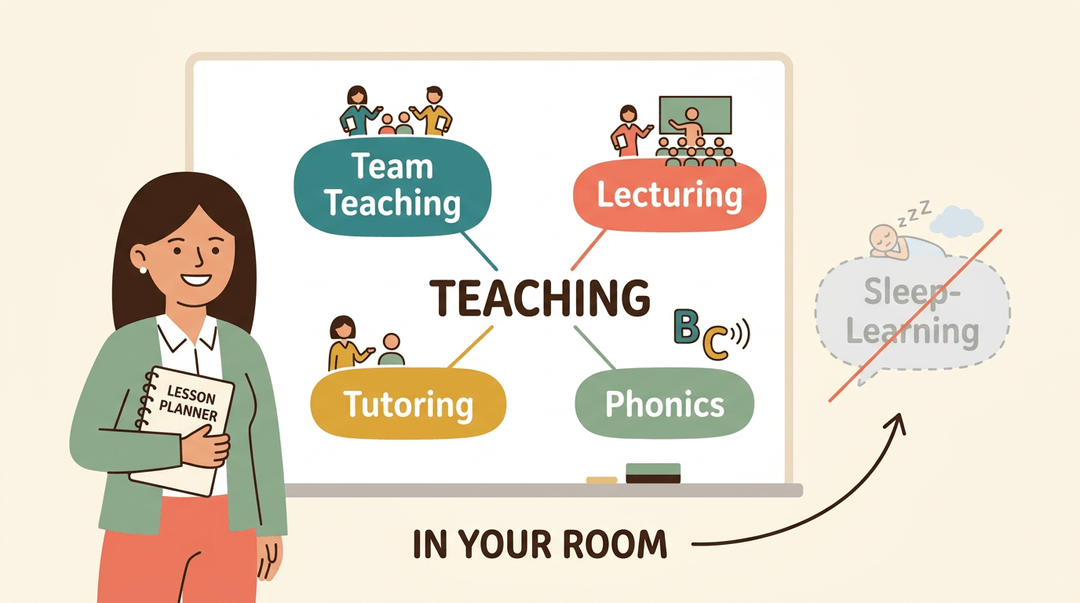
- Team teaching pairs two or more educators in one room, so one can lead while another circulates to support students.
- Lecturing delivers information directly to a group, which suits big ideas but leaves less room for questions.
- Tutoring, also called tutelage, offers one-on-one or small-group guidance tailored to a single learner's needs.
- Phonics teaches the link between letters and sounds. It's foundational for early readers.
You'll also hear about sleep-learning, the idea of absorbing material while asleep. Focus on what you can plan and check in your room, not what only sounds promising online.
Teaching synonyms is really about giving students choices. When they understand that similar words carry different shades of meaning, their writing gets sharper and their reading gets richer.
Start with a clear definition, use the lists and connotation ideas here, and pair them with a simple lesson framework so the concept sticks. Your students will notice the difference in every paragraph they write. Ready to plan it out?
Try our Lesson Planner, where you can write, organize, and reuse lesson plans across multiple classes from one place.
Frequently asked questions
What is another word for teaching tools?
Another word for teaching tools is **resources**. Other suitable synonyms include **materials** and **aids**, depending on the context.
What is a synonym for "taught me"?
Synonyms for “taught me” include **showed me**, **trained me**, and **guided me**. “Guided me” sounds warmer, while “instructed me” is more formal.
What is a fancier word for teacher?
A fancier word for teacher is **educator** or **pedagogue**. **Instructor** and **mentor** are also appropriate, depending on the setting.
What is the opposite of teach?
The usual opposite of **teach** is **learn**. **Unteach** can mean to undo or remove something previously learned, although it is less common.