Learned Behavior Examples in Animals and People

Jump to section
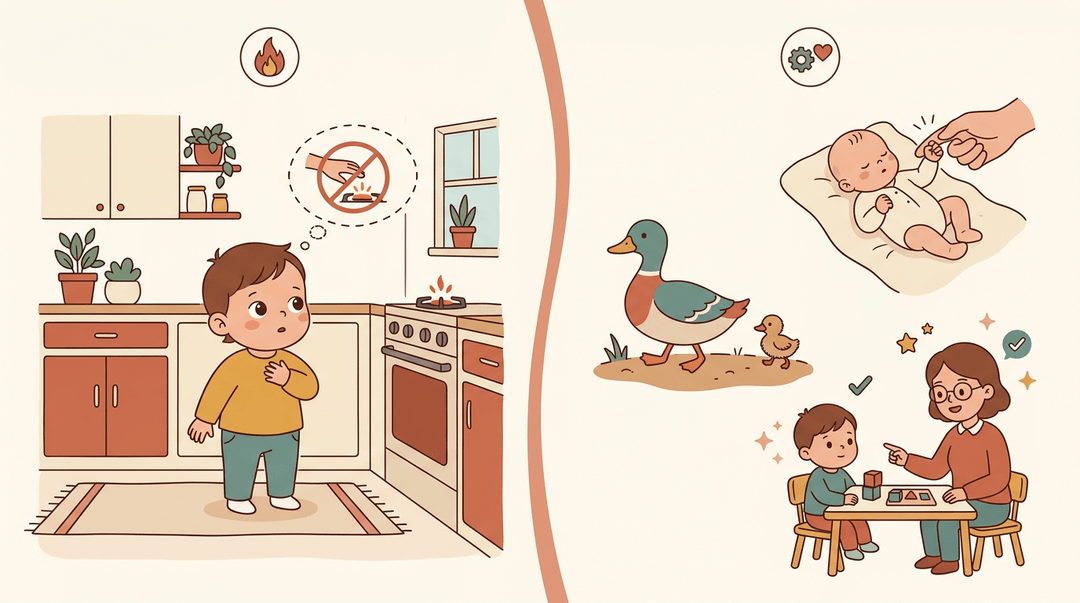
Picture a toddler who touches a hot stove once and never does it again. Nobody needed a lecture for that lesson.
The child learned it through experience, which is what learned behavior is: actions we acquire through practice, observation, and consequences, rather than ones we're born knowing.
Instinct, by contrast, is built in, like a newborn's grasp reflex. Learned behavior can be taught and reinforced, which means you can help shape it.
Here, we'll explore clear examples from animals and children, then walk through a lesson sequence with checks for understanding you can use right away.
How Learned Behavior Examples Differ from Instinct
Learned behavior is easiest to understand next to its counterpart, instinct.
What is another word for learned behavior?
Learned behavior is behavior gained from experience, also called acquired behavior or conditioned behavior.
Each describes a response (what an animal or person does) to a stimulus (something that triggers it), and practice improves performance by strengthening that link.
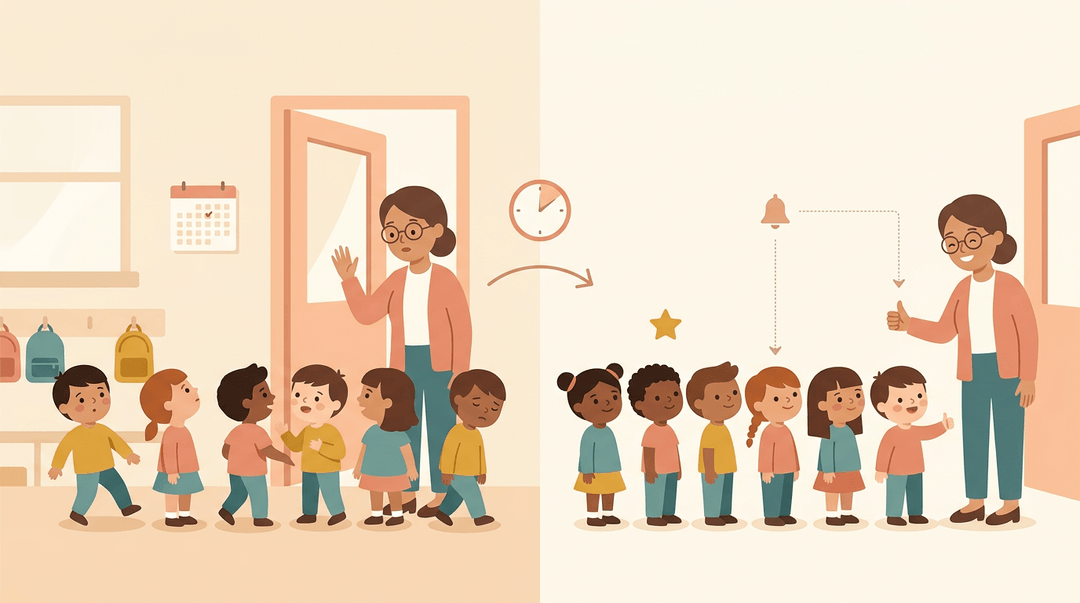
Broadly, behaviors fall into two types: inherited instincts and learned behaviors. Think of a first-grade teacher whose class lines up slowly. After a week of modeling and praise, the line forms in seconds, saving minutes every day. A routine with several steps, like this one, can be taught through forward chaining and backward chaining examples.
Instincts versus learned behavior side by side
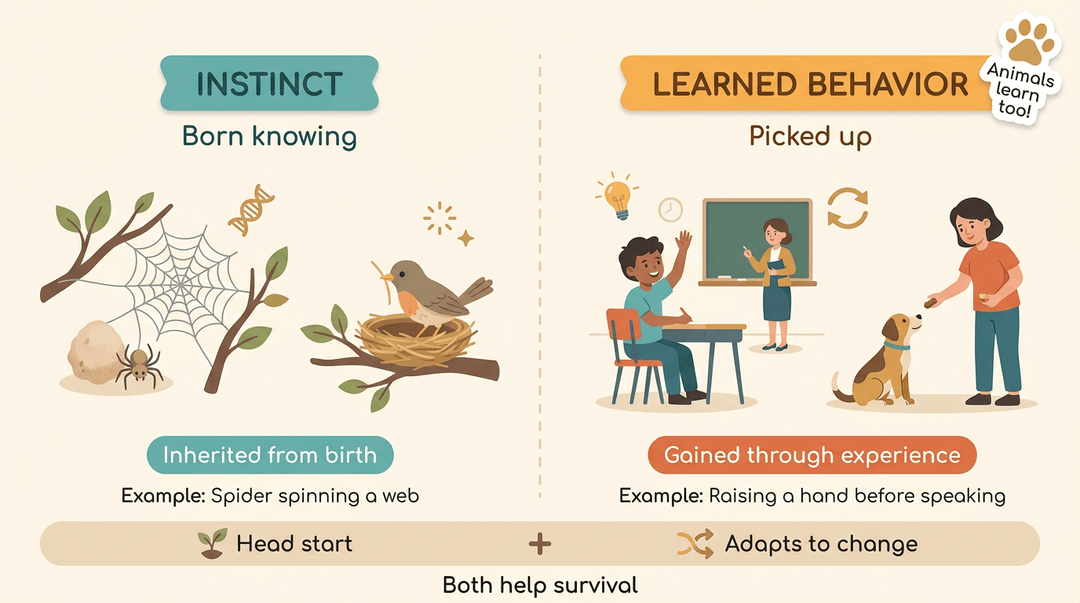
Instincts are inherited, while learned behavior is experiential. Here's the contrast:
| Instinct | Learned behavior | |
|---|---|---|
| How it arrives | Inherited, present from birth | Gained through experience |
| Example | A spider spinning its web | A student raising a hand before speaking |
Instinct is what a creature is born knowing; learned behavior is what it picks up. Spider webs and nest building are classic instincts, since many birds build nests without being taught.
A common misconception is that only people learn, but that's not true: animals learn too. Both help survival. Instinct gives an animal a head start, and learning lets it adapt when conditions change.
Where learned behavior shows up in life
Learned behavior is everywhere, from the wild to your classroom. A dog that learns to sit on cue is showing learned behavior. In a sentence: 'Raising her hand before speaking was learned behavior, not something she was born doing.'
Study habits, manners, and how students tackle hard problems are all learned, so you can teach them. Repetition builds it.
Simple Lesson Steps for Teaching Learned Behavior
This is a five-step lesson you can run in one period. Students sort instinct from learned behavior and explain their thinking.
Before you teach
Confirm these four things are ready:
- Clear objective stated: it's on the board in student language.
- Visual examples included: every card has a picture, not just words.
- Misconception check built in: you've picked at least one tricky card.
- Differentiation options ready: support and extension are prepped (see below).
Objective on the board: I can sort behaviors into instinct or learned and explain how I know.
The five-step sequence
- State the objective: sort instinct vs. learned
- Say: "Today we decide: were you born doing it, or did you learn it?"
- Open with an everyday behavior bell ringer
- Prompt: "Name something you do every day. Could you do it as a baby?"
- Run the card sort together
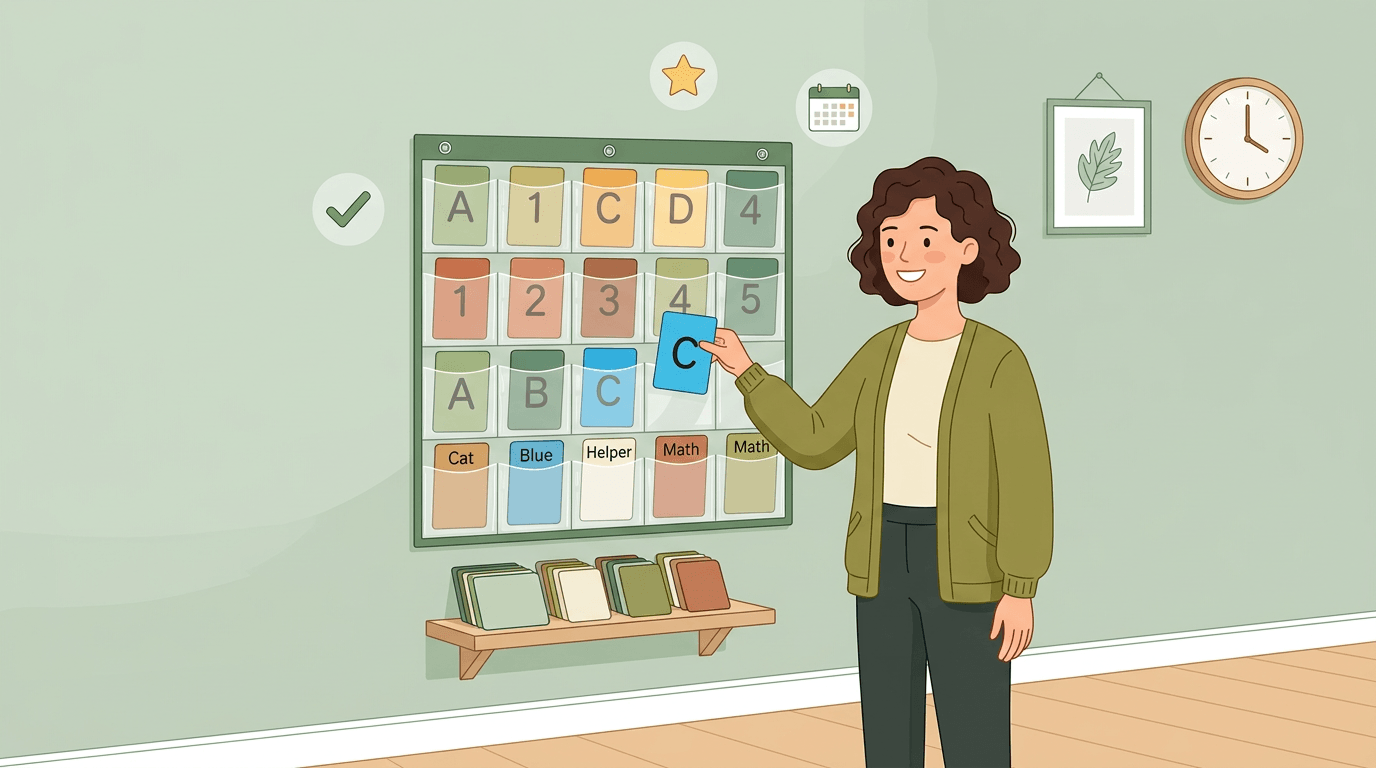
- Students sort picture cards into two columns: instinct and learned.
- Ask: "Did someone have to teach it, or did practice change it?"
- Assign an independent example journal
- Students list three behaviors they notice, label each, and write one reason.
- Close with an exit ticket
- Write one instinct, one learned behavior, and how you know which is which.
Example: A first-grade teacher holds up a picture of a child on a bike and asks, "Did you know how to ride as a baby?" Students say no, so the card goes under learned. Then the teacher holds up a baby sucking its thumb, and the class debates.
⚠️ Watch out: Many students think all animal behavior is instinct. Include a pet trained to sit, and ask what had to happen first.
Pick examples by grade band
| Grade band | Use these examples | Sample card |
|---|---|---|
| K-2 | Pets and riding bikes | A dog sitting for a treat |
| 3-5 | Animal conditioning examples | A dog running to the kitchen at the treat bag sound |
| 6-8 | Human habits and conditioning | Reaching for your phone when it buzzes |
Differentiate on the spot
| When you see... | Try... |
|---|---|
| Students stuck on a card | A sentence frame: "I think ___ because ___." |
| Students sorting too slowly | Fewer cards, with picture labels |
| Students finishing early | Write a tricky card and explain how it was learned |
Build and reuse this lesson sequence in EMStudio's online lesson planner.
Learned Behavior Examples from Animals and Children
Learned behavior is what an animal or child picks up through experience, practice, or watching others. Instinct arrives built in. Learned behavior, by contrast, is acquired.
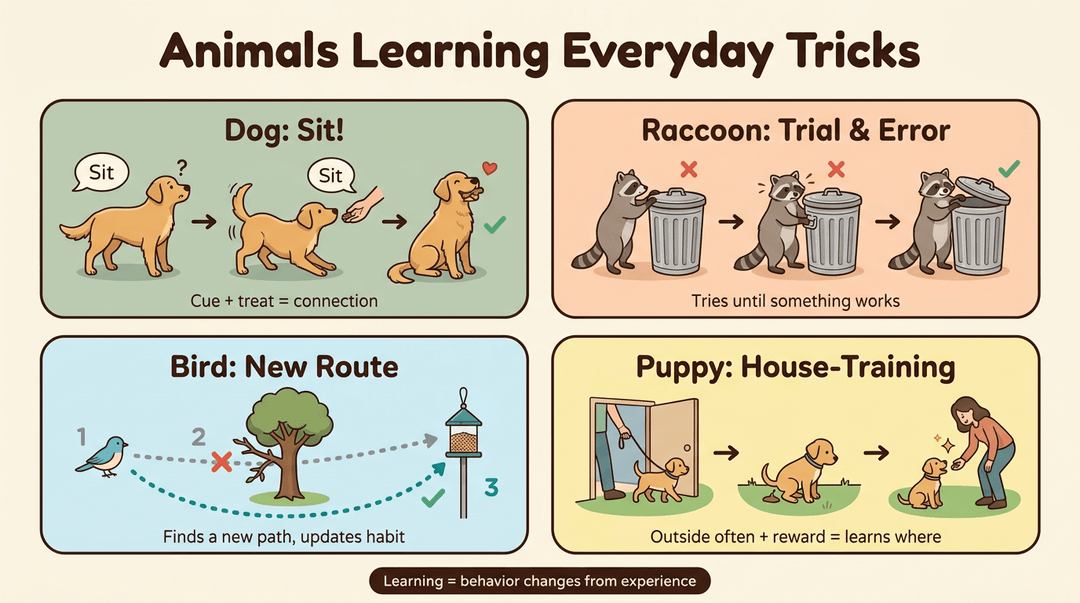
Animals learning everyday tricks and routines
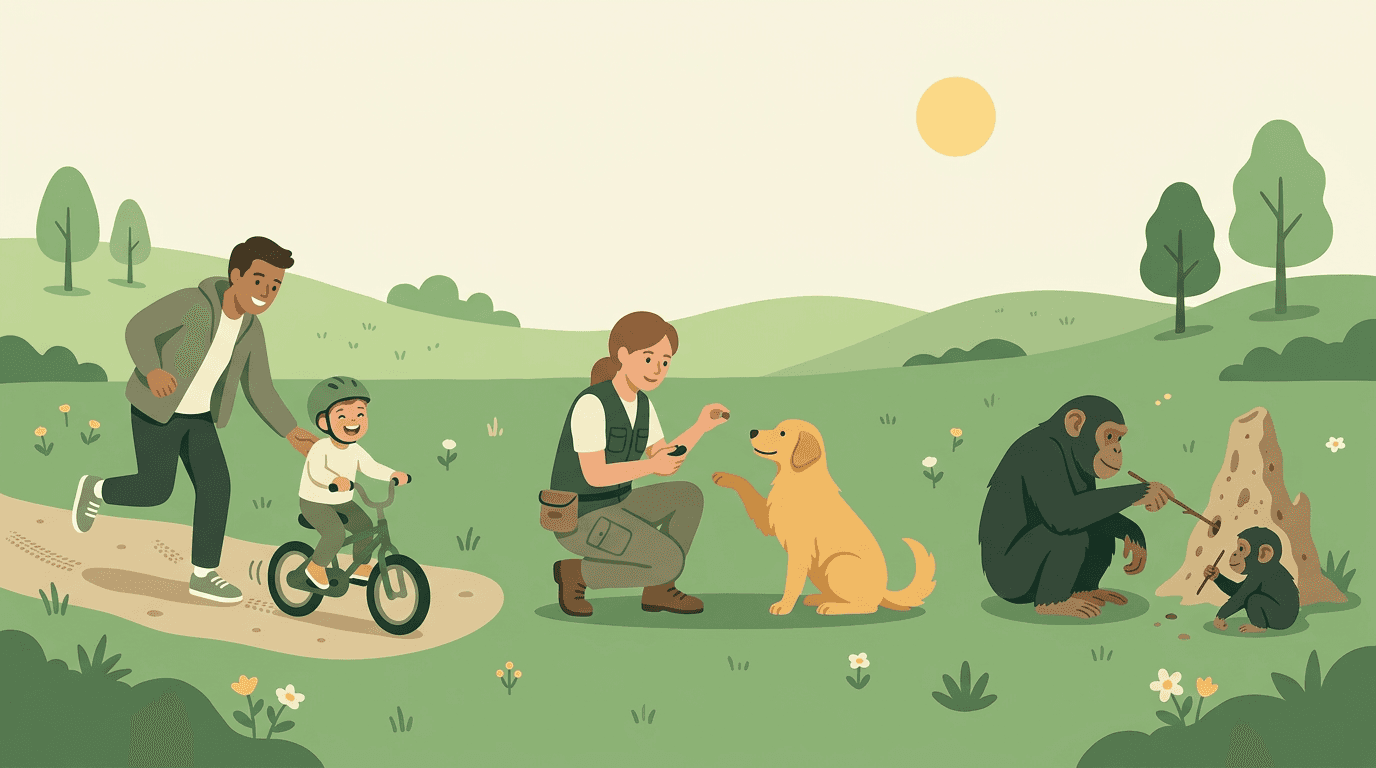
- Dog sitting on command. At first, the dog doesn't know what "sit" means. Repeated cues and treats connect the word to the action.
- Raccoon opening a trash can. Through trial and error, a raccoon finds the push, pull, or twist that opens the lid.
- Bird learning a new route. A bird that finds a new flight path to a feeder is updating its habits.
- Puppy house-training. A puppy learns where to go when it's taken outside often and rewarded for getting it right.
How do children learn behaviors?
Children learn behaviors through practice, feedback, and repetition. Watching matters too: a child who sees a classmate raise a hand before speaking can pick up that habit by watching rather than being told.
That's observational learning, a form of social learning where children copy what they see.
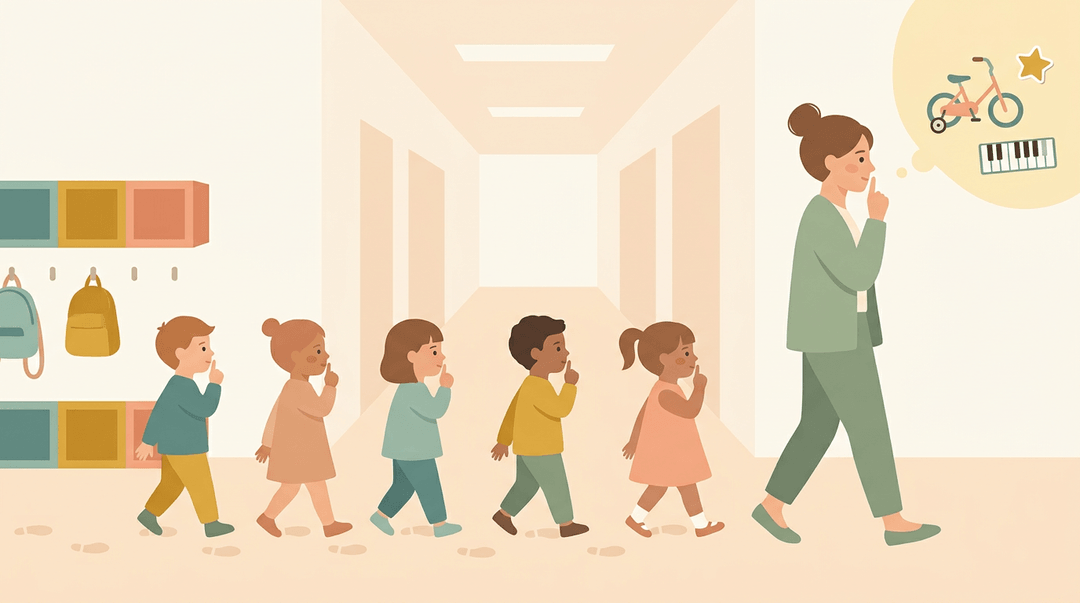
Consider a kindergarten teacher who models a quiet hallway walk. Soon the students copy the calm lines they see, and the reminders start to fade.
- Riding a bike. A child wobbles, falls, adjusts, and tries again until pedaling and steering finally work together.
- Typing and piano. Slow, repeated practice makes each keystroke or note automatic rather than deliberate.
- Avoiding hot objects. A single painful touch of a hot stove can teach a child to keep their distance.
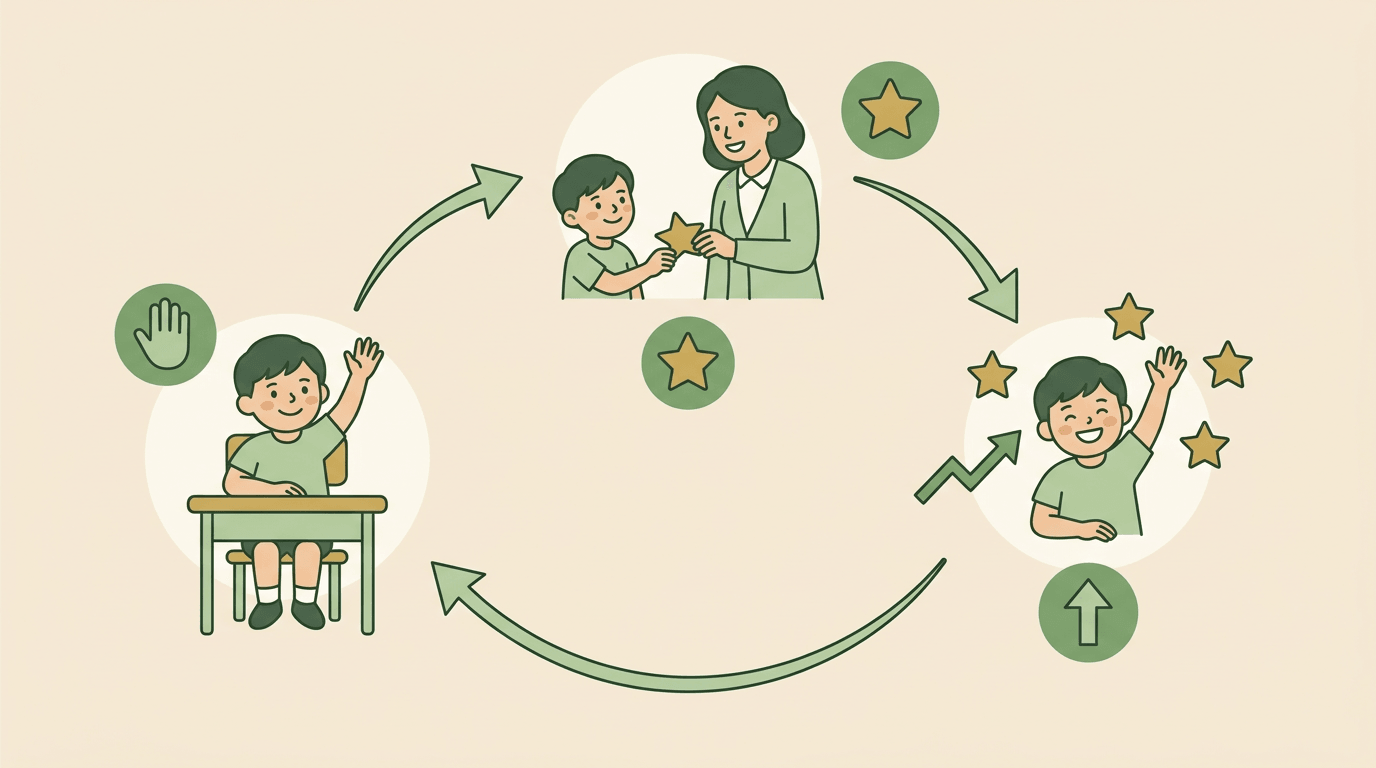
- Behaving for rewards. A sticker or a privilege for finishing homework makes that behavior more likely to repeat.
Each of these was learned, which means you can teach it.
The Simplest Ways Animals Learn
Some of the simplest animal learning needs no rewards or lessons. It's about what repeats, what hurts, and what comes first.
How animals stop reacting to harmless repeats
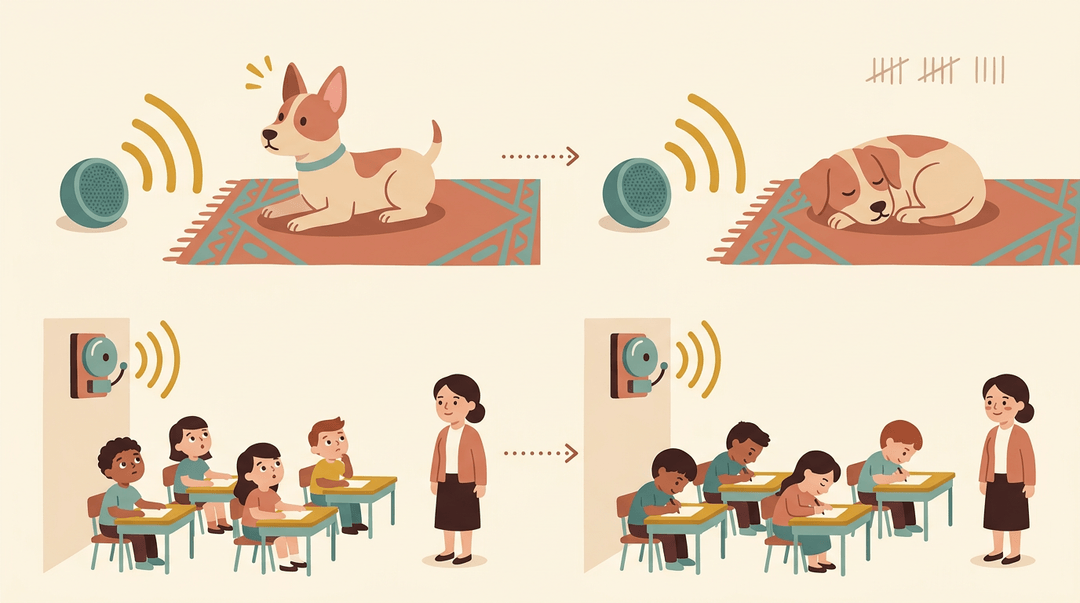
When something repeats and nothing happens, animals learn to stop responding. Scientists call this habituation. A dog that hears the same sound over and over eventually stops looking up. The sound never changed. The dog did.
Think of a teacher whose students stop glancing up at the same hallway chime by the second week. That's worth remembering in your own room: a constant signal can lose its pull.
The effect can be long-lasting. According to a revised description of habituation, the reduced response can last hours, days, or even weeks under some repeat patterns.
Reacting more strongly after a harsh experience
After punishment or another harsh experience, an animal can react more strongly to later stimuli. Scientists call this sensitization. Habituation makes a response weaker; sensitization makes it stronger.
Researchers have used the sea slug Aplysia to study sensitization and short- and long-term memory. The short-term part fades, while long-term memory can hold on. Some memories stick.
Newborns bond with whatever they see first
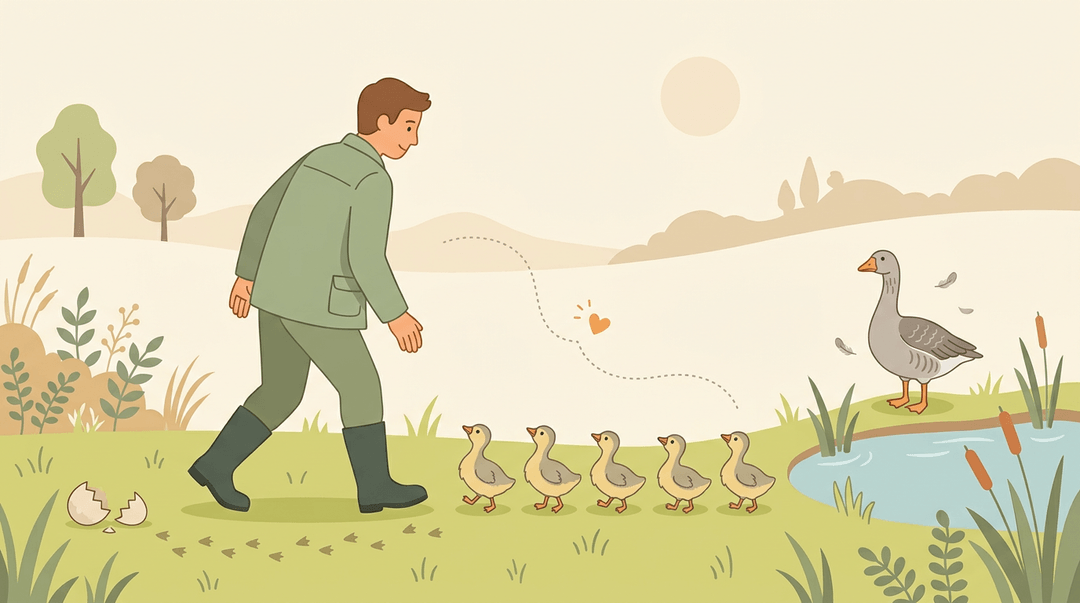
Biologists Konrad Lorenz and Niko Tinbergen observed that young greylag goslings don't recognize their own species right after birth, but follow the first moving object they see. In Lorenz's work, that object was him.
Scientists call this imprinting, and it happens during a critical window just after birth. Mice show the same pattern with smell.
According to research on mouse pups, odor-driven activity during the neonatal critical period drives imprinting on the odor of their littermates. Same idea, different sense.
How Animals Link Signals and Solve Puzzles
A learned behavior is picked up through experience, not inherited. Many behaviors are mixed, blending instinct with learning, and we can see that blend clearly in animals.
Pavlov's dogs learning to link a signal
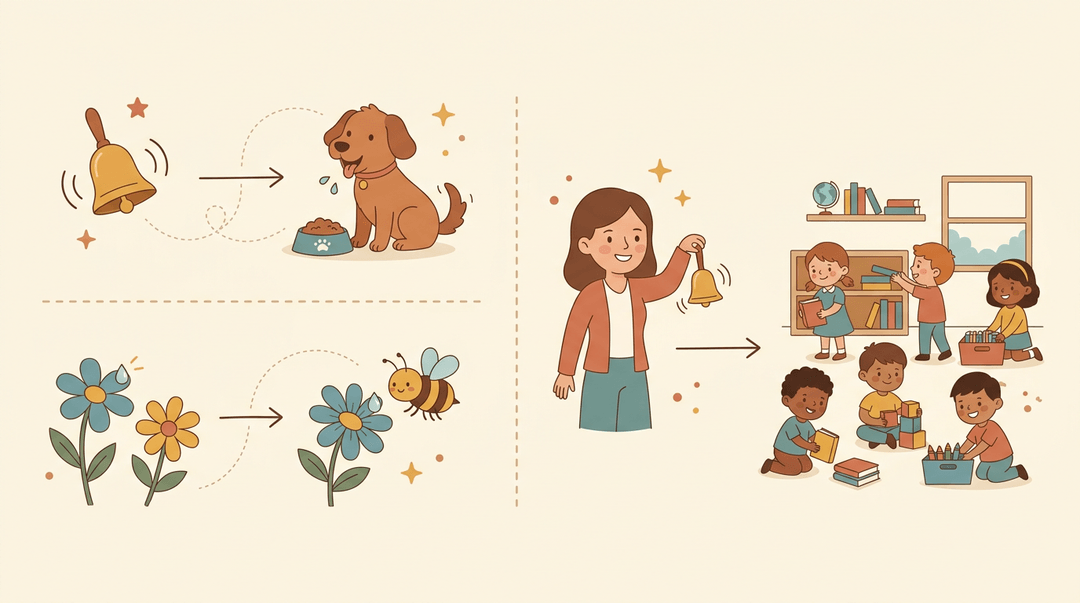
In Pavlov's dogs, food naturally triggered salivation: that's the unconditioned stimulus. Pair a neutral signal with food often enough, and the signal alone becomes a conditioned stimulus.
Bees learn this way too: a study of color discrimination in the honeybee shows they can tell colors apart through classical conditioning.
Picture a second-grade teacher who plays a chime before cleanup. Soon students tidy up at the sound alone, which means fewer reminders and more minutes for teaching.
Rewards shape behavior through trial and error
Reward shapes behavior: an action that pays off tends to happen again. Skinner's pigeons showed this clearly.
Trial-and-error learning follows the same logic. An animal tries an action, keeps what works, and drops what doesn't. A chimpanzee solving a maze tries one path after another. Each wrong turn is information, not failure.
How animals suddenly grasp abstract ideas
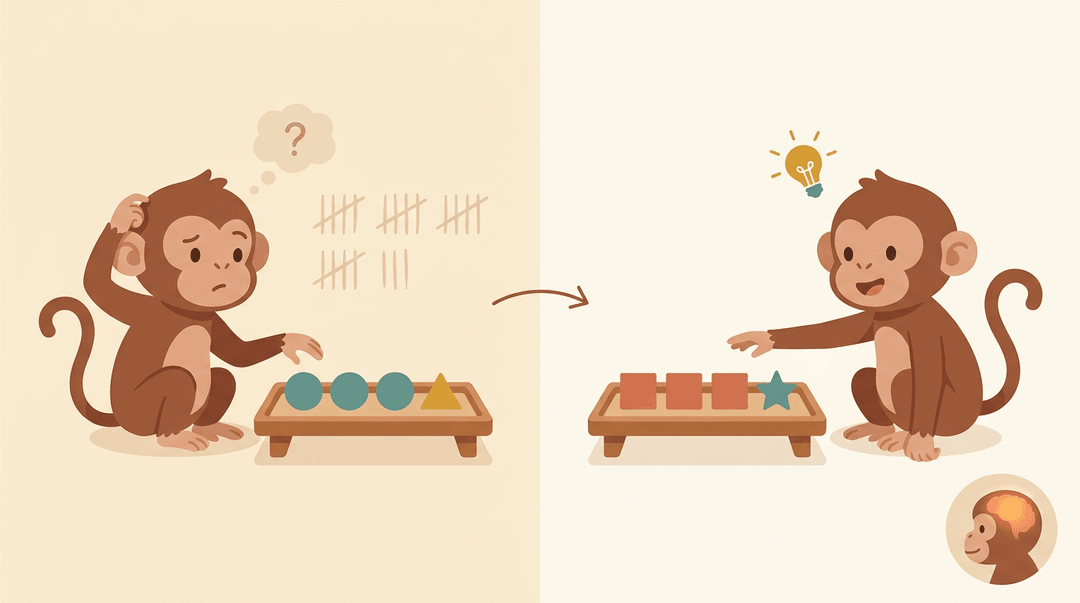
Researchers study concept formation, the ability to grasp a general idea, using oddity problems, where the animal picks the item that doesn't match.
Comparative studies in simple oddity learning found that monkeys and chimpanzees could solve them and apply the idea to new items.
Sometimes the shift looks sudden: after many trials, an animal applies the rule to new items almost at once.
A Frontiers study on abstract rule learning in monkeys reports that learning and following abstract rules relies on intact regions of the prefrontal cortex, the front part of the brain.
Classroom Activities for Teaching Learned Behavior
Knowing the definition is one thing; watching students see it is another. These activities make learned behavior visible, then give you quick ways to check what stuck.
Hands-on activities to try in class
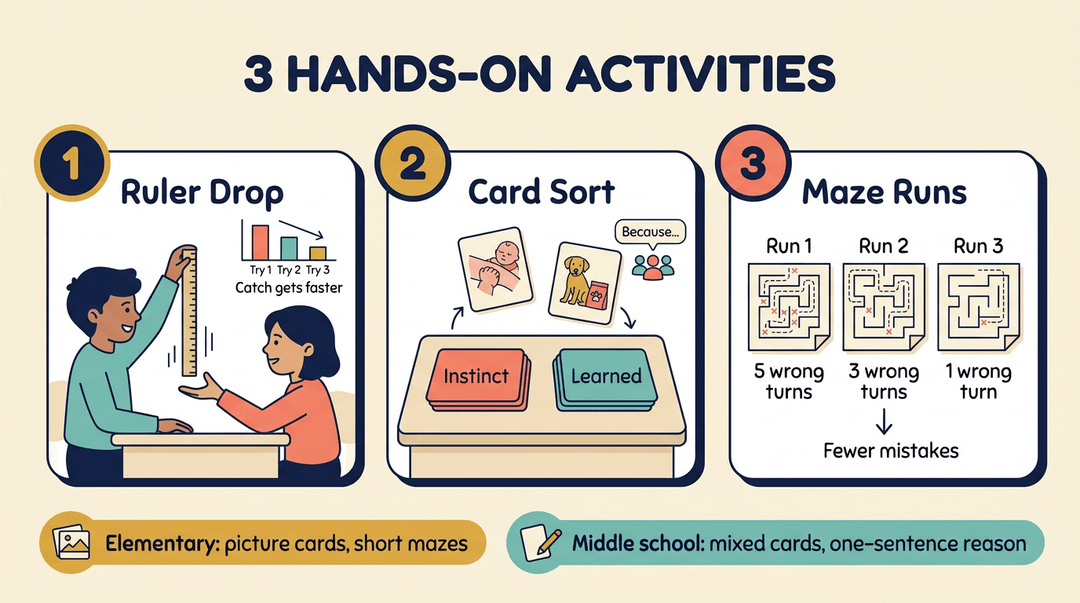
Start with a ruler drop demo. Have a partner hold a ruler above your open fingers and drop it without warning. After a few tries, most students catch it faster, a clear picture of practice shaping a response.
Next, run a behavior card sort. Small groups sort cards, like a dog sitting when it hears a treat bag or a newborn gripping a finger, into instinct and learned piles, then defend their choices.
Try maze practice trials too. Students run the same paper maze several times, counting wrong turns on each run. Fewer mistakes with every attempt make trial-and-error learning easy to see.
Adapt each activity to your grade band:
- Elementary: Use picture cards and simple words, and keep mazes short.
- Middle school: Mix categories on the cards and require a one-sentence reason for every sort.
How to check what students learned
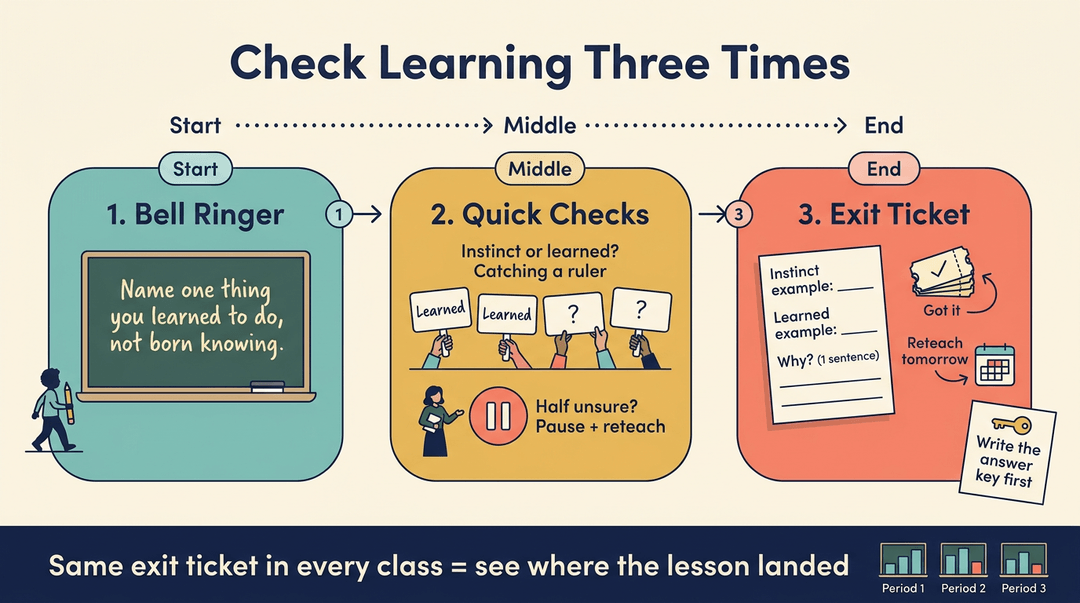
Open with a bell ringer on the board as students arrive: "Name one thing you learned to do rather than were born knowing."
During the lesson, use quick-check items: two or three questions on whiteboards. If half the room hesitates on "Is catching a ruler an instinct or a learned behavior?", pause and reteach before moving on.
Close with an exit ticket asking for one example of each type plus a one-sentence reason. Write your answer key beforehand so sorting takes minutes. The pile of wrong answers shows you exactly what to reteach tomorrow.
Use the same exit ticket in every class. Comparing results class by class shows whether a lesson landed everywhere or only in one section.
How Learned Behavior Shapes People and Relationships
Many habits you carry into adulthood were never chosen. They were learned at home, in school, and in relationships, and they shape how we connect.
Habits passed down through families
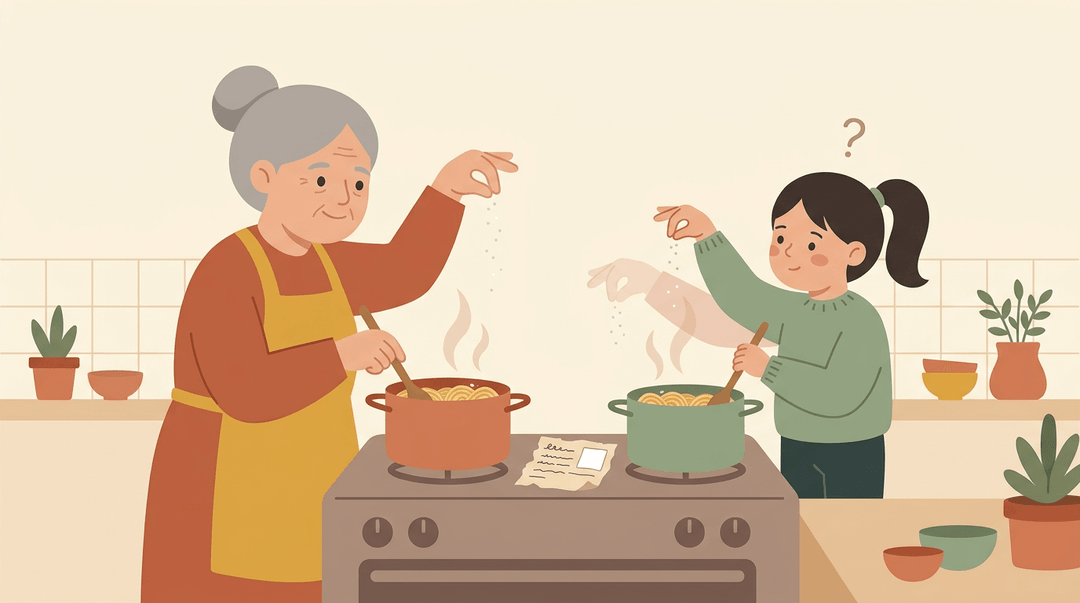
Think of a grandmother who always salts her pasta water twice, with no reason written on her recipe card. Her granddaughter now does it too, without knowing why. That's a habit with a history.
Over time, family scripts (the unwritten rules a household lives by) often lose their original purpose. Some get handed down without explanation, so the next generation simply copies what they saw.
What gets passed down is often a reflex rather than a rule. The habit outlives its reason.
Learned patterns that hold people back
Not every learned pattern helps. Self-defeating behaviors protect us briefly but cost us later, like avoiding every hard conversation until resentment boils over.
Trauma-bonded family messages tie love to fear or silence. Adults raised on them often struggle with intimacy, pulling away just as a partner gets close.
Teachers see this too: a student who shuts down at the first sign of conflict may be running a pattern learned long before your classroom.
How counselling helps people change habits
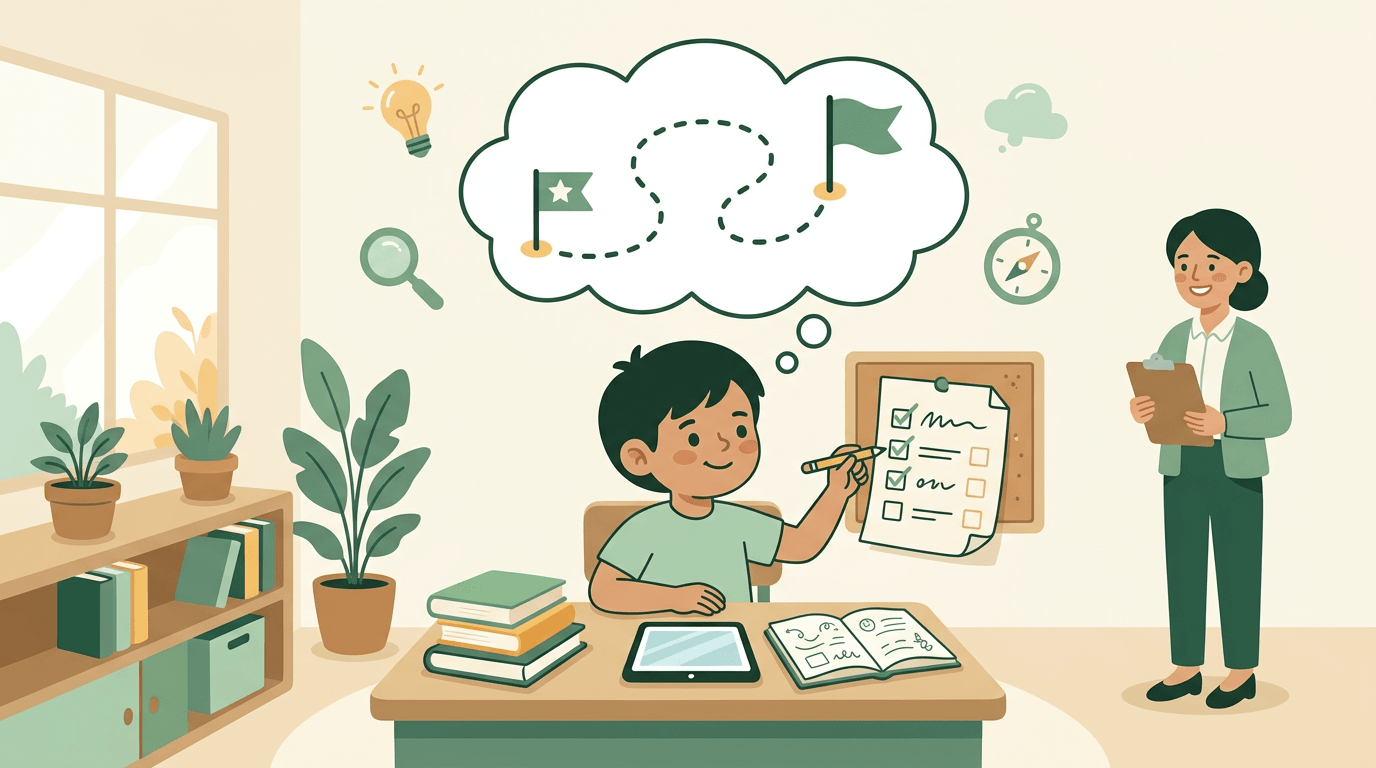
Change starts with understanding root causes. A counsellor helps you trace where a habit began, so it feels less like a flaw and more like a learned response.
Many old patterns run on anxiety. Counselling eases that distress, so the urge to avoid or lash out loses some of its grip.
Finally, counselling helps people build healthier ways of responding and practice them until they feel natural. The habit didn't come from nowhere, and what was learned can be relearned.
Learned behavior is everywhere once you start noticing it. The same pattern shows up in animals and children alike: practice, feedback, and consistency shape what we do over time.
That's encouraging for teachers, because what students learn to do, they can keep learning to do with the right support.
Ready to put this into practice? Check out Lesson Planning to write, organize, and reuse your lesson plans across multiple classes from one place.
References
- Separation of pups from their mother mice enhances odor associative learning at the late lactation stage — pmc.ncbi.nlm.nih.gov (2025)
- Frontiers | Back to basics: A re-evaluation of the relevance of imprinting in the genesis of Bowlby’s attachment theory — frontiersin.org (2022)
- Comparative studies in simple oddity learning: I. Cats, raccoons, monkeys, and chimpanzees — doi.org
- Habituation Revisited: An Updated and Revised Description of the Behavioral Characteristics of Habituation — pmc.ncbi.nlm.nih.gov (2008)
- Interaction between Amount and Pattern of Training in the Induction of Intermediate- and Long-Term Memory for Sensitization in Aplysia — pmc.ncbi.nlm.nih.gov (2002)
- Conditioning procedure and color discrimination in the honeybee Apis mellifera — pubmed.ncbi.nlm.nih.gov (2004)
- Frontiers | Contributions of Lateral and Orbital Frontal Regions to Abstract Rule Acquisition and Reversal in Monkeys — frontiersin.org (2018)
Frequently asked questions
What is another word for learned behavior?
Another word for learned behavior is **acquired behavior**. It can also be called conditioned behavior.
What are different types of behaviors?
Behavior is broadly divided into **inherited instincts** and **learned behaviors**. Learned behaviors can develop through observation, practice, consequences, conditioning, trial and error, habituation, sensitization, or imprinting.
How do children learn behaviors?
Children learn behaviors by practicing, repeating actions, receiving feedback, and watching others. Rewards can encourage a behavior to happen again, while experience can also teach children to avoid something unsafe.
What does learned behaviour mean?
Learned behaviour is an action or response gained through experience rather than present from birth. It can be acquired through practice, observation, and the consequences of actions.