Formative Formal Assessment: What It Means and How to Use It

Jump to section
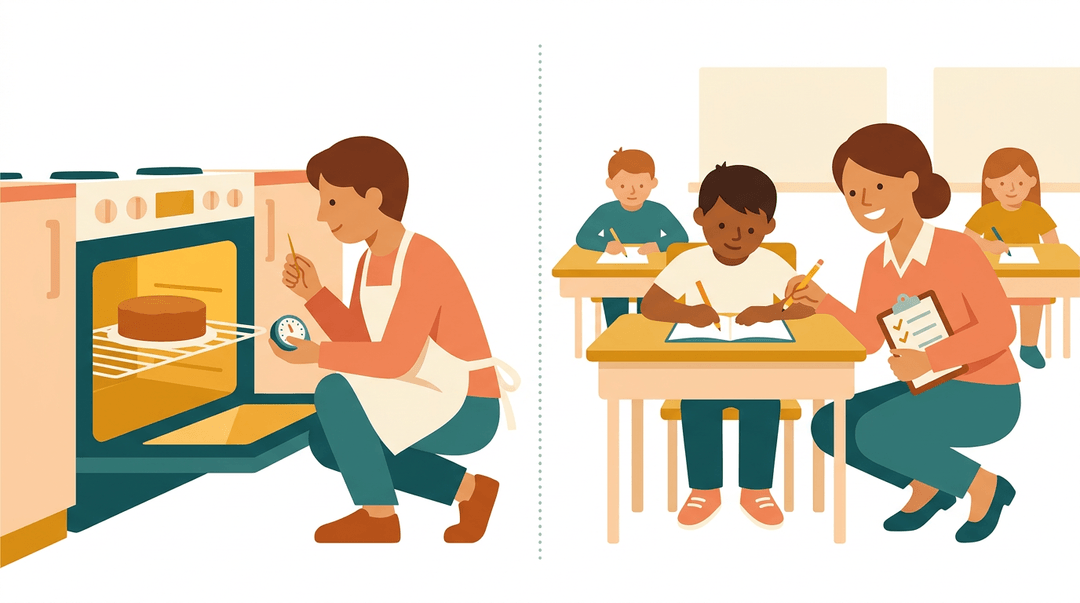
Think about checking a cake while it's still in the oven. You don't wait until it's burnt to find out something went wrong: you peek, you poke, you adjust the timer. Formative assessment works the same way in your classroom.
It's the ongoing checking-in you do while students learn, not just after. That's different from summative assessment, which grades the finished product.
In this post, we'll break down what each one means, why formative checks matter, and how to actually run them this week.
What Formative Assessment Means in the Classroom
Picture a teacher circling the room during independent practice, pausing at one desk to ask a single clarifying question before moving on. That's formative assessment at work, and it shapes far more of a lesson than any quiz ever could.
What formative assessment measures in real time
Formative assessment is an ongoing check built right into the learning, not a verdict handed down after it's over. It's a low-stakes feedback tool: no grades riding on it, just information you can use immediately.
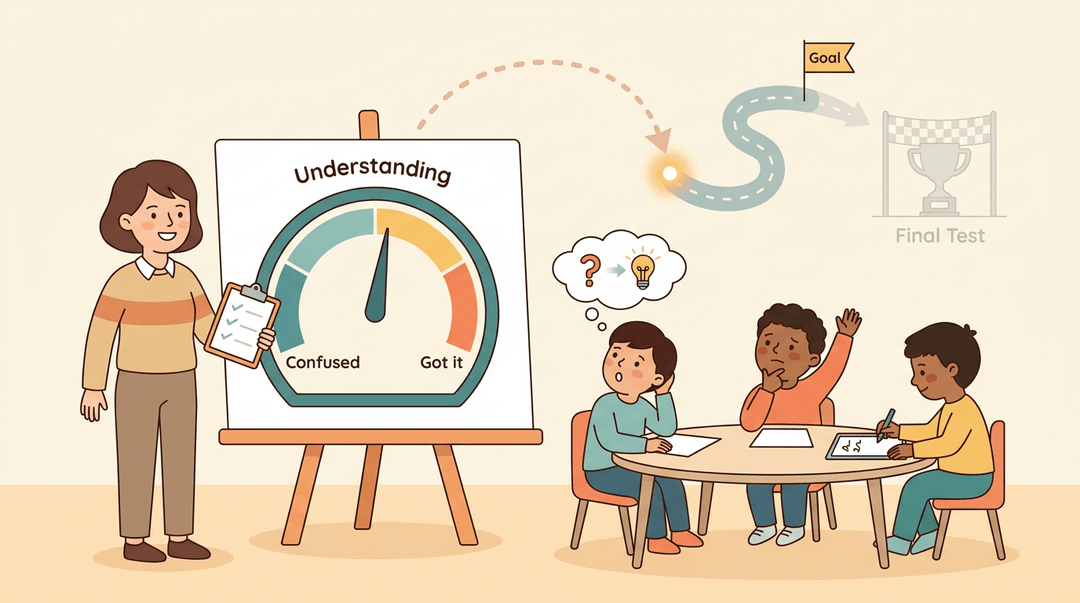
Think of it as a real-time gauge of understanding, catching confusion while there's still time to fix it.
That's the key difference between in-process insight and a final skill demonstration: one tells you where a student is headed, the other tells you where they landed.
What makes formative assessment work
A few traits make formative checks genuinely useful:
- Quick to administer. A thumbs-up/thumbs-down or a one-sentence exit slip takes seconds, not a class period.
- Frequent and continuous. Used once, it's a snapshot. Used often, it's a running record of growth.
- Flexible data. It can be qualitative (a facial expression, a hesitant answer) or quantitative (a quick quiz score).
- Dialogue-driven. It opens a conversation between you and the student, not just a transaction.
What is another word for formative assessment?
You'll often hear it called assessment for learning, a common synonym that captures the point well: the goal is to inform what happens next, not just record what already happened.
A "check for understanding" is related but narrower, usually a single quick moment rather than an ongoing practice. Formative assessment goes further, revealing patterns in how a student thinks, not just whether they memorized the right answer.
Formative vs Summative Assessment Explained
Formative and summative assessment aren't competing systems: they're two tools built for different moments in a unit. Here's how they actually differ:
How formative and summative assessments differ
| Formative | Summative | |
|---|---|---|
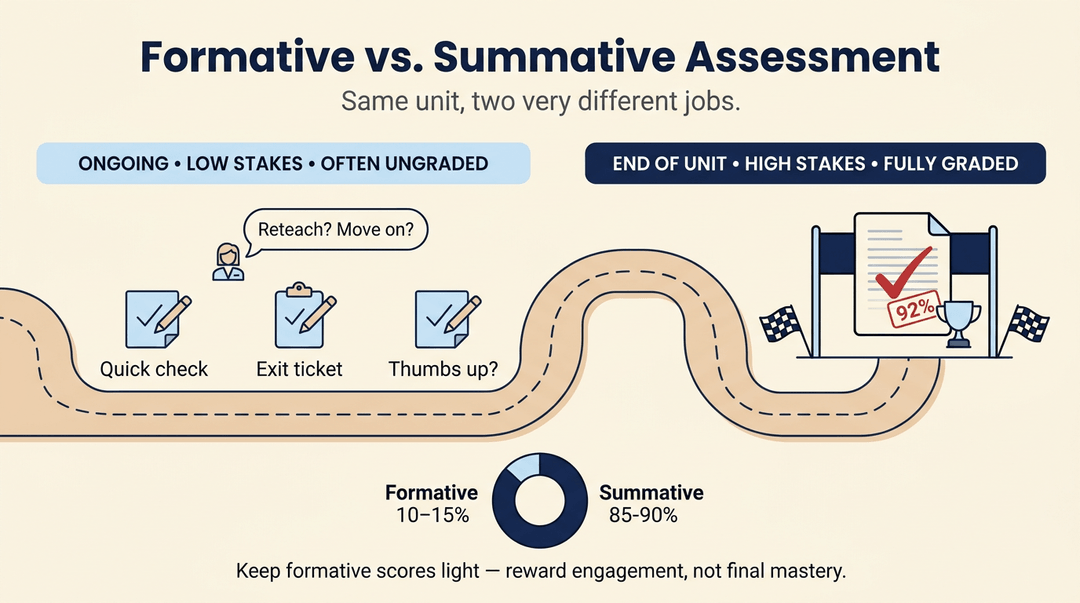
| Timing | Ongoing, woven through a lesson or unit | Comes at the end, once learning should be complete |
| Purpose | Guides your next move as a teacher | Evaluates what a student actually learned |
| Stakes | Low: a chance to adjust, not a final judgment | High: it's the record of mastery |
| Grading | Often ungraded, or lightly weighted | Fully graded |
If you do record formative scores, keep them light: 10 to 15 percent of the overall grade is plenty. That rewards engagement without inflating a mark a student hasn't fully earned yet.
Using formative and summative assessment together
The two are complementary, not competing. A single activity can even serve both jobs: a quiz you give mid-unit to check understanding is formative, but that same quiz format given as a final check becomes summative.
Lean on one alone and you lose something: all formative, and you never confirm mastery; all summative, and you catch problems too late to fix them. You need both for the full picture.
Examples of formative and summative assessment
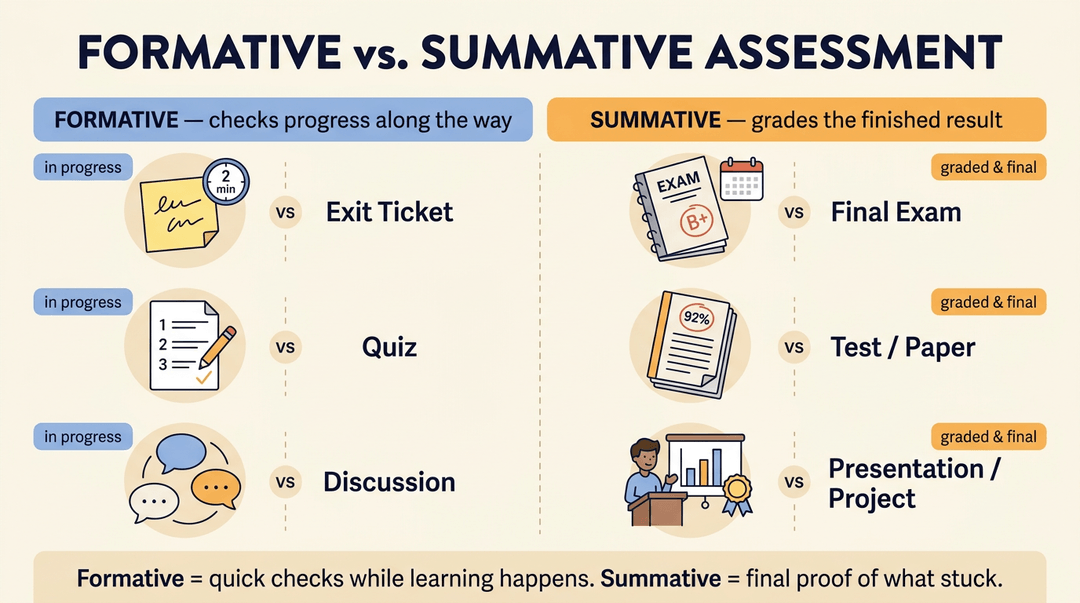
- Exit tickets vs. final exams. A two-minute exit ticket flags who got today's lesson; a final exam confirms what stuck across the whole course.
- Quizzes vs. tests or papers. A quick quiz checks progress along the way; a unit test or paper grades the finished product.
- Discussions vs. presentations or projects. A class discussion surfaces thinking in real time; a presentation or project is the graded, polished result.
Why Formative Assessment Matters
Think about the difference between a doctor checking your blood pressure during a visit and one who only sees results after you've left the building.
Formative assessment is the regular check-in: the ongoing pulse-check on learning while it's still happening, not after the unit has already closed.
How formative assessment helps teachers
Quick, low-stakes checks let you adjust your teaching in real time instead of waiting for a test to tell you what went wrong. They help you:
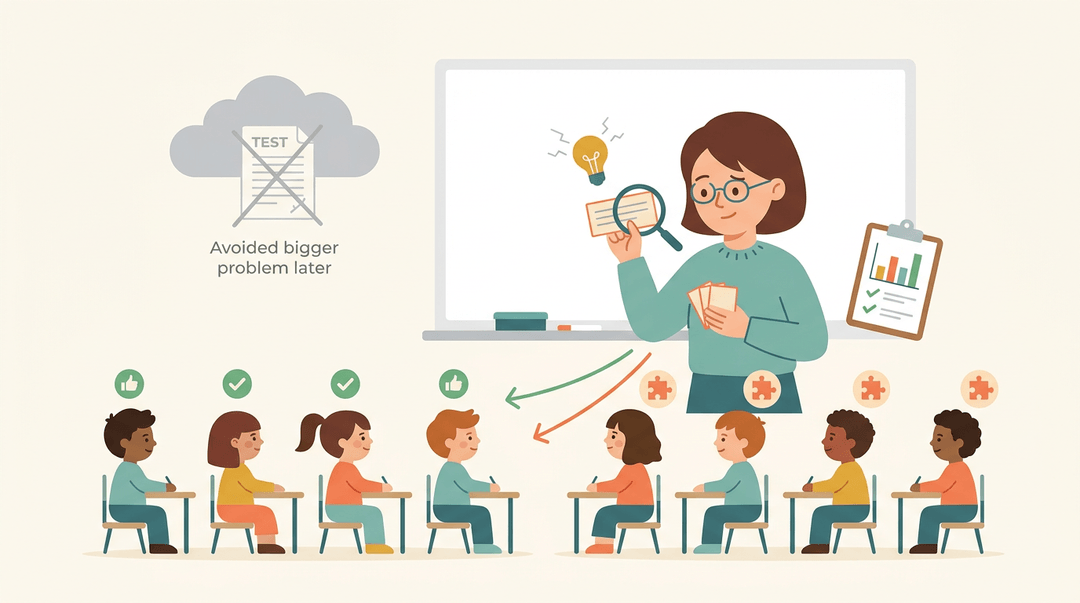
- Catch gaps early. A confused look or a shaky exit-ticket answer flags a misunderstanding before it snowballs.
- Cut down on re-teaching. Fixing a misconception today saves you from reteaching the whole unit next week.
- Make decisions with data, not guesswork, about who needs more support and who's ready to move on.
How formative assessment helps students
For students, these checks aren't just about grades. They build ownership over learning: when a student sees their own progress mid-unit, they start believing they can actually improve it. That kind of self-reflection also takes the pressure off.
A quick thumbs-up, thumbs-down check feels nothing like exam stress.
The payoff shows up in outcomes, too.
According to a meta-analysis of K-12 formative assessment research, formative assessment is linked to real gains in students' knowledge, skills, and self-efficacy, largely because it keeps learners actively engaged rather than passively waiting for a grade.
What wrong answers reveal about learning
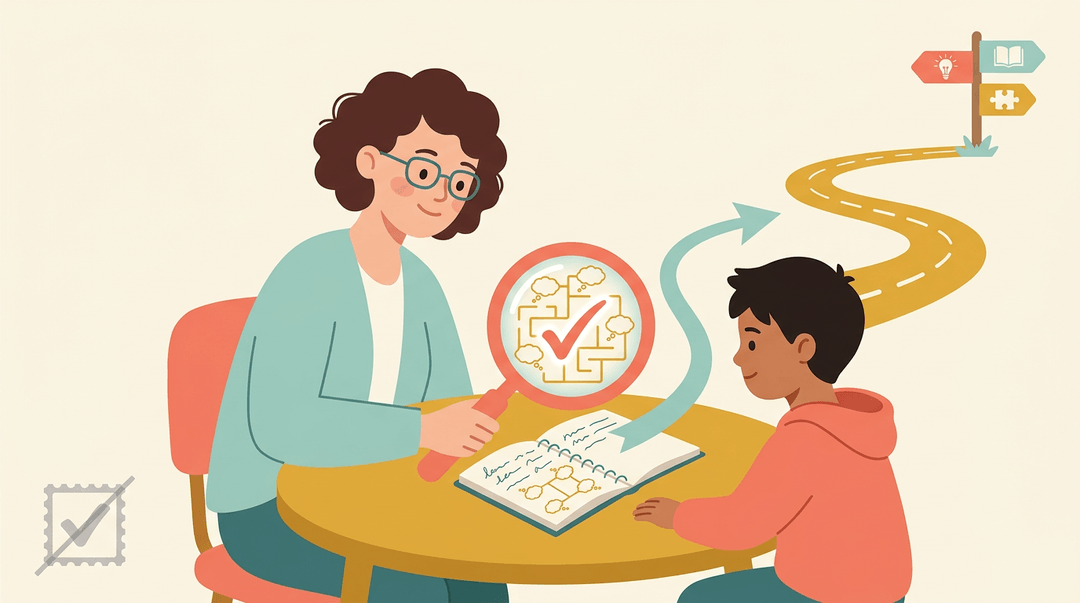
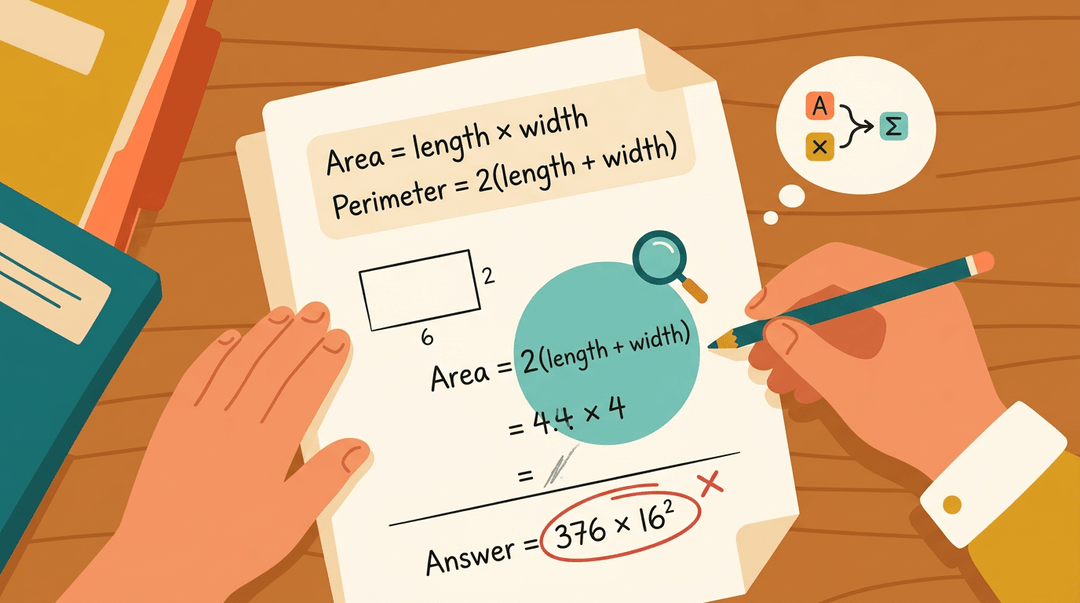
Consider a sixth-grade math teacher reviewing a student's work: the final answer is wrong, but the steps show the student mixed up two formulas, not that they didn't try.
A wrong answer is a window into how a student is thinking, not just proof they didn't get it. Catching that now, instead of on a final exam, stops a small misunderstanding from hardening into a permanent one.
Formative Assessment Strategies You Can Use
Knowing what formative assessment is only gets you so far. The real question is how to run it on a Tuesday afternoon with thirty students in front of you, without adding hours to your week. Here's a toolkit you can start using tomorrow.
Everyday classroom formative assessment techniques
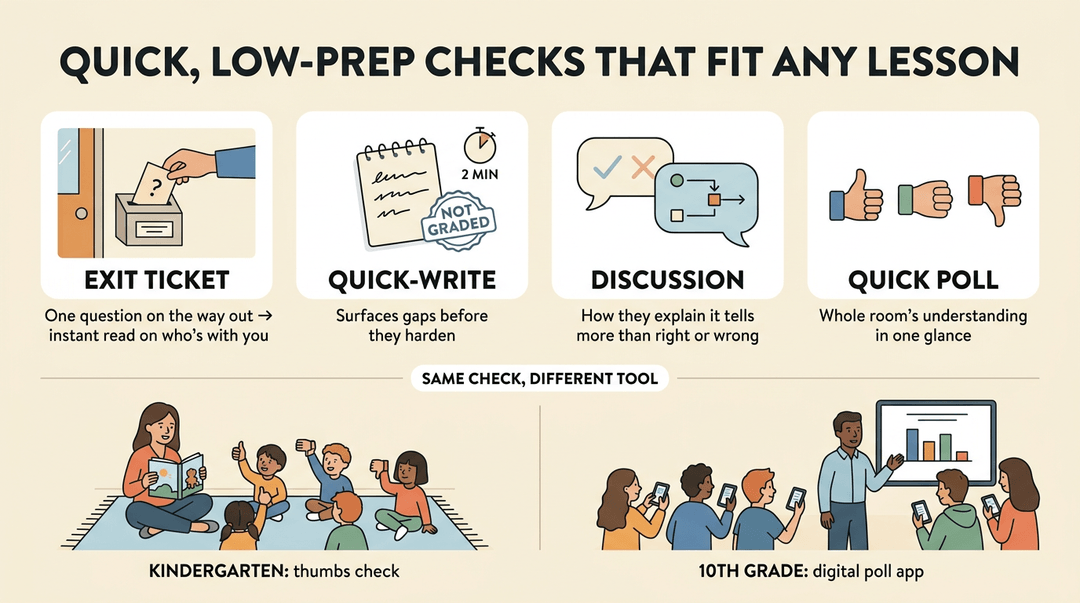
These are the quick, low-prep checks that fit into any lesson:
- Exit tickets. A single question answered on the way out the door gives you an instant read on who's with you and who isn't.
- Quizzes and quick-writes. A short, ungraded quiz or a two-minute written response surfaces gaps before they harden into misunderstandings.
- Class discussions. Listening for how students explain an idea tells you more than a right or wrong answer ever could.
- Polls, surveys, and thumbs-up checks. A quick show of hands or thumbs captures the whole room's understanding at once.
The tools shift by grade band. A kindergarten teacher might use a thumbs-up, thumbs-sideways, thumbs-down check after a read-aloud, while a tenth-grade teacher runs that same instant check through a digital polling app.
Self and peer assessment methods
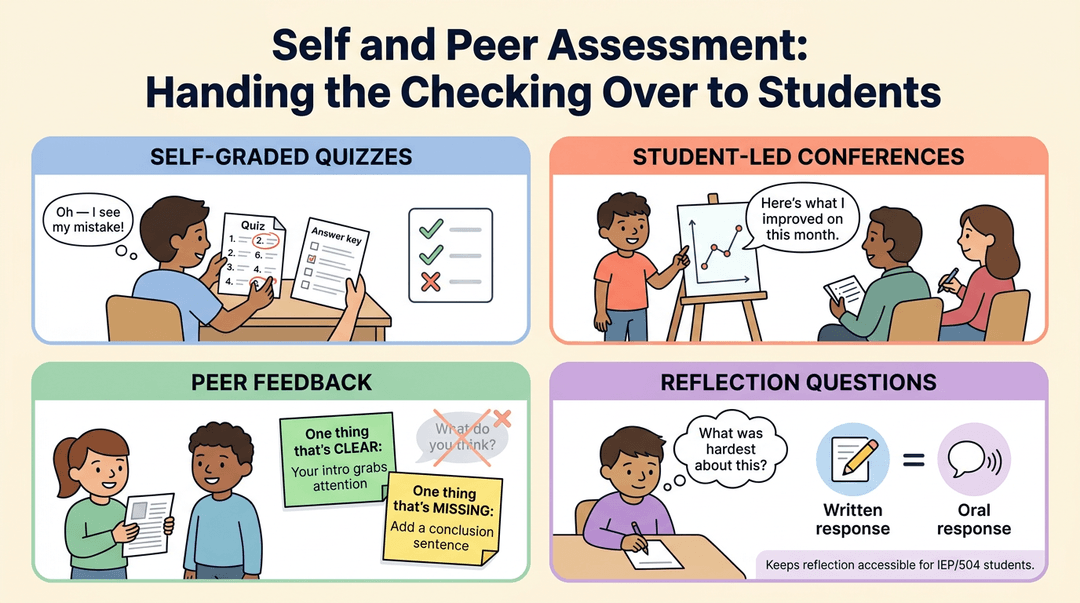
Handing some of the checking over to students builds ownership. Self-graded quizzes let a student compare their own work against an answer key and notice their own mistakes.
Student-led conferences put the student in charge of explaining their progress to you or a parent.
Peer feedback works when it's structured: give students a specific lens, like "one thing that's clear, one thing that's missing," rather than an open-ended "what do you think?"
Reflection questions ("What was hardest about this?") turn a task into evidence of thinking. For students with an IEP or 504 plan, offering an oral option alongside a written one keeps the check meaningful instead of a barrier.
Questioning and discussion techniques that work
The Socratic method uses a chain of guiding questions to lead students to their own conclusion. Inverted questioning flips that: students generate the questions, which shows you what's still fuzzy.
Think-pair-share gives every student a rehearsal before speaking up, not just the quickest hands. The parking lot method collects lingering questions on a board to revisit later, so curiosity doesn't get lost.
Low-stakes ways to grade formative work
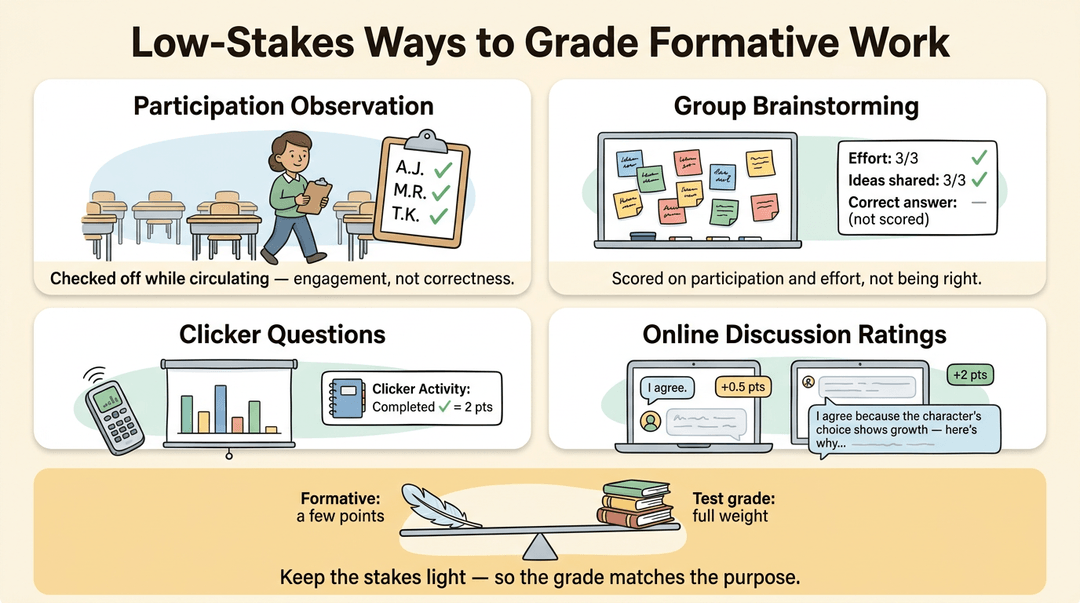
Formative work should stay low-pressure, but it can still count. Participation observation (a simple checklist as you circulate) tracks engagement without a single worksheet.
Group brainstorming can be scored on participation and effort rather than correctness. Clicker questions give instant, anonymous data you can log as a completion grade. Online discussion ratings can score the quality of a post, not just whether it exists.
Keep the weight light: a few points, not a test grade, so the stakes match the purpose.
A Quick-start Guide to Formative Assessment
You don't need a new unit plan to start formative assessment: you need five minutes a day and one skill in focus. Here's the whole routine, ready to run tomorrow.
The 5-minute daily check
- Pick one target skill.
- Narrow beats broad: "add fractions with unlike denominators," not "fractions."
- Choose a two-minute technique.
- Grab one from the grade-band table below.
- Collect quick data from everyone.
- Every student responds, not just volunteers: thumbs, slips, or scores.
- Note the top misconceptions.
- Jot the two most common wrong answers, e.g., "added the denominators."
- Adjust the next lesson.
- Swap tomorrow's warm-up or first example to hit that exact gap.
Key principle: A check only counts as formative if it changes what you teach next. If nothing would change either way, skip the check.
One technique per grade band
| Grade band | Technique | What it looks like |
|---|---|---|
| K-2 | Thumbs up/down | "Thumbs up if this word rhymes with cat." |
| 3-5 | Exit ticket drawing | Sketch the water cycle, label two parts |
| 6-8 | Quick quiz app | Three auto-graded questions as students pack up |
| 9-12 | Socratic seminar | Tally who cites evidence on your roster |
From data to next steps
The check is only half the routine; the same-day follow-through is where learning moves.
- Review results the same day.
- Sort responses into three piles: got it, shaky, lost.
- Flag struggling students by name.
- Star them on your roster; counts alone won't tell you who needs you.
- Plan a micro re-teach.
- Five minutes, one misconception, one fresh example, tomorrow's warm-up slot.
- Log the pattern for your records.
- One line is enough: "10/14: 8 of 24 added denominators."
- Give feedback next class.
- Say: "Yesterday a lot of us added the denominators. Watch what happens here instead."
Example: A fifth-grade teacher's exit drawings show half the class reversing evaporation and condensation. She stars those twelve names, opens the next day with a two-minute arrow-by-arrow re-draw, and logs "water cycle direction, 12/24" in her notes. Total cost: seven minutes across two days.
At a glance: check one skill daily, read the data that afternoon, re-teach the gap tomorrow, log the pattern. Once you're logging daily, it helps to track formative check-ins alongside summative grades in one view with EMStudio's online gradebook.
Planning and Implementing Formative Assessment
A formative check only earns its keep if it shows up at the right moment and ties back to what you actually want students to learn. Here's how to build that into your planning, start to finish.
When should a teacher use formative assessment?
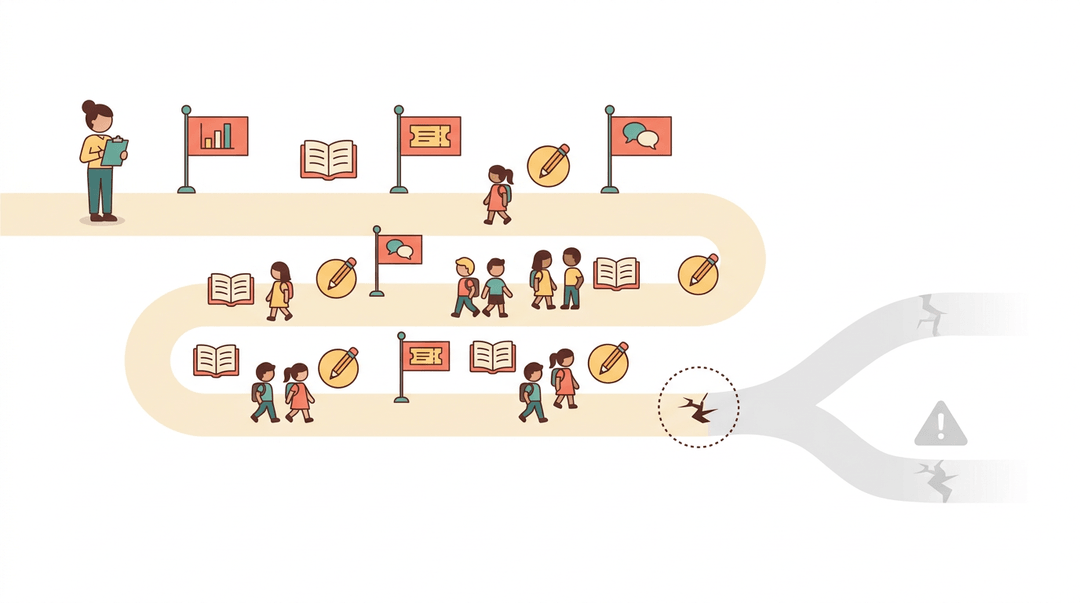
The short answer: before a gap becomes a pattern. Start by identifying which skills you need to assess, then choose a format that fits (a quick poll, an exit ticket, a one-on-one check).
Build these checkpoints into your unit plan from the outset, not as an afterthought once the unit's underway.
A common pitfall is treating formative assessment as something you squeeze in when there's time left; instead, schedule feedback breaks at natural pause points, right after new material lands and before students practice it independently.
Aligning assessment with learning objectives
Every check should tie directly to your key learning targets. If the objective is identifying main idea, don't assess vocabulary recall instead.
This alignment ensures focused student effort: students know exactly what they're working toward, and you're measuring the thing that actually matters.
Collecting data and giving fast feedback
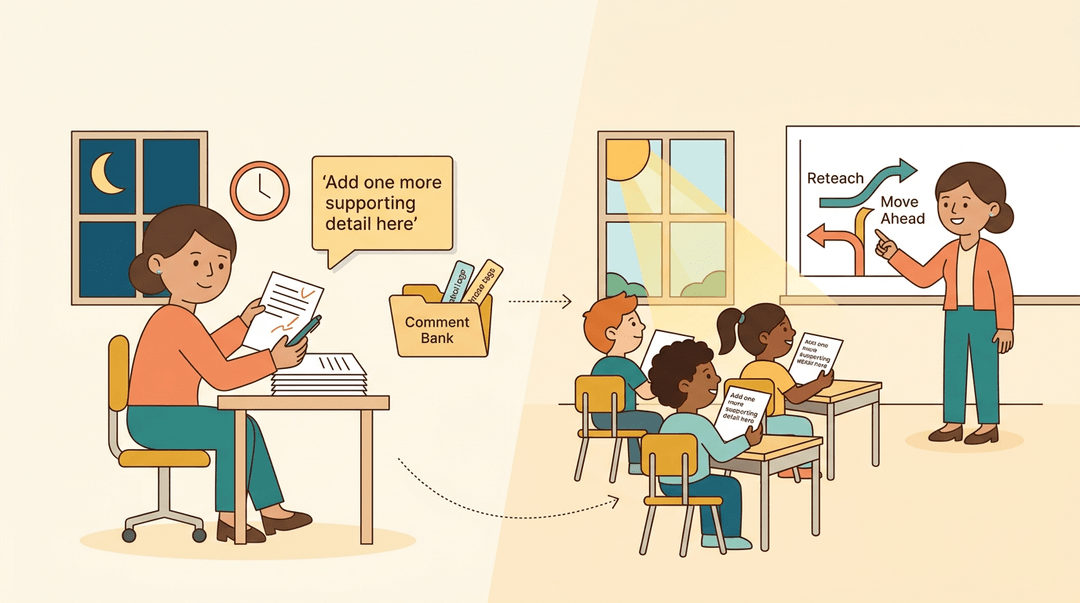
Analyze what you collect promptly, ideally the same day, so trends and gaps are still fresh. Give feedback that's timely and specific: not "good job," but "add one more supporting detail here."
Use what you find to adjust tomorrow's instruction, whether that's reteaching or moving ahead. Keeping a quick feedback comment bank on hand (phrases you reuse across similar errors) saves you time without losing specificity.
What Are the Five Methods of Assessment?
Assessment isn't one-size-fits-all, and teachers actually have five main methods to draw from, each suited to a different moment in the learning cycle.
Diagnostic and summative assessments get their own spotlight elsewhere in this piece, but three more show up constantly in everyday classroom life.
Checking prior knowledge before a unit
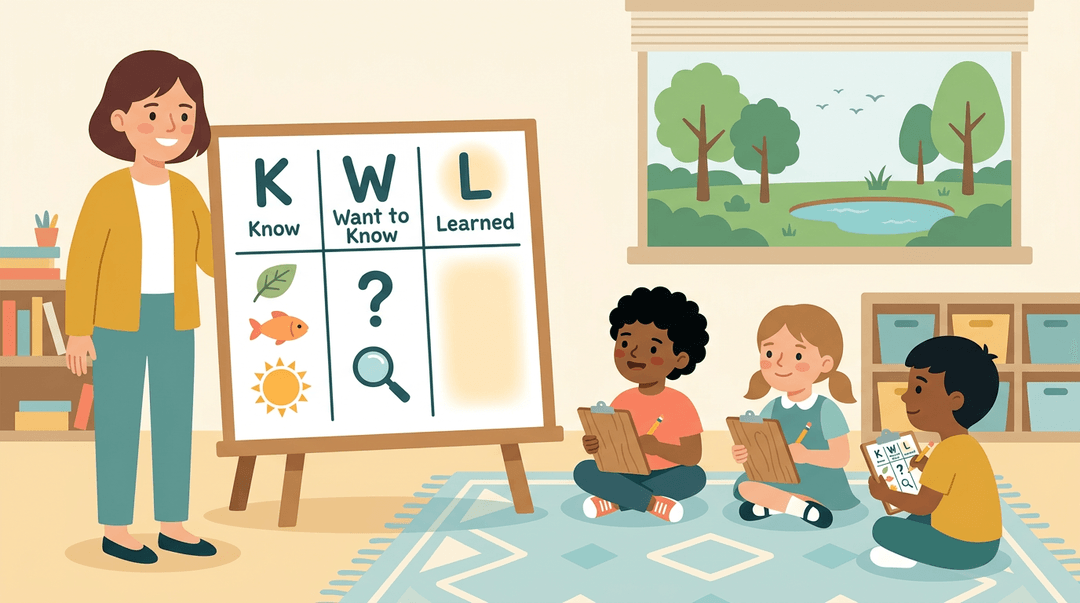
Before you introduce a new topic, it helps to know what students already bring to the table. That's the point of gauging prior knowledge: you're not testing for a grade, you're scouting the terrain. A KWL chart (what students Know, Want to know, and have Learned) is a classic example. A fifth-grade teacher opening a unit on ecosystems might hand out a KWL chart before the first lesson, then circle back to the "L" column once the unit wraps. This method is used before the unit starts, not during or after.
Interim and benchmark assessments explained
Interim and benchmark assessments zoom out from a single classroom to measure grade-wide progress. These are often district-level proficiency tools, built to track how an entire grade level is moving toward state standards partway through the year. State and standardized exams fall into this category too, giving schools a consistent way to compare performance across classrooms and campuses.
Using assessment for well-being and behavior
Not every check is about academics. Some assessments exist purely to support social-emotional learning: quick well-being checks, mood check-ins, or behavior monitoring that help you notice when a student is struggling before it ever shows up in their grades. A homeroom teacher running a weekly check-in can catch a quiet shift in behavior long before report cards would.

Using Technology for Formative Assessment
Technology doesn't replace the exit ticket or the quick thumbs-up check. It just makes those same checks faster, more precise, and far easier to act on. A handful of tool categories do most of the heavy lifting:
Digital tools and platforms for assessment
- Custom quizzes and polls. Build a five-question check in minutes and get results while students are still in the room. Consider a middle school math teacher who runs a two-minute poll on dividing fractions right after modeling it: a quick glance tells her whether to reteach now or move on.
- Standards-aligned tracking. Good platforms tag each question to the standard it measures, so results roll up into a clear picture of who has mastered what, not just an overall score.
- Personalized feedback tools. Instead of one comment written twenty times, these tools flag each student's specific gap and suggest the next step, whether that's a reteach video, a practice set, or an extension task.
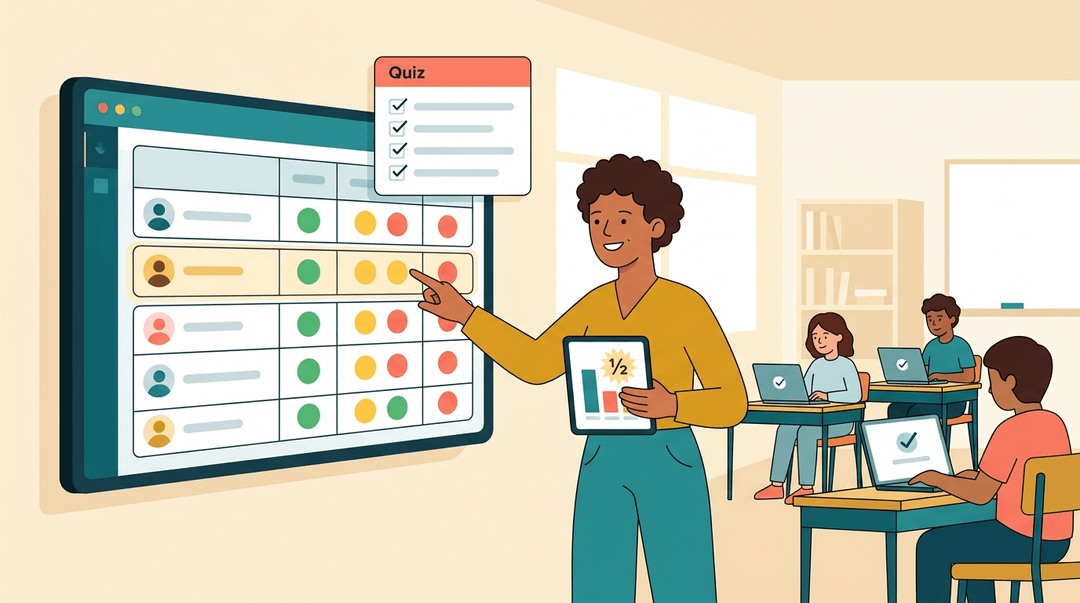
- Class-level data dashboards. A dashboard turns scattered quiz and poll results into a single view: green for mastered, yellow for shaky, red for not there yet. That makes grouping students for the next day's lesson a five-minute job instead of an evening of cross-referencing spreadsheets.
Used together, these tools don't just speed up grading. They turn formative data into something you can act on before the unit test, not after it.
Formative and summative assessment aren't rivals: they're partners. One guides the learning in real time, the other confirms it landed. Used together, with a few quick strategies and a clear plan, you'll catch confusion before it hardens into a bad grade.
Ready to turn all those quick checks into grades that actually make sense? Check out our Grading & Assessment feature to keep it organized, with automatic calculation doing the heavy lifting for you.
Frequently asked questions
What is another word for formative assessment?
Another word for formative assessment is **assessment for learning**. It is also sometimes called a check for understanding, although that term usually refers to one quick check rather than an ongoing process.
What are the five methods of assessment?
The five common assessment methods are gauging prior knowledge, formative assessment, interim or benchmark assessment, summative assessment, and social-emotional or behavioral assessment. Each serves a different purpose, from identifying starting points to evaluating learning and supporting student well-being.
What is an example of a formative and summative assessment?
A formative assessment example is a quick quiz or exit ticket used during a unit to identify misunderstandings and guide the next lesson. A summative assessment example is a final exam, unit test, presentation, or completed project used to evaluate learning at the end of instruction.
When should a teacher use formative assessment?
A teacher should use formative assessment throughout instruction, especially after introducing new material and before students practice independently. It should also be built into natural pause points so the teacher can identify gaps early, provide feedback, and adjust the next lesson.