Teaching Active Learning Strategies: A Complete Guide

Jump to section
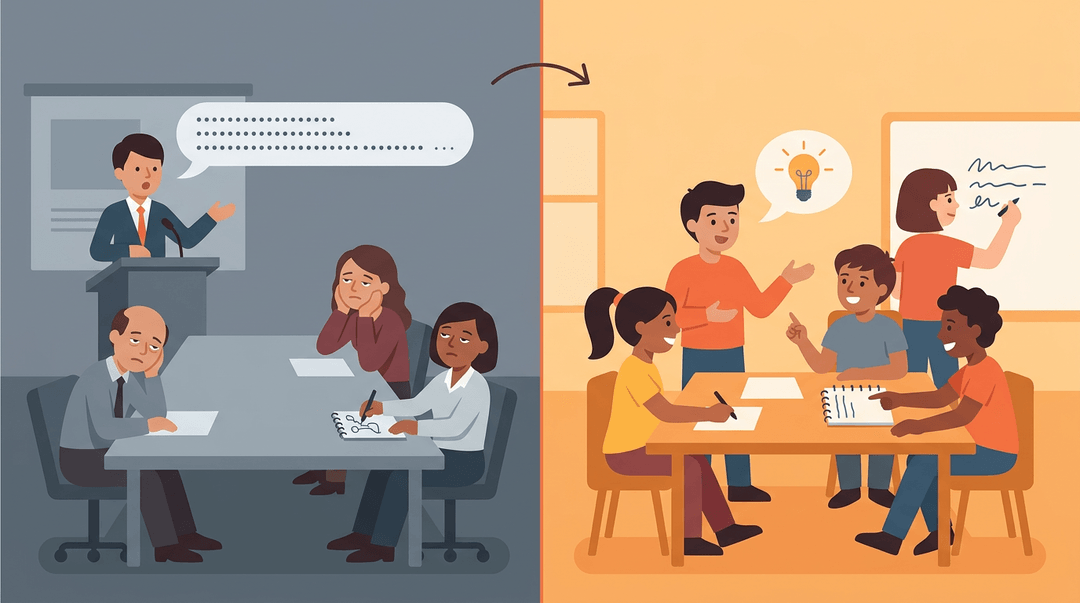
Think about the last time you sat through a meeting that never gave you a chance to speak. You probably remembered very little of it. Students feel the same way when they only listen.
Active learning flips that script. It means students do something with the material: talk it through, solve it, argue for an answer, or teach it to a classmate. Put simply, it's learning by doing rather than watching.
In this guide, we'll cover the theory behind active learning, walk through how to build a lesson, share strategies worth trying, and look at the evidence for what actually works.
Understanding Active Learning for Effective Teaching
Ever nodded along in a lesson, then couldn't explain the idea afterward? That gap is exactly what active learning is designed to close. Here's what it means and where it comes from.
Learning by doing, not just listening
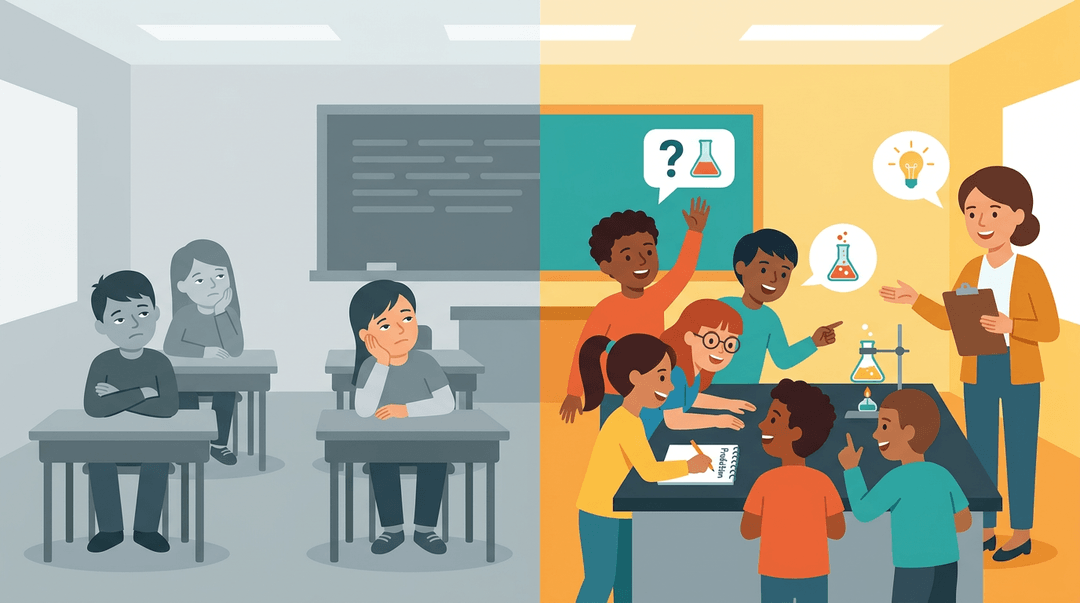
Active learning is learner-centered engagement, meaning students do the thinking, talking, and building instead of only receiving it. Picture a seventh-grade science teacher who asks students to predict what will happen before the experiment starts.
Those students are working. A listener is passive, while a doer applies, discusses, or creates. The shift is doing rather than listening, and that's the heart of the approach.
What is Vygotsky's theory of active learning?
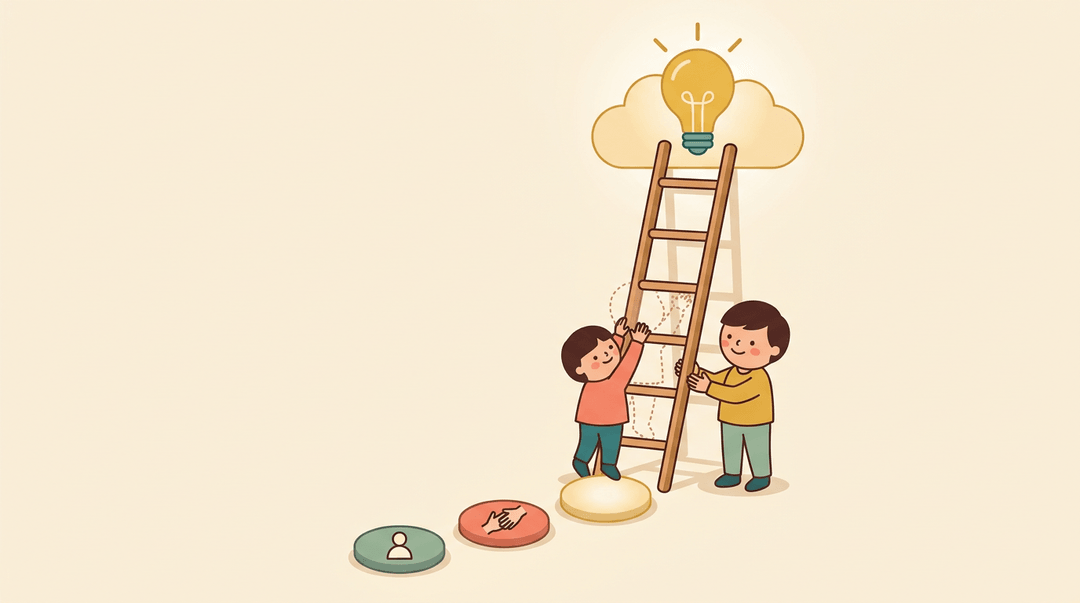
Vygotsky's view rests on constructivist learning theory, the idea that learners build understanding by connecting new ideas to what they already know. Social constructivism adds that much of that building happens through peer interaction.
A key piece is Vygotsky's zone of proximal development, the range of tasks a learner can handle with guidance or collaboration but not yet alone. On the memory side, active processing helps ideas get encoded so they can be recalled later.
The modern term and approach trace back to Bonwell and Eison's 1991 work, which framed active learning as a way to create excitement in the classroom.
The three core parts of active learning
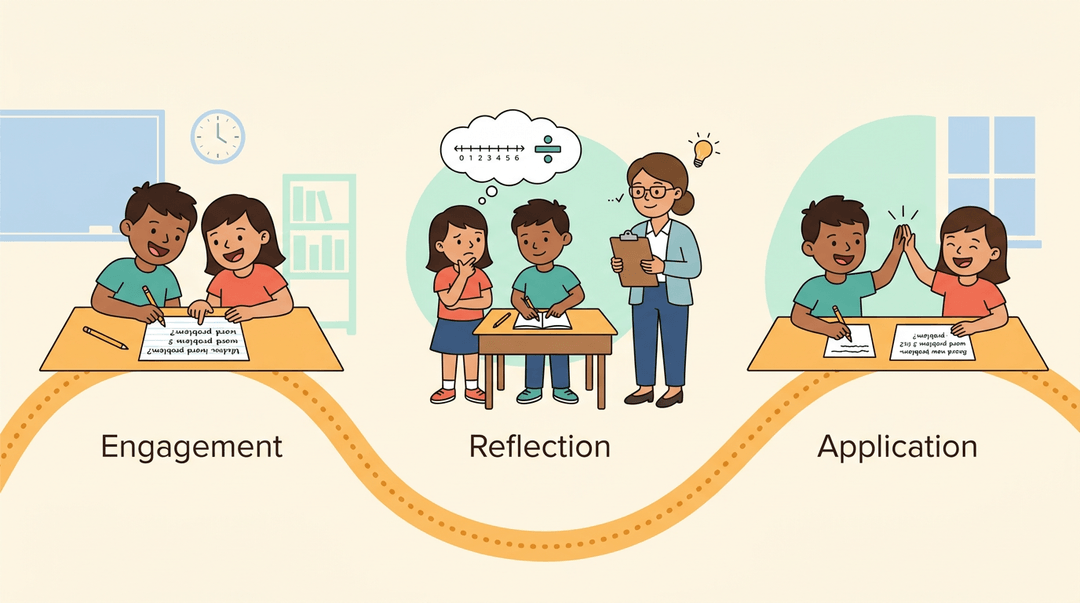
Active learning rests on three components:
- Engagement: students are involved from the first minute.
- Reflection: students pause to examine what they did and why.
- Application: students use the idea in a new situation.
A collaborative element runs through all three, since peers push each other's thinking at every step. Consider a fourth-grade teacher who pairs students to solve a word problem, asks each pair to explain its strategy, then gives a new problem to try.
Students engage, reflect, and apply in one lesson, and you spot misconceptions while there's still time to fix them. That's active learning in one lesson.
How to Build an Active Learning Lesson
This guide helps you plan one active learning lesson in about five minutes, then choose a technique that fits your students' age. Reach for it when you've got a topic and need a way to get students doing, not just listening.
The five-minute plan
Work through these four moves in order. Jot each answer on a sticky note.
- State the objective
- Finish this sentence: "Students will be able to ___ by the end of class."
- Example: "Students will explain why 3 + 4 equals 4 + 3."
- Pick one technique
- Choose from the menu below, matched to the objective.
- Example: partners build both sums with counters.
- Set a timer
- Give the activity a fixed window and show it on the board.
- Example: 8 minutes for building, 2 for sharing.
- Plan the reflection moment
- Write the closing question before class starts.
- Say: "What's one thing you figured out today?"
💡 Tip: Pick one technique per lesson. A single activity, done with a clear timer, beats three squeezed in and rushed.
Technique menu by grade band
Find your students' level, then read across.
| Grade band | Technique | What it looks like |
|---|---|---|
| Elementary | 30-second turn-and-talk | Pose a question, partners trade answers, timer on |
| Elementary | Hands-on math manipulatives | Students build the problem with counters or blocks |
| Elementary | Simple reflection drawing | Students sketch what they learned and label one part |
| Middle and high | Socratic seminar debate | Students answer an open question, citing evidence |
| Middle and high | Jigsaw reading groups | Each group masters one section, then teaches others |
| Middle and high | Exit-ticket quiz | A few quick questions, collected at the door |
For a turn-and-talk, try: "Turn to your partner and tell them one thing the story taught us." Then call time at 30 seconds.
A plan, filled in
Example: A second-grade teacher is teaching addition. Her objective: students will show that 3 + 4 and 4 + 3 make the same total. Her technique is manipulatives. Partners build both sums with counters, and the timer is set for ten minutes. For reflection, each student draws the two groups of counters and labels the total. She reads the drawings on the way out and knows who got it.
Slot these activities straight into your unit plans with EMStudio's Curriculum Planner.
Why Active Learning Works so Well
Ever wonder why some lessons stick while others fade by Friday? The answer usually comes down to what students do, not just what they hear. Here's how active learning pays off.
How active learning boosts memory
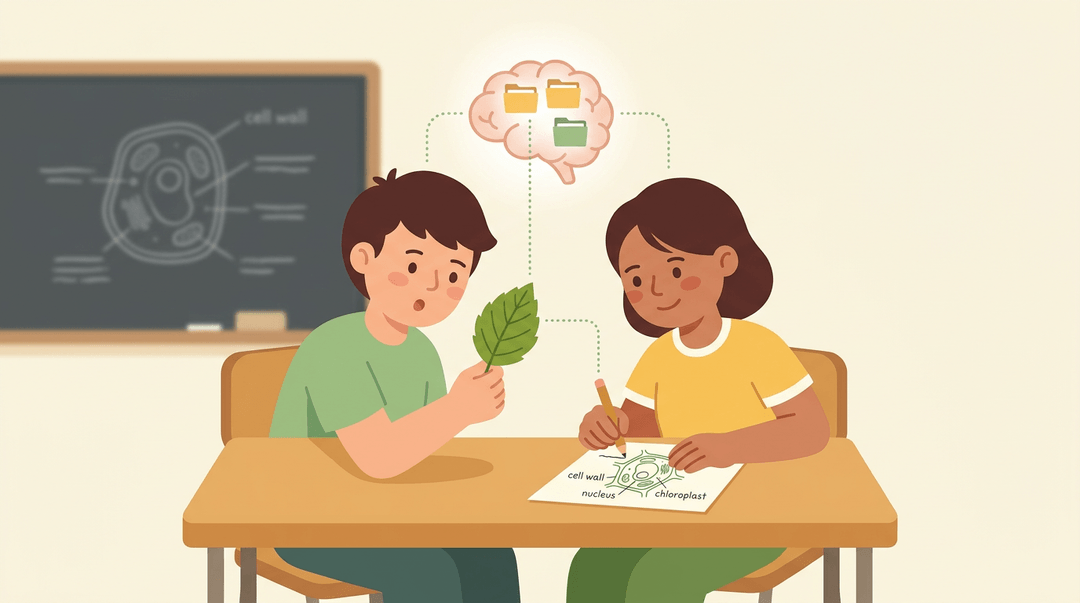
When students work with new material, they support long-term memory encoding, the process of moving information into storage they can retrieve later.
Information passes through distinct processing stages, and active tasks give it more chances to make that journey. Active work also connects new ideas to prior knowledge, so new content has something to attach to.
A personal connection to the material strengthens the link even further.
Consider a seventh-grade science teacher who pauses a lecture on cells and asks pairs to sketch and label a plant cell from a leaf they brought in. Those students wrestle with the parts of the cell, and that struggle gives the ideas a place to live.
How active learning builds critical thinking
Active learning climbs the ladder of Bloom's taxonomy, the framework that moves from recalling facts toward analyzing, evaluating, and creating.
Instead of repeating a definition, students break a problem apart (analysis) and assemble ideas into something new (synthesis). That's where problem-solving skills get built, and the result is deeper understanding rather than surface familiarity.
For example, a high school history teacher might have groups compare two primary sources and decide which better explains an event. Students aren't just repeating the textbook. They're weighing evidence.
Building teamwork and classroom community
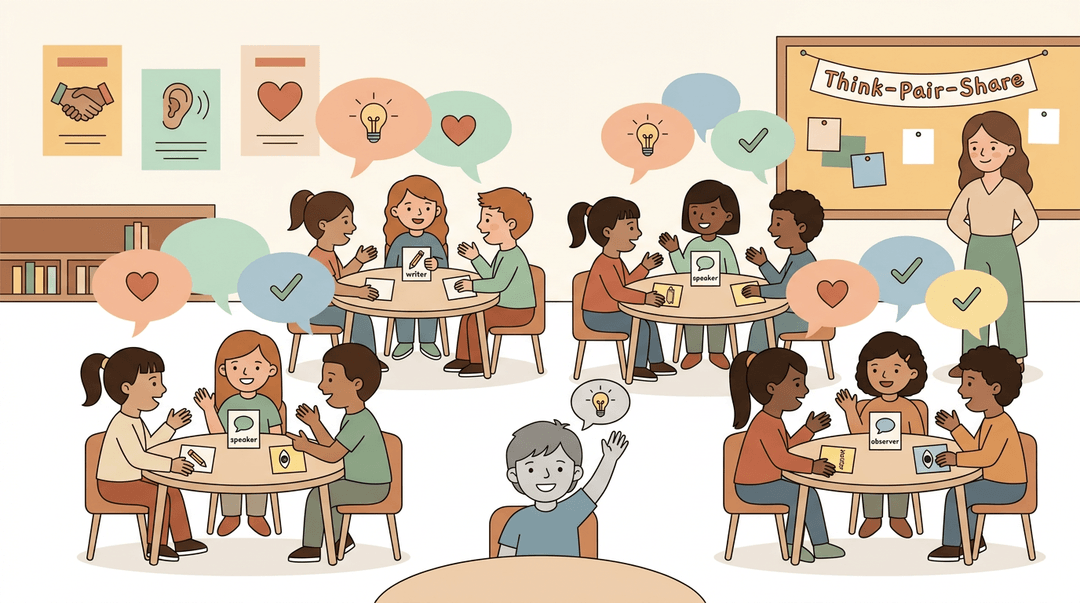
Pair and group tasks build teamwork skills as students divide roles, listen, and negotiate. Every discussion is peer interaction that gives students a reason to talk with classmates they might otherwise avoid.
Over time, these routines help form a classroom community and quietly sharpen interpersonal skills like giving feedback and disagreeing respectfully.
Think of a first-year teacher whose quiet room fills with conversation during a think-pair-share routine. The students who rarely spoke learn that their ideas have a place here.
Keeping students engaged and motivated
Active tasks spark increased interest because students make choices and see results. They also reduce the boredom and disengagement that creep in during long stretches of passive listening. Most importantly, they build motivation to learn.
When students feel capable and involved, they want to keep going.
Better grades and smaller achievement gaps
The outcomes show up in the research. A recent study of gateway engineering courses found that active learning increases student performance in science, engineering, and mathematics.
A meta-study of more than 200 studies of active learning classrooms found that average exam scores and concept test performance improved compared to lecture-dominated courses, and students in lecture-heavy classes were more likely to fail.
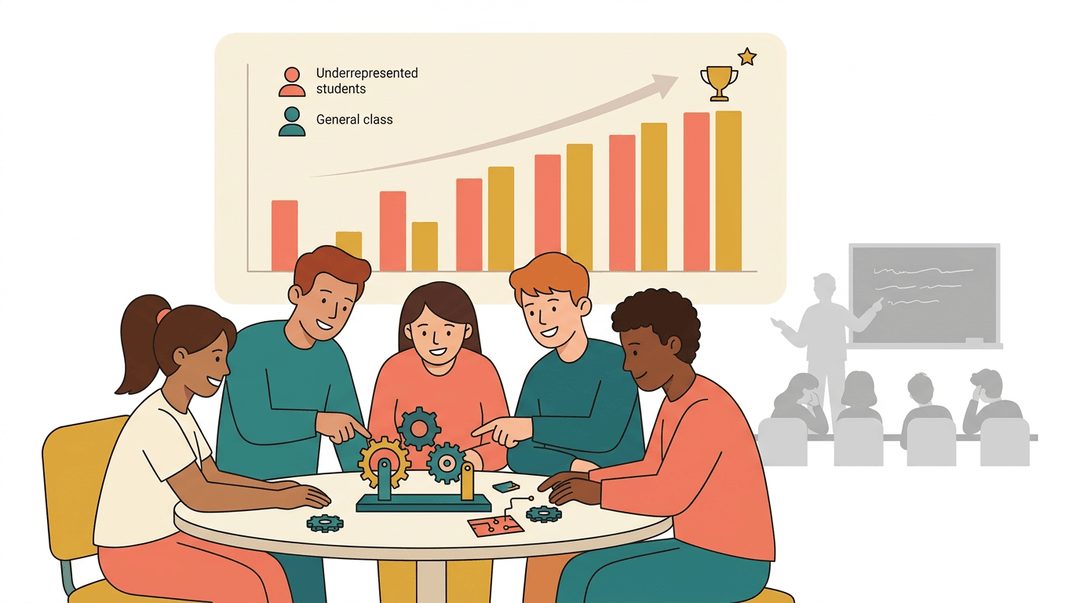
Equity matters too. MIT's Teaching + Learning Lab reports that active learning narrows achievement gaps for underrepresented students in undergraduate science, technology, engineering, and math.
Results like these are why active learning is worth the planning time.
Active Learning Strategies Worth Trying
Active learning puts students in the thinking seat instead of the watching seat.
Most of these strategies need nothing more than paper, a timer, and a plan, and many can run through your learning management system (LMS), the platform where you post assignments and grades, or a polling app.
Think, pair, and share with partners
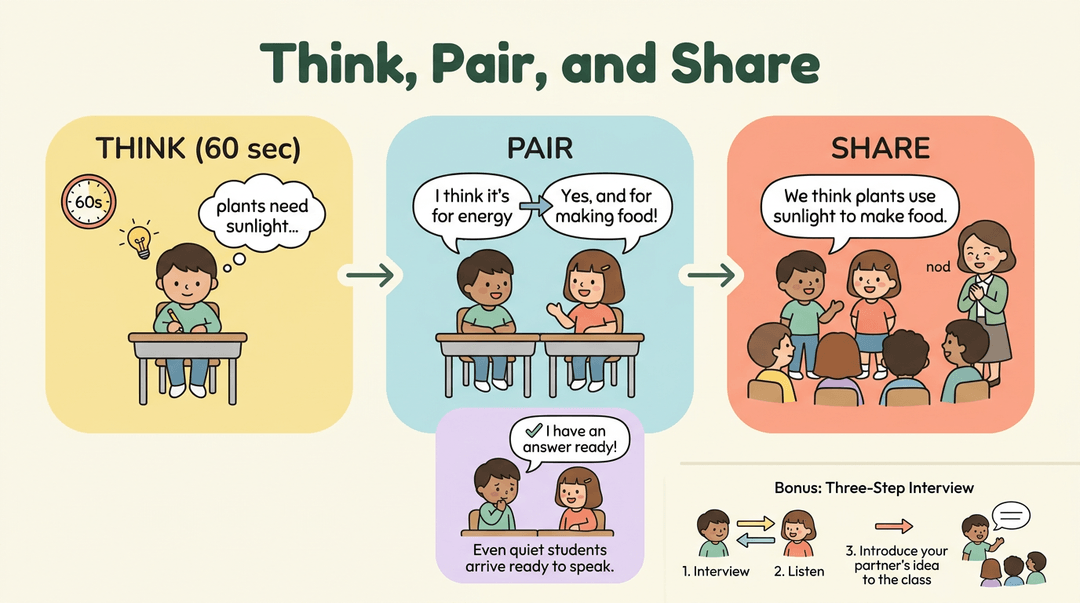
Start with think, pair, and share: students think alone, compare ideas with a partner, then report to the group.
- Individual think: Give students 60 seconds to write an answer alone.
- Peer discussion: Partners build on each other's reasoning.
- Share with the group: Pick a few pairs to report back.
- Three-step interview: Partners interview each other, then one introduces what they heard.
Think of a fifth-grade teacher asking why plants need sunlight. The student who usually stays quiet has a sentence ready to share with a partner before the whole-class question even comes up.
Testing yourself to remember more
Pulling an answer out of memory strengthens it more than rereading notes does. This is called active recall.
- Flashcards: Students write a question on one side and the answer on the other, then quiz themselves.
- Active recall quizzing: Open class with two or three short questions about yesterday's content.
- Practice tests: Use low-stakes quizzes so mistakes become information, not penalties.
- Spaced retrieval across the week: Revisit the same content on Monday, Wednesday, and Friday instead of cramming.
Learning through real-world case studies
Case studies connect content to situations students might actually face.
- Real-world scenario application: Present an everyday situation and ask what the concept predicts.
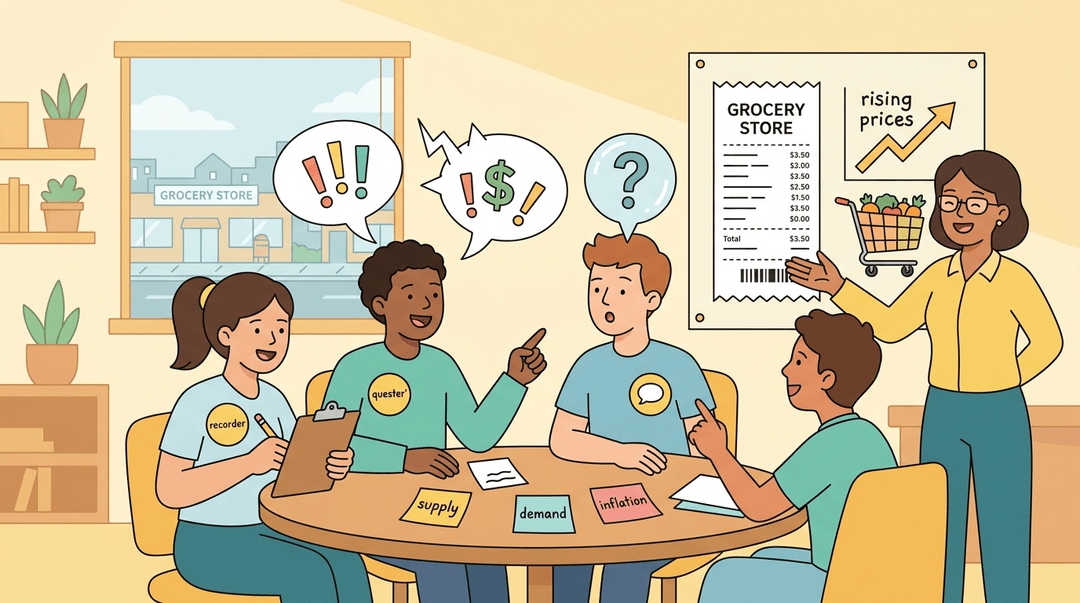
- Group problem solving: Assign each group member a role, like recorder or questioner.
- News and current-event cases: Use a recent story your class can check together.
- STEM practical problems: Have students design, test, or troubleshoot something concrete.
For example, a high school economics teacher gives groups a local grocery price increase and asks which factors explain it. Students who usually tune out suddenly have opinions to defend.
Role-play, simulations, and classroom games
Role-play asks students to step into someone else's shoes, while simulations let them test choices and see the results.
- Perspective-taking role-play: Students argue from a historical figure's point of view.
- Simulations: Students change one variable in a model, like a market or ecosystem, and watch what happens.
- Game-based quizzes: Turn review into a team trivia round.
- Competitive learning: Teams compete on accuracy and improvement, not just speed.
Having students teach each other
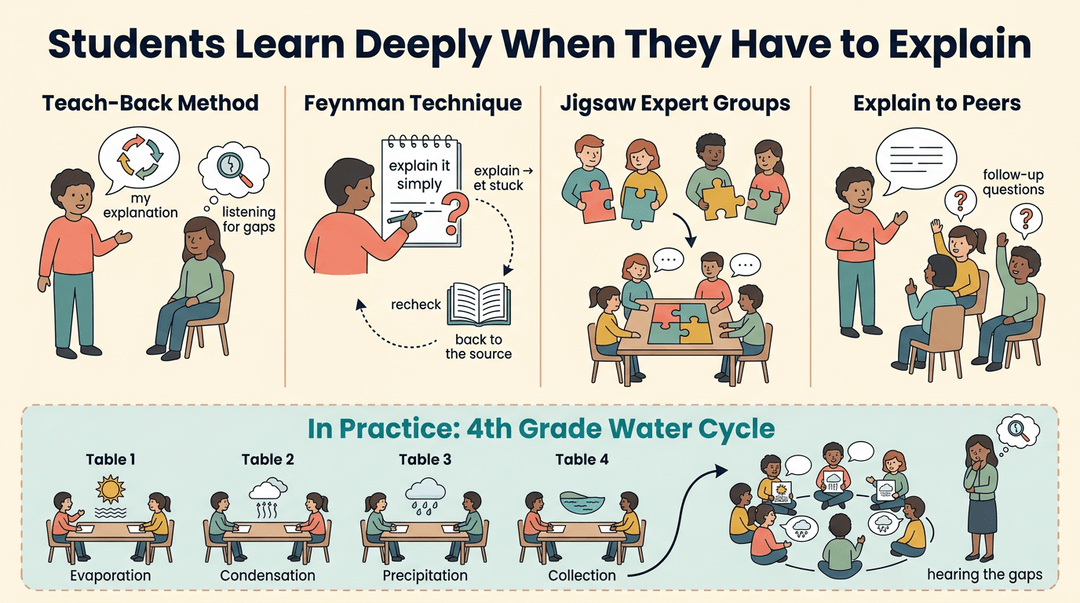
Students learn deeply when they have to explain.
- Teach-back method: A student explains a concept to you or a partner while you listen for gaps.
- Feynman technique: Learners explain an idea in plain language, then return to the source wherever their explanation breaks down.
- Jigsaw expert groups: Each student masters one piece, then teaches it to a new group.
- Explain to peers: Students explain in writing or aloud, and classmates ask follow-up questions.
Consider a fourth-grade teacher who assigns each table one stage of the water cycle. When the experts regroup, every student must teach their piece, and the teacher hears the gaps during the discussion.
Interactive tools for reflection and feedback
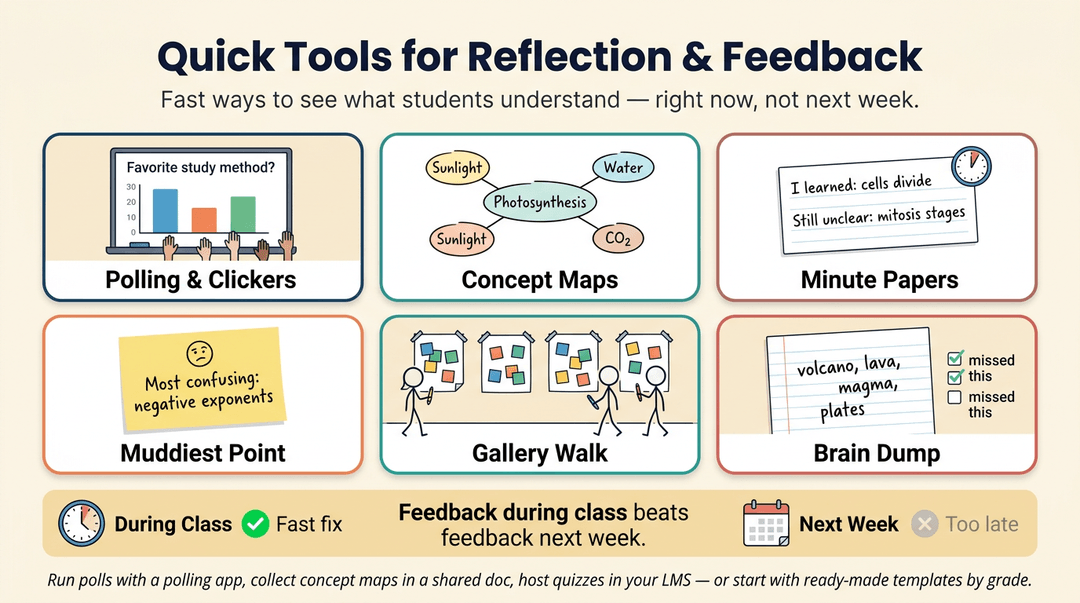
Quick tools give you a fast read on what students understand.
- Polling and clickers: Ask a question and see class results on screen right away.
- Concept maps: Students draw how key ideas connect.
- Minute papers: Students write what they learned and what's still unclear in one minute.
- Muddiest point: Students name the single most confusing idea from the lesson.
- Gallery walk: Post student work around the room and have classmates leave sticky-note feedback.
- Brain dump and reflection: Students write everything they remember, then check what they missed.
Your LMS can host the quiz, a polling app can run the poll, and a shared document can collect concept maps. Ready-to-use activity templates by grade help you start without building from scratch.
Feedback that arrives during class beats feedback that arrives next week.
Putting Active Learning into Your Course
Knowing what active learning is only gets you so far. The real question is how to bring it into your course without losing your pacing or your students. This section covers the planning, setup, and timing decisions that make it work.
Matching activities to your learning goals
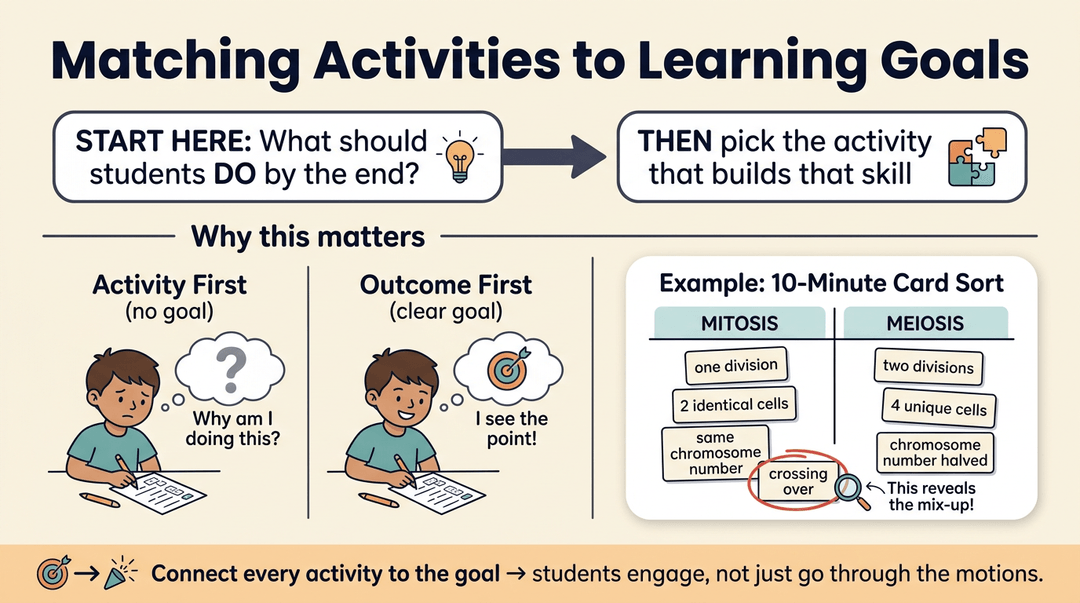
Start with the outcome, not the activity. Ask yourself, "What should students be able to do by the end of this unit?" Then choose the activity that builds that skill. When you design around outcomes, students can see the purpose behind every task.
Target the topics your students find confusing. A quick pair discussion or sorting task can reveal misunderstandings that a lecture would miss. Consider a high school biology teacher whose students keep mixing up mitosis and meiosis.
A ten-minute card sort shows her exactly which stage is tripping them up.
Connect every activity back to a goal. When students know why they're doing something, they're more likely to engage than to simply go through the motions.
Setting clear expectations with students
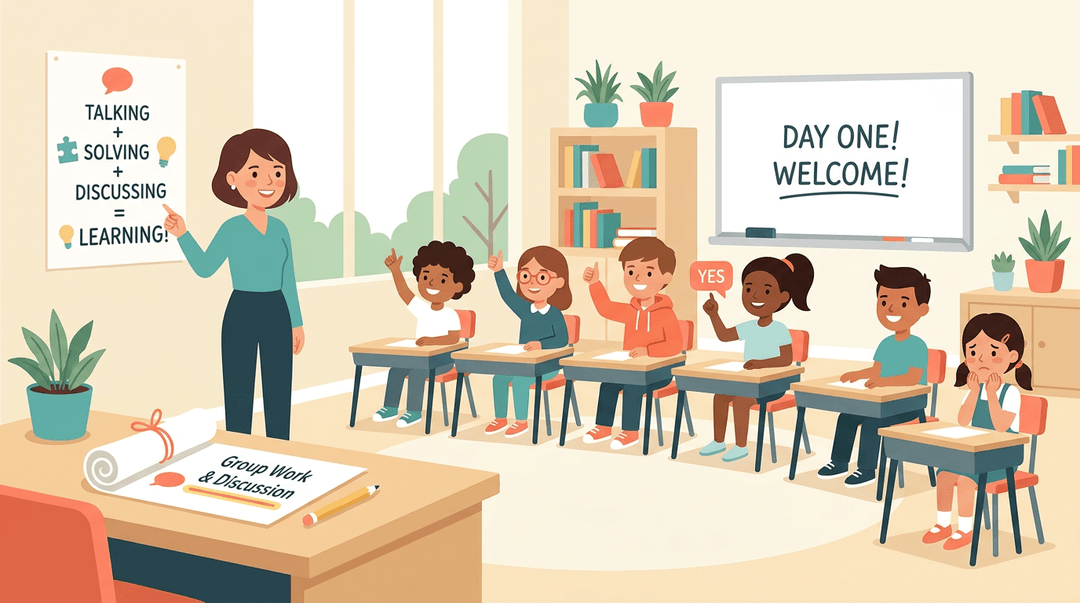
Explain the rationale on day one. Tell students that talking, solving, and discussing are part of how they learn, not a break from learning. Share research on why active participation supports learning, so the approach feels purposeful rather than random.
Add a note to your syllabus or course description. A sentence about group work, discussion, and hands-on tasks means nobody is surprised when the first activity starts.
Use icebreakers for comfort. A low-stakes opener, like a thumbs-up poll or a one-word chat reply, helps shy students speak up before the real work begins. That first small success makes the next activity feel less risky.
What does an active learning classroom look like?
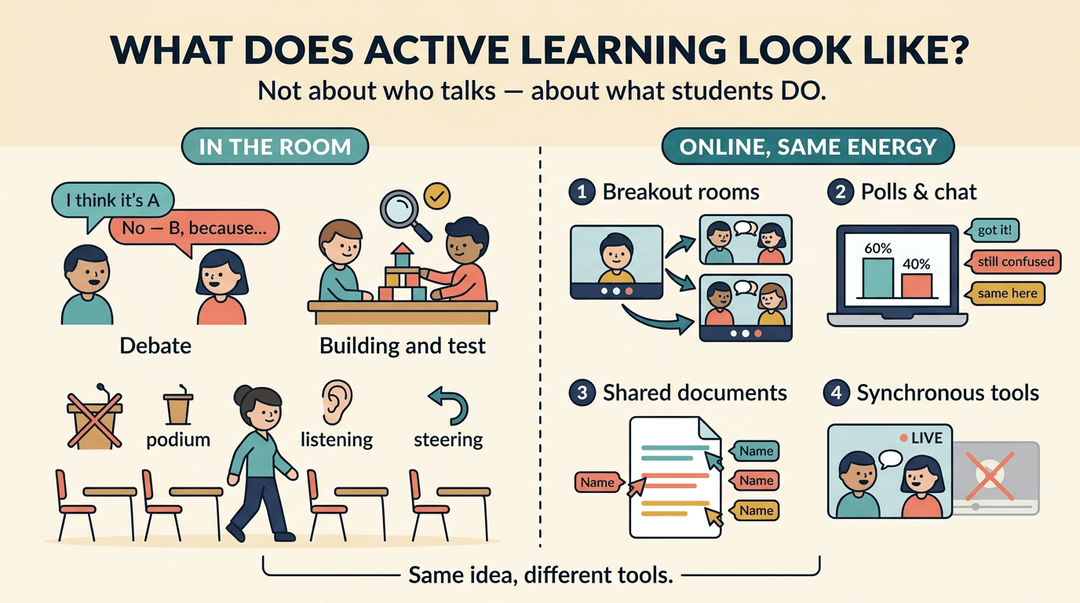
An active classroom is less about who is talking and more about what students are doing with the content. They work in pairs, debate, build, test, and explain. You move around the room, listening and steering rather than standing at the front all period.
In remote or hybrid settings, the same ideas apply with different tools:
- Breakout rooms let pairs or small groups tackle a problem, then return to the main session to share.
- Polls and chat give everyone a quick way to respond, so you can see who's following along.
- Shared documents let students post answers and track class progress in real time.
- Synchronous remote tools keep the conversation live rather than leaving students to work alone.
Matching activities to student needs and resources
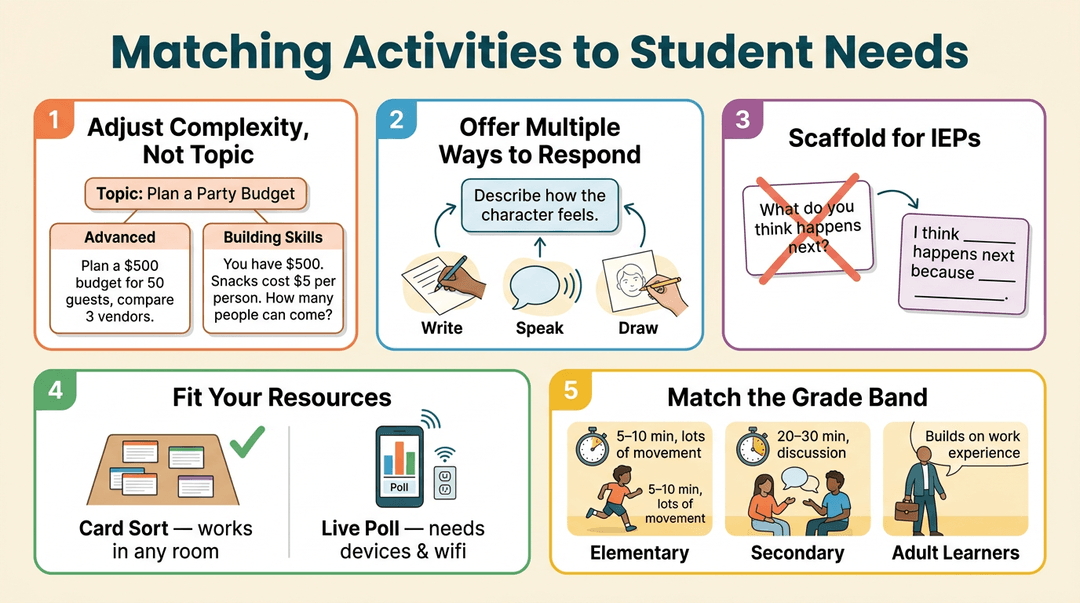
Start with your learners: their proficiency, strengths, and gaps. A group challenge that excites advanced students may overwhelm a learner still building basic skills. Adjust the complexity, not just the topic.
Plan for accessibility and learning differences. Offer more than one way to participate, such as writing, speaking, or drawing an answer.
A special education teacher adapting a lesson for an IEP might give a student a sentence starter instead of an open-ended prompt.
Consider the materials and technology you actually have. A card sort works in any room, while a live poll needs devices and reliable internet. Pick activities that fit your setup.
Grade bands look different, too. Elementary students usually need shorter, more movement-based tasks with frequent switches. Secondary students can handle longer discussions and independent problem-solving.
Adult learners often bring work experience you can build on. Seniority and context matter, so adjust your expectations to fit.
Managing class time for activities
Active learning can eat up a period fast, so plan your time. Pause lecture periodically to give students a quick task. Then cut lecture content that doesn't need a full explanation.
An activity that lets students discover a concept often teaches it better.
Use timed exercises with a clear end. Set a limit so students know when to wrap up. Timers and signals, like a chime or a hand raise, bring the class back together quickly.
Visual timer cues on the board help students pace themselves, especially those who need to see time passing. Time limits keep things moving.
Tackling Common Active Learning Challenges
Active learning only works when students are willing to take part, so it helps to plan for the friction you'll likely meet. Here's how to ease in and keep momentum going.
Dealing with student resistance to participation
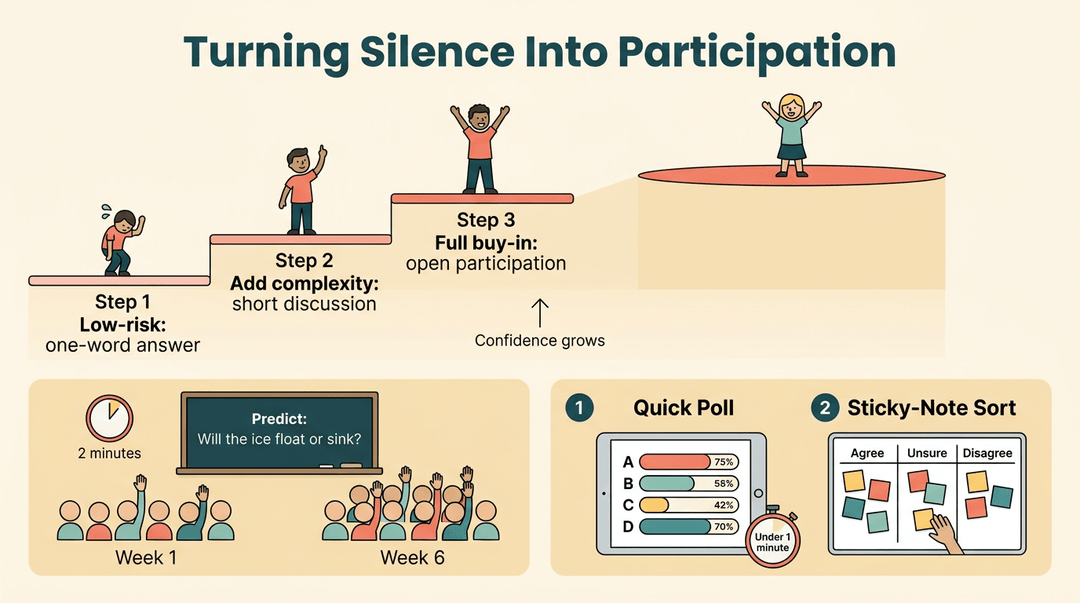
Some students hold back because they're unsure what's expected or worried about looking foolish. Start with simple exercises, like a one-word poll, so answering feels low-risk.
Build buy-in gradually by adding complexity as confidence grows, and explain purpose clearly: tell students why the activity matters before you begin.
Consider a sixth-grade science teacher who opens each lesson with a two-minute prediction poll. Students learn that answering costs them nothing, and more hands go up.
Quick-win activities deliver early buy-in. Try:
- Quick polls that take under a minute and show everyone's answers at once.
- Sticky-note sorts where students place their answer on the board.
Making group work easier for students
Groups run smoothly when students feel safe first. Begin with icebreakers before deep sharing, such as a low-stakes question about weekend plans.
Assign partners for shy students so no one is left choosing alone, and build comfort first before asking for personal reflection.
Think of a middle school teacher who pairs a quiet student with a patient, friendly classmate. The first partner talk is short, and the quiet student contributes an answer out loud for the first time.
Balancing content coverage with activities
Less lecture time means more room for activities, but it can feel risky with a full pacing guide. Move some content outside class through pre-class reading or short quizzes, so students arrive ready to practice.
This setup is the flipped classroom model, and the goal is doing rather than listening.
Flipped classroom prep has its own snags. Not every student completes the reading, so open class with a quick check-in and keep a short in-class summary ready as a backup. Start small, and let the activities do the teaching.
Does Active Learning Actually Work?
It's a fair question. Here's what the research says and how you can check it yourself.
What the research says about active learning
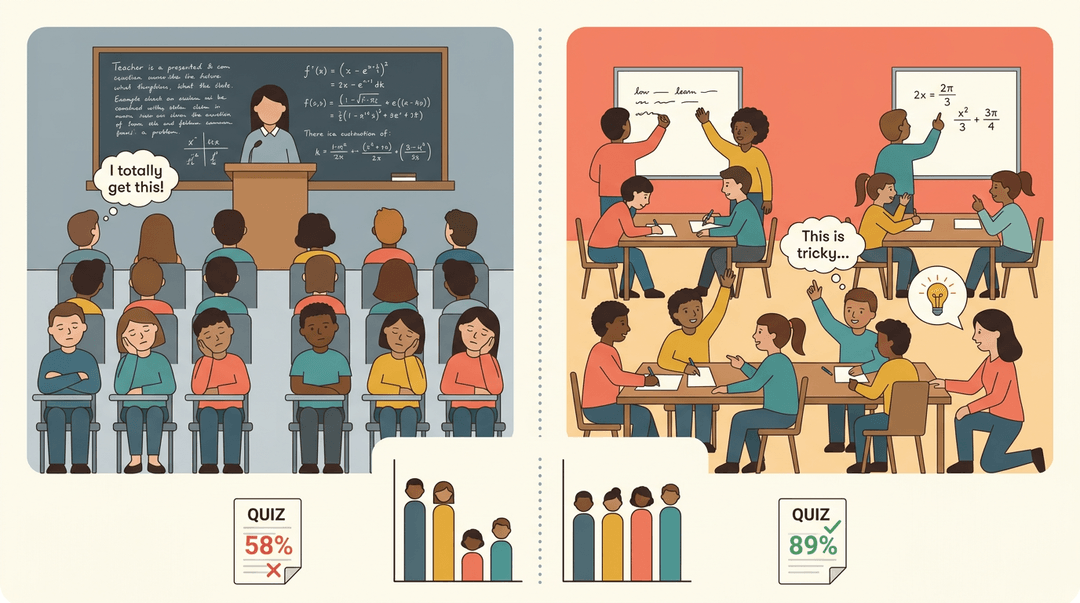
In 2014, Scott Freeman and colleagues analyzed research on active learning in college STEM courses, where students do something with the material instead of only listening.
A 2019 study by Deslauriers et al. compared what students actually learned with how they felt they learned.
Carnegie Mellon researchers found that replacing lectures with practice problems and immediate feedback helped students learn faster.
The strongest equity evidence comes from Theobald et al. (2020), who found that active learning reduces achievement gaps on exams by 33% and passing-rate gaps by 45%.
Not every study points the same way, so healthy skepticism is fair. Testing it in your own room is the best proof.
Gathering feedback to check progress
Trust, but verify with four checks:
- Surveys and feedback forms. A short weekly survey shows how students experience the activities.
- Instructor observation. A teacher who circulates during think-pair-share spots three stuck pairs and reteaches the idea in two minutes.
- Key performance indicators (KPIs). Track one measurable goal, like exit-ticket accuracy, across lessons.
- Peer and instructor feedback loops. Trade observations with a colleague to keep refining your approach.
Research gives you the reason to try. Your own data tells you if it's working.
Active Learning Strategies for Solo Study
Studying alone means nobody is there to ask the follow-up question. Active learning fixes that, so you do the thinking instead of just reviewing.
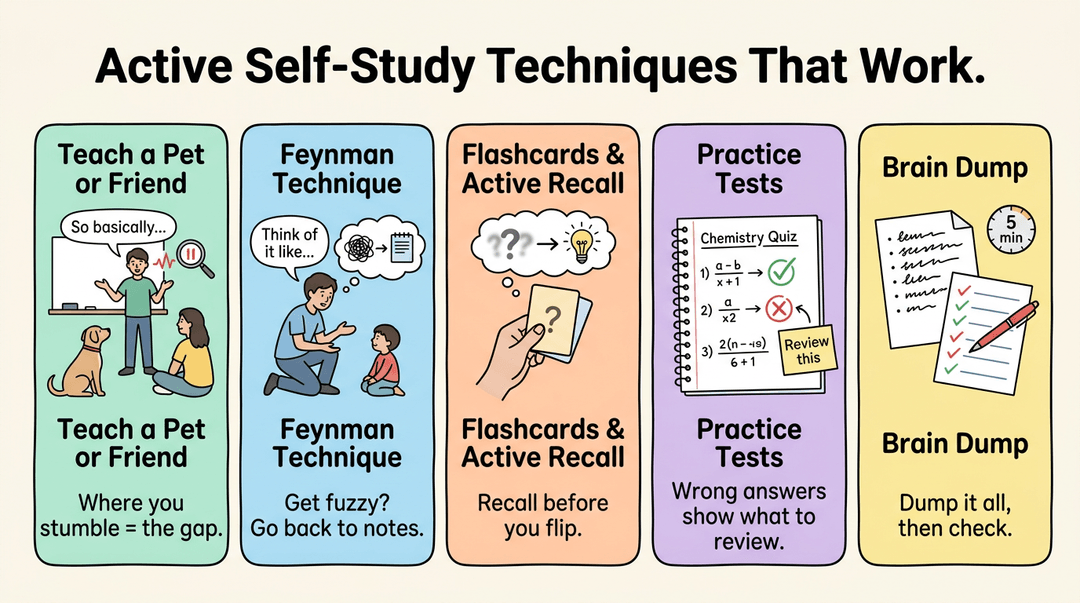
Active self-study techniques that work
- Teach a pet or friend. Explain the concept out loud. Wherever you stumble, you've found a gap.
- Feynman technique. Explain the idea in plain words, as if to a young learner. Wherever you get fuzzy, go back to your notes.
- Flashcards and active recall. Pull the answer from memory before you flip the card. That retrieval effort is what makes it stick.
- Practice tests. Consider a high school student who quizzes herself on last night's chemistry unit. Each wrong answer shows exactly what to review next.
- Brain dump. Set a timer for five minutes and write everything you remember on a blank page. Then check it against your notes.
Passive studying versus active studying
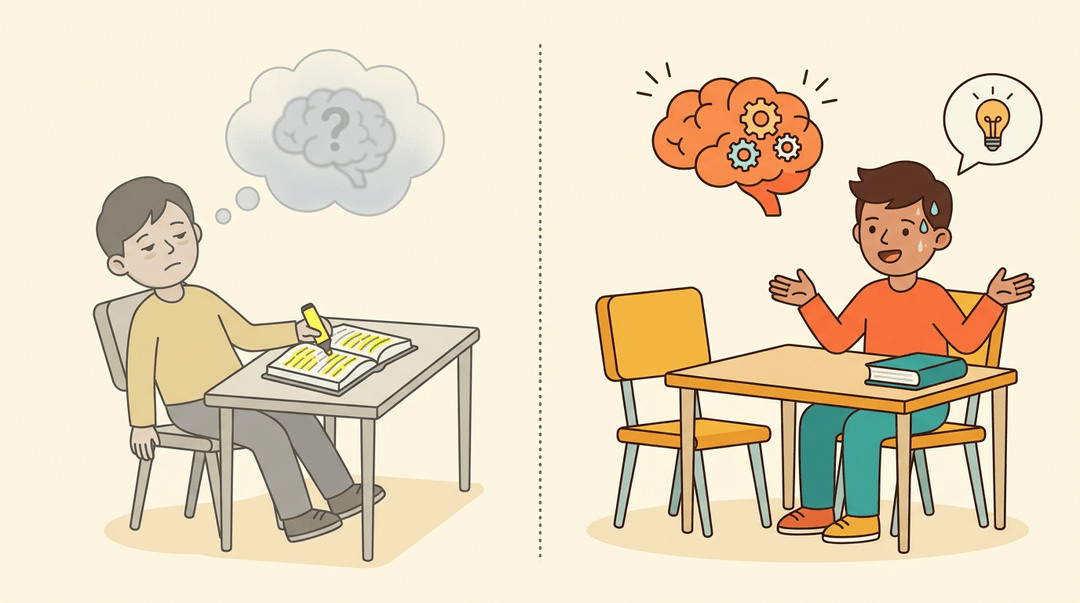
Passive study keeps your brain on autopilot. Active study asks it to work.
| Passive studying | Active studying | |
|---|---|---|
| Brain engagement | Low: recognizing material | High: retrieving and explaining |
| Typical methods | Highlighting, rereading | Recall, practice tests, teaching |
| How it feels | Comfortable and familiar | Effortful, sometimes frustrating |
| What it reveals | Recognition feels like learning | Retrieval shows what you actually know |
Highlighting and rereading feel productive because the material looks familiar. But familiar isn't the same as remembered.
Active learning isn't about adding flashy activities. It's about giving students regular chances to think, talk, and apply what they're learning, and that shift pays off in deeper understanding. You don't have to overhaul your whole year to start.
Ready to map out where these strategies fit across your units? Check out our Curriculum & Standards feature, an all-in-one online planner for building units, lessons, and standards across the school year.
References
- Active Learning: Creating Excitement in the Classroom - Charles C. Bonwell, James A. Eison — books.google.com.eg
- Active Learning Increases Gateway Engineering Course Outcomes and Closes Preparation Gap for Underrepresented Students — doi.org (2025)
- Practice Makes Perfect — cs.cmu.edu (2025)
- Active Learning - Detailed Overview — ctli.vermontstate.edu
- How active learning can improve inequities in STEM — tll.mit.edu
- Incorporating Active Learning into a Large Lecture Course — cee.ucdavis.edu
- Topic Brief 4: The Zone of Proximal Development: An Affirmative Perspective in Teaching ELLs and MLs — nysed.gov
Frequently asked questions
What are the top 10 active learning strategies?
1. Ten effective active learning strategies include think-pair-share, active recall, practice testing, spaced retrieval, case studies, group problem-solving, role-play, simulations, peer teaching, and interactive reflection tools such as polling, concept maps, and minute papers.
What are the five active learning methods?
2. Five widely used active learning methods are collaborative learning, problem-based learning, inquiry-based learning, experiential or hands-on learning, and peer instruction. Each requires students to process, apply, discuss, or explain content rather than only listen to a lecture.
What are the 5 most effective teaching strategies?
3. Five effective teaching strategies are explicit instruction, active learning, cooperative learning, formative assessment with timely feedback, and differentiated instruction. Strong teaching usually combines these approaches around clear learning objectives and student needs.
What are the four main approaches to active learning?
4. Four useful approaches to active learning are collaborative learning, experiential learning, inquiry-based learning, and reflective learning. They involve students working with others, doing or testing something, investigating questions, and thinking about what they learned and how they learned it.
What are five steps to active learning?
5. Five practical steps are to define the learning objective, choose an activity that matches it, explain the task and expectations, set a clear time limit, and end with reflection or feedback. This sequence keeps active learning focused rather than turning it into unstructured group work.
What are the four learning strategies?
6. Four broad learning strategies are rehearsal, elaboration, organization, and metacognition. Rehearsal practices information, elaboration connects it to existing knowledge, organization structures it, and metacognition involves monitoring and adjusting one's learning.
What are the techniques of active learning?
7. Active learning techniques include think-pair-share, discussion and debate, peer instruction, jigsaw groups, case studies, problem-solving, role-play, simulations, hands-on tasks, active recall quizzes, concept mapping, polling, minute papers, exit tickets, and teach-back activities. The common feature is that students think, apply, explain, create, or reflect during the lesson.
What is Vygotsky's theory of active learning?
8. Vygotsky's theory views learning as a socially constructed process in which learners build understanding through interaction with others. His zone of proximal development describes tasks students cannot yet complete independently but can accomplish with guidance or collaboration, often through scaffolding from a teacher or more capable peer.