Adaptive Physical Education Meaning, Explained in Plain Terms

Jump to section
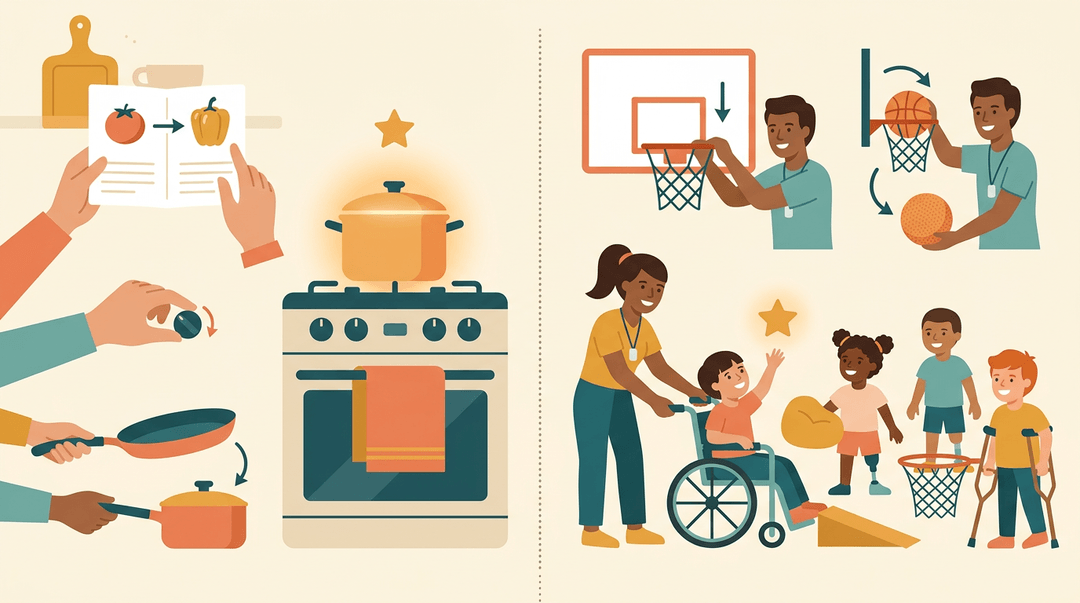
Think about the last time you tried a new recipe. You followed the steps, but you swapped an ingredient, changed the pan, or lowered the heat so nothing burned. The dish still worked because you adjusted the method, not the goal.
Adaptive physical education works the same way.
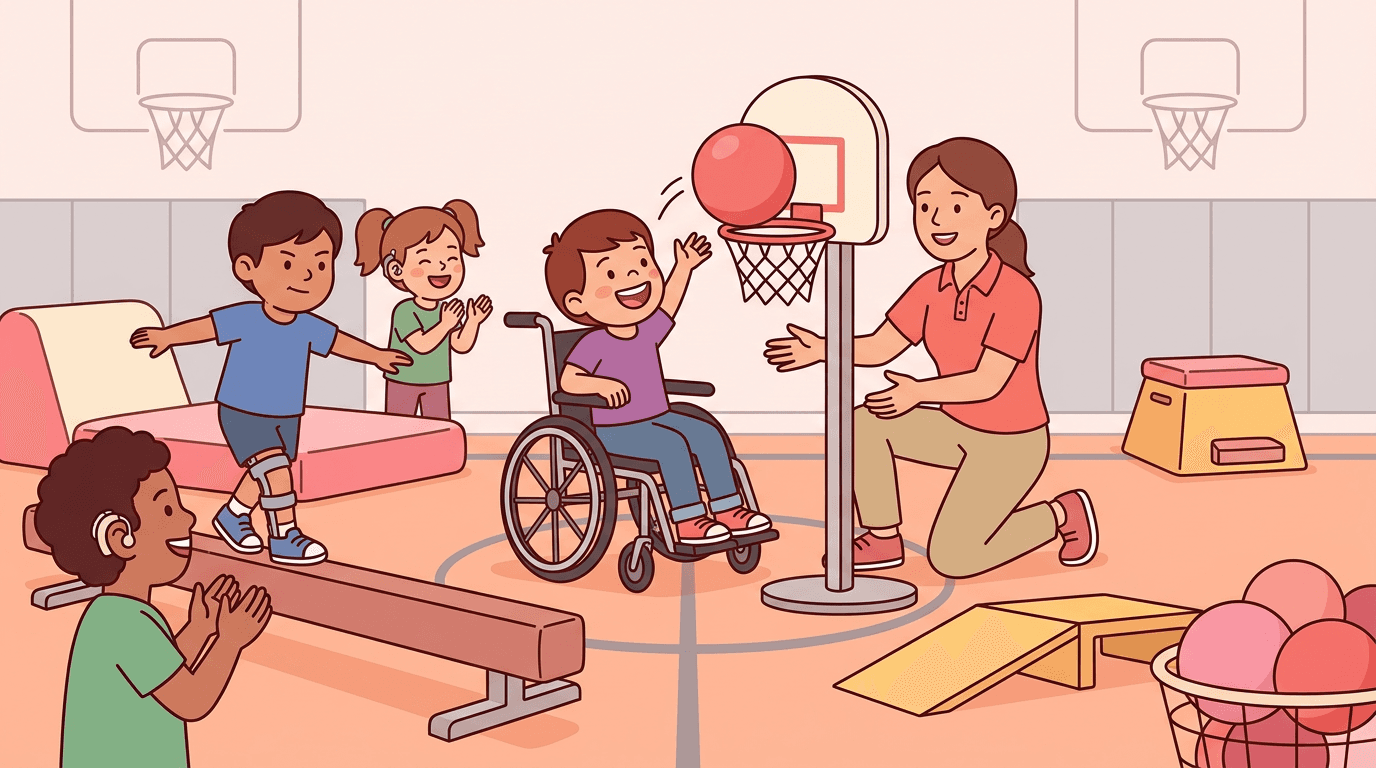
In plain terms, adaptive physical education (APE) is PE that changes activities, equipment, rules, or pace so every student, including those with disabilities, can take part and work toward the same core goals.
It has a legal basis, and it differs from adaptive teaching and inclusive PE in useful ways. This post covers what it means, how teachers modify activities, and a lesson-planning guide you can use this week.
What Adaptive Physical Education Means
Adaptive education broadly means adjusting instruction so every learner can reach the same goals. In adaptive physical education (APE), that means changing how students participate, not whether they do.
SHAPE America's eligibility criteria notes that the Individuals with Disabilities Education Act (IDEA) and Section 504 provide the legal basis for adapted physical education.
What is adaptive teaching in PE?
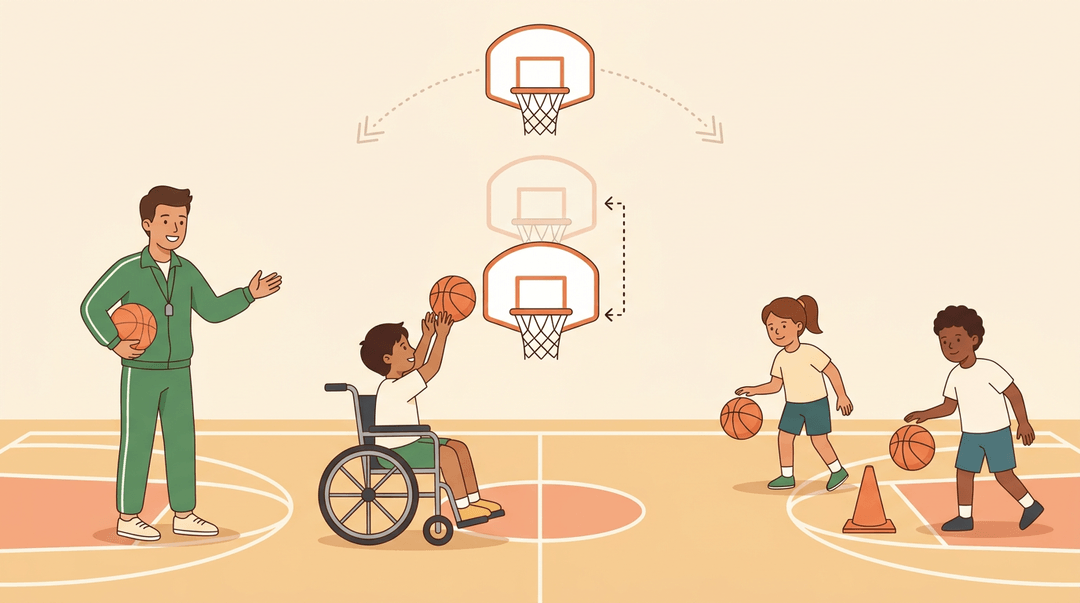
Adaptive teaching in PE means a modified curriculum tailored to individual needs. Picture a fourth-grade teacher who keeps the basketball unit but lowers the hoop for one student and adds a dribbling station with no defenders.
That's differentiation of instruction: the goal stays, and the path changes. Teachers may add special equipment and activities, like lighter balls, but every change must ensure safety and effectiveness.
Adaptive teaching is the strategy; adapted PE is the formal service for students who qualify.
Who adaptive PE is designed to help
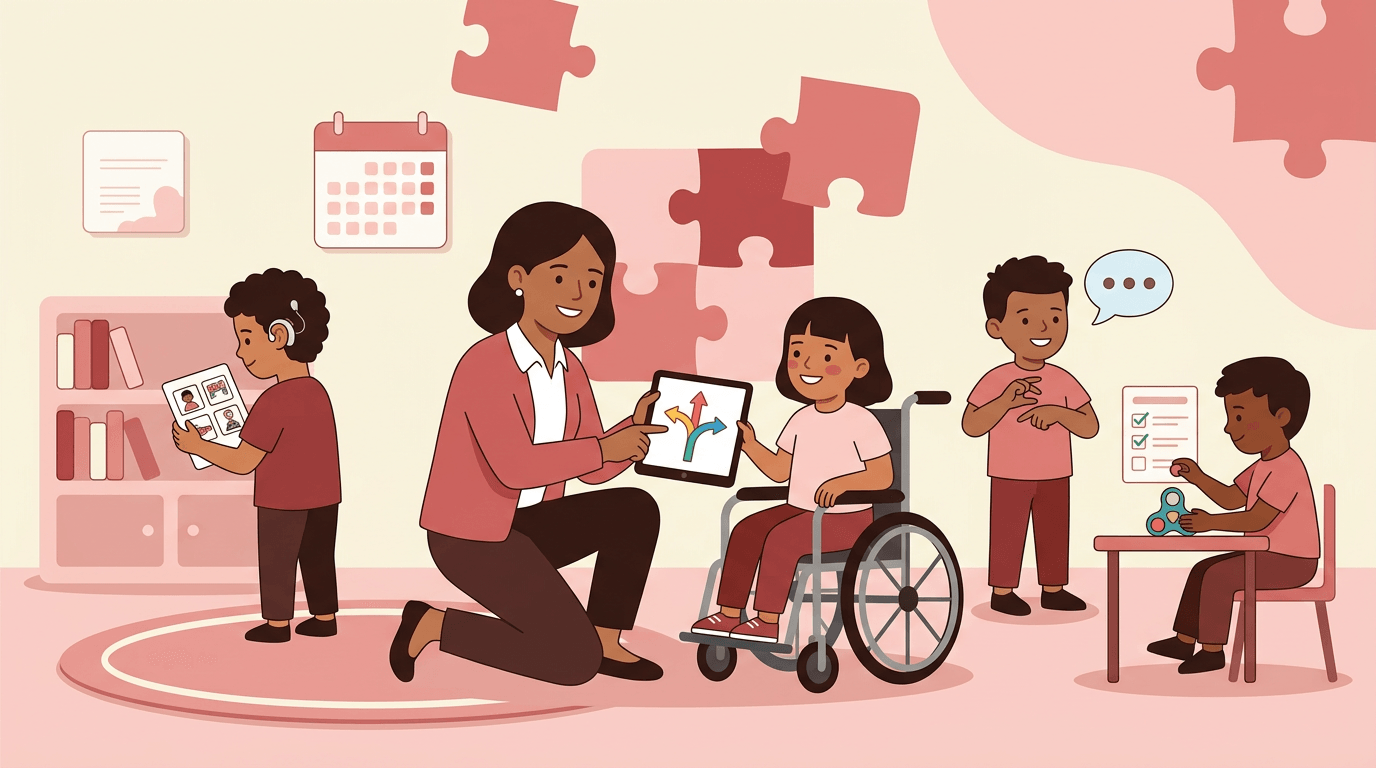
Adaptive PE is built for students with disabilities, including students with autism, visual or hearing impairments, mobility issues, or brain injuries. General students benefit too, since more movement options help everyone. Access comes first.
The core principles behind adaptive PE
- Individualization: planning around each student's strengths and needs.
- Adaptation: changing the task so students can take part.
- Inclusion: learning alongside peers.
- Equal access to education: a real chance to learn for every student.
Adapted PE serves individual students, modified PE reshapes a whole class, and inclusive PE keeps everyone together.
How Teachers Modify PE Activities
Good adaptations start with one question: what does this student need to take part? Once you know, you can change the gear, the rules, the space, or the plan, and the activity stays the same for everyone. The goal is participation, not perfection.
Adapting equipment for different needs
Equipment is often the quickest fix. Think of a fifth-grade PE teacher whose students with limited grip keep missing a standard ball.
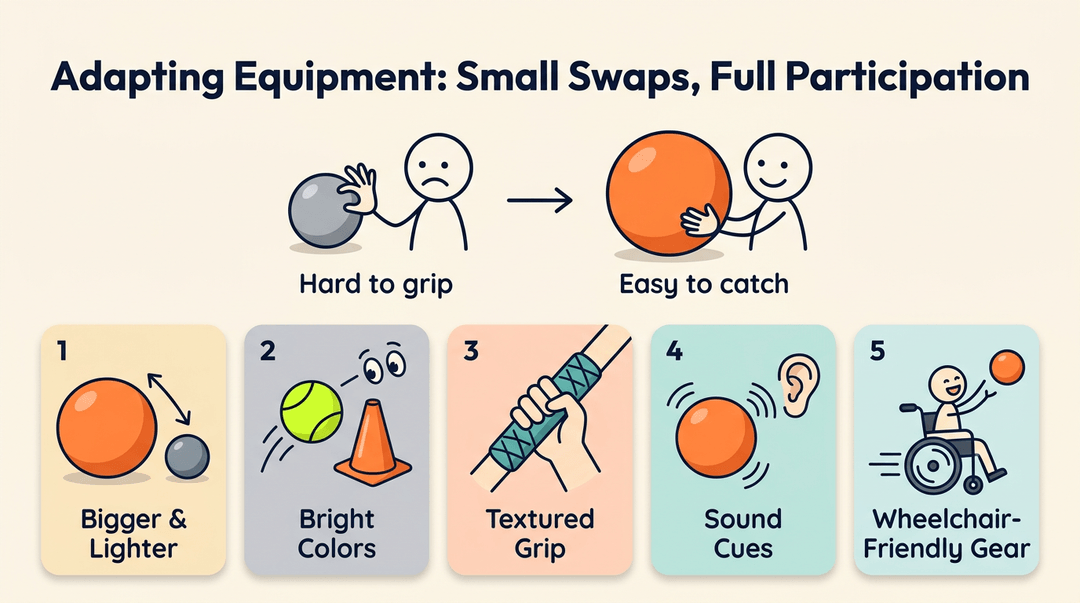
Swapping in a larger, lighter ball gives them a real chance to succeed, and the game keeps moving. Useful options include:
- Larger or lighter equipment that's easier to see, catch, and throw
- Brightly colored gear that helps students track a ball or cone
- Textured surfaces for grip, such as tape or textured handles
- Sound-emitting objects so students can locate a ball by hearing it
- Wheelchair-accessible equipment that lets students move and play fully
Adjusting rules so everyone can play
Rules are another lever. Consider a middle school teacher whose basketball unit keeps the same two players on the ball. A simple rule that everyone touches the ball before a team can score spreads the action around. Other adjustments include:
- Adjusting team size so each student gets more touches
- Using scooters for students with mobility issues
- Introducing adapted sports such as sitting volleyball and goalball
- Using softer balls or balloon polo for lower-impact play
Same game, new access.
Changing the playing area for accessibility
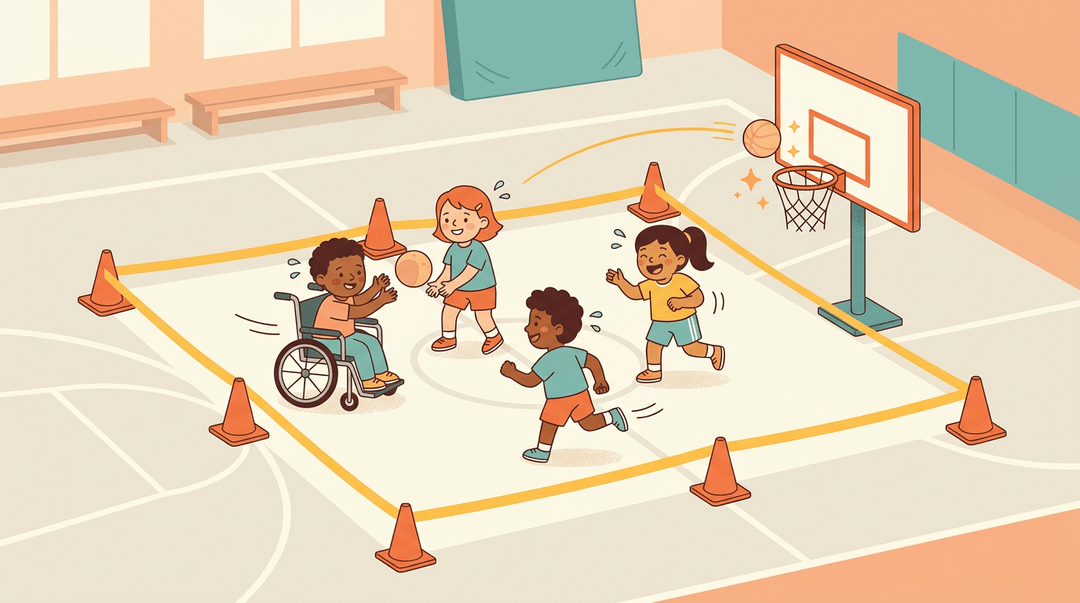
Space matters as much as gear. Small-sided games, played with fewer players on a smaller court, mean more repetitions and less waiting. Pair that with clear boundaries, such as bright cones or tape lines, so students always know where to go.
You can also lower targets and hoops so a student can score and feel the win.
Planning lessons around each student
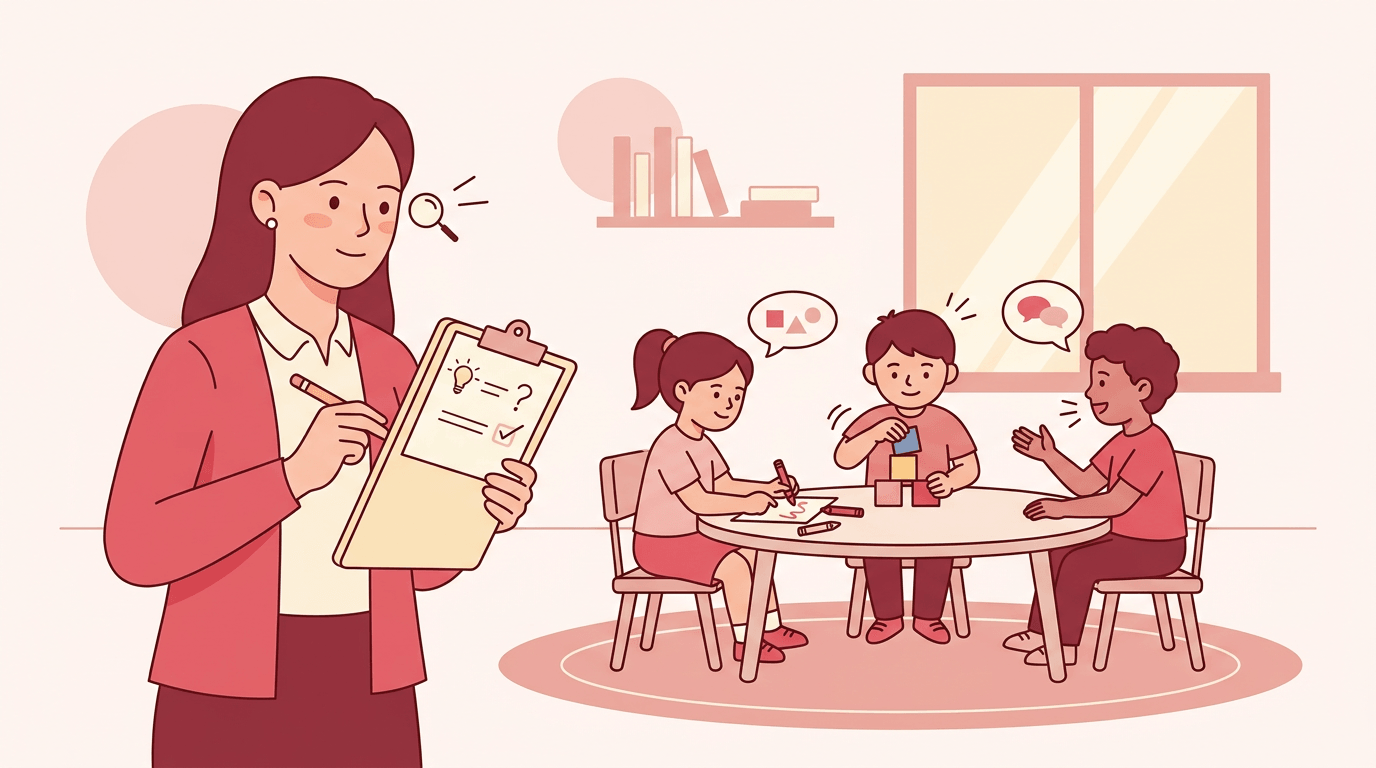
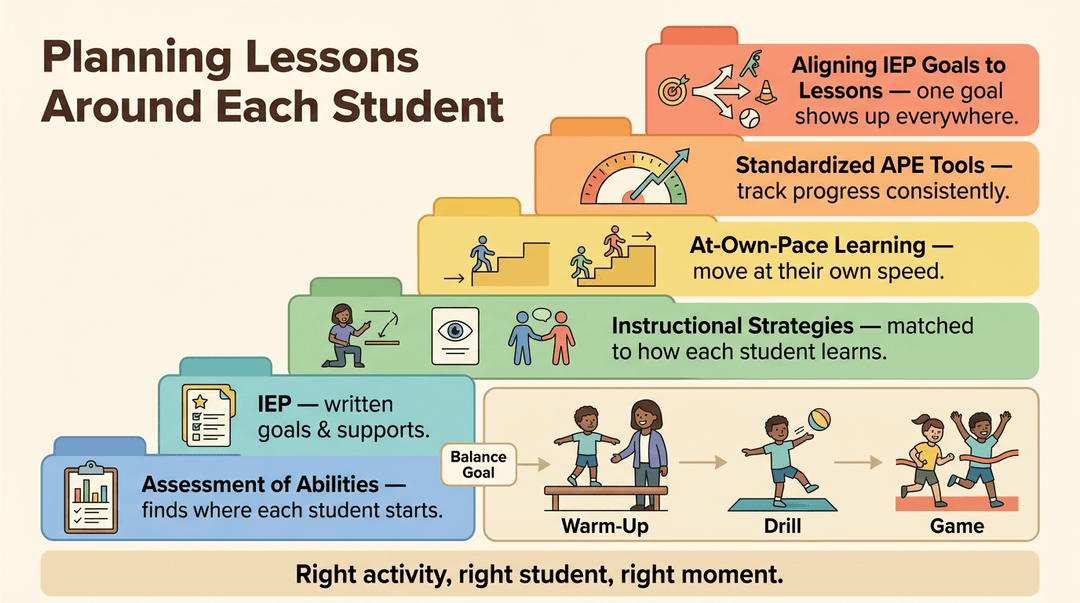
This is where the pieces come together. Start with an assessment of abilities so you know each student's strengths, gaps, and goals. Then build from there:
- Assessment of abilities to find where each student starts
- Individualized education programs (IEPs), written plans that set goals and supports for students who need them
- Instructional strategies matched to each learner, like demonstrations, visual cues, or partner work
- At-own-pace learning that lets students move through skill levels at their speed
- Standardized APE assessment tools that track progress with consistent measures
- Aligning IEP goals to lessons so a goal like better balance shows up in warm-ups, drills, and games
Picture a special education teacher whose student has a balance goal in their IEP. She builds balance stations into every warm-up, so the goal shows up each class and the student joins the relay with more confidence.
Right activity, right student, right moment.
Planning an Adaptive PE Lesson
Reach for this card when you're building a PE lesson around students' IEP goals. It runs in three phases: prepare, teach, record.
Before the lesson
Do these in order, since each one shapes the next.
- Review each student's IEP goals
- Pick the one or two goals PE can move, like "catches a ball with two hands."
- Check equipment and space needs
- Jot it down: foam ball, wider lane, clear path, quiet corner.
- Set one measurable objective
- Name the skill, the support, and the count.
Here's what separates a usable objective from a vague one:
✅ Maya will catch 4 of 5 underhand tosses from 10 feet using a foam ball.
❌ Students will improve their catching.
The difference: the first names the skill, the support, and the count, so you can tell afterward whether it happened.
During the lesson
Offer the same skill at three levels and let students choose their starting point.
| Tier | What changes |
|---|---|
| Easier | Softer ball, bigger target, shorter distance |
| Core | Standard ball and distance |
| Challenge | Smaller target, moving partner, added count |
⚠️ Watch out: Tiers are options, not labels. Let students move between them without announcing who's where.
Keep one eye on engagement and safety, and adjust as you go:
| When you see... | Try... |
|---|---|
| A student frustrated or drifting off | Drop one tier. Say: "Want to try the closer line?" |
| Crowding or near-collisions | Pause, then reset lanes and spacing |
| Students succeeding every rep | Move them up a tier |
| Long waits between turns | Add a station or shorten the rotation |
After the lesson
Take two minutes while it's fresh. A simple log keeps it quick:
| Log this | Sample entry |
|---|---|
| Progress toward IEP goal | Maya: 3 of 5 catches at 10 feet, up from 2 |
| What worked | Foam ball helped; floor markers didn't |
| Share with support team | One-line note with the next step |
Example: A fourth-grade teacher plans a catching lesson for a student whose IEP goal is two-handed catching. She sets out foam balls and a marked lane, then runs three distances. When the student drops three in a row, she moves her one tier closer. Afterward she logs the count, notes the foam ball worked, and emails the occupational therapist a single line.
Map each adaptation and IEP goal across the year with EMStudio's curriculum planner.
Why Adaptive PE Matters
When you think about adaptive physical education (PE), think beyond getting students moving. It shapes how they grow, feel, and function on the field and off it.
Building strength and motor skills
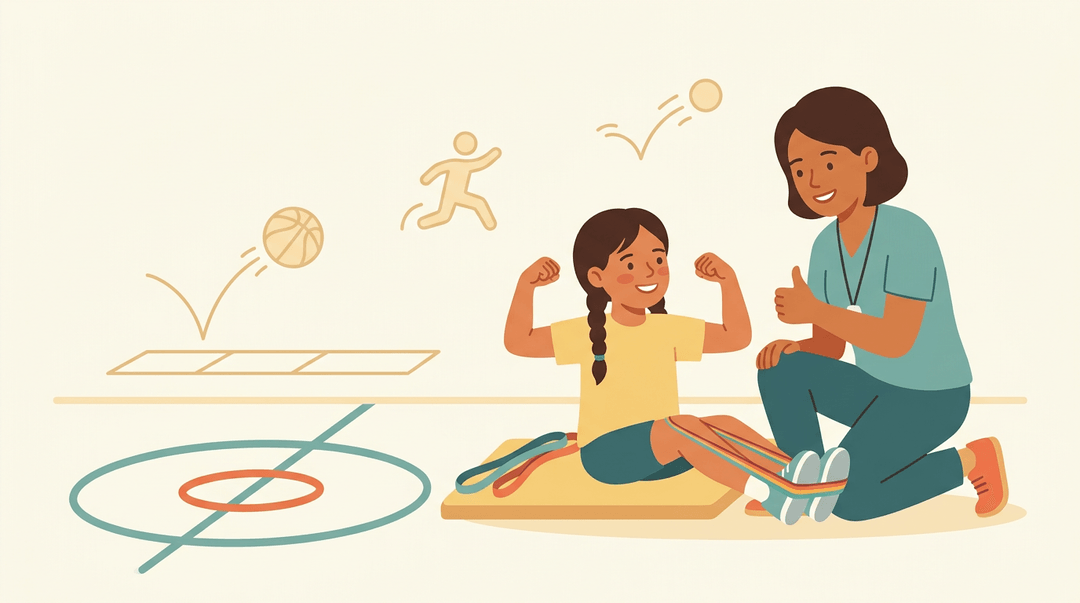
Adaptive PE helps students build physical fitness through activities matched to their abilities. Consider a fourth-grader with low muscle tone who builds strength with resistance bands at her own pace.
Over time, that practice builds motor skills like throwing, jumping, and catching. Strength, flexibility, and coordination grow together, and short, repeatable balance drills help students control their bodies with confidence.
Growing confidence and social connection
Social interaction and collaboration happen when students work in pairs or small teams on tasks suited to their skills. Think of a student who is always picked last.
When his teacher gives him a role that plays to his strengths, he suddenly has a job that matters. Each small win boosts self-esteem, and clear personal goals reduce stress and anxiety compared with constant comparison.
Success is less about being the fastest and more about belonging to the team. The student who used to hang back starts calling for the ball.
Developing focus and everyday life skills
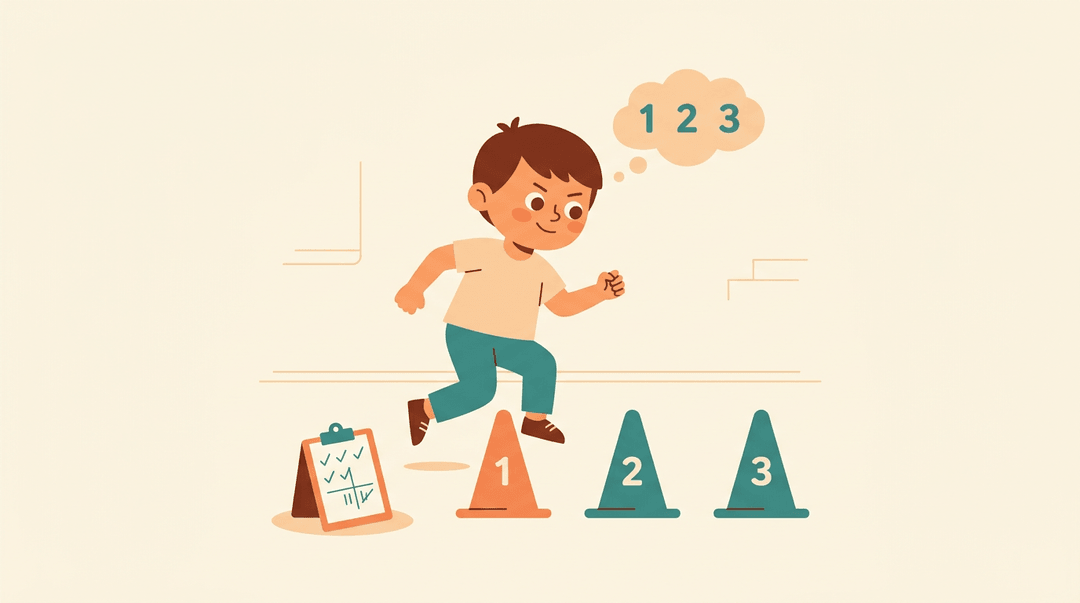
Activities with multi-step directions or a sequence to remember strengthen cognitive skills, the thinking processes behind learning. A game with three rules asks students to hold all of them in mind while they move.
Better concentration follows from short, focused tasks with clear cues. Students also develop independence when they set up equipment and track their own scores. These life skills carry into the hallway, the home, and the workplace.
A student who can plan a warm-up and stick to it is building habits for life.
Making PE accessible and inclusive
Every student deserves equitable access to PE, meaning the same chance to learn and be active regardless of ability. Adaptive PE makes that real by changing equipment, rules, or space instead of sidelining anyone.
Picture a teacher who swaps a fast relay for a rolling-ball station everyone can join. Nobody sits out, and everyone practices the same skill.
An inclusive environment lets students with and without disabilities train and cheer together, and equal participation opportunities mean every student gets a turn and useful feedback.
Adaptive PE in Action
Adaptive physical education looks different in every gym because it's built around the student in front of you.
What adaptive PE looks like in practice
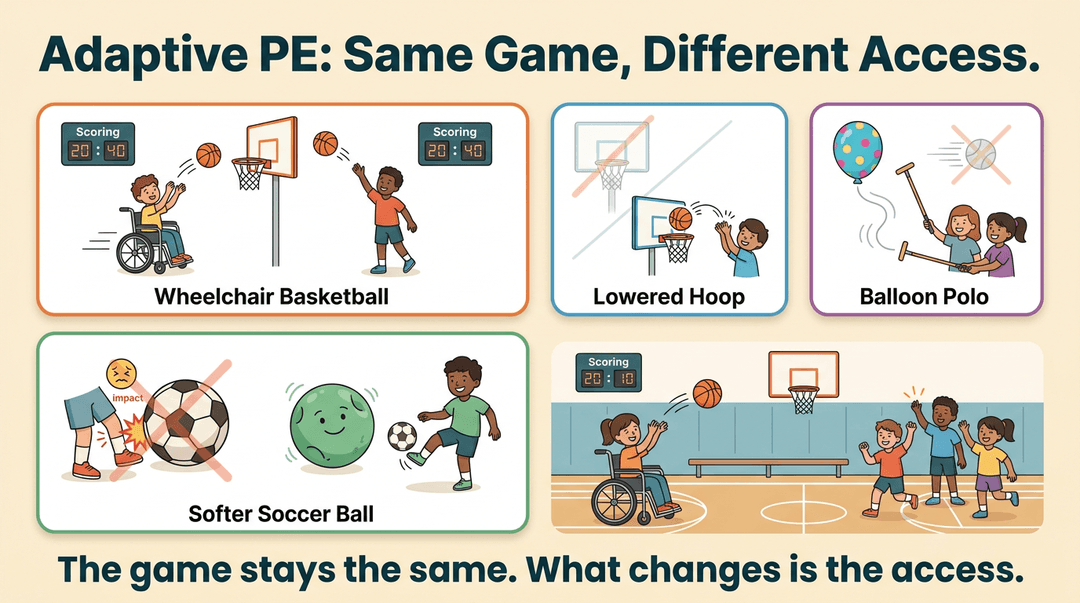
Adaptive PE changes the equipment, the rules, or the space so every student can take part. A few common examples:
- Wheelchair basketball: Students play with the same goal and scoring, but they move with their chairs.
- Lowered basketball hoop: Shooters practice the full motion and feel success on more attempts.
- Softer balls in soccer: Students can control, pass, and kick without fear of a hard impact.
- Balloon polo: A lightweight balloon slows the game down, so students can track it and join in.
Consider a middle school PE teacher with a student who uses a wheelchair. Instead of sitting that student out, she runs a wheelchair basketball station, and the student scores in the same game as everyone else.
The game stays the same. What changes is the access.
Common goals behind adaptive PE lessons
Most adaptive lessons aim for a few shared outcomes:
- Develop motor and physical skills: Build balance, coordination, and strength at each student's pace.
- Equal participation opportunities: Every learner gets reps, turns, and time on task.
- Social-emotional well-being: Confidence and teamwork grow when students feel included.
- Promote healthy lifestyles: Students build habits they can carry beyond the gym.
- Translate objectives into measurable targets: Swap "be active" for "completes three laps without stopping" so you can tell what's working.
Becoming an Adaptive PE Teacher
Wondering what an adaptive PE teacher actually does, what training it takes, and what it pays? Here's what we'll look at.
What the job involves day to day
Adaptive PE teachers design modified programs so every student can take part. Think of a fourth grader with low muscle tone who can't keep up in a running relay.
Her teacher might build a seated version with lighter equipment so she still contributes to her team.
Before planning, you assess student abilities to find each child's strengths and gaps.
You'll also help create the individualized education program (IEP), the written plan that sets a student's goals and supports, and choose adaptive techniques and technology, like visual cues or adjustable equipment.
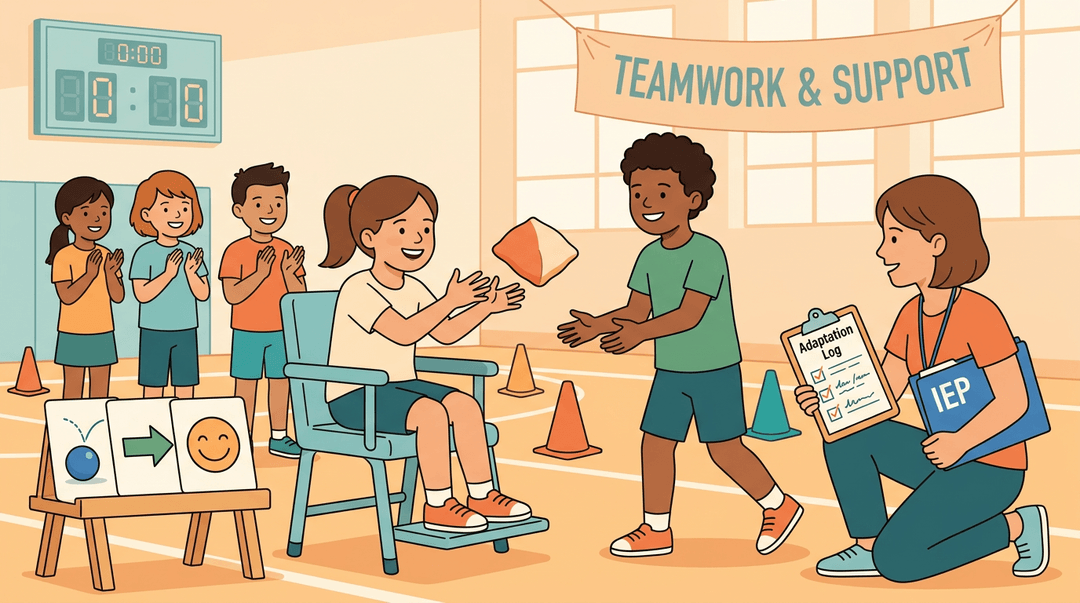
Keep an adaptation log of every change you make and how the student responds. It's your compliance record. When a parent or administrator asks why a plan looks the way it does, the log is your answer.
Working alongside other specialists
This job is a team sport. You'll work closely with special education teachers, who know each student's classroom needs, and partner with occupational therapists (OTs) on movement skills.
You'll also coordinate with administrators and parents so everyone knows the plan. The aim is shared planning, not a separate track for these students.
Education and certification you'll need
Here's the typical path:
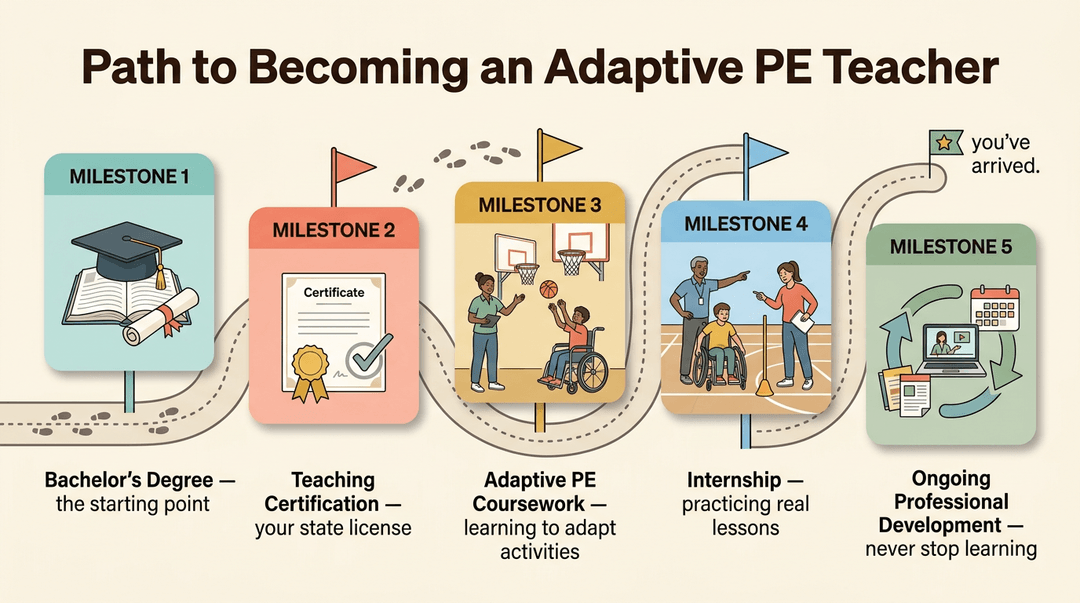
- Bachelor's degree: required, and the starting point for everything else.
- Teaching certification: the state credential that qualifies you to teach.
- Specialized adaptive PE coursework: training in adapting activities for students with disabilities.
- Internships and hands-on experience: practice adapting real lessons before you're on your own.
- Continued professional development: ongoing training that keeps your skills current.
What adaptive PE teachers earn
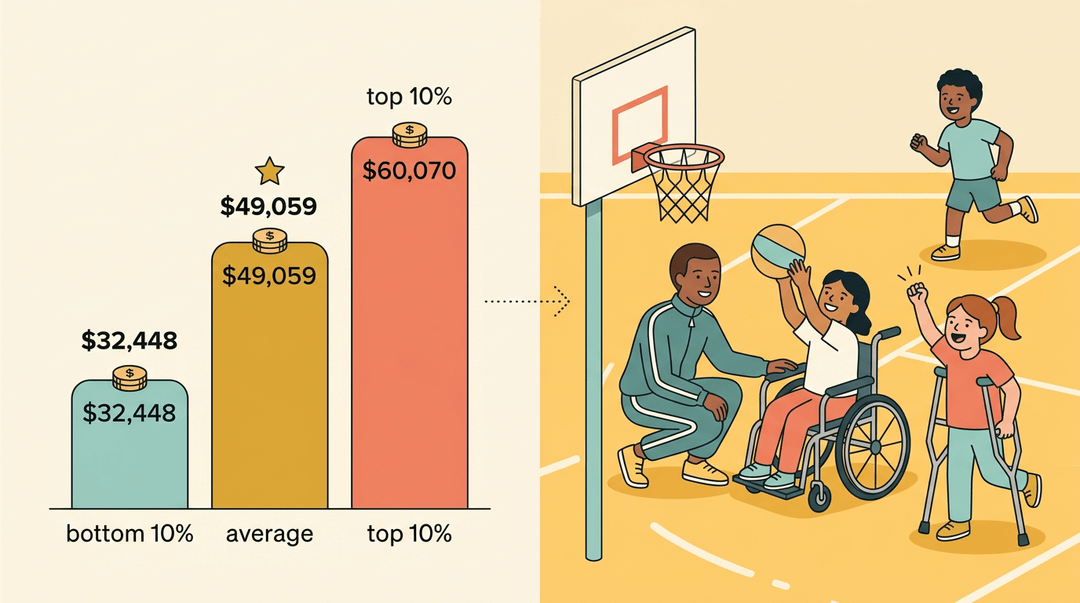
According to NACDD's career overview, an adaptive PE teacher makes about $49,059 a year on average, or roughly $23.59 an hour, in the United States. Pay also spreads widely by percentile.
The bottom 10% earn about $32,448 a year, while the top 10% earn about $60,070, per the same NACDD data.
That's a wide range, and it's worth knowing before you choose a path.
Adaptive physical education comes down to one idea: every student deserves a real chance to move, play, and grow. When you change the activity instead of lowering the expectation, students who once sat out start participating fully.
Ready to build your next adaptive PE unit? Check out our Curriculum Planner to plan units, lessons, and standards across the whole school year.
References
Frequently asked questions
What is adaptive teaching in PE?
Adaptive teaching in PE means modifying instruction, equipment, rules, space, or pace to meet individual student needs while keeping the core learning goal the same. For example, a teacher might lower a basketball hoop, use a lighter ball, or provide visual cues so a student can practice the same skill as classmates.
What are the main goals of adapted physical education?
The main goals are to develop motor and physical skills, provide equal opportunities to participate, support confidence and teamwork, promote healthy lifelong habits, and set measurable learning targets. Lessons are adjusted to each student's abilities while maintaining meaningful expectations.
Can you give me some examples of adaptive physical education?
Examples include wheelchair basketball, lowered basketball hoops, softer soccer balls, balloon polo, sitting volleyball, and goalball. Other adaptations include larger or lighter equipment, textured grips, sound-emitting balls, smaller playing areas, adjusted team sizes, and shorter distances.
What does adaptive education mean?
Adaptive education means adjusting instruction so every learner can work toward the same educational goals. In physical education, this may involve changing the equipment, rules, activities, space, or pace so students with different abilities can participate safely and effectively.