Proficiency Scales 101: From the 1-4 Levels to Classroom Use

Jump to section
Think about the last time you checked a map before a road trip. You didn't just want to know that you'd arrive. You wanted to know how close you were and what was left to cover. Proficiency scales do that same job for learning.
They break a learning goal into clear levels so you and your students can see exactly where things stand.
In this post, we'll explain how the 1-4 levels work, how they connect to grading and instruction, and what they look like by subject, plus a practical guide to writing one for your own classroom.

What Proficiency Scales Are
A proficiency scale shows where a learner stands on a skill, step by step, rather than handing over one final score. Here's how it works, starting with the core idea.
What Does Academic Proficiency Mean?
Academic proficiency describes a learner's current status on a specific learning target.
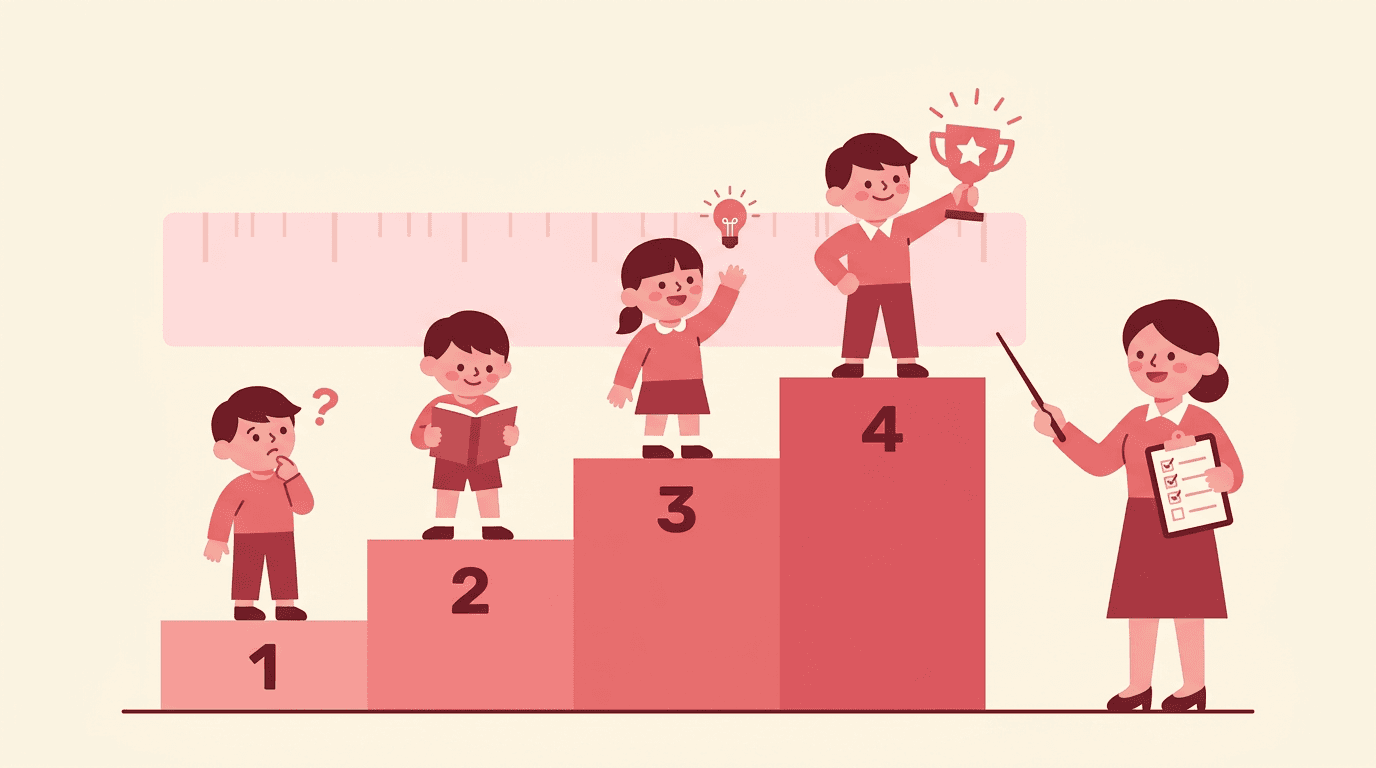
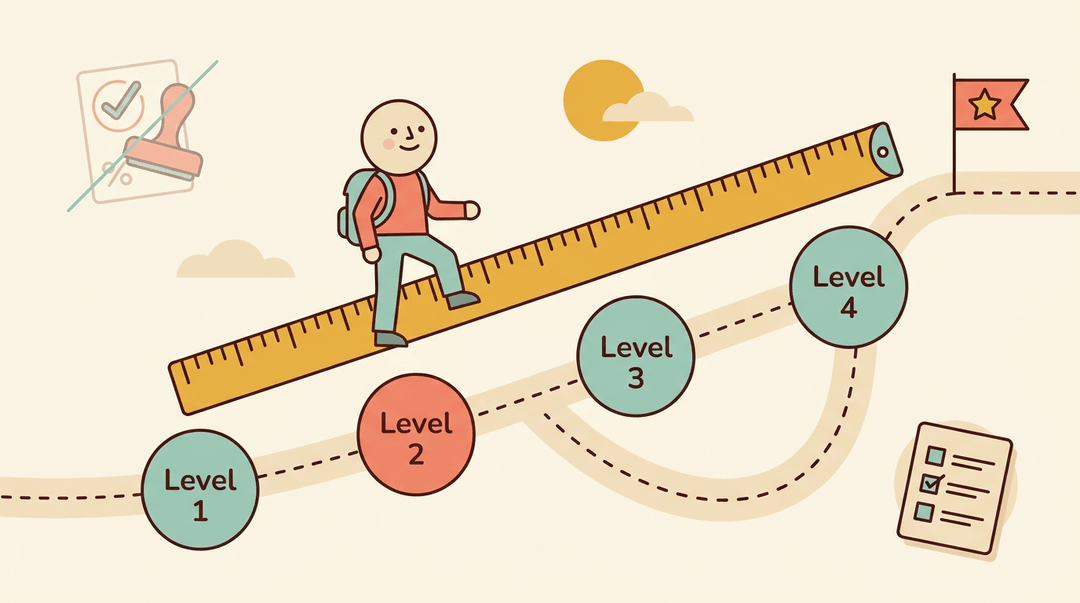
Think of it as a ruler rather than a verdict: it measures how far a student has traveled along a learning progression, and that distance can be reported in different units, like levels, percentages, or descriptive phrases.
A proficiency scale tracks status rather than points. It isn't a grading tool itself, though it can inform one. Proficiency scales also differ from rubrics. A rubric judges a finished product, while a scale tracks growth across a target.
How Do You Measure Proficiency Level?
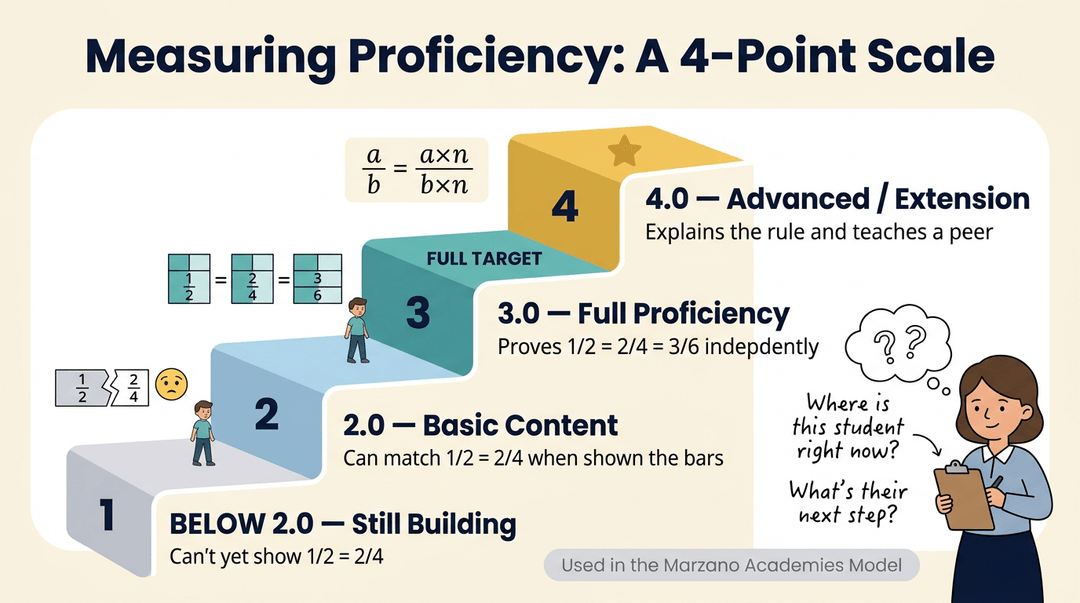
Most scales use four levels:
- Level 2.0: the student is knowledgeable of the target's basic content.
- Below 2.0: foundational building is still underway.
- Level 3.0: the student demonstrates proficiency on the full target.
- Level 4.0: advanced, extension work beyond the target.
Ask yourself two diagnostic status questions: where does this student stand right now, and what's the next step? Consider a fifth-grade teacher checking fraction equivalence.
Her answers place each learner on the scale, so she knows who needs reteaching on Monday and who's ready to extend. You'll also see this approach in the Marzano Academies model, so it's worth knowing the name.
Building a Classroom-Ready Proficiency Scale
This is a build-and-launch guide: write one scale in four steps, check it against three samples, then get students using it. Start with a single standard, not a whole unit.
Write the scale in four steps
Write the 3.0 before the 2.0 and 4.0, because both are defined by their distance from it. Here's one scale built from a middle school math standard.
- Identify your target standard
- Pick one standard and name the single thing students must do.
- Example: "Solve multi-step linear equations."
- Write the 3.0 proficient descriptor
- Describe what students show when they've fully met the standard.
- "I can solve two-step equations and explain each step."
- Draft the 2.0 foundational skills
- List the vocabulary and prerequisite skills the 3.0 rests on.
- "I can solve one-step equations and name the inverse operation."
- Add the 4.0 extension task
- Describe thinking that goes beyond the standard, not extra practice.
- "I can write and solve an equation for a situation I choose."
⚠️ Watch out: A 4.0 isn't "more of the same." If it's just ten extra problems, rewrite it as a new kind of thinking.
Three samples to borrow from
At a glance: the same 2.0 / 3.0 / 4.0 pattern across grade bands.
| Grade band | 2.0 | 3.0 | 4.0 |
|---|---|---|---|
| Elementary reading | I can retell the key events | I can retell a story and name its message | I can compare messages across two stories |
| Middle school math | I can solve one-step equations | I can solve two-step equations and explain | I can write equations from real situations |
| High school science | I can define independent and dependent variables | I can design a fair test with controls | I can critique a flawed experiment and redesign it |
Notice that every 3.0 starts with a verb students can show, not "understand."
Roll it out in class
A scale only works if students can see it and use it. Run through these before and during the unit.
- Share the scale before the unit starts. Post it and walk through it on day one.
- Use student-friendly language. Write in "I can" statements, like the samples above.
- Reference the scale in feedback. Point to the level and the next step up.
- Track status over time. Record each student's level after every assessment, so growth shows as a trend.
Try this feedback line: "Your work shows a solid 2.0. To reach 3.0, explain why you divide in step two."
Example: A seventh-grade math teacher posts the equations scale on Monday. After a Friday quiz she writes "2.0, next: explain your steps" on each paper. Students highlight their level on a personal copy, and by the next quiz, most can say what they need to reach 3.0.
Map proficiency scales straight to your units and standards with EMStudio's Curriculum Planner.
Using Scales to Teach and Assess
A scale only matters once it changes what happens next in class. Here's how to act on each level.
Matching Instruction to Student Status
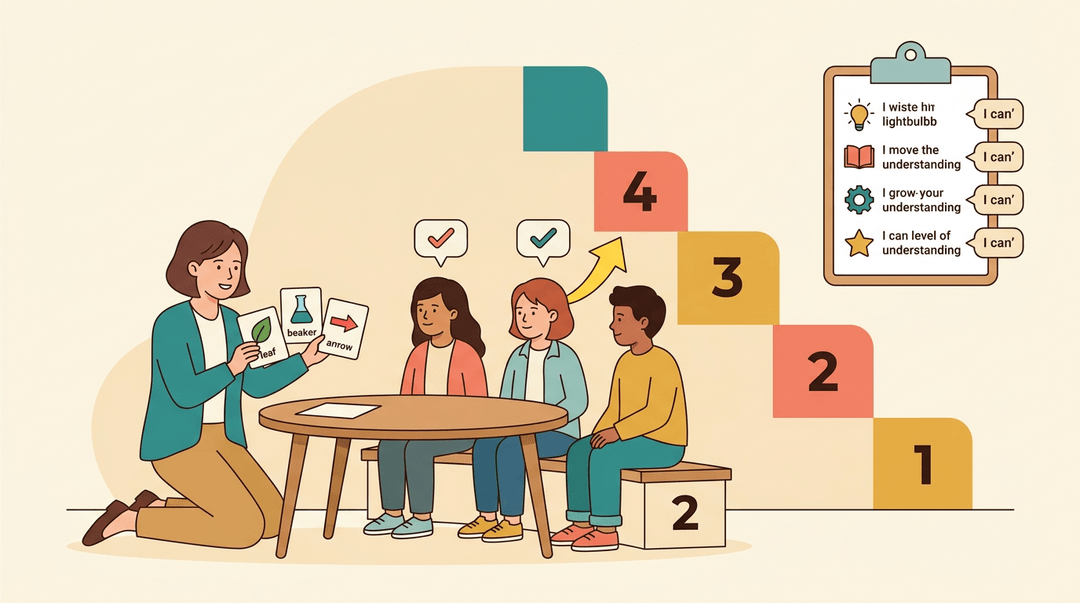
Each level points to a next step. Level 2 students need foundational knowledge building: the core facts and vocabulary everything else rests on. Level 3 students are ready for knowledge application tasks, using what they know in new situations.
Level 4 students tackle cognitively complex tasks.
Consider a seventh-grade science teacher with three students stuck at level 2. Instead of reteaching the whole unit, she offers targeted help: a short vocabulary review with just those three.
By the next quiz, all three reached level 3. Targeted help works.
Write one item per level so results show exactly where each student stands. Then turn the scale into "I can" wording, like "I can explain how my data supports my claim," so students can track their own growth.
Writing a scale works in five steps:
- Start with the learning target.
- Describe a 3: the expected performance.
- Write a 4 that goes deeper and a 2 showing partial understanding.
- Describe a 1 as the simplest foundational piece.
- Test the wording on real student work.
Ongoing Training and Support for Teachers
- Why and how. Our blog covers both the reasoning and the practical steps.
- Learning Hub community channels. Swap scales and feedback with other teachers.
- Office hours for educators. Bring a draft scale and get direct feedback.
- CBE implementer discussions. Connect with colleagues in competency-based education (CBE), where students advance by demonstrating mastery.
How Proficiency Scales Connect to Grades
Once you know what a proficiency scale measures, the next question is how it becomes a grade. Here's where the 1-2-3-4 levels meet the report card.
What Is the Grading Scale 1, 2, 3, 4?
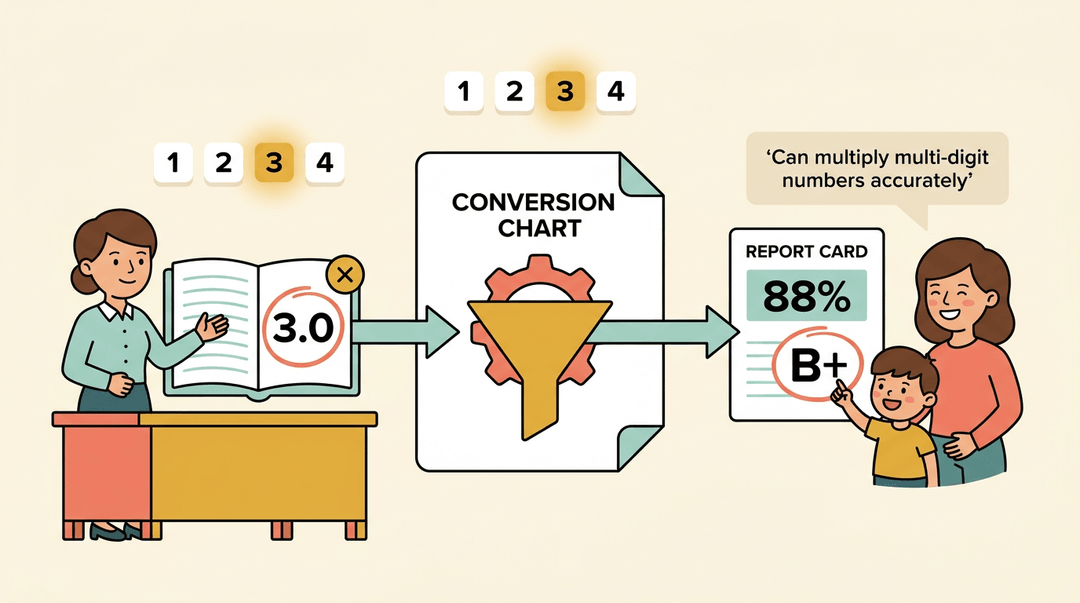
The grading scale 1, 2, 3, 4 is the translation layer between a proficiency rating and the grade families see. A 3.0 marks proficiency, and that rating maps to a percentage in your school's conversion document.
Consider a fifth-grade teacher who records a 3.0 in multiplication. The gradebook converts that rating to a percentage and a letter grade, so the report card speaks the language parents already know.
Because the conversion is an editable document, your community defines its own reporting units and cutoffs. Pair the number with sample report card comment language so each grade says what the student can actually do.
The score reports learning rather than points. Simple, but powerful.
More on Standards-Based Grading
Standards-based grading (SBG) reports how students perform on each standard instead of blending everything into one average. A few companion resources round out the picture:
- SBG practices page
- Family SBG information
- Staff SBG resources
- SBG video series
- SBG FAQ page
Start with the one that answers your most pressing question today.
Proficiency Scales by Subject
Every subject asks students to think in different ways, so a proficiency scale looks a little different in each classroom. Here's how the four levels can look in the subjects you teach most, starting with English language arts (ELA).
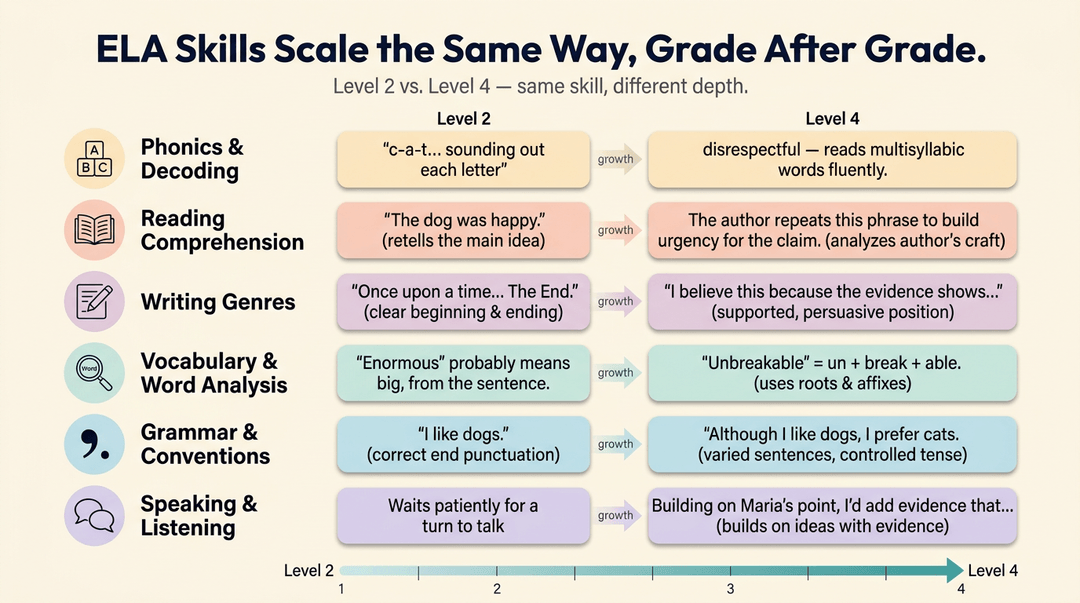
ELA Scales Across Grade Levels
Think of a second-grade teacher tracking decoding. A level 4 student blends unfamiliar words with ease, while a level 2 student still sounds out most words one letter at a time. Each ELA skill follows the same pattern:
- Phonics and decoding: from sounding out single letters to reading multisyllabic words fluently.
- Reading comprehension texts: from retelling the main idea to analyzing how an author builds a claim.
- Writing genres: narrative and argument, moving from a clear beginning and ending to a supported, persuasive position.
- Vocabulary and word analysis: from guessing a word's meaning in context to using roots and affixes to decode new ones.
- Grammar and conventions: from correct end punctuation to controlling sentence variety and tense.
- Speaking and listening: from taking turns in discussion to building on classmates' ideas with evidence.
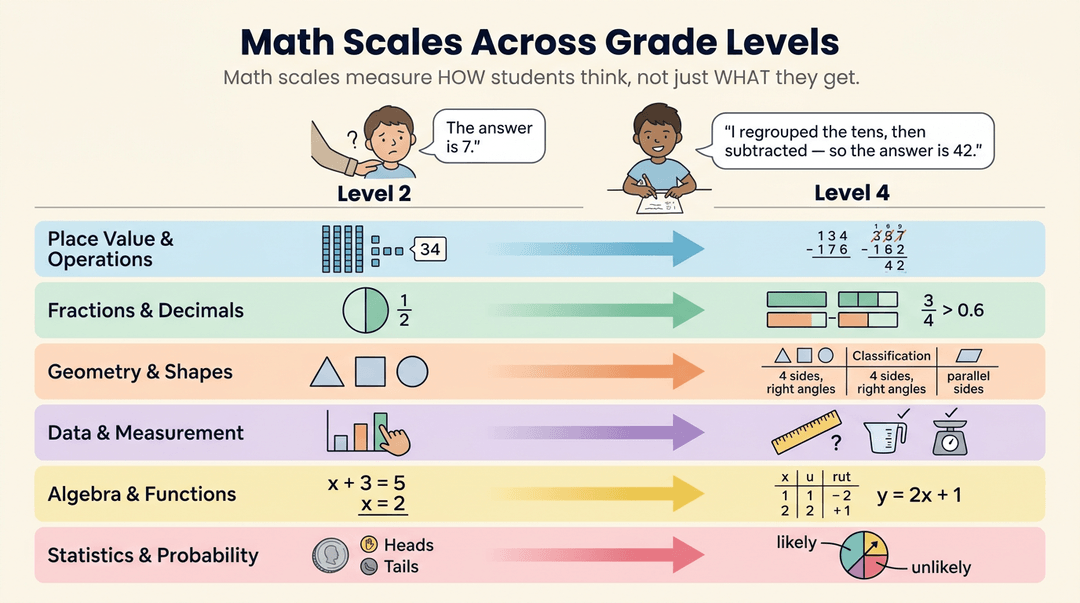
Math Scales Across Grade Levels
Math scales measure how students think as much as what they get. A level 4 student solves a problem and explains the strategy. A level 2 student reaches an answer with help. Consider these areas:
- Place value and operations: from modeling numbers with blocks to applying multi-digit algorithms fluently.
- Fractions and decimals: from naming equal parts to comparing and operating with both.
- Geometry and shapes: from identifying shapes by sight to classifying them by their properties.
- Data and measurement: from reading a simple graph to choosing the right tool and unit for a task.
- Algebra and functions: from solving one-step equations to writing a rule that models a pattern.
- Statistics and probability: from listing possible outcomes to judging how likely a result is.
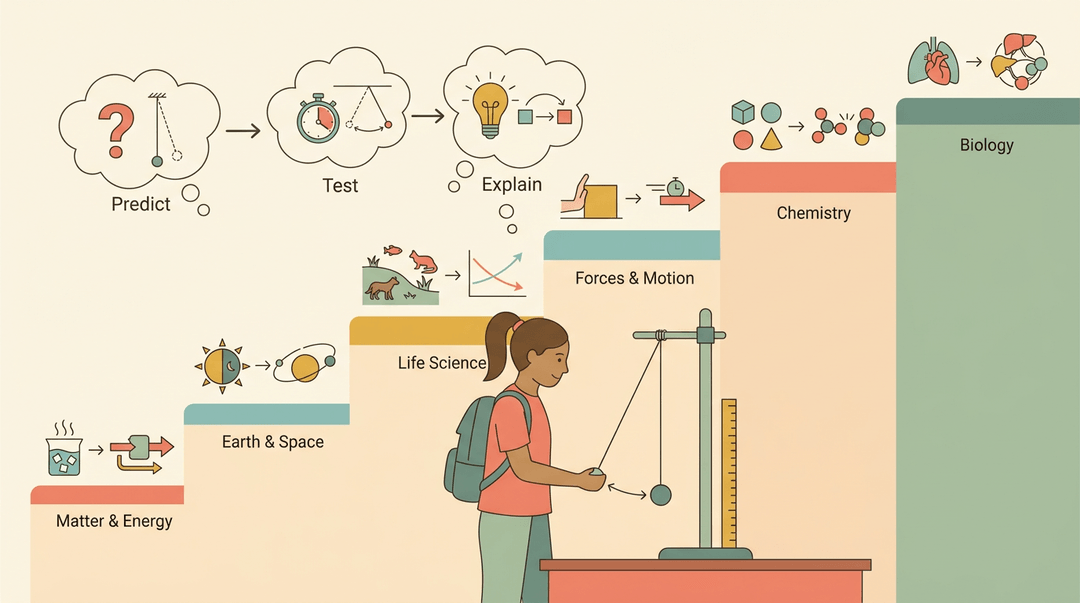
Science Scales Across Grade Levels
Science scales reward reasoning from evidence. A middle school teacher might watch a student predict how a longer string changes a pendulum's swing, test the prediction, and explain the result.
That explanation is the proof of a high score. Across the strands:
- Matter and energy: from naming states of matter to tracing how energy moves through a system.
- Earth and space systems: from describing day and night to explaining seasons with a model.
- Life science and ecosystems: from naming organisms in a habitat to predicting what happens when one population changes.
- Forces and motion: from identifying a push or pull to explaining how force changes speed.
- Chemistry concepts: from sorting substances by observable properties to explaining reactions at the particle level.
- Biology and anatomy: from labeling major organs to explaining how body systems work together.
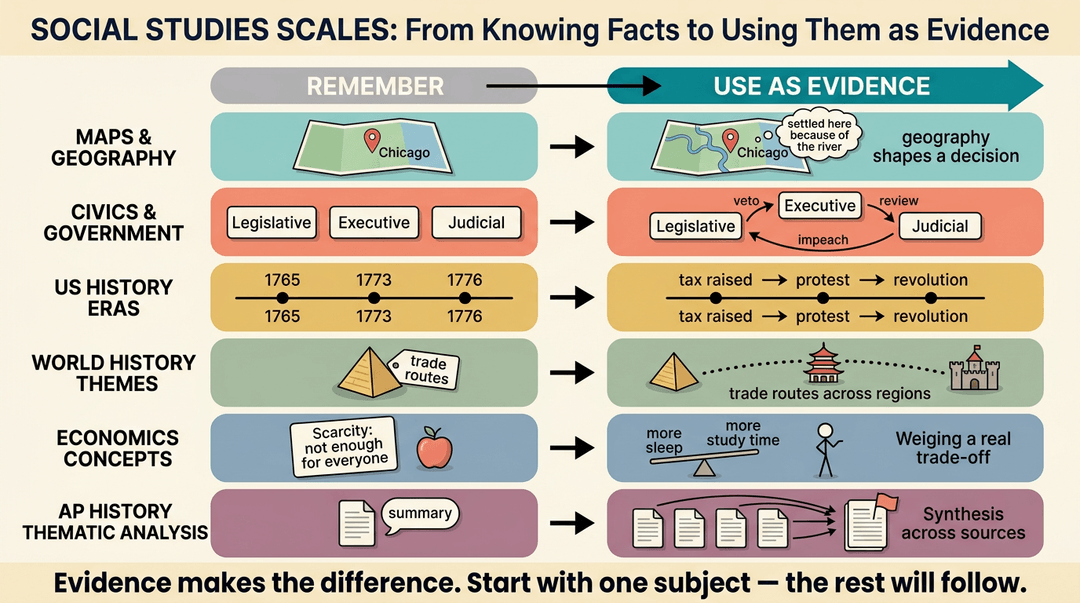
Social Studies and History Scales
Social studies scales move students from remembering facts to using them as evidence. The goal is using the facts, not just knowing them. Here's what that looks like:
- Maps and geography: from locating places to explaining how geography shaped a decision.
- Civics and government: from naming branches of government to comparing how they check one another.
- US history eras: from sequencing key events to explaining causes and effects.
- World history themes: from spotting a theme in one civilization to tracing it across regions.
- Economics concepts: from defining scarcity to weighing trade-offs in a real choice.
- AP history thematic analysis: for Advanced Placement (AP) courses, from summarizing a document to building an argument across several sources.
Evidence makes the difference. Start with one subject, and the other scales will follow.
District Resources for Getting Started
Before you write a single scale, it helps to know what your district already has. Most of it lives in one place, and a few minutes of looking can save you an evening of guesswork.
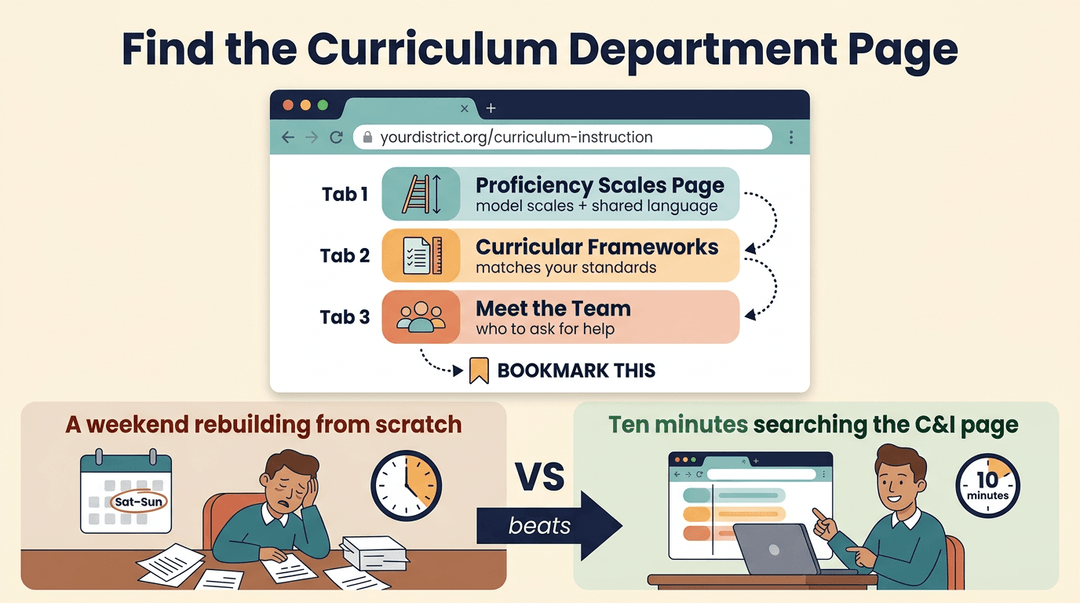
Find the Curriculum Department Page
Start with your district's Curriculum and Instruction (C&I) department. Look for a dedicated proficiency scales page, which may offer model scales, shared language, or a template your colleagues already use.
Next, check for a curricular frameworks link, since your scales should line up with the standards you're expected to teach. If you're not sure who to ask, the meet the team page lists the people behind the work.
Think of a new fifth-grade teacher who spends a weekend building a scale from scratch, only to learn the district already had one. The C&I navigation is usually the fastest route, so bookmark it.
Ten minutes of searching beats a full weekend of rebuilding.
Other Helpful District Resources
Beyond the curriculum pages, a few other resources can shape how your scale connects to grading and support.
- Grading resources page: Guidance on how scores become report card marks.
- Graduation requirements link: Shows what students must demonstrate by the end of high school, so your scale points toward the finish line.
- Multilingual and assessment data page: Lets you check how your students are performing across languages and assessments.
- Gifted education resources: Useful when advanced students are ready to move beyond the 4 level without waiting for the rest of the class.
Proficiency scales turn a big learning goal into clear steps, so students know where they're headed and you know where to help. When you write them in plain language and use them every day, feedback gets sharper and grades mean more.
Ready to map your standards into units you can actually teach? Check out our Curriculum Planning feature, an all-in-one online planner for mapping units, lessons, and standards across the school year.
Frequently asked questions
What is the grading scale 1, 2, 3, 4?
A 1-4 grading scale translates a student’s proficiency on a learning target into a reportable rating. Typically, 3.0 means the student meets the full target, 4.0 indicates advanced work beyond it, 2.0 reflects foundational knowledge, and 1.0 represents the simplest foundational understanding. The exact conversion of these ratings into percentages or letter grades is set by the school or district.
What are proficiency scales used for in education?
Proficiency scales show a student’s current status on a specific learning target and clarify the next step in learning. Teachers use them to plan targeted instruction, provide precise feedback, monitor growth, and help students understand what they can do and what they need to learn next.
How do you measure proficiency level?
Proficiency is measured by comparing a student’s demonstrated knowledge and performance with clearly described level descriptors. Evidence from assessments, classwork, explanations, and applications can show whether the student is below foundational knowledge, at level 2, proficient at level 3, or performing advanced work at level 4.
What does academic proficiency mean?
Academic proficiency is a learner’s current level of performance on a specific learning target. It describes what the student can demonstrate and how far they have progressed toward the target, rather than simply counting points or judging one finished product.