What Is Secondary Education and How Does It Work?

Jump to section
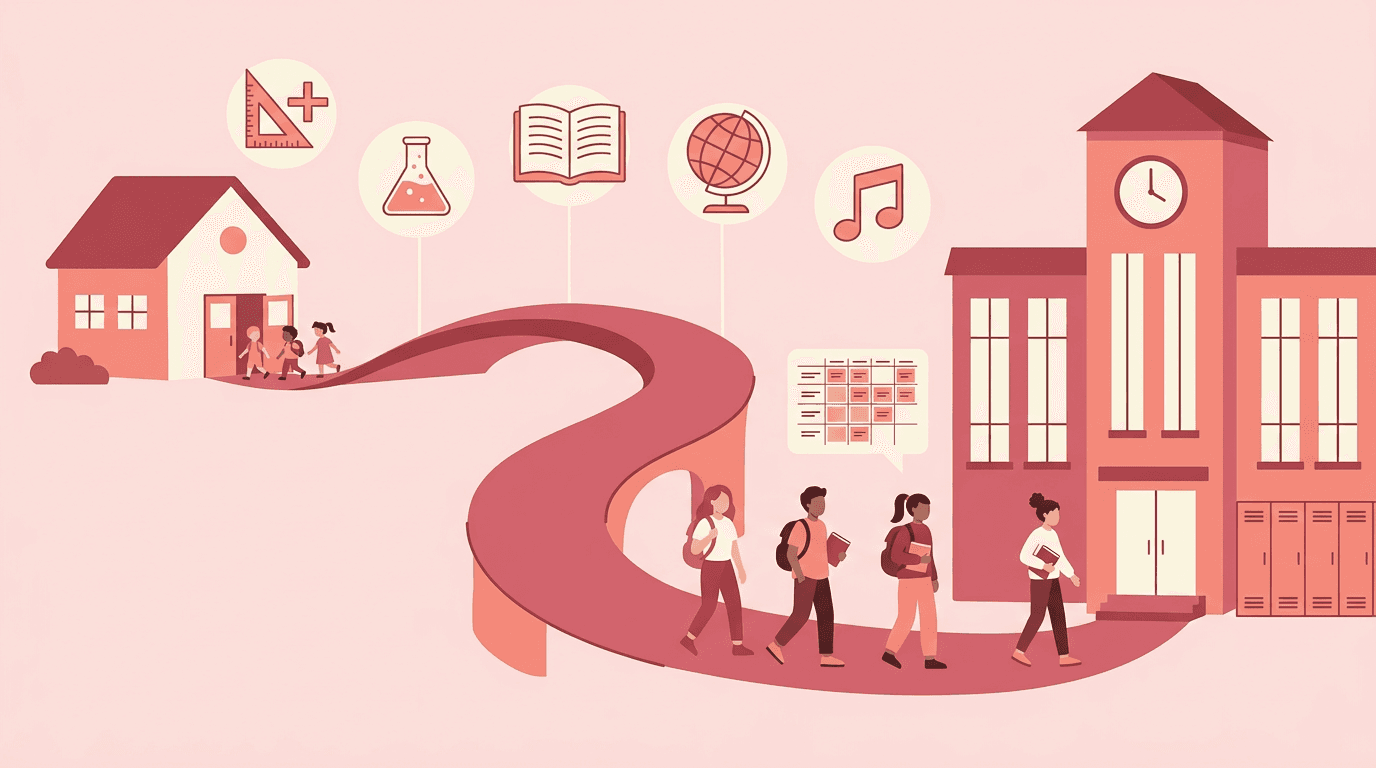
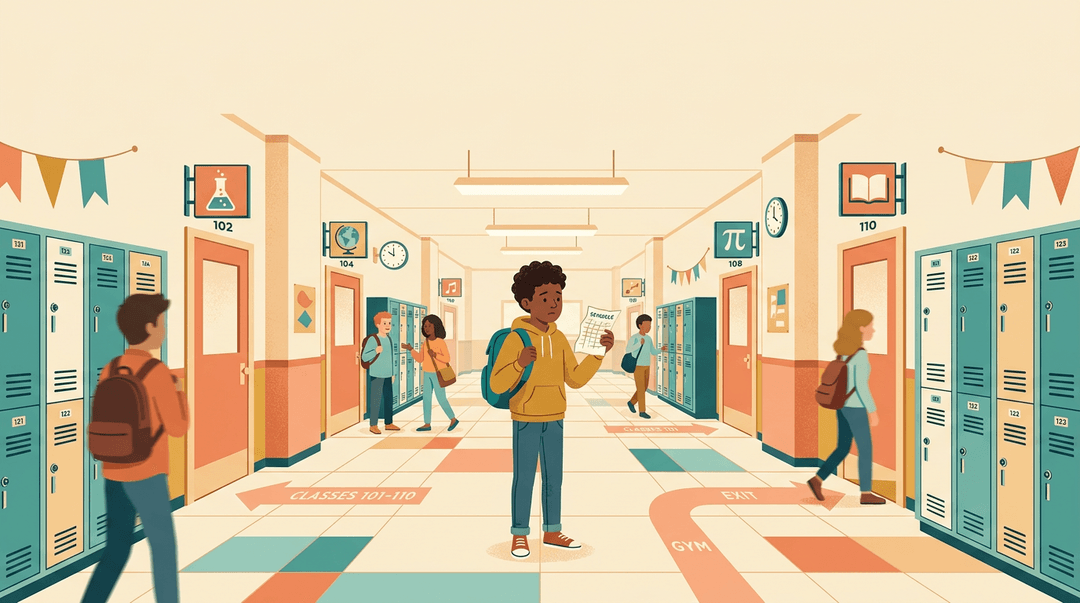
Remember your first day of middle school, hunting for a new room every period? That's the start of secondary education, where learning gets more specialized and more independent.
Put simply, secondary education is the schooling that follows elementary school, typically spanning middle and high school. Students move from the basics into deeper subjects and skills they'll carry into college, careers, and life.
Here, we'll cover what it is, how the curriculum is structured, and the types of schools you'll find, plus the challenges teachers face and a practical planning lens for pacing and standards.
What Is Secondary Education?
So what exactly is secondary education? It's the stage that bridges elementary school and what comes next, and it asks more of you as a planner.
What comes after elementary school
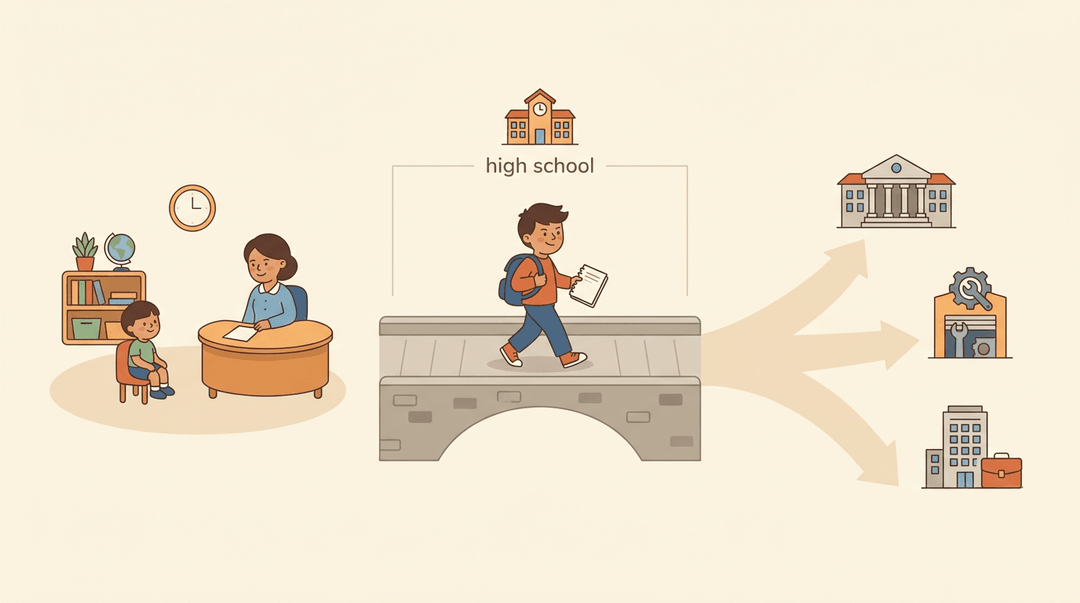
Secondary education follows primary (elementary) school and comes before higher education. It's commonly called high school, and it works as a bridge to college, vocational training, or the workforce.
A ninth grader who spent years with one homeroom teacher now needs more independence, so your lessons should build it step by step.
Grade levels and ages covered
The core range is grades 9 through 12, usually for students aged roughly 14 to 18. Some systems also include grades 6 through 8.
Grade bands and ages vary by country and district, and compulsory schooling laws, which set the age students must stay in school, often fall within these years. Confirm both where you teach.
How it differs from elementary school
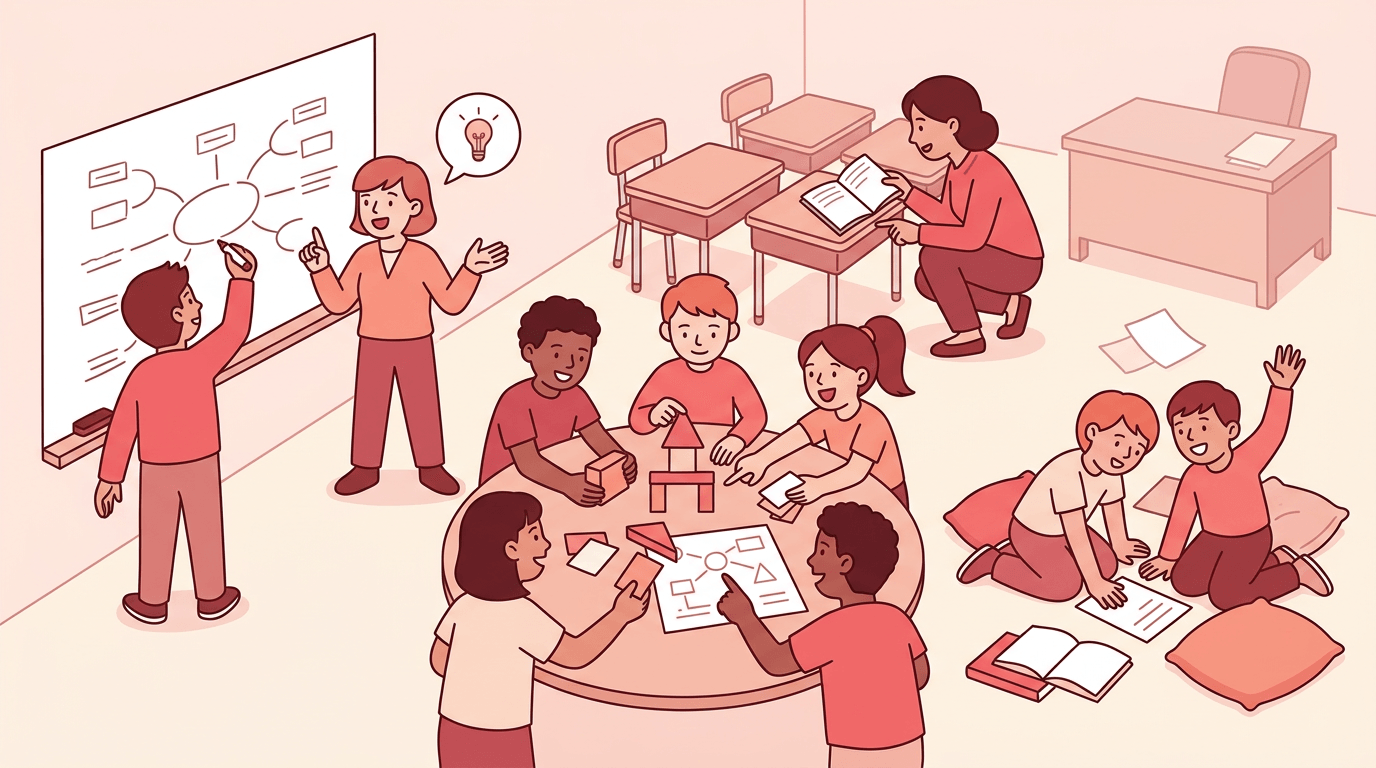
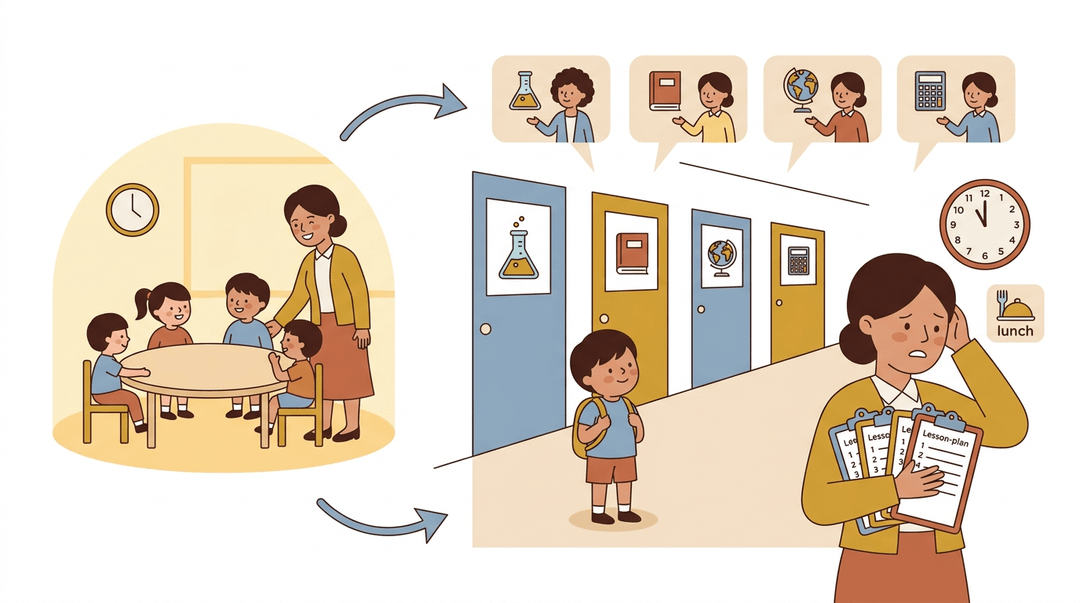
The biggest shift is that a student who had one teacher most of the day now moves between several subject specialists.
The building is usually larger, and instruction leans more analytical, asking learners to compare, evaluate, and explain their reasoning. The change is less about the room and more about the thinking. For you, it means managing multiple daily preps.
A high school science teacher running three sections of one course and one of another has four lesson plans to keep straight before lunch. That's a lot to juggle.
Where it fits among school stages
Schooling moves in sequence:
- early childhood comes first
- primary
- secondary
- postsecondary education, which includes college and vocational programs
Some systems add a middle school or junior high as a sub-stage, often covering grades 6 through 8.
How the Curriculum Is Structured
Secondary schools organize learning around a core of required subjects, a set of electives, and a path that shifts as students move through the grades. Here's how those pieces fit together and where your planning can fill the gaps.
Core subjects and electives offered
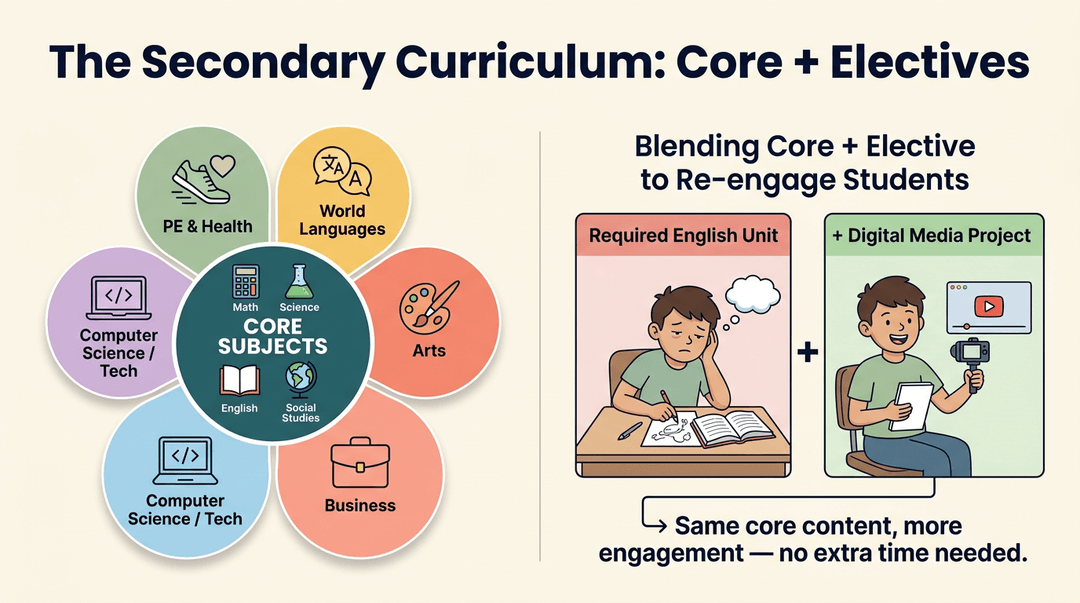
Every secondary program builds on the same core subjects: math, science, English, and social studies. Around that core sit physical education and health, world languages, arts, business courses, and computer science or technology classes.
Consider a ninth-grade teacher who notices that half her students tune out in required courses. Pairing a required English unit with a short elective digital media project can give those students a reason to engage without pulling time from the core.
Choosing an academic track or stream
Students usually follow one of three broad paths:
- general education
- vocational training
- academic preparation for college
In some systems, such as India, the academic path splits into streams like science, commerce, and arts.
Within a track, students may be placed in honors or AP (Advanced Placement) courses, or in specialized career-focused tracks. The International Baccalaureate (IB) is another option at some schools, offering a structured, rigorous program.
Plan units by track level. A lesson that thrills an honors section may overwhelm a general class, so build each unit at both levels rather than one watered-down version for everyone.
Lower versus upper secondary stages
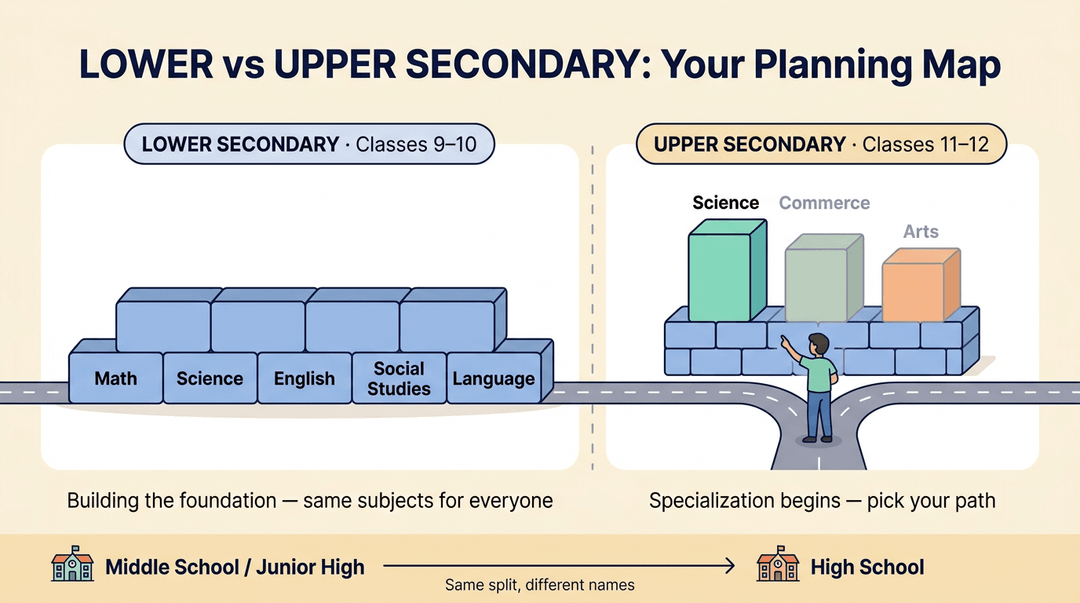
Secondary education splits into two stages. Lower secondary, such as classes 9 and 10, lays the foundation. Upper secondary, classes 11 and 12, is where specialization begins.
Middle school or junior high often serves as the lower tier, and high school is the final stage. That split is your planning map.
Exams, diplomas, and graduation credits
At the end of each stage, students often sit board exams, and the results can shape what comes next. Graduating earns a diploma. For students who don't finish, a GED (General Educational Development) credential offers an alternative route.
Credit requirements to graduate vary, so check your state or district rules before you map out a student's final years.
Why Secondary Education Matters
Secondary education is where students start to see what comes next, and it prepares them for college, work, and adult life.
Preparing students for college
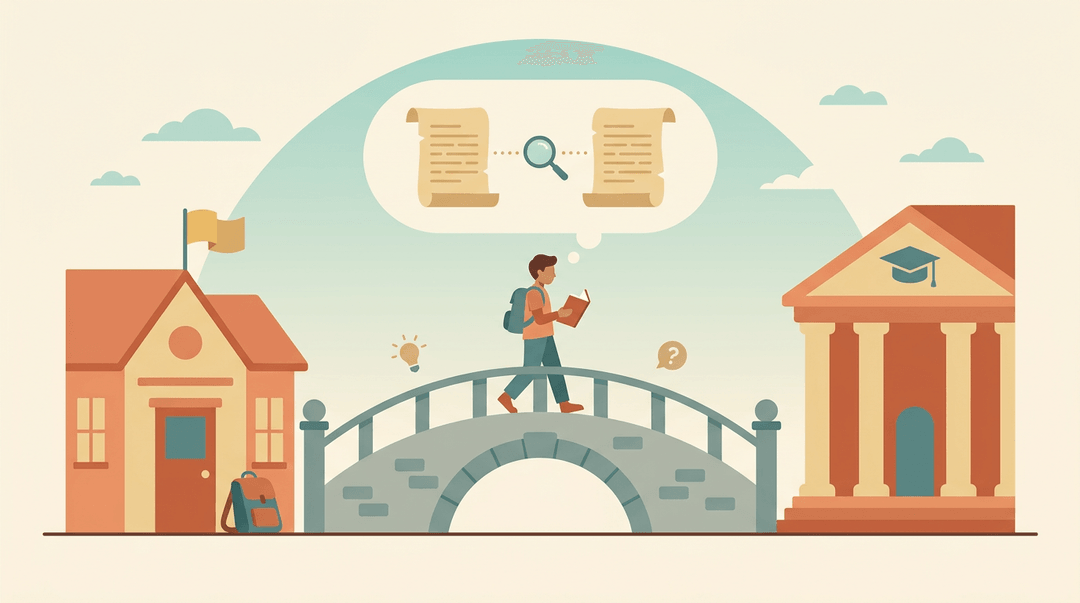
Secondary school is the bridge to college and university, deepening academic knowledge along the way. It develops critical thinking skills, the difference between memorizing and reasoning.
A history teacher who has students compare two primary sources builds exactly that. Exploring subjects they enjoy also supports career-oriented subject choice.
Building career and workforce readiness
Not every student heads straight to a four-year degree. Career counseling services help students match strengths to options, and vocational and technical pathways build hands-on skills. Many programs add industry certifications and internships.
Picture a junior who loves taking things apart: her counselor maps an electrical program with a certification at the end, giving her a plan. Her options just got clearer. Schools also stress college and career readiness for every student.
Growing socially, civically, and personally
Secondary school also shapes who students become.
In a report on social mobility in Latin America and the Caribbean, the Organisation for Economic Co-operation and Development (OECD) notes that when educational success is independent of socio-economic background, it fosters social mobility.
Schools also build responsible citizenship and encourage creativity and innovation. Supporting adolescent intellectual and emotional growth helps students handle setbacks and figure out who they are.
How to Plan Across the Secondary Spectrum
Use this guide when you're planning a unit, a course, or a whole year in grades 6-12. We start with the band you teach, then build the unit, then plan supports before anyone falls behind.
Plan the two bands side by side
Lower and upper secondary share one goal line, so plan backward from the end of grade 12 and forward from the start of grade 6.
| Planning move | Grades 6-8 | Grades 9-12 |
|---|---|---|
| Align goals | Build core skills and habits | Apply skills toward graduation |
| Map prerequisites | Check elementary foundations | Check middle school foundations |
| Adjust pacing | More reteaching time built in | Tighter pace, set by course and credits |
Prerequisite chain. Jot it as a backward arrow: Algebra I ← proportional reasoning (grade 7) ← ratios (grade 6). If a link is weak, it becomes your first week's review.
Build the unit, step by step
- Unpack each grade-level standard
- Circle the skill and the content: "Analyze how an author develops a central idea."
- Set a proficiency scale
- Write three levels students can see: Identifies the idea. Explains how it develops. Evaluates how well.
- Sequence units across the year
- Put prerequisite units first, and leave a flex week before each major assessment.
- Note cross-curricular links
- Mark overlaps, such as ratios in math and data tables in science, so colleagues can reinforce each other.
Example: A seventh-grade science teacher unpacks a data-analysis standard and finds it leans on ratios. She checks with the math teacher, schedules her graphing unit after the ratios unit, and uses the same three-level scale language in both rooms.
Support every learner from week one
Planning for variety up front is easier than patching it later. Find your situation and read across.
| When you see... | Try... |
|---|---|
| A student missing a prerequisite skill | Flag an RTI (response to intervention) tier early, then start small-group support |
| One class with mixed readiness | Differentiate by track: same standard, different text complexity or scaffolds |
| A high schooler slipping on credits | Check credit progress every grading period and plan recovery before it piles up |
💡 Tip: Start RTI flags from your prerequisite map. The skills you already listed are the skills to screen first.
At a glance:
| Phase | Key move | What you get |
|---|---|---|
| Bands | Map goals, prerequisites, pacing | A realistic starting point |
| Unit | Unpack, scale, sequence, link | A standards-aligned year |
| Learners | Flag, differentiate, track | Support before gaps widen |
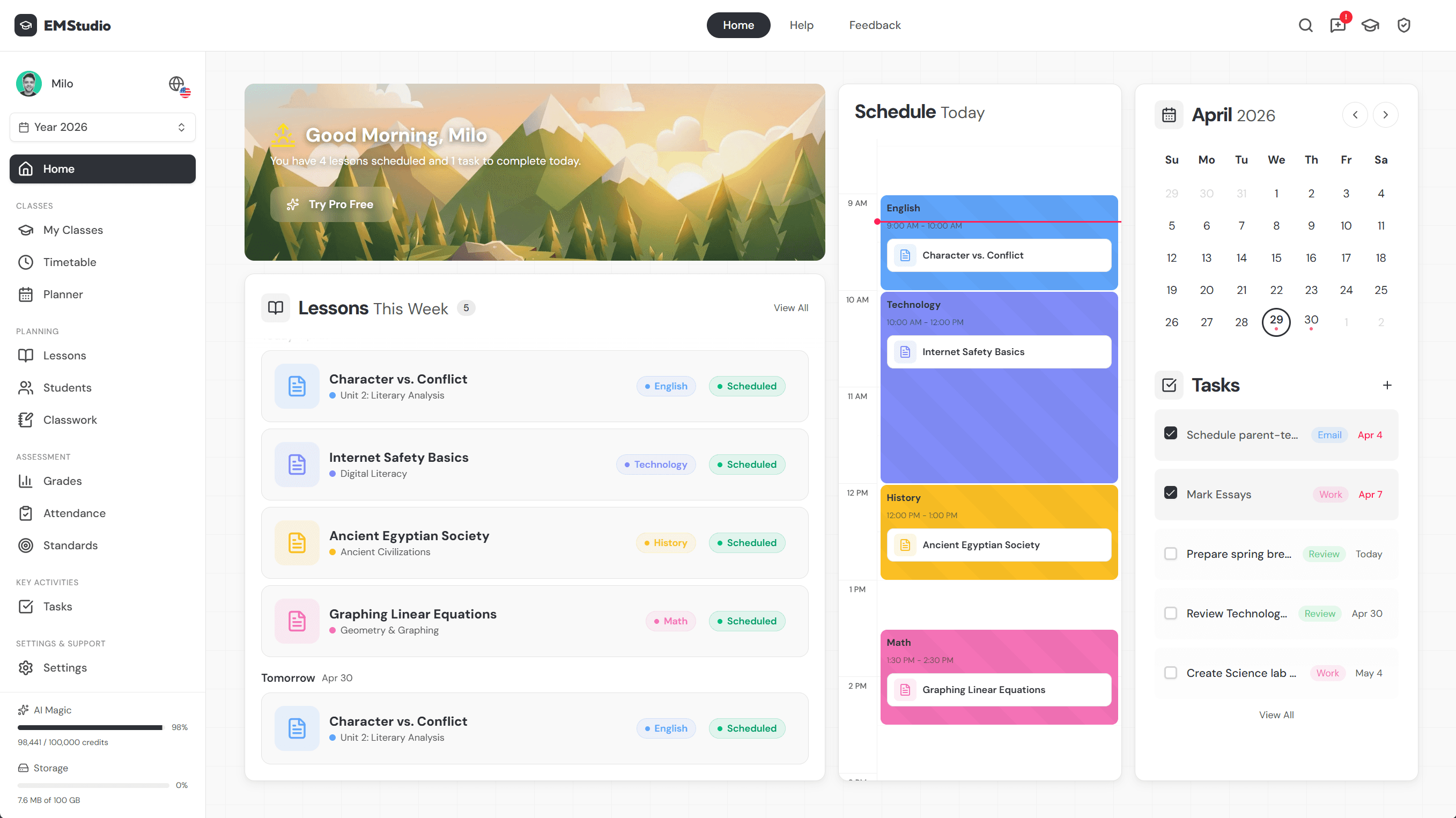
Curriculum Planner maps standards and pacing across every secondary grade band in one view.
Careers in Secondary School Teaching
A master's degree can open new doors for secondary teachers, and knowing your options makes the choice easier. Here's how the paths and pay compare.
Master's degree paths for teachers
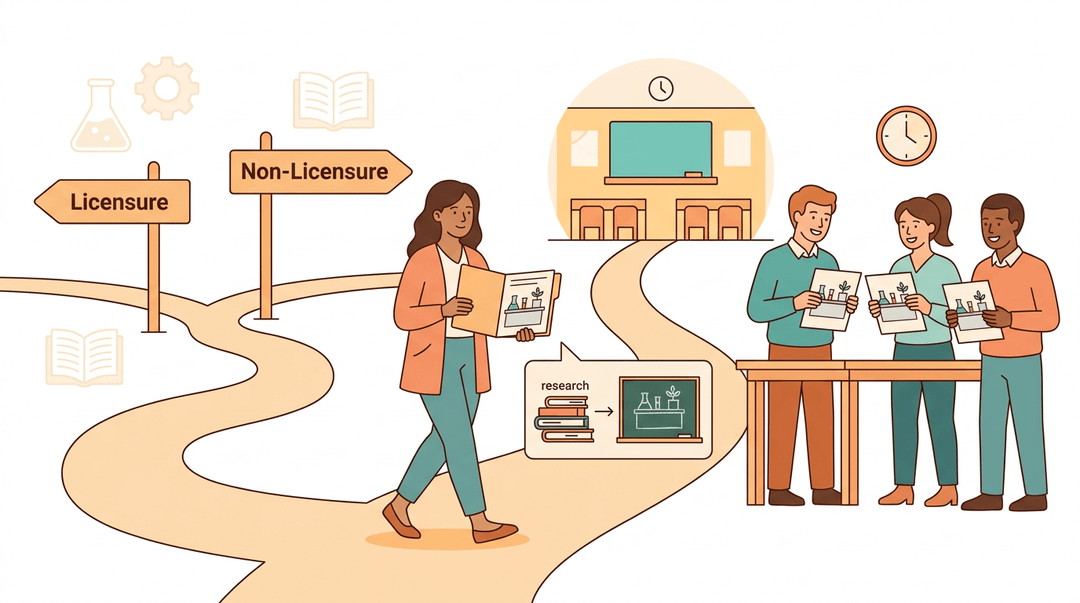
A licensure track leads to certification, while a non-licensure track skips it and goes deeper into subject knowledge or leadership.
Either way, the coursework bridges theory and classroom practice: you read research on how teenagers learn, then try it in your room the next morning.
Specialization in STEM or the humanities is common. Consider a high school biology teacher who earns a master's focused on lab design, then shares her redesigned labs across the department, saving colleagues hours of prep.
Career changers can also use these programs to pivot into teaching, bringing industry or research experience with them. Once you're settled, mentoring new secondary teachers is a natural next step that keeps experienced educators growing too.
Salary and career outcomes for teachers
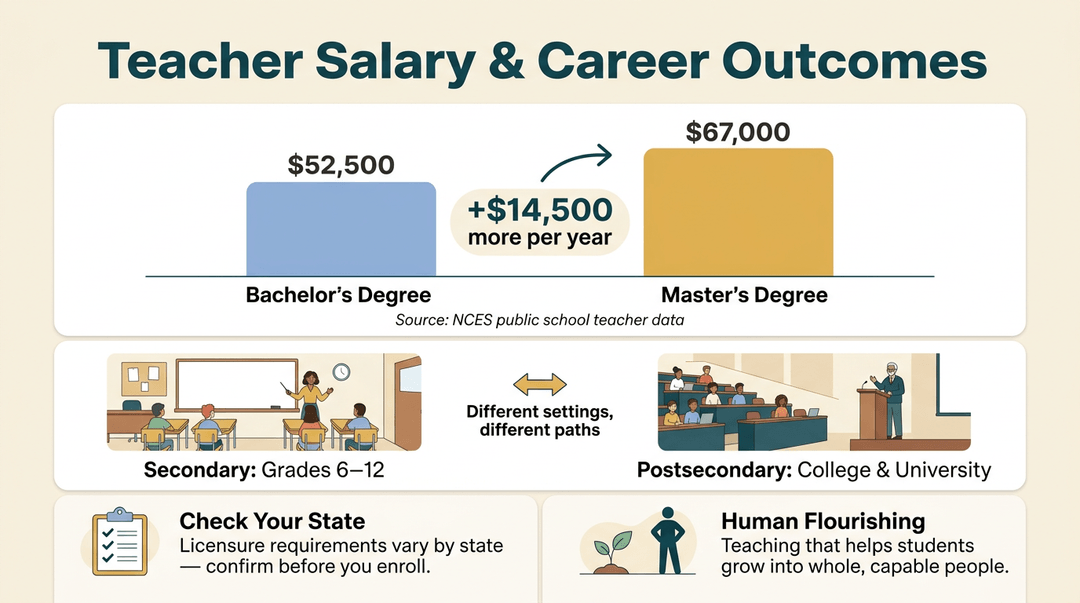
Secondary roles (teaching grades 6 to 12) differ from postsecondary roles at colleges and universities, so check which setting fits your goals. Pay is another factor.
According to NCES data on public school teachers, the salary for teachers with a master's degree is $67,000, compared with $52,500 for teachers with a bachelor's degree. That gap is one reason many educators pursue graduate study.
State licensure requirements vary, so confirm what your state requires before you enroll. Some programs also frame teacher preparation around human flourishing: the belief that good teaching helps students grow into whole, capable people.
Look for that focus when you compare programs, because it shapes how future teachers are prepared.
Types of Secondary Schools
Secondary schools don't all look alike, and the type you teach in shapes how you plan.
Public, private, and charter school differences
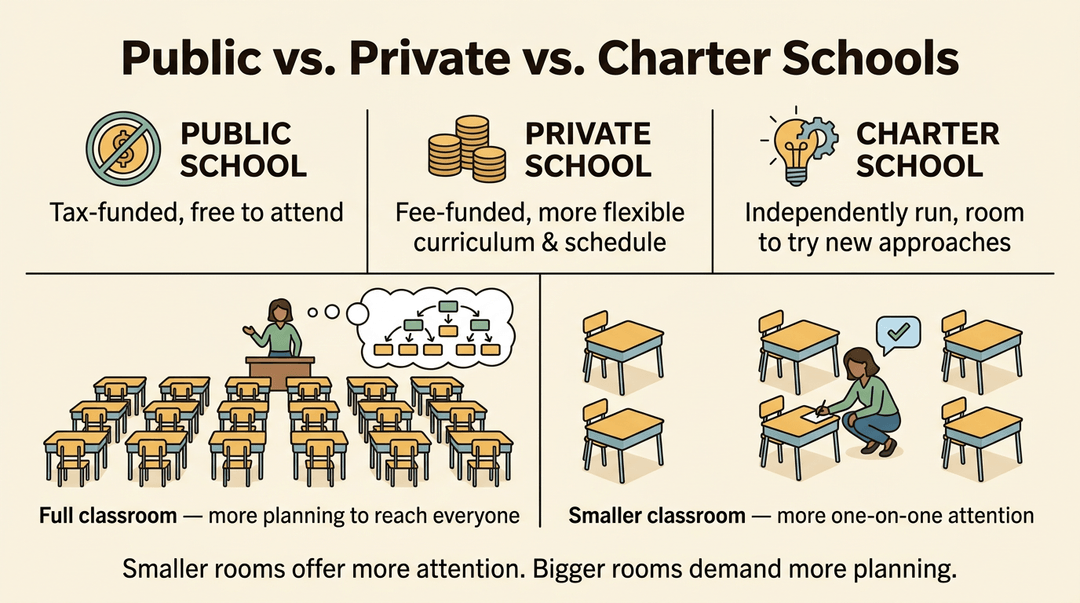
Public schools are tax-funded and free to attend. Private schools are fee-funded, which often gives them more flexibility in curriculum and scheduling. Charter schools are independently operated, so their teams have more room to try new approaches.
Class size and individual attention vary across all three. Think of a ninth-grade English teacher with a full roster, then imagine one with a smaller class.
The smaller room makes one-on-one feedback easier to fit in, while the full room demands careful grouping. Smaller rooms offer more attention. Bigger rooms demand more planning.
Education boards in India
In India, the CBSE (Central Board of Secondary Education) curriculum is widespread, so many schools follow a shared set of standards. State boards manage secondary education within their own regions, so your local framework may differ.
International boards also offer secondary education, which means you may teach a curriculum from outside the country. Check which board your school follows before you plan, since it shapes your pacing and standards alignment.
Alternative and specialized school options
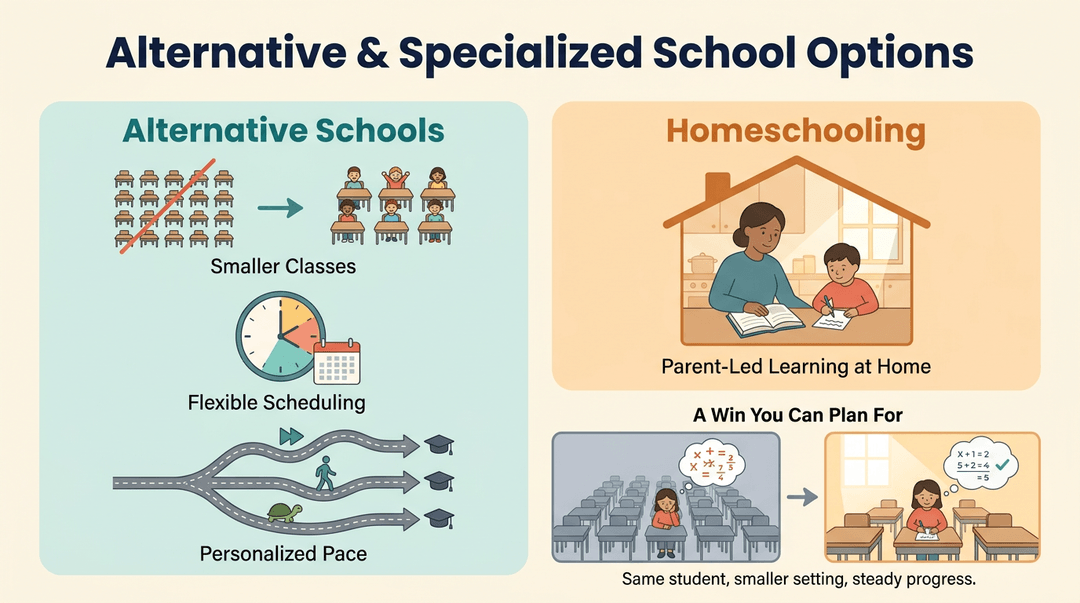
Alternative schools often serve students who are struggling in traditional settings. They typically offer:
- smaller class sizes
- flexible scheduling
- personalized learning approaches
Homeschooling is another secondary path, with a parent or guardian leading the learning at home.
Consider a student who falls behind in a crowded classroom. In a smaller program with flexible scheduling, she can work through algebra at her own pace and rebuild her confidence. That's a win you can plan for, even inside a traditional school.
Activities and Support Beyond Academics
Learning doesn't stop at the bell. Activities build connections, and targeted support catches students before they fall behind.
Sports, clubs, and other activities
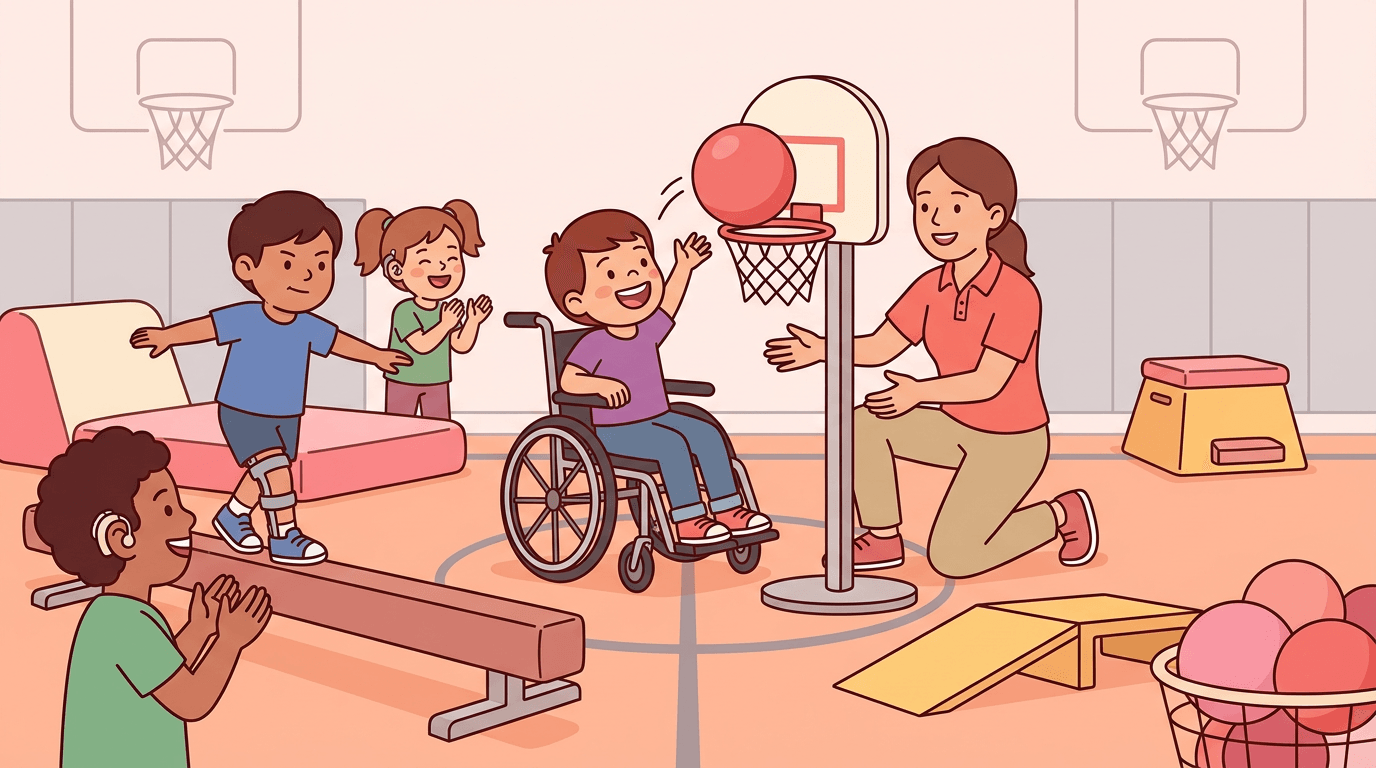
Sports teams, clubs, and performing arts groups give students a place to belong. Think of a student who struggles with algebra but anchors the school newspaper every week. That role builds confidence that often carries back into class.
Arts, band, and drama ask students to practice, take feedback, and perform for others. Yearbook and newspaper clubs teach deadlines and teamwork.
The bigger payoff is social: students learn cooperation and leadership, and they get more comfortable asking for help.
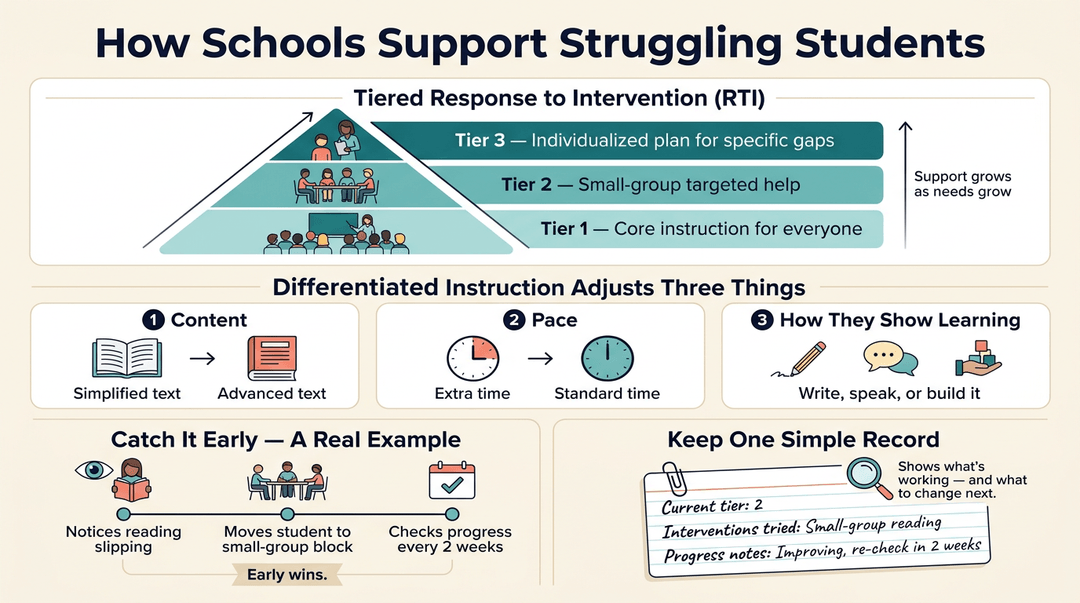
How schools support struggling students
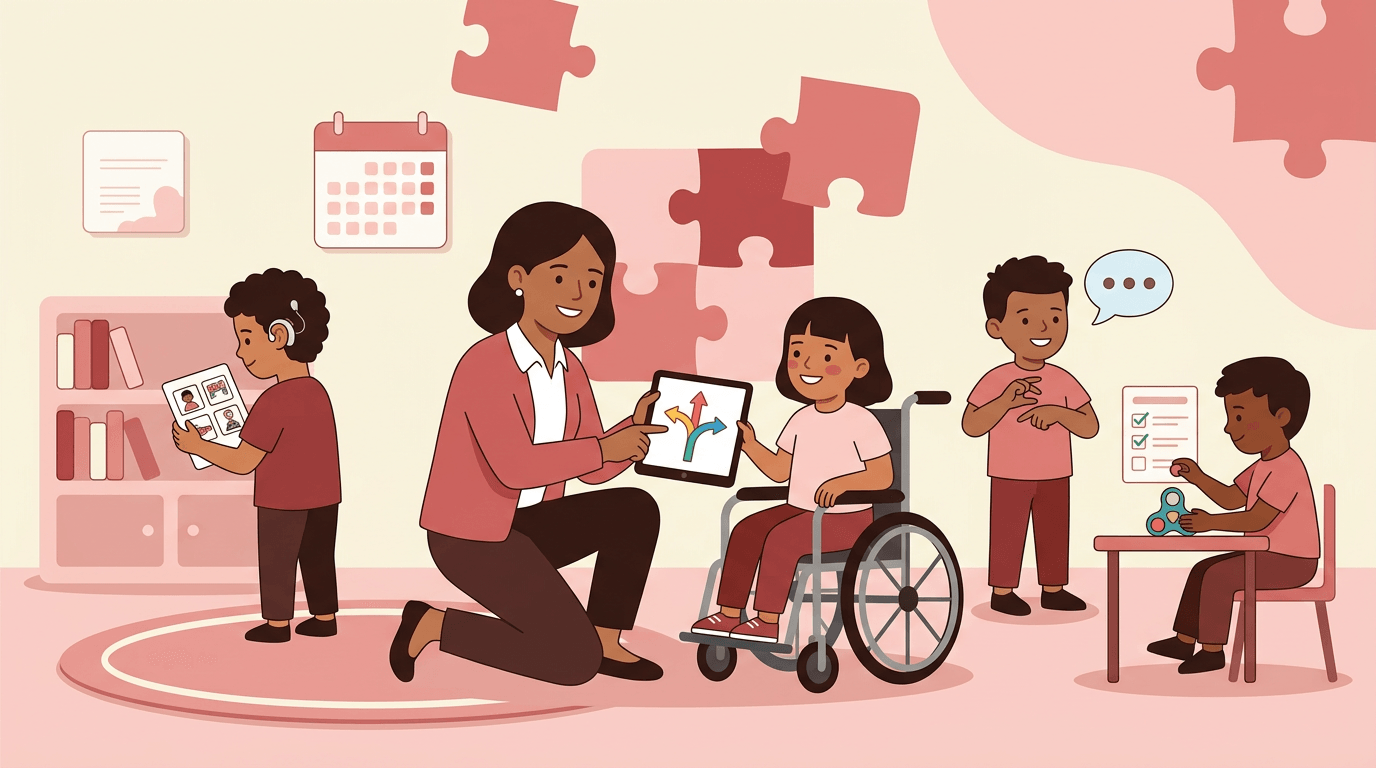
Many schools use a Tiered Response to Intervention (RTI) model, where support grows in intensity as needs grow. Core instruction comes first, and targeted help follows when students need it.
In class, differentiated instruction adjusts:
- content
- pace
- how students show learning
For students who need more, individualized support builds a plan around specific gaps.
Acting early beats waiting for the gap to widen. Early identification of learning needs, through screening and close observation, lets you respond while problems are small. Consider a ninth-grade English teacher who notices a student's reading slipping.
She logs the concern, moves him into a small-group block, and checks progress every two weeks. Early wins.
Documenting RTI tiers doesn't have to be complicated. Keep one simple record per student:
- current tier
- interventions tried
- progress notes
That view shows what's working and what to change next.
Challenges and Trends in Today's Schools
Secondary schools face real hurdles, from students who leave early to new tools reshaping lessons. Here's where the pressure points are and what they mean for your planning.
Dropout rates and access barriers
Secondary education faces high dropout rates. UNESCO reports that prior efforts to make education affordable improved access but compromised quality, raising dropout rates.
Access varies widely. Students in rural areas may face long commutes, and financial pressure or family responsibilities can pull them away from class.
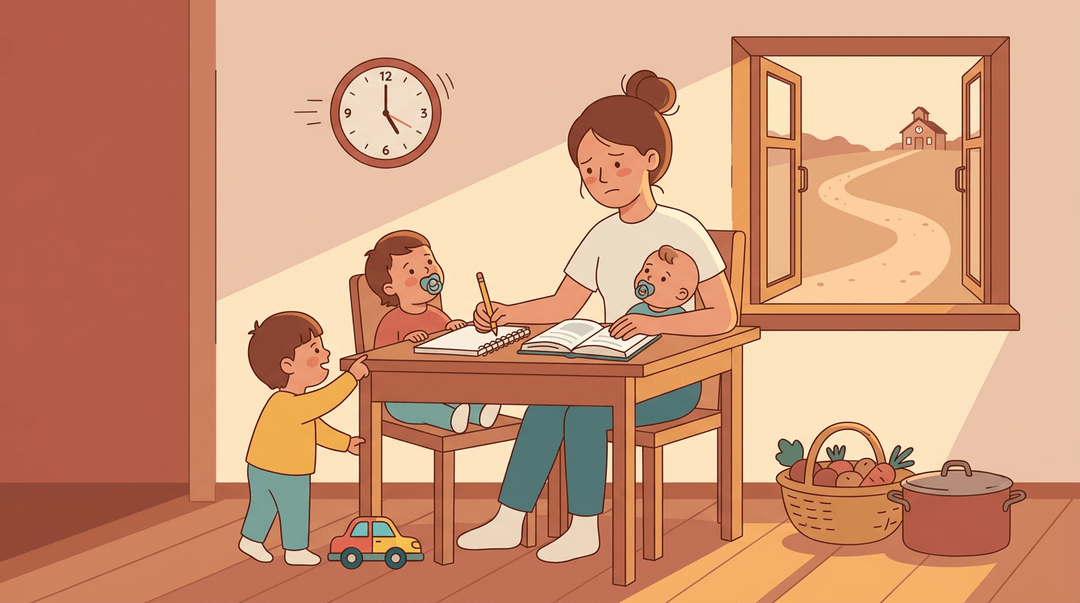
Think of a tenth grader who helps care for younger siblings every afternoon: she's motivated, but she's running out of hours to keep up. Access is the first hurdle.
Exam pressure adds another layer. Researchers studying rural science classrooms in Sri Lanka found that examination-oriented learning limits critical thinking. When the test is the finish line, students learn to recall rather than reason.
Why career guidance often falls short
Many students reach high school without a clear sense of where they're headed. Three gaps stand out:
- Limited counseling time. Counselors are often stretched across more students than one person can realistically know.
- Wrong streams. Students sometimes pick a track because a friend did. Picture a junior who joins an advanced science track, then discovers in senior year that she loves history. Changing course late is hard.
- Better guidance systems. Schools need earlier, ongoing check-ins instead of a single meeting before course selection.
Emerging trends like AI and tech
New tools are changing what teaching looks like. The U.S. Department of Education has issued guidance on artificial intelligence (AI) use in schools, and it's worth reading alongside your own district policies. Three trends to watch:
- AI and digital literacy. Students need to understand what AI tools do and when to question them.
- Multiculturalism and digital citizenship. Classrooms bring together students from many cultures, so teaching digital citizenship means showing learners how to communicate respectfully and safely online.
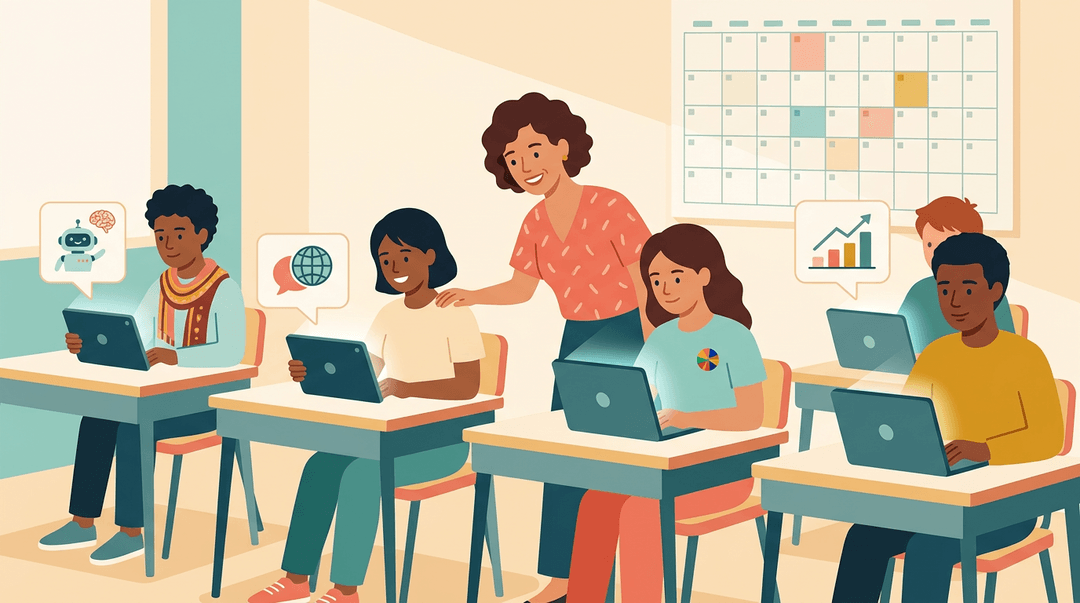
- Personalized learning technologies. Adaptive tools can adjust practice to each student's pace. They work best when a teacher still knows the learner behind the screen.
Secondary education is where students shift from learning the basics to building the independence and skills they'll use long after graduation.
When teachers plan with pacing, standards, and learner support in mind, that shift feels much more manageable for everyone in the room.
Ready to map out your year? Check out our Curriculum Planner to plan units, lessons, and standards across the whole school year.
References
- From rote learning to critical inquiry: fostering higher order thinking skills through collaborative questioning in a rural secondary English-medium science classroom — rda.sliit.lk (2025)
- U.S. Department of Education Issues Guidance on Artificial Intelligence Use in Schools, Proposes Additional Supplemental Priority — ed.gov (2025)
- COE - Characteristics of Public School Teachers — nces.ed.gov
- Social Mobility and Inequality in Latin America and the Caribbean — oecd.org
- More children out of school for the 7th year in a row, up to 273 — unesco.org