Kolb Experiential Learning Cycle: Four Stages Explained

Jump to section
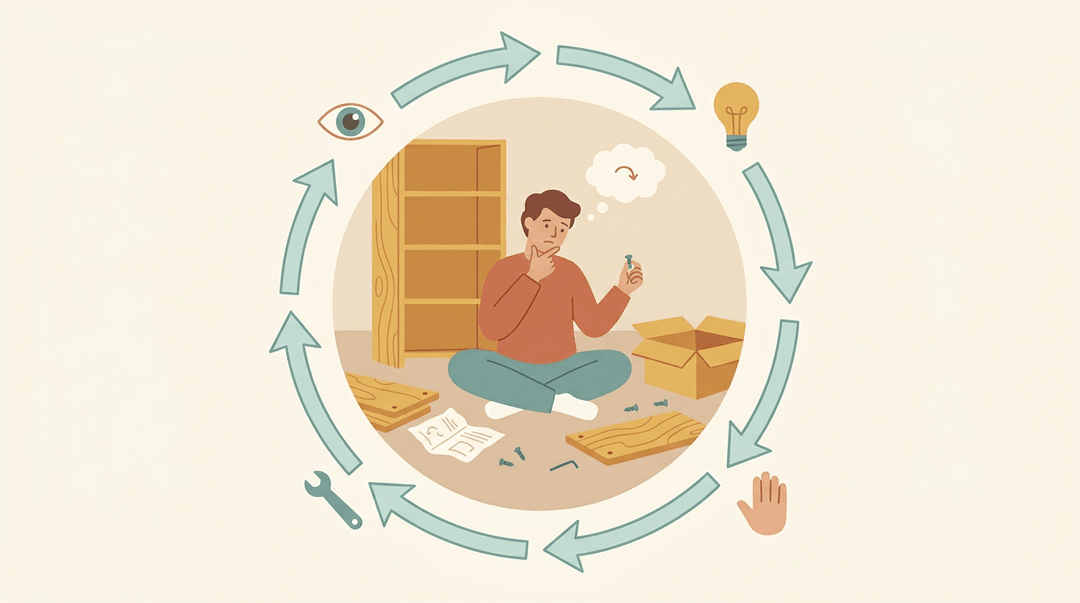
Think about the last time you assembled furniture from a box. You skimmed the instructions, tried a step, found a screw in the wrong hole, and went back to fix it. That loop of doing, pausing, and adjusting is how a lot of real learning happens.
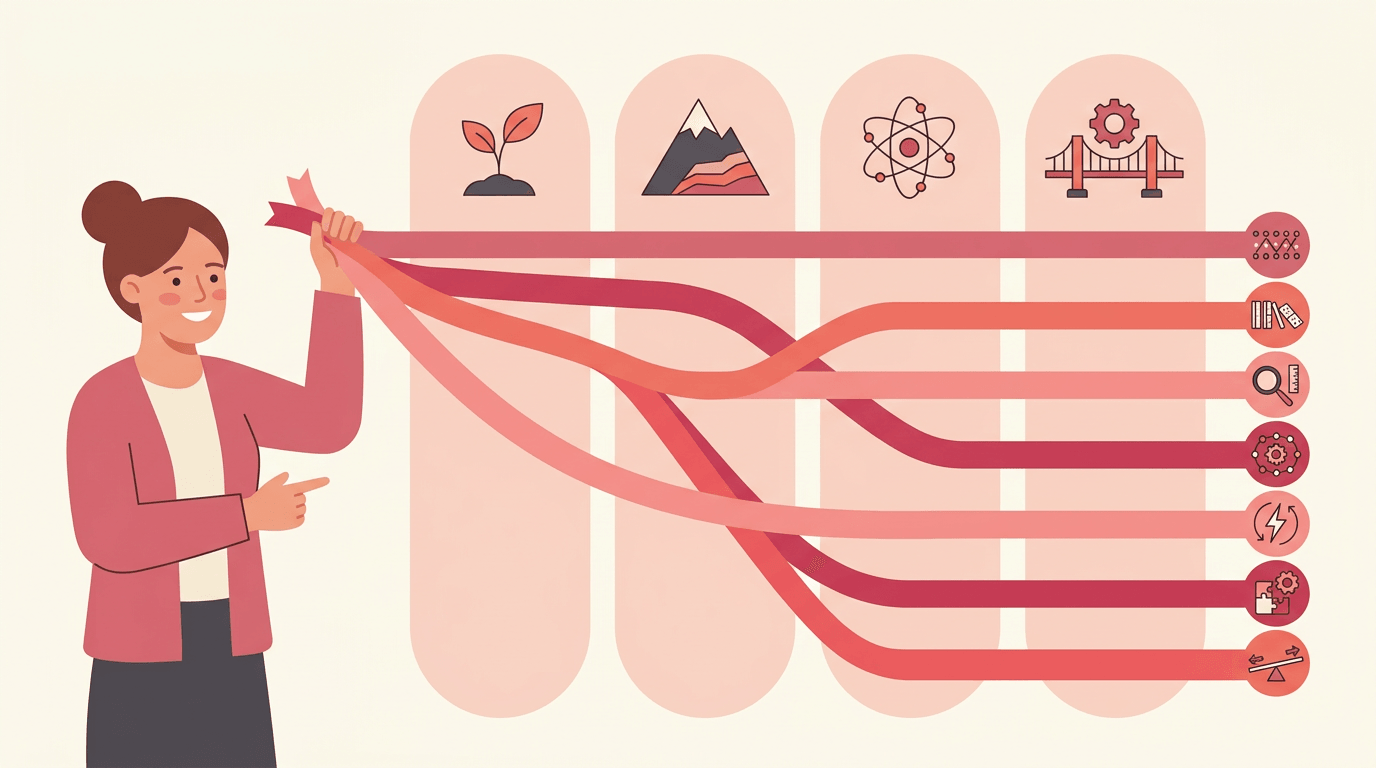
The Kolb experiential learning cycle turns that loop into a model with four stages. In this post, we'll walk through each one, the two dimensions behind them, where the model came from, and how you can build it into your unit and lesson planning.
How the Kolb Experiential Learning Cycle Works
Kolb's cycle draws on ideas from Dewey, Lewin, and Piaget, and it treats learning as a loop rather than a straight line.
What happens at each stage
Two dimensions sit behind the four stages: taking in experience runs from concrete to abstract, and processing it runs from reflecting to experimenting. Here's what we see in each stage:
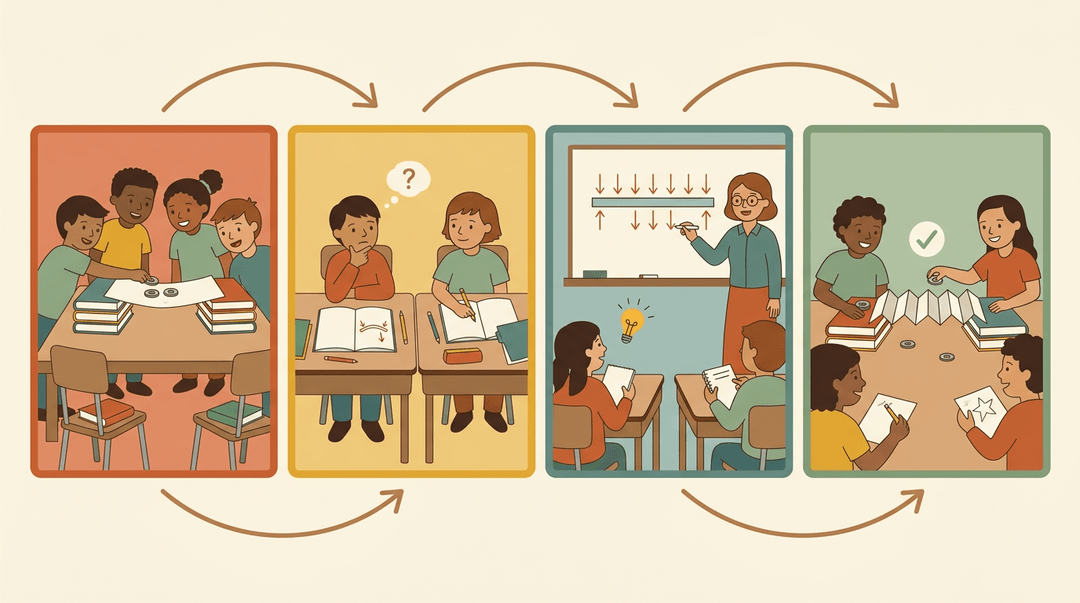
- Concrete experience. A fourth-grade teacher's class builds paper bridges and tests which ones hold weight before anyone mentions structure.
- Reflective observation. Students jot down which bridges sagged and what surprised them.
- Abstract conceptualisation. The teacher explains how weight spreads across a beam, and students connect their notes to that rule.
- Active experimentation. Students rebuild with a new shape, predict the result, and load it to check.
Where learners start and how they move
Learners can enter anywhere, and sources disagree on where the cycle starts and how its stages are ordered. Learning isn't strictly sequential, either.
It's less about where they begin and more about whether every stage gets its turn. Order is flexible. Coverage isn't.
A math teacher whose class is stuck drops back to manipulatives, then returns to the rule, and everyone gets unstuck.
Repeating the cycle over days to years
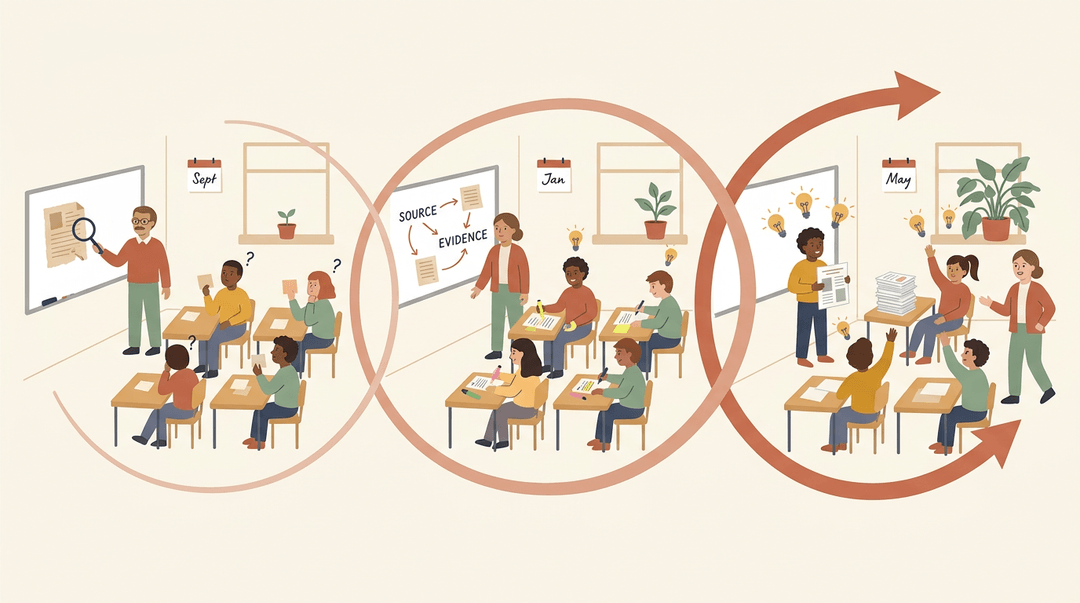
One pass teaches something, but repetition is where progress shows. The cycle has no fixed timespan, so it can run in one class period, across a unit, or over several school years. Returning to theory refines it too, since each test sharpens the concept.
A history teacher who revisits source analysis from September to spring finds students building their own arguments by May.
Using peers to observe and discuss
Students don't have to run the cycle alone. Peers can watch and note specific moments, giving reflective observation a second set of eyes. Discussion deepens reflection: compare the learner's account with the observer's, and the gaps show up fast.
A second-grade teacher pairs readers so the partner marks every word that trips the reader up. The reader feels confident, but the notes reveal a pattern, and the next practice session targets it.
Planning a Lesson Around the Cycle
Use this card when you're sketching a lesson or unit and want all four of Kolb's stages in it. Plan the four slots in order, test them against the examples, then run the check before you teach.
The four-slot lesson
- Start with a hands-on activity
- This is concrete experience: students do something before they hear the idea.
- Try: "Sort these objects into groups any way you like."
- Guide the reflection
- This is reflective observation: students notice and talk before you explain.
- Say: "What did you notice? What surprised you?"
- Teach the concept or model
- This is abstract conceptualization: name the idea once students have an experience to hang it on.
- Say: "The groups you made show what we call a property."
- Apply it in a new task
- This is active experimentation: students test the idea somewhere unfamiliar.
- Try: "Now sort a new set using what we just named."
⚠️ Watch out: Reflection is the stage that gets squeezed when time runs short. Write a minute count next to it on your plan, so it doesn't disappear.
The cycle across ages and settings
The four slots stay the same. The activity inside them changes with your learners.
| Setting | Starter, reflection, concept, application |
|---|---|
| Primary | Science sorting activity, talk about the groups, name the property, sort a new set |
| Secondary | Lab first, analysis in pairs, teach the model behind the results, design a follow-up test |
| Adult or tutoring | Work a case study, debrief the choices, introduce the framework, apply it to a fresh case |
| Homeschool | Project-based unit: build, discuss weekly, teach the concept, change the project and try again |
In a unit, the cycle can run once per lesson or stretch across a week. Either way, each lesson's application becomes the starting experience for the next.
Check your plan before you teach
Confirm each of these before you walk in:
- Every stage is represented. You can point to the starter, the reflection, the teaching, and the application on your plan.
- Reflection time is protected. It has its own minutes, not "if we have time."
- Each stage links to a learning target. The starter and the application both serve the target, not just the teaching.
- The next experiment is planned. Tomorrow's starter grows out of what students tried today.
Map Kolb-stage activities across a unit with EMStudio's Curriculum Planner.
Putting the Cycle into Daily Practice
Knowing the cycle is one thing. Using it every week changes teaching, and we'll show you how.
Steady teacher development, not one-off events
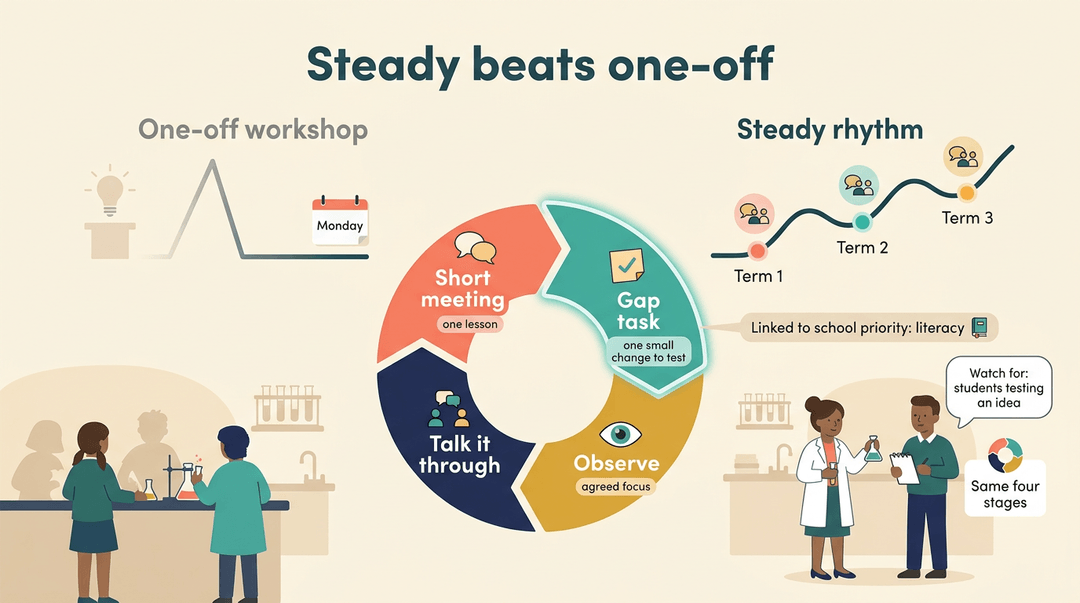
A one-off workshop fades by Monday. Rhythm works better: a short meeting each term on one lesson, then a gap task, one small change to test before the next meeting.
Link it to whole-school priorities, such as this year's literacy focus, so it's never one more initiative.
Tie observation to each session. A science teacher and her head of department agree beforehand to watch for active experimentation, the moment students test an idea, then talk through the lesson using the same four stages.
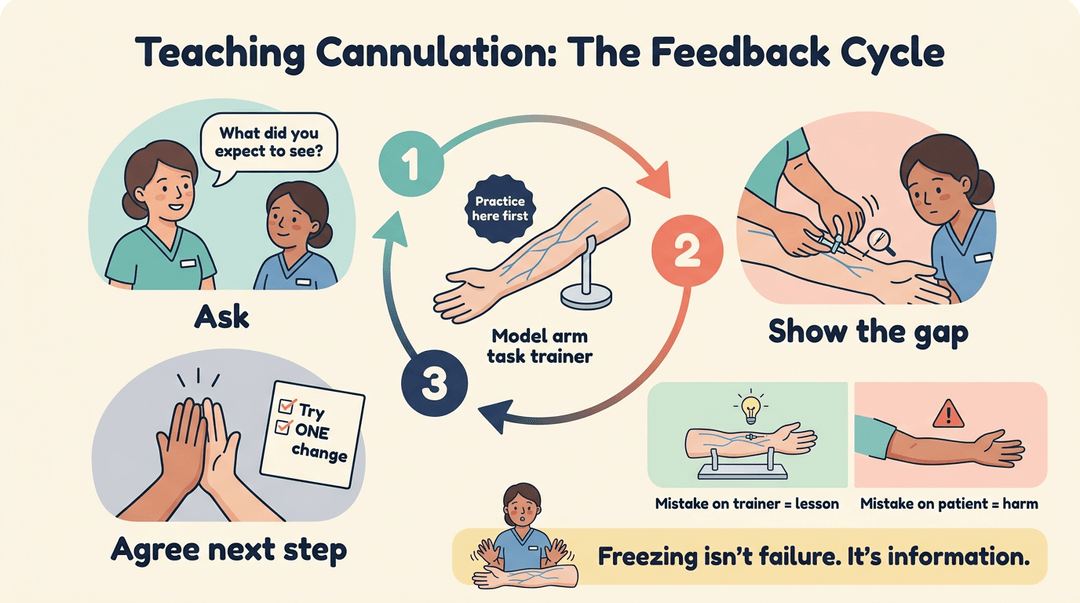
Teaching cannulation in clinical practice
Cannulation, placing a thin plastic tube called a cannula into a vein, is hard to learn from a textbook. Here's the cycle in action:
- Ask what the learner thinks happened. Start with, 'What did you expect to see?'
- Explain or demonstrate missing knowledge. Teach the gap directly, slowly, while they watch.
- Agree what to try next. Pick one change before the next attempt.
Rehearse on a task trainer, a model arm, before a real patient. A mistake on the trainer is a lesson; on a real patient, it can cause harm.
Consider a student nurse who rehearsed on the trainer, then froze with her first real patient. The steps above turn that freeze into a lesson. Freezing isn't failure. It's information.
Getting real value from reflection
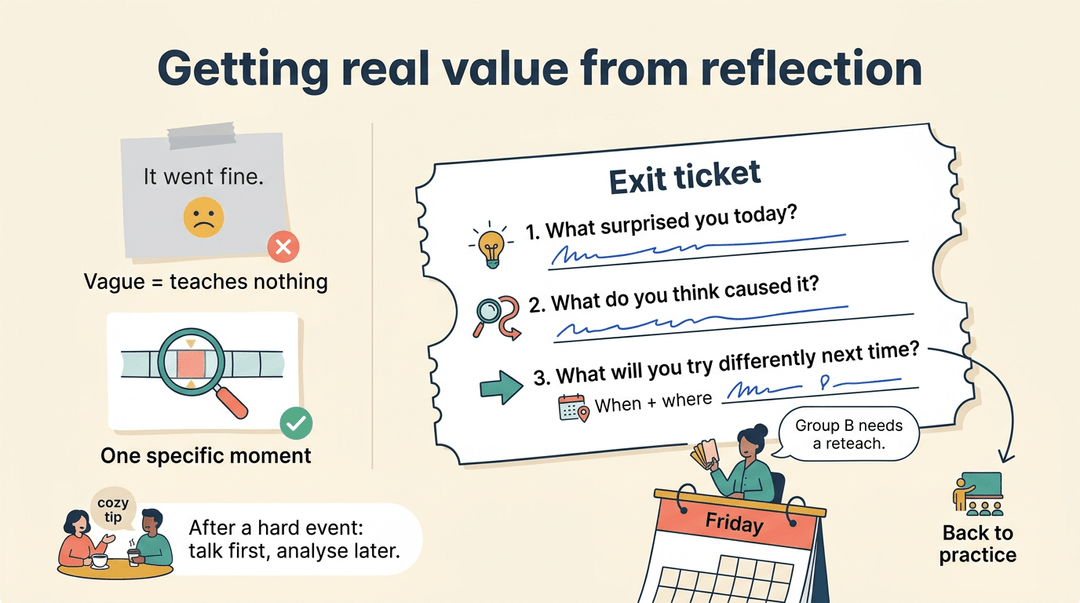
Reflection is more than writing a reflection. Two lines saying 'it went fine' teach nobody anything. Give learners one specific moment to examine.
After a difficult event, support comes first. Let people talk it through with a colleague before asking for analysis.
Close every reflection with a plan to return to practice: when and where the change will happen.
A short exit ticket works well here. Try these prompts:
- What surprised you today?
- What do you think caused it?
- What will you try differently next time?
A Year 9 science teacher reads those answers on Friday and knows which group needs the lesson retaught.
Spotting the gaps in your teaching
Experience without examination is the first trap. Doing the lesson is one thing; examining it is another.
Discussion without follow-up is the second. A great debrief with no next step leaves the cycle half turned.
Gaps between stages need the most attention. Reflection without a new idea goes nowhere, and an untested idea is just a hunch. Ask yourself which stage you tend to skip. Gaps are where learning leaks out.
Learning Styles and Common Criticisms
Kolb's cycle often gets mixed up with learning styles, and it has its critics.
How the cycle differs from learning styles
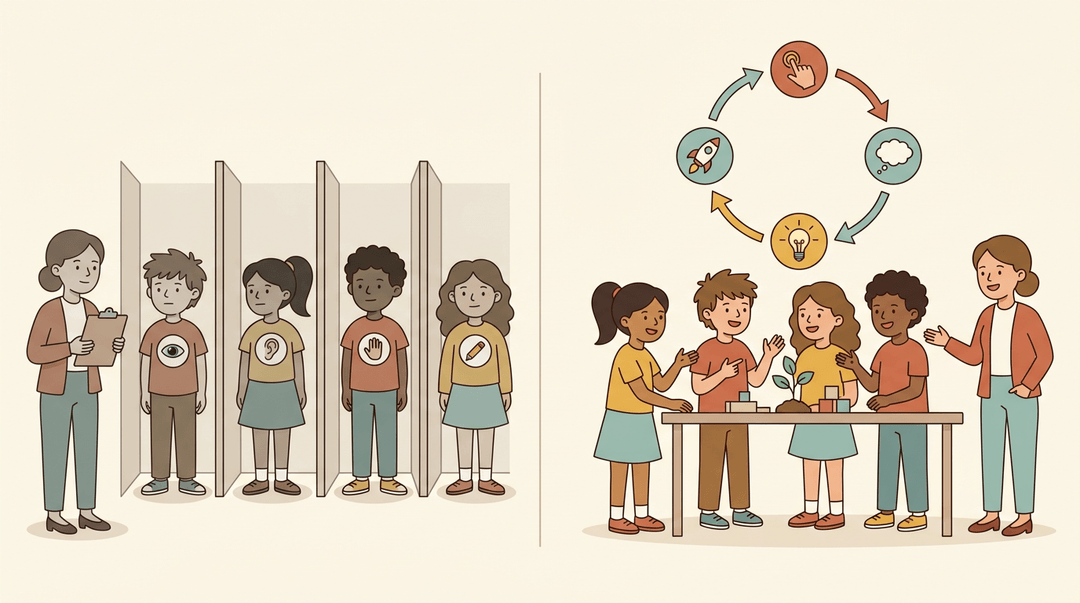
The cycle is about how learning unfolds, not what kind of learner someone is. Learning styles claim each student has a mode of instruction that works best for them.
Kolb also developed a styles framework of his own, which is one reason the two get tangled. Don't label learners and plan around the label. Use the stages to design experiences for everyone.
Why learning styles lack solid support
A guest post on The Learning Scientists blog describes matching teaching to learning styles as a neuromyth and notes it remains "a remarkably entrenched mindset" among teachers.
The article Learning Styles: Concepts and Evidence finds insufficient evidence to support routinely assessing learners' styles, and that a preference for one doesn't establish that matching instruction to it improves learning.
Consider a fifth-grade teacher who labels Maya an "auditory learner" and gives her only spoken explanations. Maya may enjoy them, but liking a format isn't the same as learning from it. Preference isn't progress.
Where the model falls short and why
Morris, in David Kolb's Experiential Learning Machine, questions the heavy emphasis on concrete experience, arguing the model "ignores the process nature of experience."
Critics also want more attention to context: the setting and people around each experience. Any revision needs empirical testing before we accept it. The cycle doesn't explain everything about learning, and it isn't the only model of adult learning.
Gibbs's reflective cycle is a different model, so keep the two straight when you plan.
When students get to experience something, reflect on it, make sense of it, and then try it again, learning tends to stick. The Kolb cycle gives you a simple way to design for that rhythm, whether you're planning a single lesson or an entire unit.
Ready to put the cycle on your calendar? Check out Curriculum & Standards to plan units, lessons, and standards across the whole school year.
References
- Learning Styles: Concepts and Evidence — pubmed.ncbi.nlm.nih.gov
- David Kolb's Experiential Learning Machine — doi.org (1993)
- GUEST POST: Matching instruction to preferred learning styles does not raise achievement — learningscientists.org