Stages of Second Language Learning, Explained

Jump to section
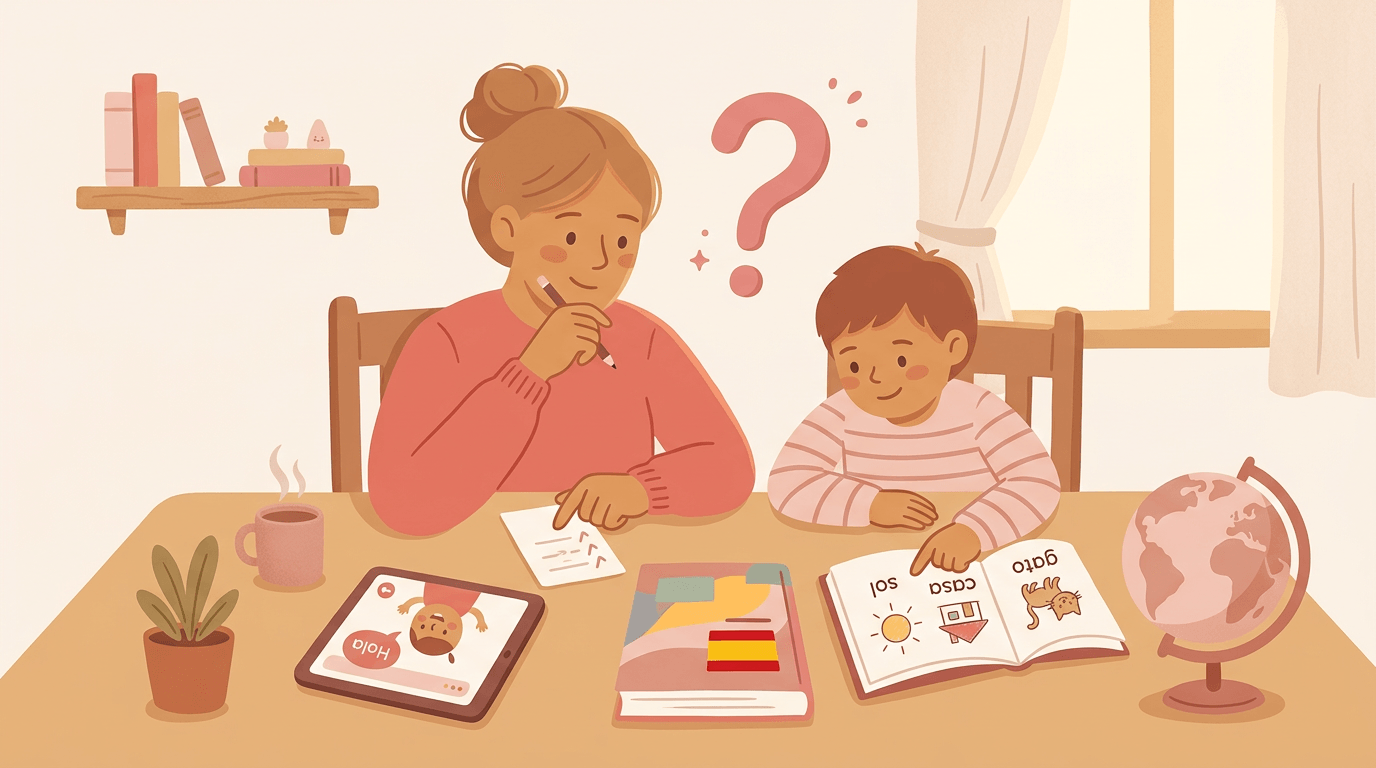
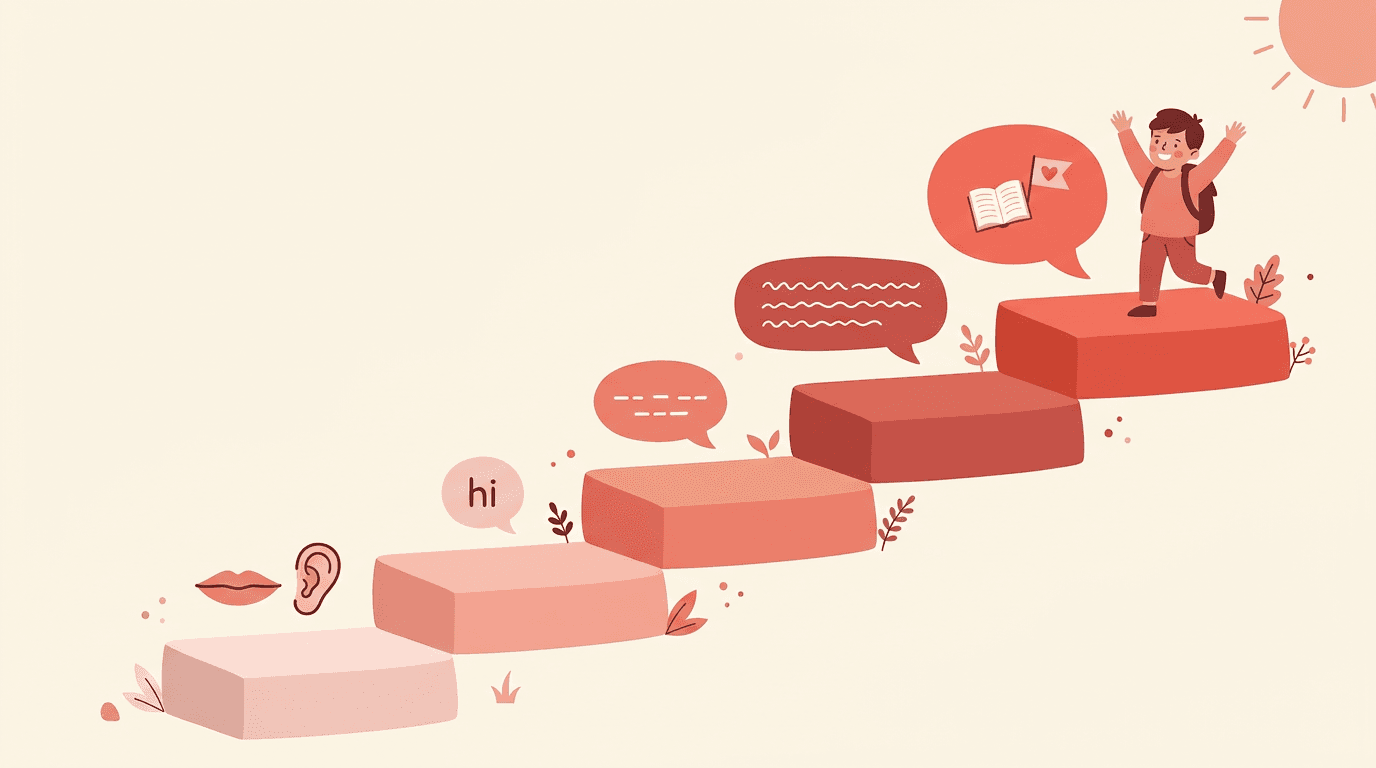
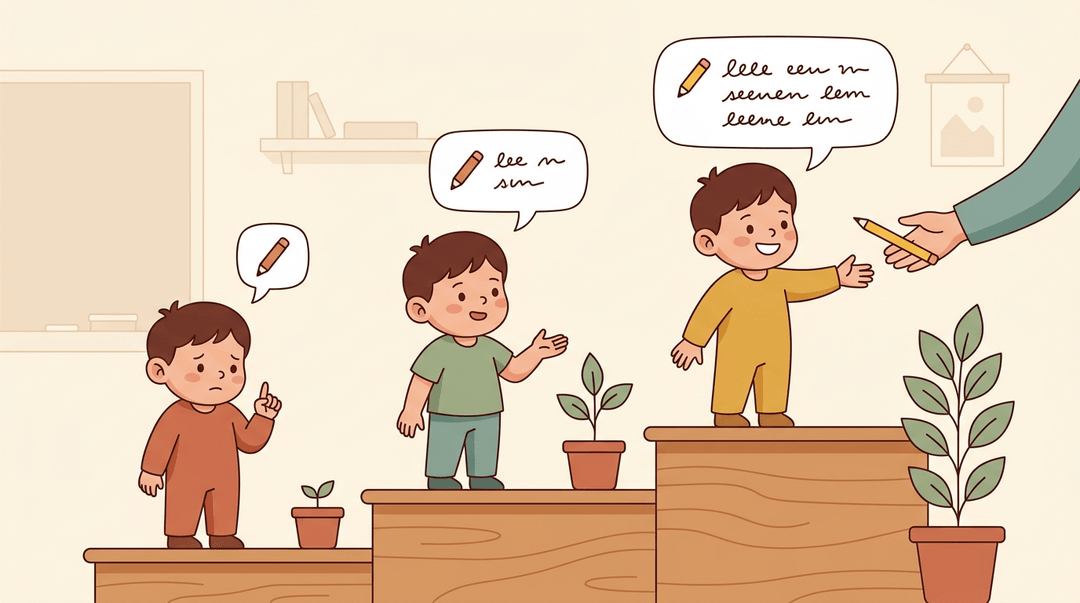
Picture a new student who knows only a few words of English. Over time, they're asking to borrow a pencil in full sentences. That growth doesn't happen all at once, and it doesn't move at the same speed for every learner.
Second language learning moves through recognizable stages, and knowing where a learner sits tells you what to teach next.
In this post, we'll walk through each stage, the theories behind them, and the factors that speed or slow progress. We'll also show you how to map those stages to proficiency frameworks so your lessons stay on target.
Stages of Second Language Learning, Step by Step
Most learners move through the same broad stages, though not at the same speed. Knowing them helps you respond to what your students can actually do.
The silent period before speaking starts
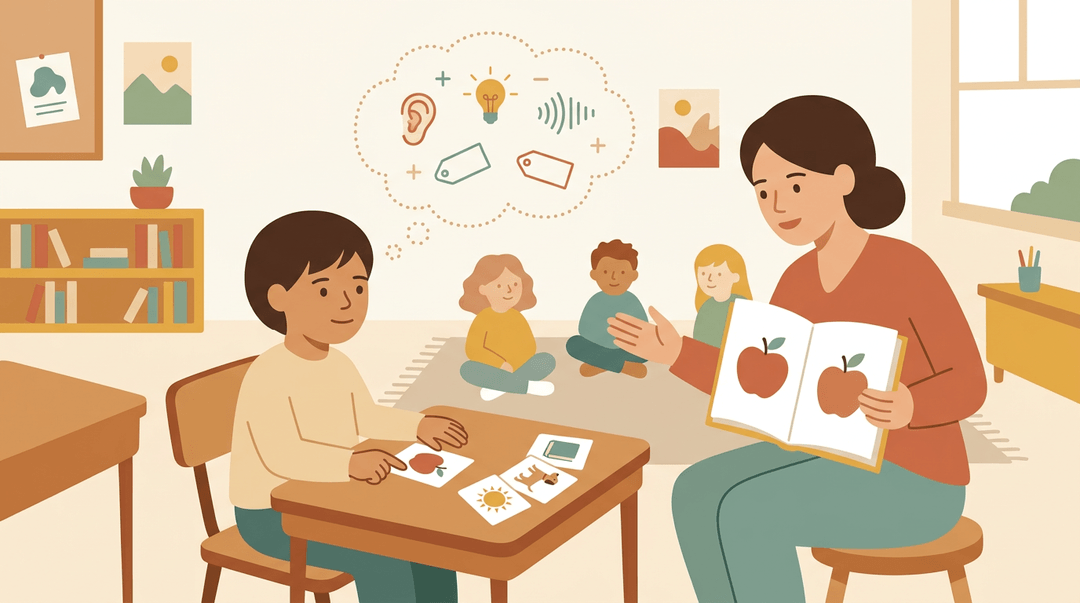
In the silent period, learners take in the language through listening and observing, often with minimal comprehension. They may rely on gestures instead of speech while they quietly build vocabulary.
Picture a newcomer in your third-grade class who spends the first month pointing to picture cards and nodding during read-aloud. That student isn’t lost. A clear visual or gesture from you helps them keep up without pressure to talk.
Duration varies by source, so don’t set a fixed clock on it. Silence isn’t disengagement. Quiet often means thinking rather than checking out.
First words and simple phrases appear
Soon students produce single words and simple phrases, including fixed expressions like greetings: “good morning,” “see you later,” or “more, please.” Comprehension is still limited, so keep directions short and visual.
Consider a student who greets classmates with “good morning” at the door every day. Celebrate that win out loud. It builds the confidence that carries learners into the next stage.
When short sentences begin to form
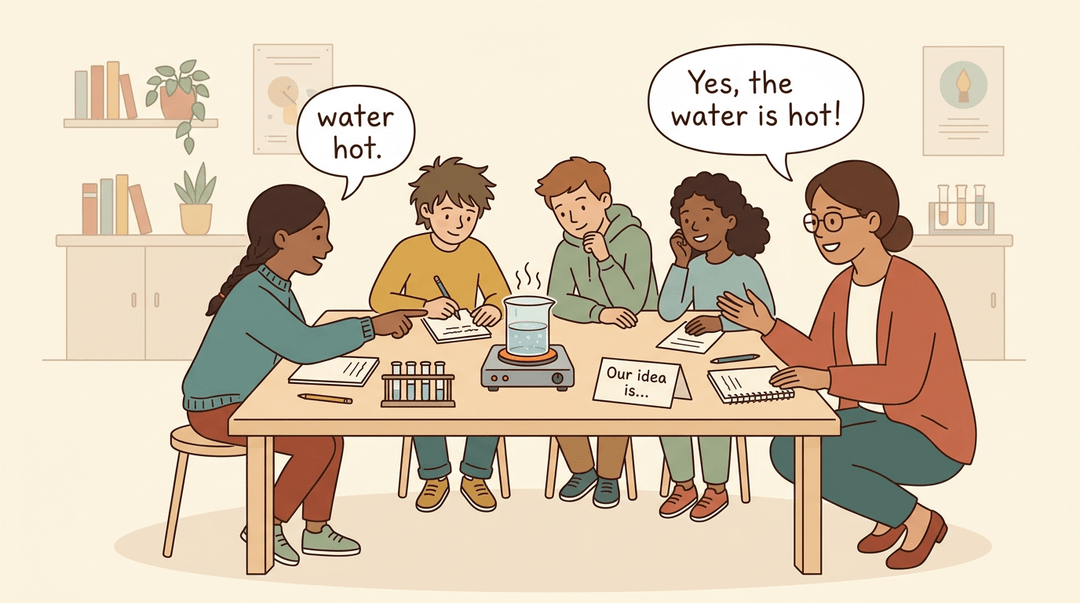
Learners now string words into simple sentences like “The water is hot” and hold short conversations with a partner. Errors are still common (“He go to lunch”), but comprehension keeps getting better.
In a science lab, a student says “water hot.” Instead of stopping the group, reply “Yes, the water is hot!” The student hears the correct model, and the group keeps talking.
Aim for communication first and accuracy second. Sentence frames like “Our idea is...” keep partner talk moving.
Sharing opinions in longer conversations
Learners now handle complex sentences and longer conversations. They share opinions with a bigger vocabulary and idioms (expressions whose meaning isn’t clear from their separate words), and they feel more at ease in group discussions.
Consider a middle school student who argues that the hero gets off too easily, using “although” and the idiom “let off the hook.” Give them time to finish before you step in. The focus moves from getting the words out to shaping the argument.
Near-native skill, reached over several years
At the far end, learners reach near-native skill, so their speech and writing sound natural across complex discussions and professional tasks. Regional accents and dialects often remain, and that’s a sign of identity, not failure.
Picture a student years from now working in a clinic and explaining treatment options to a family. Reaching this level takes several years of steady practice.

How long each stage typically lasts
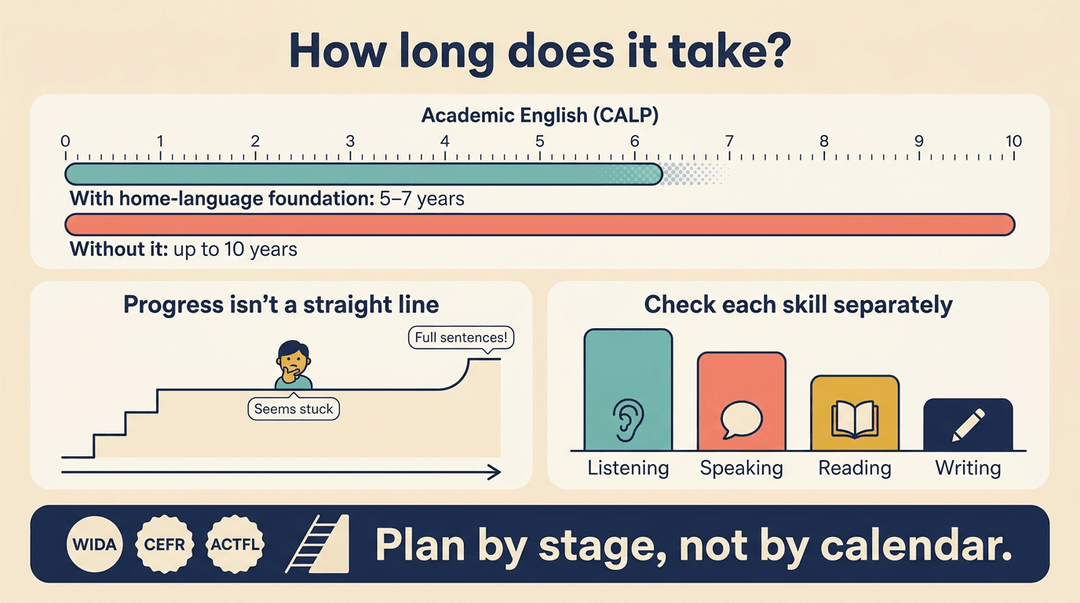
Durations vary, and individual learners move at their own pace. The full journey can take up to 5 to 7 years.
Jim Cummins describes academic language, which he calls Cognitive Academic Language Proficiency (CALP), as typically taking 5 to 7 years to acquire, and up to 10 without a native-language foundation.
Progress isn’t always linear. A student may seem stuck for months, then suddenly ask questions in full sentences. Check each of the four domains:
- listening
- speaking
- reading
- writing
on its own, since a student can be further along in one than another.
Proficiency frameworks such as WIDA (World-Class Instructional Design and Assessment), CEFR (Common European Framework of Reference for Languages), and ACTFL (American Council on the Teaching of Foreign Languages) describe what learners can do at each level.
Mapping students to one lets you plan by stage, not by calendar.
Planning Lessons Around Each Learner's Stage
Use this guide to match one lesson to learners at different stages. Check where students stand, tier the targets, then pace the language goals across the year.
Check where each learner stands
- Run a two-minute listening and speaking check
- Listening, say: "Show me the one that's bigger."
- Speaking, say: "Tell me about your picture."
- Watch with an observation checklist
- Keep a roster and tally what students do during normal activities.
- Look-fors: pointing, single words, short phrases, full sentences.
- Record the stage, then review each term
- Jot it beside the name: Maria: early production, Oct.
- Stages shift, so recheck at the start of every term.
Tailor one standard for every learner
Keep the standard the same and tier the language demand. Here's one standard, "Compare two characters in a story," tiered by stage:
| Stage | Student target | Sentence frame |
|---|---|---|
| Preproduction | Point to or draw the brave character | Point to the ___. |
| Early production | Name traits in words or phrases | The character is ___. |
| Speech emergence | Compare in a simple sentence | ___ is ___, but ___ is ___. |
| Intermediate fluency | Compare with a reason | Although ___, ___ because ___. |
Then add a language objective to every lesson, beside the content objective. Put it on the board like this:
Content: I can compare two characters. Language: I can use but to show how they differ.
Key principle: Comprehension runs ahead of speaking. A student who answers by pointing may understand the whole lesson, so set output targets lower than listening targets.
Pace language goals through the year
Treat language goals as part of the pacing calendar, not an add-on.
- Build goals into pacing. Pair each unit's content standard with one or two language objectives.
- Revisit vocabulary in spiral units. Bring key words back in later units, in new contexts.
- Plan supports for gradual release. Start with frames and visuals, then fade them as students grow.
Example: A fifth-grade teacher introduces compare in September with picture cards and frames. In November she reuses the word in a science unit with fewer frames. By January, her early-production students are writing but sentences without the frame.
Before you teach, confirm
- Stage identified and documented: every learner has a stage and a date beside the name.
- Output matches comprehension level: no one is asked to produce beyond their stage.
- Gentle feedback is built in: you plan to restate errors correctly, not stop to correct them.
⚠️ Watch out: Don't skip the review. A stage recorded in September can be wrong by December.
Map language objectives to standards and pacing in EMStudio's Curriculum Planner.
What Affects How Fast Learners Progress
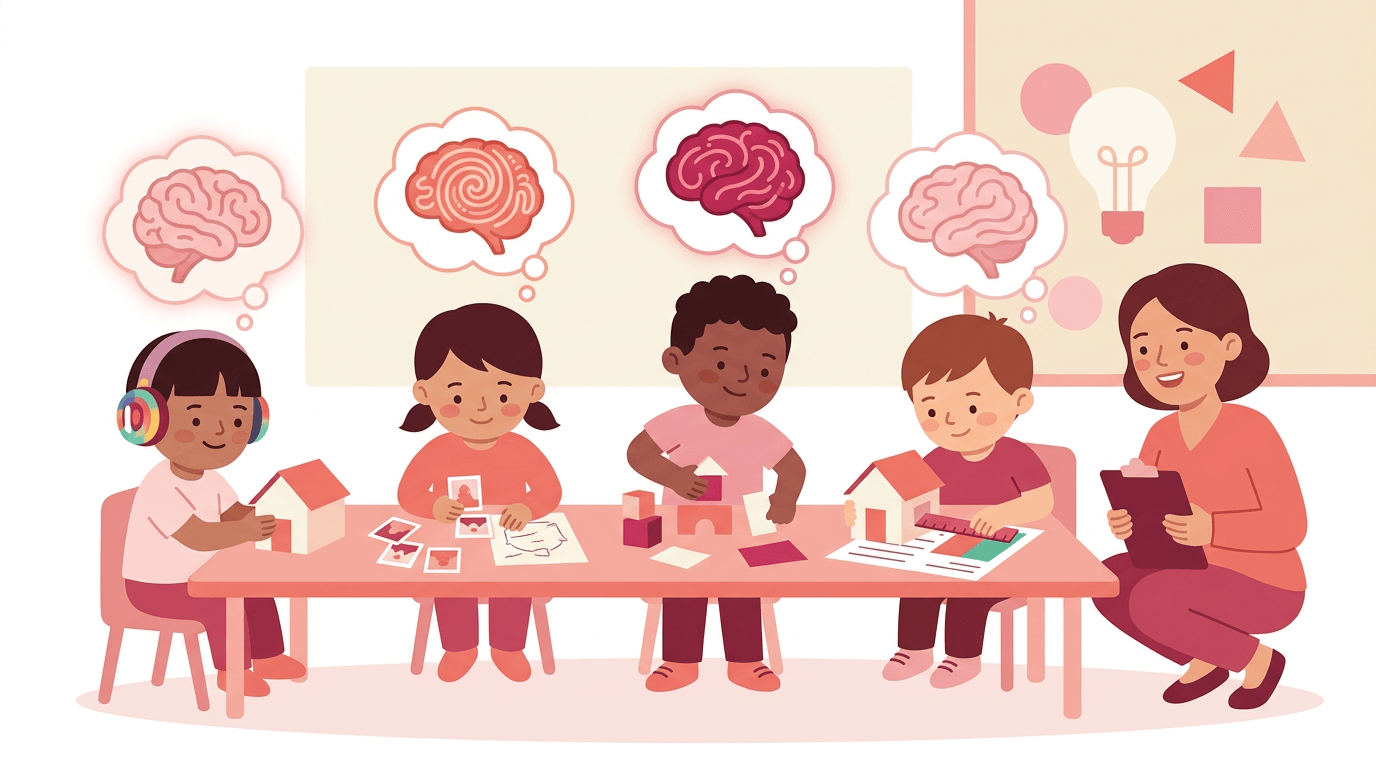
Learners don't all progress at the same pace, and several factors explain why.
How age and the critical period matter
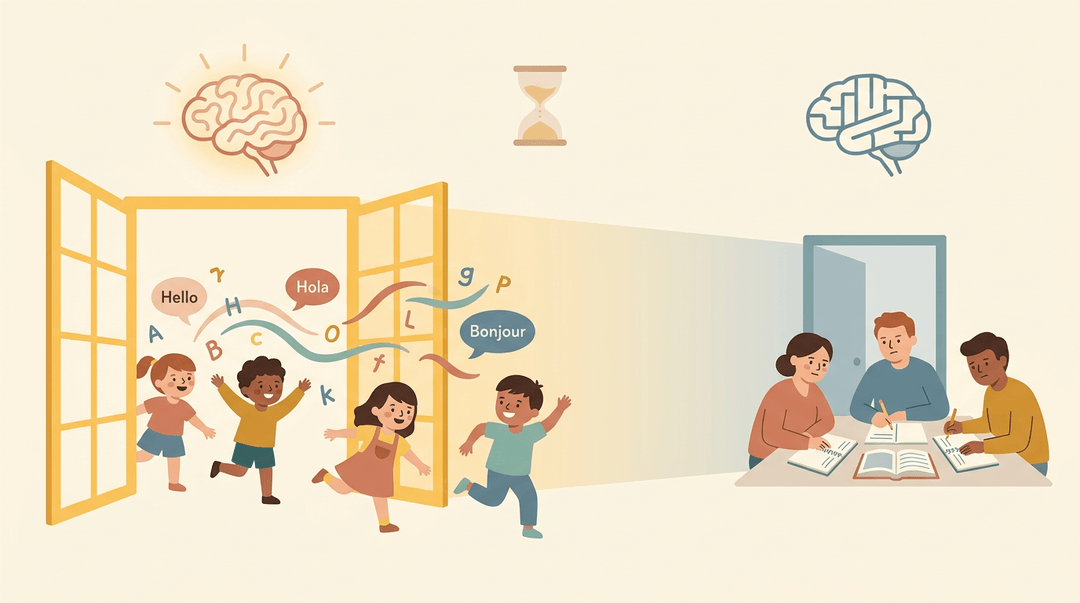
According to an ELT Journal article, the critical period hypothesis holds that there's an optimal window for acquisition, ending at puberty. Starting before puberty puts learners inside that window.
Brain plasticity, the brain's capacity to reorganize itself, is also shaped by starting age, according to a Frontiers paper. Young children often absorb a language effortlessly, while adults usually need more deliberate work.
Timing matters, but it isn't the whole story.
How surroundings and daily exposure matter
Community language exposure fuels every stage: a learner who hears the language at the store gets far more input than one who meets it only in a weekly class. Practice frequency matters too, and short, frequent sessions tend to beat occasional long ones.
Limited exposure creates barriers, including fewer chances to hear natural speech and fewer reasons to speak.
Family background sets the starting point: a child whose family reads together arrives with literacy habits that help. First language transfer means skills from a learner's first language carry over, for better or worse.
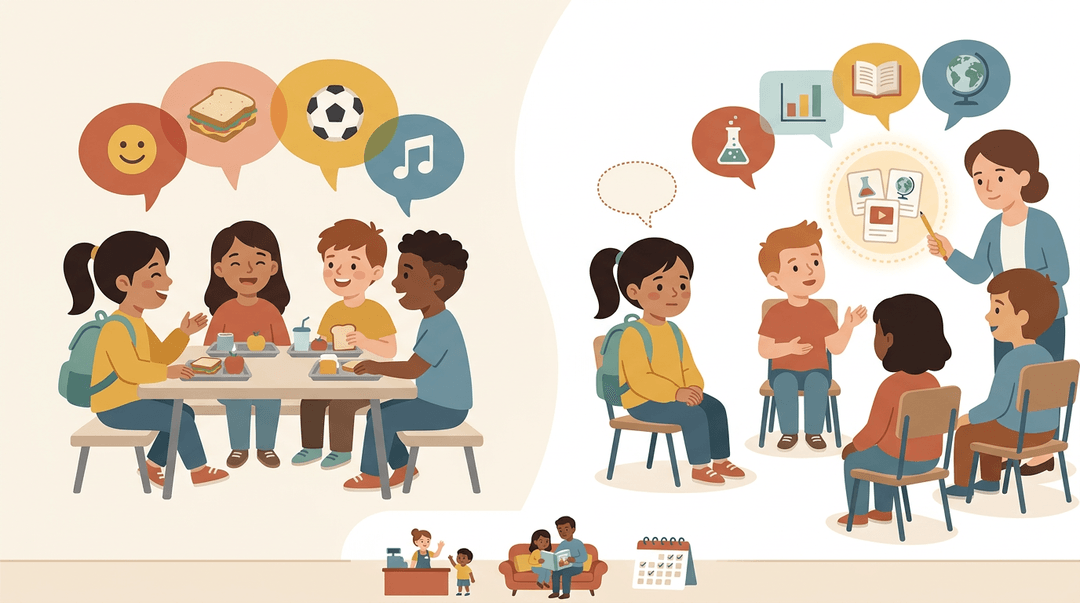
Consider a newcomer who chats easily at lunch but goes quiet in class discussions. That gap tells you exactly where to focus: academic vocabulary.
How personality and feelings shape progress
Personality, interests, and motivation shape engagement: a learner who loves soccer may happily read match reports in the target language. Emotions shift across the stages.
Anxiety about speaking can keep a learner silent, even when understanding is well ahead of speaking.
Adults can lean on systematic study, like explicit grammar and deliberate practice, to organize what they're learning.
Progress is rarely a straight line, and plateaus show up at every stage. Patience and persistence carry learners past them. Showing up counts.
Strategies and Support Matched to Each Stage
Here's how you can match activities, feedback, and methods to each stage.
Pick activities that fit each stage
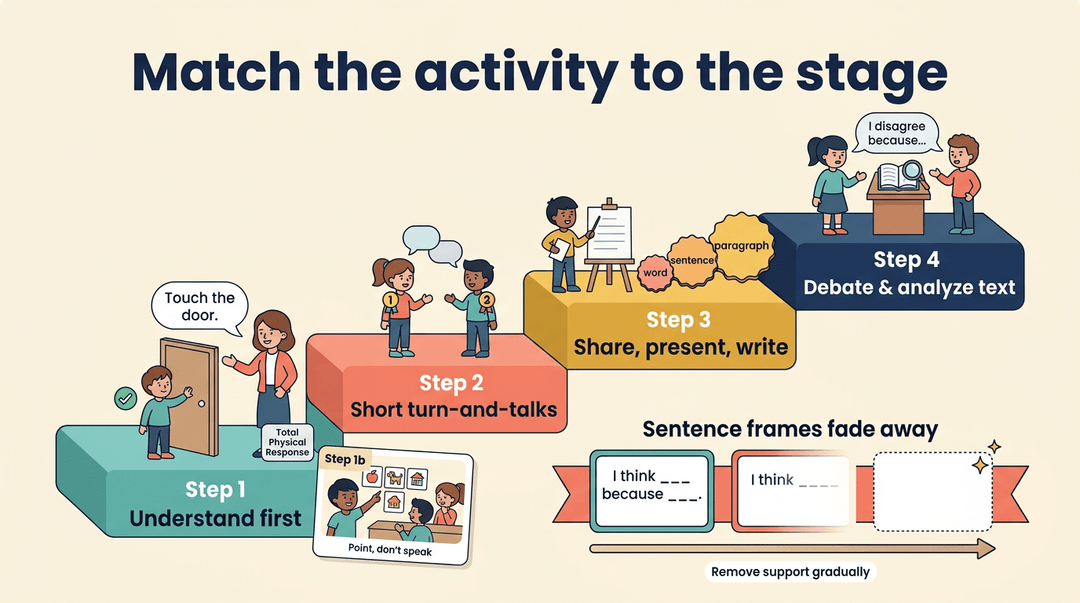
In preproduction, learners need to understand before they speak. Total Physical Response builds that through movement, like acting out "touch the door," with no pressure to talk.
Consider a fourth-grade teacher whose student new to English stays silent during group work. Instead of demanding sentences, she has him point to picture cards as classmates describe them. Soon he's calling out the words himself.
As learners gain confidence, widen what they produce:
- Chances to produce language: short turn-and-talks give every student a turn.
- Opinion sharing, presentations, and essays: these build from single words to organized ideas.
- Debates and text analysis: arguing a position or unpacking a passage pushes richer language.
- Sentence frames by stage: give early learners full frames, then remove supports gradually.
Keep learners motivated with gentle feedback
- Relaxed atmosphere: keep practice low-stakes so mistakes don't feel scary.
- Gentle correction: if a student says "The plant need water," repeat the sentence correctly and keep the conversation going.
- Encouragement keeps motivation high: name specific progress, like "You used three new words."
Accuracy follows confidence, not the other way around.
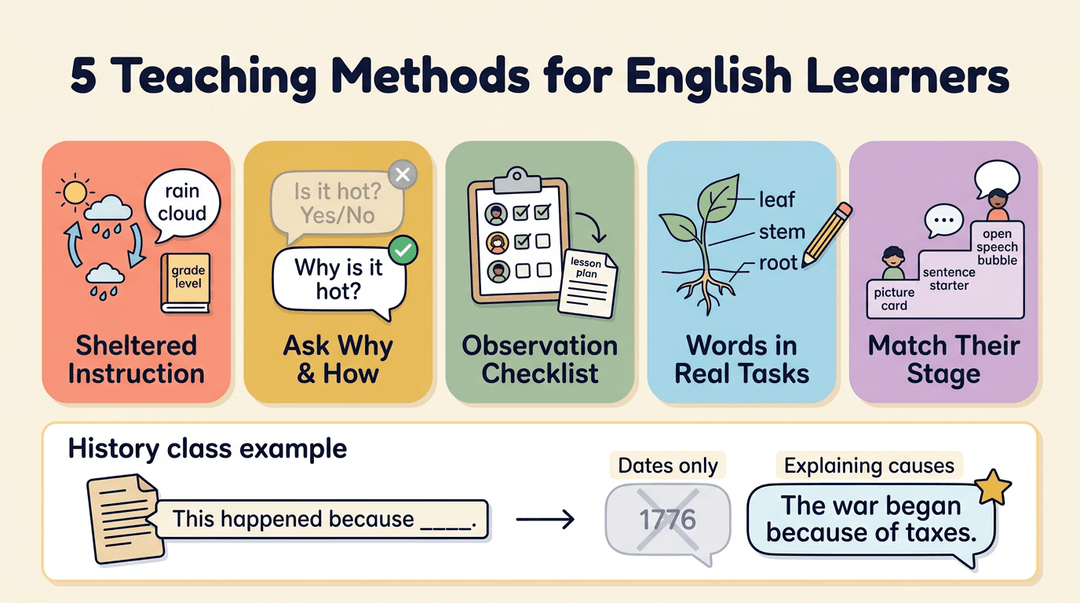
Teaching methods that work for English learners
- Sheltered instruction: teach grade-level content with visuals and simpler vocabulary.
- Higher-order questioning: ask "why" and "how," not just yes-or-no questions.
- Observation checklists: note what each learner can do, then shape your next lesson.
- Context-embedded instruction: teach vocabulary inside real tasks, like labeling a diagram.
- Instruction reflecting acquisition levels: match tasks and supports to each learner's stage.
A history teacher who adds a sentence frame to a primary source gets students explaining causes, not just dates.
Theories Explaining How Second Languages Are Learned
Why do some learners chat easily while others struggle for years? These ideas explain the gap and give you a place to start.
Krashen's ideas about order and emotional barriers
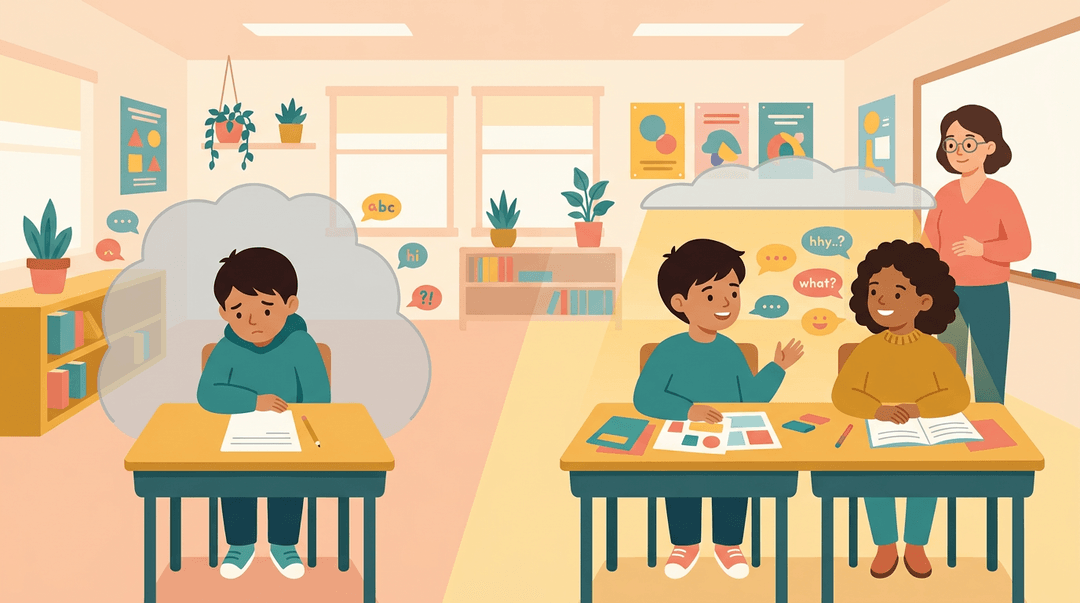
Krashen's Natural Order Hypothesis says grammar is acquired in a fairly predictable order. His Affective Filter Hypothesis adds the emotional side. Three factors raise or lower the filter:
- Motivation keeps learners reaching for the language.
- Confidence lets them take risks with new words.
- Anxiety raises the filter and blocks input.
Picture a fourth-grade teacher whose newcomer sits silently through every lesson. A patient partner gets him talking, and soon he's answering in short phrases. Lowering the pressure, not adding worksheets, made the difference.
Picking up a language versus studying it
Unconscious acquisition is picking up a language through real conversation and stories. Conscious rule learning is studying grammar rules and their exceptions.
A Spanish teacher's weekend chat gets students using past-tense verbs before any rule lesson, and the grammar lesson later explains what they already use.
How BICS and CALP differ for learners
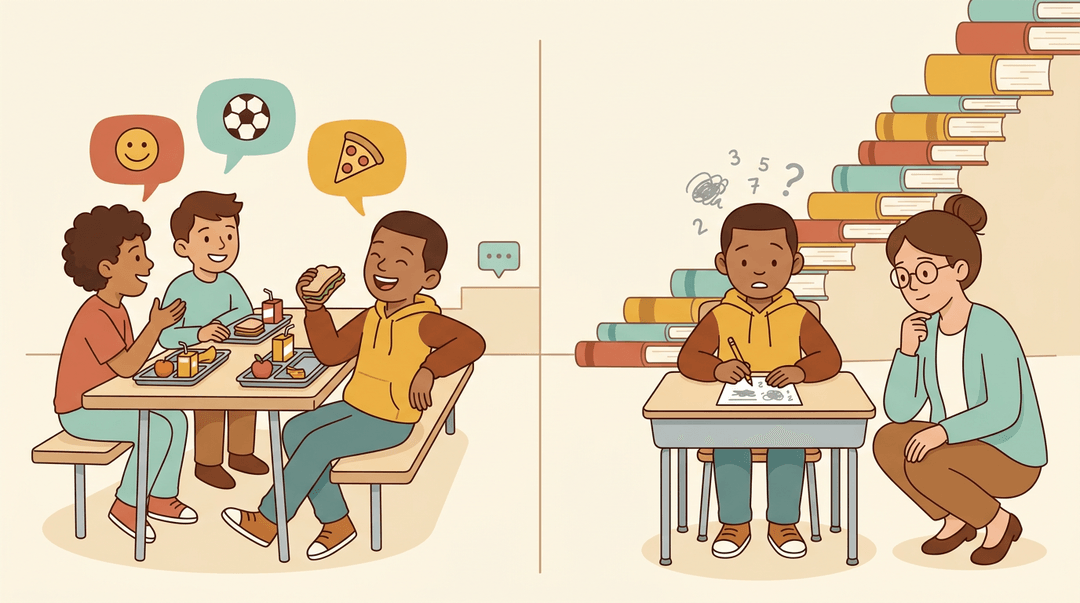
Basic interpersonal communicative skills (BICS) are everyday talk supported by context. According to Jim Cummins, it usually develops within 6 months to 2 years. Cognitive academic language proficiency (CALP) is the language of textbooks and tests.
A paper on CALP in diverse classrooms found most bilingual students fluent within 0 to 2 years of arrival, but approaching normal CALP took 5 to 7 years.
Social fluency isn't academic readiness. Think of a fifth-grade teacher whose student chats at lunch but freezes on a word problem. Fluent at lunch doesn't mean ready for the test.
Knowing your learners' stages turns a vague sense of 'they're getting there' into a clear plan for what comes next. When you match tasks to where each student actually is, lessons feel less like guesswork and more like steady progress.
Ready to build standards-aligned lessons for every stage? Check out our Curriculum & Standards page to plan units, lessons, and standards across the whole school year.
References
- Jim Cummins — g.co
- Developing Cognitive Academic Language Profic iency (CALP) in Diverse Classrooms — digitalcommons.usu.edu (2011)
- Age and the critical period hypothesis | ELT Journal — academic.oup.com (2008)
- Frontiers | Plasticity, Variability and Age in Second Language Acquisition and Bilingualism — frontiersin.org (2018)