What Do Restorative Practices Look Like in Action?


Jump to section
Think about the last time a disagreement with a friend actually got resolved. Someone probably asked what happened, how it affected everyone, and what could fix it.
That conversation is the whole idea behind restorative practices: a way of responding to conflict and harm that repairs relationships instead of just handing out consequences.
More schools are leaning on this approach every year. In this post, we'll break down what restorative practices actually mean, how they differ from restorative justice, and how to run your first classroom circle step by step.
What Are Restorative Practices?
Restorative practices are best understood as an umbrella term: a whole toolkit of strategies for building community and relationships, not one single technique.
They work both proactively (before conflict) and reactively (after it), and we can organize most of them under a four pillars framework that shapes everything from morning meetings to how you handle a fight in the hallway.
Repairing harm instead of just punishing it
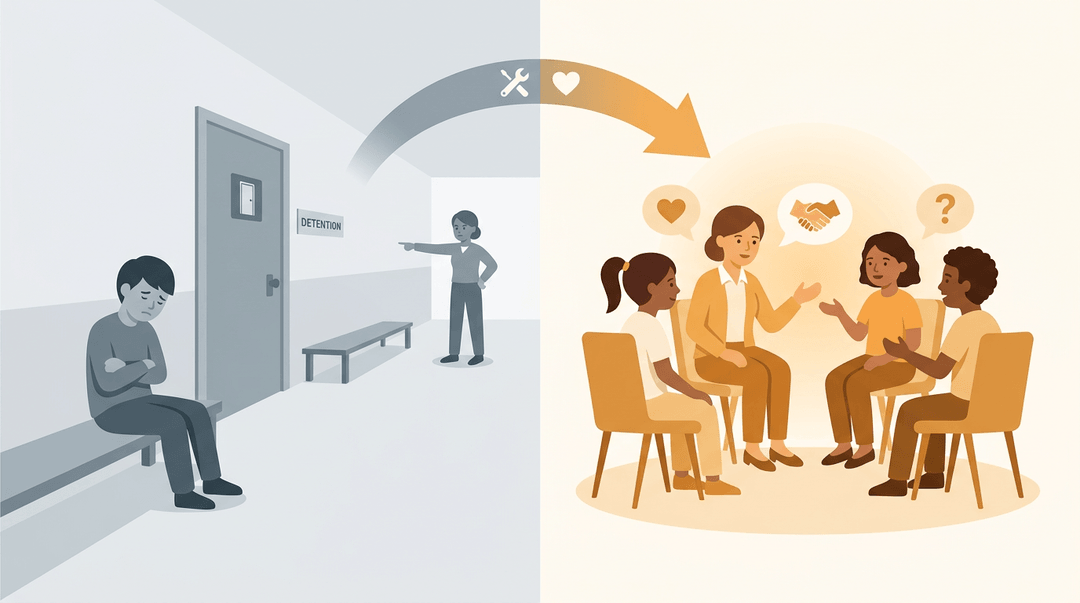
Instead of sending a student straight to detention, restorative practices ask what happened, who was affected, and how to make it right.
That's the shift: from punishment to repair. Used proactively, they build the relationships and trust that head off conflict before it starts.
Used reactively, they give you a structured way to repair harm after it happens, an alternative to punitive discipline that keeps students in the room instead of pushing them out.
What are the four pillars of restorative practices?
Most frameworks group restorative practices into four pillars:
- Classroom meetings. Regular check-ins that build community and give every student a voice.
- Community-building circles. Structured time to strengthen relationships before anything goes wrong.
- Conflict resolution and mediation strategies. Guided processes for working through disagreements face to face.
- Affective statements and reentry support. Naming how harm affected you, then welcoming a student back in after an incident.
How restorative justice differs from restorative practices
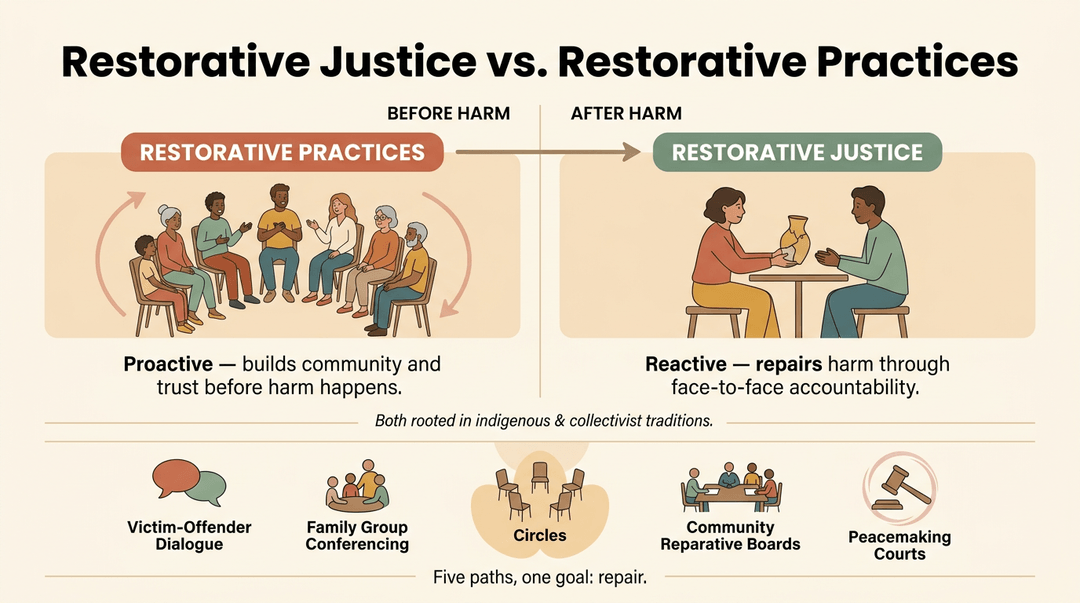
Restorative justice tends to be more reactive: it holds the person who caused harm accountable through face-to-face repair with the person affected.
Restorative practices, especially circle practice, lean more proactive, building the community that prevents harm in the first place. Both trace back further than any school handbook: they're rooted in diverse indigenous and collectivist worldviews.
Restorative justice itself breaks into five types:
- Victim-offender dialogue
- Family group conferencing
- Circles
- Community reparative boards
- Peacemaking courts
Each one a different path to the same goal of repair.
Why Schools Are Turning to Restorative Practices
For years, the default response to a classroom conflict was a trip to the office. That default is losing ground, and the research explains why.
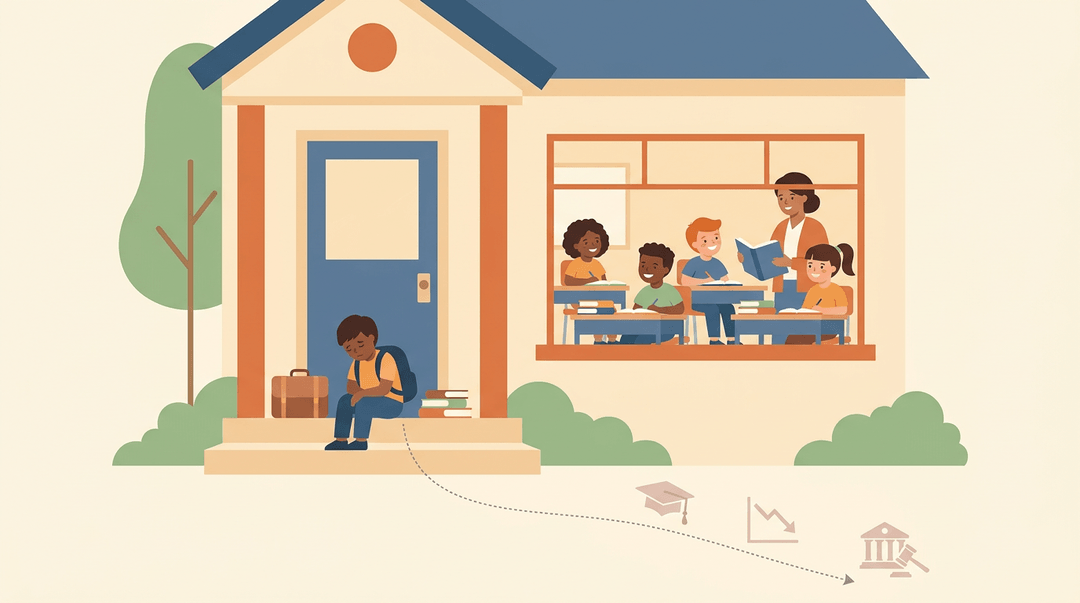
The downside of suspensions and expulsions
Zero-tolerance discipline sounds tough, but it doesn't hold up under scrutiny. Pulled together, the research paints a troubling picture:
- It doesn't reduce misbehavior. According to Brookings, "research indicates that suspension-promoting policies do not reduce student misbehavior, nor do they make schools safer."
- It undermines school climate. A study published by the Office of Justice Programs found that a stronger sense of school climate was linked to a lower likelihood of suspension in the first place.
- It lowers achievement. Research summarized in a presentation on exclusionary discipline ties suspensions and zero-tolerance policies to lower academic achievement.
- It raises dropout and custody risk. A study in the Journal of Quantitative Criminology found that fixed-term exclusions "caused a 2.5 percentage point increase in the probability of a student being in youth custody by age 18."
- It hits some students harder than others. The U.S. GAO found that Black students, boys, and students with disabilities were disproportionately disciplined in K-12 public schools.
Building a fairer, more inclusive classroom
Restorative practices offer a different starting point: repair instead of removal. Instead of asking who to punish, you ask who was harmed and what it'll take to make it right.
That shift builds equity into the everyday rhythm of a classroom. Every student gets treated with the same dignity and respect, and every voice, including the quiet ones, gets a turn to speak.
Consider a student who's routinely written up for talking back: a restorative conversation gives that student a real say instead of another consequence, which can narrow achievement gaps and give marginalized students a classroom that finally works with them, not against them.
What Does a Restorative Classroom Look Like?
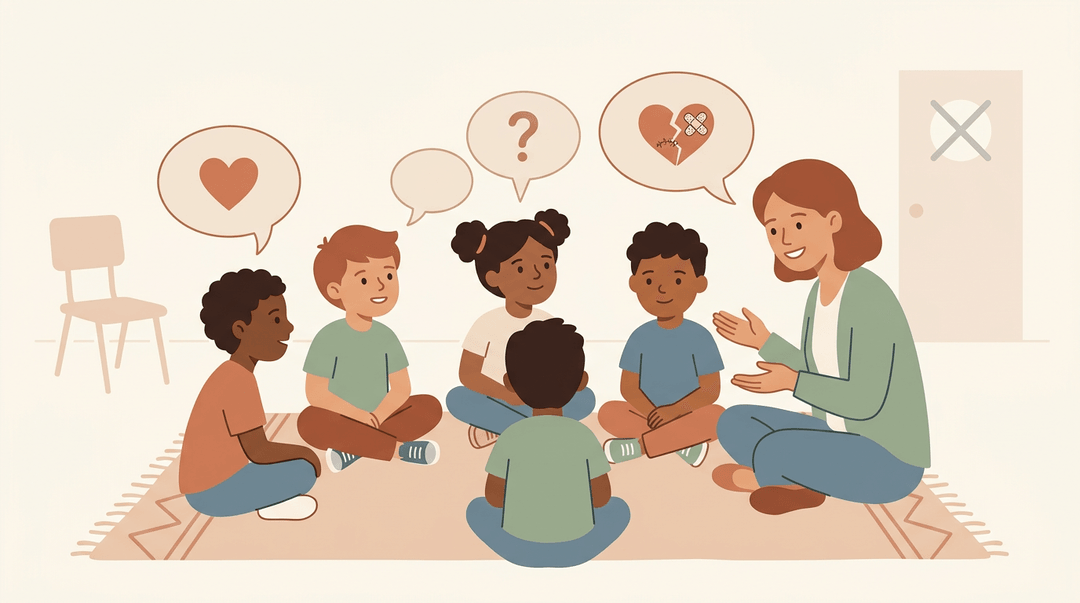
Picture a classroom where conflict doesn't end with a trip to the office, but with a conversation. That's the shift restorative practices ask for: less punishment, more repair.
Getting there follows a clear, repeatable process, and it starts with the whole school, not just one room.
Getting your whole school on board
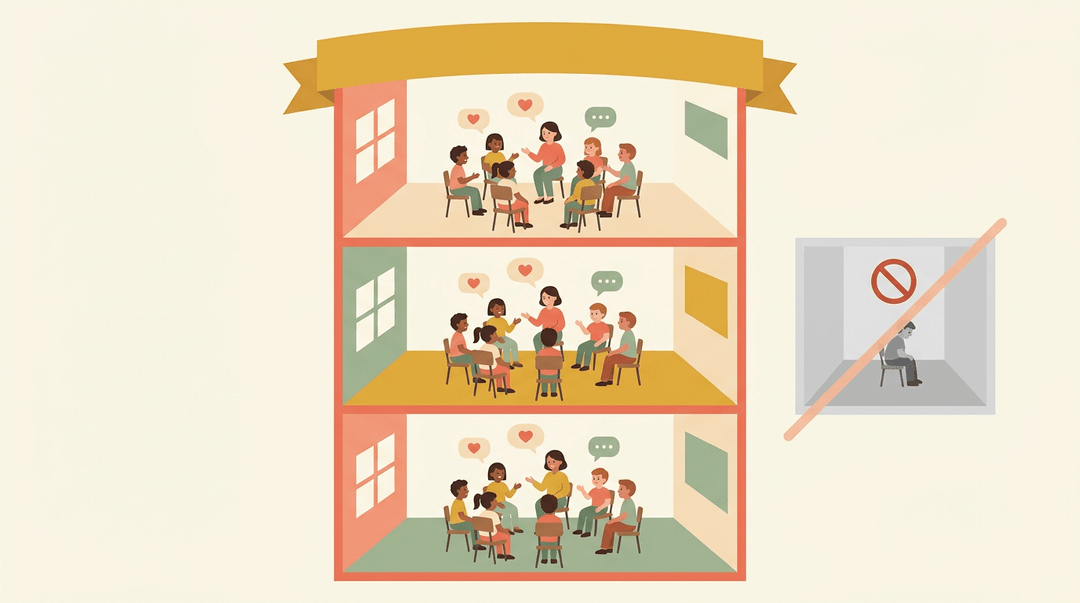
Restorative practices work best when they replace zero-tolerance policies, not sit next to them. That means integrating community-building strategies into everyday routines, not just pulling them out during a crisis.
Whole school investment matters: one teacher running circles while the rest of the building still hands out suspensions won't move the needle.
Staff buy-in and training get everyone speaking the same language, and embedding the approach into accountability systems (how behavior actually gets tracked and discussed) keeps it from fading by spring.
For a substitute covering an unfamiliar room, a quick script helps: "In this class, we solve problems by talking them through, not by getting in trouble. Who wants to share first?"
How to design an effective restorative circle
Every circle needs a clear goal before it starts:
- building community
- working through a conflict
- simply checking in
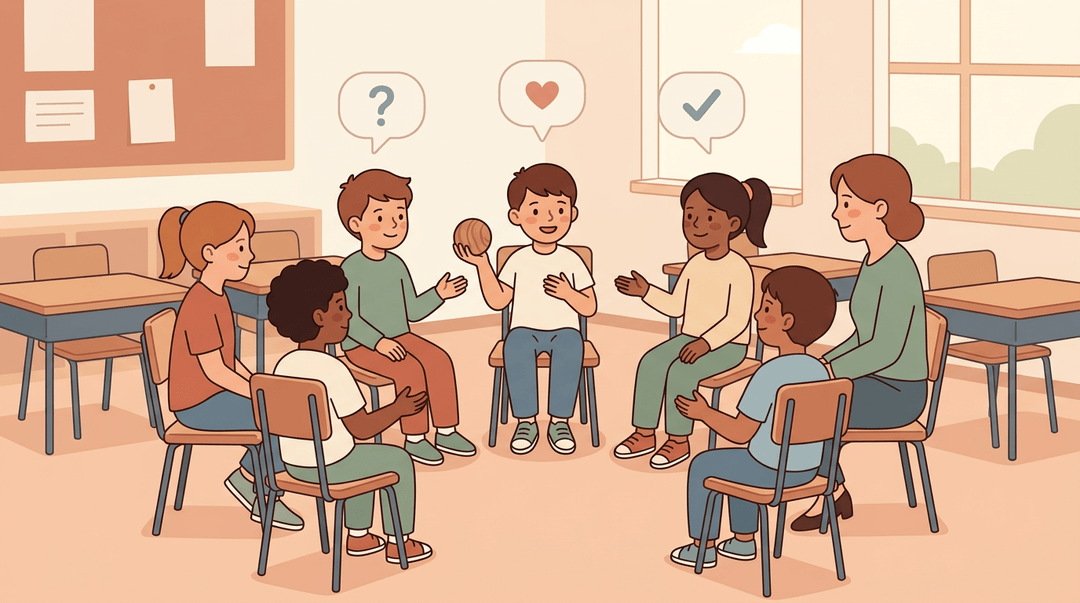
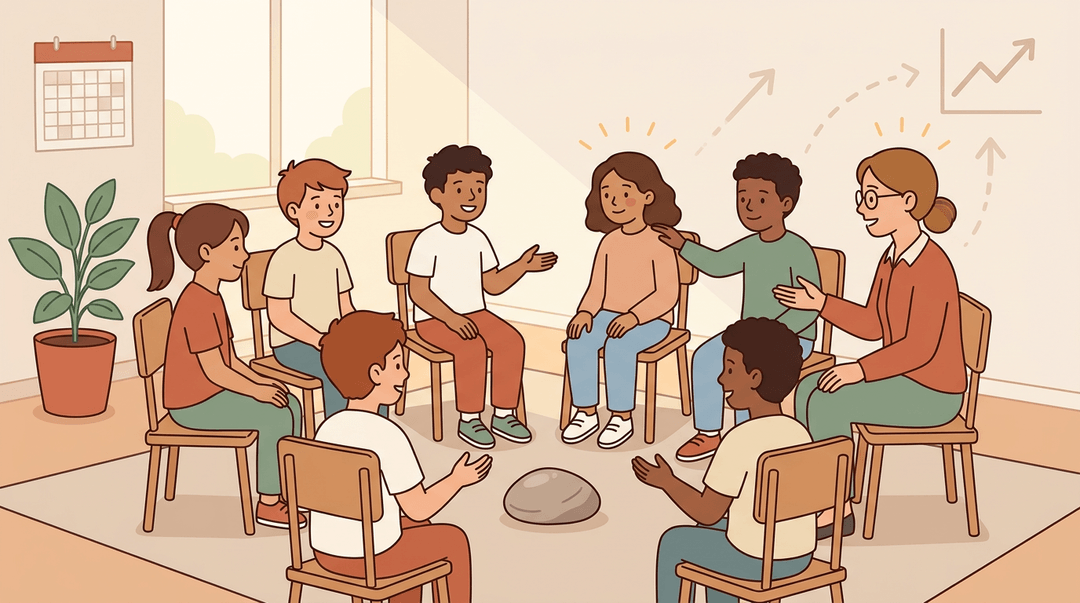
Opening and closing rituals (a question, a quote, a moment of quiet) signal this space is different from a regular lesson. A talking piece, passed hand to hand, keeps one voice speaking at a time.
Simple check-in and check-out questions bookend the discussion rounds. Prompts should shift by grade band: younger students might answer "What made you smile this week?" while high schoolers might tackle "When did someone misunderstand you?"
Laying the groundwork for success
Restorative work connects naturally to the Universal Design for Learning (UDL) framework, since both start by meeting students where they are.
Equity audits, gathering real student voice, and building trust before you need it all matter more than the circle itself. Start early in the year and keep it continuous, not just after the first blowup.
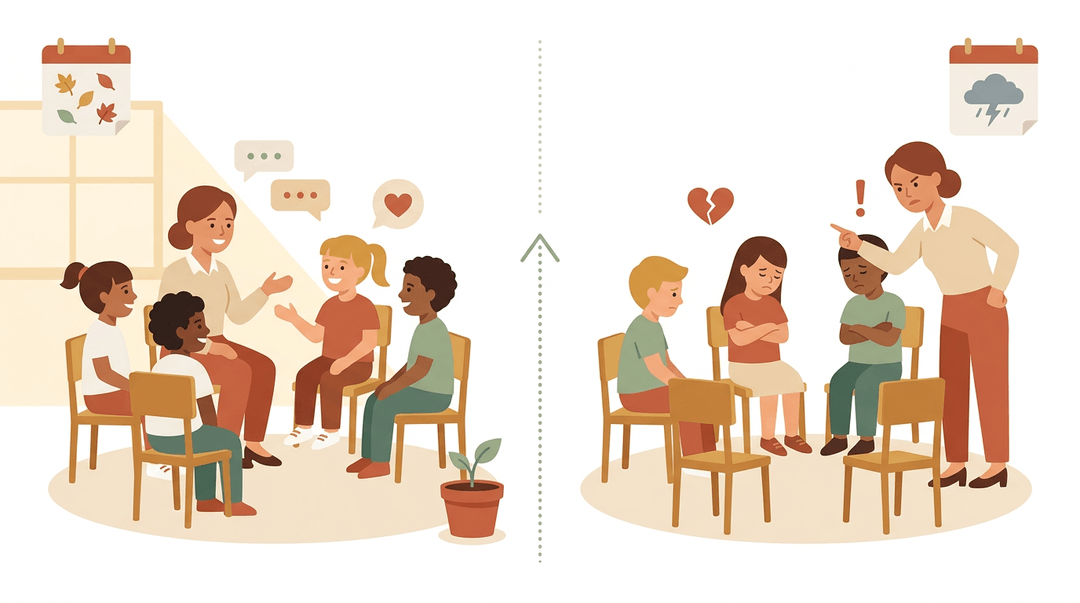
The common pitfall: treating circles as a punishment response instead of routine practice.
What are the five restorative questions?
Affective statements ("I felt frustrated when...") anchor impromptu conversations, peer conflict mediation, and staff-student resolution meetings alike, and daily check-in circles keep that muscle strong. The five restorative questions ask:
- What happened?
- What were you thinking at the time?
- Who's been affected, and how?
- What do you need to make things right?
- How do we make sure this doesn't happen again?
Run a Restorative Circle Step by Step
Think of this as your run sheet: five minutes of setup, a clear sequence for the talk, and a close that leads somewhere. It works the same whether you're building community on a Monday or repairing harm after a rough Friday.
Set up before students arrive
- Write one clear goal for the circle.
- On the board: "Today's circle: how we treat borrowed supplies."
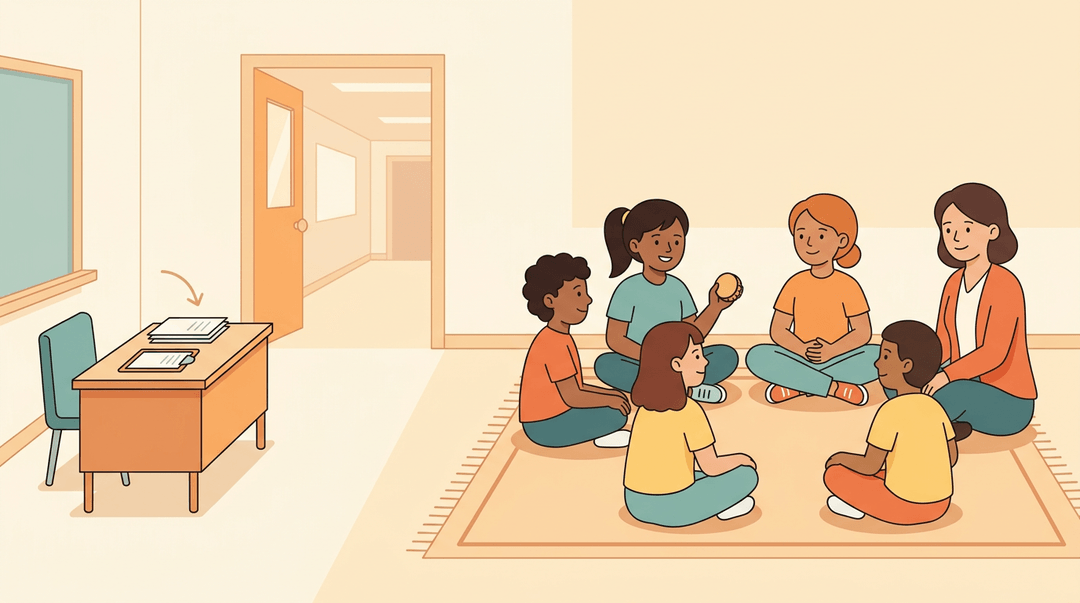
- Choose a talking piece. Only the person holding it speaks.
- Anything passable works: a class mascot, a smooth stone, a beanbag.
- Arrange seating in a true circle. No desks in front, everyone visible to everyone.
- Pick a short opening ritual to mark that circle time is different.
- Try a one-word check-in: "One word for how you're arriving today."
Guide the conversation
- Open with an affective question. Ask about feelings and impact, not blame.
- Say: "How did it feel when the group project fell apart on Friday?"
- Pass the talking piece in order around the circle. One voice at a time, no cross-talk.
- Allow any student to pass. No explanation required, no follow-up stare.
- Circle back at the end: "Anyone who passed want the piece now?"
- Summarize the key themes before you close. Reflect back what the circle said.
- Try: "I heard frustration about interruptions, and three ideas for fixing that."
⚠️ Watch out: the pass option has to be real. Chasing a student who passed teaches the whole class that the circle isn't safe, and next week you'll get twenty passes.
Match the format to your grade band
The sequence stays the same at every age; the way students enter the conversation changes.
| Grade band | Lead with | What it looks like |
|---|---|---|
| K-2 | Short visual prompts | A feelings-faces card; students point, then say one sentence |
| 3-5 | Sentence starters | "I felt ___ when ___, and I need ___." |
| 6-12 | Peer-led discussion | A rotating student facilitator; you sit as an equal member |
Example: A fifth-grade teacher opens every Monday circle with the starter "One thing that helped me last week was..." By October, students finish each other's check-ins and she mostly listens.
Wrap up and follow through
- Close with a ritual or reflection so the circle ends on purpose, not on the bell.
- Ask: "One thing you're taking with you from this circle."
- Log follow-up needs while they're fresh. Note who needs a private check-in or a repair plan.
- Schedule the next check-in before you leave the room. Circles work as a routine, not a one-off event.
Slot circle time into your weekly timetable and log follow-ups right in EMStudio's class notes.
Growing Students' Social and Emotional Skills
Restorative circles do more than settle disputes. Every time students sit in that circle and talk through what happened, they're practicing skills that outlast the conflict itself.
The five core skills students develop
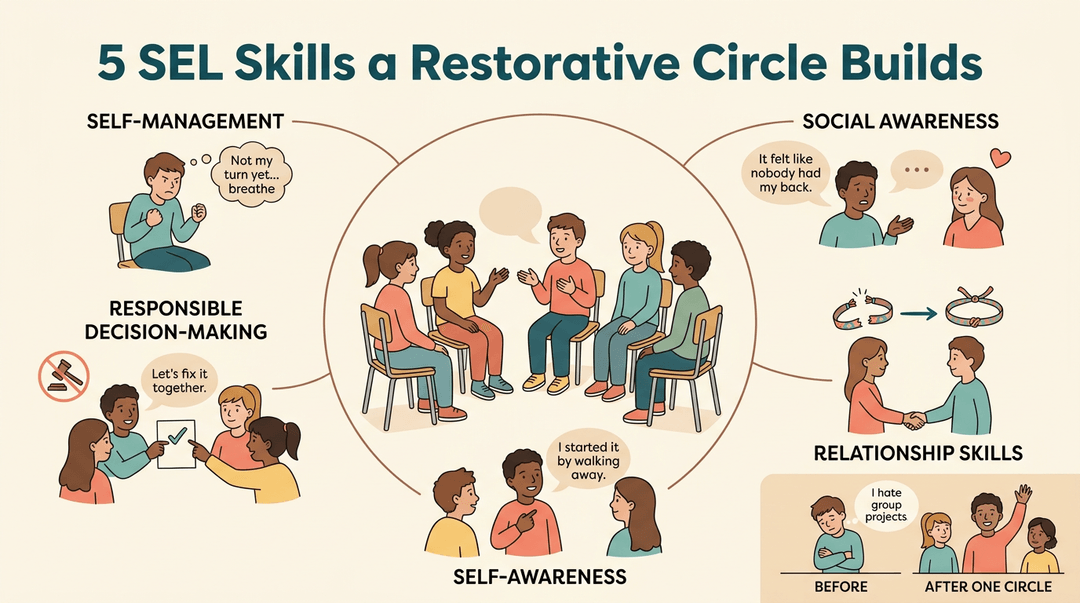
Educators often group these under social-emotional learning (SEL): the ability to understand emotions, build relationships, and make sound choices. A restorative circle gives students repeated, low-stakes practice at all five.
- Self-management. A student who's furious about a broken friendship has to sit still, wait for a turn, and speak calmly instead of storming off.
- Social awareness. Hearing a classmate describe how the same incident felt from their side builds real empathy, not the poster-on-the-wall kind.
- Relationship skills. Circles teach students how to repair a friendship instead of just walking away from one.
- Self-awareness. Naming your own role in a conflict out loud, in front of peers, takes honest reflection few adults manage easily.
- Responsible decision-making. Choosing a fair way to make things right together beats a punishment handed down from above.
Consider a sixth grader who dreads group projects because an old disagreement never got resolved. One well-run circle can hand that student the words and confidence to try again.
The Results Schools Are Seeing
Restorative practices sound good in theory, but do they actually change what happens in your hallways and on your students' report cards? The research says yes, and we can walk through what that evidence shows.
Fewer fights, referrals, and suspensions
Teachers who've adopted restorative practices consistently report improved student behavior: fewer scuffles in the hallway, fewer blowups derailing a lesson.
A study of Boston Public Schools found that "restorative practices in schools have been associated with decreased bullying and school violence, improvements in positive school climate and decreased use of suspensions."
That combination, less fighting and fewer suspensions, also tends to shrink the office referrals piling up on your desk and narrow the disciplinary gaps that too often fall hardest on the same students year after year.
A stronger school climate and better grades
The ripple effects go beyond discipline. Classrooms build a warmer climate, students feel more connected, and the trust between teachers and students deepens. That connectedness pays off academically too.
Researchers tracking more than 30,000 California students from 5th to 6th grade found that "increases in exposure are linked to higher academic achievement, reduced suspensions, and smaller related racial disparities."
The University of Chicago Education Lab saw similarly strong results studying Chicago Public Schools, noting that "suspensions and arrests decreased, driven by effects for Black students," with Latino students seeing gains as well.
What the research really shows
That California study is one of the largest of its kind, and it makes a simple point: the more exposure students get, the better the outcomes tend to be.
The Education Lab's broader research backs that up, finding restorative practices "reduce student arrests in and outside of school and for violent and non-violent offenses" while supporting genuine behavior change.
Alongside those numbers, schools report improved student mental health and a stronger overall sense of safety, the kind of results that make the effort worth it.
Restorative practices aren't a soft alternative to discipline. They're a structured way to help students repair harm, build trust, and grow the social and emotional skills that carry them well beyond your classroom.
Start with one circle, and you'll likely see the shift for yourself.
Ready to bring more structure to your classroom routines? Check out our Classroom Management feature to keep your classes, rosters, and schedules organized so you can focus on the conversations that matter most.
References
- School Exclusion and Youth Custody | Journal of Quantitative Criminology — link.springer.com (2025)
- Examining the Efficacy of Circles on School Safety and Student Outcomes in Boston Public Schools, Massachusetts, 2017-2020 — doi.org (2025)
- “I felt good being up here!” Empirically evaluating what happens when students gain exposure to a core restorative practice — doi.org (2025)
- From Retributive to Restorative: An Alternative Approach to Justice in Schools — educationlab.uchicago.edu (2025)
- Restorative Practices — educationlab.uchicago.edu (2025)
- Indigenous Roots of RJ — restorativejustice.ucsf.edu
- What does the research say about how to reduce student misbehavior in schools? — brookings.edu
- The Relationship of School Climate With Out-of-School Suspensions — ojp.gov
- Assessing the Effect of Exclusionary Discipline on Student ... — adecm.ade.arkansas.gov
- K-12 Education: Discipline Disparities for Black Students, Boys, and Students with Disabilities — gao.gov
- Restorative Practices in Schools: Research Reveals Power of Restorative Approach, Part II — iirp.edu
- Research shows restorative practices improves school climate, reduces student suspensions and discipline disparities — iirp.edu
- Promoting School Connectedness Through Restorative Practices | Reducing Health Risks Among Youth — cdc.gov
- Restorative practices in reducing school violence — frontiersin.org
- Improving Student Outcomes Through Restorative Practices — learningpolicyinstitute.org
- Restorative Practices Help Reduce Student Suspensions — rand.org
Frequently asked questions
What is a restorative practice?
A restorative practice is an overarching approach to conflict and harm that focuses on repairing relationships rather than solely imposing consequences. It functions as a toolkit of strategies for building community and strengthening relationships, adaptable for both proactive and reactive situations.
What are the 5 steps of restorative practices?
Restorative practices typically involve five key steps: identifying harm, active listening to those affected, facilitating dialogue between involved parties, collaboratively developing solutions to repair harm, and monitoring the agreement to ensure accountability and healing. These steps aim to address conflict and wrongdoing in a way that promotes understanding, amends harm, and rebuilds relationships within a community.
What are the 4 pillars of restorative practices?
The four pillars of restorative practices are classroom meetings, community-building circles, conflict resolution and mediation strategies, and affective statements and reentry support. These pillars encompass various strategies for both proactive community building and reactive harm repair.
What are the five restorative questions?
The five restorative questions are: What happened? What were you thinking at the time? Who's been affected, and how? What do you need to make things right? How do we make sure this doesn't happen again?
What are some examples of restorative practices?
Examples of restorative practices include regular classroom meetings, community-building circles, guided conflict mediation, and using affective statements to express the impact of harm. These practices aim to repair relationships and build community.
What is an example of restorative practices?
An example of a restorative practice is a classroom circle where students discuss how a group project falling apart affected them. This allows participants to share feelings and impacts, working towards a resolution rather than just assigning blame or punishment.
What are examples of restorative practices in schools?
In schools, examples of restorative practices include teachers conducting regular check-in circles, using talking pieces to facilitate discussions, and leading guided conflict resolution conversations between students. These strategies help build a supportive classroom environment and address harm constructively.
What does a restorative classroom look like?
A restorative classroom prioritizes conversation and repair over punishment. It features practices like regular circles for community building and conflict resolution, where students sit together to discuss issues and how to make things right, ensuring every voice is heard.