Logical Consequences at Home and in the Classroom

Jump to section
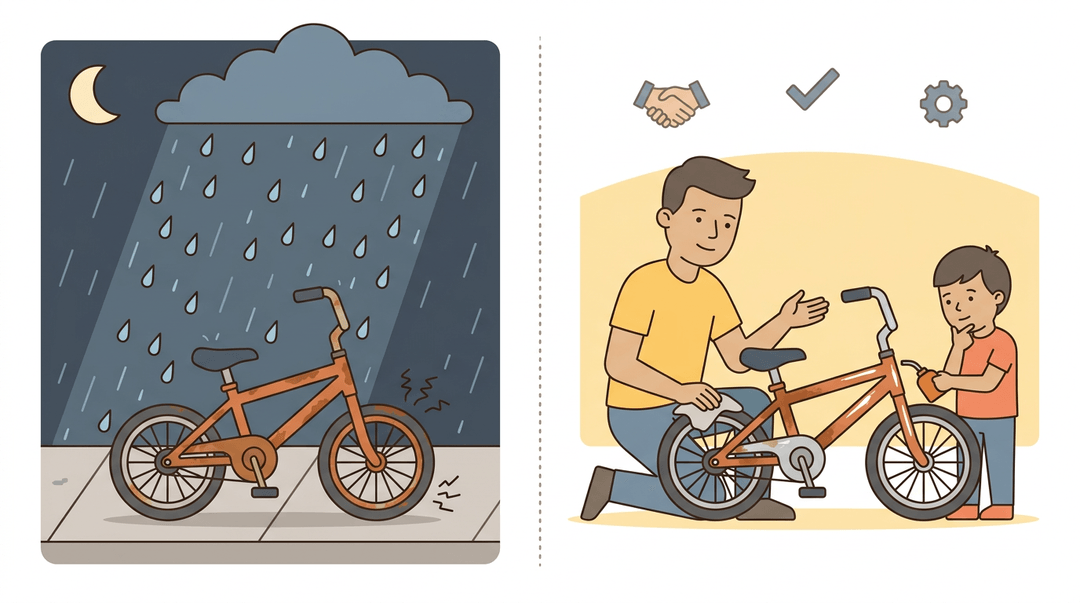
Think of a kid who leaves a bike out in the rain, and by morning it's rusted and squeaky. Nobody planned that lesson, it just happened.
Logical consequences work differently: you, the adult, step in and design a response that actually fits the behavior, on purpose.
That's the heart of it: a consequence that's related, respectful, and reasonable, built to teach rather than punish.
In this post, we'll unpack where the term comes from, how it plays out in classrooms and at home, and a checklist you can use Monday morning.
What Logical Consequences Really Mean
Ask ten teachers to define a "logical consequence," and you'll likely hear ten different answers, often tangled up with punishment.
The term (you'll also see it called a consequence or repercussion) comes from Rudolf Dreikurs' theory of discipline, which drew a clear line between what happens on its own and what an adult deliberately puts in place.
Natural Consequences Happen on Their Own
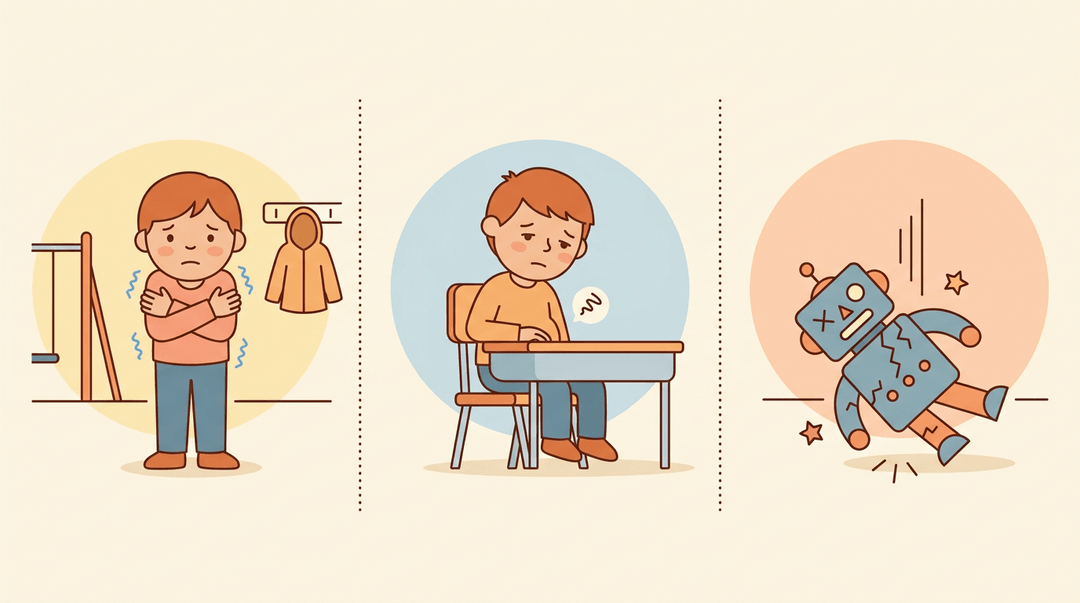
A natural consequence is unplanned and automatic: it happens whether or not any adult steps in. A student who forgets a coat feels cold at recess. A child who skips lunch gets hungry by last period. A toy handled roughly eventually breaks.
No teacher has to engineer any of this; the world does it on its own, and the student learns responsibility straight from experience.
What Did Rudolf Dreikurs Mean by Logical Consequences?
A logical consequence works differently. It's imposed by an adult, but never arbitrarily.
Dreikurs described it as something that "expresses the reality of the social order, not the person, is intrinsically related to the misbehavior, involves no element of moral judgment."
In practice, the response ties directly to what happened, carried out by the teacher or caregiver as a deliberate follow-up, not a random penalty pulled from a jar.
Why Logical Consequences Aren't Punishment
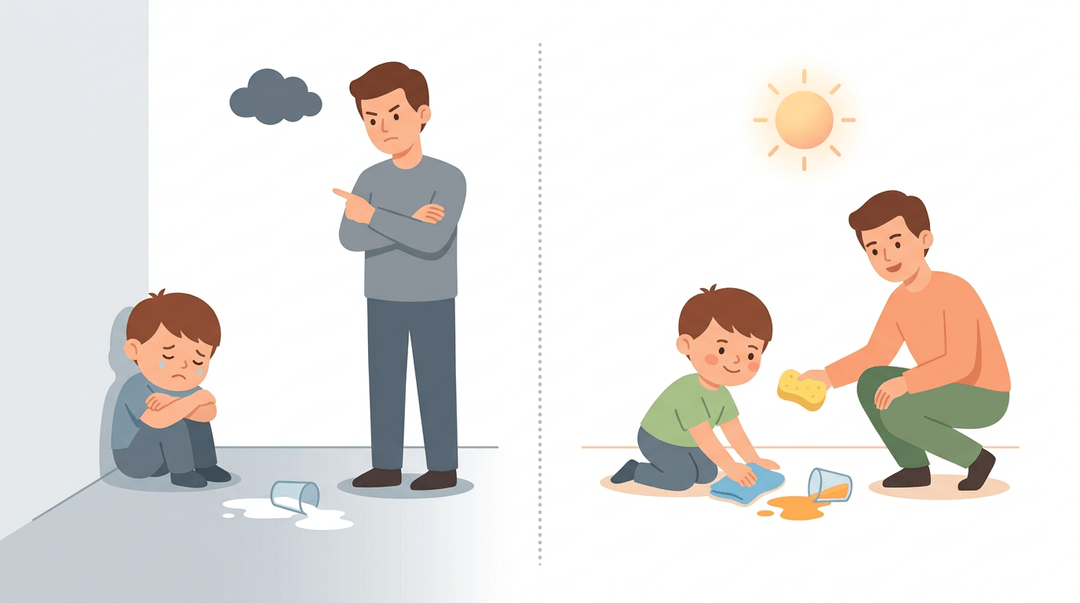
Punishment might stop behavior in the moment, but research spanning two decades shows it's ineffective over the long term. Worse, it's linked to resentment and low self-esteem in kids. Logical consequences skip the shaming.
They target the behavior, not the child.
Why Logical Consequences Help Kids
So what makes this approach worth building into your classroom routine? It gives kids a clear, respectful path from mistake to repair, without the fallout that comes from punishment or from simply letting a risky situation play out on its own.
Teaching Responsibility Without Shame
When a consequence connects directly to the behavior, kids start to see the link between what they did and what happens next. That clarity builds a real sense of responsibility instead of just compliance.
For example, a student who knocks over a classmate's block tower and helps rebuild it learns something a lecture never teaches: actions have effects, and fixing them is possible.
This works because the child still feels safe and connected to you, not cornered or exposed. Logical consequences target the behavior, never the kid, so there's no public callout, no sarcasm, no humiliation.
That matters: a child who feels shamed tends to shut down or act out again, while one who feels respected tends to actually listen.
Keeping Kids Safe With Adult Guidance
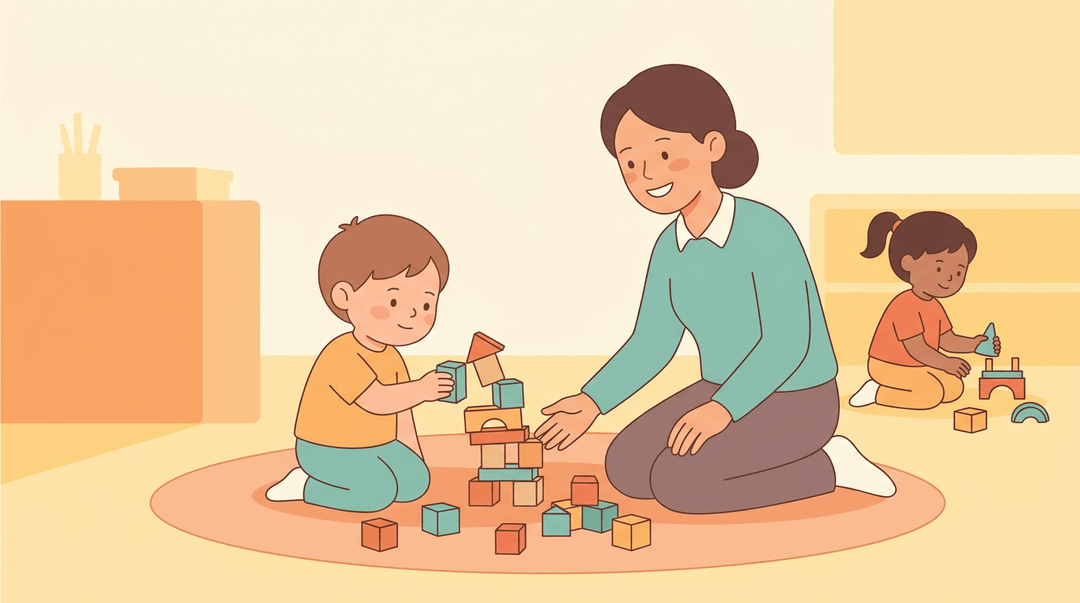
Natural consequences (the ones that unfold with no adult involved) aren't always safe to let happen. A child who runs into the street or shoves a peer toward the stairs can't simply "learn from experience." That's where adult guidance steps in.
By stepping in with a logical consequence, you prevent outcomes that could seriously harm a child or the classmates nearby.
It's also far more controllable than waiting to see what happens naturally: you set the boundary, you choose the response, and you protect every other child in the room in the process.
Putting Logical Consequences into Practice
Knowing the theory behind logical consequences is one thing. Making it work with twenty-five kids and a packed schedule is another. Here's how to put the idea into daily motion without losing your cool or your classroom.
Stay Calm and Stay Connected
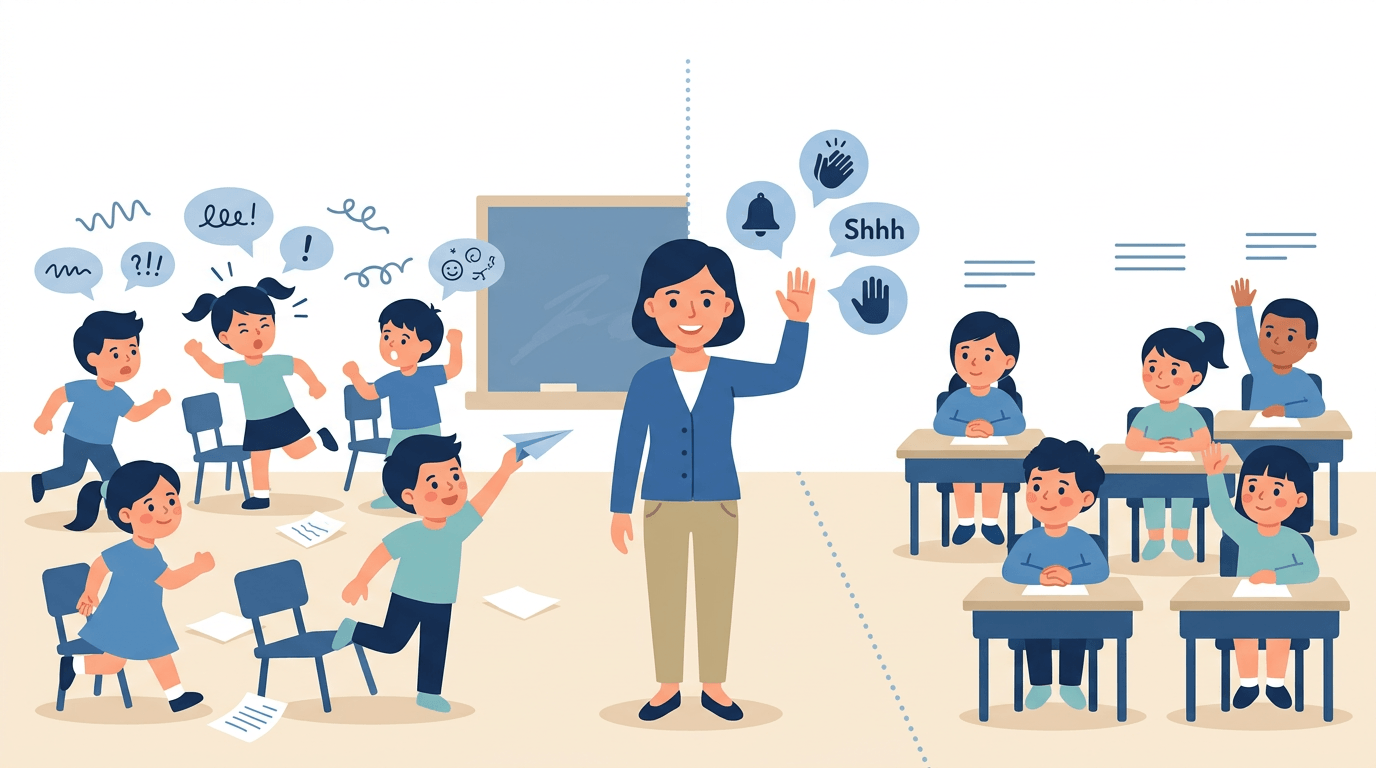
A logical consequence only teaches if it's delivered calmly. Raising your voice turns a learning moment into a power struggle, and it rarely sticks. Avoid yelling, and avoid anything that feels like you're bullying rather than guiding.
Correct the student privately when you can: a quiet word at your desk lands better than a public call-out. Through all of it, stay emotionally connected.
A student who feels liked, even mid-correction, is far more likely to accept the consequence and move on.
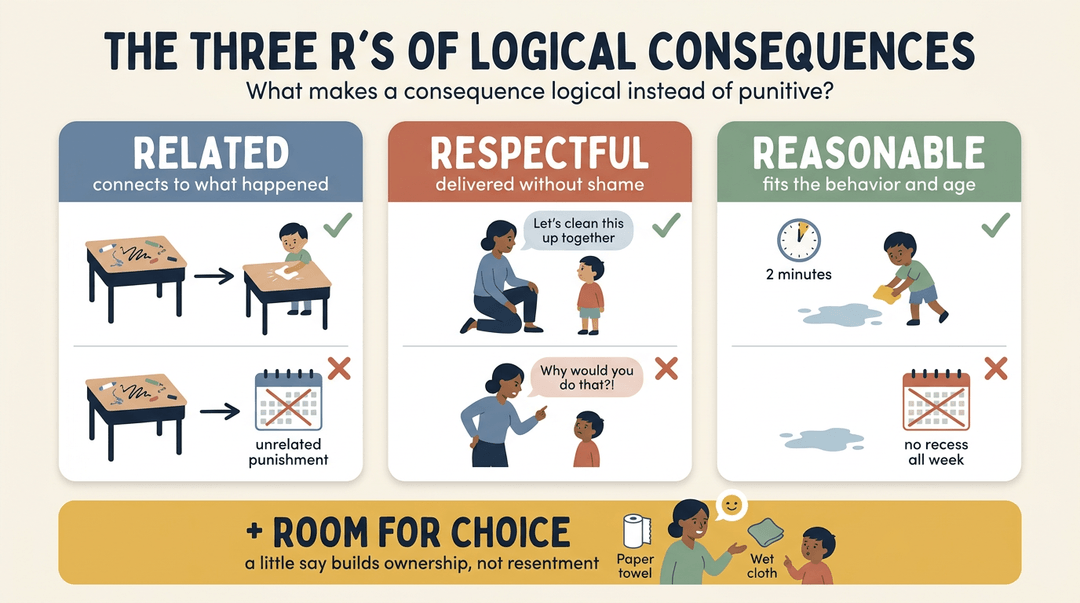
What Are the Three R's of Logical Consequences?
So what actually makes a consequence "logical" instead of just punitive?
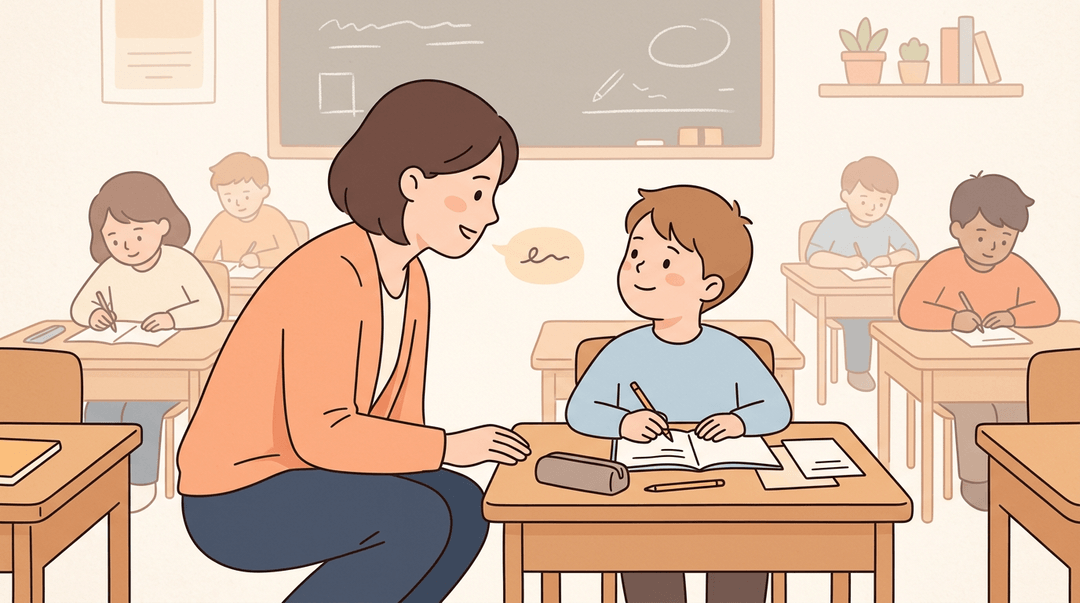
Conscious Discipline outlines the answer as the Three R's: a consequence should be related to the misbehavior, respectful in how it's delivered, and reasonable in its severity. A few things to check:
- Related. The consequence connects directly to what happened, not something unrelated tacked on.
- Respectful. It's delivered without shame, in a tone you'd want used on you.
- Reasonable. The length and weight fit both the behavior and the child's age.
- Has room for choice. Giving a student some say, even a small one, builds ownership instead of resentment.
Steps to Follow Through Consistently
Consistency is what makes logical consequences work over time. Try this sequence:
- Decide if a consequence is actually needed, rather than reacting on autopilot.
- Explain the rule in advance so the link is clear before anything happens.
- Offer a chance to correct course first.
- Follow through promptly if the behavior continues.
- Keep it short.
- Apply it the same way every time, for every student.
That last point matters for co-teachers and substitutes too: agree on the approach ahead of time so a student doesn't get a different response depending on who's in the room.
Let Kids Help Solve the Problem
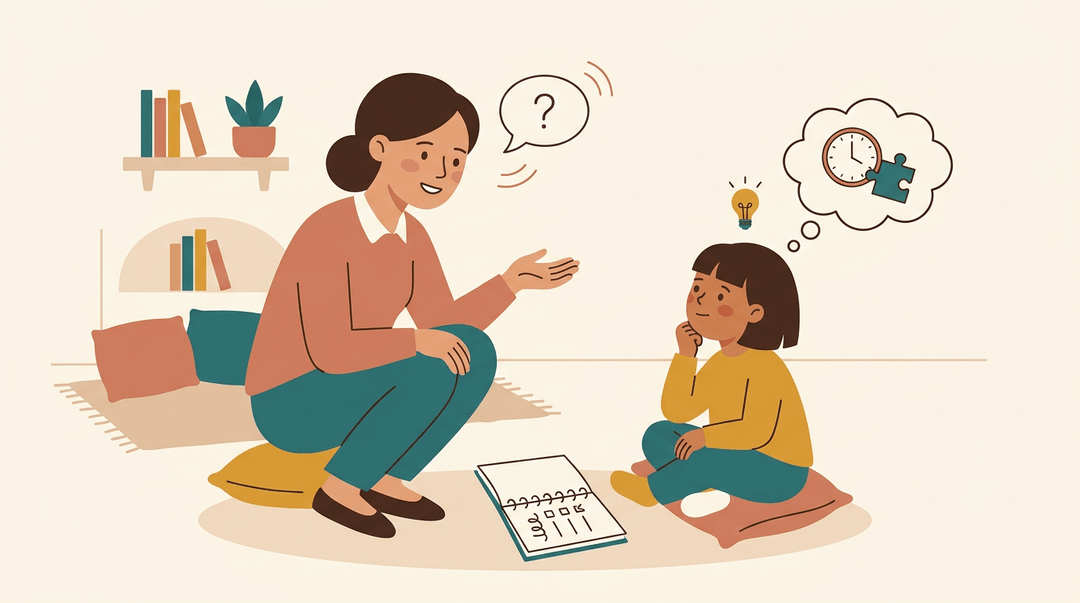
Sometimes the most effective move is asking, "What do you think should happen now?" Letting a student suggest their own consequence builds real ownership.
It also helps to treat misbehavior as a message rather than a crime: a student acting out is often signaling an unmet need, like attention, rest, or a skill they haven't mastered yet. Find that need, and the consequences start happening a lot less often.
A Classroom Checklist for Logical Consequences
Logical consequences only work when they're predictable, and predictability is built before, during, and after the incident. Run this checklist in those three phases, and pin it where you can see it.
Before: set the stage
Confirm these are in place before you ever need a consequence:
- Rules are specific and posted. ❌ "Be respectful." ✅ "Materials stay on your own desk."
- You've modeled the behavior. Walk through the routine yourself; don't just announce it.
- Consequences are explained in advance. A student should be able to predict what follows a broken rule.
💡 Tip: Quiz the class early in the term: "If someone writes on a desk, what happens next?" If they can't answer, the consequence will feel like punishment when it arrives.
In the moment: three moves
When a rule is broken, run this sequence and move on:
- Stay calm and neutral.
- Flat tone, relaxed posture: the consequence does the teaching, not your frustration.
- State the logical link out loud.
- Say: "You wrote on the desk, so you'll clean it before break."
- The behavior and the consequence should connect in one sentence.
- Offer a brief choice, then step away.
- Try: "You can work quietly here or finish at the side table. You pick."
- Don't stay to debate; walking away signals the matter is settled.
Example: A sixth grader keeps spinning a fidget toy during instructions. The teacher says quietly, "The toy's distracting you, so it stays on my desk until the bell. You can collect it on your way out," and returns to the lesson. No lecture, no audience, and the link between behavior and outcome is obvious to everyone.
Afterward: follow through
- Apply it every time. Same behavior, same consequence, every student, every lesson.
- Keep a one-line record per student. Date, behavior, consequence is enough:
Oct 3: wrote on desk → cleaned it at break.
Then let the record tell you what to do next:
| If the record shows... | Then... |
|---|---|
| A one-off incident | Let the consequence close it; nothing more needed |
| The same behavior three or more times | Revisit privately: ask what's driving it, agree a plan |
Consistency is where most of us slip, and the record is what keeps you honest. Log each consequence against a student's profile in EMStudio to spot patterns across the term.
What Are Logical Consequences in Parenting?
Logical consequences are consequences you, the parent, put in place because they connect directly to the misbehavior.
Unlike a skinned knee from running too fast, nothing here happens on its own: you decide the response, and you make sure it fits the action. That's the whole point: the child learns cause and effect without feeling punished out of nowhere.
Examples of Natural Consequences
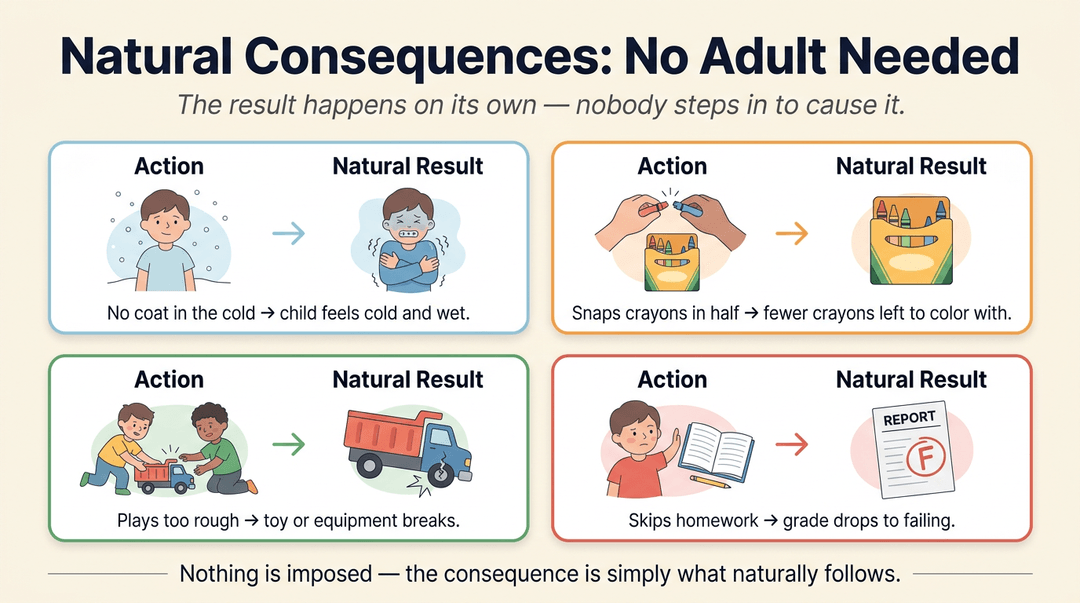
Before getting to logical consequences, it helps to see what they're not. Natural consequences unfold without any adult stepping in:
- No coat on a cold day? The child feels cold or gets wet.
- Wasting crayons by snapping them in half means fewer crayons left to color with.
- Rough play can end with broken toys or equipment.
- Skipping homework leads to a failing grade.
Examples of Logical Consequences
Here, you step in with a response that still ties to the behavior:
- Throwing sand means leaving the sandpit for the rest of playtime.
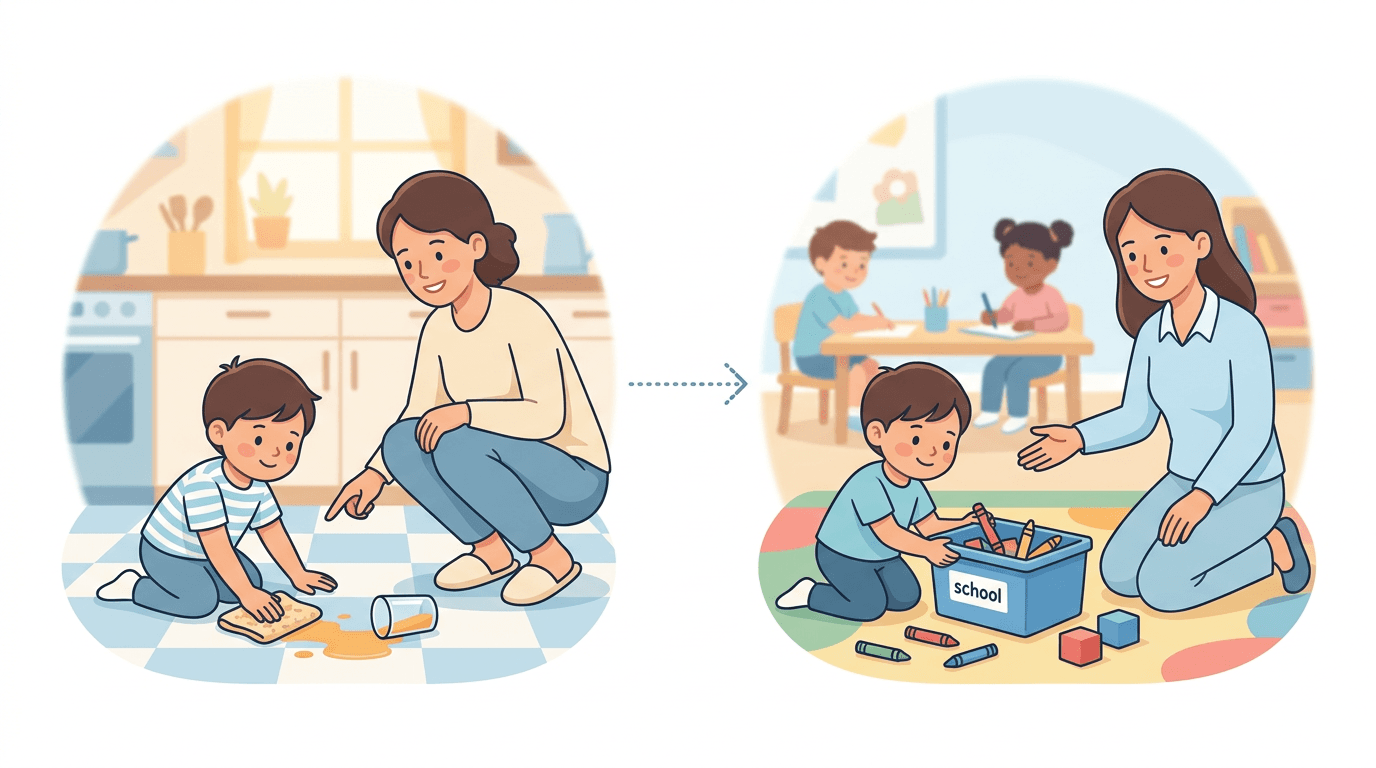
- Making a mess means cleaning it up before moving on to the next activity.
- Leaving a bike out overnight means the bike gets put away, maybe out of reach for a day.
- Fighting over a toy means the toy gets removed for everyone involved.
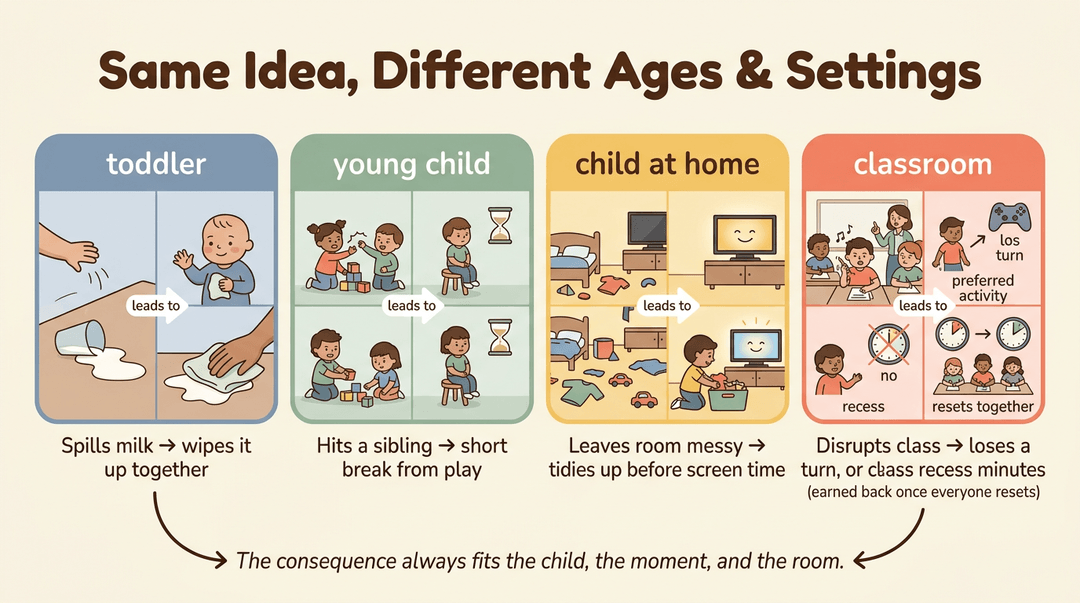
Examples by Age and Setting
The same idea flexes to fit the child and the room:
- A toddler who spills milk helps wipe it up, hand over hand with a parent.
- A young child who hits a sibling takes a short break from playing together.
- A child who leaves a room messy tidies it before screen time starts.
- In a classroom, a student disrupting a lesson might lose a turn at a preferred activity, and if the whole class is off task, the teacher can apply the same consequence group-wide: lost recess minutes, earned back once everyone resets.
Limits of Natural and Logical Consequences
Neither approach works everywhere, and knowing where each one breaks down keeps you from leaning on it past its usefulness.
When Natural Consequences Fall Short
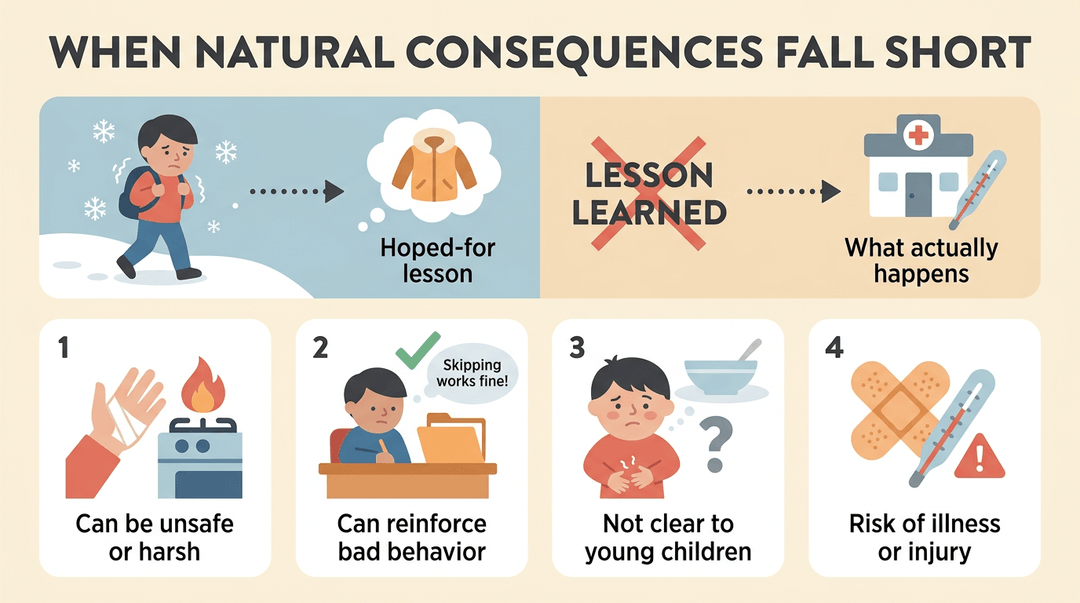
Letting the world teach the lesson sounds appealing, but it isn't always wise. Consider a student who skips a coat on a freezing morning: the "natural" lesson could mean a trip to the nurse, not a gentle nudge toward better planning.
- They can be unsafe or harsh. A burned hand or a bad fall teaches nothing useful if the price is an injury.
- They can reinforce bad behavior. A student who skips homework and faces no real fallout may just learn that skipping it works fine.
- They're not always clear to young children. A kindergartner rarely connects a stomachache to skipping breakfast on their own.
- They carry a real risk of illness or injury. Some lessons cost more than they teach.
When Logical Consequences Are Harder to Use
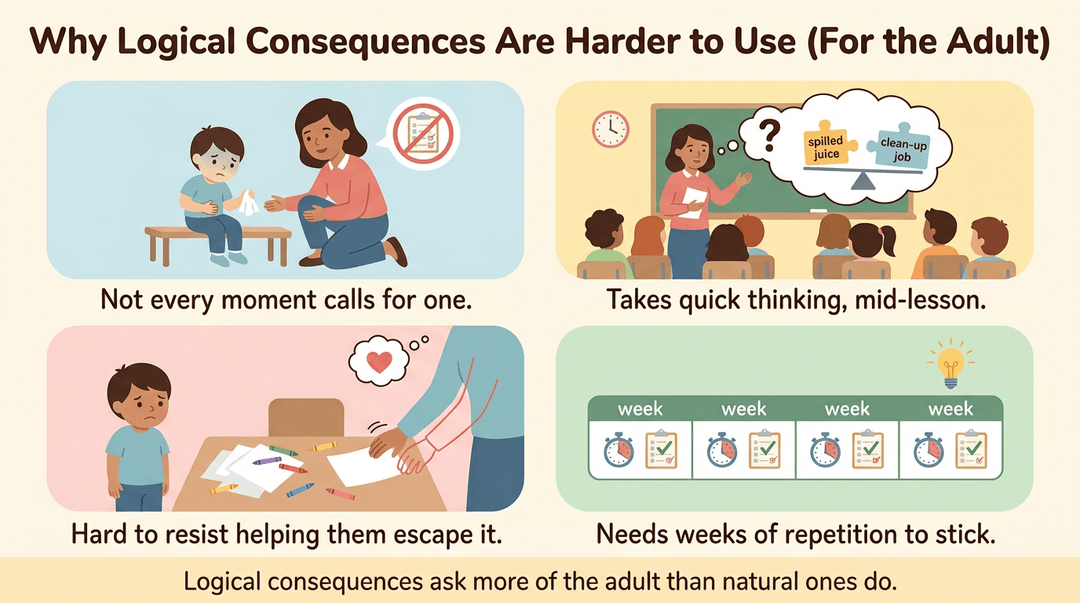
Logical consequences ask more of you, the adult in the room, than natural ones do.
- They're not always appropriate. A medical issue or a one-off accident calls for support, not a consequence at all.
- They require adult creativity. Matching a fitting, related consequence to each situation on the spot isn't simple, especially mid-lesson.
- They tempt you to rescue the child. It's hard to watch a student lose recess over a messy desk instead of just cleaning it up for them.
- They take repeated use to sink in. One time rarely changes a habit. The pattern has to hold for weeks before it clicks.
Other Discipline Strategies to Know
Logical consequences aren't the only tool in your kit, and knowing where other strategies fit helps you reach for the right one in the moment. Two classroom staples worth a closer look are taking away a privilege and the short time-out.
Both work differently than restorative practices, which focus on repairing harm rather than removing something or pausing the action.
Taking Away a Privilege
Taking away a privilege means removing a favorite object or activity, think recess, a classroom job, or screen time, until a student shows they're ready to handle it responsibly.
This approach works better with older children, who can connect the loss to their own choice and reflect on what led to it.
For example, a middle school teacher might pause a student's library pass after repeated misuse, then restore it once the student shows they can follow the rules.

Using a Short Time-Out
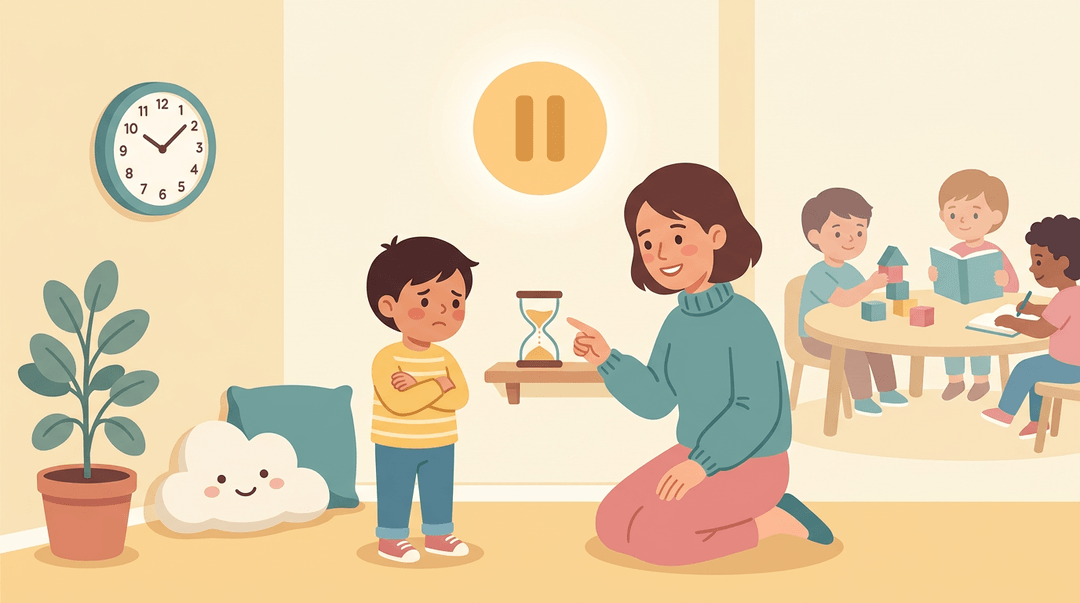
A short time-out is a brief removal from an activity, just long enough to break the momentum of a tough moment. It's most useful to calm down young children who are overwhelmed or escalating, giving them a few minutes to reset before rejoining the group.
A kindergarten teacher might guide a frustrated student to a quiet corner for two minutes, not as punishment, but as a pause button that gets everyone back to learning faster.
Logical consequences aren't about punishment. They're about teaching: related, respectful, and reasonable responses that help kids connect their choices to real outcomes.
Whether you're running a classroom or raising a child at home, the goal stays the same: build judgment, not just compliance.
Ready to put this into practice across your classroom? Check out our Classroom Management feature to organize classes, rosters, and routines that make consistent, logical consequences easier to apply every day.
References
- Physical punishment of children: lessons from 20 years of research — pmc.ncbi.nlm.nih.gov
- Proponents and opponents for rewarding children — exa.ai (1997)
- The Three Types of Consequences and How to Give Them — consciousdiscipline.com
Frequently asked questions
What is another word for "logical consequence"?
Another word for “logical consequence” is “repercussion.” It can also be called a consequence, provided it is deliberately connected to the behavior rather than imposed as an arbitrary penalty.
What are the three R's of logical consequences?
The three R’s are related, respectful, and reasonable. A logical consequence connects to the behavior, is delivered without shame, and fits the child’s age and the seriousness of the action.
What are logical consequences in parenting?
In parenting, logical consequences are adult-imposed responses that connect directly to a child’s misbehavior. They teach cause and effect without humiliating or punishing the child, such as having a child clean up a spill they caused.
What is an example of a logical consequence?
One example is requiring a child who makes a mess to clean it up before moving on to the next activity. The response is directly related to the behavior and helps the child practice responsibility.
What did Rudolf Dreikurs mean by "logical consequences"?
Rudolf Dreikurs meant a consequence imposed by an adult that reflects the reality of the social order, is intrinsically related to the misbehavior, and contains no moral judgment. It addresses the behavior rather than labeling or condemning the person.