CHAMPS Education Explained: A Complete Guide

Jump to section
Picture the first day of a new school year: twenty-five students, a dozen different ideas about what's allowed, and you at the front of the room trying to make sense of it all. Clear expectations are what turn that chaos into a calm, working classroom.
That's where CHAMPS comes in. It's a classroom expectations framework that defines success in every kind of activity. In this post, we'll break down what each letter stands for and how it works across your day.
We'll also walk through building and teaching your own expectations chart, plus how rewards keep students motivated.
What Champs Education Aims to Achieve
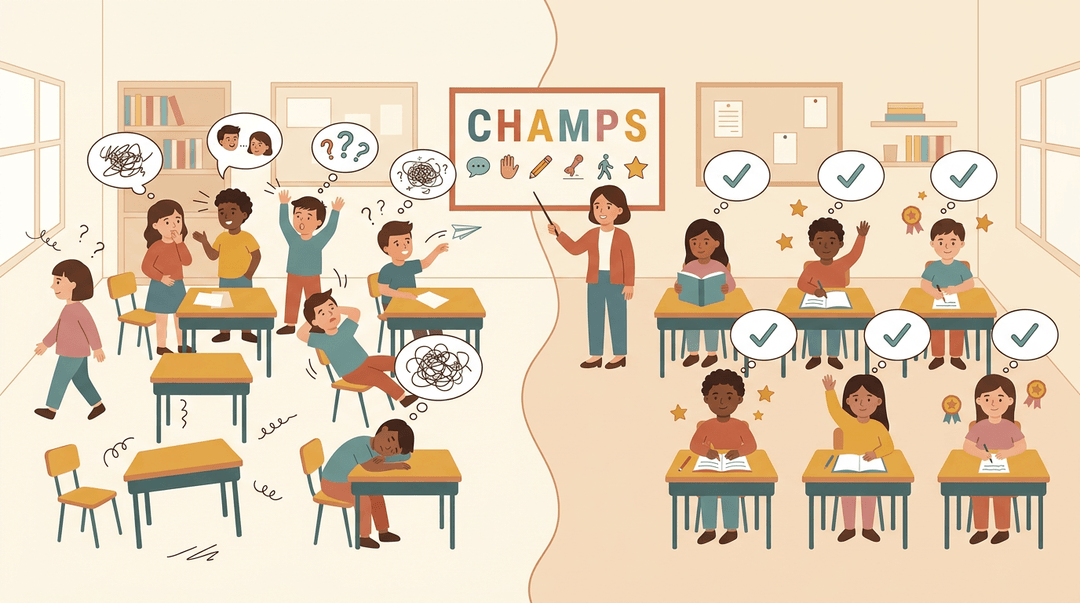
What if every student knew exactly what good behavior looks like before a problem ever came up? That's the goal behind CHAMPS.
How this classroom management approach works
CHAMPS is built on a few core features:
- Proactive, positive classroom management. Teach expected behavior before problems appear, not after.
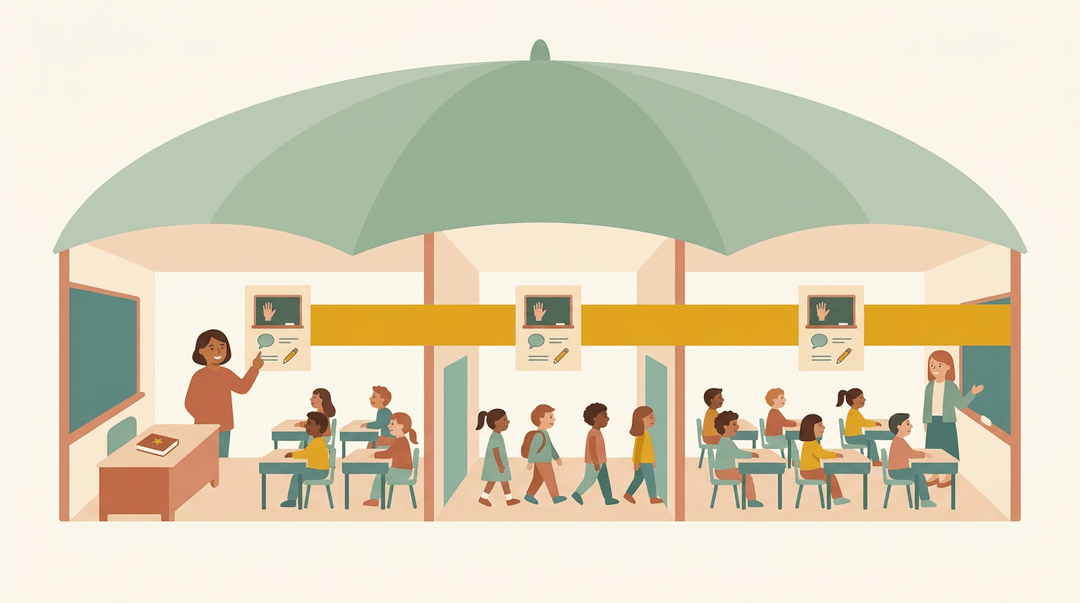
- A schoolwide behavior protocol. It's designed for use across the whole building, not just one room.
- Part of a Positive Behavior System. It sits inside the broader Positive Behavioral Interventions and Supports (PBIS) framework.
- Based on the CHAMPS book (3rd ed.). The approach draws on the third edition of the CHAMPS book.
The difference is one of scope. PBIS is the broader framework, while CHAMPS is one specific protocol that works within it.
What CHAMPS helps students and teachers reach
- Define behavior expectations. Spell out exactly what you want to see so nobody has to guess.
- Students who are responsible and motivated. When students know the target, they can take ownership of hitting it.
- Students who are highly engaged in tasks. Clear expectations keep more of class time on the work itself.
- Success taught directly. Teach the behavior you want instead of hoping students pick it up on their own.
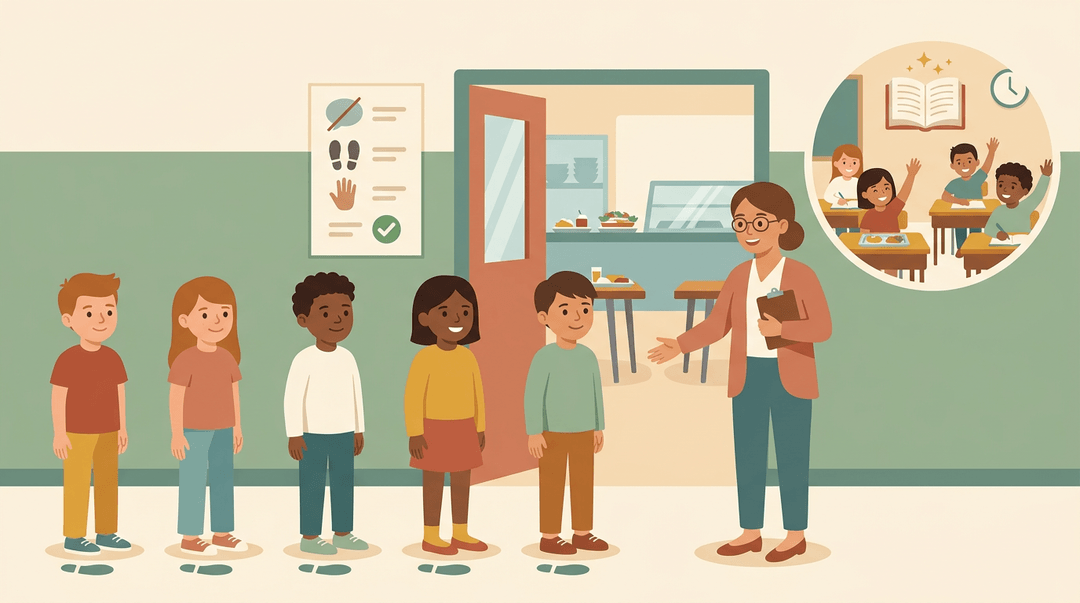
Think of a fifth-grade teacher who spends the first week showing exactly what a ready lunch line looks like, then practices it until it sticks. Fewer reminders are needed, and more minutes go to the lesson. Less guessing. More learning.
What Each CHAMPS Letter Stands For
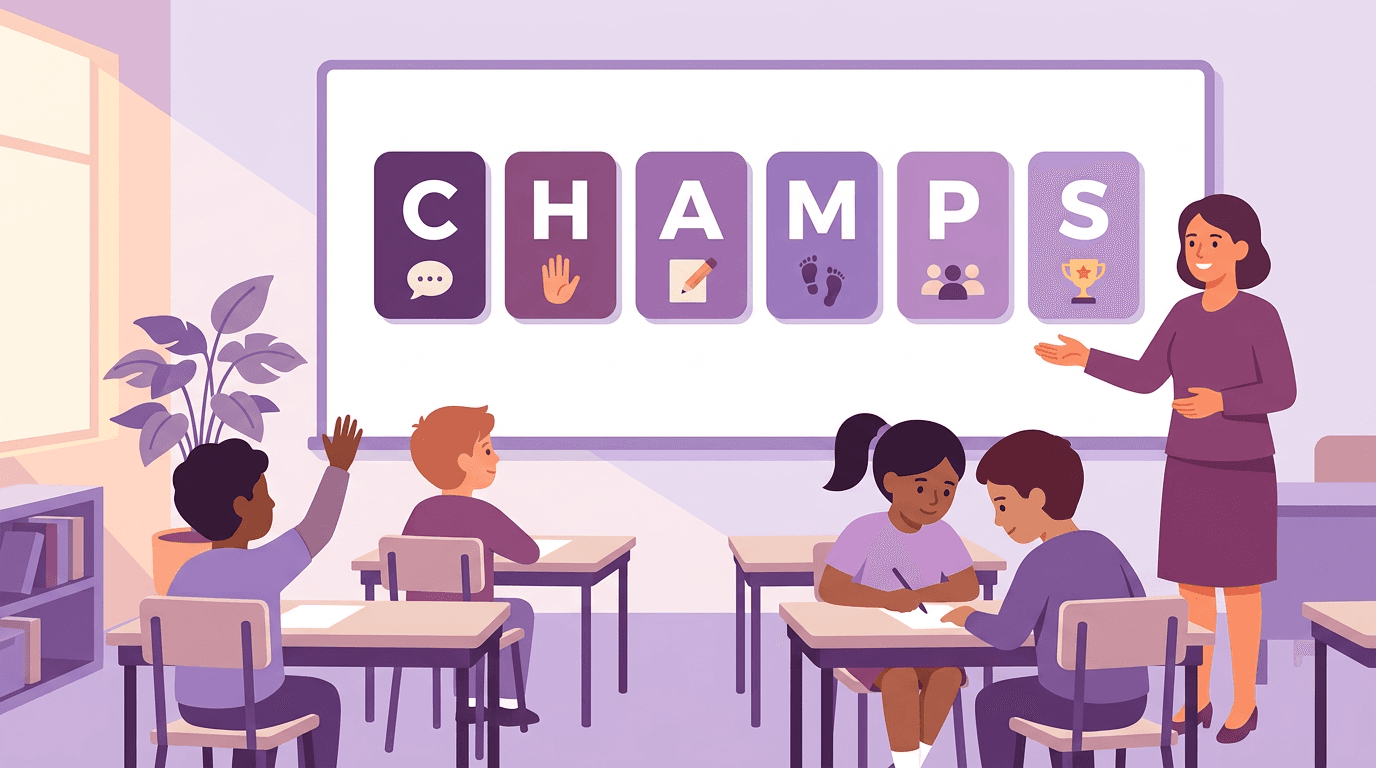
Students can't meet expectations they can't picture, so we use CHAMPS (Conversation, Help, Activity, Movement, Participation, Success) to turn them into six questions you can answer for any activity.
Breaking down each letter's meaning
Each letter asks one question:
- Conversation: Can students talk, and about what?
- Help: How do students get your attention?
- Activity: What's the task, and what end product is expected?
- Movement: Can students move around the room?
- Participation: What does engagement look and sound like?
- Success: How will students know they've met expectations?
Answer all six for one activity, and students get specific expectations instead of vague reminders to just behave.
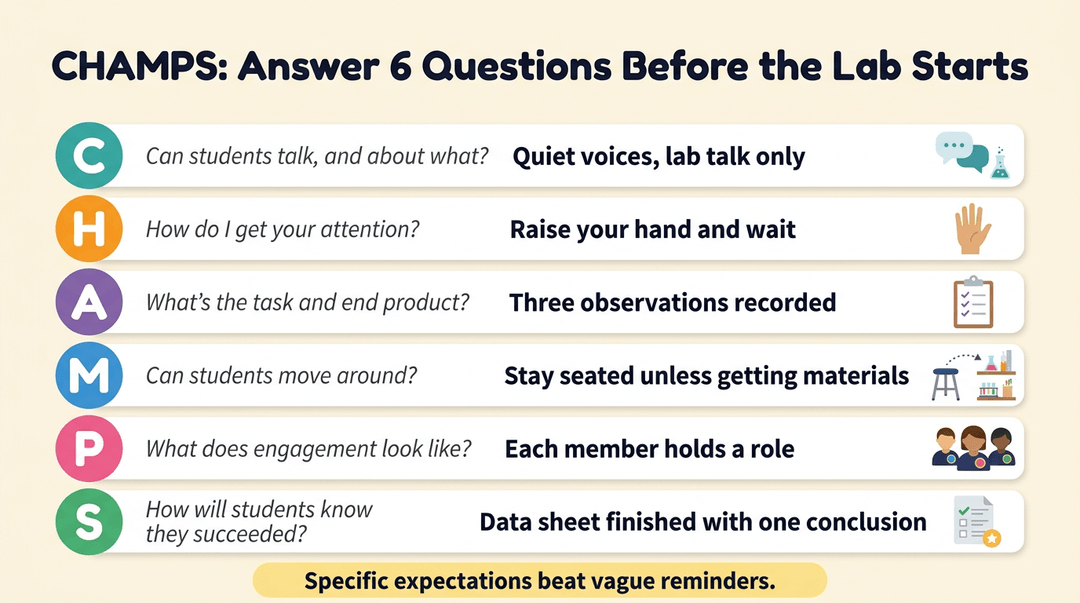
A middle school science teacher answers them before lab groups start, so nobody has to guess whether they can leave their table. Clarity beats reminders.
Here's the chart she filled in:
| Letter | Lab expectation |
|---|---|
| Conversation | Quiet voices, lab talk only |
| Help | Raise your hand and wait |
| Activity | Three observations recorded |
| Movement | Stay seated unless getting materials |
| Participation | Each member holds a role |
| Success | Data sheet finished with one conclusion |
Using CHAMPS during everyday activities
Same six letters, different emphasis:
- Teacher-directed instruction: Conversation and Help do the work as students listen, then raise a hand.
- Independent seat work: Movement and Help matter most when students work alone.
- Class discussions: Conversation sets who speaks, and Participation shows what good listening looks like.
- Cooperative group work: Conversation, Movement, and Activity define the group's shared work.
- Transitions: Movement and Activity cover where students go and what they do first.
Whichever activity you're running, post the chart before it starts, not after the first problem shows up.
Teach CHAMPS Expectations in Your Classroom
This guide helps you build a CHAMPS chart for one routine, teach it so it sticks, and keep it alive all year. Start with a single activity, not your whole day.
Build the chart
CHAMPS stands for Conversation, Help, Activity, Movement, Participation, and Success. Answer all six for each routine.
- List your recurring activities
- Think independent work, small groups, transitions, and whole-class instruction.
- Answer each CHAMPS letter per activity
- Write one answer for each letter, one activity at a time.
- Rewrite answers in student language
- Swap "Maintain on-task behavior" for "Eyes on your paper, pencil moving."
Here's what a filled-in chart looks like for independent work:
| Letter | Student-language answer |
|---|---|
| Conversation | Silent. Voices off. |
| Help | Raise your hand and keep working. |
| Activity | Finish the worksheet. |
| Movement | Stay seated. Sharpen pencils before we start. |
| Participation | Eyes on paper, pencil moving. |
| Success | Complete, neat, turned in. |
Teach it
A posted chart isn't a taught chart. Plan a few minutes of teaching before students first use it.
- Model the expectation correctly
- Say: "Watch how I ask for help during independent work."
- Model a non-model on purpose
- Break one rule, such as calling out, and ask: "What did I miss?"
- Run a short practice round
- Students do 2 minutes of independent work, following the chart.
- Check understanding quickly
- Say: "Thumbs up if you know how to get help right now."
Example: A fourth-grade teacher models getting help by waving a hand silently, then models calling out "Miss!" Students spot the difference, name which letter it broke (Help), and then practice the right version.
See it at each level
The same six letters flex to fit your students.
| Level | What the chart looks like |
|---|---|
| Elementary | Icons and photos beside each letter |
| Middle | Discussion norms: how to disagree, who talks when |
| High school | Group work roles, volume, and when to ask the teacher |
Keep it visible
Run this check once a week:
- Chart visible? Students can see it from their seats during the activity.
- Expectations reinforced? You've praised students by naming a letter this week.
| When you see... | Try... |
|---|---|
| Students drifting off expectations | Say: "Check Movement on our chart." |
| Students returning from a break | Reteach: model, then one practice round |
| New activity, no chart yet | Build a new chart before you start |
⚠️ Watch out: Don't assume students remember the chart after a long weekend or holiday. Reteaching takes five minutes and saves the whole week.
Draft activity-specific CHAMPS charts and lesson steps faster with EMStudio's AI Lesson Editor.
Ready-made Materials to Download
Building an expectations chart from scratch takes real time, so these downloads do much of that work for you.
Printable forms and icon sets
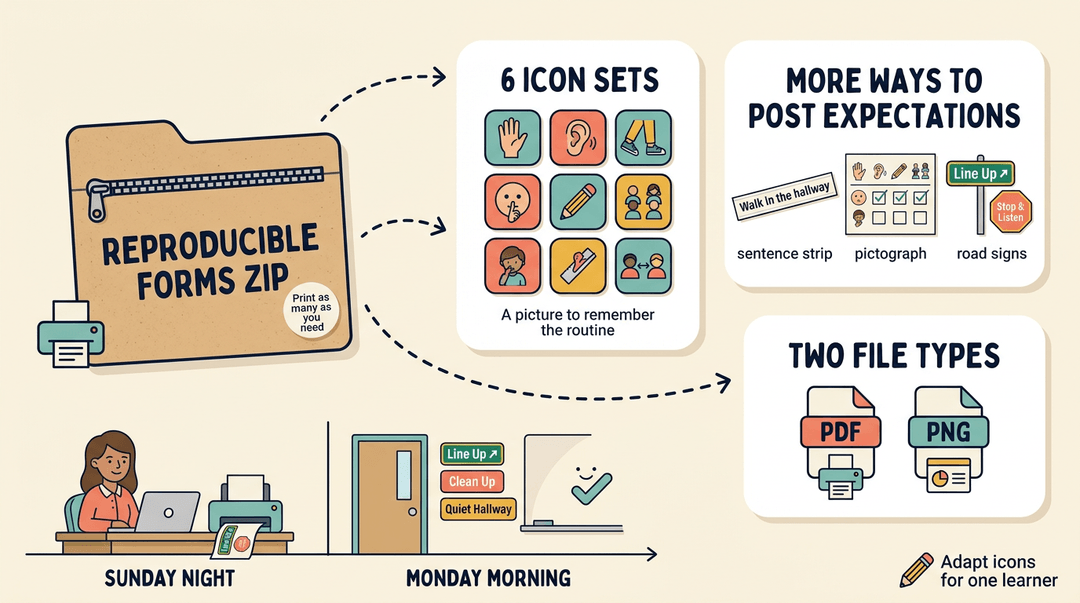
Start with the reproducible forms zip, a bundle you can print as many times as you need. Inside, you'll find six icon sets that give each expectation a visual anchor for younger learners and anyone who needs a picture to remember a routine.
Files come in PDF (portable document format) and PNG (portable network graphics) formats, so you can print them or drop the images into a slide deck.
The visuals stretch beyond the chart, too. Sentence strips, pictographs, and road signs give you more ways to post expectations around your room.
Picture a third-grade teacher who prints the road signs Sunday night and has every transition labeled by Monday morning, without designing a single sign. A tutor or homeschool parent can also adapt the icons to fit one learner.
Extra guides, worksheets, and usage terms
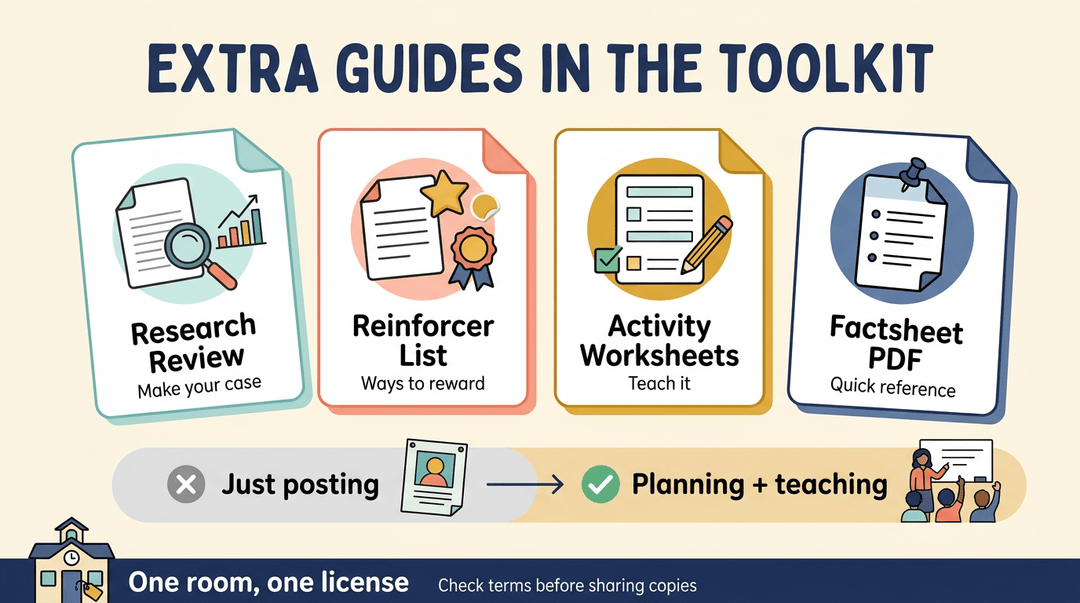
An evidence-based research review gathers the evidence behind the framework, so you can make the case to colleagues or administrators.
A list of reinforcers offers options for rewarding good behavior, while activity worksheet examples show how to turn an expectation into a lesson. The factsheet PDF is a quick reference for your desk or a colleague.
Use these guides for planning rather than just posting. The worksheets help you teach each expectation, not just hang it up.
The materials come with a single-classroom use license, so they're meant for your own room. Check the terms before sharing copies with colleagues. One room, one license.
How Rewards Keep Students Motivated
Rewards work best when they're tied to clear expectations, so students know exactly what earns them. Here's what backs CHAMPS and how to set up rewards that hold up.
Is CHAMPS backed by evidence?
CHAMPS is evidence based.
A study of the CHAMPS intervention with middle schoolers looked at its effects on academic and behavioral outcomes, and asked whether the student-teacher relationship (the everyday rapport between a student and teacher) played a role.
So the connection you build with students deserves as much attention as the chart on the wall.
Rewards come in two main forms:
- Individual reinforcers go to one student for their own effort, like a positive note home or the job of line leader.
- Group reinforcers reward the whole class for reaching a shared goal, like earning extra choice time.
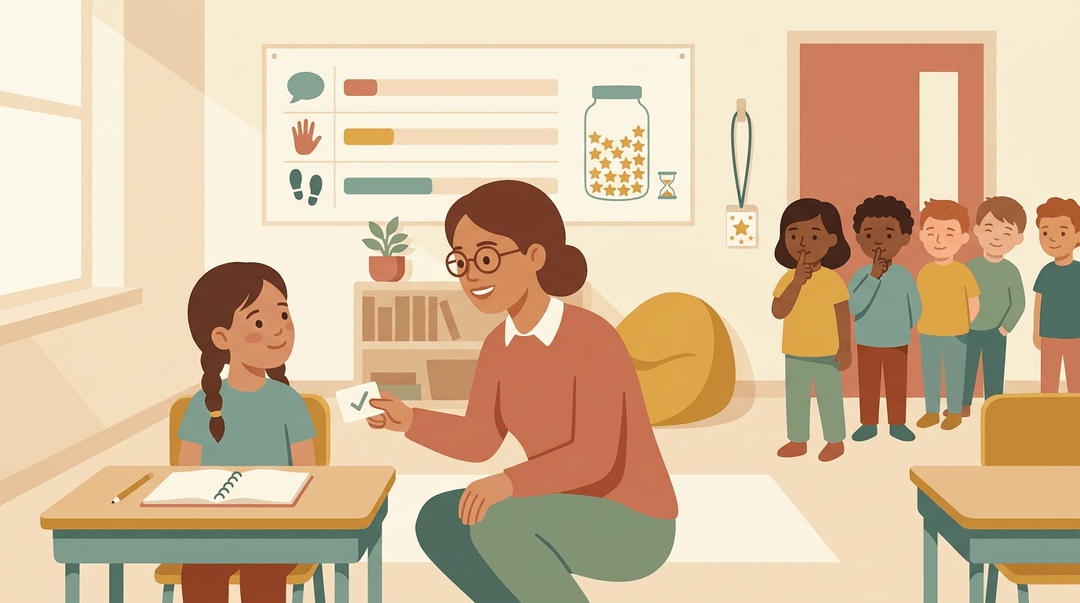
Consider a fourth-grade teacher whose class gets loud every afternoon during transitions. They set one group goal: finish the transition quietly, and the class earns five minutes of choice time.
Meanwhile, a student who rarely gets noticed earns a personal check for a thoughtful question. The class gets its reward, and that quiet student gets noticed.
A reward-based motivational system links points or tokens to the expectations you've posted, so students can see the path from behavior to payoff. Watch for these common implementation mistakes:
- Rewarding things students can't yet control.
- Letting the same few students win every time.
- Forgetting to pay out what you promised.
The fix is to reward effort rather than perfection. Fairness keeps the system working.
When expectations are clear, students know exactly what good behavior looks like, and you spend less time correcting and more time teaching.
A well-built chart, taught with intention and backed by meaningful rewards, keeps that routine steady all year long.
Ready to bring the same clarity to your lesson plans? Check out our Workflow & Tools page to draft and refine lessons with built-in AI assistance.