Meme Education: What It Is and How It Works

Jump to section
Think about the inside joke that ricochets through a group chat in seconds. Everyone gets it, and nobody needs a long explanation. That same pull makes memes a surprisingly useful teaching tool.
In meme education, students learn to read, question, and create the images and phrases that shape how people talk online.
This post covers what memes and meme literacy are, where they came from, how teachers use them in class, the tools students can use to make them, and risks like copyright and moderation.
You'll also find a step-by-step checklist to help you plan a meme-based lesson without starting from scratch.
Why Memes Matter in Meme Education
Memes look like jokes, but they work like ideas, and that's worth your attention.
How memes spread like ideas
A meme is an idea that travels from person to person, often changing a little with each share. The study of this process, called memetics, traces back to Richard Dawkins's account of cultural replication.
Dawkins and Dennett have argued that these cultural units survive through a process resembling natural selection, and Terence McKenna is another name often linked to the field's philosophy.
So memes are more than funny images. They spread ideas, not just pictures.
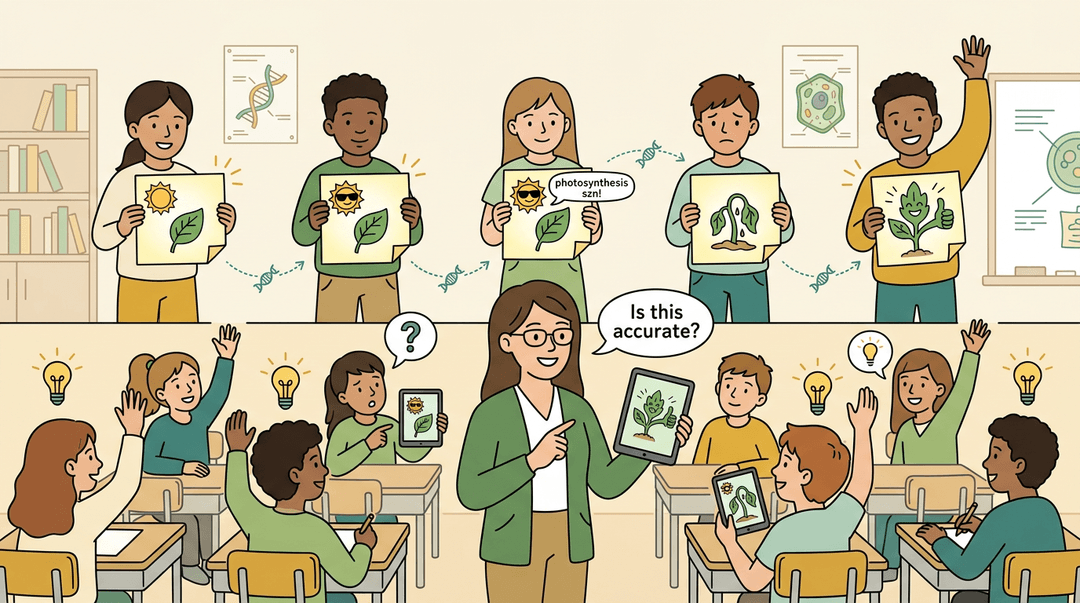
Consider a sixth-grade science teacher who spots a photosynthesis meme spreading through her class. Instead of banning it, she asks what makes it funny and whether it's accurate.
The conversation shows her who really understands the idea and who needs another pass.
What is meme literacy?
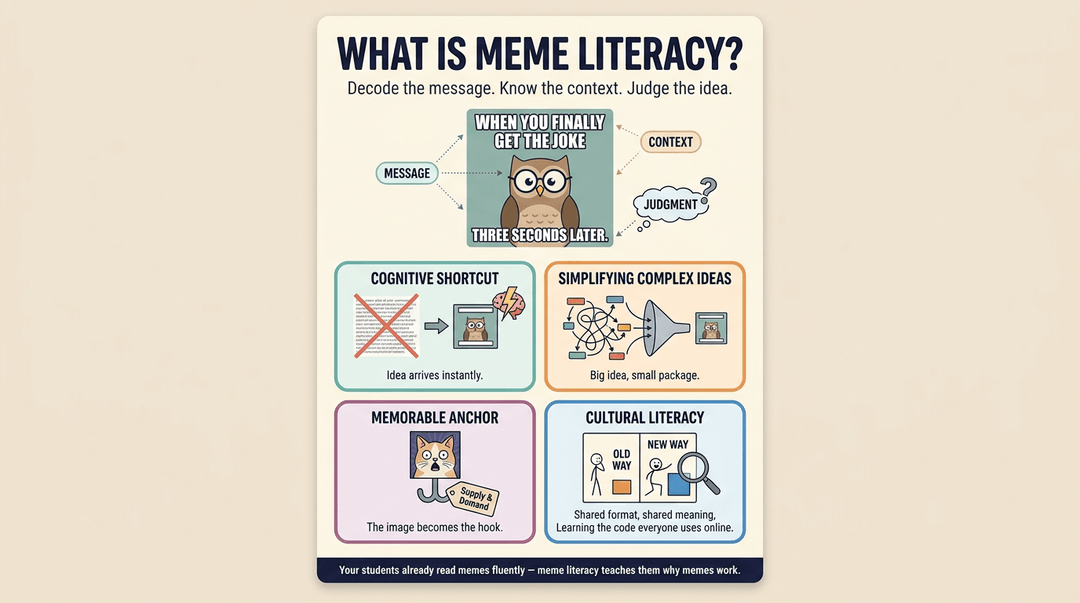
Meme literacy is the ability to decode a meme's message, understand the context that gives it meaning, and judge the ideas it's pushing. Your students already read memes fluently. Meme literacy asks them to understand why one works. It helps in four ways:
- Cognitive shortcuts. A meme packs an idea into one image and a line of text, so the brain grabs the point fast.
- Simplifying complex ideas. Dense concepts shrink into something students can actually hold in mind.
- A memorable anchor. A striking image gives a concept a hook students can hang it on later.
- Building cultural literacy. Students learn the references and tone that shape how people communicate online.
What Is a Meme in Education?
A meme in education is a short image or caption, usually built on a familiar format, that uses humor to make a classroom idea easier to grasp. Using memes well starts with meme literacy: reading a meme's message, context, and intent.
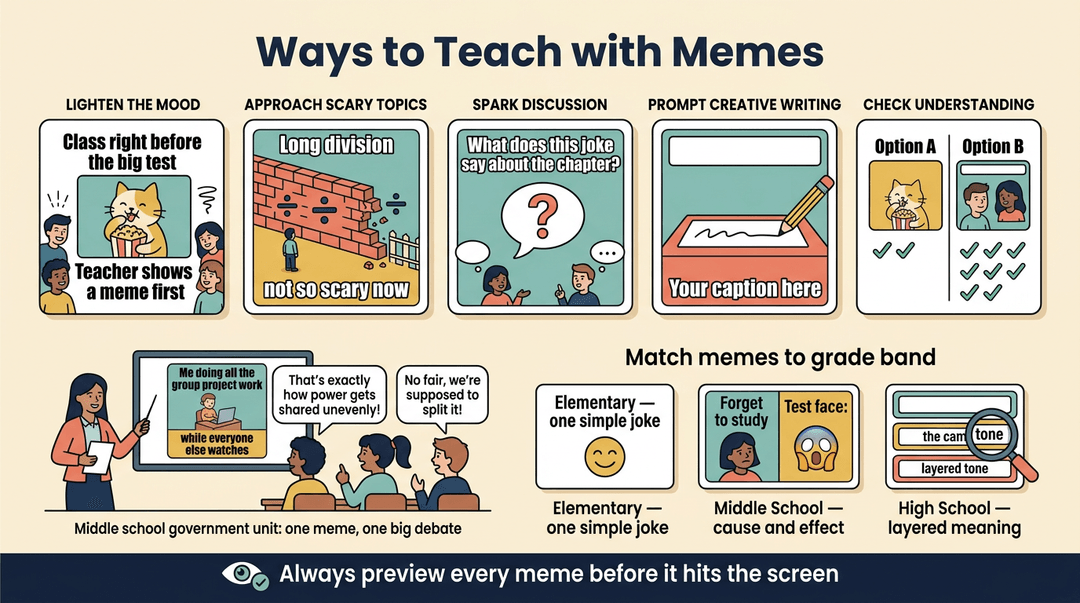
Ways to teach with memes
- Lighten the mood. A funny image at the start of class can ease tension before a tough topic.
- Approach intimidating subjects. A meme about long division can make a scary topic feel less like a wall.
- Spark discussion. Ask what the joke says about the chapter.
- Prompt creative writing. Students write a caption or short story inspired by a meme.
- Check understanding informally. A quick meme poll shows who's following along.
A middle school social studies teacher opens a government unit with a group-project meme, and students debate how the joke fits the way power is shared.
Sample memes by grade band:
- simple, single-message images for elementary,
- cause-and-effect memes for middle school,
- layered memes that invite tone analysis in high school.
Preview every meme before it hits the screen.
How memes build critical thinking skills
Memes are less about what a picture shows and more about how it makes its point. Students interpret layers of meaning, along with the social and political context that gives a joke its punch.
Students who create their own memes must synthesize course material into a short, accurate message. Grade them with a simple rubric:
- accuracy,
- clarity,
- and connection to the objective.
If a student can't explain the concept in a caption, they probably don't own it yet.
How memes build classroom community
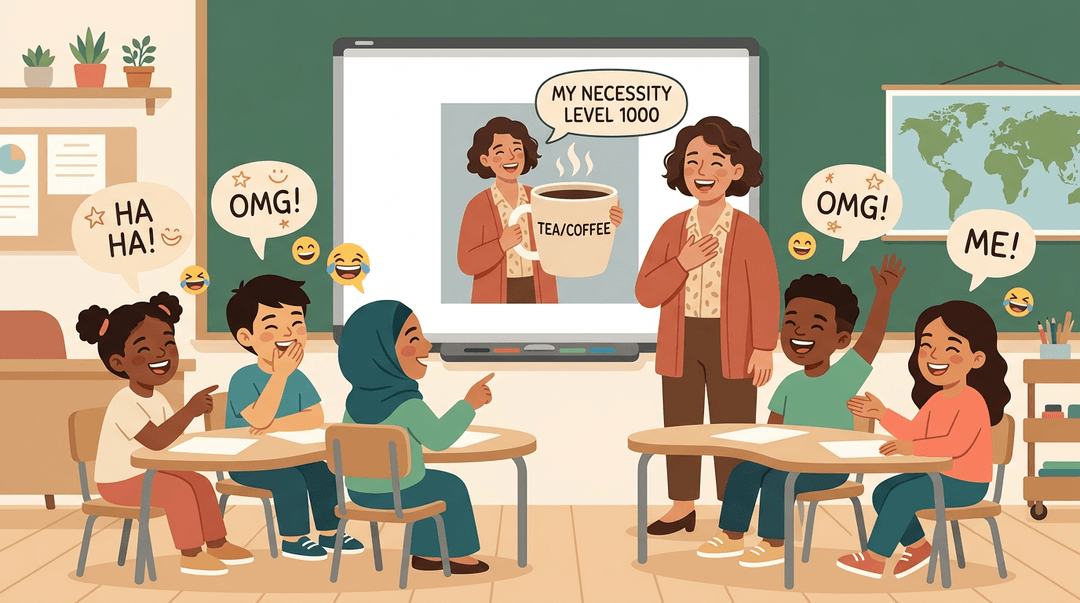
Shared humor bonds students, and a teacher who laughs at a meme about their own habits bridges the educator-student gap. Memes also capture relatable academic struggles, like the panic before a test.
Students feel more comfortable asking questions when they see their experience reflected. That comfort is where participation starts.
Why you shouldn't overdo memes
Memes support the lesson; they shouldn't become it. Tie each one to a clear objective and use them judiciously, because one well-chosen meme often beats five. Students tune out a joke that shows up every few minutes.
Check copyright and fair use rules before projecting a meme, since fair use is a legal idea with limits, not a blanket permission. Remove any inappropriate or offensive meme, even a popular one.
Memes about teacher life
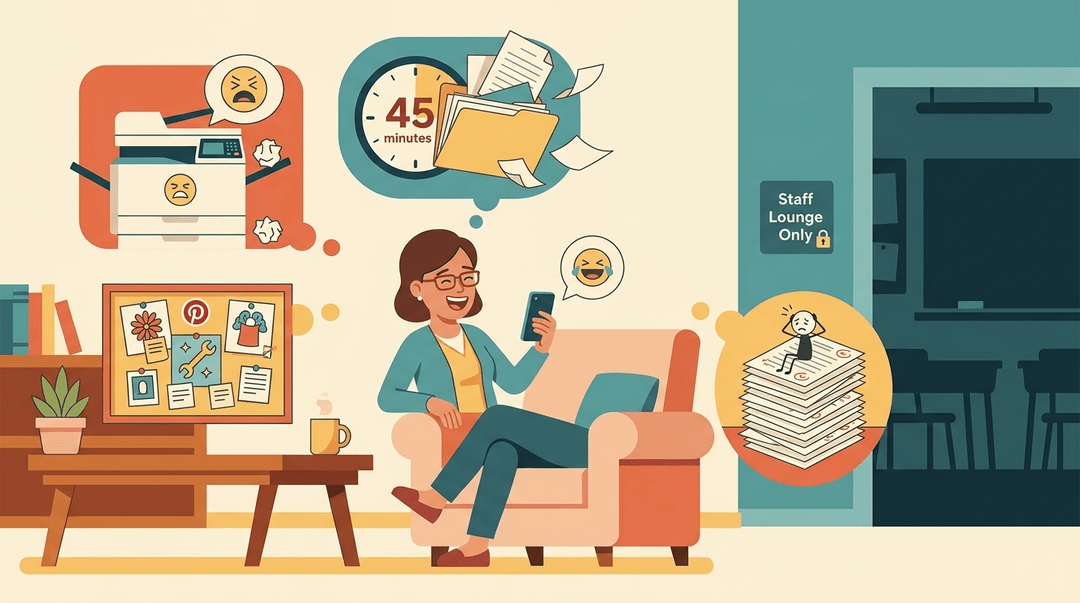
Teacher problems memes capture the copier jam and the lesson plan that never fits in 45 minutes. Back-to-school humor helps everyone reset, and Pinterest lesson planning memes poke fun at ideas that never get done.
Standardized testing and classroom management jokes let you vent, but save them for the staff lounge, not student slides.
A Quick-start Checklist for Meme Lessons
Reach for this when you're planning a meme-based lesson and want a clear path from idea to classroom. Confirm the prep first, then run four moves in class.
Before class: confirm it's ready
Each item below is a yes/no check. If one is a no, fix it before students see anything.
- The meme matches your objective. The joke should run on the very skill you're teaching.
- Board version: "I can explain how the image and caption create irony."
- It fits your grade band. Read the full source, not only the image, for language and references.
- Two or three backups are ready. Swap one in if the first confuses students or gets blocked.
- One discussion prompt is written. Decide it now so you're not improvising.
- Try: "What does the caption want us to believe, and who is it for?"
⚠️ Watch out: A meme that needs a long explanation has already lost the room. If you can't explain the joke in one sentence, use a backup.
In class: run the four moves
These happen in order, because each one builds the thinking the next one needs.
- Model critical reading first. Show students what careful looking sounds like before they try it.
- Say: "First I notice the image. Then I see how the caption changes what it means."
- Have students explain the meaning. Make them put the joke into words.
- Prompt pairs: "Explain this to your partner without saying 'it's funny.'"
- Let students remix or create. Hand over a format and a constraint so they aren't staring at a blank page.
- Constraint: keep the template, but change the topic to today's content.
- Finish with an exit-ticket meme. One quick response tells you who got it.
- Ask for one caption that shows today's big idea.
Example: A seventh-grade ELA teacher wants students to spot irony. She models one meme aloud, and pairs explain a second one. Then students rewrite the caption using a scene from their class novel. Their exit tickets show who can name the gap between what's shown and what's said.
At a glance:
| Phase | Key move | What you get |
|---|---|---|
| Before | Match meme to objective, prep backups | A lesson that stays on target |
| During | Model, explain, remix | Students reading memes critically |
| After | Exit-ticket caption | A fast check on understanding |
Save your best meme prompts as reusable blocks in EMStudio's lesson planner for next term.
How to Learn to Make Memes
Making memes sounds simple until you're staring at a blank screen. Here are three ways to build that skill, from structured courses to learning on your own.
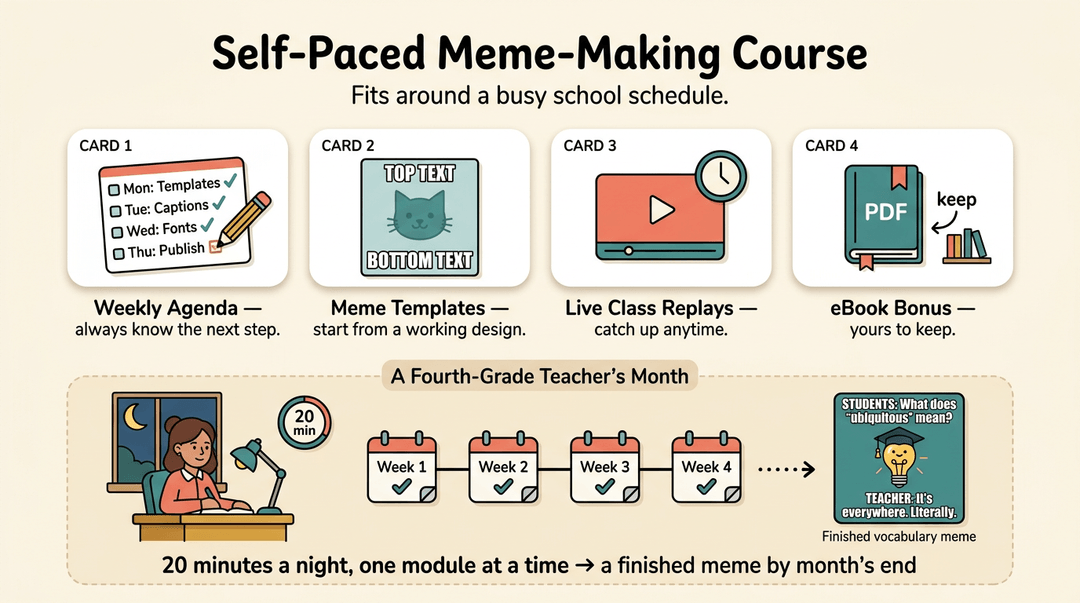
Take a self-paced meme-making course
A self-paced course fits around a busy school schedule. The weekly class agenda shows you what to cover and when, so you always know the next step. Each lesson also includes meme templates, so you start from a working design instead of an empty canvas.
Missed a session? Live class replays let you catch up on your own time, and the eBook bonus material gives you a reference to keep after the course ends.
Consider a fourth-grade teacher with twenty minutes each evening. She works through one module at a time and ends the month with a finished meme for her vocabulary review.
Hands-on meme workshops for teachers
Prefer learning alongside other educators? An Adobe Express workshop walks you through the tool in a guided setting.
The sessions combine digital literacy training with hands-on meme making, so you practice making memes rather than just watching someone else do it. Complete the online registration before the session so you're ready to go when it starts.
Teaching yourself to make memes
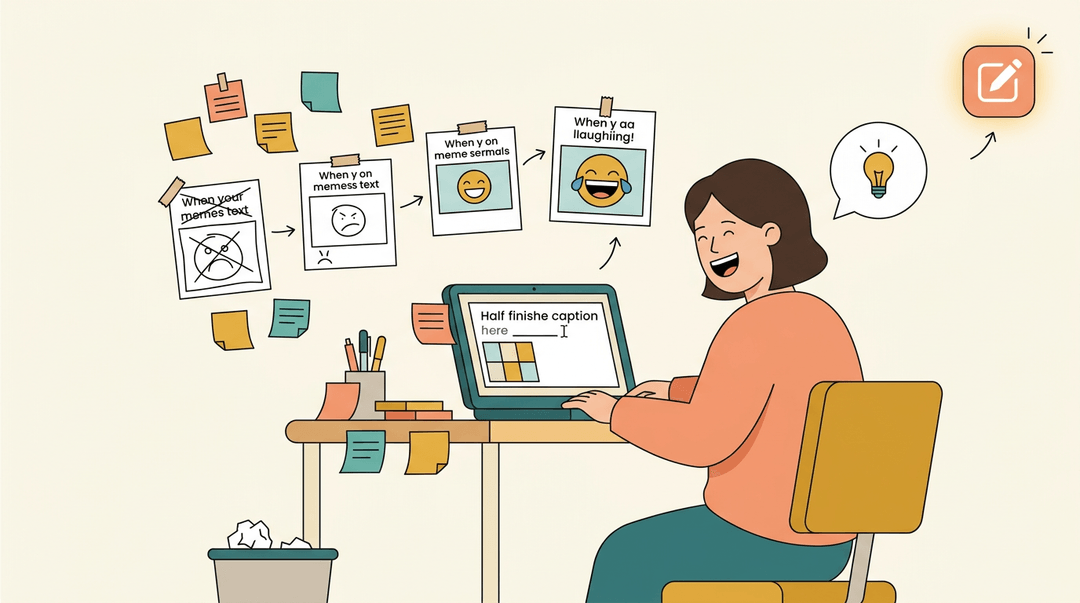
Many teachers learn this way through trial and error. Open the tool, try a template, and see what lands. Once you stop worrying about getting it perfect, the process becomes an easy and fun process. Your first meme won't be your best. That's the point.
Share your creations on your blog, and you'll have a reason to keep experimenting.
Meet People Who Make Memes
Some of the most engaging meme makers started out posting for fun. If you've ever sent a meme to a colleague at 3 p.m., you already get the appeal. Here's how a hobby can grow into something bigger.
From hobby memes to a career
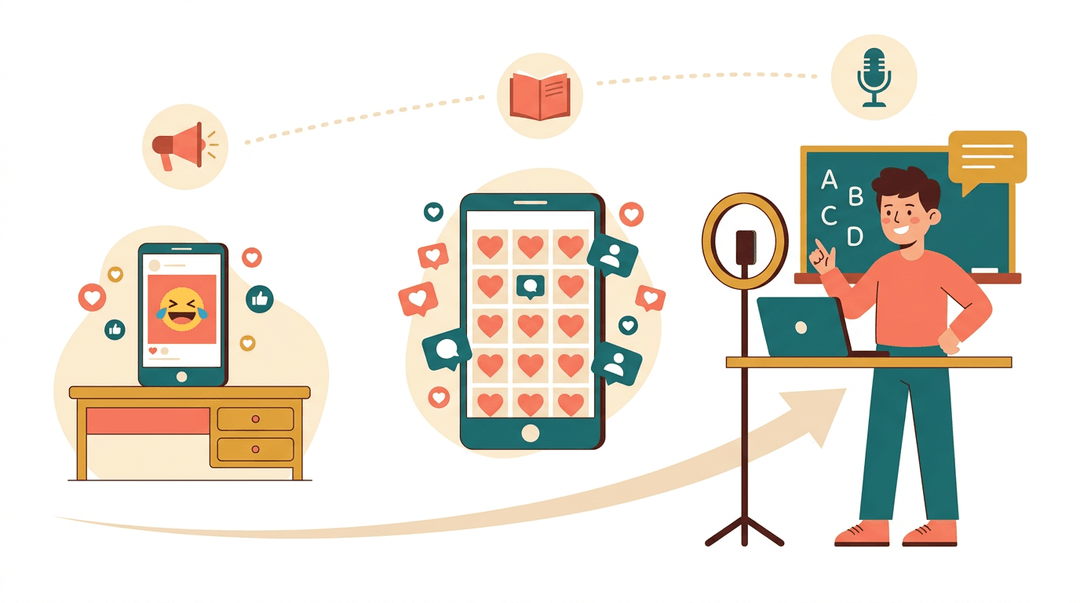
A funny image that gets shared can grow into a real audience. Over time, that audience can open doors to writing, speaking, and even teaching creative professionals how to make content that connects. Researchers see this pattern beyond memes, too.
A University of South Florida dissertation notes that "microcelebrities who teach English on Douyin utilize linguistic and other semiotic resources for both instructional and self-branding purposes."
Teaching and online fame can feed each other, and self-branding becomes part of the lesson.
A teacher's meme blogging hobby
Plenty of teachers are hooked on internet memes, and it's easy to see why. Think of a middle school science teacher who saves a funny image every time a class says something unexpected.
Each week she posts a roundup on her blog, focused on the humor of teaching: the missing homework, the substitute's panic, the 3 p.m. slump.
Her readers laugh, and they feel less alone. That's the point. It's less about the punchline and more about belonging. Laughter helps, and teachers know that better than anyone.
The History and Culture of Memes
Memes have a longer story than most people expect, and it's worth knowing before you bring them into class.
What is the most famous meme ever?
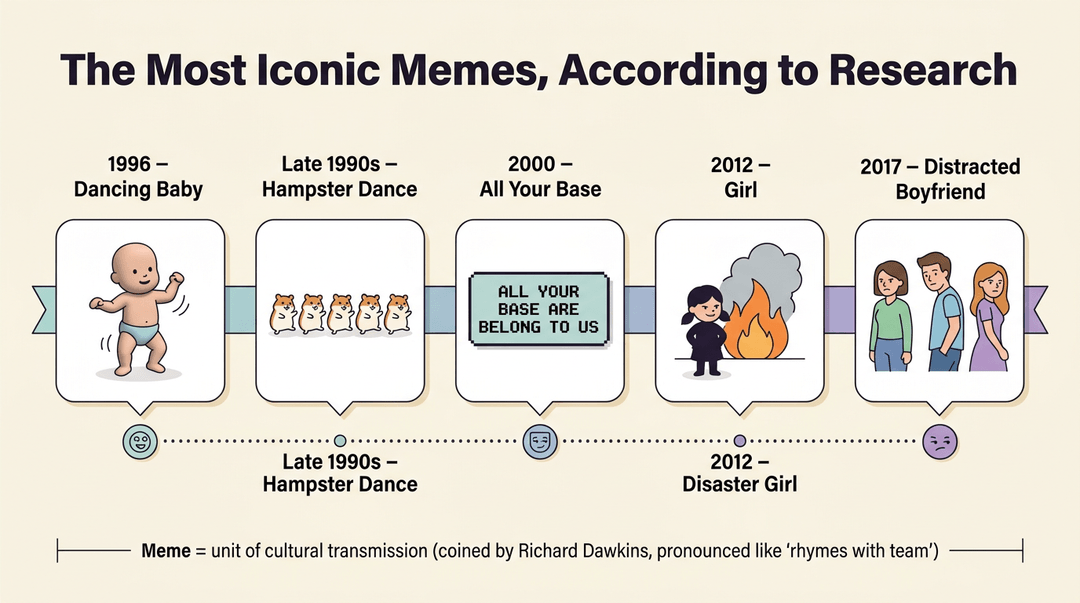
There's no official winner, but some memes have clearly become iconic. A recent study on meme heritage points to:
- the ‘Dancing baby’
- ‘All your base are belong to us’
- the ‘Hampster dance’ from the late 1990s
- later favorites like ‘Disaster girl’ and ‘Distracted boyfriend’.
Memes are a participatory digital culture shaped by social media. Leiser's research on political internet memes describes them as "artifacts of participatory digital culture" (Wiggins & Bowers, 2015). The idea behind the word goes further back.
Richard Dawkins coined the word meme, pronounced like "cream," to describe units of cultural transmission. Talks by Dawkins and Terence McKenna address the history and philosophy of memetics, the study of how those units spread.
Think of a middle school teacher who projects Distracted boyfriend at the start of a media literacy unit and asks, "What's the joke?" Within minutes, students are explaining how one image can carry a whole idea.
That quick discussion makes the rest of the lesson easier to start.
What is school even about meme?
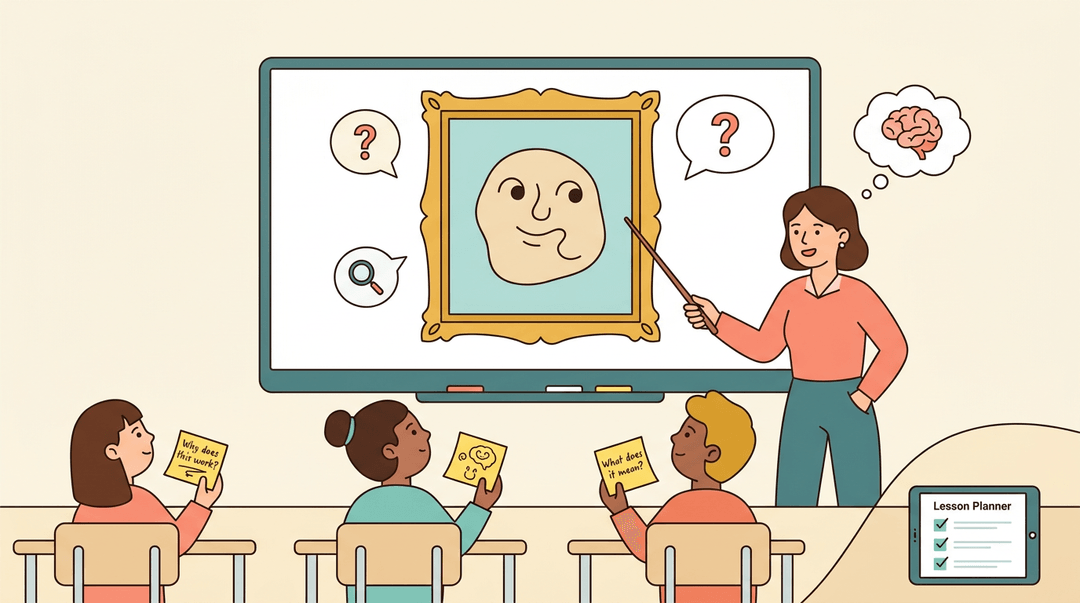
We can't trace this meme's origin from our sources, so we won't guess at it. What we can say is that memes like it sit where modern art, cultural criticism, and questions about consciousness meet.
It's less about what the meme says and more about why it lands. Asking that question is a strong opening for media analysis, and it's where this thread leads.
Memes can feel like a distraction, but with a clear purpose they become a window into how students think, question, and communicate.
Keep your learning goals front and center, use the checklist as your roadmap, and let students show what they understand in their own words and pictures.
Ready to build your next lesson? Check out our Lesson Planner to write, organize, and reuse your plans across all your classes from one place.
References
- The Making of Microcelebrities on Douyin: Multimodal Design and Online Identities in Informal English Instruction Videos — digitalcommons.usf.edu (2022)
- ‘All your image are belong to us’: heritagization, archiving and historicization of memes — doi.org (2024)
- Memes, Minds and Evolution — cambridge.org
- Leiser: Psychological Perspectives on Participatory Culture: Core Motives for the Use of Political Internet Memes — jspp.psychopen.eu
- 3 MEMETIC EVOLUTION — jackbalkin.yale.edu
- What's in a Meme? — richarddawkins.net
Frequently asked questions
What is meme literacy?
Meme literacy is the ability to decode a meme’s message, understand the context that gives it meaning, and judge the ideas or assumptions it promotes. It also involves recognizing how images, captions, references, tone, and cultural context work together.
What is the most famous meme ever?
There is no official single most famous meme. Widely recognized examples include Dancing Baby, All Your Base Are Belong to Us, Hampster Dance, Disaster Girl, and Distracted Boyfriend.
What is meem in education?
A meme in education is a short image or caption, usually based on a familiar format, that uses humor to make a classroom idea easier to understand. Teachers can use memes to introduce topics, spark discussion, prompt creative work, or check students’ understanding.
What is school even about meme?
The “school even about” meme is an ambiguous, reflective meme that questions the purpose or meaning of school. Its value in education comes from prompting students to discuss why school matters, how learning connects to life, and why the meme’s wording or format feels meaningful.