SEL in Education: What It Is and How It Works

Jump to section
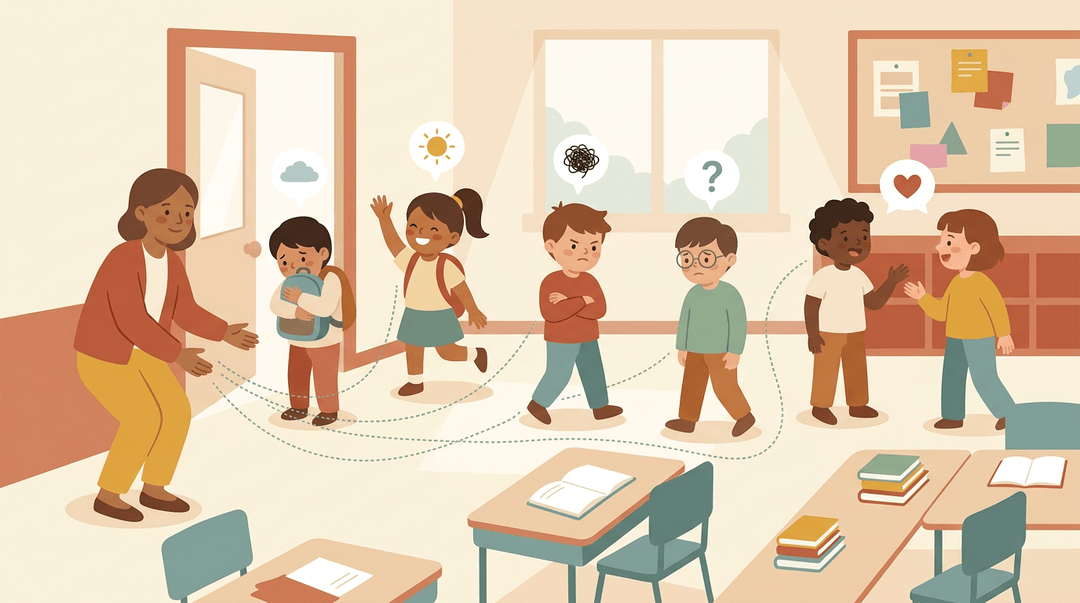
Picture the first week of school. Students arrive with different moods, histories, and ways of handling frustration, and you're the one helping them find their footing.
That's where social and emotional learning (SEL) comes in: the skills students use to understand their feelings, build relationships, and make good choices. SEL isn't an extra subject to squeeze in.
It's a set of skills you can weave into the learning you already do.
This post covers what SEL is, the core skills it builds, what the research says, and how to embed it in your curriculum planning and standards.
Why SEL in Education Matters
Before you plan where social and emotional learning fits, get clear on the basics.
What does SEL stand for?
SEL stands for social and emotional learning, the process of acquiring life skills like managing emotions and building relationships. These skills are integral to education and development.
Academics-only models focus on what students know; SEL focuses on how they handle people and feelings.
SEL belongs at the core of teaching
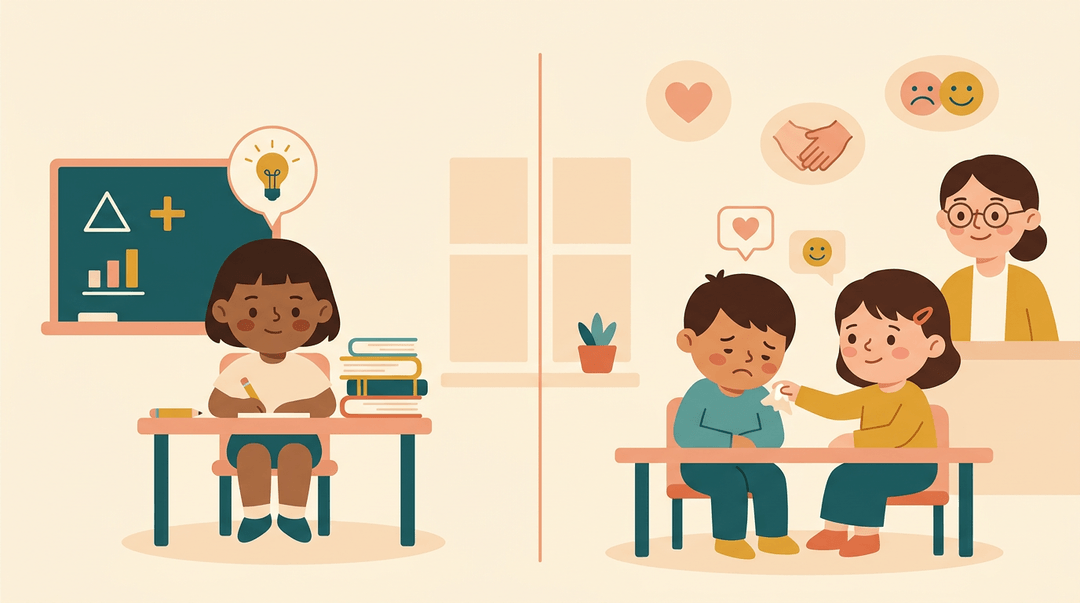
SEL isn't a side project. It's a core part of a quality curriculum, because every student brings their own feelings and needs into the room. Meeting those needs alongside academic goals supports the whole child.
Academic and emotional growth aren't competing priorities. Both belong in your plan.
Consider a fourth-grade teacher whose class is tense every Monday. She opens with a ten-minute check-in where students name how they're feeling. Over a few weeks, she may notice smoother transitions and fewer disputes landing on her desk.
That's whole-child development in action.
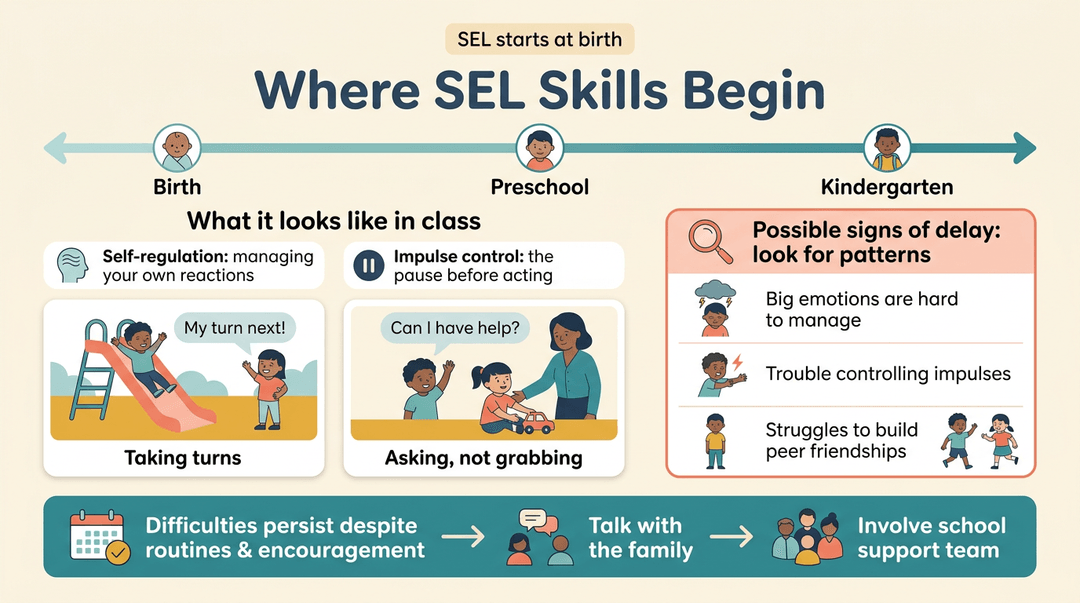
Where SEL skills begin in early childhood
SEL starts at birth, long before the first day of school. Self-regulation is the ability to manage your own reactions, and impulse control is the pause before acting on a feeling.
In preschool and kindergarten, you'll see these skills show up in moments like taking turns and asking for help instead of grabbing.
Wondering about signs of social and emotional delay? Look for patterns, especially when a child:
- Struggles to manage strong emotions
- Has trouble controlling impulses
- Finds it hard to build relationships with peers
If those difficulties persist despite routines and encouragement, talk with the family and your school's support team.
Core Skills SEL Builds in Students
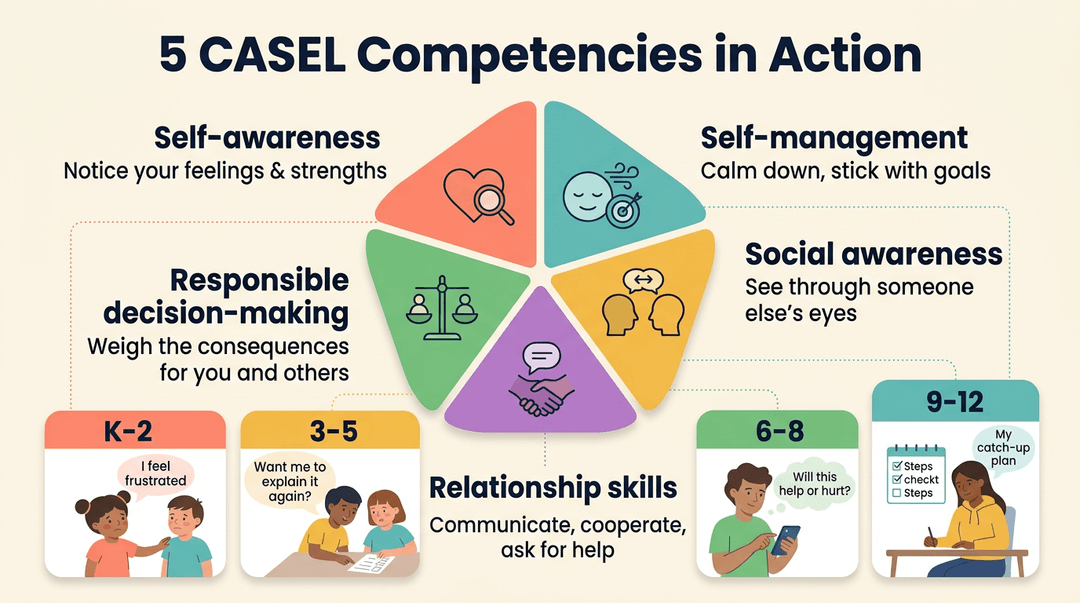
Social and emotional learning (SEL) rests on five competencies from the Collaborative for Academic, Social, and Emotional Learning (CASEL).
The five CASEL competencies by grade band
Here's each one in plain terms:
- Self-awareness. Noticing your own feelings, strengths, and gaps.
- Self-management. Regulating emotions and working steadily toward goals.
- Social awareness. Seeing things from someone else's perspective.
- Relationship skills. Communicating clearly, cooperating, and asking for help.
- Responsible decision-making. Weighing choices by their consequences for yourself and others.
Grade-band examples:
- Grades K-2: A kindergartner names the feeling, frustration, instead of pushing a classmate away.
- Grades 3-5: A third grader notices a partner looking lost and offers to re-explain the directions.
- Grades 6-8: A middle schooler pauses before posting a reply and asks whether it will help or hurt the group.
- Grades 9-12: A high schooler maps out a plan to catch up on missed work.
Everyday life skills SEL teaches
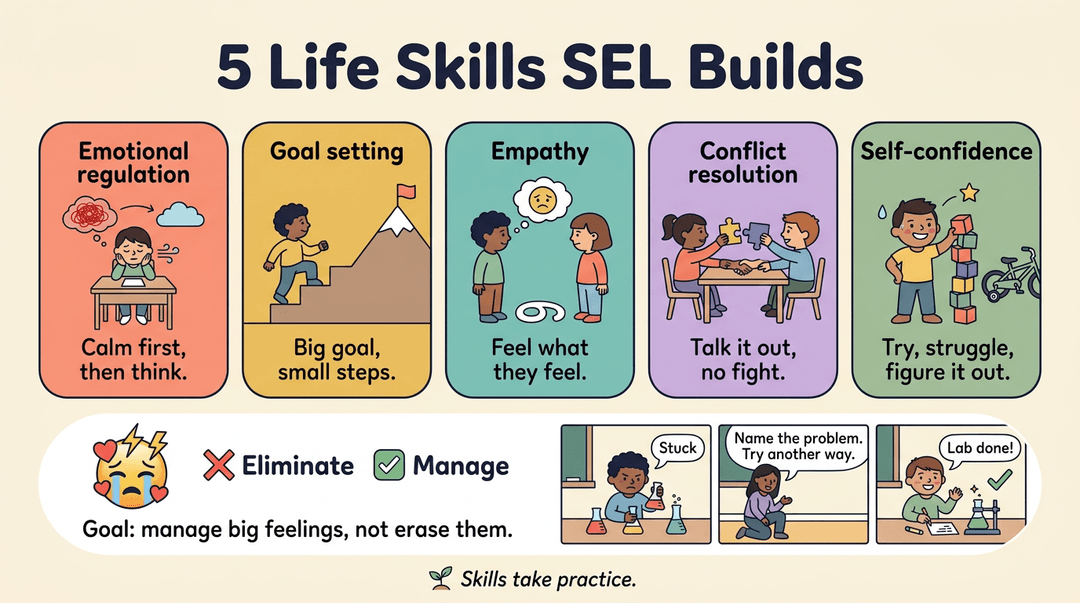
Students carry these skills out of your room and into everything else:
- Emotional regulation. Calming down enough to think clearly before reacting.
- Goal setting. Breaking a big target into steps you can actually take.
- Empathy. Understanding how someone else feels, even when you see things differently.
- Conflict resolution. Working through a disagreement without it becoming a fight.
- Self-confidence and self-reliance. Trusting your own ability to try, struggle, and figure things out.
The goal isn't to eliminate big feelings. It's to help students manage them. Consider a fourth-grade teacher whose students shut down mid-lab. She coaches them to name the problem and try another approach, and the lab gets finished. Skills take practice.
Weave SEL into Your Year-long Curriculum
This guide helps you plan SEL once so it shows up in every unit, not just in a one-off lesson. Reach for it when you build or revise your year-at-a-glance.
Match SEL to each unit
- Find your state SEL standards
- Search "[your state] SEL standards" on your state education department's site.
- If your grade band has none, use CASEL's five competencies as your frame.
- Pair one competency per unit
- Choose the competency the unit's content already stretches.
- A group-project unit, for example, pairs naturally with relationship skills.
- Add it to your year-at-a-glance
- Put SEL in a column right beside the academic standards.
Sample year-at-a-glance rows:
| Unit | Academic focus | SEL competency |
|---|---|---|
| 1 | Opinion writing with peer feedback | Relationship skills |
| 2 | Historical turning points | Responsible decision-making |
| 3 | Long-term science investigation | Self-management |
Build it into everyday lessons
Once the plan is set, SEL lives in three small, repeatable moves. Each one fits inside a lesson you're already teaching.
| Lesson moment | The move | Try saying |
|---|---|---|
| Opening | Check-in routine | "Hold up one to five fingers: how ready are you to learn?" |
| Middle | Cooperative learning task | "Pick your role: speaker, recorder, or questioner." |
| Closing | Reflection exit prompt | "What did you do today when the work got hard?" |
⚠️ Watch out: Don't grade how students feel. Assess the skill you can see, like whether they invited a quiet partner to share.
See what it looks like by grade
| Grade band | Activity | Competency it builds |
|---|---|---|
| Pre-K | Feelings vocabulary with picture cards | Self-awareness |
| Elementary | Conflict role-play with a partner | Relationship skills |
| Middle | Goal-setting journals, revisited weekly | Self-management |
| High school | Decision-making case studies | Responsible decision-making |
Example: A fifth-grade teacher pairs her group-project unit with relationship skills. Students role-play a disagreement over who does which task, then use the same "I feel... because... I need..." wording in real groups the next day. The skill gets practiced, then used.
Check your plan before you teach
Confirm each lesson or unit has:
- A clear competency target: one named competency, not "SEL in general."
- An age-appropriate activity: matches the grade-band examples above.
- An observation or rubric: a look-for you can note in seconds.
- A family connection idea: a question or task students can take home.
Map SEL competencies alongside academic standards in EMStudio's Curriculum Planner.
What the Research Says About SEL Benefits
Is social and emotional learning (SEL), the skills students use to manage emotions and relationships, worth your time? Here's what the research shows.
How SEL lifts test scores and attendance
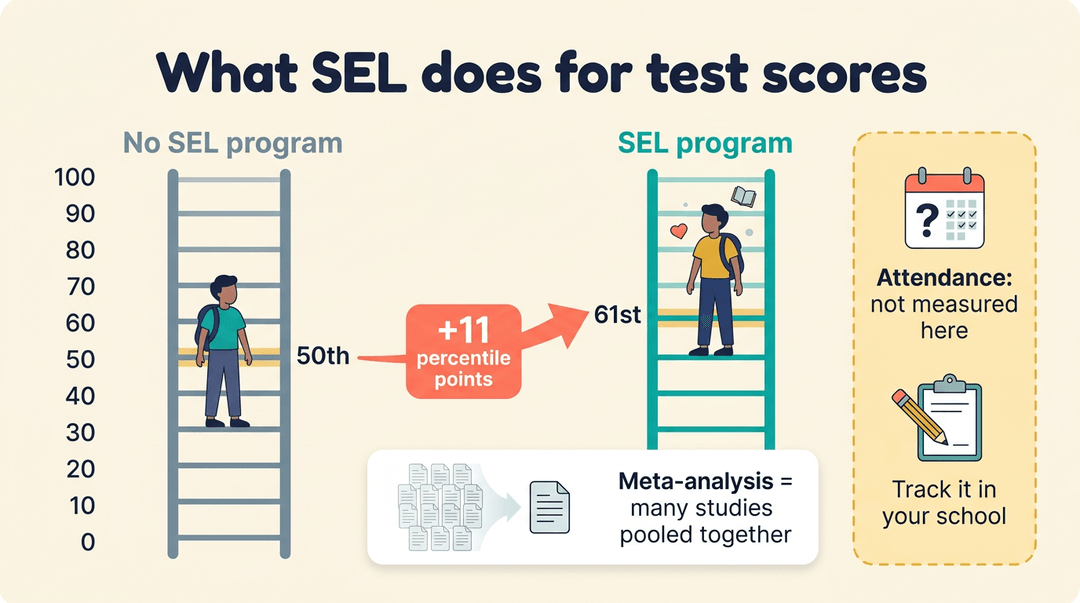
A meta-analysis of school-based universal interventions found that students in SEL programs had academic performance averaging 11 percentile points higher than students in control groups. That's a big return.
Attendance is harder to pin down, since the research we have here doesn't measure it, so track it in your own school. A meta-analysis pools many studies, so it's broader than any single program.
Gains in classroom behavior and well-being
Picture a middle school teacher whose group work stalls every time two students argue. A quick pause-name-retry routine gets the group back to work.
School-based SEL programs have been associated with reductions in bullying, drug use, and violence, and a 2026 systematic review and meta-analysis by Jared Muser and colleagues suggests universal programs can help reduce antisocial behavior when used alongside other strategies.
Better behavior, less stress and distress, and fewer disciplinary referrals are worth tracking, but the research here doesn't measure them. Start with your own referral data.
Payoffs students see later in life
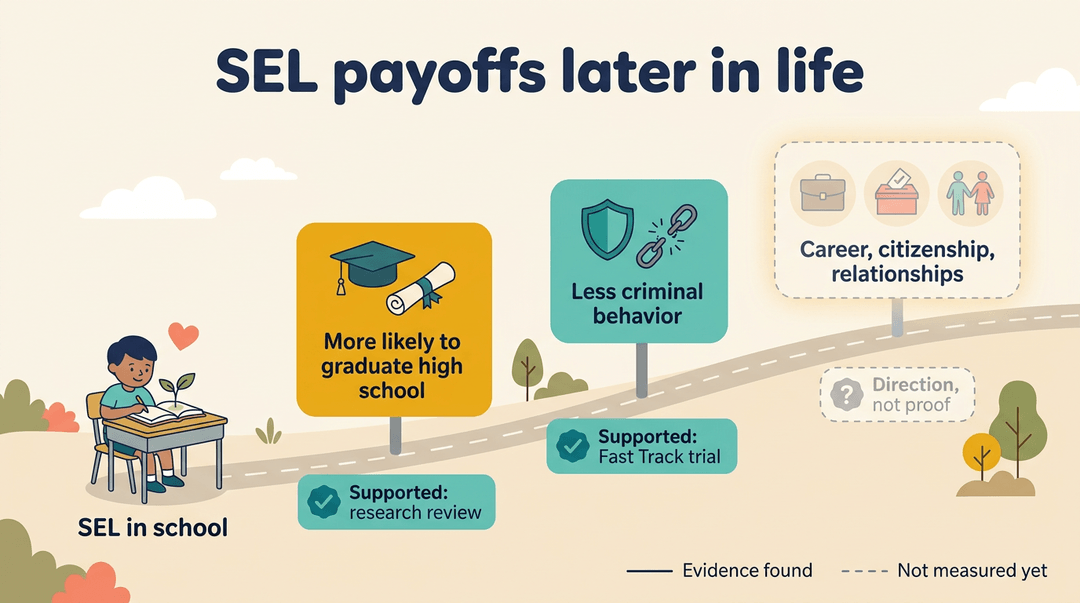
The long-term picture is where SEL's reach becomes clear:
- Higher graduation likelihood. A scoping review of long-term SEL outcomes found that participation is associated with a greater likelihood of graduating high school.
- Reduced criminal behavior. The Fast Track intervention, a randomized controlled trial for children at risk of conduct problems, lowered criminality.
- Career success, engaged citizenship, and positive relationships. The research we're linking doesn't measure these yet, so treat them as direction, not proof.
How SEL helps close opportunity gaps
Not every student starts from the same place, and SEL is often linked to breaking generational poverty. Growth mindset (the belief that ability grows with effort) and social capital (the relationships that open doors) help explain the link.
Think of a fourth grader who's rarely been asked what she thinks. When her teacher starts class with one quick question, she begins raising her hand.
Equity means asking who gets the chance to build these skills, not just who already has them. We don't have a study to link on that yet, so this is where the evidence is thinnest.
Putting SEL into Practice Across Schools
Knowing what social-emotional learning (SEL) is only gets us so far. The real work happens across the whole school and in your own room.
Making SEL part of the whole school
SEL works best when it isn't a separate subject tucked into Friday afternoons. Explicit SEL instruction teaches skills directly in dedicated time, while integrated SEL builds them into math, reading, and daily school life.
Integrating SEL across the curriculum and school culture is less about adding it and more about weaving it in.
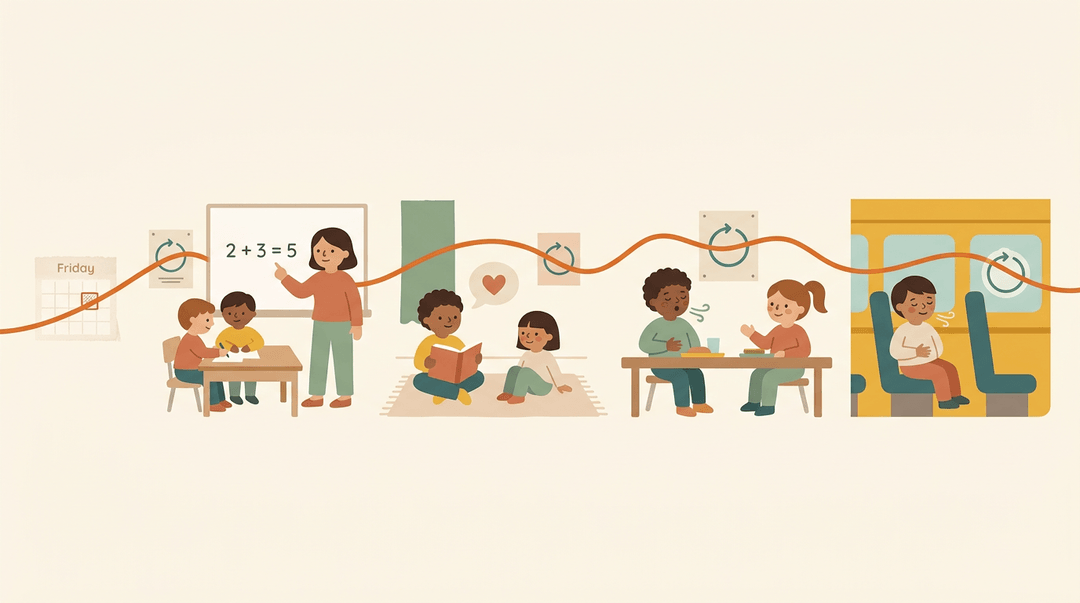
Coordinate fragmented programs around shared goals, then review what's working each term, adjust, and check again. A calming strategy learned in class should sound the same at lunch and on the bus.
Working with families and communities
Collaboration extends beyond school walls. Consider a second-grade teacher who sends home one calming strategy each week so parents can reinforce it at dinner, giving students more chances to practice.
Cultural responsiveness means honoring the routines and beliefs families bring and inviting them to share what already works. Students belong in the conversation too. Ask what helps them calm down, then use their answers.
When they have a real say, they have more reason to own the skills.
Training and coaching adults in SEL
Teachers can't model skills they haven't practiced, so professional development should give staff time to try strategies and reflect on them. One-time workshops rarely change daily habits.
Coaching gives you someone to observe a lesson, offer feedback, and help you try again next week.
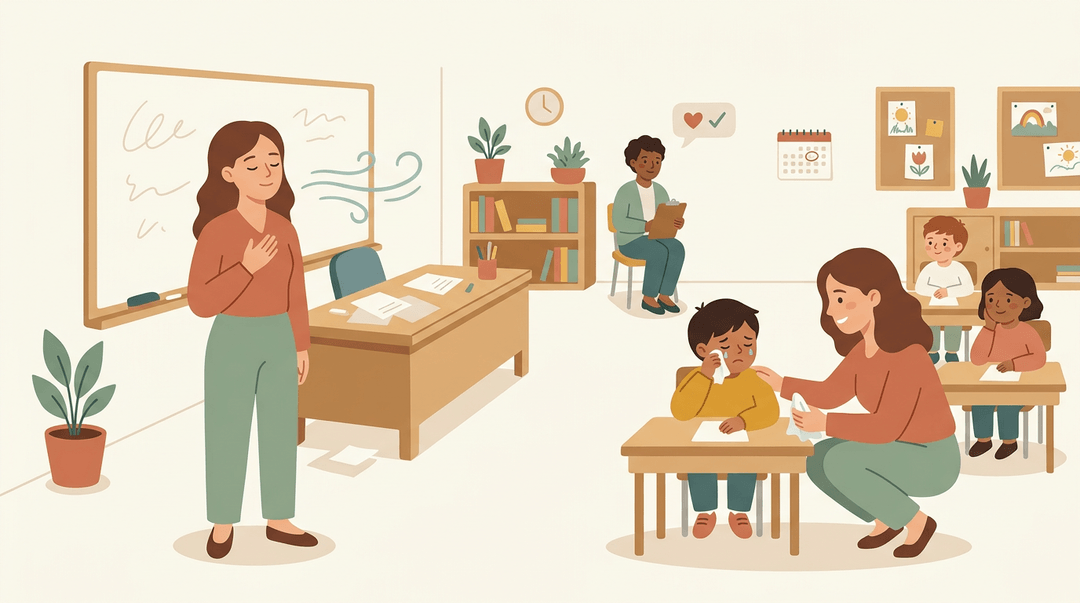
Adults need these skills too. A teacher who takes a breath after a rough morning, then reconnects warmly with an upset student, is teaching by example.
What a strong SEL curriculum includes
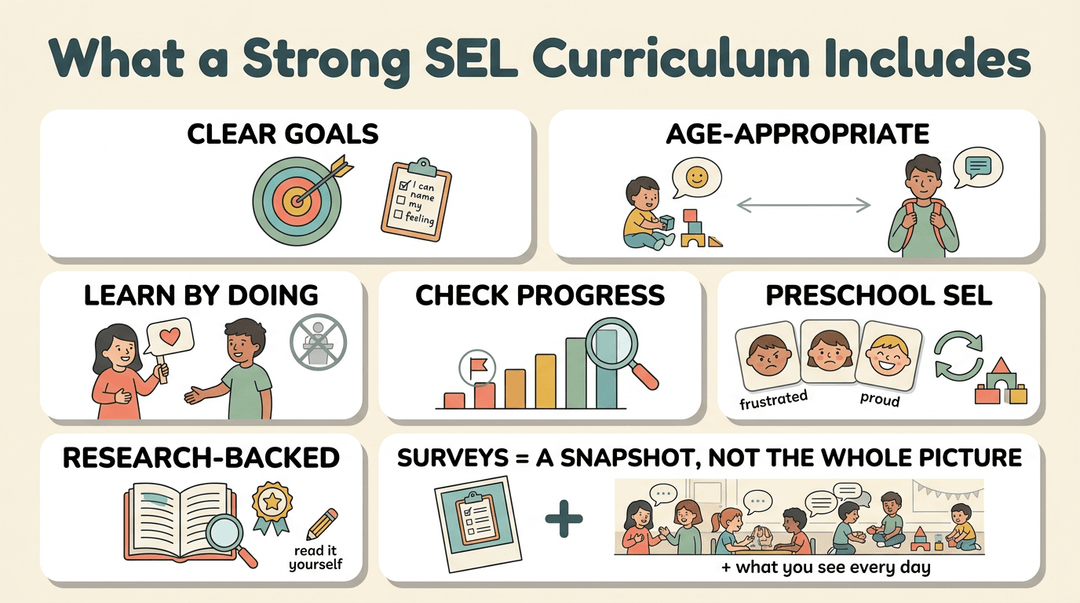
Here's what we'd look for in a strong curriculum:
- Clear goals and objectives. Name what students should be able to do, like identifying their own feelings.
- Age-appropriate content. A kindergartner and a high schooler need different scenarios and vocabulary.
- Engaging, experiential activities. Students learn by practicing and role-playing, not just listening.
- Assessment and evaluation. Check progress regularly so you know which skills need another pass.
- Evidence-based programs. Choose programs with research behind them, and read that evidence yourself.
- Good preschool SEL curriculum. For preschoolers, look for play-based lessons with short, repeated routines and simple words for feelings like "frustrated" or "proud."
- Assessing SEL: tools and limits. Surveys and checklists give a snapshot, not the full picture, so pair them with what you see every day.
Creating a safe, supportive classroom
Students learn best when they feel safe to make mistakes. Safety comes from relationships more than rules, so greet every student by name and make room for every voice.
A morning check-in or closing reflection takes only minutes, and it gives SEL a steady rhythm in your daily routines. Routines work best inside a supportive school climate, where the whole building backs them up.
When students see the same expectations in the hallway and the cafeteria, consistency is what makes the classroom feel safe.
How SEL Shows up in Real Programs
Social and emotional learning (SEL) is easiest to see in action. Here's where it shows up.
How esports and gaming build teamwork
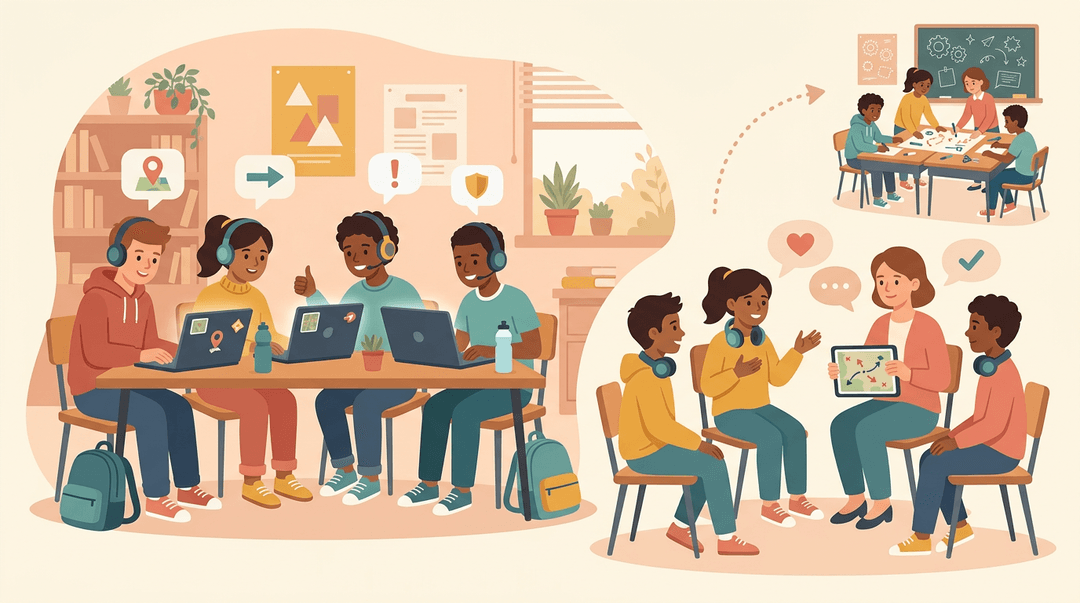
Competitive gaming asks players to coordinate in real time, building teamwork and collaboration through shared callouts. They also practice stress management and strategic decision-making under pressure.
Digital citizenship is less about whether players talk and more about how they treat each other online.
Consider a middle school teacher who starts an after-school esports club and debriefs each match. Students reflect on how they communicated, a habit they carry back to class.
More programs putting SEL to work
Other programs apply the same skills. Group projects, including the Sankofa Chronicles project, ask students to listen, compromise, and own a shared outcome. Computer science builds persistence when students keep troubleshooting after a fix fails.
A sensory bus for Head Start children offers young learners hands-on ways to calm down. In pre-K looping, a teacher stays with the same children for more than one year, so trust is already in place when the year begins. Relationships come first.
Careers that use SEL skills
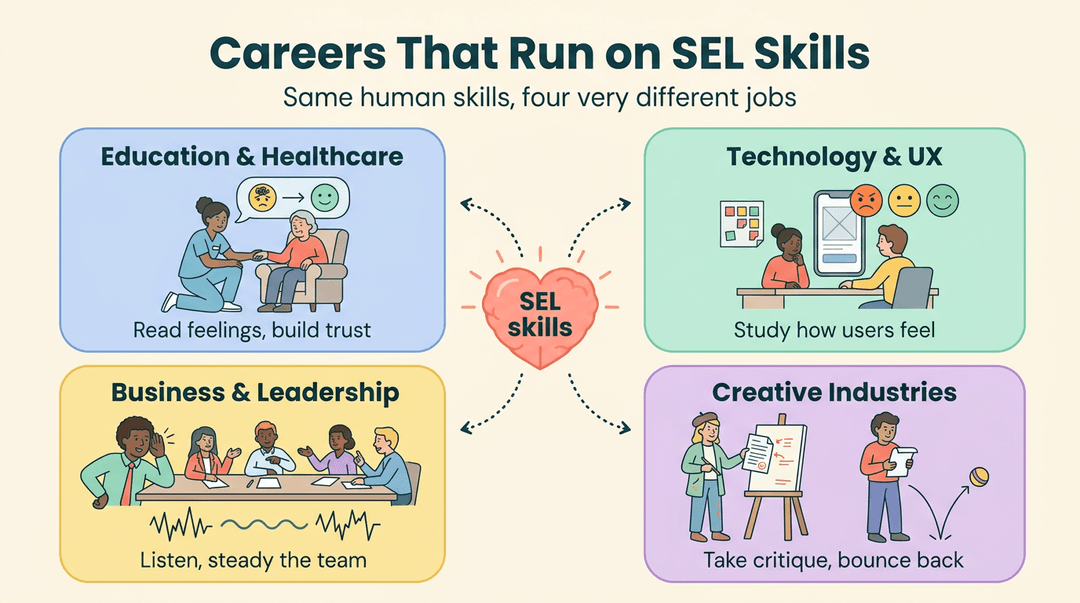
Many careers rely on the same skills:
- Education and healthcare: teachers, counselors, and nurses read emotions and build trust daily.
- Technology and UX: user experience (UX) designers study how real people feel using a product.
- Business and leadership: managers who listen well keep teams steady through change.
- Creative industries: artists and writers take critique and bounce back from rejection.
Becoming an SEL specialist
Start by building your own SEL skills, since you can't teach what you haven't practiced. Then gain hands-on time with students and learn the core SEL competencies well enough to explain them.
Look for coordinator or coaching roles that build SEL across a school. Picture a veteran teacher who leads a morning check-in, then coordinates her school's SEL plan.
How Policy Shapes SEL and Discipline
Policy shapes social and emotional learning (SEL) by setting what schools teach, fund, and how they respond to behavior. Here's what that means for you.
What states require and fund for SEL
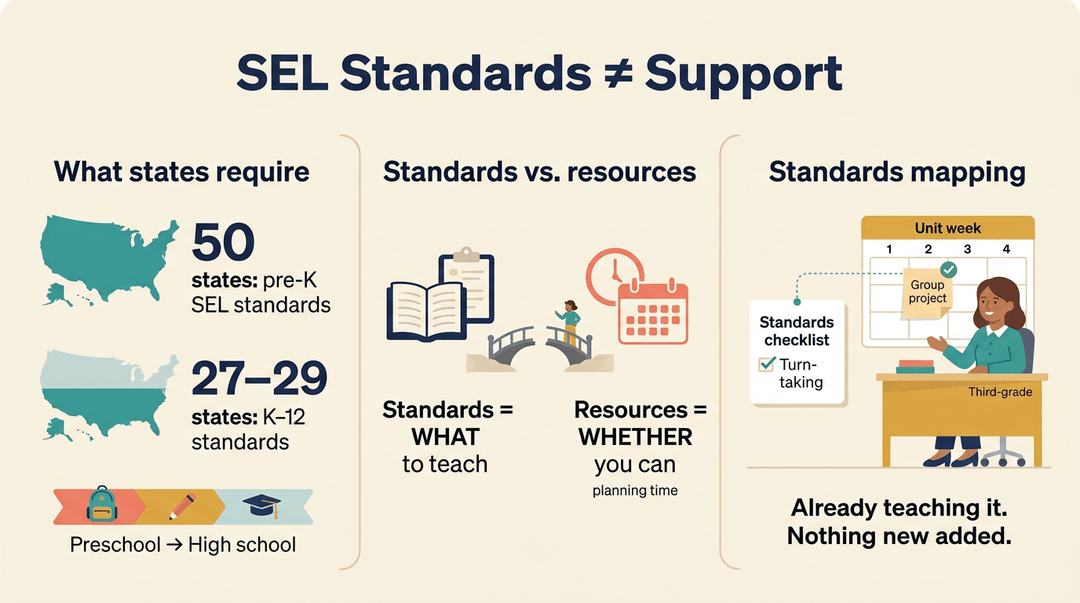
According to NU, as of 2025 all 50 states have pre-K SEL standards, and roughly 27 to 29 have adopted K-12 standards. Standards span preschool through high school, but they aren't the same as support.
Implementation is often under-supported and needs dedicated resources like planning time. Standards tell you what to teach; resources decide whether you can.
That's where standards mapping helps. A third-grade teacher can match her state's standards to her unit calendar and spot that a group project already teaches turn-taking. Nothing new lands on her plate.
Replacing suspensions with positive discipline
Research from the Nese Lab finds that alternatives such as Positive Behavioral Interventions and Supports (PBIS) reduce suspensions and expulsions, though evidence is thinner in middle and high school, so we'd treat it as a starting point.
Whichever model your school uses, positive discipline means teaching the behavior you want, not only punishing the one you don't. Picture a middle school teacher whose class keeps sending one student out.
She teaches a quick turn-taking signal, so the student stays and keeps learning.
Keeping public and political support strong
Support has held despite political pushback. According to surveys by the EdWeek Research Center, educators' views have stayed steadily positive for the past four years, if not overwhelmingly so.
Parents and policymakers ask about SEL too, so be ready to show a lesson or a student's growth. Workforce and business endorsement gives you a plain answer when someone asks why SEL belongs in the schedule. Make your work visible.
SEL is about more than calm classrooms. It's about helping students understand themselves, care about others, and make choices they can stand behind, and it works best when it's built into the everyday plan rather than tacked on.
When you plan SEL alongside your academic goals, those skills become part of how students learn, not a separate lesson they forget.
Ready to make it happen? Check out Curriculum & Standards to plan units, lessons, and standards across the whole school year.
References
- The impact of enhancing students' social and emotional learning: a meta-analysis of school-based universal interventions — pubmed.ncbi.nlm.nih.gov
- Can universal school-based social and emotional learning programs reduce early antisocial behaviours? A systematic review and meta-analysis - Jared Muser, Tyson Whitten, Josephine Virgara, Nadine Connell, Stacy Tzoumakis, 2026 — journals.sagepub.com (2025)
- The long-term outcomes of social emotional learning programs in K-12 school systems: a scoping review — hdl.handle.net (2026)
- Fast Track Intervention Effects and Mechanisms of Action Through Established Adulthood — pure.psu.edu (2025)
- Promoting Resilience with Social-Emotional Learning: Young Adult Follow-up of a Preschool Randomized-Controlled Trial — pmc.ncbi.nlm.nih.gov (2026)
- What is Social Emotional Learning (SEL): Why It Matters — nu.edu (2026)
- Journal Articles — neselab.org
- SEL and Student Attendance: Research and Policy Recommendations — casel.org (2026)
- Support for Teaching SEL Skills Remains Steady Despite Political Pushback — edweek.org (2026)
Frequently asked questions
What is a good social-emotional learning curriculum for preschoolers?
A good preschool SEL curriculum uses play-based lessons, short repeated routines, and simple feeling words such as “frustrated” and “proud.” Look for age-appropriate activities that let children practice skills through play and role-play, with clear goals and regular progress checks.
What are some signs of social and emotional delay in children?
Possible signs include persistent difficulty managing strong emotions or controlling impulses, and trouble building relationships with peers. Look for ongoing patterns despite routines and encouragement, and discuss concerns with the child’s family and school support team.
How to become a SEL specialist?
Build your own SEL skills, gain hands-on experience working with students, and learn the core SEL competencies well enough to explain and teach them. Then seek coordinator or coaching roles that help develop SEL across a school; requirements can vary by employer and location.
What does SEL stand for?
SEL stands for social and emotional learning. It is the process of developing skills such as understanding and managing emotions, building relationships, and making responsible choices.