Spanish Homeschool Curriculum: How to Choose the Right One

Jump to section
Picture walking into a grocery store with a dozen cookbooks and no plan for dinner. Choosing a Spanish curriculum for your homeschool can feel just as overwhelming.
Product pages can make every option sound perfect, but they don't always tell you what your child actually needs.
The right choice comes down to a few clear decisions: your teaching approach, your learner's level, the materials, and your budget.
In this post, we'll walk through each one, then plan a full year of Spanish with pacing, proficiency goals, and progress tracking.

Which Grades This Spanish Curriculum Homeschool Covers
Picking a level starts with knowing where the program fits. Here's the grade range, the high school path, and who it's built for.
Lessons for elementary and middle schoolers
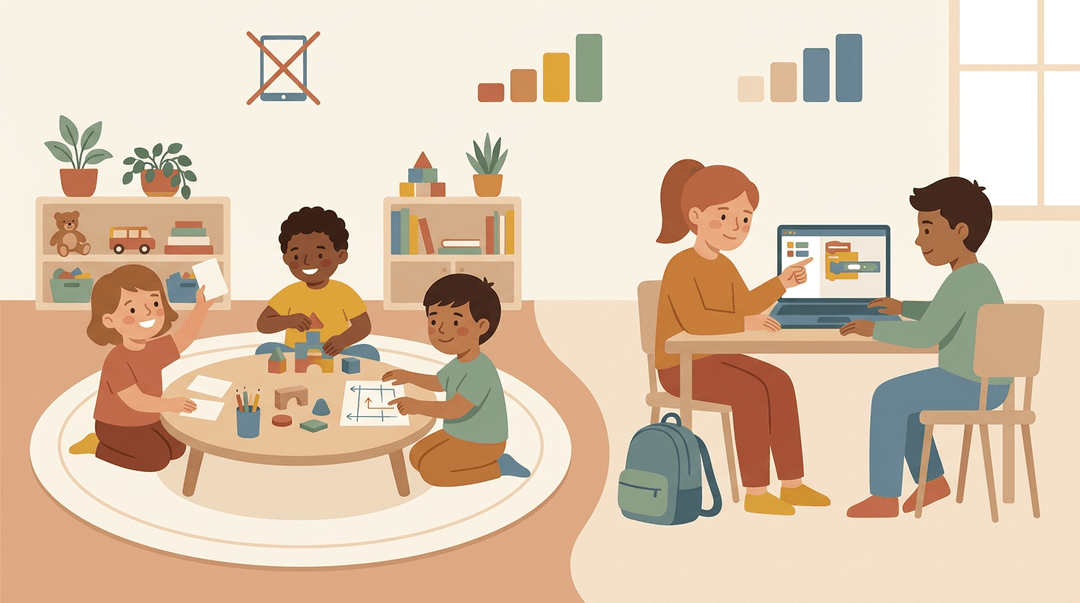
The lessons are designed for Grades 3-8 and also for ages 3-11, so younger learners have a place here too. There's also a dedicated middle school course for older students.
For learners below 7th grade, there's a screen-free option, handy when you'd rather your child practice without a device in hand.
High school credit and self-paced adult learning
High school students can work through levels 1-3 and earn high school credit. Adults learning at their own pace are welcome too, and you can start at any level, so nobody has to begin at the very first lesson if they already know some Spanish.
Finishing the work is one thing. Documenting it for a transcript is another. Jot down what was completed and when as you go, because it's much harder to reconstruct a year later.
Who this program is built for
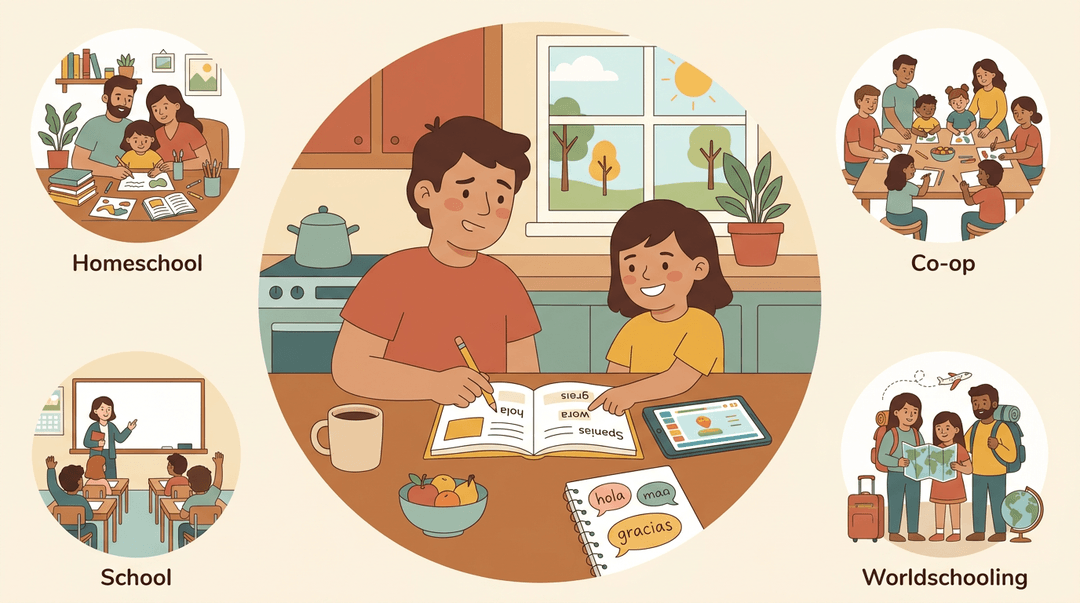
Here's who it serves:
- Homeschool families teaching at home.
- Homeschool co-ops that bring families together around shared lessons.
- Schools and teachers looking for a Spanish course for the classroom.
- Worldschooling families who learn while they travel.
Wondering whether you can teach Spanish without being fluent? You can. It's less about being fluent and more about learning alongside your child.
Think of a parent who studied a little Spanish in high school, now sitting beside a fourth grader at the kitchen table. They don't have to be the expert on day one. They learn side by side.
How the Program Is Designed and Taught
Here's how this program fits together, from unit sequence to what happens inside each lesson.
Themed units that build on each other
The program is organized into thematic units, each built around a familiar topic like family, food, or school. Each theme builds on the one before, and the stages progress across the years, giving you a clear multi-year learning path.
A scope and sequence sample shows that whole path.
Consider a homeschool parent who starts in February. They can jump in at the current unit and keep moving. No starting over.
The language skills each lesson builds
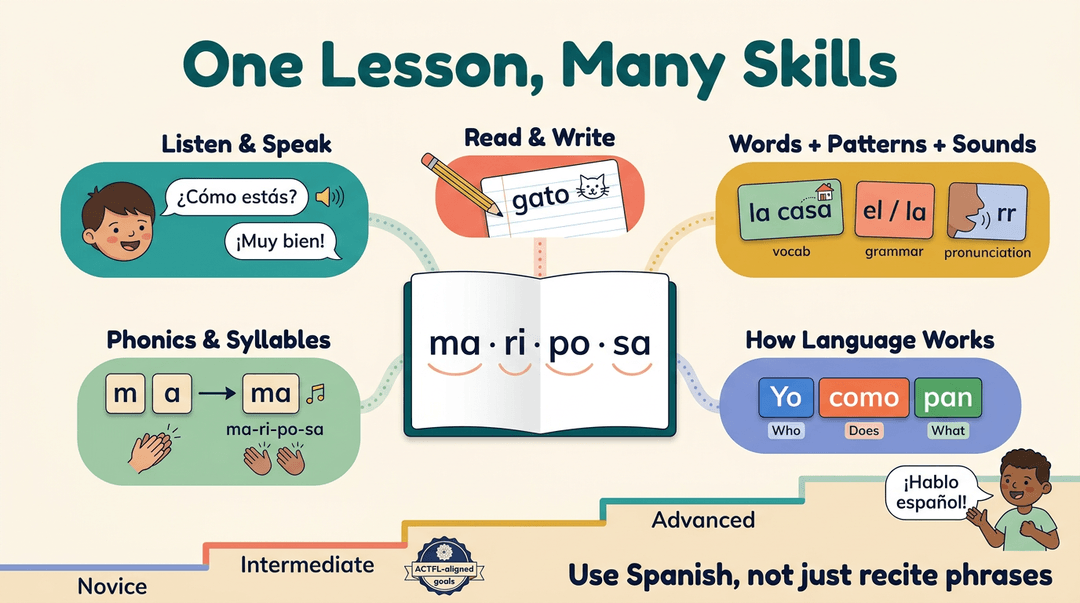
Each lesson builds several skills at once:
- Listening and speaking: learners hear Spanish and answer out loud.
- Reading and writing: learners read new words and write their own.
- Vocabulary, grammar, and pronunciation: new words arrive with the patterns and sounds that make them usable.
- Phonics and syllables: learners link sounds to letters and break words into syllables.
- How language works: lessons explain the structure behind sentences.
Proficiency goals by level follow ACTFL (American Council on the Teaching of Foreign Languages) guidelines, so you'll know what learners should be able to do by each stage.
The aim is bilingual development: learners who can use Spanish, not just recite a handful of phrases.
Learning through games, songs, and culture
Songs, games, and flashcards make repetition feel like play. Picture a reluctant student who perks up during a flashcard round, so practice feels like a game, not a chore.
Art and storytelling bring in Spanish and Latin American culture. Culture-focused lessons connect words to the people who speak them, so Spanish feels like a living language, not a school subject.
Interactive activities keep learners talking, not just listening.
Plan a Full Year of Homeschool Spanish
Use this guide to turn a Spanish curriculum into a year you can actually follow: one goal, a handful of units, a steady weekly rhythm, and simple proof of progress.
Set your goal and divide the year
Start with one sentence about what your child should be able to do by June. Keep it concrete enough to test.
Year goal: By June, my child can hold a two-minute conversation about family, food, and daily routine, and write a short paragraph on each.
Next, split the year into themed units. Here's a 36-week example with six units. Each unit gets four teaching weeks plus one review week, and six weeks stay open for sick days and holidays.
| Unit | Weeks | Theme | Unit target |
|---|---|---|---|
| 1 | 1 to 5 | Greetings and me | Introduce yourself aloud |
| 2 | 6 to 10 | Family and home | Describe your family |
| 3 | 11 to 15 | Food and shopping | Order a meal, ask prices |
| 4 | 16 to 20 | Daily routine | Describe your day |
| 5 | 21 to 25 | Town and travel | Ask for directions |
| 6 | 26 to 30 | Past events | Tell what you did last weekend |
Weeks 31 to 36 are your flex time. Use them to catch up, then revisit the weakest unit.
Run a simple weekly rhythm
Short, frequent practice beats one long session. Aim for about 15 minutes a day, adjusted to your child's age.
| Day | Focus | Example |
|---|---|---|
| Mon | New words, listening | Song or short audio, then repeat |
| Tue | Speaking | Describe a picture aloud |
| Wed | New structure | One grammar pattern, five sentences |
| Thu | Listening and speaking | Answer questions about a clip |
| Fri | Review day | Replay the week, redo what felt shaky |
Every day should include both listening and speaking, even if one gets only two minutes.
⚠️ Watch out: Don't fill all 36 weeks with new material. Skipped flex weeks turn one missed week into a pile-up.
Track progress as you go
Write two or three "I can" targets per unit before you start it. Then check them off at the end of the review week.
Unit 3 targets: I can order a meal in Spanish. I can ask how much something costs. I can name ten foods without help.
Proficiency checklist. Review it each unit, and confirm that your child can:
- Understand slow, simple speech on the unit's topic.
- Speak in full sentences without switching to English.
- Read a short passage and answer questions.
- Write a few connected sentences from memory.
Portfolio samples. Save one speaking and one writing sample per unit.
- A phone recording of a short conversation, labeled with the date.
- A paragraph written without notes.
Compare unit 1 with unit 6 in June. The growth will show you more than any single score.
Map your Spanish scope and sequence across the year with EMStudio's Curriculum Planner.
Formats and Materials Included
Each format in a Spanish curriculum does a different job. Here's how to evaluate curricula by what they include and how they reach your student.
Printed books, flashcards, and worksheets
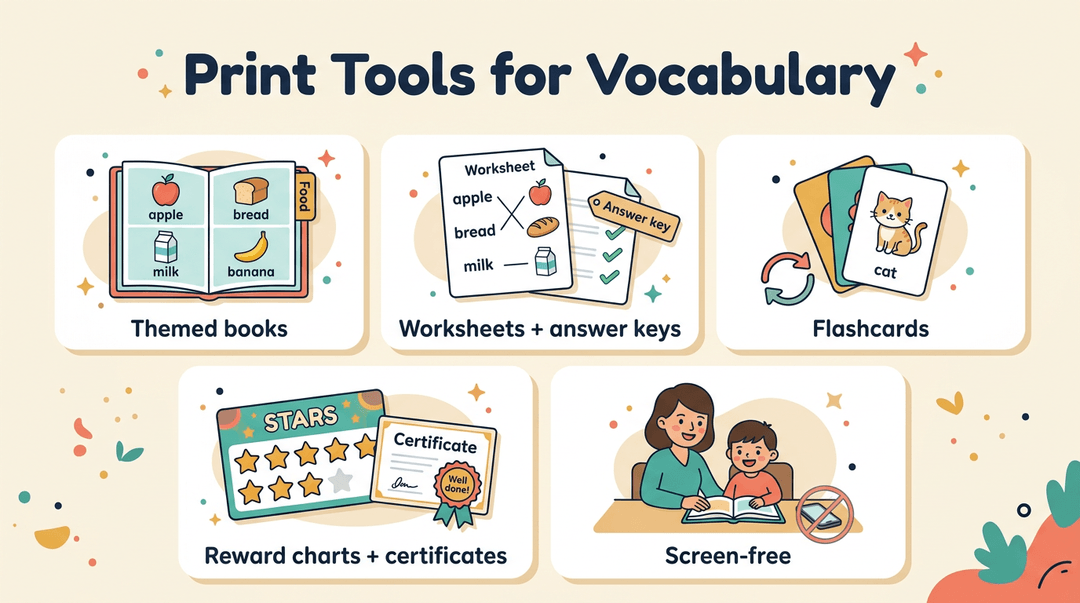
- Themed books group vocabulary by topic, like food or family, so each word has a context.
- Worksheets and answer keys let you check progress without guessing.
- Flashcards handle the repetition that vocabulary needs.
- Reward charts and certificates celebrate milestones.
- A screen-free curriculum suits families who want to step away from devices.
Audio files, videos, and online access
This is about hearing Spanish as well as reading it:
- MP3 audio files (downloadable sound files) let your student practice pronunciation in the car or during chores.
- QR codes (Quick Response codes) link a printed page to a song: scan it and sing along.
- Online video lessons take some of the teaching off your plate.
- 24/7 course access means lessons are ready whenever your schedule opens.
- Supplemental 5-minute lessons fit a quick review or a busy morning.
Picture a homeschool parent who doesn't speak Spanish yet. A five-minute lesson at breakfast gives the family a warm-up with no prep.
Lesson plans and support for teachers
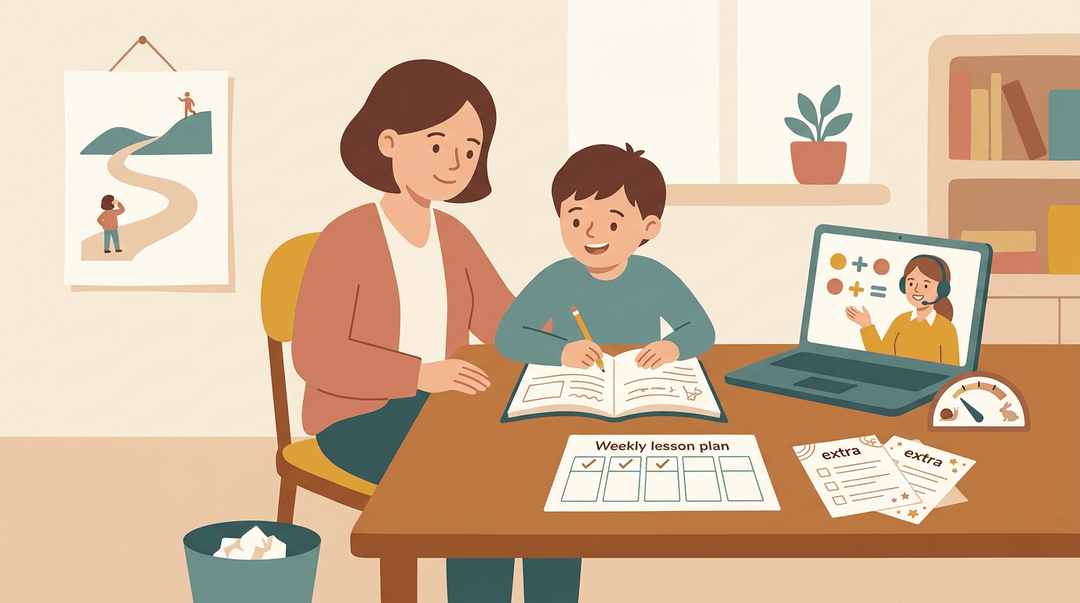
- Weekly lesson plans tell you what to teach, so you can skip the blank page.
- Bonus lessons give early finishers more practice.
- An adjustable pace lets you slow down or speed up as needed.
- Weekly pacing for short lessons keeps each session manageable.
- Customer support gives you someone to ask when something doesn't work.
- Live tutoring sessions add a real person to the mix.
Consider a parent whose child is stuck on one hard unit. Slowing the pace and adding live tutoring keeps the student moving without starting over. Less prep, more teaching.
What It Costs and How to Buy
Cost is the first question most homeschool families ask, and the answer depends on how you plan to use the program. Here's how to weigh your options and what protections come with them.
Pay per lesson, monthly, or by package
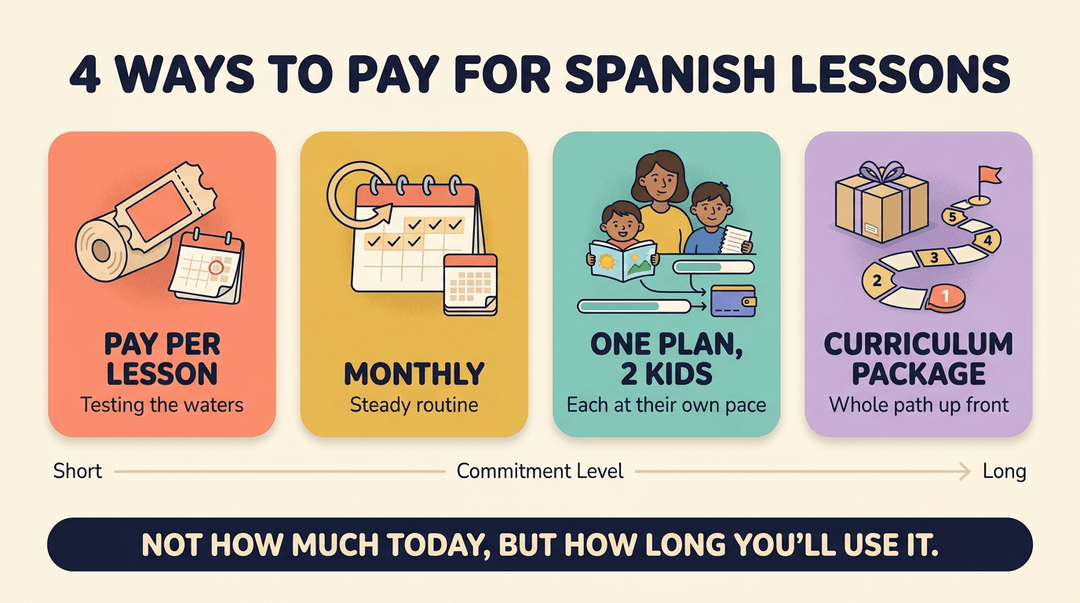
Here are the four ways you can pay:
- Pay-as-you-go lessons. Buy individual lessons as you need them, which suits a family testing the waters or filling a short gap.
- Monthly family subscription. Pay each month for ongoing access, which helps you keep a steady Spanish routine going.
- Multiple students, one subscription. Think of a homeschool parent with two children at different levels. One subscription can cover both, so each child works at their own pace under a single plan.
- Curriculum packages. Get a full sequence in one bundled purchase when you want the whole path mapped out up front.
The question isn't how much you'll pay today. It's how long you'll actually use it. Match the option to your week.
When it's available and what's guaranteed
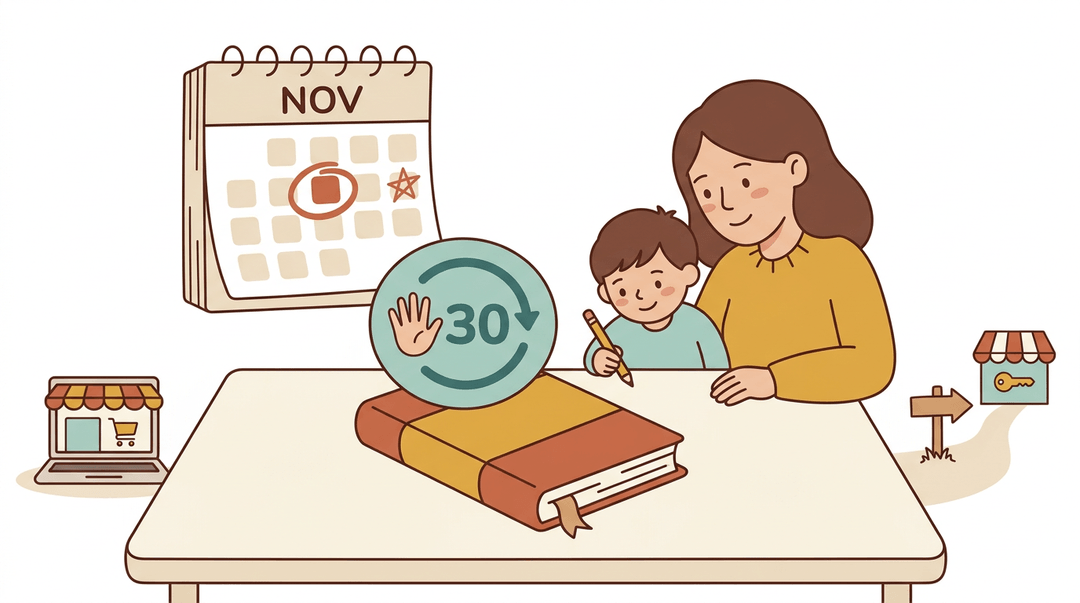
The 30-day money-back guarantee gives you 30 days to try the program with your own students. If it isn't the right fit, you can get your money back.
That's a low-risk way to see whether the approach works for your family before you commit to the whole program.
The book is available in November, so if you're mapping out a Spanish year, mark that date and plan your start around it. You can buy directly through the online store.
If you're interested in running the program as a business, there's also a franchise opportunity, which is a different path from buying for your own home or classroom.
Read the terms before you check out.
Why People Trust This Program
How do you know a Spanish program is worth your time and money? Start with what other people have experienced, then we'll look at who built the lessons.
Reviews, awards, and standards it meets
Reviews are proof, not promises.
NEO Homeschool Connections reports that Señora Stacko's courses have earned numerous positive reviews and testimonials, plus the 2025 Best of the Best Homeschool Award and a winning position in the 2026 Top 100 Educational Products list from HomeschoolAwards.com.
The program also meets national standards, which gives you a clear reference point when you're comparing options. It also appears in district vendor listings, so school systems, not just homeschool families, can find it.
Think of a homeschool parent with three Spanish programs open in separate browser tabs. Awards, standards, and vendor listings help narrow the field before anyone spends a dime.

The teacher's degree and classroom experience
Behind every curriculum is a person, and that person's background shapes the lessons. The teacher behind this program holds an education degree, which means formal training in how students learn.
So it's less about what the sales page promises and more about who is doing the teaching.
Public school teaching experience adds practical grounding. Time in front of a real class teaches what keeps students engaged and what loses them. Theory doesn't manage a room.
Reach is another signal. Marisol Rodero, founder of Nobis Pacem, an accredited private school and homeschooling curriculum provider, says she has helped thousands of families access high-quality, flexible, and culturally relevant education.
Choosing a Spanish homeschool curriculum really comes down to matching the approach, level, materials, and cost to your family. When those pieces fit together, planning the year gets simpler and your learner has a clear path forward.
Ready to map out your year? Check out Curriculum & Standards to plan units, lessons, and standards across the whole school year.
References
- Pilot test of the Hablemos Juntos Tier 2 academic language curriculum for Spanish-speaking preschoolers — sciencedirect.com
- NEO Homeschool Spotlight: Meet Clara Stacko {Simply Teaching Spanish} — neohomeschoolconnections.com (2026)
- Marisol Rodero — exa.ai (2026)