Unpacking Standards: A Complete Guide to the Process

Jump to section
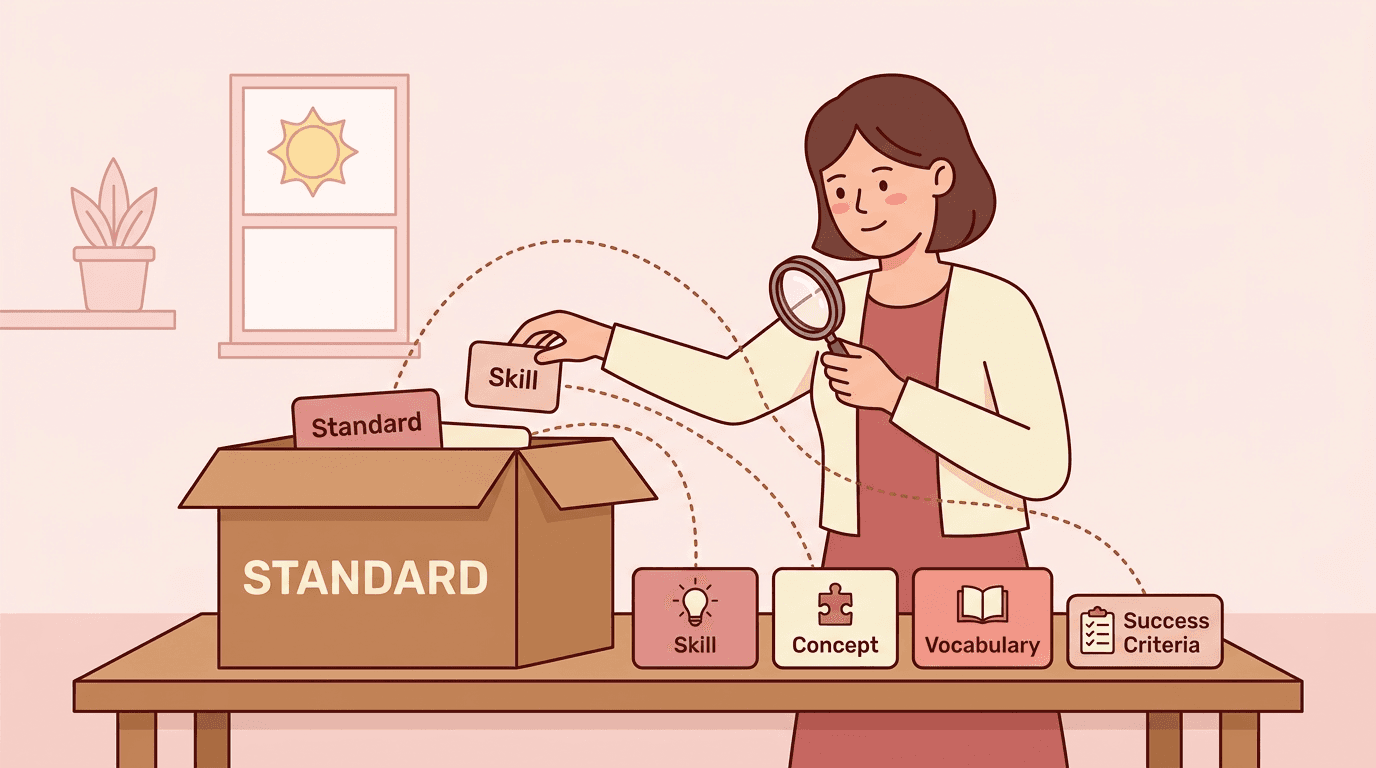
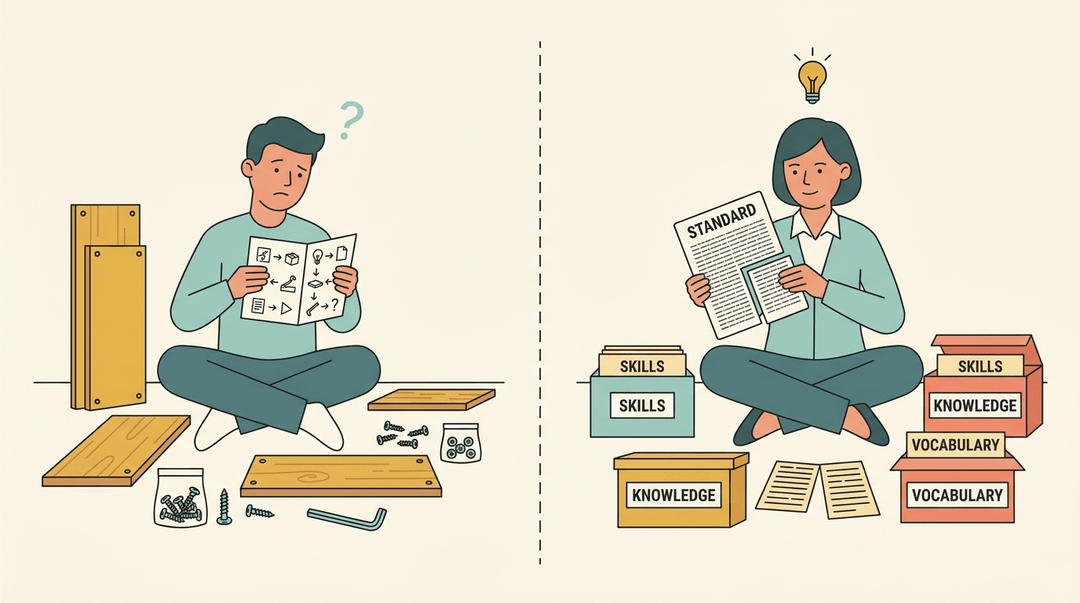
Flat-pack furniture always comes with a sheet of tiny icons and no real sentences. You have to translate those pictures into actual steps before anything gets built.
Standards work the same way: dense, compressed, and not much use until someone breaks them down.
That's unpacking standards: taking a standard apart to find the skills, knowledge, and vocabulary hiding inside it. This post walks through the process, the rigor frameworks behind it, and a checklist you can reuse every time.
Why Unpacking Standards Matters
Ever read a standard three times and still felt unsure what to actually teach on Monday? That's the gap unpacking standards closes.
Unpacking standards means breaking a dense, often jargon-heavy standard into plain-language learning targets: what students need to know, understand, and be able to do before you ever open a lesson plan.
What unpacking actually accomplishes
Once you've broken a standard down, you know it inside out, not just its wording but its intent.
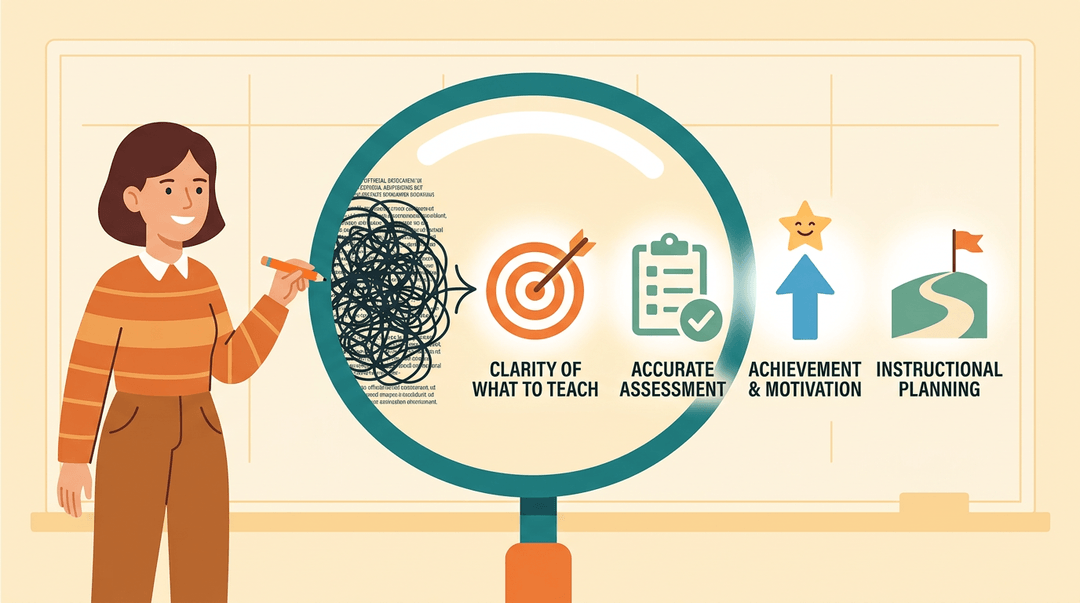
A study on setting clear learning targets found that teachers must unpack standards and develop explicit learning targets to make rigorous standards accessible to students. That same clarity:
- Clarifies what to teach and what's just optional filler.
- Supports accurate assessment, because you're measuring the actual target, not a guess at it.
- Increases achievement and motivation, since students can see exactly what success looks like.
- Becomes the basis for instructional planning, giving every lesson a clear destination before you build the route there.
What is the 70/30 rule in teaching?
The 70/30 rule is a guideline for balancing teacher talk with student talk. As researchers studying teacher-centered versus learner-centered classrooms put it, students should speak for roughly 70% of a lesson while teachers speak for about 30%.
Unpacking standards makes that ratio realistic: once you know exactly what to teach, you spend less time explaining and more time letting students work.
The research behind this shift draws on Marzano's work and the McREL framework, plus Wiggins and McTighe's Understanding by Design framework, all pointing toward the same idea: clarity up front buys active learning later.
The Core Process of Unpacking Standards
Unpacking a standard starts with one question: what is it actually asking students to know and do? The process below breaks that question into a few repeatable moves you can run on any standard.
Separating nouns and verbs in standards
Start by selecting one priority standard. Trying to unpack everything at once is the most common mistake teachers make, and it buries the few standards that matter most.
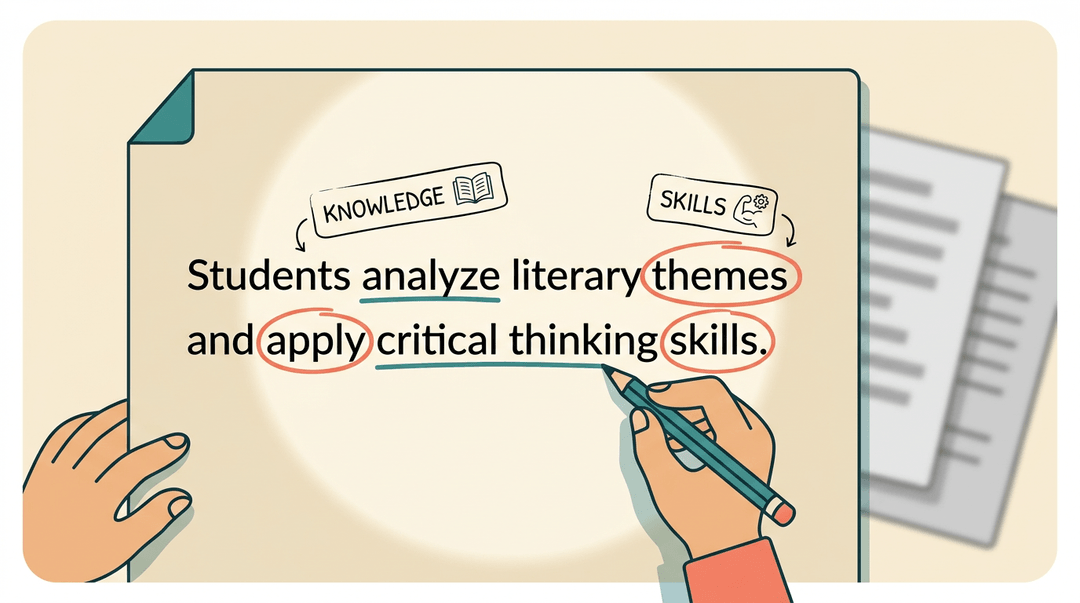
Read your standard slowly and mark it up: underline every noun or concept, then circle or capitalize each verb. The nouns point to the knowledge students need; the verbs point to the skills they'll use to prove it.
Many standards bundle several ideas into one sentence, so separate those elements before moving on.
What are unpacking learning competencies?
Unpacking learning competencies means sorting what you've marked into two buckets. Declarative knowledge is the vocabulary, facts, and concepts students must know.
Procedural knowledge is the skills, thinking, communicating, researching, that they must be able to do. Nearly every standard is asking for both at once, and missing either half is another common mistake worth avoiding.
Walking through the unpacking steps
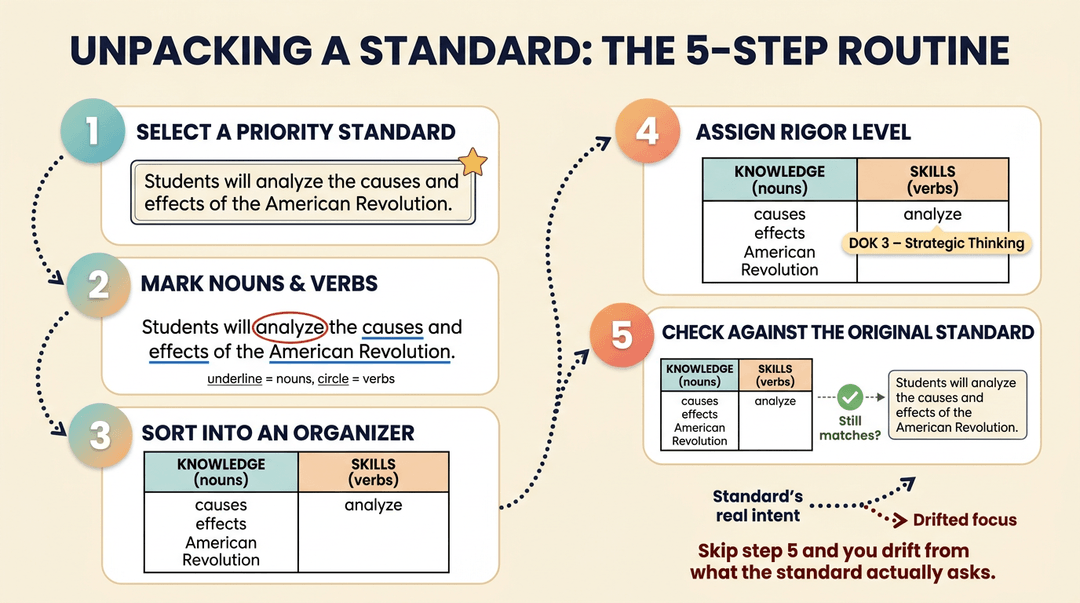
Put it together as a short routine:
- Select a priority standard.
- Underline nouns and circle verbs.
- Build a simple graphic organizer that separates knowledge from skills.
- Assign a rigor level to each piece.
- Double-check that your organizer still matches the standard's original intent.
Skip that last step and it's easy to drift from what the standard actually asks.
Your 5-step Checklist for Unpacking Standards
Here's the whole routine on one page: five steps to run with any standard, a grade-level adjustment guide, and a quick check before you teach. Pin it next to your plan book.
The five steps
- Pick one priority standard. Don't unpack everything.
- Choose the standard that's assessed, builds on prior grades, and feeds next year's work.
- Highlight the nouns and verbs. Circle verbs, underline nouns.
- Example: "Compare two fractions with different denominators" becomes circle compare, underline fractions and denominators.
- Sort knowledge from skills. Nouns tell you what students must know; verbs tell you what they must do.
- Jot it as two columns: Know: fractions, denominators. Do: compare.
- Assign a DOK or Bloom's level. Let the verb set the rigor.
- "Compare and justify" lands at DOK 2 or Bloom's Analyze; "list" would only be DOK 1.
- Draft an "I can" statement. Translate the standard into student language.
Example "I can" statement: "I can compare two fractions with different denominators and explain which one is larger."
⚠️ Watch out: if your "I can" statement uses a weaker verb than the standard (❌ "I can identify fractions" vs. ✅ "I can compare fractions"), you've quietly lowered the rigor. Match verb to verb.
Adjust for your grade level
The five steps don't change; the size of the bite does. Find your band and shape the unpacking to match.
| Grade band | What to unpack | What it looks like |
|---|---|---|
| Elementary | A single verb at a time | One "I can" per verb: compare today, justify next week |
| Middle school | A two-skill blend | One statement pairing verbs: analyze and cite evidence |
| High school | Multi-step rigor | A chain of "I can" statements building to the full standard |
Before you teach, confirm
This is the verification pass, not a to-do list. Run it after planning, before the lesson:
- It matches your planned assessment. The verb in your "I can" statement is the verb students perform on the task. If they'll compare on the exit ticket, the statement says compare.
- Students can restate the goal. Ask two students to say the "I can" in their own words. If they can't, simplify the language, not the rigor.
- You can justify the rigor level. Finish this sentence aloud: "This is DOK 2 because students must..." If you can't, revisit step 4.
Once a standard passes all three checks, it's ready to teach, and worth keeping: save and sequence your unpacked standards directly inside EMStudio's curriculum planner so next year starts from a finished library, not a blank page.
Frameworks for Gauging Rigor
Once you've pulled the verbs and nouns out of a standard, you still need a way to judge how deep it actually goes. Two frameworks do that heavy lifting, and knowing both gives you a sharper read on any standard you unpack.
Using Bloom's taxonomy to gauge rigor
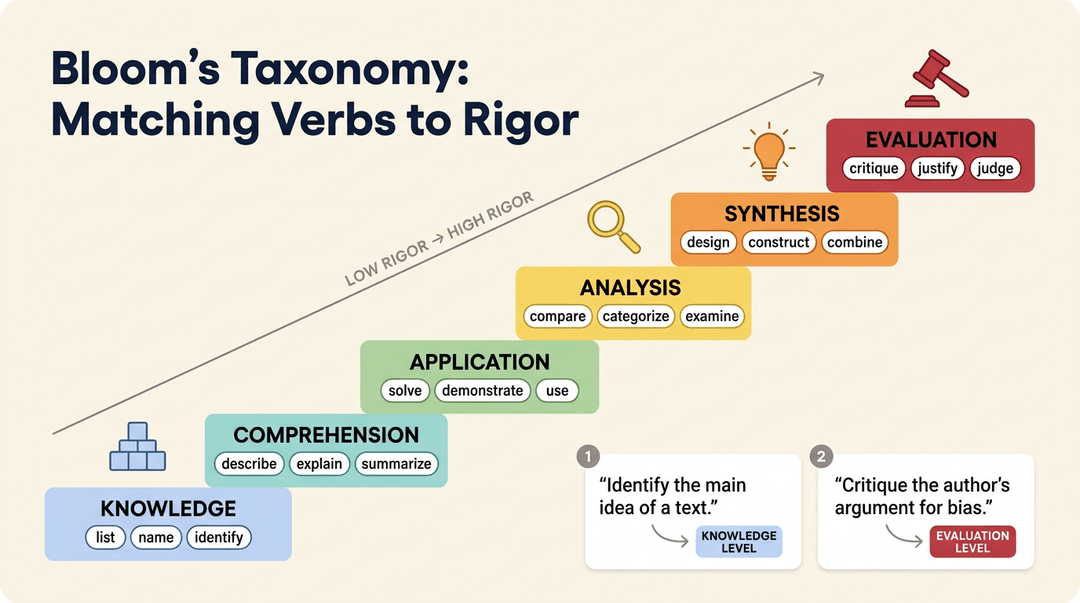
Bloom's taxonomy sorts thinking into six levels, from simple recall up to full evaluation:
- Knowledge
- Comprehension
- Application
- Analysis
- Synthesis
- Evaluation
Each level has its own verb list, so when a standard says "identify," you're in knowledge territory; "critique" or "justify" lands you up in evaluation.
Matching a standard's verb to a level tells you how rigorous the skill really is, and it's the first move in assigning a rigor level to anything you're about to teach.
What Depth of Knowledge levels mean
Depth of Knowledge (DOK), developed by Norman Webb, measures something slightly different: not the type of thinking, but how deeply a student has to engage with it.
DOK runs from recall, through skill and concept application, to strategic thinking and extended thinking. Pairing DOK with Bloom's gives you a fuller picture: a standard might sit at Bloom's
Getting to Big Ideas and Essential Questions
Once a standard is unpacked into its parts, the real payoff is turning those parts into something students can actually hold onto. That's where big ideas and essential questions come in.
Finding the big idea in a standard
The big idea is the key understanding you want students to walk away with, the takeaway that outlasts the lesson itself.
It's derived directly from the unwrapped standard: once you've broken a standard into its skills and concepts, ask yourself what single understanding ties them together.
For example, a fifth-grade teacher unpacking a standard on ecosystems might land on the big idea that living things depend on each other to survive.
Rather than handing that sentence to students, let them discover it on their own through the lesson's tasks. It sticks better that way.
This is also a natural point to link your unpacked standard to a proficiency scale: the big idea often sits at the "proficient" level, with simpler facts below it and extended application above.

Using essential questions to engage students
Essential questions are the open-ended prompts you pose at the start of a unit, before students have the answers. They're meant to stay unresolved for a while, pulling students through the unit as they build toward the big idea.
Using the ecosystems example, a teacher might open with: "What happens when one part of a habitat disappears?" Students won't fully answer that on day one, and that's the point.
By the unit's end, their answer should echo the big idea you identified, proof that the unpacking actually translated into real understanding.
Sharing Learning Goals with Students
Unpacking a standard only pays off once students know what they're aiming for, too. Once you've broken a standard into its parts, the next job is turning that work outward: sharing it with the class in language they can actually use.
Writing clear 'I can' statements
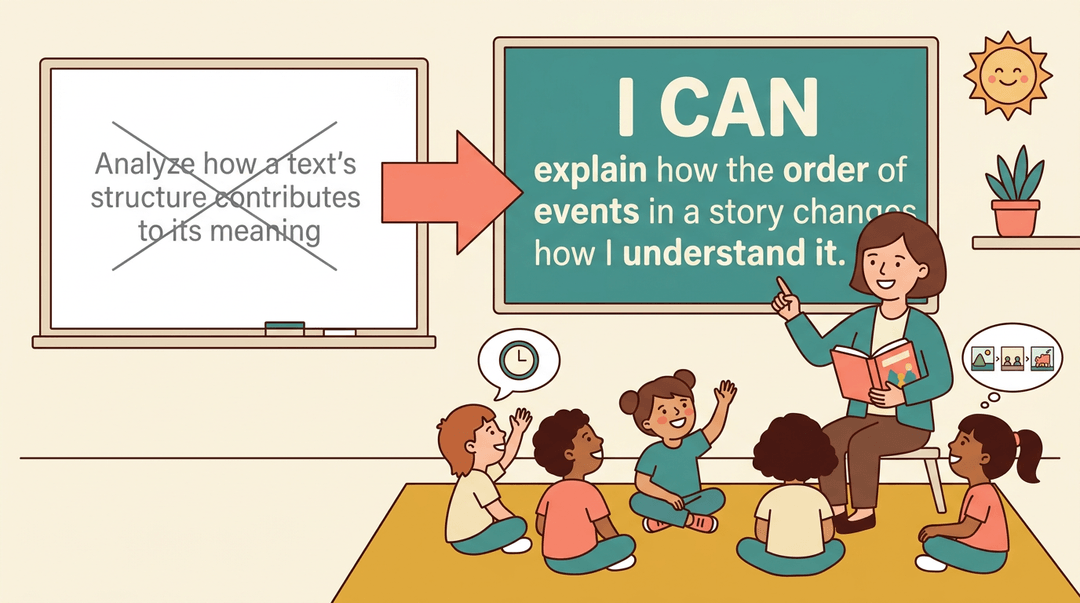
The simplest way to share a goal is to rewrite it as an "I can" statement: a first-person sentence that names exactly what a student will be able to do.
A standard like "analyze how a text's structure contributes to its meaning" might become "I can explain how the order of events in a story changes how I understand it." Post it somewhere students will see it before the lesson starts, not after.
This isn't just a nice gesture.
According to a 2026 panel study by Boitcov, Adamovich, and colleagues in Psychological Science and Education, specific and sufficiently challenging goals sharpen students' focus, boost their effort, and push them toward better learning strategies.
Clear "I can" statements, in other words, can move achievement and motivation at the same time.
Consider a fourth-grade teacher who reads the day's "I can" statement aloud before diving into the lesson. Students know the target going in, and they can check their own progress against it as the class moves along.
Better yet, unpack the standard with students directly. Ask them, "What would it look like if you could do this?" and you can build the statement together. When students help write the goal, they're far more likely to own it.
Visual Tools That Organize Standards
Once you've unpacked a standard into its parts, you still need a way to hold those parts in front of students. Visual tools do that work, turning dense language into something learners can actually see and use.
Mapping standards with graphic organizers
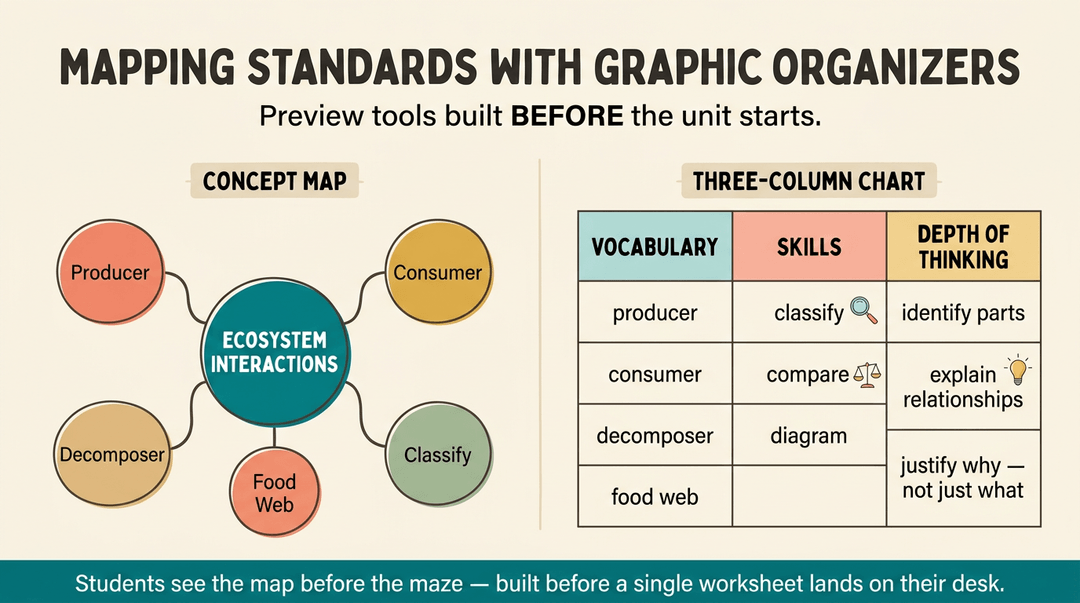
A graphic organizer can be as simple as an outline or bulleted list, or as structured as a chart that separates what students need to know from what they need to do.
Consider a middle school teacher building a concept map that places the standard's big idea at the center, with related vocabulary and skills branching out from it. A three-column chart works well too:
- One column for key vocabulary
- One for skills
- One for the depth of thinking expected
Built before the unit starts, this becomes a teacher-made preview tool, giving students a visual display of the concepts and skills they're about to meet before a single worksheet lands on their desk.
Building a word wall with students
A word wall works best when students build it, not when you hand it to them finished.
For example, a fourth-grade teacher might pull potential vocabulary straight from the standard and ask the class to sort it: which words are relevant to the concept at hand, and which are just noise. That sorting step does real work.
It pushes students to identify the main concepts themselves, turning the wall into a conceptual framework tool they helped construct, not just a decoration on the bulletin board.
What Are Examples of Content Standards?
Content standards look different depending on the subject, but they all share one job: naming what students should know and be able to do. Here's how that plays out across social studies, English language arts (ELA), and math:
A social studies standard unpacked
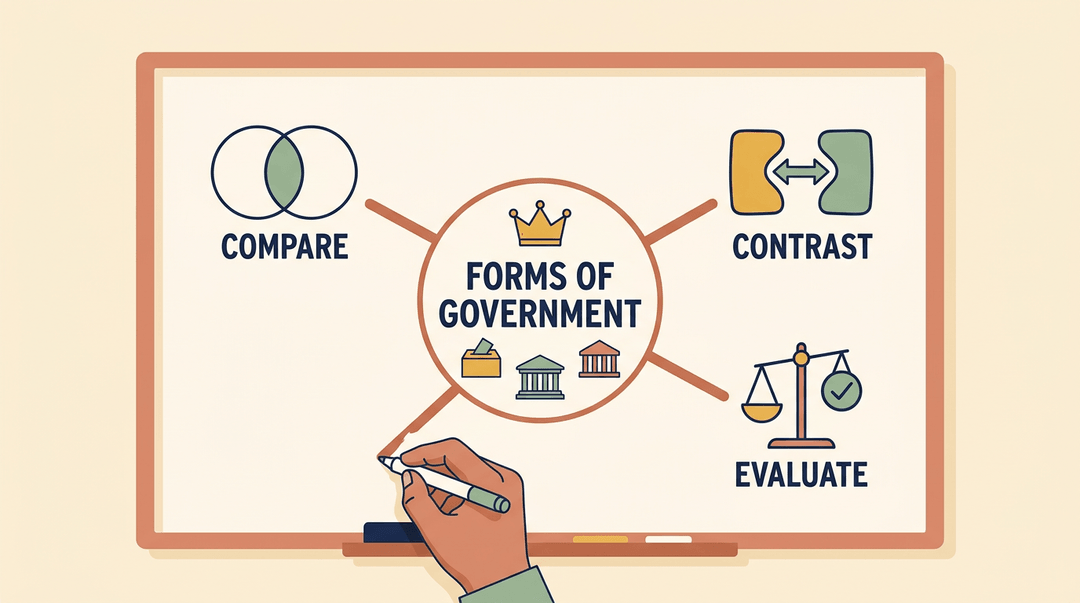
Consider a standard asking students to compare, contrast, and evaluate forms of government. Unpacking it means pulling the skill verbs apart from the content:
- compare and contrast (spotting similarities and differences)
- evaluate (judging which system works and why)
- forms of government (democracy, monarchy, and the rest) as the subject matter itself
For example, a civics teacher might sketch a concept map with "forms of government" at the center and a branch for each verb, so students see exactly what move they're making at each step.
An ELA reading standard unpacked
Take RI.6.6, a standard that asks students to determine an author's point of view and explain how the author conveys it, often tied to persuasive techniques like loaded language or appeals to emotion.
Unpacking separates the skill (determine, analyze) from the content (point of view, persuasive technique), so a sixth-grade teacher can teach each piece on its own before asking students to combine them in a single passage.
A math standard unpacked
A standard on reading and interpreting data displays, bar graphs or line plots, pairs a concrete skill with concrete content, much like a place value standard covering addition and subtraction with regrouping.
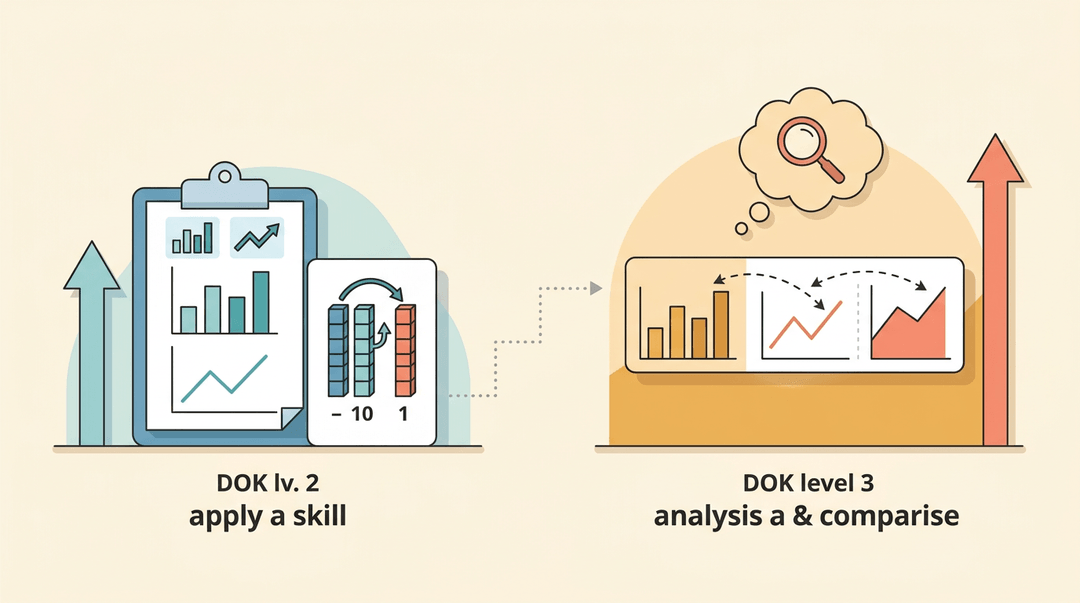
Both follow the same structure, but not the same depth: the data display standard often sits at depth-of-knowledge (DOK) level 2, applying a skill, while asking students to compare trends across multiple displays can push that same standard into DOK level 3.
How Memory Affects Learning
Unpacking a standard means asking what students need to remember just as much as what they need to do. That starts with understanding how memory actually works.
The different types of memory
Not all knowledge lives in the brain the same way.
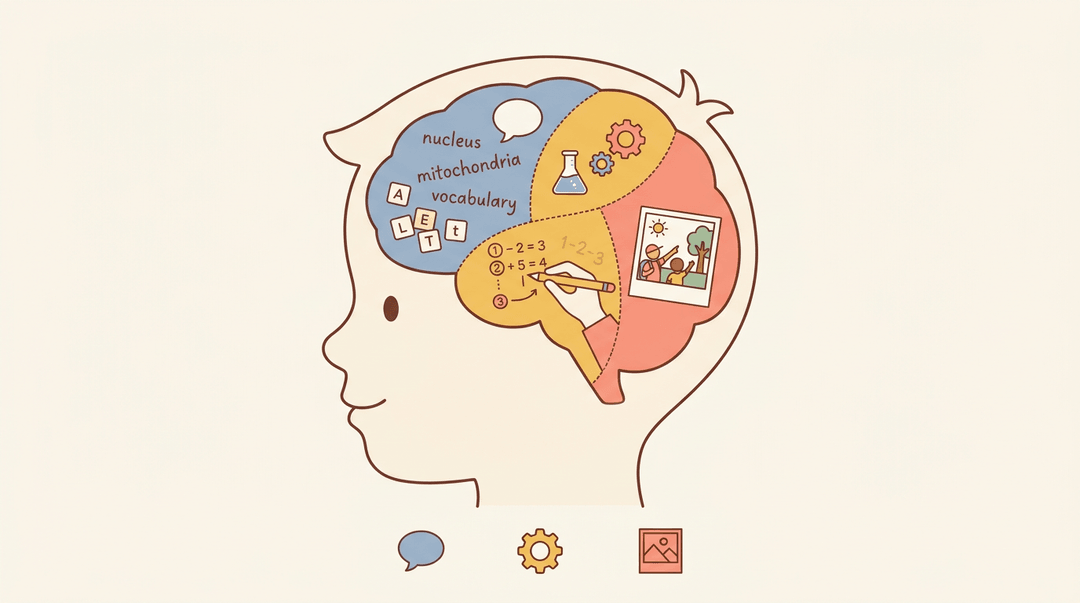
- Semantic memory is language-based: it's how students hold onto facts, vocabulary, and concepts. As described in a review in Nature Reviews Neuroscience, semantic memory covers "people's general conceptual knowledge about objects and events," including the words we use to describe them. A student naming the parts of a cell is drawing on semantic memory.
- Procedural memory is hands-on: think of a student solving a multi-step equation or running a lab protocol without consciously narrating each move.
- Episodic memory is context-based, tied to a specific moment: a field trip, a class debate, the day a science demo went sideways.
Students also differ in memory capacity. A fourth-grade teacher juggling a unit on fractions will see some students hold five new terms with ease, while others need the list trimmed to two or three.
How knowledge networks form in memory
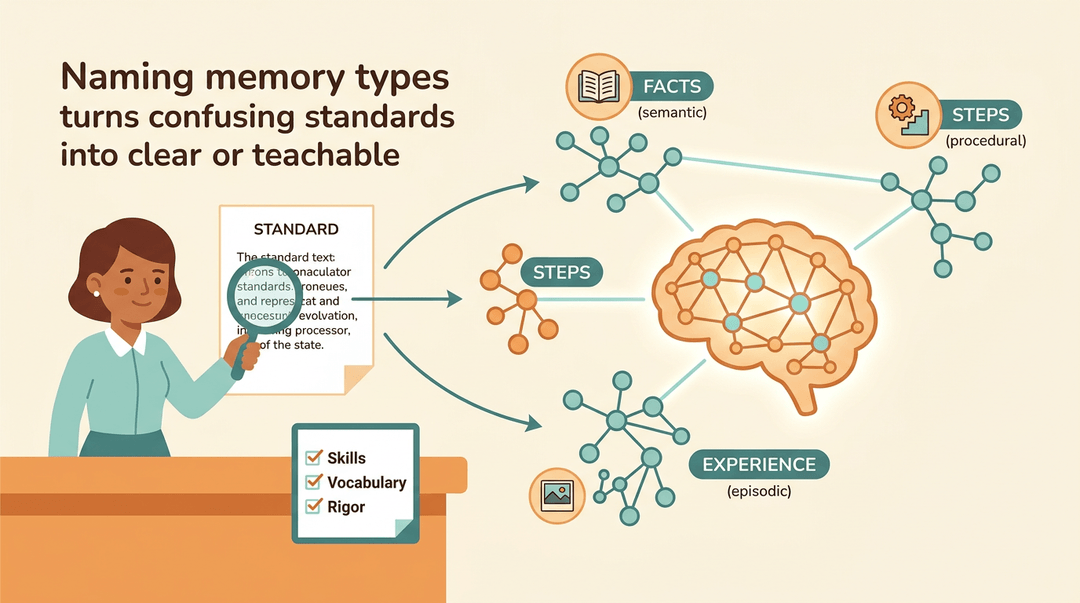
Memory rarely works in isolation. The Kris Nei model suggests knowledge gets stored as connected networks, linking semantic facts, procedural steps, and episodic context together.
When a teacher unpacks a standard, naming each memory type it touches helps build those networks on purpose, rather than leaving them to chance.
Unpacking standards turns a dense sentence into something you can actually teach: clear skills, clear vocabulary, and a clear sense of how rigorous the work needs to get. Once you've built that habit, lesson planning stops feeling like guesswork.
Ready to put this into practice? Check out our Curriculum Planning feature to plan units, lessons, and standards across your whole school year.
References
- Accuracy of learning goals and academic achievement: a panel study in an online course // Psychological Science and Education — 2026. Vol. 31, no. 2 — psyjournals.ru (2026)
- TEACHER TALKING TIME VS. STUDENT TALKING TIME: MOVING FROM TEACHER-CENTERED CLASSROOM TO LEARNER-CENTERED CLASSROOM — exa.ai (2019)
- Setting Clear Learning Targets to Guide Instruction for All Students — journals.sagepub.com
- Where do you know what you know? The representation of semantic knowledge in the human brain — nature.com
- Map it Out: A School Improvement Plan — exa.ai (2020)
- Pre-service teachers’ application of understanding by design in lesson planning — exa.ai (2020)
- Understanding by Design: A Framework for Effecting Curricular Development and Assessment — pmc.ncbi.nlm.nih.gov (2007)
- M1-Slide_22_DOK_Hess_Cognitive_Rigor — static.pdesas.org
Frequently asked questions
What is unpacking the standards?
Unpacking the standards means breaking a dense standard into its essential skills, knowledge, concepts, and vocabulary. Teachers identify the nouns students need to know and the verbs students need to perform, then turn them into clear learning targets.
What is the 70/30 rule in teaching?
The 70/30 rule is a guideline that students should speak or participate for roughly 70% of a lesson while the teacher speaks for about 30%. It encourages active, learner-centered instruction rather than primarily teacher-led explanation.
What are unpacking learning competencies?
Unpacking learning competencies means separating the knowledge students must acquire from the skills they must demonstrate. Declarative knowledge includes facts, vocabulary, and concepts, while procedural knowledge includes actions such as thinking, communicating, researching, or applying a process.
What are examples of content standards?
Examples of content standards include comparing and evaluating forms of government in social studies, determining an author's point of view in ELA, and reading or interpreting data displays in math. They specify what students should know and be able to do within a subject area.