Remedial Education: A Complete Guide to Filling Skill Gaps

Jump to section
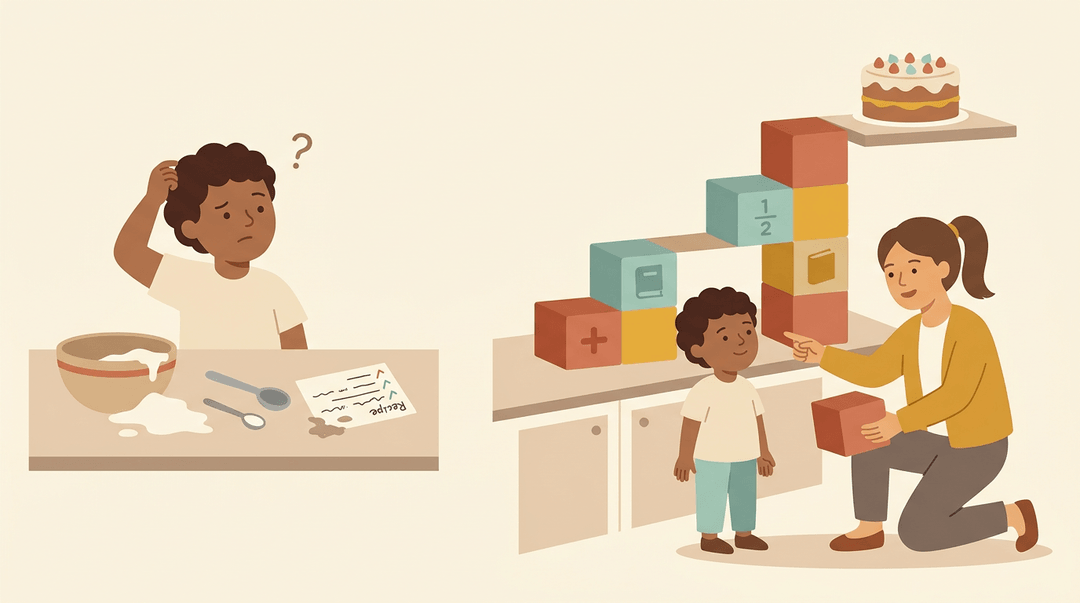
Picture a student who's handed a recipe they've never made and can't tell a tablespoon from a teaspoon. They manage the first few steps, then everything falls apart.
Many learners hit that same wall in math or reading when a skill from last year quietly blocks this year's lesson.
That's where remedial education comes in. It's targeted instruction that helps students fill gaps in skills they haven't yet mastered, so they can rejoin grade-level work.
Here, we'll cover who needs it, how teachers deliver it, and how to plan lessons that match your standards.
Who Needs Remedial Education and Why
Remedial support serves students who are behind, and the numbers show how many aren't ready yet.
What are remedial studies?
Remedial studies give students extra help to meet the learning objectives they've missed, tailored to their needs. Most target literacy and math.
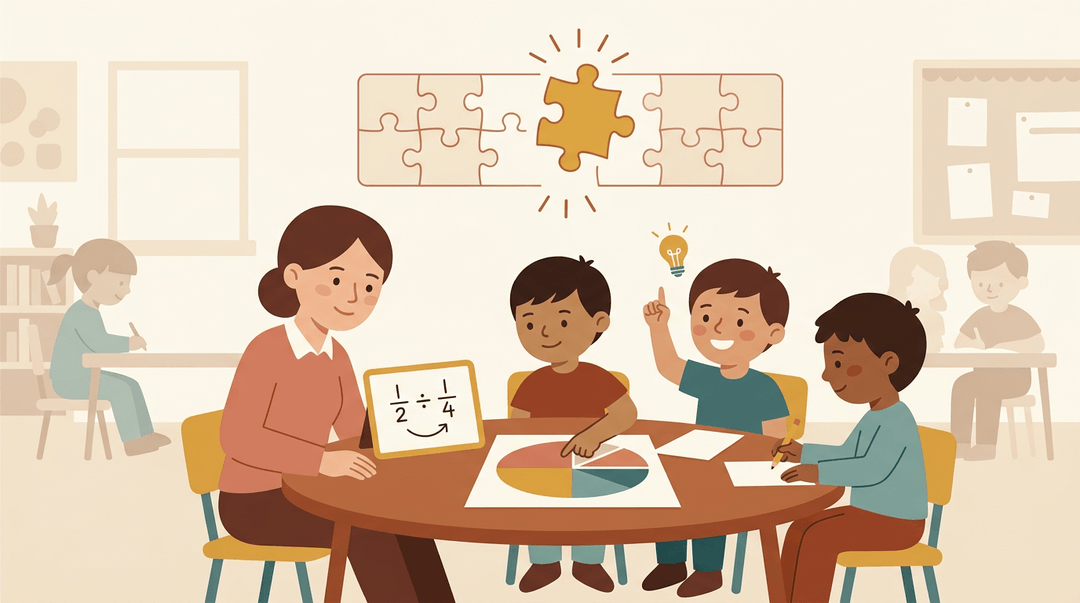
Think of a fifth-grade teacher with three students who can't yet divide fractions. A small-group lesson on that one skill helps them catch up.
Remedial help is less about repeating the lesson and more about closing the specific gap.
Which students qualify and where cutoffs fall
Several groups qualify:
- Special needs or learning disabilities. These students need individualized support.
- Students below the 35th percentile. One research analysis defined risk as performance below the 35th percentile at the start of fourth grade on a broad calculations assessment.
- Pandemic learning loss. Students who fell behind during the pandemic need catch-up help.
- The lowest-achieving students. They have the furthest to go and are the most critical to reach.
How many students are not ready
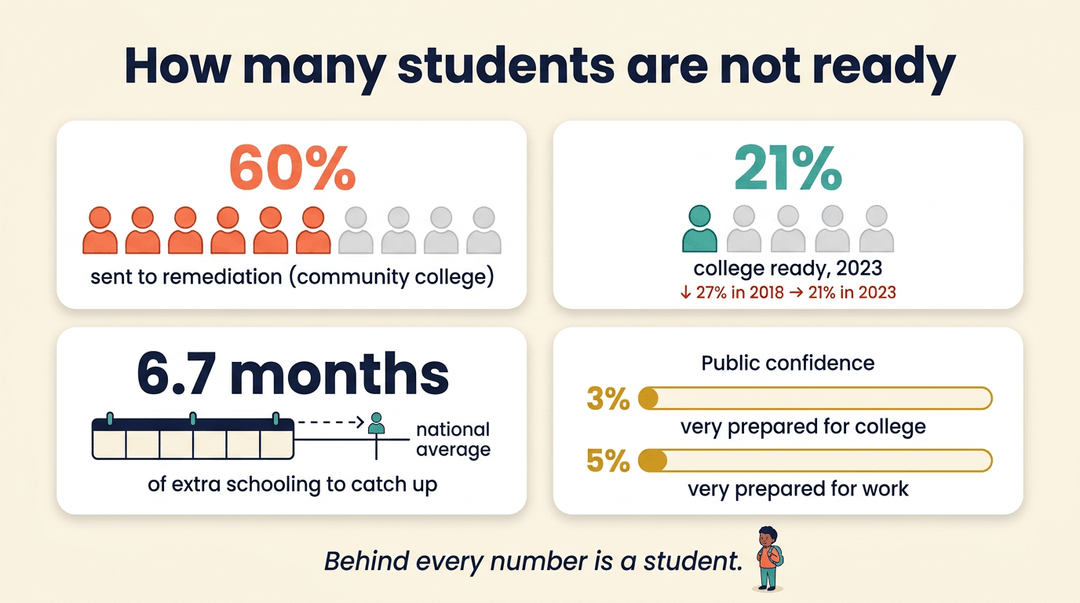
- Many freshmen need college remediation. Nationwide, 60% of recent high school graduates entering community college are assigned to remediation, according to a report on community college placement.
- Readiness rates are low. According to ACT's college readiness data, only one of five students (21 percent) were considered college ready in 2023, down from 27 percent in 2018.
- Students fell months behind after the pandemic. A 2022-23 research brief notes that 6.7 additional months of schooling would return students to levels still about a third of a standard deviation below the national average.
- The public lacks confidence in graduates. According to Gallup, only 3% of Americans say high school graduates are "very prepared" for college and 5% for the workplace.
Behind every number is a student.
Ways Teachers Deliver Remedial Support
Remedial help comes in four forms: how you group students, how you teach, what software supports you, and which named programs you use. Let your diagnosis pick the format.
One-on-one and small group lessons
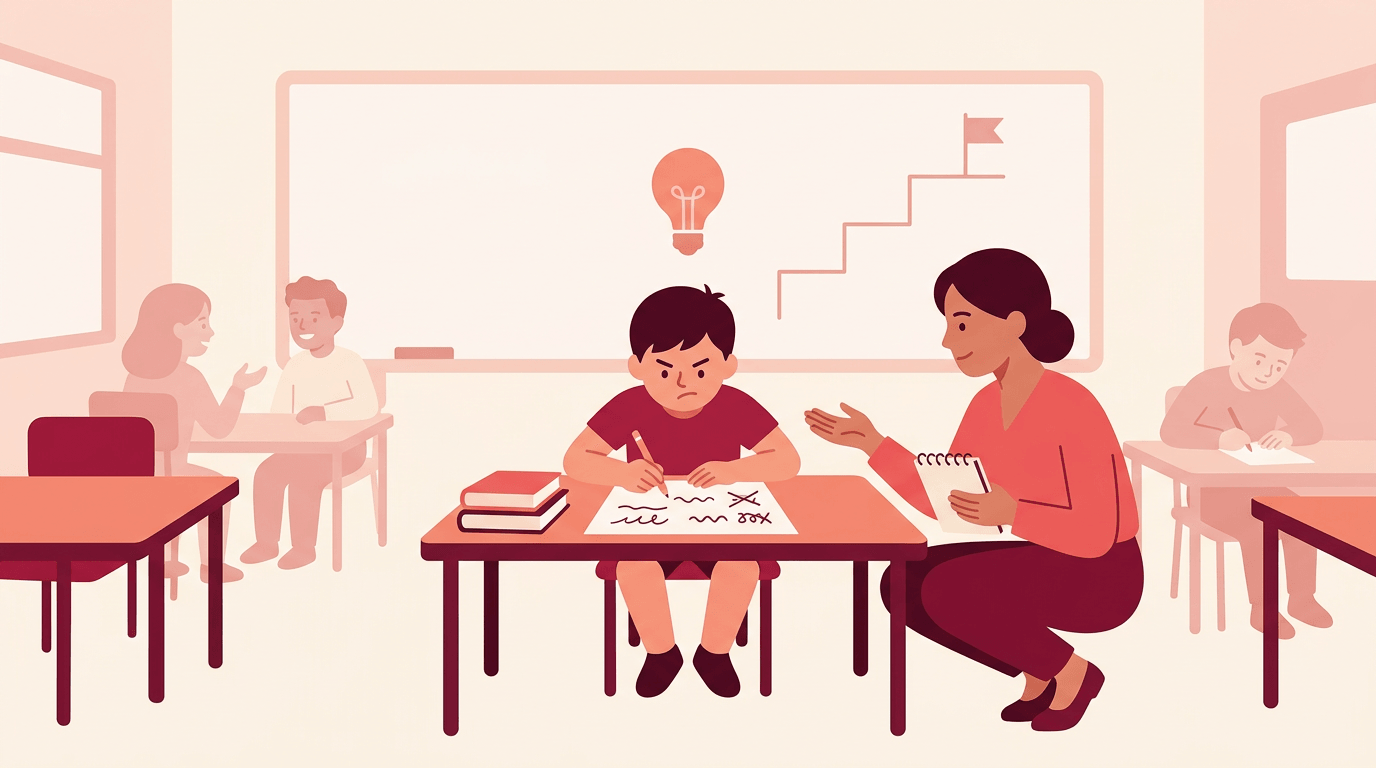
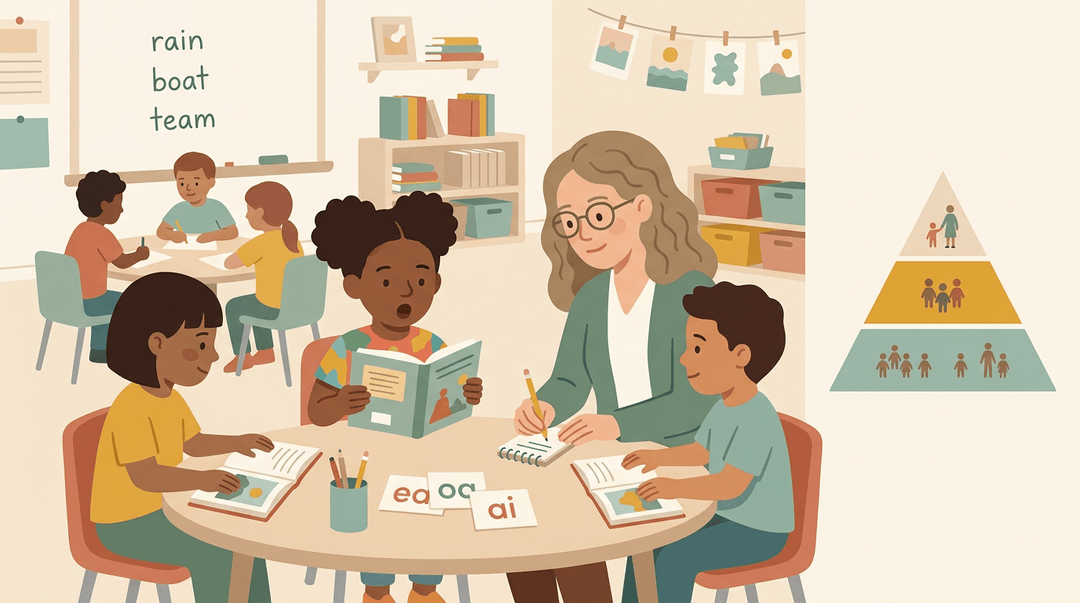
One-on-one teaching targets exactly the skill one student is missing. Small group instruction pairs students who share a gap. Consider a fourth-grade teacher who notices a few students stumbling on vowel teams.
She pulls them into a small group, listens to each one read aloud, and adjusts tomorrow's lesson to what she hears.
Personalized skill-level lessons group students by where they are, not by grade. Private tutoring adds one-on-one time outside class, though not every student can access it.
Many schools frame this within a Response to Intervention (RTI) model, part of a Multi-Tiered System of Support (MTSS). Tier 1 is whole-class instruction, Tier 2 adds small-group help, and Tier 3 offers the most intensive support.
Teaching methods that help struggling learners
The format sets up the lesson, but how you teach it decides whether the skill sticks.
Multisensory techniques engage sight, sound, touch, and movement at once, so a letter sound is seen, spoken, traced, and tapped. Orton-Gillingham is a structured, explicit phonics approach designed for students with dyslexia.
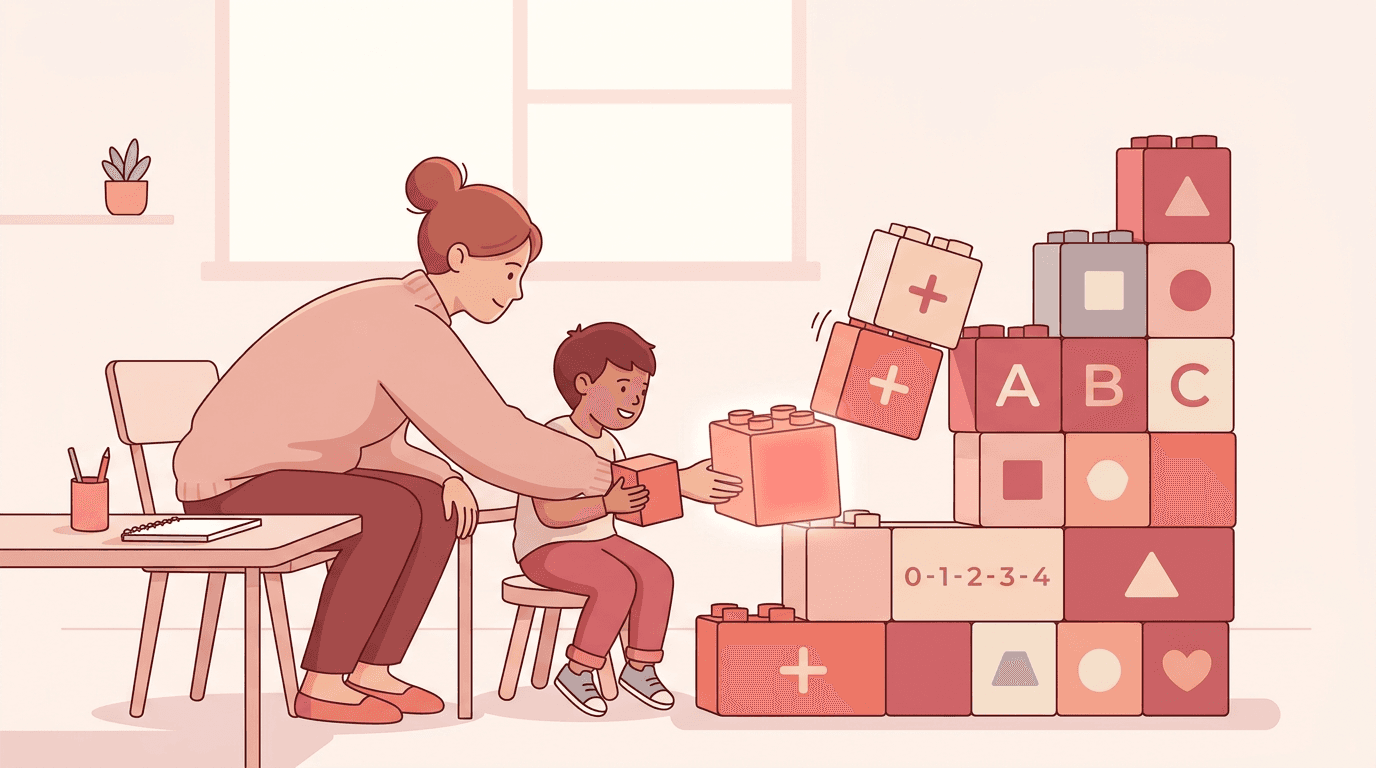
Simplifying difficult concepts means breaking a big idea into smaller steps, each mastered before the next.
Extra practice time helps most when it's targeted, not just more. Tie each block to the gap your diagnosis revealed, or students will repeat the same mistakes.
Using software and assistive tech
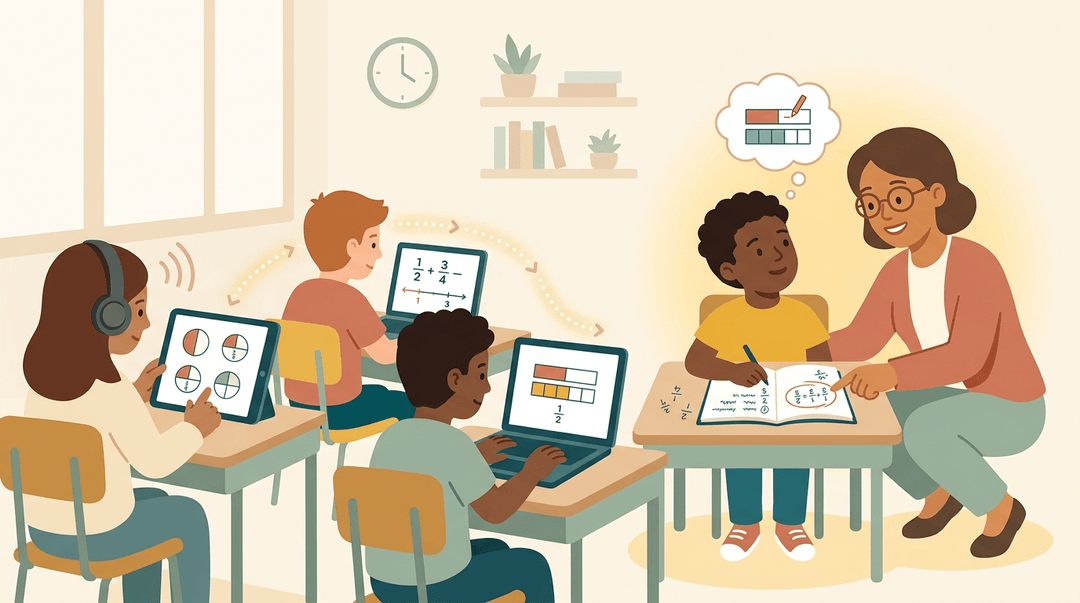
Adaptive learning software adjusts difficulty based on each student's responses. Machine learning personalization uses answer patterns to pick each next task.
Text-to-speech and assistive tech read text aloud, so struggling readers can follow content while you build the skill.
A practical setup is hybrid software plus teacher. Picture a seventh-grade math teacher who lets software handle fraction practice while she checks in with students whose errors point to a deeper misunderstanding.
The software handles repetition; she handles judgment calls.
Named programs for reading and math
You'll see labels like:
- Reading Skills and Strategies
- Math Skills and Strategies
- structured literacy programs built for students with dyslexia
Placement by percentile sorts students by where their scores fall compared with peers. Match the program to the gap, not the other way around.
Plan Remedial Lessons That Match Standards
This guide helps you turn a grade-level standard into a short, targeted plan for students who are missing earlier skills. Reach for it when a student keeps stalling on current work and you need to know why.
Find the gap
Work backward from the standard. Follow these three steps in order.
- Unpack the grade-level standard
- List the skills hiding inside it.
- "Solve two-step equations" needs: undo addition, undo multiplication, keep both sides equal.
- Trace the prerequisite skills
- Jot the chain, newest skill first.
- Two-step equations ← one-step equations ← inverse operations
- Run a quick diagnostic check
- Give 3 to 5 items per prerequisite, one skill at a time.
- Say: "Show me how you'd get x alone. Talk me through it."
The first link in the chain where a student slips is the gap. Write it down next to their name.
Build the plan
Fill in one row per intervention group. Here's the template with a worked entry.
| Slot | What to write | Example |
|---|---|---|
| Gap | The first broken link | Inverse operations |
| Skill order | Prerequisite first, standard last | Inverse ops, one-step, two-step |
| Target | Measurable, with a number | 4 of 5 correct, no hints |
| Block | Small group, set time | Group B, during independent work |
Example: A seventh-grade math teacher finds four students who can't undo operations. She writes the target "Students solve 4 of 5 one-step equations correctly without hints," meets them in a small group while the class works independently, and moves to two-step equations only after they hit it.
⚠️ Watch out: Don't reteach the whole year. Teach only the missing link, then reconnect it to the grade-level standard.
What to teach, by grade band
Start with the skills below, then confirm with your own diagnostic.
| Grade band | Common starting points |
|---|---|
| Elementary | Phonics, number sense |
| Middle | Fractions, reading fluency |
| High school | Algebra readiness, writing |
Check your remedial plan
Before you launch, confirm:
- Gap identified and documented: the specific skill is written down for each student.
- Targets tied to standards: each target leads back to a grade-level standard.
- Progress checked every 2 weeks: a quick recheck is on your calendar.
- Exit criteria defined: you know what "caught up" looks like, so students can leave the group.
Map prerequisite standards and pacing for each intervention group in EMStudio's Curriculum Planner.
Is Remedial Class Special Education?
Not automatically. Remedial class provides academic help for skill gaps, while special education serves students with disabilities, and the two sometimes overlap.
Building IEPs and 504 plans together
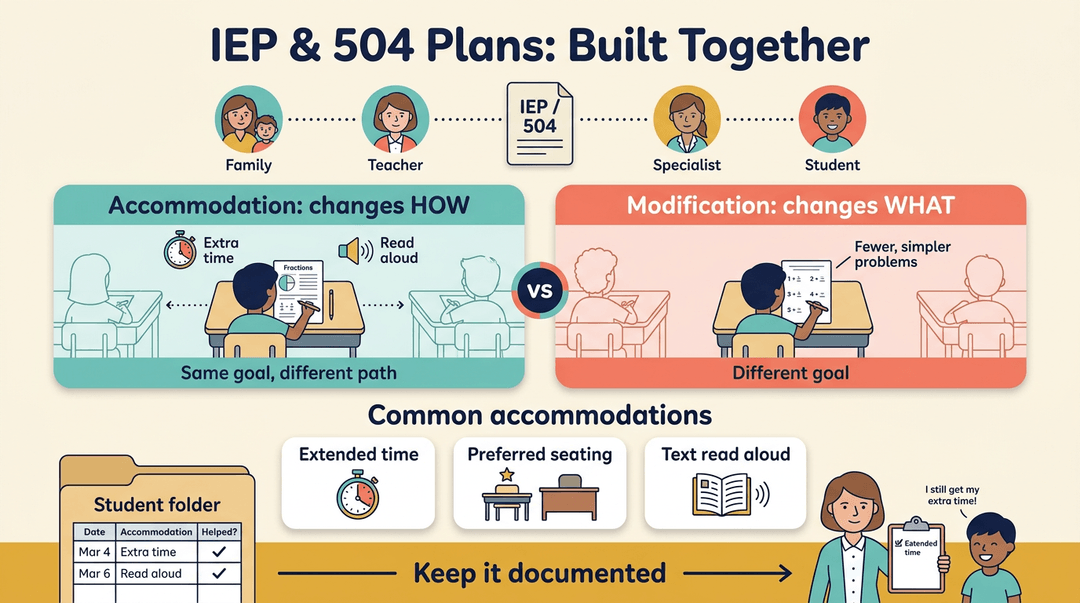
Students may have an Individualized Education Program (IEP) or a 504 plan, both built collaboratively with families, specialists, and teachers. Accommodations change how a student learns, while modifications change what they're expected to learn. Any change to what students are expected to learn raises a question about rigor in education.
Common accommodations include:
- Extended time on tests
- Preferred seating
- Text read aloud
Documenting takes time: keep one folder per student with a simple log of when each accommodation is used and whether it helped. Think of a fifth-grade teacher whose substitute follows a one-page checklist, so the student still gets extended time that day.
Including students in mainstream classes
Inclusive classrooms can benefit students with disabilities, and a systematic review of student achievement in secondary schools found most studies showed students without special educational needs weren't disadvantaged.
An Education Next piece cautions that placing more students with disabilities in regular classrooms doesn't necessarily improve their outcomes, and it may unintentionally affect non-disabled peers and general-education teachers.
Placement alone isn't the fix.
Inclusion also adds planning time, so keep that load manageable if you want to last. Pull-out support, where students leave class for small groups, can work but costs core instruction time, so compare progress before and after.
Identifying needs and arranging specialist services
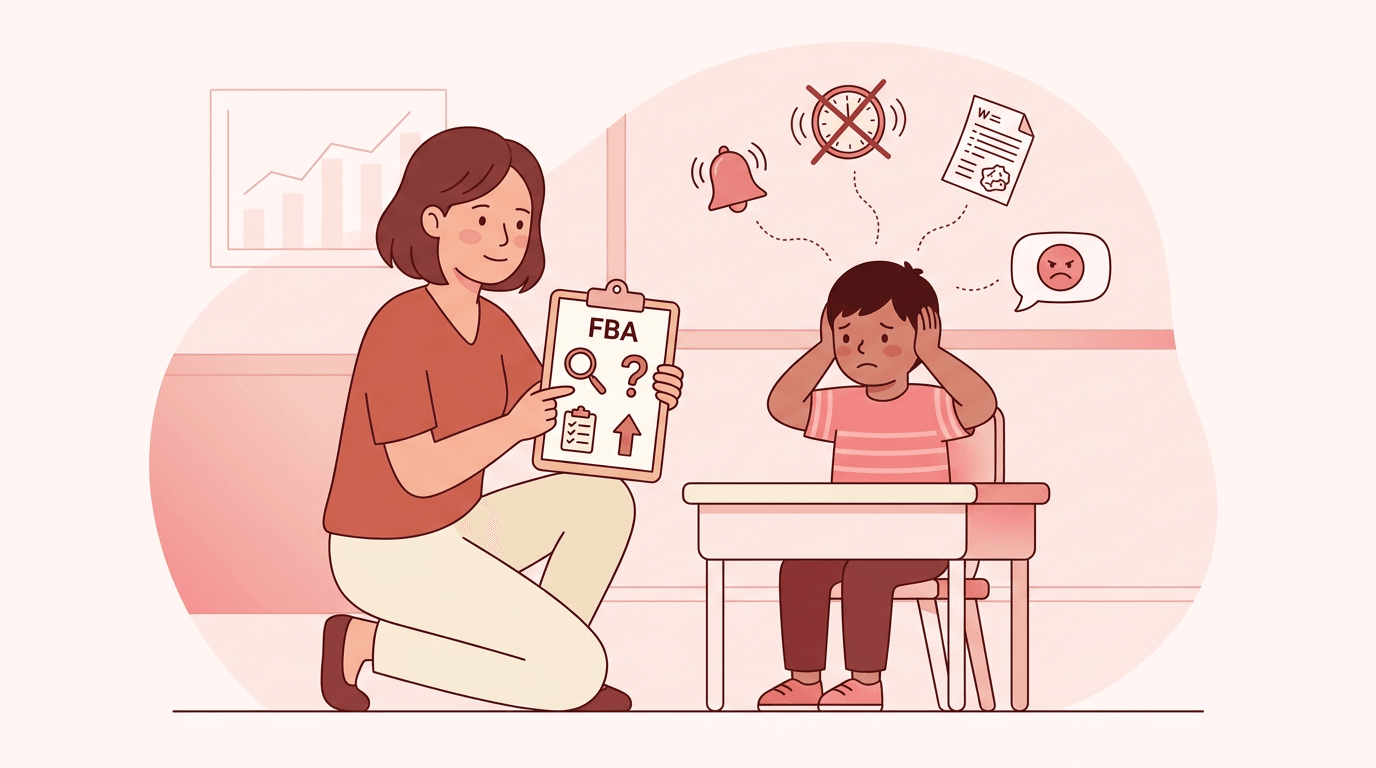
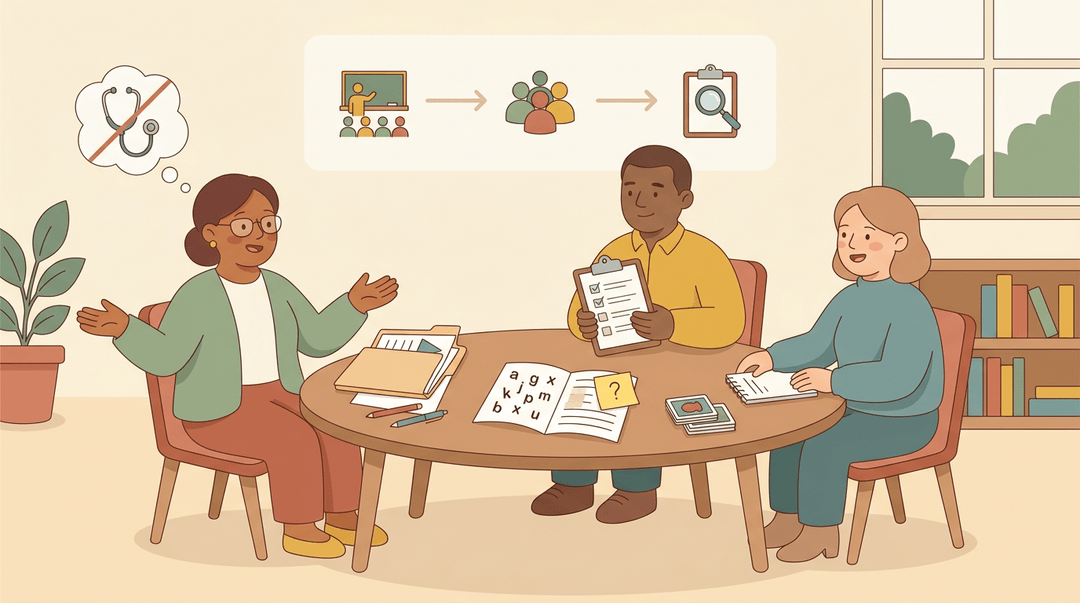
Autism, attention-deficit/hyperactivity disorder (ADHD), and dyslexia, a difficulty with reading, can look like a skill gap from the outside. Start with your school's support team, and if targeted help isn't closing the gap, ask about a formal evaluation. An FBA in special education is one kind of formal evaluation worth asking about.
Therapists and specialists, such as speech-language pathologists, can weigh in. You don't have to diagnose anything.
Support That Goes Beyond Schoolwork
Remedial help isn't only about the worksheet. Confidence and habits matter too.
Building confidence and social skills
Students who fall behind often decide they're "just bad at this." Build self-esteem by naming a specific success, like "You solved four problems on your own." Confidence grows from progress rather than perfection.
Falling behind breeds anxiety. Picture a fifth grader who stops raising her hand. A low-pressure check-in before class lets her succeed first.
Offer low-stakes partner work to help students feel part of the room. Use positive reinforcement that names the effort or strategy, so students know what to repeat. Small wins add up.
Skills like time management and goal setting
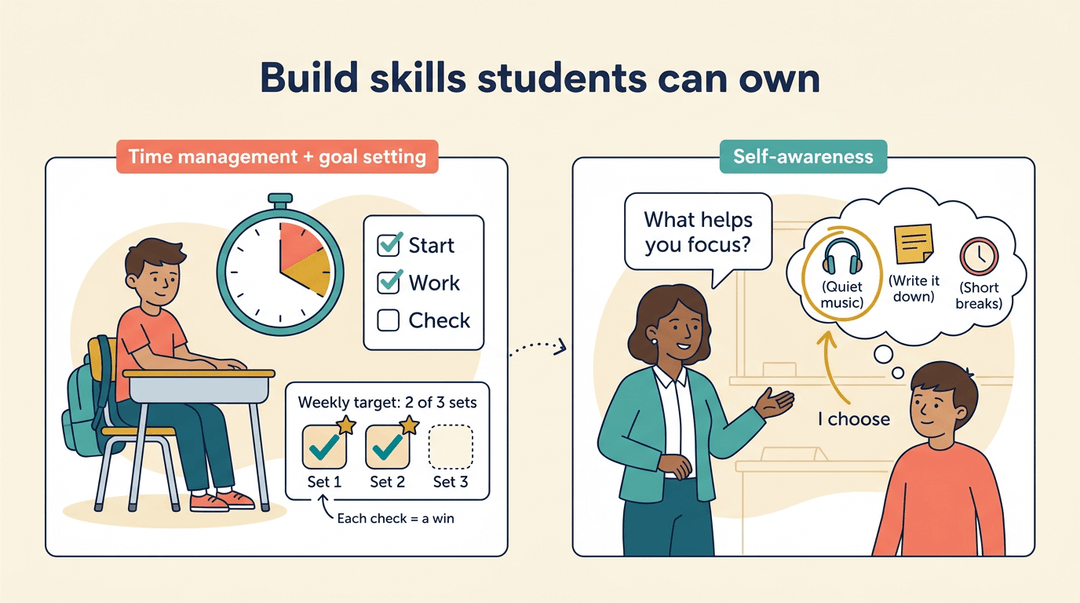
Think of a seventh grader who never finishes on time. Teach a routine: a visible timer and a three-step checklist. Practice goal setting with one weekly target, like finishing two of three practice sets, and track it on a chart. Each check mark is a win.
Ask students what helps them focus and remember. Building that self-awareness helps them choose strategies rather than wait to be told.
Working with families and tracking progress
A short weekly note with one win and one next step helps parents and caregivers reinforce learning at home.
Consider a classroom teacher and a reading specialist who compare notes weekly, so the student hears one clear message.
Check growth often, not only at the end of a unit. Progress monitoring means brief, regular checks, like an exit ticket, that show whether support is working.
Each week, log your progress-monitoring data in one shared place:
- The score or skill result
- What helped or got in the way
- The next step
How Well It Works and What It Costs
Remedial courses are meant to help, so here's the fair question: do they? The evidence raises real concerns.
How college remedial courses turn out
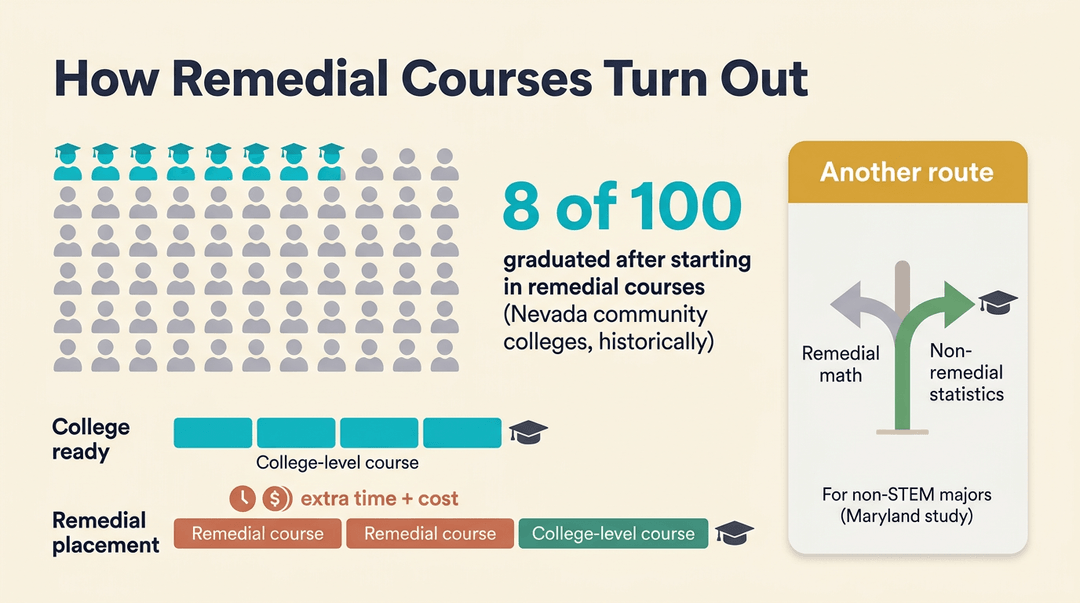
Students in college remediation have low completion rates in remedial coursework.
Open Campus reports that historically only eight of every 100 students placed into one at Nevada's community colleges would graduate, according to a 2020 Nevada System of Higher Education document.
Degree completion lags too. Wisconsin Right Now notes that research consistently shows students placed into remedial coursework are less likely to complete a degree than peers who arrive college ready.
Every remedial course also delays college-level work, which can mean extra time and expense. Some colleges offer a different route.
A study of Maryland's community colleges describes non-remedial statistics courses as an alternative to remedial math for students not pursuing STEM degrees.
How it affects other students and standards
Remedial approaches may lower academic standards for all students, but the debate cuts both ways.
The Chronicle reports that some argue eliminating nearly all remedial-math courses has led to higher failure and dropout rates and pressure to relax standards on some campuses.
Pressure to pass students may contribute to grade inflation. The Conversation notes that because student evaluations are commonly used in promotion and retention decisions, university teachers may inflate grades to get positive evaluations.
Teachers can also shift toward activity organizers, keeping students busy instead of closing gaps. If that becomes the norm, the diploma loses its meaning.
Other options and when to act
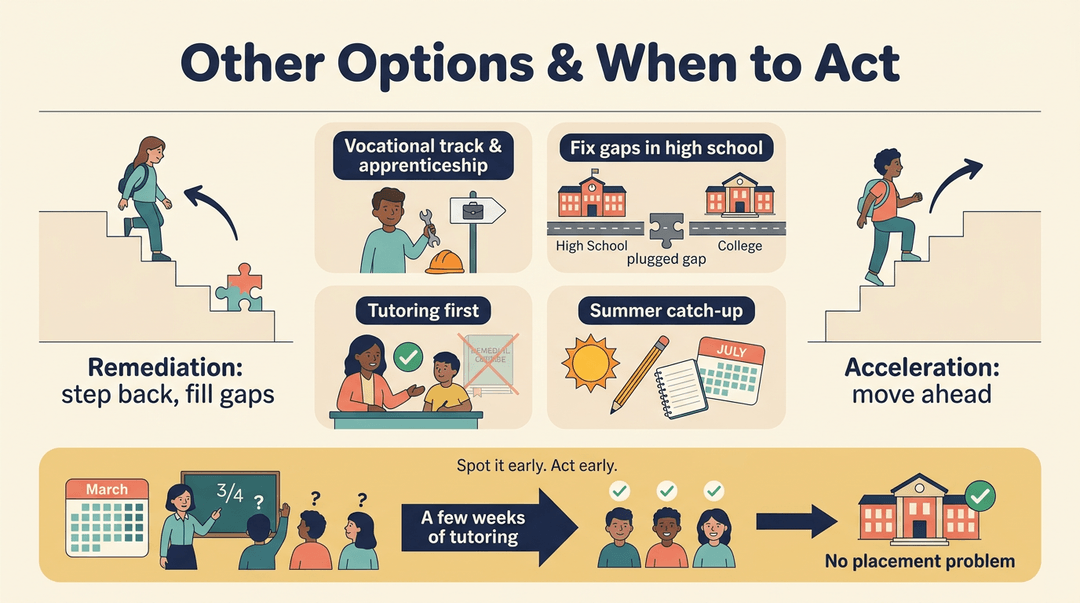
Remediation steps back to fill gaps, while acceleration moves students forward through grade-level content. Other options include:
- Vocational tracks and apprenticeships. Hands-on pathways offer a different route to a career.
- Remediate before college. Close gaps in high school before students reach college placement.
- Tutoring before remedial courses. Targeted help can come first, before a remedial course is ever on the table.
- Summer catch-up tutoring. A focused summer stretch can close gaps before the next school year.
Imagine you're a math teacher who spots three students still shaky on fractions in March. A few weeks of tutoring can close that gap before it becomes a college placement problem.
What happens when students fall behind
Gaps left unaddressed can put graduation requirements at risk and follow students after high school into college placement. Falling behind also erodes confidence, and disengagement tends to follow. Confidence is hard to rebuild.
Remedial education isn't about labeling students as behind. It's about finding the missing piece, teaching it well, and getting learners back into the lesson with confidence.
When you diagnose gaps and match support to your standards, every student gets a real path forward.
Aim for progress rather than completion. Ready to plan remedial lessons that line up with your standards? Check out Curriculum & Standards to plan units, lessons, and standards across the whole school year.
References
- Disentangle the Curriculum and Structural Effects of Math Pathway Reforms: Evidence from Maryland Community College System — doi.org (2025)
- Full article: The benefits of inclusive education: a systematic review of student achievement in secondary schools — tandfonline.com (2025)
- ‘The customer is always right’: why some uni teachers give higher grades than students deserve — theconversation.com (2025)
- ED552925.pdf?ref=quillette.com — files.eric.ed.gov
- Thousands of Community College Students Misplaced Into ... — ccrc.tc.columbia.edu
- EPIGraph – College Readiness of High School Graduates, 2018-2023 (ACT) — educationalpolicy.org (2026)
- Bad at math? A new approach in Nevada colleges is easing pain for some students — opencampus.org (2026)
- If More Students Are Graduating From UW Than Ever Before, Why Do So Many Still Need Remediation? — wisconsinrightnow.com (2026)
- Is Remedial Education Actually a Good Thing? — chronicle.com (2026)
- High school credit recovery programs help students graduate, but there are critics : NPR — npr.org (2025)
- Educations-long-covid-2022-23-achievement-data-reveal-stalled-progress-toward-pandemic-recovery_NWEA_Research-brief — nwea.org
- Americans Have Little Confidence in Grads' Readiness for Work, College — news.gallup.com
- How do so many top students end up in remedial classes? — greatschools.org
- Has Inclusion Gone Too Far? — educationnext.org
Frequently asked questions
What are remedial studies?
Remedial studies provide targeted extra instruction to help students master skills or learning objectives they have missed, often in literacy or math. The goal is to close specific gaps so students can rejoin grade-level work, rather than simply repeat an entire lesson.
What are the four types of remedial teaching?
Four common forms of remedial support are one-on-one or small-group lessons, targeted teaching methods such as multisensory instruction, adaptive software and assistive technology, and structured programs for reading or math. The best format depends on the student’s specific learning gap.
Which school is the best for remedials?
There is no single best school for remedial support; the right choice depends on the student’s needs and the services available. Look for a school that identifies specific skill gaps, provides targeted instruction, monitors progress regularly, and coordinates with specialists or families when needed.
Is remedial class sped?
No. Remedial class provides academic help for students with skill gaps and is not automatically special education. It can overlap with special education when a student with a disability also needs remedial support.