Common Core Standards Kindergarten Math: A Complete Guide

Jump to section
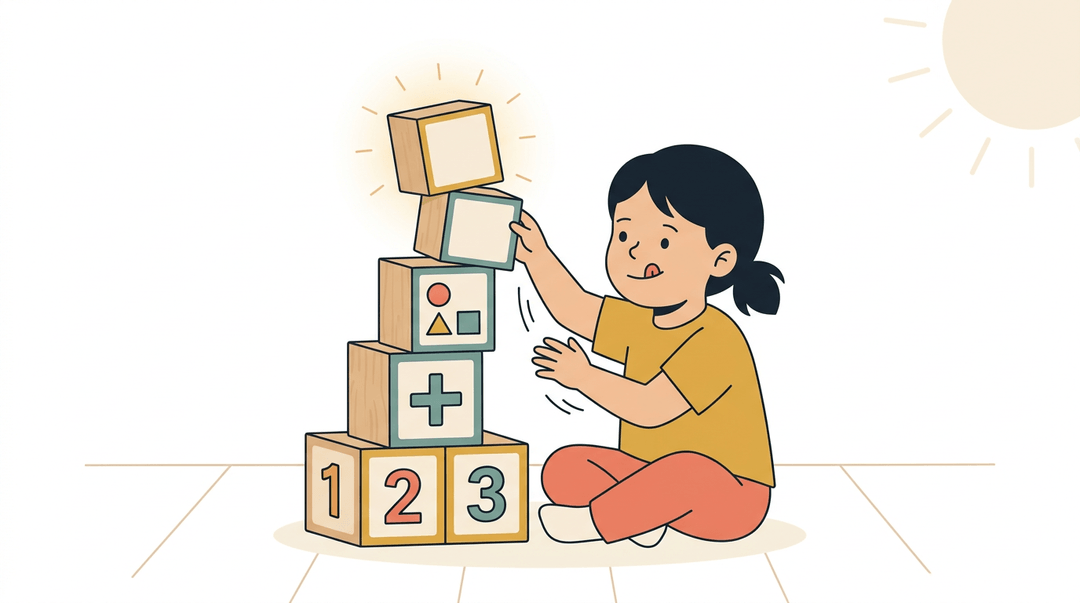
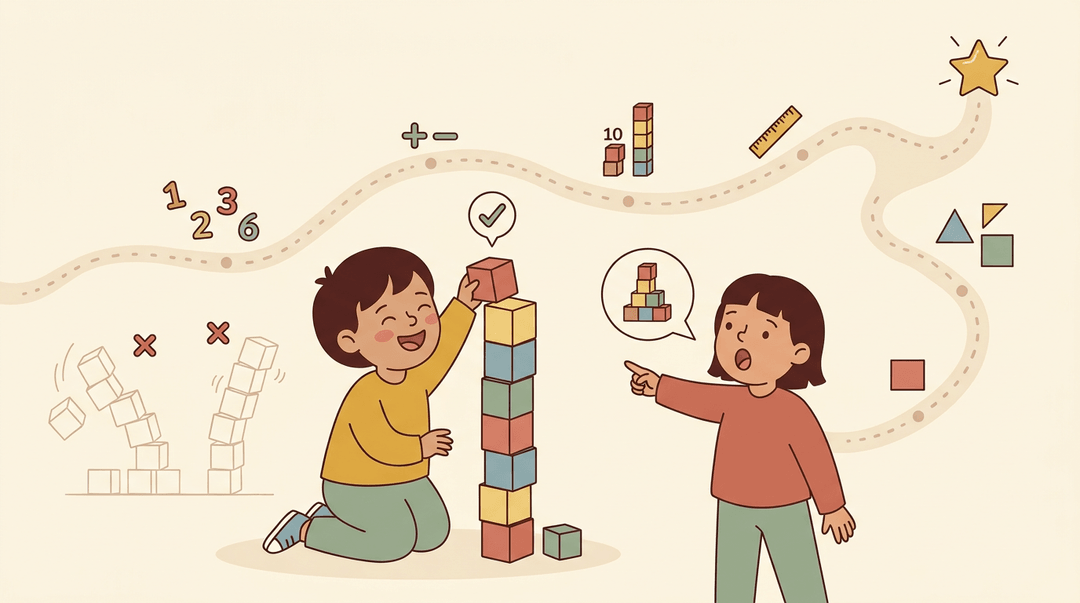
Think about teaching a child to stack blocks before they build a tower. You start small, add one piece at a time, and the structure holds because the base came first. Kindergarten math works the same way.
Common Core kindergarten math standards lay out that foundation: counting, early addition, shapes, and more, in a clear sequence. They matter because what sticks in kindergarten shapes every math class that follows.
Here's what they actually cover, domain by domain, plus a checklist and pacing structure you can use this week.
What Are Common Core Standards for Kindergarten Math?
So what are common core standards for kindergarten, really?
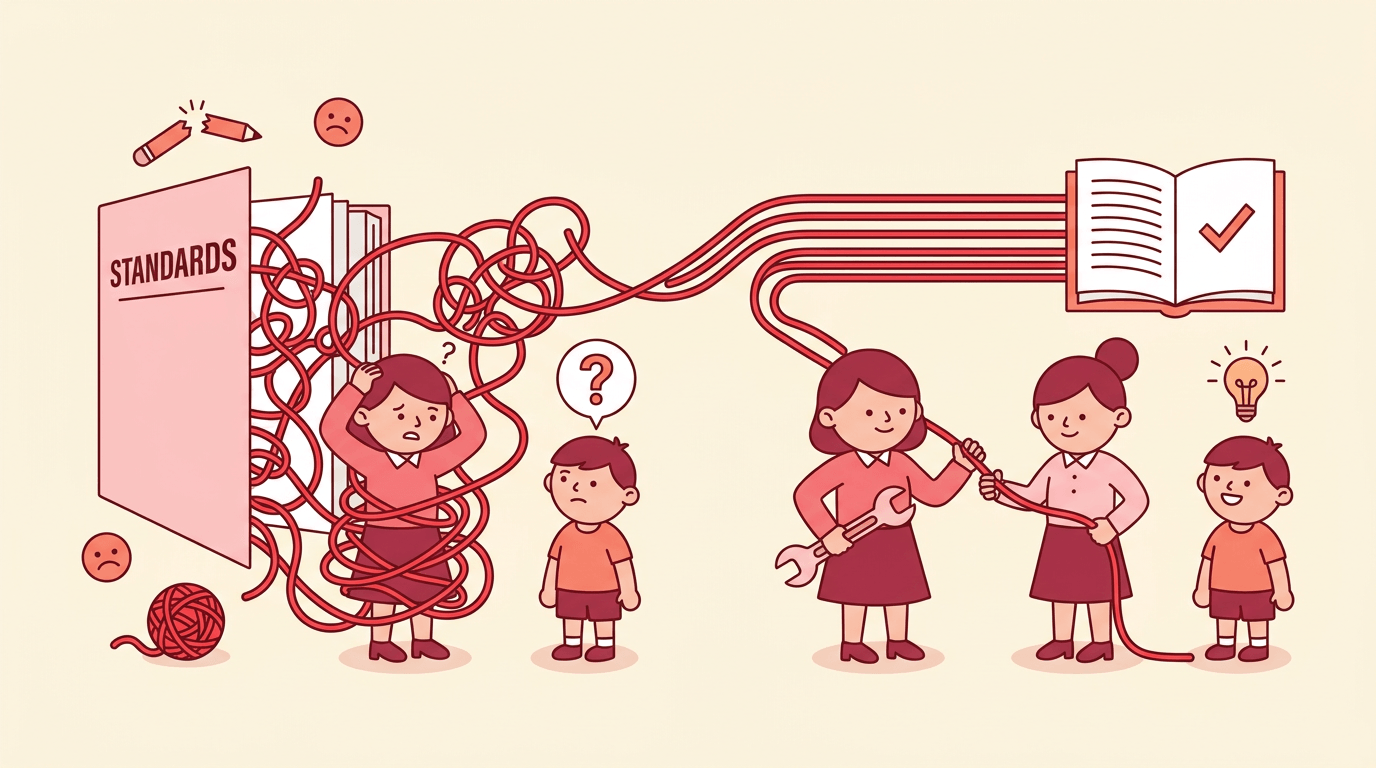
At their core, they're a shared set of grade-by-grade expectations for what students should know and be able to do, and for math specifically, they spell out the skills a kindergartner needs before moving into first grade.
Think of them as a shared map that every classroom, no matter the zip code, can follow.
Why Common Core standards were created
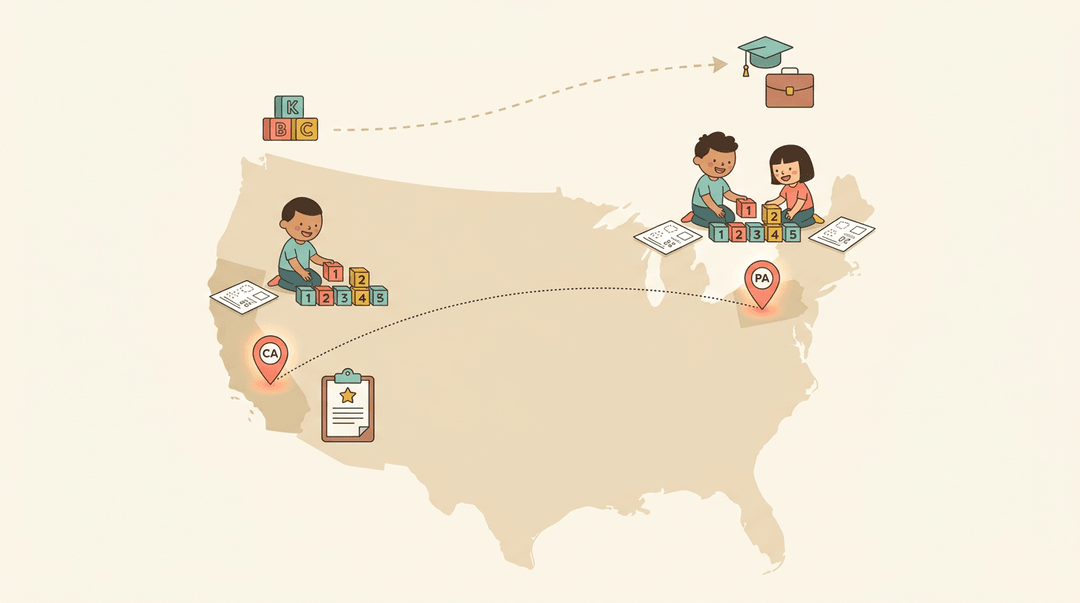
The goal was simple: standardize expectations across states so a kindergartner in one district learns the same core skills as a kindergartner three states away.
Behind that is a bigger target, college and career readiness, built from kindergarten on up so students aren't scrambling to catch up later.
States adapt the framework to their own needs. Pennsylvania, for example, folds the standards into its own academic standards system. California goes further, with its own detailed math framework.
As the California Department of Education notes, "The California Common Core State Standards: Mathematics (CA CCSSM) were modified January 16, 2013, following the recommendation of State Superintendent of Public Instruction (SSPI) Tom Torlakson."
That's the answer to what the California kindergarten math standards are: the national framework, adapted and formally adopted at the state level.
The five kindergarten math domains
Kindergarten math breaks into five key domains:
- Counting and cardinality
- Operations and algebraic thinking
- Number and operations in base ten
- Measurement and data
- Geometry
Each standard carries a code (like K.CC.1) that marks the grade, domain, and skill number, so teachers can find exactly where a lesson fits.
The domains scaffold deliberately: counting comes before adding, shapes before spatial reasoning, each skill building toward Grade 1 math.
That consistent progression gives every student, regardless of school or state, the same equitable benchmarks to grow from.
Counting and Cardinality Skills
Counting and Cardinality is the foundation domain in kindergarten math, and the big idea underneath it is simple: numbers stand for real amounts you can count, match, and compare. It breaks down into three skill sets.
Counting all the way to 100
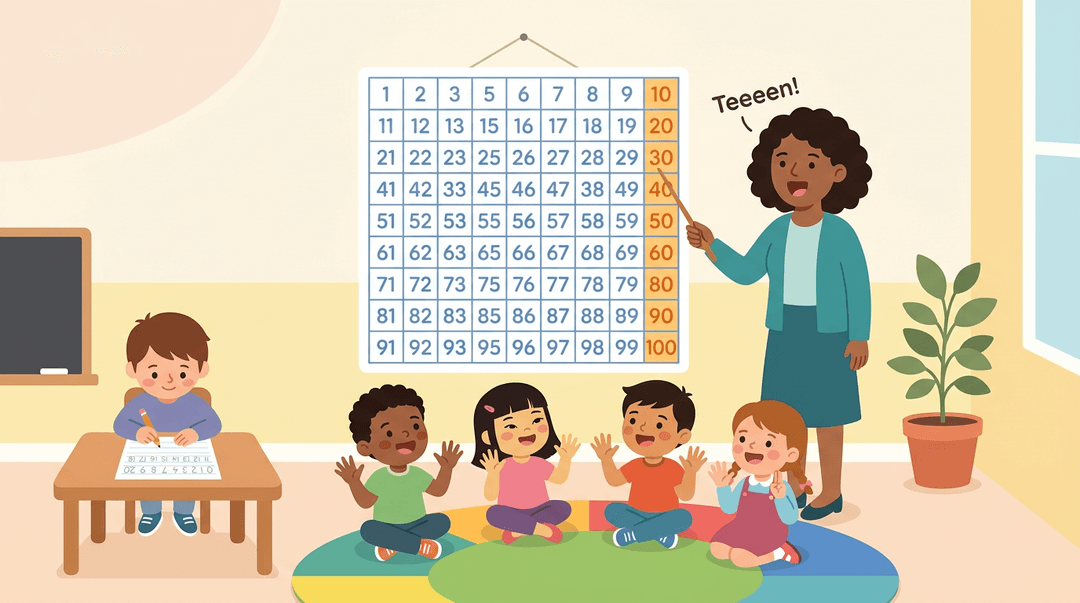
Kindergartners learn to count by ones and by tens, working their way up to 100. They also need to count forward starting from any given number, not just from 1, and write numbers 0 through 20 by hand.
Think of a kindergarten teacher running a quick morning routine: counting the days of school aloud by tens on a hundreds chart. That repetition builds the number sequence long before it ever shows up on a worksheet.
Matching each object to one number
This is cardinality: the understanding that the last number counted tells you the total size of a group. A student lining up ten blocks and tagging each one with a number name ("one, two, three...") is practicing far more than recitation.
She's learning that numbers and quantities are connected, that "five" isn't just a word, it's that many objects.
Comparing which group has more
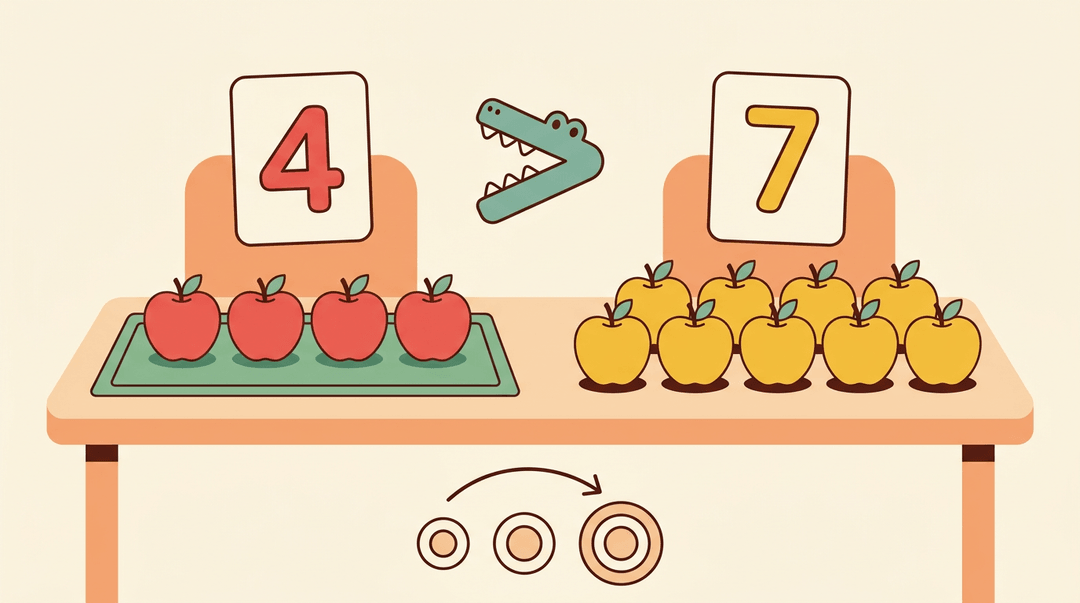
Here, students compare using greater than, less than, and equal to, both with written numerals and with actual groups of objects. For example, a student might look at two numeral cards and say which is bigger, then check the answer by lining up counters.
Ordering numbers and objects by size rounds out the skill, from smallest to largest and back again.
Building Early Addition and Subtraction
Before a kindergartner ever sees a worksheet full of plus signs, they're building number sense with blocks, fingers, and drawings. That hands-on groundwork is what makes the equations click later.
Adding and subtracting within 10
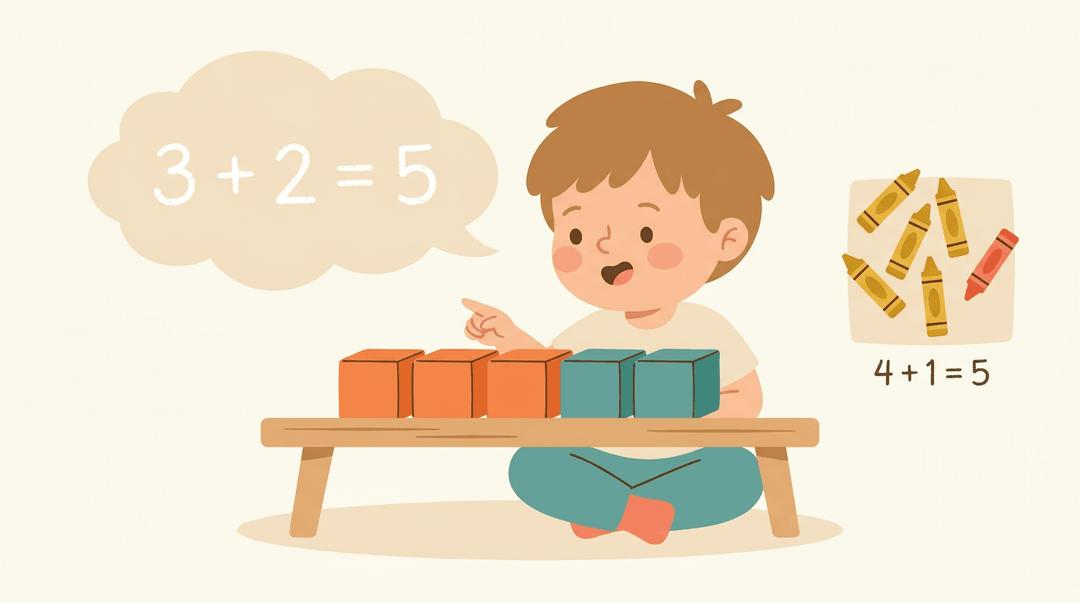
Kindergartners start by adding and subtracting within 10 using objects, fingers, or drawings: counting out blocks, tallying marks on a page, whatever makes the quantity visible.
For example, a student solving "3 plus 2" might line up five blocks and count them twice to check the total. From there, students move into simple word problems ("You have 4 crayons and find 3 more.
How many now?") and learn to represent that same story with an equation like 4 + 3 = 7. By year's end, they should fluently add and subtract within 5, meaning those small combinations come without counting on fingers every time.
Breaking numbers apart to make 10
Learning to decompose numbers up to 10 (seeing that 7 is 5 and 2, or 4 and 3) gives students flexibility instead of rote memorization. A common task asks students to find the number that makes 10 when paired with a given number, like knowing 6 needs 4.
Number bonds activities, small circles connected to a total, make this visual. A simple practice tip: ten-frames.
Filling in dots on a two-by-five grid shows at a glance how close a number sits to 10, which pays off the moment regrouping shows up in later grades.
Understanding what equals really means
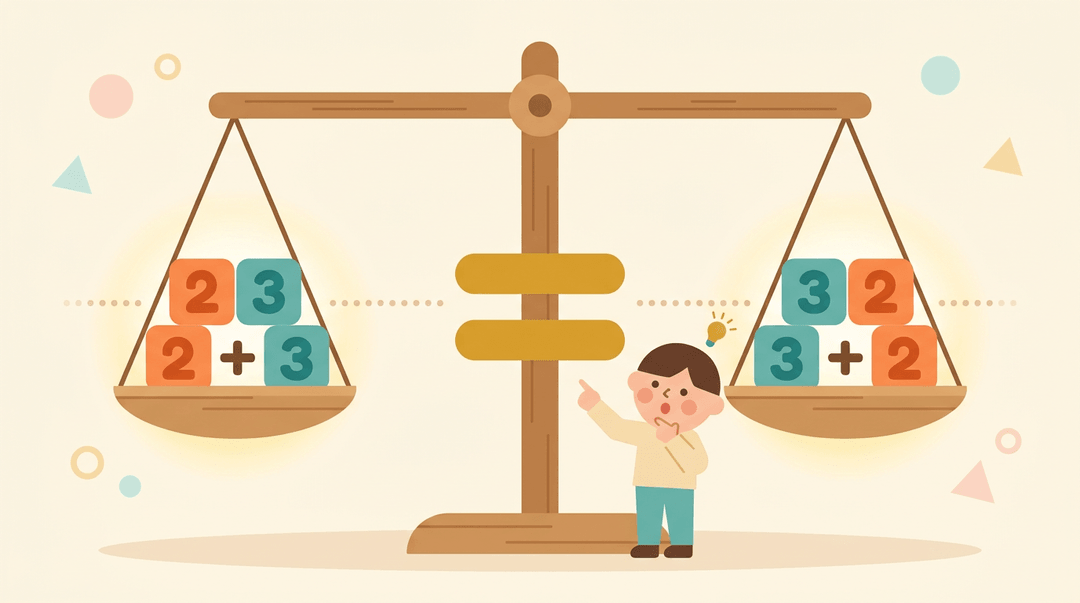
The equal sign isn't a signal to "find the answer." It means both sides balance, a concept of equality that prevents confusion down the road.
Pair that with the commutative property: 2 + 3 and 3 + 2 land on the same sum, so order doesn't change the outcome.
Place Value Basics for Kindergarten
Teen numbers trip up a lot of five- and six-year-olds, and it's not hard to see why: 14 doesn't look like "ten plus four" at first glance.
Kindergarten math standards tackle this head-on by building the earliest seeds of place value, long before kids ever see a tens-and-ones chart.
Breaking down teen numbers into tens
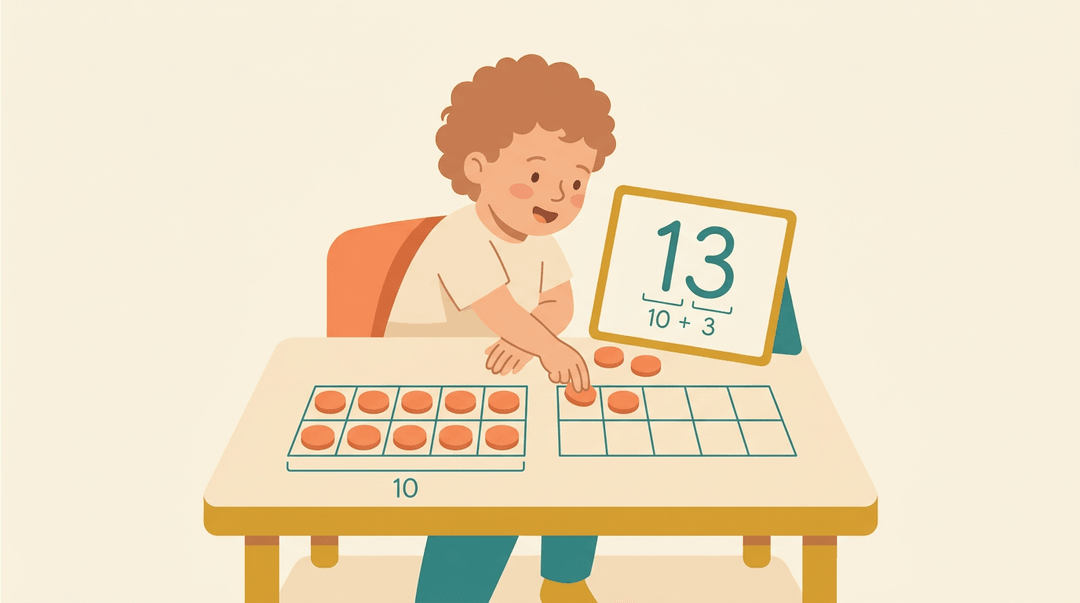
The standard asks kindergartners to compose and decompose numbers 11 through 19 into ten ones and some extra ones. In plain terms: a student should be able to look at 16 and see it as a group of ten, plus six more, not just a number on a page.
Consider a kindergarten teacher handing out ten-frames and loose counters. A student fills one ten-frame completely, then drops three more counters next to it. That's 13: ten ones, plus three ones.
Doing this over and over with different teen numbers (hands-on, not worksheet-only) is what makes the idea stick.
This isn't just a counting trick. It's the foundation for everything place value will become in first and second grade: regrouping, adding two-digit numbers, eventually working with hundreds. Skip this step, and later math gets shakier.
Nail it in kindergarten, and the tens-and-ones system stops feeling like a mystery and starts feeling like something they already know.
Measuring and Comparing Everyday Objects
Long before kindergartners measure with a ruler, they learn to measure with their senses. This part of the standards, often called Measurement and Data, asks students to compare, sort, and describe the world around them using objects they can touch.
It breaks down into three everyday skills:
- sizing things up
- sorting them into groups
- making sense of time and money
Comparing length, weight, and capacity
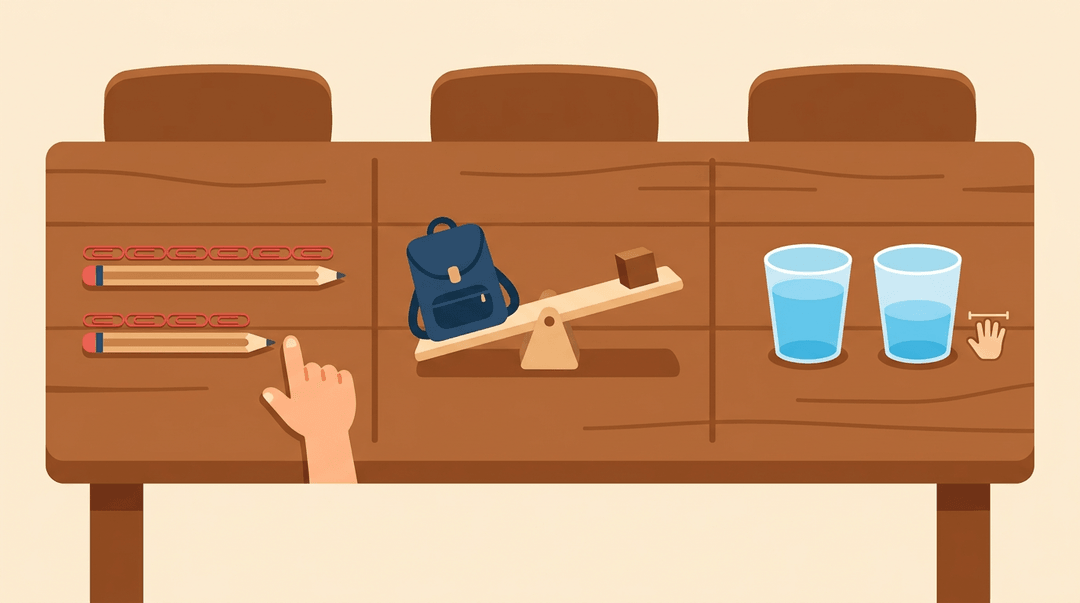
Kindergartners learn to describe and compare objects directly: which pencil is longer, which backpack is heavier, which cup holds more. Instead of using rulers or scales, they rely on non-standard units like paper clips, blocks, or hand spans to measure length, weight, and capacity. For example, a teacher might have students line up paper clips along a book to see whose stack is longer than whose. Students also start noticing liquid measure (more water versus less) and temperature (warmer versus cooler), building intuition they'll later attach to numbers.
Sorting and counting objects by category
Students classify objects into categories like color, shape, or size, then count how many fall into each one. This naturally leads to comparing groups by count: are there more red blocks or more blue ones? A simple graphing activity, like a picture graph of favorite fruits, turns that sorting into early data skills they'll build on for years.
Learning about time and money
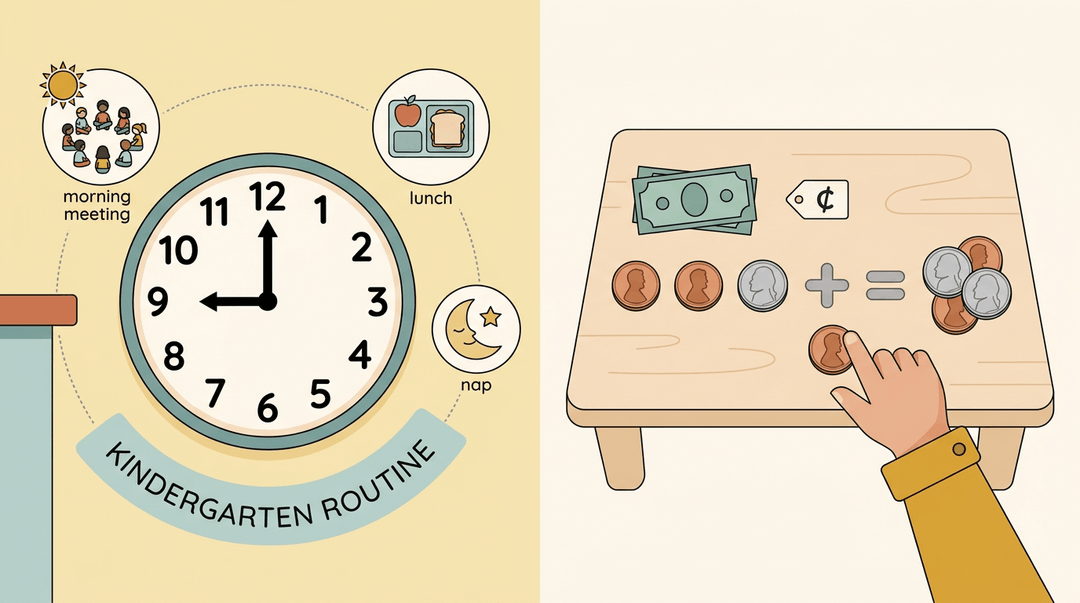
Kindergartners begin telling time to the hour and half-hour, and connecting clock time to parts of their day: morning meeting, lunch, nap. They also get introduced to coins and bills, learning to recognize them and practice simple adding money problems, like counting two pennies plus a nickel.
Shapes and Spatial Thinking
Geometry in kindergarten isn't about memorizing vocabulary for a quiz. It's about helping students notice the shapes already hiding in their world, and the standards build that skill in two stages: naming shapes, then describing where they sit in space.
Identifying 2D and 3D shapes
Kindergartners learn to sort and name two-dimensional (2D) shapes like circles, squares, and triangles, alongside three-dimensional (3D) shapes like cubes, cones, and spheres.
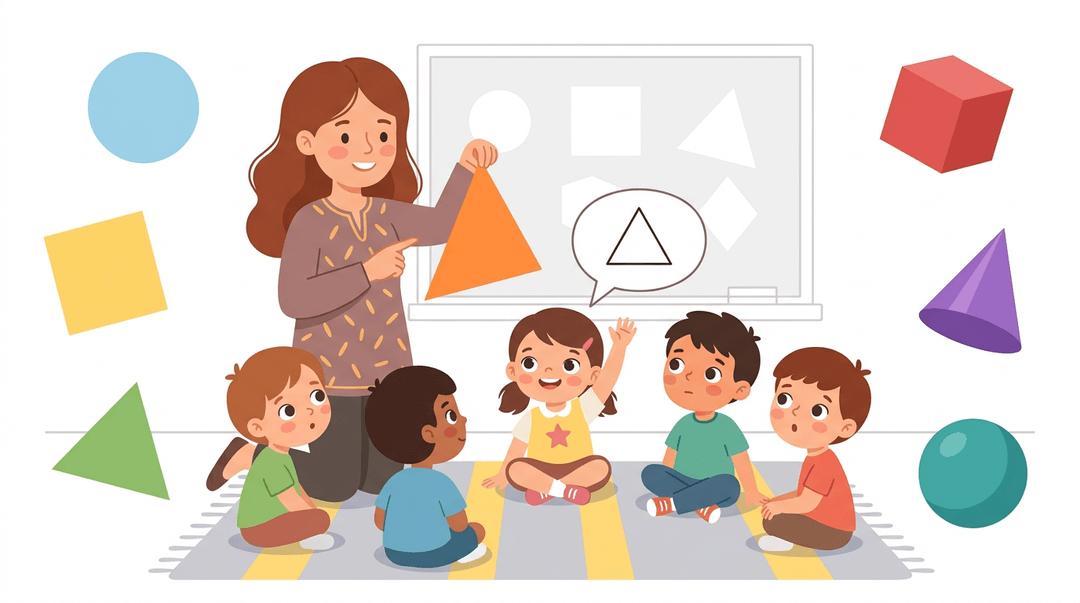
The standards also expect students to name a shape regardless of orientation: a triangle is still a triangle whether it's sitting flat, balanced on a point, or flipped upside down.
For example, a kindergarten teacher might hold a triangle at an odd angle and ask the class to name it. A student who answers correctly without hesitation is showing real understanding, not just pattern-matching a picture from a worksheet.
Students also learn to describe attributes:
- how many sides a shape has
- whether its corners are pointed or round
- whether it's flat or solid
Understanding positions like above and below
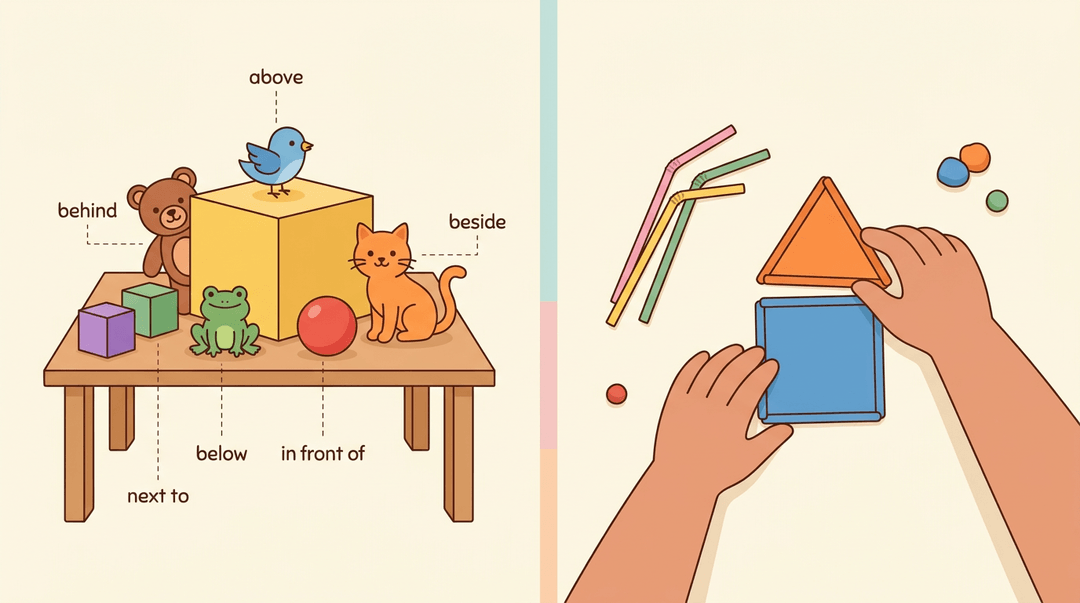
Alongside naming shapes, students learn positional words:
- above
- below
- beside
- in front of
- behind
- and next to
These words give young learners the language to describe where objects sit relative to each other, a skill that shows up constantly outside math, too.
Students also start to compose simple shapes by combining smaller ones, like putting two triangles together to make a square, and model shapes from real components.
Think of a student using straws or modeling clay to build a cube, or arranging a square and a triangle on top of each other to form a simple house shape. That hands-on modeling is where spatial thinking really sticks.
Bringing These Standards into Your Classroom
Knowing the five domains is one thing; turning them into Tuesday's math block is another. Here's a simple planning template, a sample week, and a tracking system you can set up in an afternoon.
Plan one standard at a time
For each lesson, fill in these four slots. The whole plan fits on an index card.
- Objective: rewrite the standard in kid-friendly words.
- On the board: "I can count a group of objects and tell how many."
- Manipulatives: match the tool to the domain.
- Counting: ten frames or counting bears. Operations: linking cubes. Geometry: pattern blocks.
- Formative check: one 60-second task before cleanup.
- Say: "Show me seven with your cubes." Scan the tables, done.
- Differentiation: jot one support and one stretch.
- Support: work within 10 instead of 20. Stretch: count backward from the total.
Example: A kindergarten teacher planning an addition lesson writes the objective as "I can put two groups together and count them all," hands out linking cubes, and ends with "Build 3 and 2. How many?" Students who finish fast build 4 and 4. The plan took five minutes; the check told her exactly who needs a small group tomorrow.
A sample week
You don't need every domain every day. Rotate them so each gets regular attention.
| Day | Domain focus | Sample move |
|---|---|---|
| Monday | Counting and cardinality | Count collections, record "how many" |
| Wednesday | Operations practice | Join and separate groups with cubes |
| Friday | Geometry and measurement review | Shape hunt, then compare object lengths |
Tuesday and Thursday work well as flex days: reteach from Monday's check, or extend.
Track mastery simply
- Build a standards-based checklist. One roster page per domain, standards across the top, names down the side.
- Score with a three-point scale. Write it once and reuse it everywhere:
- 1 = Not yet (needs support every time)
- 2 = Getting there (succeeds with a prompt)
- 3 = Got it (independent, three separate days)
- Translate scores for parents. One plain sentence per domain, no jargon.
- ✅ "Maya counts to 20 on her own and is working on counting backward."
- ❌ "Maya scored a 2 on counting and cardinality." The difference: parents can act on the first.
💡 Tip: Update the checklist from your daily formative check, not from separate testing. The 60-second exit task is your data.
Once the template and checklist feel routine, you can map each standard to lessons and track mastery automatically with EMStudio's curriculum planner.
Putting the Standards into Practice
Knowing what the standards say is one thing. Getting a room of five-year-olds to actually meet them is another challenge entirely.
Hands-on strategies that help students learn
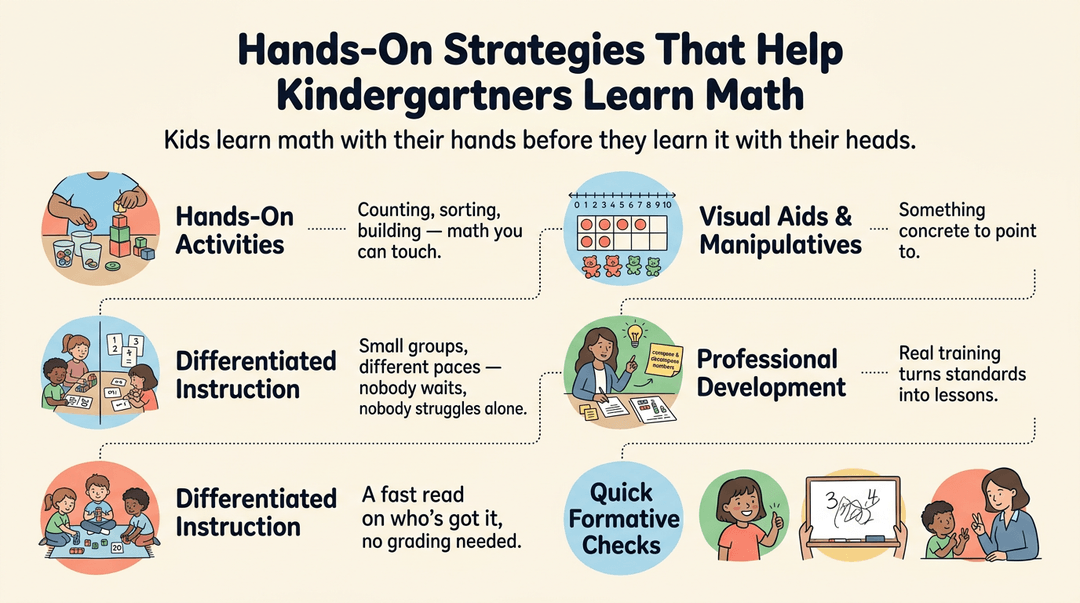
Kindergartners learn math with their hands before they learn it with their heads, so the best classrooms lean into that:
- Hands-on activities. Counting snacks, sorting buttons, or building shapes out of blocks turns an abstract standard into something a five-year-old can touch.
- Visual aids and manipulatives. Number lines, ten-frames, and counting bears give students something concrete to point to before they're asked to picture a number in their head.
- Differentiated instruction. Some students will count to 20 by October; others need until spring. Small groups and leveled tasks let both keep moving instead of one waiting and the other struggling.
- Professional development. Teachers need real training (and time) to turn a standard like "compose and decompose numbers" into a lesson that actually lands.
- Quick formative checks. A thumbs-up/thumbs-down count, a one-minute whiteboard answer, or a quick one-on-one count-to-ten gives you a read on who's got it, no grading required.
Why did Common Core fail?
In plenty of classrooms, it didn't fail so much as strain under real limits. Three issues come up again and again:
- Diverse learning styles. A single pace and method rarely fits every young learner.
- Resource availability. Not every school had the manipulatives, training, or staffing the standards assumed.
- Rigor concerns. Critics argued some expectations, like early abstract reasoning, outpaced where young children developmentally are.
These are the roots of most Common Core criticism, and they're worth knowing before you plan a single lesson.
Printable Worksheets and Practice Materials
Standards tell you what to teach. They don't hand you what to put in front of a five-year-old on a Tuesday morning, and that's where a stack of ready-made materials earns its keep.
Worksheets and themed activity packs
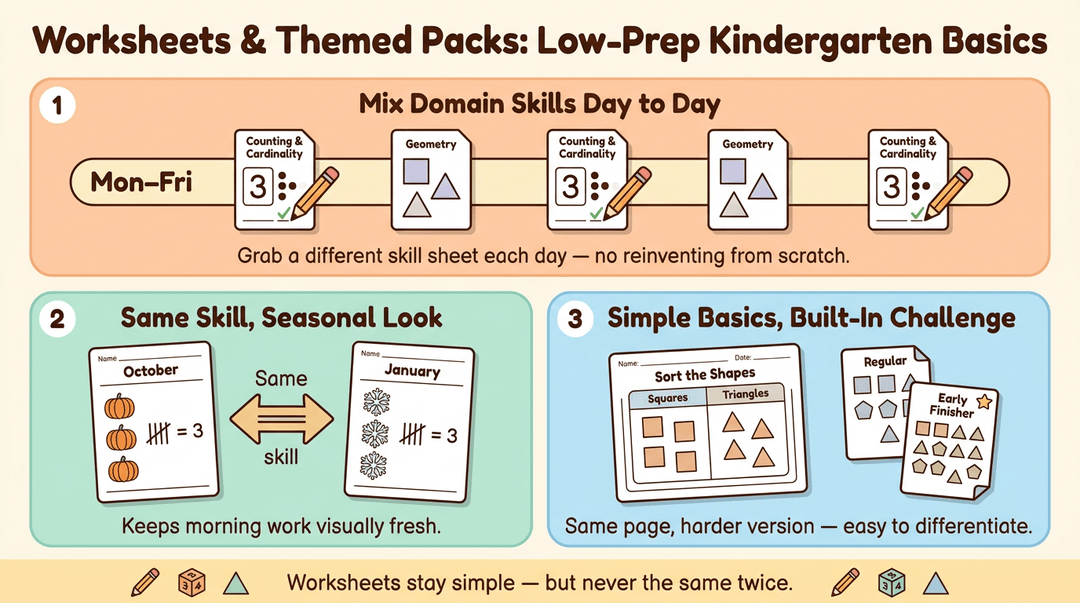
Consider a kindergarten teacher building a week around counting. Pulling domain-based worksheets means she can grab a Counting and Cardinality sheet one day and a Geometry sheet the next, without reinventing either from scratch.
Seasonal themed packs (pumpkins in October, snowflakes in January) do the same job while keeping morning work visually fresh for young learners who tire of the same template fast.
Counting worksheets that ask students to tally objects and shape worksheets that have them sort squares from triangles round out the basics: simple, low-prep, and easy to differentiate by handing an early finisher a harder version of the same page.
All-in-one teaching bundles
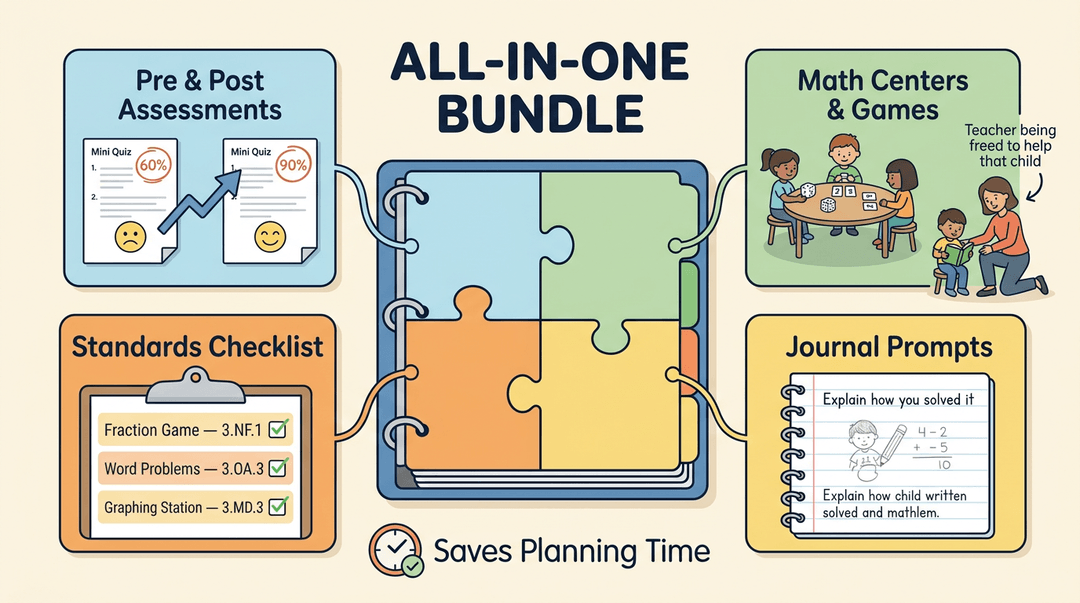
For teachers who want more than loose pages, bundles package a domain's worth of resources into one download:
- Pre- and post-assessments. A quick check before a unit starts and again after it ends, so growth is visible, not assumed.
- Math centers and games. Small-group stations that turn practice into play, freeing you to pull a struggling reader aside for support.
- Standards checklists. A one-page tracker that maps each activity back to the standard it covers, handy for report cards and parent conferences alike.
- Journal prompts. Short writing or drawing tasks that have students explain their thinking, not just circle an answer.
Together, these bundles save the planning time that loose worksheets alone can't.
Helping Your Child with Math at Home
Math practice doesn't need a desk, a worksheet, or a set time of day. For kindergartners, the richest math lessons often happen in the kitchen, the yard, or the car, and parents are usually the ones delivering them without even realizing it.
Practicing math during everyday activities
Everyday routines are full of built-in math lessons:
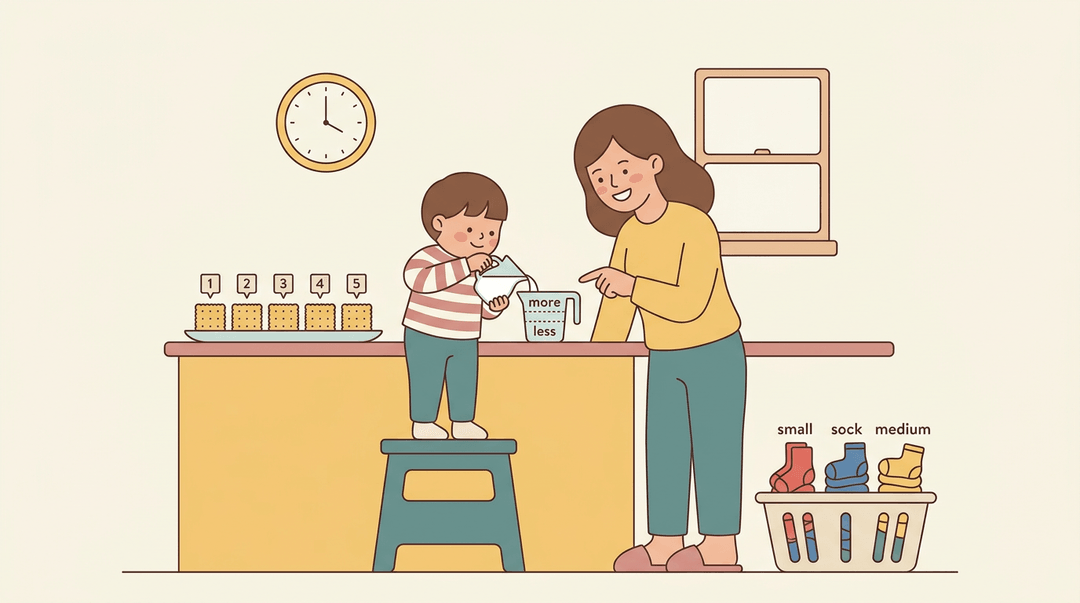
- Counting during play. Counting toy cars, steps on the stairs, or crackers at snack time builds one-to-one correspondence, the idea that each object gets exactly one number.
- Measuring in the kitchen. Scooping flour or pouring milk introduces measurement and comparison: more, less, full, empty.
- Identifying shapes in the environment. Spotting a circle on a clock or a rectangle in a window connects classroom shape names to the real world.
- Math games. Simple board games, dice, or card games sneak in counting and comparing numbers without it ever feeling like "work."
A kindergartner who sorts laundry by color or size is practicing the same classification skills a teacher introduces during a measurement and data lesson.
Apps, workbooks, and teacher communication
Educational apps and websites can reinforce what's happening in class, especially ones built around counting, number recognition, and simple shapes.
Workbooks work well too, but they're most useful in short bursts: five or ten minutes is plenty for a five-year-old's attention span.
The most reliable guidance still comes from the teacher. A quick question like "what should we be practicing this week?" often gets families further than any app.
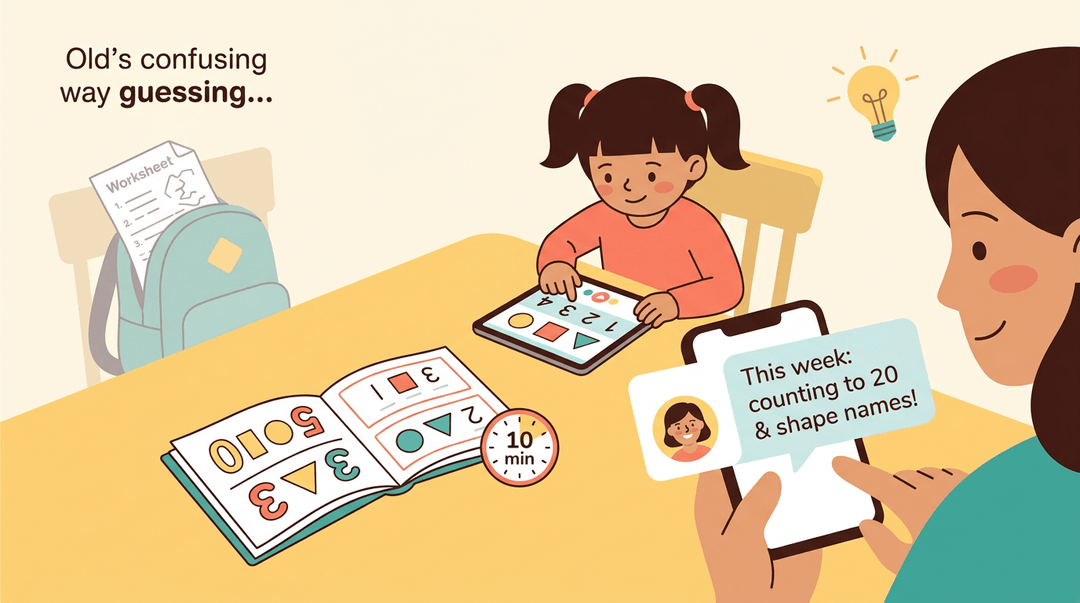
That said, many parents want clearer, more consistent communication about which standards their child is working toward and how to help at home, rather than guessing from a worksheet that comes home in a backpack.
How These Standards Affect Student Outcomes
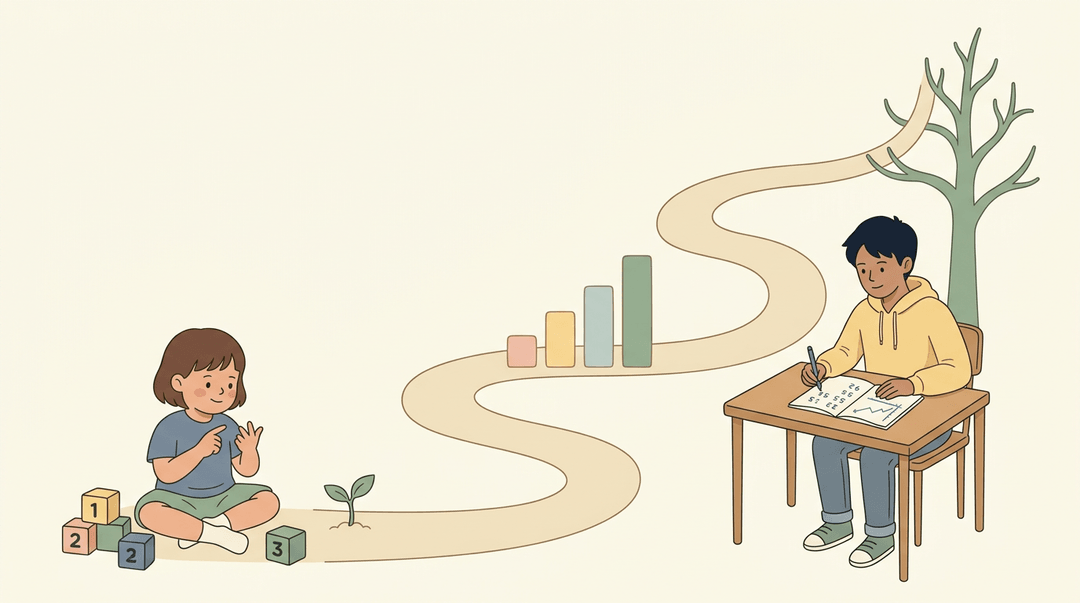
The standards aren't just a checklist for the classroom wall. What you teach in those first months of counting, sorting, and comparing has a way of echoing for years.
Closing achievement gaps and building skills
Think of a kindergartner who's still shaky on number sense in October. How that gap gets addressed now matters more than it might seem.
A study published in PLOS One confirms that early math and reading skills are strong predictors of both later math and reading achievement, even in classrooms with fairly similar early instruction.
In other words, the foundation you build in kindergarten doesn't stay in kindergarten.
That's also why how you deliver these standards matters as much as covering them. Research in Instructional Science found that full-day kindergarten was linked to higher math growth rates during the year, regardless of a family's educational background.
For a teacher working with students who arrive with very different starting points, that's an argument for consistent, high-quality instructional time over any single curriculum trick.
The payoff stretches further than you'd expect. Researchers tracking students over time, published in a study on PMC, found that growth over kindergarten and first grade predicted achievement at age 15 just as strongly as third-grade growth did.
Early numeracy isn't a box to check. It's an early signal of workforce readiness down the road.
Kindergarten Reading and Language Standards
Math isn't the only subject with a Common Core blueprint. Kindergarten reading and language standards round out the day, and they lean on many of the same skills: listening closely, asking questions, and making sense of new information.
Understanding and discussing stories
These standards ask young readers to dig into a story, not just sit through it.
- Key ideas and details cover retelling a story and naming its characters, setting, and major events.
- Craft and structure has students noticing things like who's telling the story and what certain words mean in context.
- Integration of knowledge asks them to connect pictures to the words on the page, and compare two stories about the same topic.
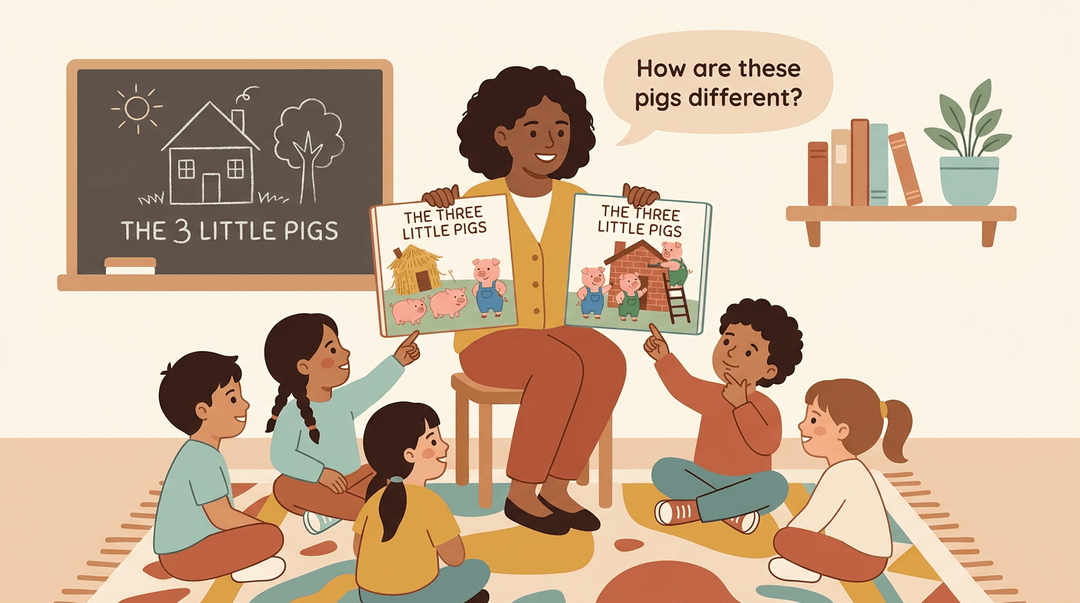
For example, a kindergarten teacher reading two versions of "The Three Little Pigs" might pause to ask, "How are these pigs different?" That's integration of knowledge in action.
All of this happens within a text complexity range suited to five- and six-year-olds: nothing too simple, nothing out of reach.
Building early reading and phonics skills
Before comprehension can click, kids need the building blocks.
- Phonics and phonological awareness cover recognizing letter sounds and blending them into words.
- Print concepts means understanding that print runs left to right, that words are separated by spaces, and that books have a front and back.
- Fluency and vocabulary round things out: reading familiar words with growing ease and picking up new words through stories and conversation.
Think of a student sounding out "cat" for the first time. That small win is the standard doing exactly what it's meant to do.
Supporting Whole-child Growth Beyond Math
Math standards don't exist in a vacuum. Kindergarten is also where kids learn how to be students, and the strongest lessons build those habits right alongside counting and shapes.
Building social and emotional skills
A counting game only works if everyone waits their turn, so self-awareness and self-management get practiced right along with number sense.
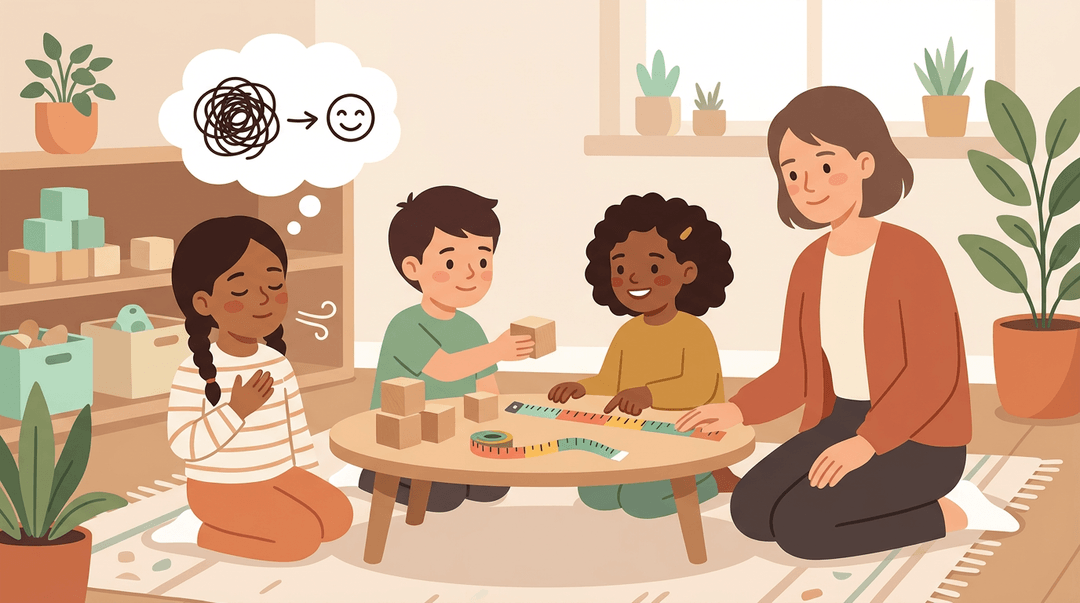
For example, a kindergarten teacher running a small-group measuring activity is also teaching kids to notice their own frustration and settle down before snapping at a partner.
The same activities build relationship skills: sharing blocks, asking for help, listening to a classmate's idea. That's where collaboration and empathy take root, not from a lecture, but from working elbow to elbow on a real task.
Using technology and digital tools
Even young learners pick up digital literacy skills just by using a tablet to sort shapes or tap through a counting app. Educational software can turn a worksheet into something interactive, and it gives teachers a quick read on who's ready to move on.
Virtual learning tools, used sparingly, add another way to meet different learners where they are without replacing hands-on practice.
Encouraging creativity and problem solving
Open-ended tasks, like building a tower with ten blocks or figuring out how to split snacks fairly, ask kids to think critically and creatively.
Think of a student who tries three different stacking strategies before one works: that's problem solving in action. These tasks also demand collaboration and communication, since explaining an idea to a partner is often harder than having it.
Exploration like this makes math feel like something to investigate, not just complete.
Strip away the jargon, and these standards are just a roadmap: counting, operations, place value, measurement, and geometry, each building toward the next.
Knowing that roadmap helps you plan lessons that actually stick, instead of guessing at what's next.
Ready to map these standards across your whole year? Check out our Curriculum & Standards planner to organize units, lessons, and standards in one place.
References
- Individual differences in executive functions and theory of mind mediate the relation between academic skills from kindergarten to 5th grade — journals.plos.org (2025)
- Kindergarten instructional practices and child reading and math growth from kindergarten through third grade | Instructional Science — link.springer.com (2025)
- What’s Past is Prologue: Relations Between Early Mathematics Knowledge and High School Achievement — pmc.ncbi.nlm.nih.gov
- California Common Core State Standards: Mathematics — cde.ca.gov
Frequently asked questions
What are common core standards for kindergarten?
Common Core kindergarten standards are shared expectations for what children should know and be able to do by the end of kindergarten. In math, they cover counting and cardinality, operations and algebraic thinking, numbers and base ten, measurement and data, and geometry.
What are common core standards for math?
Common Core math standards define grade-by-grade expectations for mathematical knowledge and skills. They include number sense, operations, algebraic thinking, measurement, data, geometry, and mathematical reasoning, with skills progressing from kindergarten through high school.
What are the California kindergarten math standards?
California kindergarten math standards are California’s adopted and modified version of the Common Core State Standards for Mathematics. They cover counting and cardinality, operations and algebraic thinking, numbers and base ten, measurement and data, and geometry, with California’s detailed framework providing guidance for instruction.
Why did Common Core fail?
Common Core did not uniformly fail, but it faced criticism and implementation challenges. Concerns included uneven access to training and classroom resources, difficulty serving different learning needs with one pace or method, and the view that some expectations were too abstract or demanding for young children.