Educational Standards Explained, From Common Core to TEKS

Jump to section
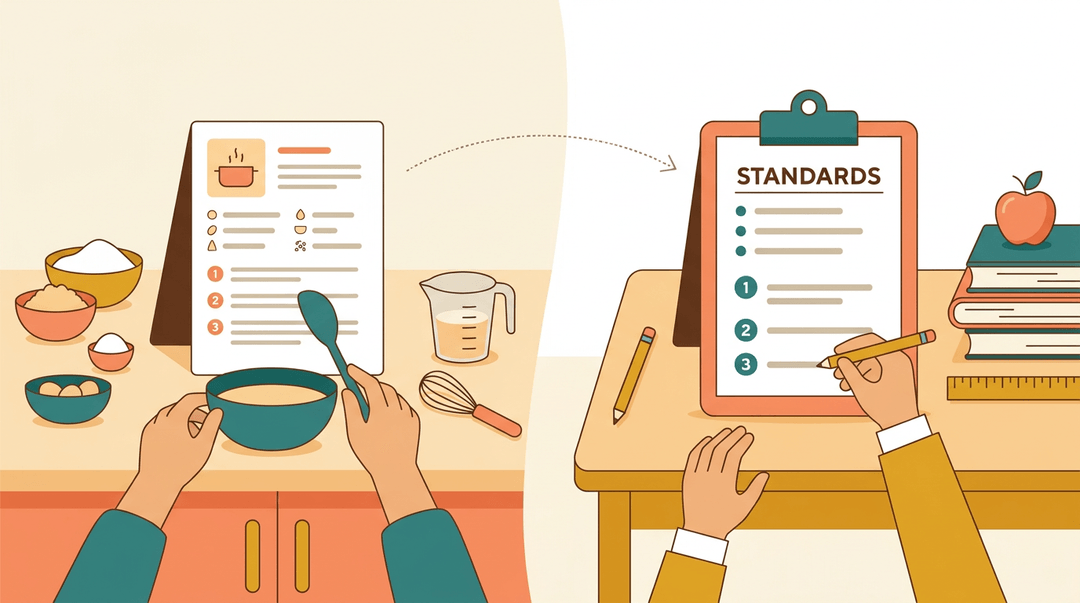
Think about following a recipe. The ingredients and steps are listed out so anyone in the kitchen ends up with the same dish, whether it's a seasoned chef or a first-timer. Educational standards work the same way in a classroom.
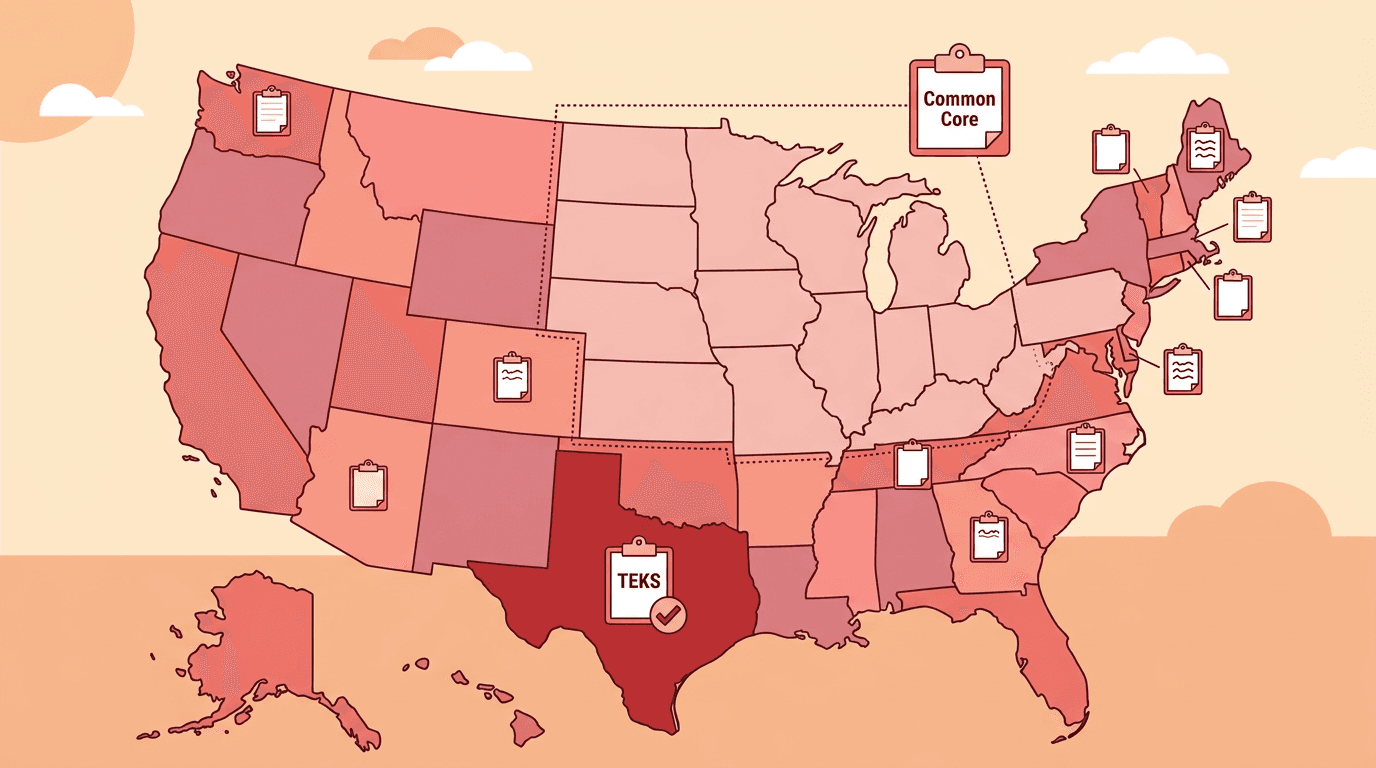
They're the shared recipe for what students should know and be able to do at each grade level. From Common Core to NGSS to state systems like TEKS, the frameworks vary, but the purpose doesn't.
In this post, we'll break down what standards actually are, how one gets built, and how to turn it into a lesson you can teach tomorrow.
What Are Educational Standards in Schools?
So what are education standards, really? They're the clear, grade-by-grade statements of what students should know and be able to do by the end of a course or year.
Educators often use academic standards and content standards interchangeably, though content standards zero in on subject-matter knowledge while academic standards also fold in skills like reasoning and communication.
How standards are grouped by subject
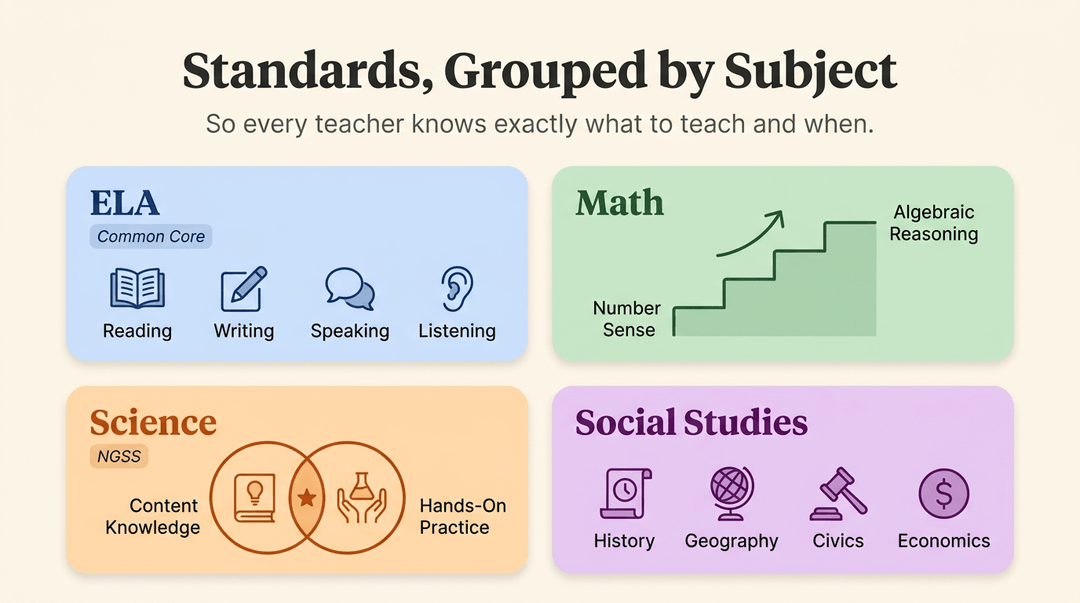
Standards are usually sorted by subject so every teacher knows exactly what to teach and when:
- ELA standards cover reading, writing, speaking, and listening, largely shaped by the Common Core.
- Math standards build skills in sequence, moving from number sense toward algebraic reasoning.
- Science standards lean on the Next Generation Science Standards (NGSS), which blend content knowledge with hands-on scientific practices.
- Social studies standards cover history, geography, civics, and economics.
How standards are organized by grade
Within each subject, standards break down into K-8 grade levels, so a third grader and an eighth grader aren't held to the same bar. Many states lean on grade-band placemats: one-page summaries showing how a skill grows across a few grades at a glance.
Science standards also group ideas into cross-cutting concept bands that repeat and deepen year over year. So what are 7th grade standards?
They're that grade's specific targets in ELA, math, science, and social studies, each one a stepping stone toward high school readiness.
Regional and national efforts to set standards
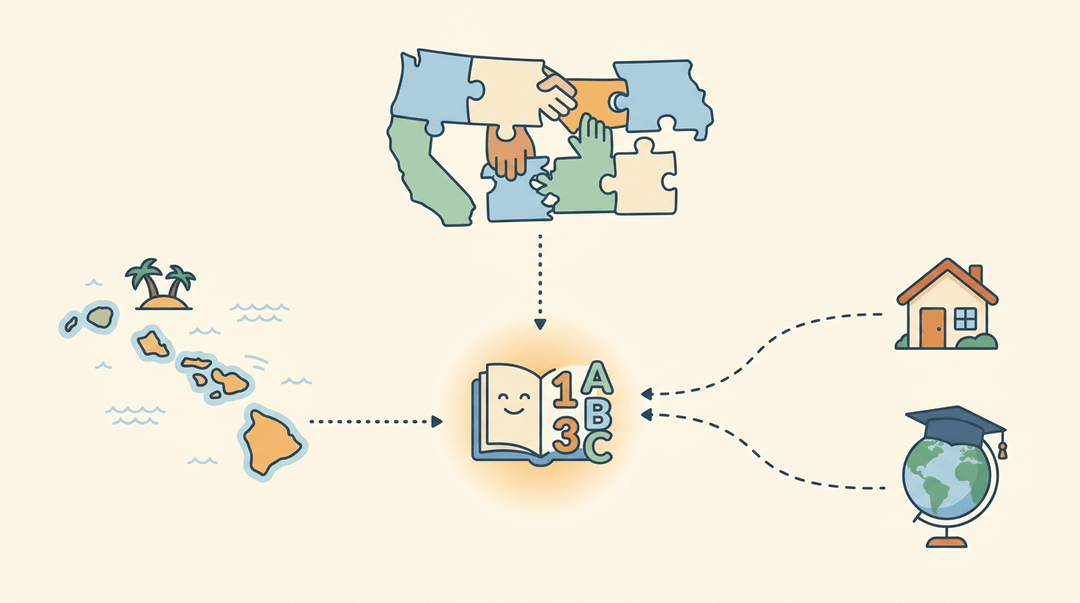
Some efforts are regional, like Pacific region development projects that tailor standards to local context.
Others grew out of a multi-state working group, pooling expertise across state lines while keeping a shared literacy and numeracy focus at the center.
Homeschool programs and the International Baccalaureate (IB) often map their own curricula back to these same standards to stay aligned with what traditional classrooms teach.
How a Single Content Standard Is Built
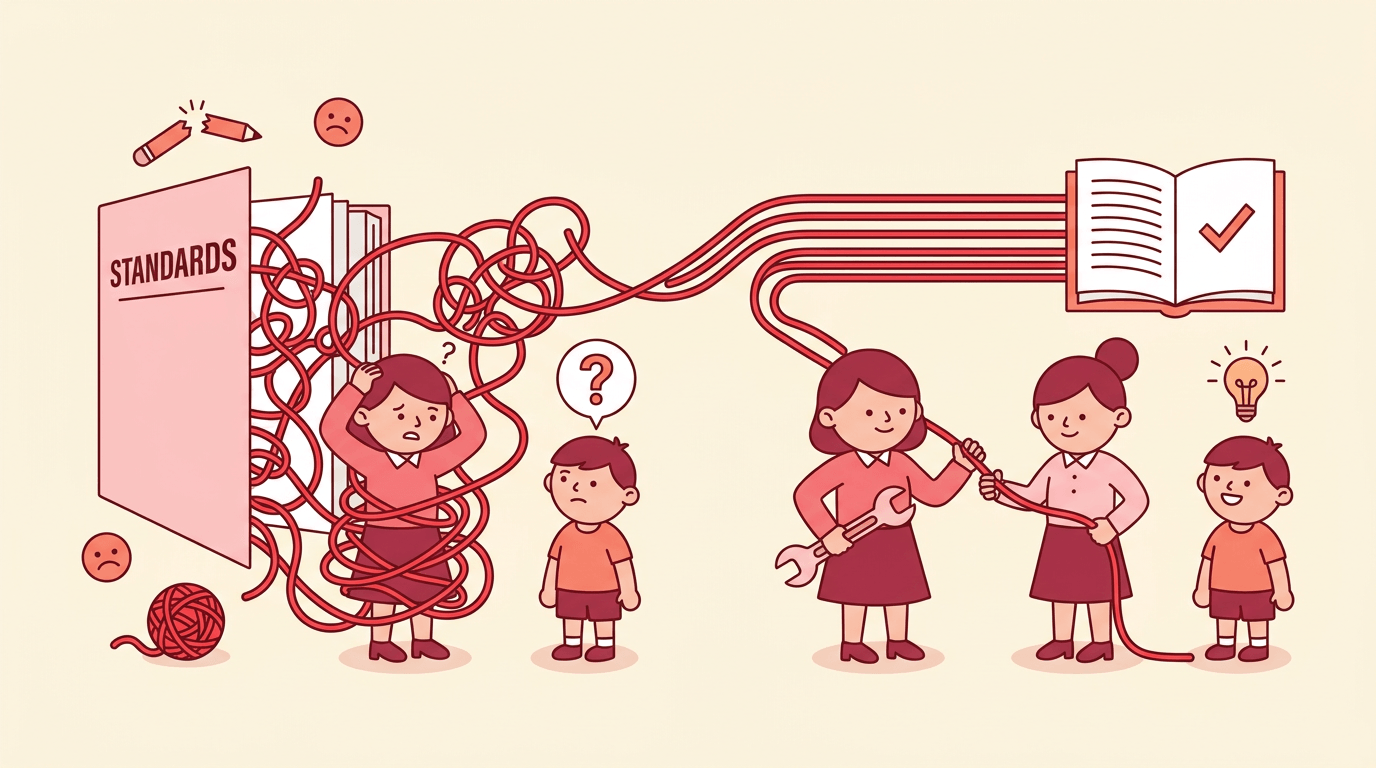
A standard can look like a jumble of letters and numbers until you know how to read it. Once you crack the code, you can unpack it into smaller learning targets, and translate it into language your students actually understand.
Reading the codes behind a standard
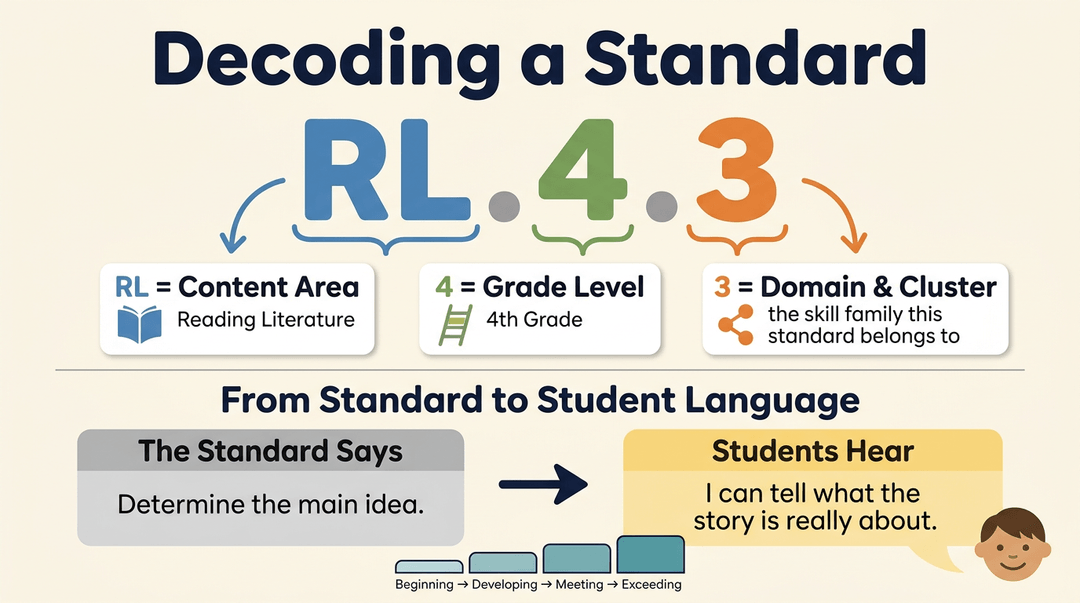
Take a code like RL.4.3. Each part tells you something specific:
- the content area tag (RL for Reading Literature)
- the grade level tag (4)
- a number that points to a domain and cluster, the broader skill family that standard belongs to within that grade
Once you've decoded it, the real work starts: breaking that one standard into a handful of learning targets or a proficiency scale students can track, then turning the formal language into something a nine-year-old can use.
"Determine the main idea" becomes "I can tell what the story is really about."
A reading standard example
Consider RL.K.6, a Kindergarten reading literature standard asking students to name the author and illustrator of a story and describe the role each one plays in telling it.
It sits in the craft and structure cluster, the group of standards focused on how a text is put together rather than just what it says.
A geometry standard example
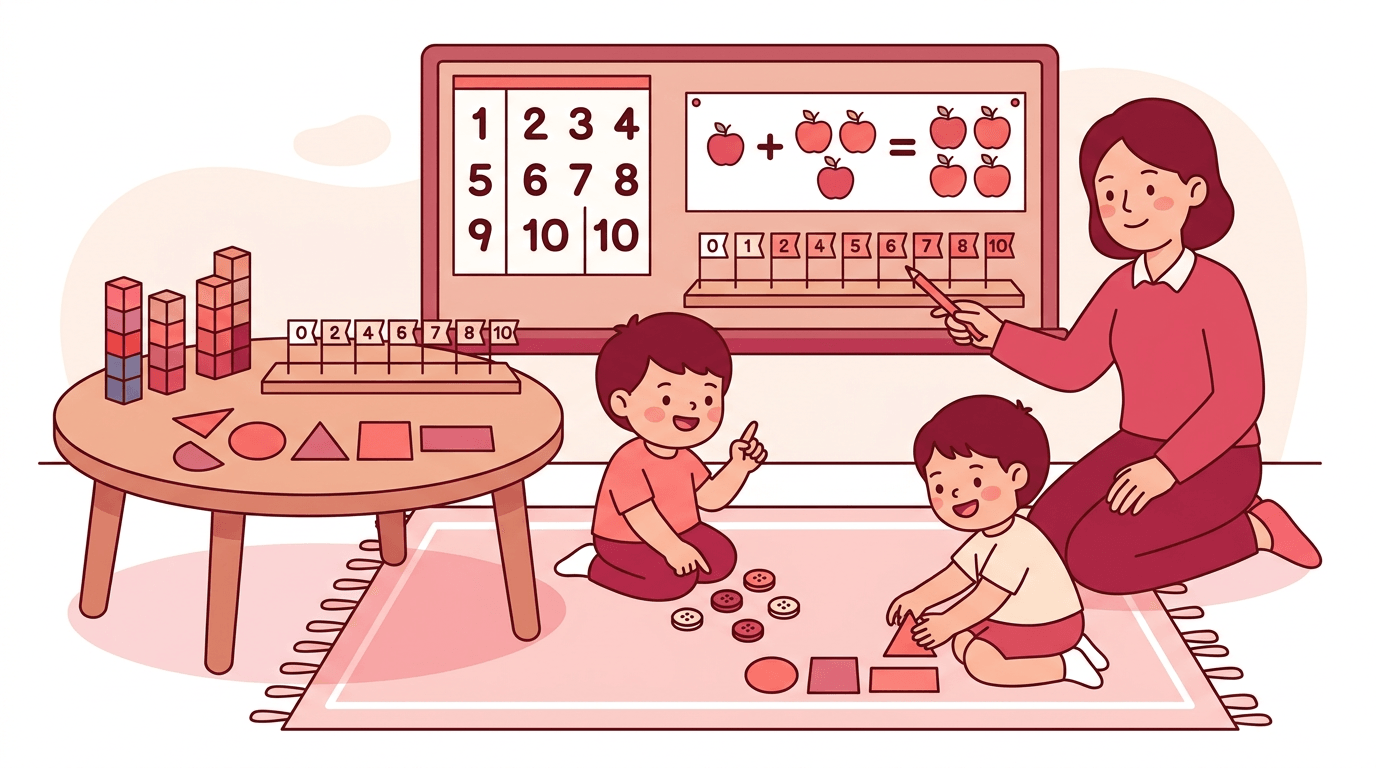
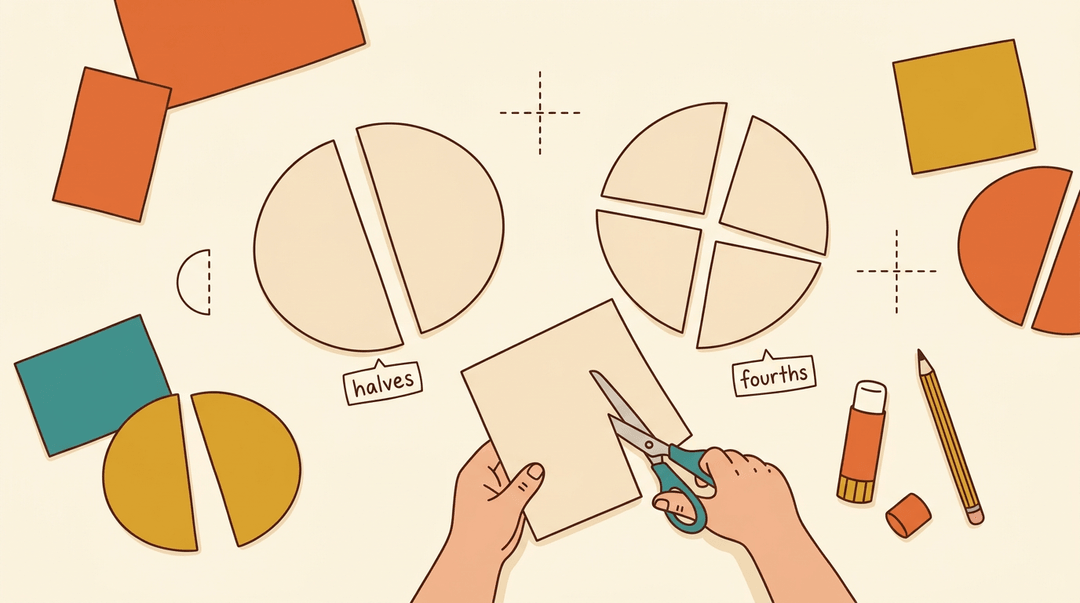
A Grade 1 geometry standard works the same way. It asks students to partition shapes into equal pieces and use the vocabulary of halves and fourths to describe them.
It's a small, concrete skill, but it's enough for a first-grade teacher to build a whole hands-on lesson around, paper shapes, scissors, and all.
Turning a Standard into a Lesson
A standard tells you what students must learn; it doesn't tell you what Tuesday looks like. This routine takes one standard and turns it into a target, a scale, and a sanity check in about ten minutes.
Unpack it in four steps
Run every standard through the same sequence, in order. We'll use one running example: "Compare and contrast two texts on the same topic."
- Read the standard and highlight the verb.
- The verb sets the cognitive bar: compare demands more than identify or list.
- In our example, the real work is compare and contrast, not summarize.
- Rewrite it as a student-friendly target.
- Start with "I can," keep the verb, swap jargon for words students use.
- On the board: "I can explain how two articles about sharks agree and disagree."
- Build a quick proficiency scale.
- Three rungs is enough: approaching, proficient, beyond.
- Approaching: names one similarity or difference with support.
- Proficient: compares and contrasts using evidence from both texts.
- Beyond: explains why the two authors see it differently.
- Check alignment with the grade band.
- Read the same standard one grade up and one grade down.
- Your target should sit between them: if next year's version adds "citing textual evidence," formal citation isn't your bar yet.
⚠️ Watch out: If your target keeps the topic but loses the verb ("I can learn about sharks"), you've planned content, not learning. The verb is the lesson.
Match the target to your grade band
The four steps never change, but what a good target sounds like shifts as students grow. Find your band and compare your draft against the sample.
| Band | What changes | A target sounds like |
|---|---|---|
| K-2 | Concrete language, things students can touch | "I can sort shapes by their sides." |
| 3-5 | Multi-step targets with visible parts | "I can find the main idea and three details that prove it." |
| 6-8 | Links across content areas | "I can use ratios to read a science graph." |
| 9-12 | Rigor and transfer to new situations | "I can apply this argument model to a topic I choose." |
Example: A seventh-grade teacher unpacking a proportions standard writes her target, then borrows a population graph from the science teacher down the hall. Same standard, two classrooms now reinforcing it, and her "beyond" rung on the scale is already written: transfer it to a new context.
Once a standard is unpacked, don't let it live on a sticky note: map every unpacked standard straight into your year-long plan with EMStudio's curriculum planner.
How Standards Get Developed and Adopted
Standards don't appear overnight. They move through a deliberate process of drafting, review, and revision long before a single classroom ever sees them.
Drafting and revising the standards
A working group, often a mix of classroom teachers, researchers, and subject-matter experts, drafts the initial benchmarks: what a fourth grader should understand about fractions, what a tenth grader should know about chemical reactions.
That draft doesn't stay in one department's hands. Curriculum specialists, assessment teams, and special education staff all weigh in, making sure the language holds up across subjects and for every learner.
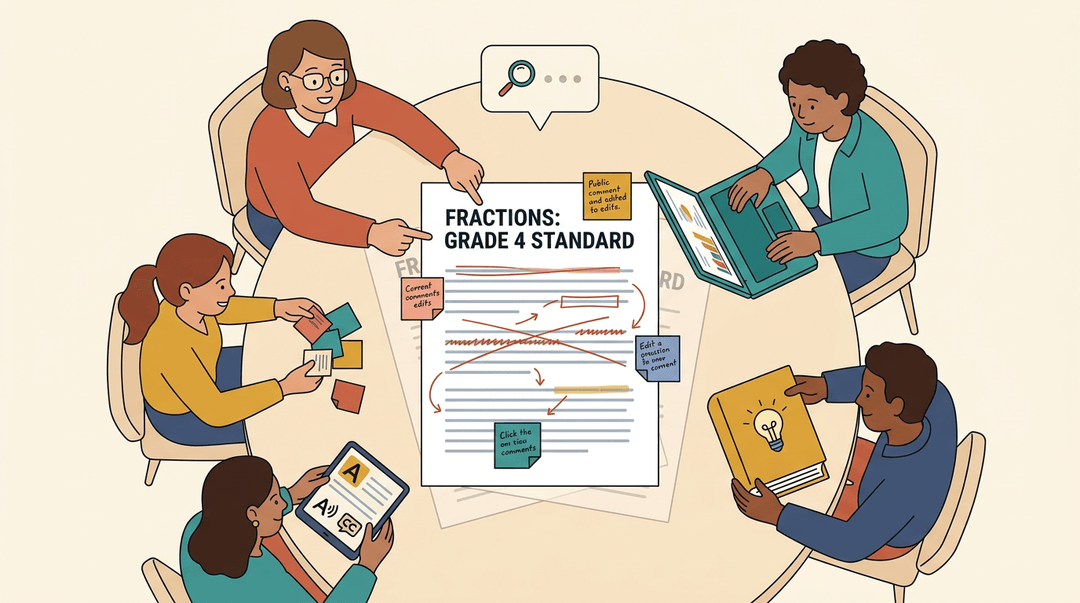
Before anything gets published, the draft goes through multiple rounds of editing, often with public comment periods, to catch gaps and clean up wording that could leave a teacher guessing how to plan a lesson around it.
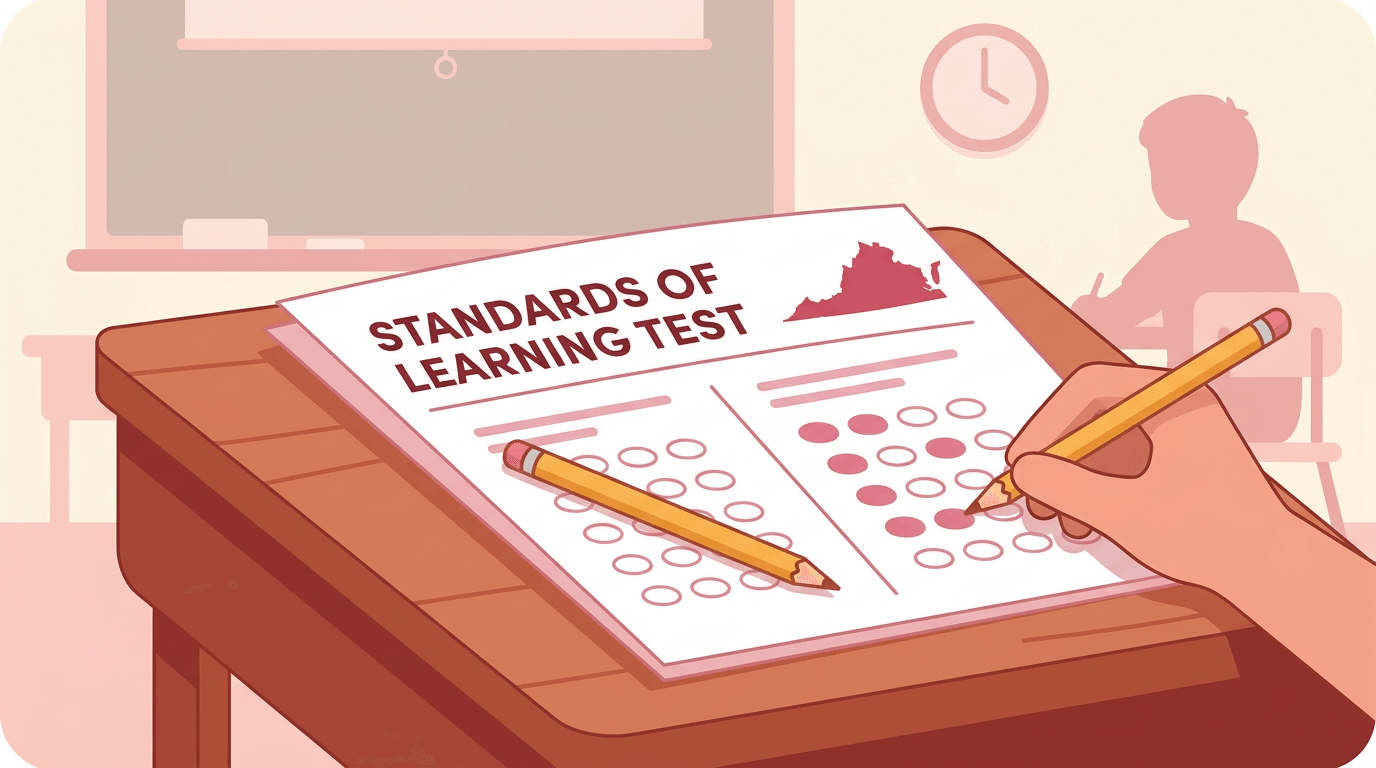
What are the state education standards in Texas?
Texas offers a clear example of how this plays out at the state level.
Its standards, known as the Texas Essential Knowledge and Skills (TEKS), are reviewed by state education leaders before being formally adopted by the association representing the state's chief education officers.
Once adopted, TEKS feed directly into Texas's broader education policy and sector plans, shaping everything from curriculum guides to classroom assessments.
For a teacher in Austin or El Paso, that alignment means a lesson built around TEKS connects directly to what the state expects students to know and do, not just recall.
Standards-based Teaching in Teacher Preparation
New teachers don't just learn a subject. They learn how to turn a standard into a lesson that actually lands, and teacher prep programs build that muscle long before the first day of student teaching.
Standards for designing your curriculum
Physical education candidates typically start with the NASPE beginning teacher standards, which spell out what a new PE teacher should know and be able to do from day one.
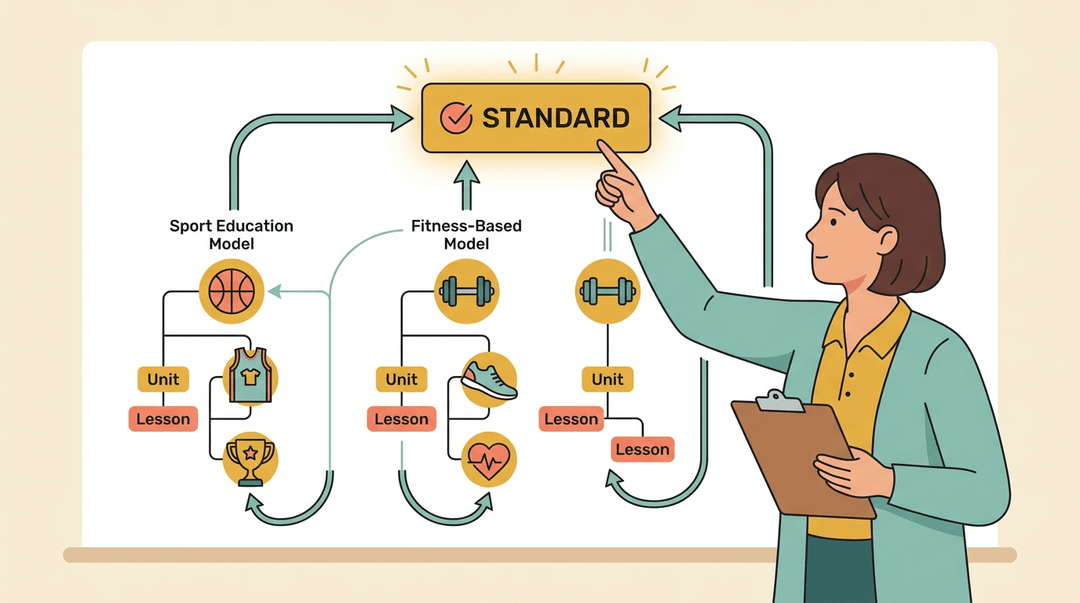
From there, prep programs teach standards-based curriculum writing: starting with the standard, then building units and lessons that lead students there, rather than planning activities first and hoping they fit.
That requires real curriculum model knowledge. Think of a student teacher comparing a sport-education model to a fitness-based model: each organizes content differently, but both have to trace back to the same standard.
Assessing students against the standards
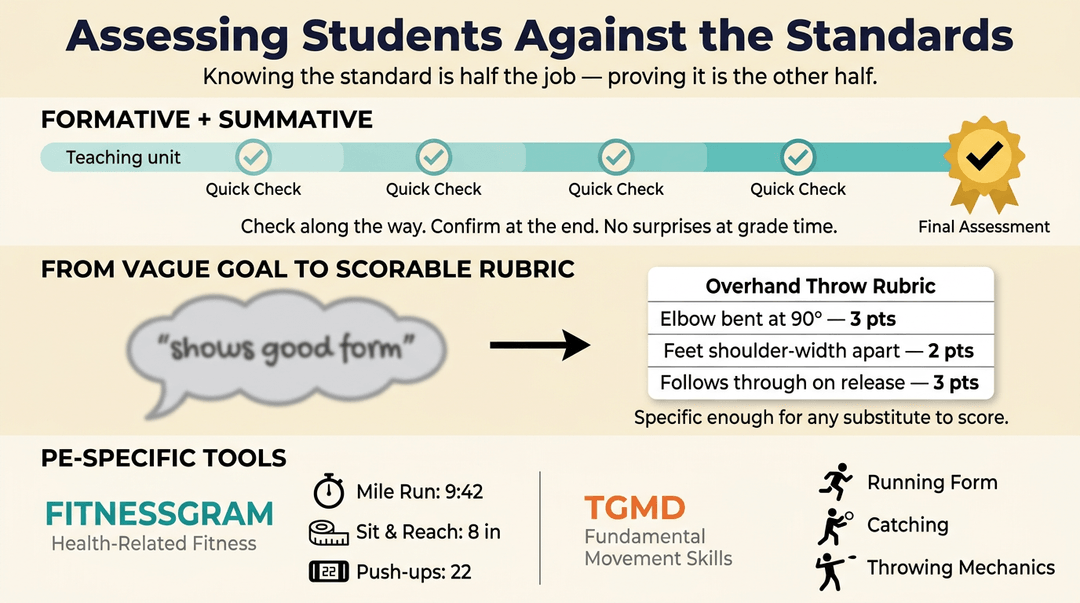
Knowing the standard is only half the job; proving students met it is the other half.
Candidates learn to blend formative and summative assessment: quick checks during a unit alongside a final measure at its end, so no one waits until the grade is already set to find out who's behind.
That skill feeds directly into grading plan creation and rubric development, where a vague goal like "shows good form" becomes specific, scorable criteria a substitute could use just as easily as the regular teacher.
In PE specifically, candidates also practice Fitnessgram testing for health-related fitness and TGMD motor assessment for fundamental movement skills, giving them concrete, standards-aligned data instead of a guess.
Standards for Professional and Clinical Assessment
Not every standard lives in a curriculum guide. Some govern the people doing the assessing, not just the students being assessed, and that's a piece of the puzzle most overviews skip entirely.
Setting standards for professional competence
When a school psychologist sits down with a student to administer a cognitive or diagnostic test, that process isn't improvised.
It's governed by psychological assessment standards: formal guidelines that spell out how an evaluation should be designed, administered, and scored so the results are valid and fair.
These standards protect students from misdiagnosis and give you, as a teacher receiving the results, confidence that the data actually means what it claims to mean.
Professional organizations are the ones who write and update these guidelines. They set the bar for what counts as sound practice, review new assessment tools, and revise standards as research evolves.
That role matters because it keeps clinical assessment from becoming a patchwork of personal judgment calls.
Those same organizations also shape training and education guidance: the coursework, supervised practice, and credentialing a clinician needs before they're authorized to assess students at all.
Think of a graduate student working toward a school psychology license. Every hour of supervised testing they log traces back to a standard someone decided was necessary for competent, ethical practice.
It's less visible than Common Core or a state framework, but it's just as foundational to getting an accurate read on a student's needs.
Standards aren't just paperwork handed down from a committee. They're the backbone of a lesson that actually teaches what it's supposed to, from the first grade-level framework down to the exit ticket you grade that afternoon.
Once you can read a standard and see the lesson inside it, planning gets a lot less stressful.
Ready to turn your standards into a plan you can actually teach from? Check out our Curriculum & Standards tool to plan units, lessons, and standards across the whole school year.
Frequently asked questions
What are the education standards?
Education standards are shared, grade-by-grade statements describing what students should know and be able to do by the end of a course or school year. They organize expectations by subject and grade level, helping teachers plan instruction and assessments consistently.
What are 7th grade standards?
Seventh-grade standards are the specific learning targets students are expected to meet in subjects such as English language arts, math, science, and social studies. They build on earlier skills and prepare students for high school, often requiring students to connect ideas, explain reasoning, and apply knowledge in new contexts.
What are the academic standards?
Academic standards define the knowledge and skills students should develop in a subject or grade level. They include content knowledge as well as broader abilities such as reasoning, communication, problem-solving, and using evidence.