How to Find the Right Debate Topics for Students at Any Age

Jump to section
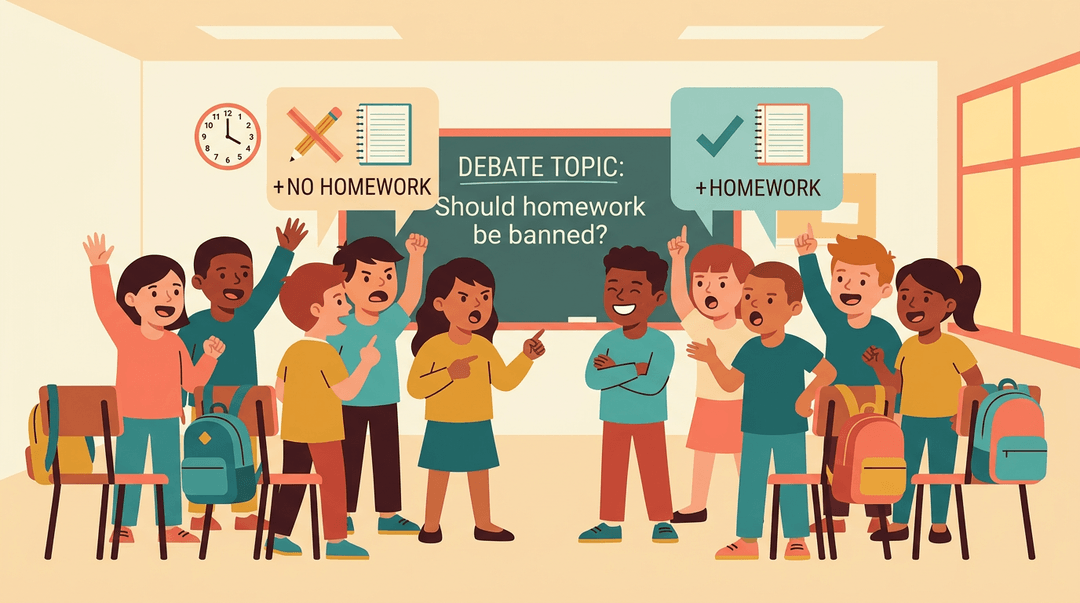
Picture a Friday afternoon when your class is buzzing about whether homework should be banned, and nobody wants to leave. That energy is exactly what a good debate topic can spark.
Debate topics for students give learners a structured way to research, reason, and respectfully disagree, whether they're in third grade or senior year.
In this post, we'll look at topics for every age group, the skills students need before they argue, a step-by-step way to run a debate, and ideas about school life, fun, technology and AI, and society and ethics.
Choosing Debate Topics for Students by Age
The right topic can make or break a debate, and the best choice depends on who is in the room.
Matching topics to age and group
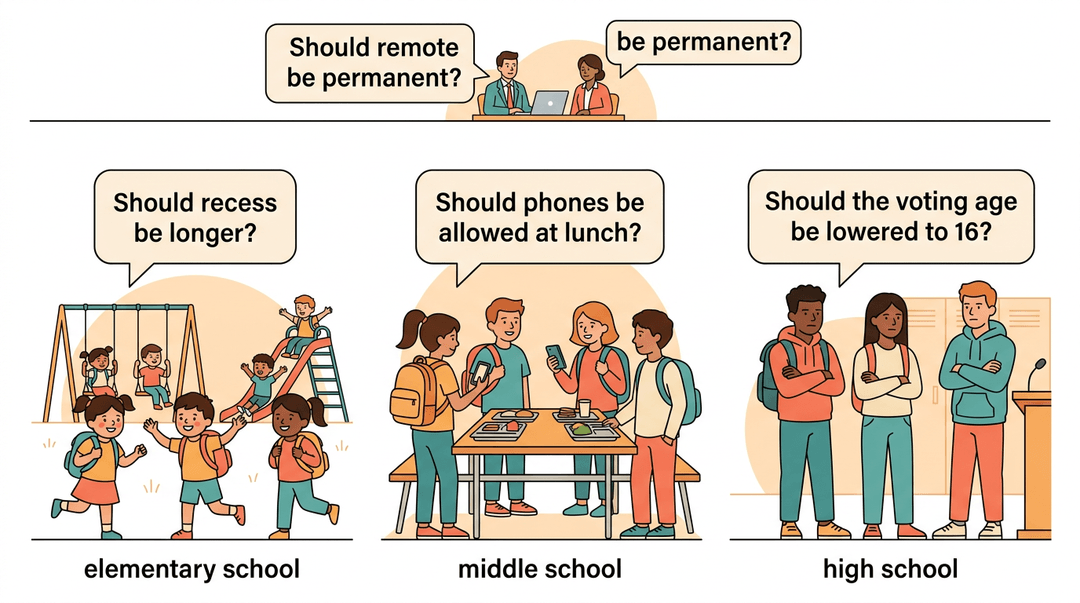
Teens respond best to topics tied to their own lives, like school policies or social media rules. Adults want stakes they recognize from work, so workplace-friendly topics, such as remote work or flexible schedules, land well in professional training.
Couple-specific icebreakers, like debating who plans the weekend, work as light warm-ups for adult groups, but they're not a fit for a classroom.
Leveling matters too. Middle schoolers need shorter claims and concrete examples, while high schoolers can handle layered trade-offs. Picture a seventh-grade teacher who swaps a broad question about government for "Should schools start later?"
Everyone can picture their own mornings. Use these grade-band starting points:
- Elementary: Should recess be longer?
- Middle school: Should phones be allowed at lunch?
- High school: Should the voting age be lowered to 16?
What makes a topic good for debate
A strong topic is relatable and easy to grasp. Students should understand the question in one read. It also sparks differing opinions, because if everyone agrees, there's nothing to debate.
Finally, it has enough evidence for pro and con, so students can build a case on both sides. Students need a question they can argue, not just one they can answer. Match the topic to your setting, and the stakes will fit the room.
Building Debate Skills and Preparation
Strong debaters aren't born with sharp arguments. They build them. Debate also has deep roots: the historic four great debates are a recognized set in the American academy.
Building a strong argument
Start with:
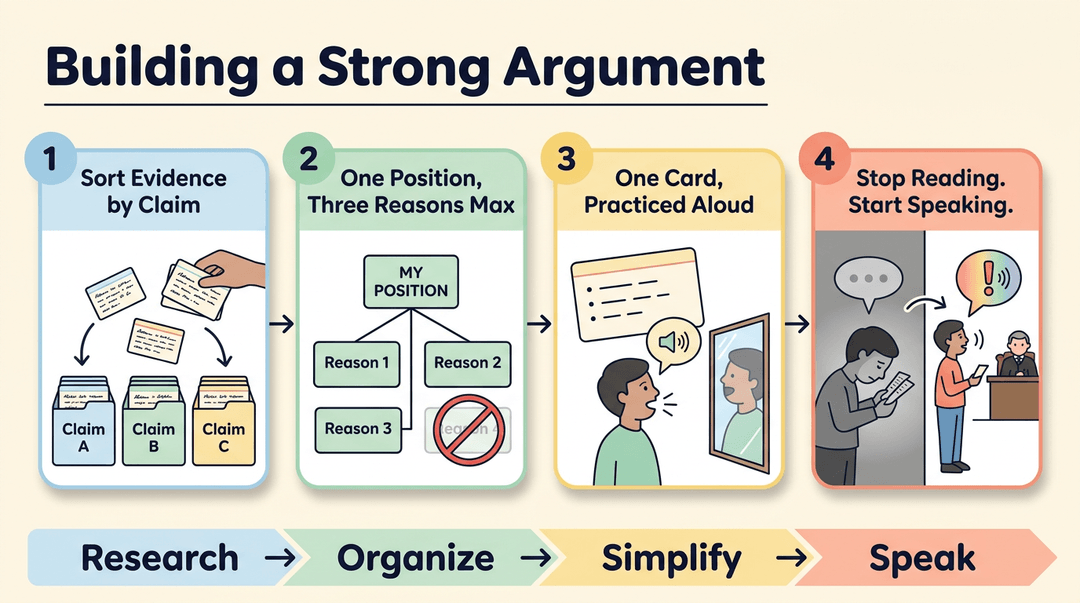
- research and note-taking, sorting evidence by claim.
- Next, organize a logical stance with one clear position and no more than three reasons.
- Then write key points on a single card and practice delivery out loud.
Consider a seventh grader who rehearses with a partner. She stops reading her notes and starts speaking to the judge.
Thinking through counterarguments
Have students write the two strongest objections to their own case. Teach them to distinguish fact from opinion: a fact can be checked, while an opinion can only be argued. When a rebuttal lands, refute it with evidence, not volume.
Easing nerves and building debate confidence
Public speaking fear is normal, so start with team debates. Structured debate also builds academic skill: a study on honors student learning describes it as a pedagogy that cultivates critical thinking and ethical, empathetic citizenship.
Pair that with respectful disagreement: attack ideas, never people.
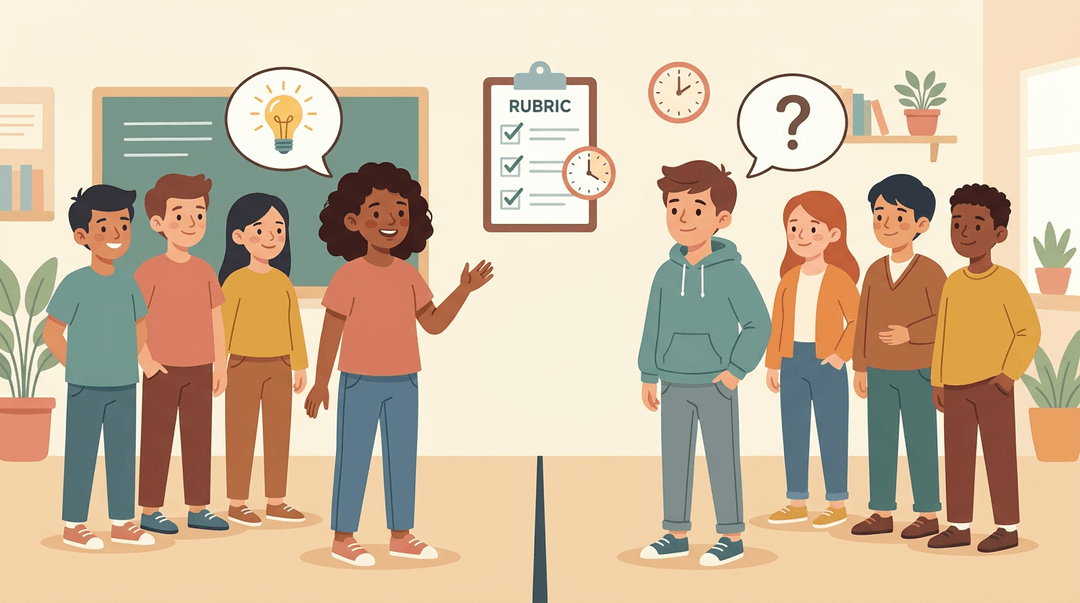
Warm up with games like 'agree or disagree,' where students move to one side of the room. Online, use breakout rooms and a shared timer. Share the judging rubric on day one so students prep for the criteria that count.
How to Run a Classroom Debate
Reach for this guide when you want a debate that runs on rails: set it up before class, steer it while it's live, and close it with a grade and a lesson learned.
Before the debate: fill in the frame
Decide these four slots before students walk in. Everything else gets easier once they're settled.
| Slot | Your entry | Example |
|---|---|---|
| Topic | A question students can argue from experience | Grade 4: "Should students wear uniforms?" |
| Sides and roles | You assign sides; each student gets a job | Opener, rebutter, closer, note-taker |
| Rubric | Three or four criteria, shared before prep | Claim, evidence, listening, respect |
| Prep limit | A fixed time, written on the board | "Prep: 10 minutes" |
Assigning sides yourself means students argue positions they didn't choose. That stretches their thinking and keeps friend groups from picking teams.
During the debate: run the clock
The structure does most of the managing for you. Keep it visible and predictable.
- Project a visible timer
- Say: "When the timer hits zero, finish your sentence."
- Rotate speaking turns by side
- Order: Side A opens, Side B opens, A rebuts, B rebuts, A closes, B closes.
- Watch tone as well as content
- Keep a quick tally of respectful and disrespectful moments for later scoring.
When something wobbles, find your row:
| When you see... | Try... |
|---|---|
| Eye-rolling or a sharp tone | Pause. Say: "Challenge the idea, not the person." |
| Talk drifting off-topic | Say: "How does that connect to our question?" |
| One student taking every turn | Give the next turn to someone who hasn't spoken |
| A speaker running over time | Point to the timer and move to the next side |
⚠️ Watch out: Score the quality of the arguments, not which side you agree with. Students notice quickly when the winner is the teacher's opinion.
After the debate: close the loop
- Score against the rubric right away
- Use your tone tally for the respect criterion.
- Debrief the key arguments
- Say: "Which argument was hardest to answer, and why?"
- Log participation grades
- Record each student's role and turns while they're fresh.
- Have students reflect
- Exit ticket: "Next debate, I'll improve by ___."
Example: A seventh-grade teacher debates "Should school start later?" She posts a 10-minute prep timer, assigns sides by row, and gives each pair an opener and a rebutter. When a rebuttal turns personal, she pauses and uses the "ideas, not people" line. In the debrief, students name the strongest opposing point, and she records scores before the bell.
Keep rosters, timers, and debate scores organized in one place with EMStudio's classroom management tools.
Debate Topics About School Life
Few debates hit closer to home than the ones about your own building. Students live these rules daily, so they usually have strong opinions.
School policies worth debating
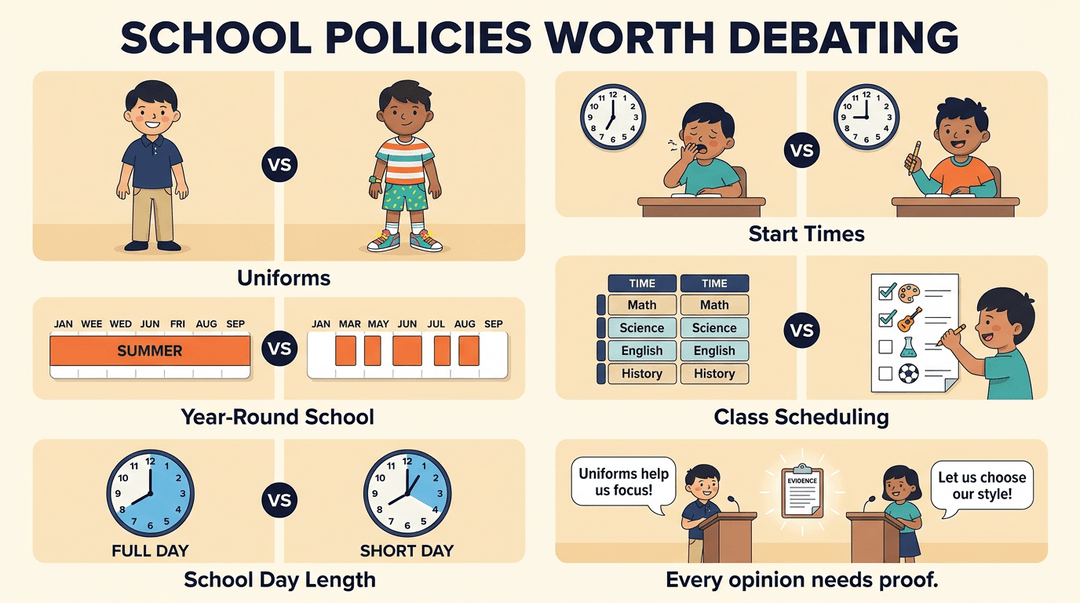
Start with the rules that shape a student's day:
- Uniforms and dress code: Should schools require uniforms, or should students choose what they wear?
- School start times: Would a later bell help teens sleep and learn better?
- Year-round school: Do shorter, more frequent breaks beat one long summer?
- Class scheduling: Should students pick their own courses?
- Shorter school days: Is less time in the building a gain or a loss?
Consider a sixth grader arguing for uniforms against a classmate who wants none. Both have to back their claims with evidence, and that's the whole point.
Grading, testing, and curriculum debates
Academic structure invites just as much friction:
- Standardized tests: Do they measure learning, or mostly test-taking?
- Pass/fail grading: Does it reduce stress, or lower motivation?
- Students grading teachers: What makes that feedback fair?
- Homework necessity: Does homework build skills, or just fill evenings?
- Curriculum choices: Should STEM or the arts get the bigger share of the day?
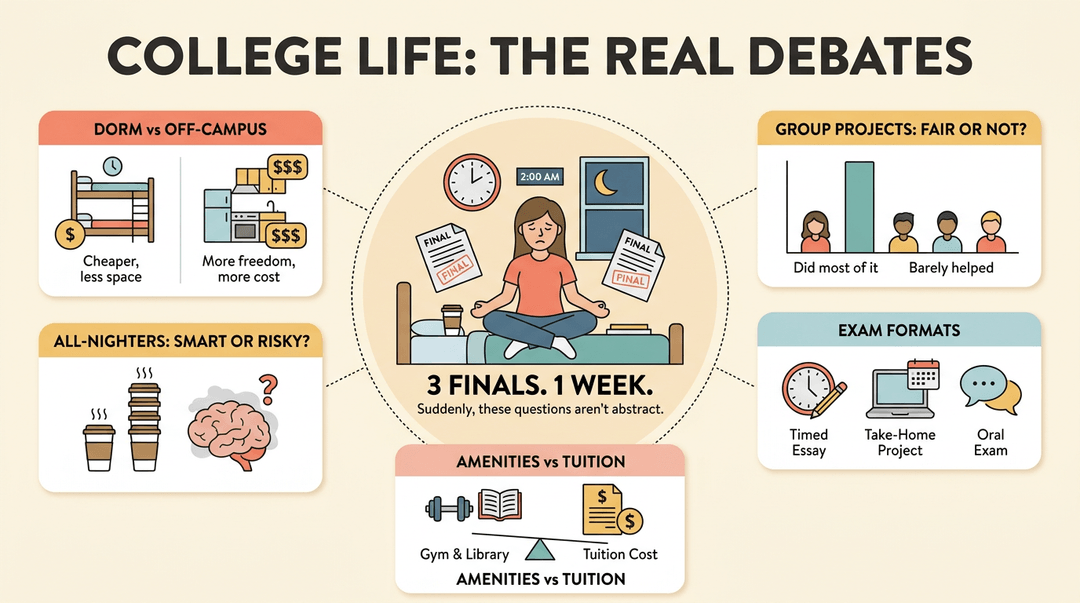
College and campus life debates
Students heading to college face a different set of questions:
- Dorm vs. off-campus living: Which setup builds independence without overspending?
- Group projects: Are they a fair test of teamwork, or a way to split unequal workloads?
- Exam formats: Should finals be timed essays, take-home projects, or something else?
- Campus amenities: Do gyms and libraries matter more than tuition?
- All-nighters and caffeine: Is pulling an all-nighter ever a smart study strategy?
Picture a college student with three finals in one week. For her, that last question is anything but abstract.
Classroom rules and student rights
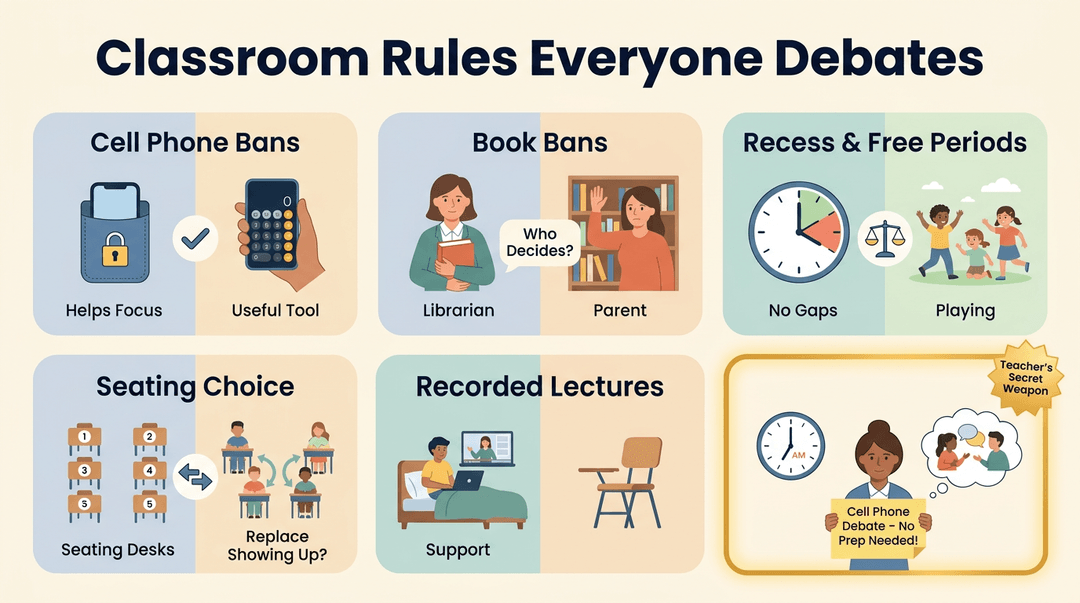
Daily classroom rules often spark the most personal debates:
- Cell phone bans: Do they help focus, or cut off a useful tool?
- Book bans in libraries: Who should decide what's on the shelf?
- Recess and free periods: Do they earn their place in a packed schedule?
- Seating choice: Should students pick where they sit?
- Recorded lectures: Do they support students who miss class, or replace showing up?
- Substitute-friendly low-prep topics: Which prompts can a sub run with almost no setup?
That last one is a teacher's secret weapon. When you're out sick and a sub needs a lesson at 7:45, a quick debate on cell phones keeps students engaged without a stack of prep.
Fun and Lighthearted Debate Topics
Nothing warms up a class like a debate nobody has to study for. These light topics get students talking, listening, and defending a position with a straight face, and they practice the same skills you'll use on heavier questions.
Food and drink debates
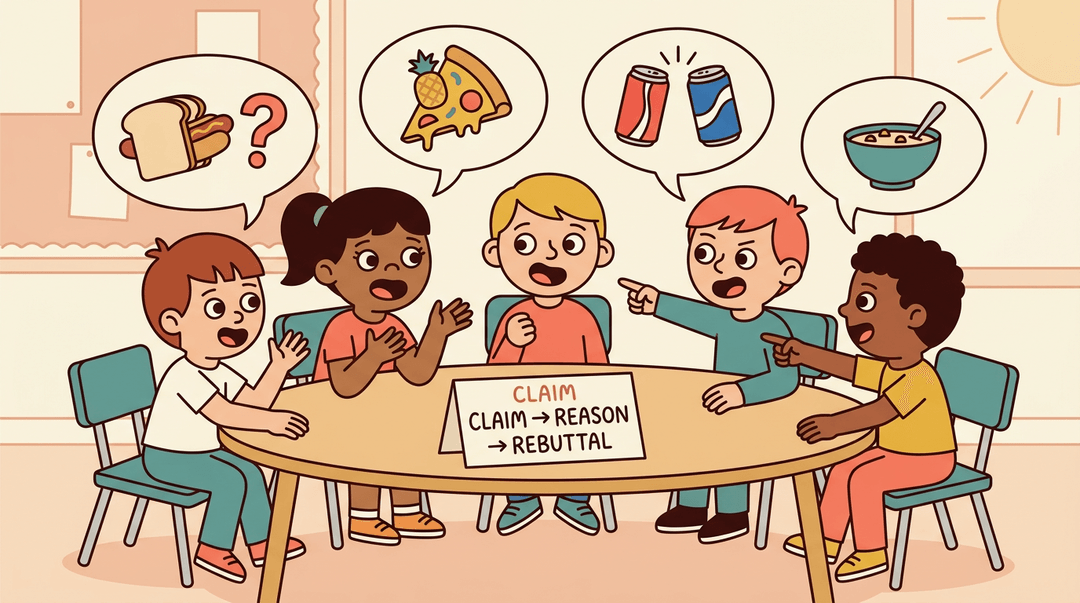
Food arguments are a great place to start because everyone has an opinion. Consider a fifth-grade teacher who opens with "Is a hot dog a sandwich?" and watches a quiet table suddenly lean in. Students can also debate:
- pineapple on pizza
- Coke vs. Pepsi
- whether cereal counts as soup
- the best pizza topping
Keep the rules simple: state a claim, give one reason, and offer a rebuttal to one opposing point. Students learn to argue why they think something, not just what they think.
Everyday things people argue about
Cats vs. dogs, summer vs. winter, and the choice of superpowers all invite strong opinions. Socks with sandals and toilet paper orientation are even better, because your students already argue about them at home.
Pair students who disagree and give each side two minutes. A quick vote afterward shows who changed their mind, and that's worth celebrating.
Pop culture debates
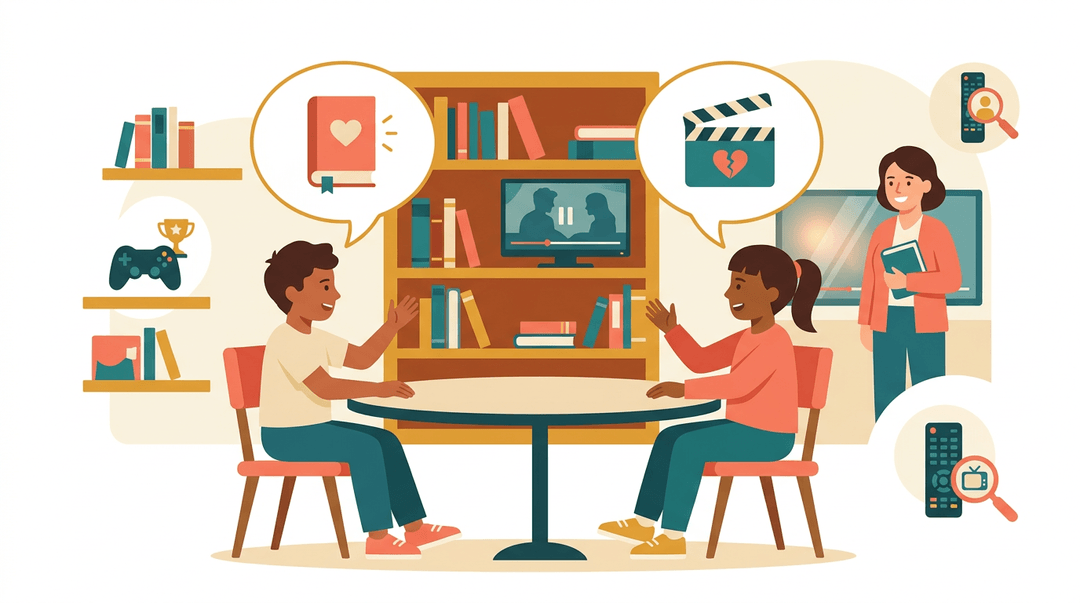
Marvel vs. DC, book vs. movie, video games as sport, and reality TV authenticity let students use media they already consume.
A middle school librarian might pair book vs. movie with a recent class read, asking which adaptation kept the story's heart and which lost it.
Video games as sport and reality TV authenticity push students to define their terms first, which makes for sharper arguments.
Casual debates for work and friends
Office snack perks, meeting scheduling humor, coworker nicknames, and couples' quirky habits are light enough for a staff lunch or a family dinner. They show students that debate is a normal part of everyday life.
Good debates are less about who wins and more about how people listen. Keep it friendly. Nobody should leave feeling roasted.
Technology and AI Debate Topics
Technology and artificial intelligence (AI) shape how students learn, talk, and spend their free time, so these questions give your class plenty to argue about. Here's where the debates tend to land.
AI's role in education
Should students use an AI tutor during exams, or does that cross into cheating? Debate whether ChatGPT belongs in essay writing or whether it's a shortcut that skips the thinking.
Should every student complete an AI literacy requirement (learning how AI works) before graduating? And should AI-generated content carry clear labels?
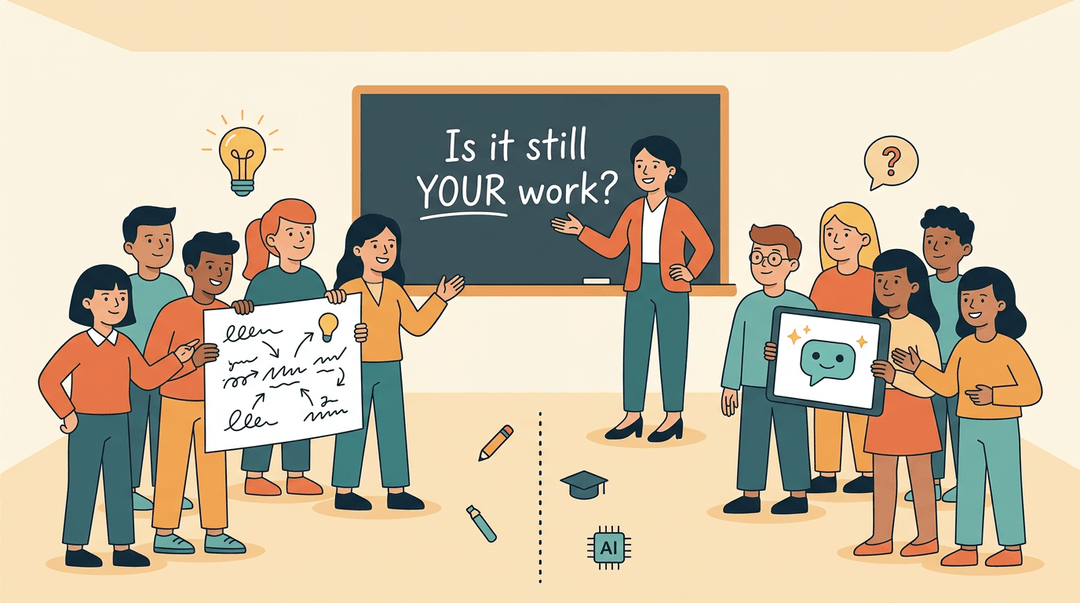
Consider a high school English teacher who asks her class to argue whether a chatbot-written essay still counts as the student's own work. Both sides have to name exactly what learning is lost or gained.
Regulating social media and digital life
Should platforms verify users' ages before they sign up? Should algorithms be restricted for minors, and should companies disclose how they use personal data?
Some students will push for anonymous posting bans, while others will defend anonymity as free expression. Let them argue both sides.
How technology affects society
Should there be firm screen time limits for kids? Debate whether tech dependency is a personal choice or a design problem, and whether self-driving car makers should be liable when a crash happens.
Net neutrality rounds out the list: should internet providers treat all traffic equally?
Social media's effect on relationships makes a strong opener.
A review on problematic social networking site use found that young adults who spent two hours or more a day on social media reported more perceived social isolation than those who spent under 30 minutes. Students can test that against their own weekends.
The real question isn't whether screens matter but how they shape your connections.

Society, Politics, and Ethics Debate Topics
These topics ask students to weigh rights, responsibilities, and the role of government. Environmental and science debates show up here too, especially in the GMO question below. Pick the one that fits your unit, not just the one that feels safest.
Government and civic policy debates
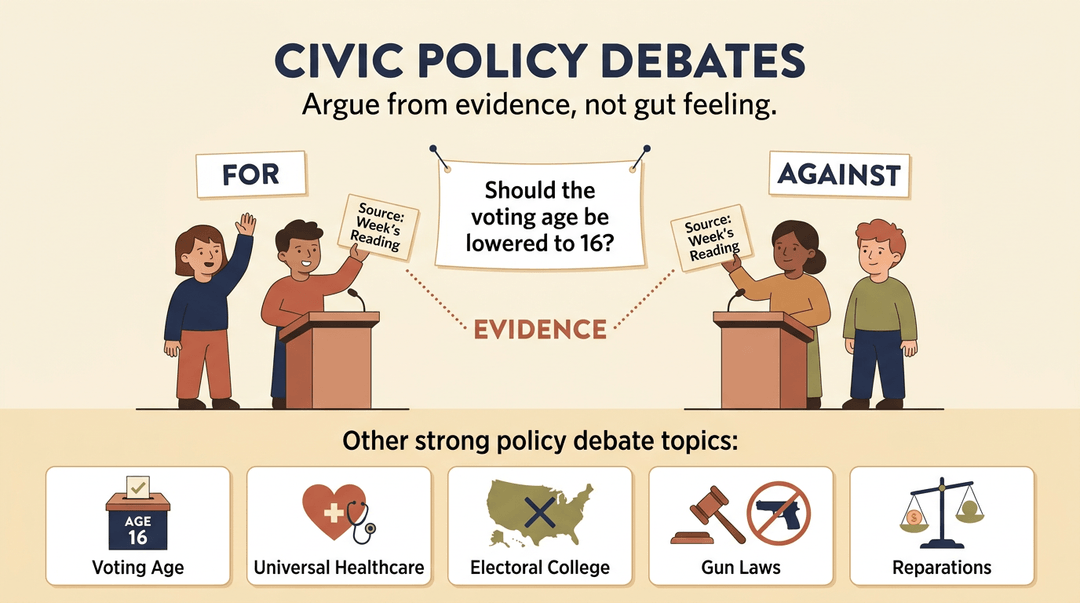
Students examine civic policy, the rules a community sets for itself. Strong options include lowering the voting age, universal healthcare, abolishing the Electoral College, gun laws, and reparations.
For example, a high school civics teacher might assign teams to argue for and against lowering the voting age. Each team must cite a source from the week's reading, so students learn to argue from evidence instead of gut feeling.
Health and bioethics debates
Bioethics asks not just what medicine and science can do but whether they should. Strong topics include euthanasia and assisted suicide, vaccine mandates, drug legalization, human cloning, and genetically modified organism (GMO) regulation.
A biology teacher might pair the GMO debate with a short reading on crop science. Science first, policy second.
Social justice and human rights debates
These debates center on fairness under the law and who gets a voice in decisions. Topics include criminal justice reform, the death penalty, immigration policy, transgender athletes, and felon voting rights.
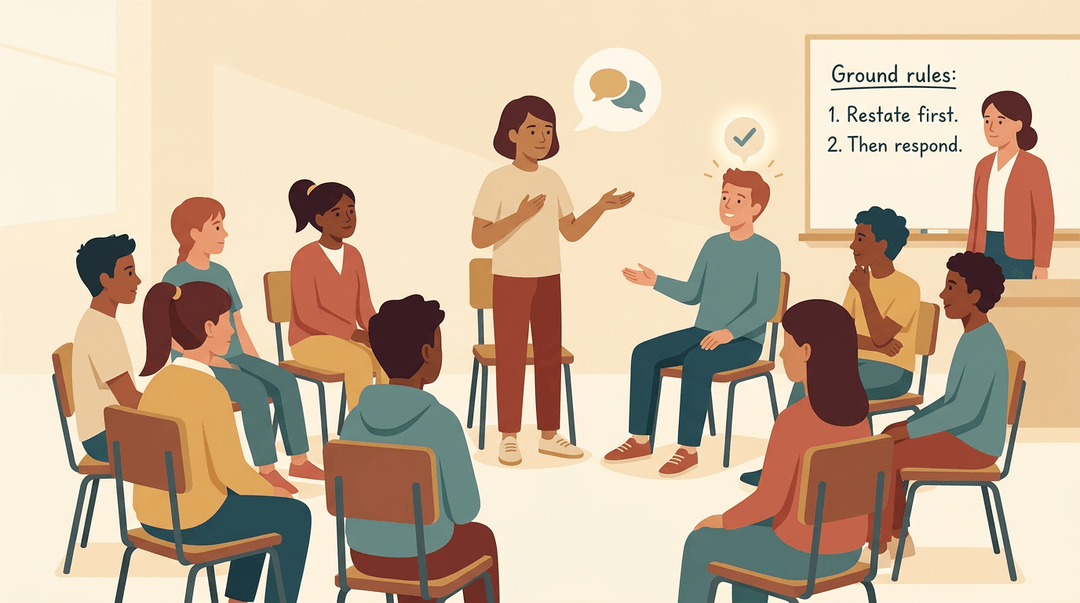
Before the criminal justice reform debate, a social studies teacher sets clear discussion norms. Each student must restate the other side's argument to the teacher's satisfaction before rebutting it. The payoff is a calmer room and sharper arguments.
Economy and business ethics debates
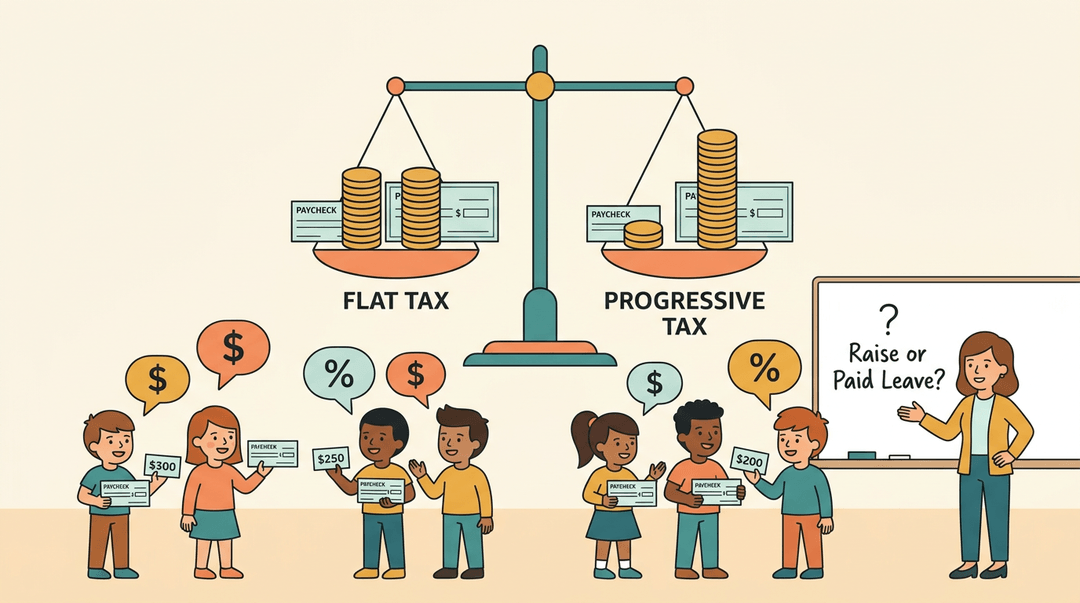
These topics test how we balance fairness, growth, and personal choice. Students can debate raising the minimum wage, universal basic income, paid parental leave, corporate diversity quotas, and the flat tax system.
A flat tax charges everyone the same rate, while a progressive tax charges higher earners more.
An economics teacher might give each student a fictional paycheck and ask whether a raise or paid leave would matter more to them. Students then argue the policy from that personal starting point, and abstract policy becomes concrete.
Debate topics for students work best when they match the learners in front of you and when the structure around them is clear. Start with a question your students already care about, give them time to prepare, and make sure every voice gets a turn.
Ready to get your debate lessons organized? Check out our Classroom Management feature to keep your classes, sections, rosters, and timetables in one place so debate day runs smoothly.
References
- Claiming Debate's Value for Honors Student Learning — files.eric.ed.gov
- Problematic Social Networking Site use-effects on mental health and the brain — pmc.ncbi.nlm.nih.gov
- The study of international relations in Japan: towards a more international discipline — exa.ai (2001)
Frequently asked questions
What are the four great debates?
The four great debates commonly refer to major foundational debates in international relations theory: the idealism versus realism debate, the traditionalism versus behavioralism debate, the interparadigm debate, and the debate between rationalist and reflectivist approaches. Their exact labels can vary by academic source.
What are the 7 types of debates?
Seven common debate formats are parliamentary, Lincoln-Douglas, policy, public forum, academic, team policy, and impromptu debate. They differ mainly in team size, speaking order, preparation time, and the type of evidence required.
What are some debate games?
Debate games include “agree or disagree,” where students move to different sides of the room; “four corners,” where each corner represents a position; and “hot takes,” where participants defend a surprising claim. Other options include role-reversal debates, speed debates, and light prompts such as “Is a hot dog a sandwich?”
What's the best topic for debate?
The best debate topic is one that is easy to understand, relevant to the participants, supports credible arguments on both sides, and creates genuine disagreement. For students, “Should schools start later?” is a strong choice because it connects to their daily lives and allows evidence-based arguments about sleep, learning, schedules, and school operations.