Deductive Reasoning Examples That Make the Logic Click

Jump to section
Think about the last time you read a mystery novel: the detective gathers clues, rules out suspects, and lands on one conclusion that simply has to be true.
That's deductive reasoning: starting with general truths and following them, logically, to a certain answer.
It's one of the most useful thinking skills you can build in students, and in this post, we'll break down how it works, where it differs from inductive and abductive reasoning, and how to teach it well.

Deductive Reasoning Examples Start Here
Seeing deduction in action makes it click faster than any definition alone. Here's how the logic actually builds, piece by piece, from a general rule to a conclusion you can trust.
Going from general rules to specific conclusions
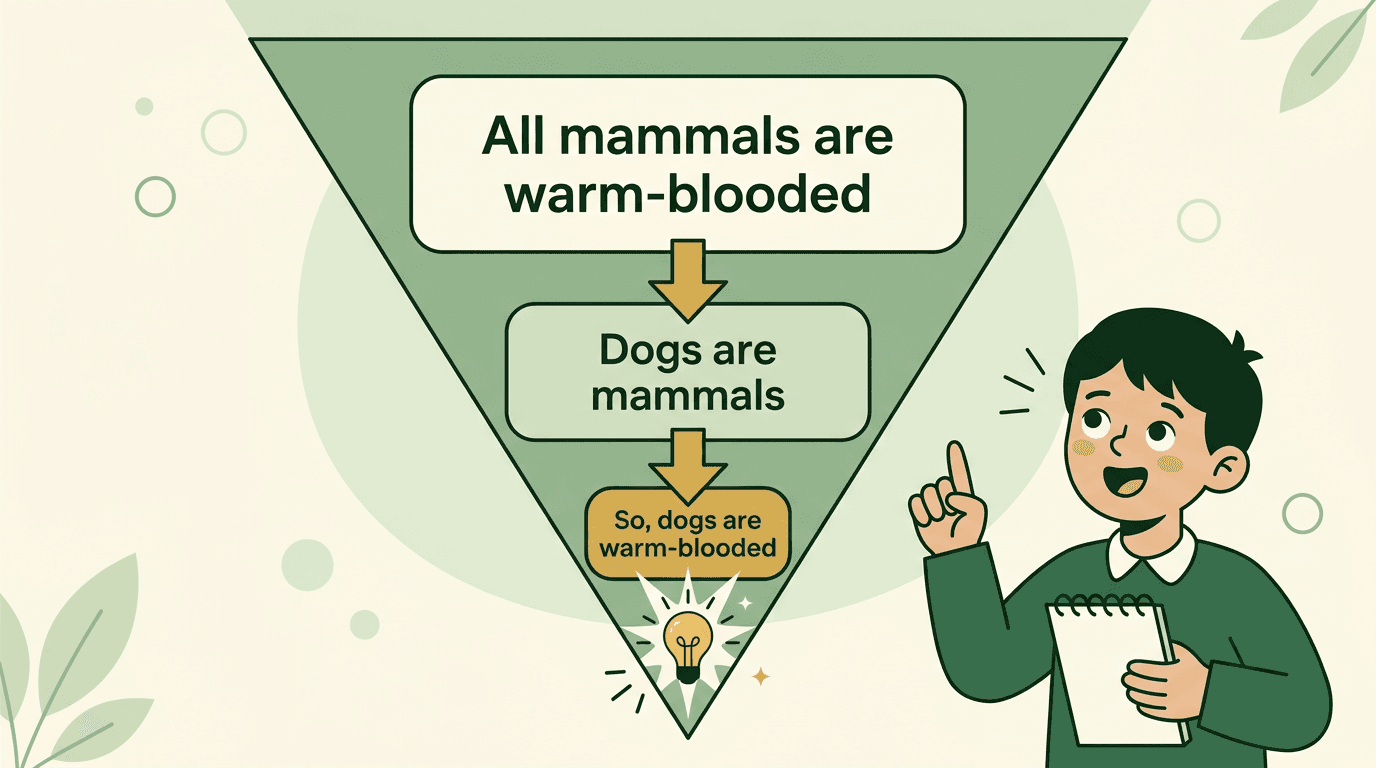
Deductive reasoning is top-down: you start with a general premise and narrow it down to a specific case. If the starting premise is true, the conclusion is logically guaranteed, not just likely.
This is also simply called deduction, and it's why math proofs and geometry lean on it so heavily.
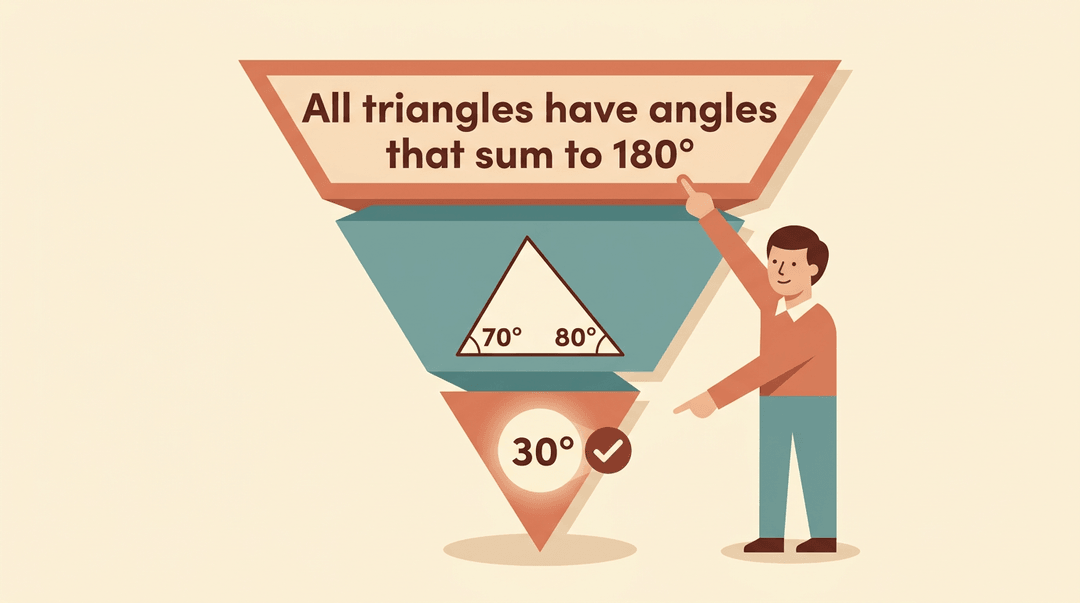
For example, a geometry teacher might start with "all triangles have angles that sum to 180 degrees" and walk students straight to the missing angle in a specific triangle.
How premises build a syllogism
Most deductive arguments take the shape of a syllogism:
- a major premise (the general rule)
- a minor premise (a specific case)
- a conclusion that follows from both
"All mammals are warm-blooded. A dog is a mammal. Therefore, a dog is warm-blooded." That's the format: general rule, specific case, guaranteed conclusion.
One useful variation is the conditional syllogism, built on "if, then" statements. Modus ponens affirms the condition ("If it rains, the game is canceled. It's raining. The game is canceled.").
Modus tollens works backward from the negative ("The game wasn't canceled, so it didn't rain.").
Why valid arguments can still be untrue
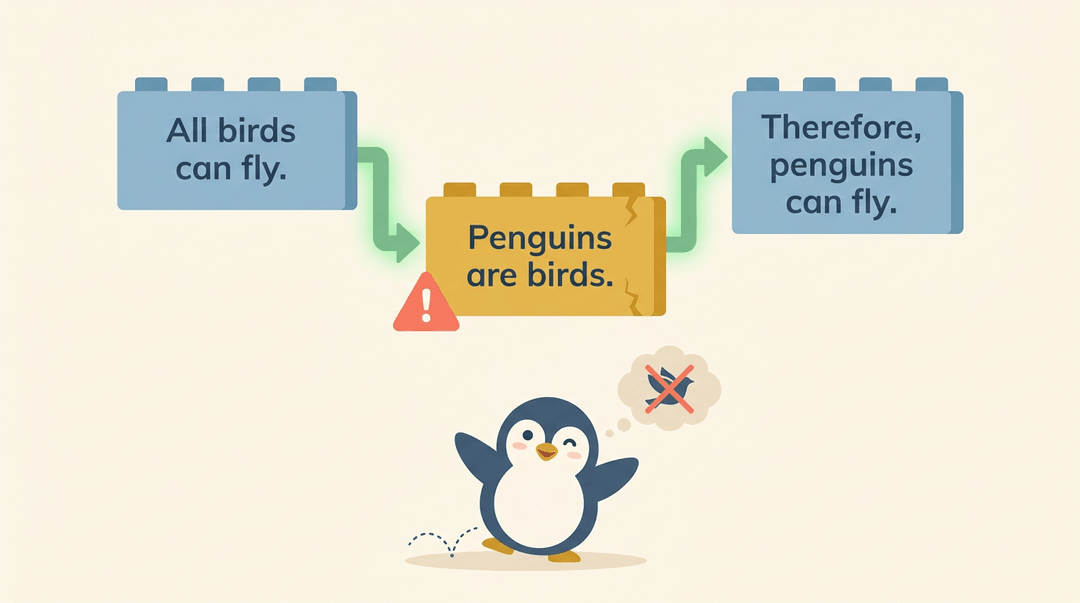
Here's the catch: an argument can be perfectly valid in structure while being factually untrue. "All birds can fly. Penguins are birds. Therefore, penguins can fly" follows the rules but rests on an unproven premise.
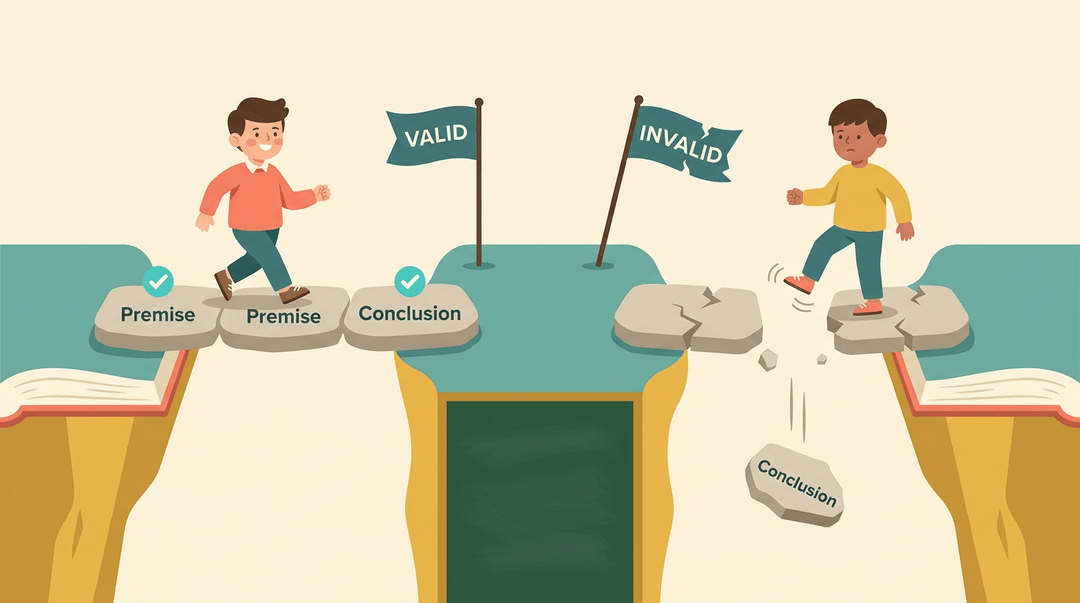
That's the difference between logical validity and factual truth, and it's the root of most deductive fallacies: the logic holds, but a premise doesn't.
Teaching Deductive Reasoning in Your Classroom
You don't need a full logic unit to teach deduction. You need an example sized to your grade level, one ten-minute routine, and a plan for the three predictable places students go wrong. Here's all three.
Pick the format for your grade level
| Grade band | Anchor format | What it looks like |
|---|---|---|
| Elementary | Simple if-then rules | "If it rains, we have indoor recess. It's raining. So..." |
| Middle school | Syllogism sorting | Card sets students sort into valid vs. invalid piles |
| High school | Geometry proofs | Two-column proofs where every line names its justification |
The skill is the same at every level: the conclusion must follow. Only the packaging changes.
Run the two-premise routine
- Write two premises on the board.
- Example: "All mammals breathe air. Whales are mammals."
- Have students state the conclusion.
- Say: "If both lines are true, what MUST be true next?"
- Insist on "must," not "probably": that word is the whole lesson.
- Discuss validity versus truth.
- Valid asks: does the conclusion follow? True asks: do the premises match reality?
- ✅ "All squares have four sides. This is a square. So it has four sides." Valid and true.
- ❌ "All fish fly. Trout are fish. So trout fly." Valid but false: the logic holds, the first premise doesn't.
Key principle: An argument can be perfectly valid and completely wrong. Validity judges the wiring; truth judges the parts. Students who can hold those apart have learned deduction.
Catch the three misconceptions
| When students... | Respond with... |
|---|---|
| Confuse deduction with induction | "Does this HAVE to be true, or is it just likely?" |
| Assume premises are always true | The flying trout argument: valid logic, false premise |
| Skip logical steps | A "because" required for every line, proof-style |
That last fix travels well beyond geometry: a paragraph, a science claim, or a debate argument all tighten up when each step has to earn its "because."
Once the routine clicks, save these reasoning activities as reusable lesson plans in EMStudio's online lesson planner so next semester's version takes minutes, not an evening.
Deductive Reasoning Examples
Definitions are easier to grasp once you see them in action, and not every "deductive" example is equally solid. Comparing a few side by side shows what actually makes an argument airtight.
Which is the best example of deductive reasoning?
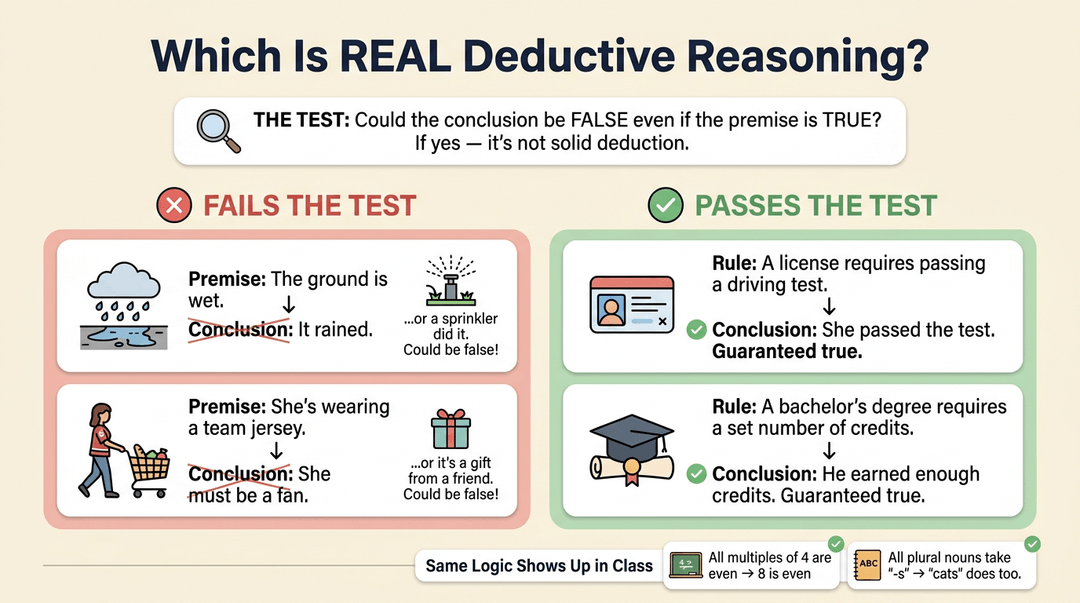
Four familiar claims get tossed around as deductive reasoning:
- rain makes the ground wet
- a valid driver's license means someone passed a driving test
- a bachelor's degree requires a set number of credits
- a shopper in a team jersey at the grocery store must be a fan
Only some hold up. The rain and wet ground example fails: wet ground doesn't prove rain caused it, since a sprinkler could too. The grocery store jersey scenario is similarly weak. A jersey suggests a fan but doesn't guarantee one.
The driver's license and bachelor's degree credits examples are the strongest, because the premise states a fixed rule ("a license requires passing a test") and the conclusion has to follow.
That's the real test we use for the best example: can the conclusion be false if the premises are true? If not, it's solid deduction.
The same structure shows up in classroom math ("all multiples of 4 are even, so 8 is even") and grammar drills ("all plural nouns take '-s,' so 'cats' does too").
Examples from science and nature
Science hands you clean categorical syllogisms:
- all mammals have backbones, so a dog has one
- all birds lay eggs, so a robin does
- all plants perform photosynthesis, so a fern does
- all spiders have eight legs, so a tarantula does
Each rests on a settled category, which is exactly what makes the conclusion certain rather than probable.
Inductive Reasoning Basics
Deductive reasoning starts with a rule and tests a case against it. Inductive reasoning runs the other way, and it's worth knowing well before you contrast the two in class.
How inductive reasoning works
Inductive reasoning is bottom-up reasoning: it starts with specific observations and builds toward a general rule. You've also heard it called inference, since you're inferring a likely pattern rather than proving a fact.
Spot the same result enough times, and you generalize it into a rule you expect to hold going forward.

Everyday examples of inductive reasoning
Your students already reason this way outside of math class:
- Every dog they've met at the park has been friendly, so they expect the next one to be friendly too.
- Dairy has upset their stomach a few times, so they conclude dairy makes them sick.
- A week of record-high temperatures suggests a pattern of unusual heat.
- Fireflies show up every summer, so they expect them again next year.
- Pulling five red coins in a row from a bag suggests the bag is full of red coins.
Each case moves from specific instances to a general expectation.
Where inductive reasoning falls short
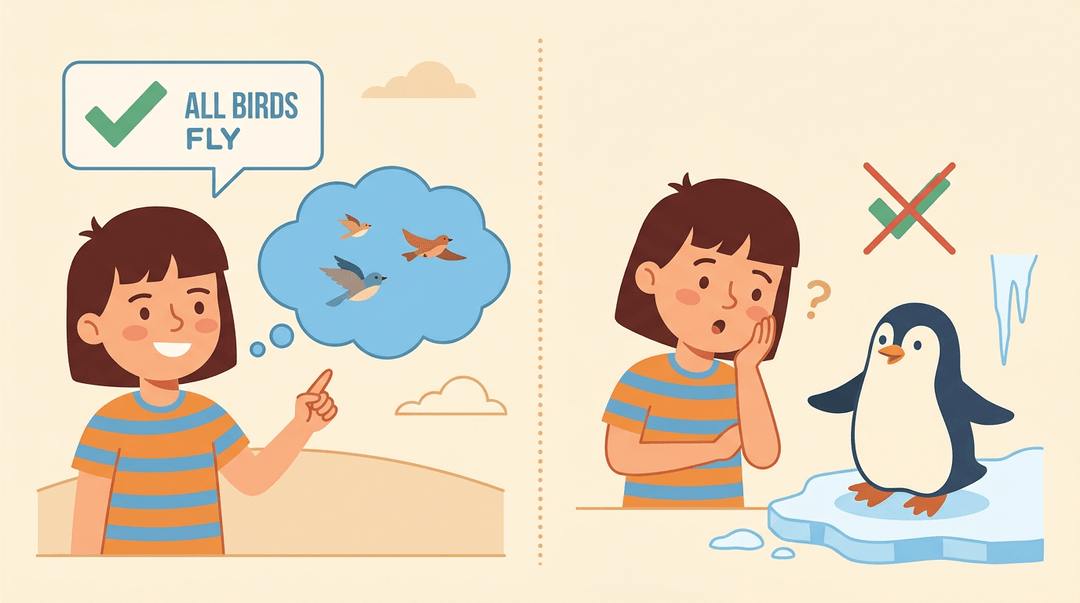
The catch: inductive reasoning can't guarantee truth, only likelihood. A small sample size can mislead you, and incomplete observations carry real risk.
Consider a student who's only ever seen flying birds and concludes all birds fly: a penguin breaks that rule instantly. The pattern held until it didn't, and that's the tradeoff worth naming for students before they trust a generalization too far.
Deductive vs Inductive Reasoning
Once you've got a feel for deduction, the natural next question is how it stacks up against its closest cousin: induction.
Both are tools for building an argument, but they pull in opposite directions, and knowing which one you're looking at changes how you judge it.
How to tell if an argument is deductive or inductive?
Deductive reasoning works top-down: it starts with a general rule and narrows to a specific conclusion. Inductive reasoning flips that path, moving bottom-up from specific observations toward a general claim.
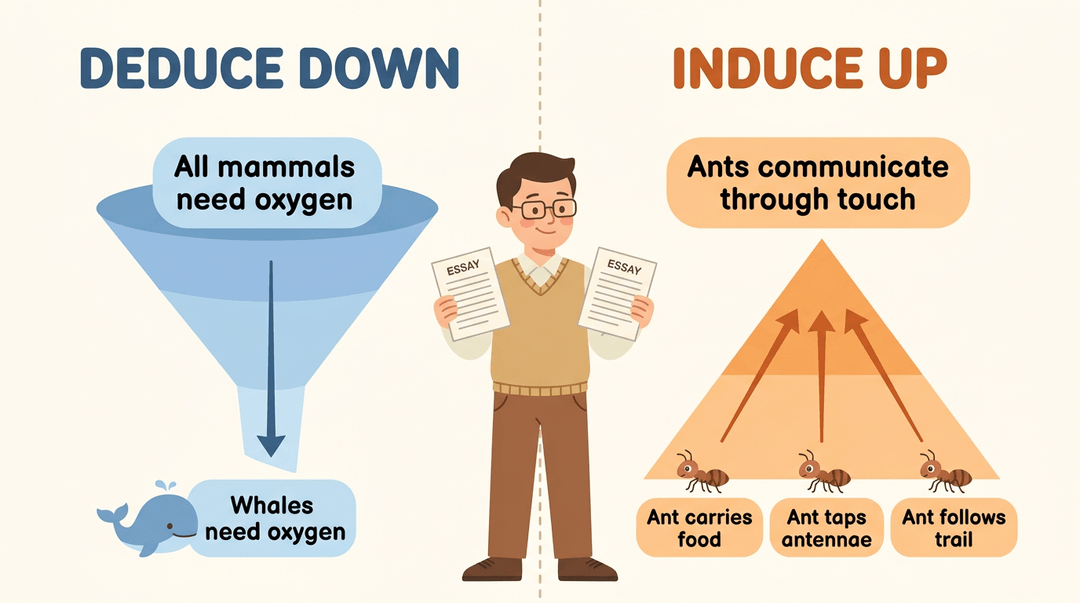
One easy mnemonic memory trick: "deduce down" (general to specific) and "induce up" (specific to general). That small phrase makes identifying argument type much faster when you're reading a student's essay or refereeing a class debate.
For example, consider a middle school teacher grading two essays. One opens with "all mammals need oxygen" and ends with "so whales need oxygen": that's deductive.
The other lists three field-trip observations about ants and concludes "ants must communicate through touch": that's inductive.
Certainty versus probability in arguments
A valid deductive argument with true premises guarantees a true conclusion, full stop. Induction can only ever offer probability: even a mountain of supporting evidence leaves room for a surprising exception.
That's why inductive conclusions can always be challenged by new evidence, while a deductive conclusion can only be challenged by attacking its premises or its logic.
This points to the strength vs validity distinction: deductive arguments are judged by validity (does the structure hold?), while inductive arguments are judged by strength (does the evidence make the conclusion likely?).
Comparing the two with diagrams
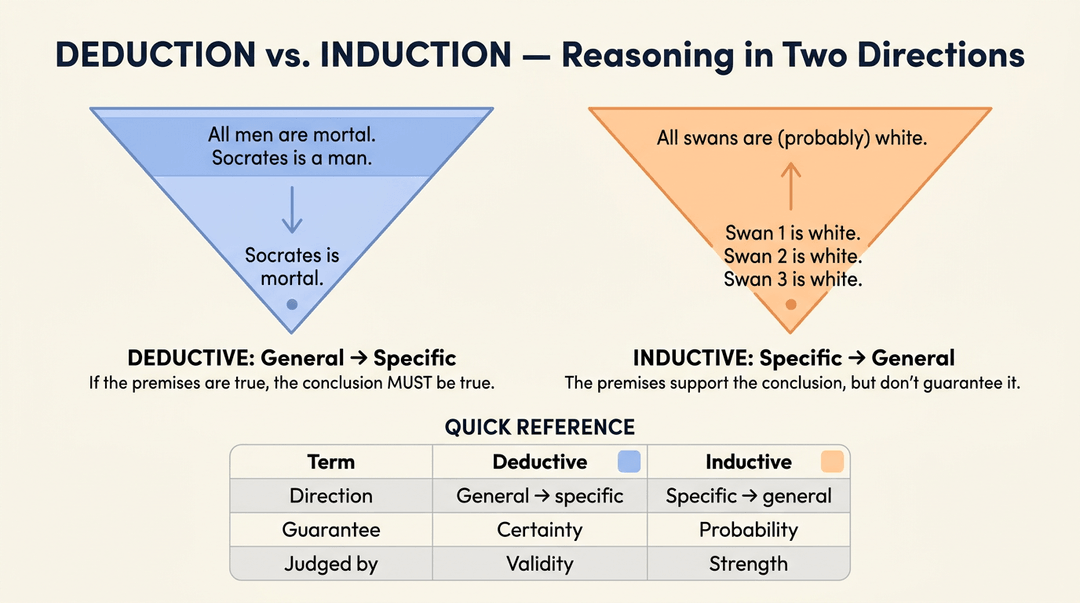
Picture two triangles. Deduction's triangle narrows from a wide base of general premises down to a single point: the specific conclusion.
Induction's triangle runs the other way, starting narrow at specific cases and widening into a general claim. A quick terminology chart helps too:
| Term | Deductive | Inductive |
|---|---|---|
| Direction | General to specific | Specific to general |
| Guarantee | Certainty | Probability |
| Judged by | Validity | Strength |
How science uses both types of reasoning
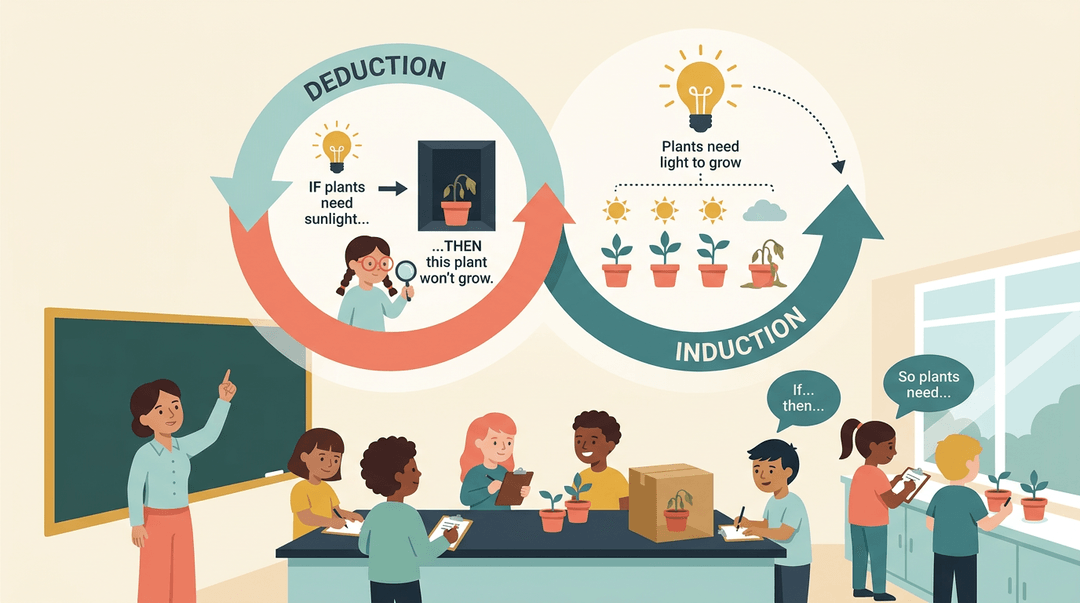
Science leans on both paths. Researchers build hypotheses from patterns they've observed (induction), then test those theories by deducing what should happen if the hypothesis holds (deduction).
A science teacher who has students observe several examples, propose a rule, and then predict a new case is walking them through that exact cycle: science alternates between induction and deduction rather than picking one side.
Understanding Abductive Reasoning
Deduction proves and induction predicts, but abductive reasoning does something different: it guesses. It's the reasoning we lean on when the evidence is thin and a decision still has to get made.
Making your best guess with abduction
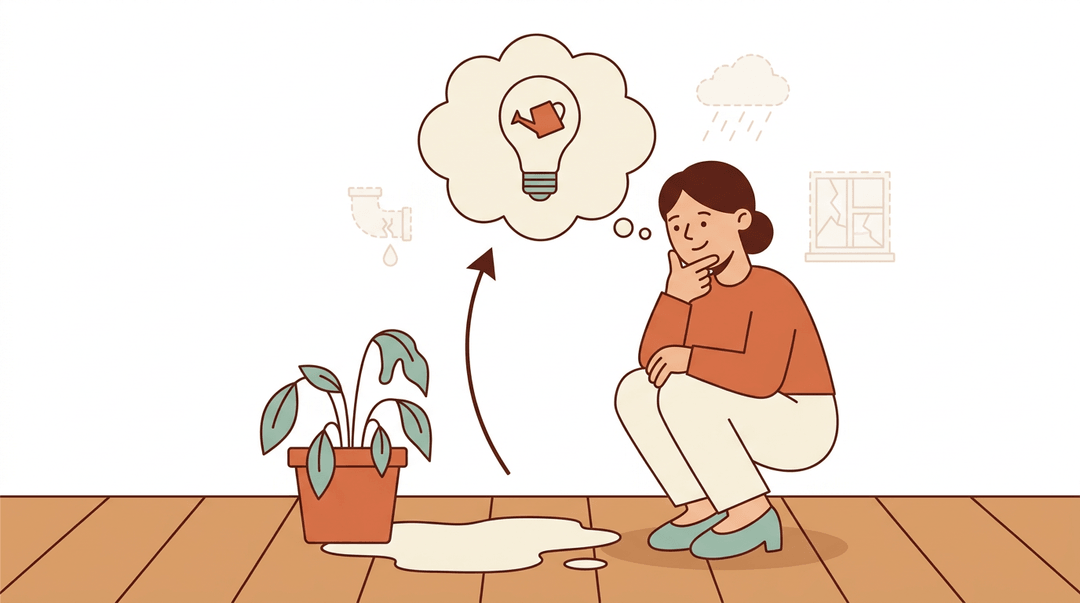
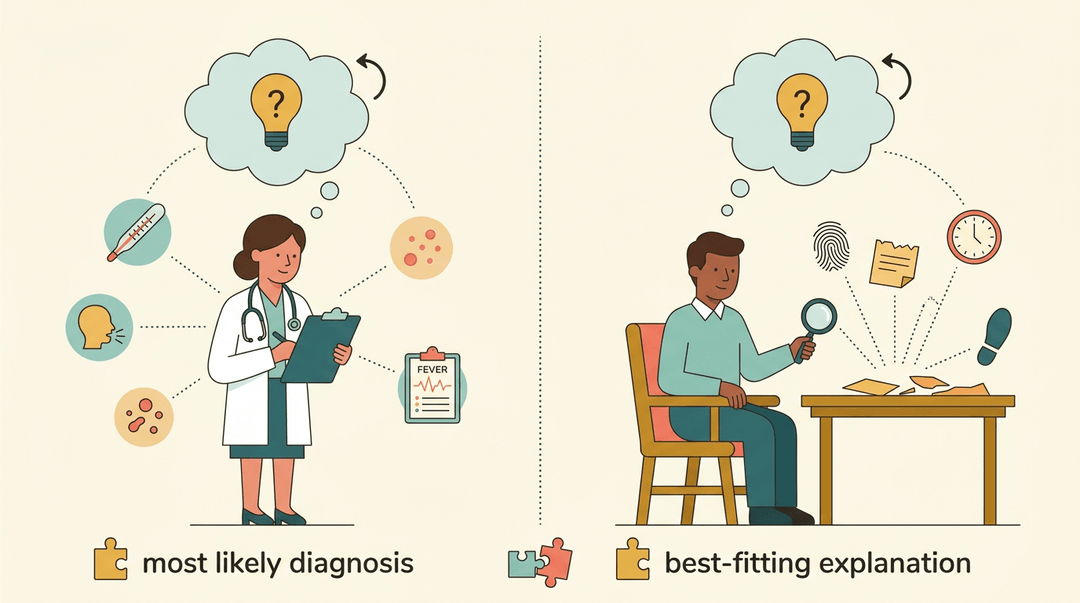
Abduction means picking the most likely explanation, not the only possible one. It thrives on incomplete data: you don't have every fact, so you reason backward from what you see to the simplest story that explains it.
That's the key difference from the other two: deduction guarantees a conclusion, induction builds a pattern from many cases, and abduction settles for the best available answer right now.
Everyday examples of abductive reasoning
Students run into abduction constantly, even if they've never named it:
- The dog and the torn papers. Shredded homework on the floor, a guilty-looking dog nearby: the simplest explanation writes itself.
- Wet grass overnight. No sprinkler, no hose in sight, so rain is the likeliest cause.
- The bag and the sandwich. A half-eaten sandwich in a lunch bag suggests someone got interrupted mid-bite.
- Celebrating team colors. A stranger in a jersey cheering loudly is probably a fan of that team.
How abduction is used in real life
Doctors diagnosing symptoms use it daily: a set of signs points to the most probable illness, not a certain one. Jurors weighing evidence do the same, choosing the explanation that best fits the facts presented.
In both cases, it's an educated guess, useful, reasonable, and always open to revision as new evidence arrives.
Putting Reasoning to Work in Real Life
Reasoning doesn't stay locked inside a logic textbook. It shows up in the lab, in a detective's notebook, and in every argument your students hear on the news.
How the scientific method uses reasoning
Scientists lean on both types of thinking, just at different stages. They test a hypothesis deductively: if the theory is true, then a specific result should follow, and the experiment checks whether it does. Once enough results come in, they build theories inductively, generalizing from repeated patterns. A middle school science teacher can show this by having students predict an outcome from a rule, run the experiment, then ask what broader pattern the class's results suggest. The two moves work together: deduction tests the theory, induction grows it.
Sherlock Holmes and detective-style reasoning
Sherlock Holmes calls his method deduction, but he's really mixing it with induction. He starts with observation, mud on a boot, a scuff on a sleeve, and infers the likely cause from there. That's induction dressed up as deduction. For a literature discussion, ask students: "Is Holmes really deducing, or is he generalizing from clues?" It's a sharp way to make the distinction stick.
How to judge if an argument holds up
A valid argument has a conclusion that follows necessarily from its premises; an invalid one doesn't, no matter how convincing it sounds. Inductive arguments get judged as strong or weak instead, based on how well the evidence supports the conclusion. Either way, validity means nothing if the premises aren't true, so always check both the structure and the facts behind it.
Deductive reasoning gives students a dependable way to think: start with what's true, follow the logic, and trust the conclusion. Once they can spot valid arguments (and catch the shaky ones) they'll carry that skill far beyond your classroom.
Ready to build these lessons into your week? Check out our Lesson Planning feature to organize and reuse your reasoning activities across every class.
Frequently asked questions
What are the differences between deductive and inductive reasoning?
Deductive reasoning moves from a general rule to a specific conclusion, while inductive reasoning moves from specific observations to a general claim. If the premises are true and the deductive argument is valid, its conclusion is certain; an inductive conclusion is only probable, even when supported by strong evidence.
How to tell if an argument is deductive or inductive?
Look at the direction of the reasoning. If it starts with a general rule and applies it to a specific case, it is deductive; if it gathers specific examples and develops a broader expectation, it is inductive. Ask whether the conclusion must be true or is merely likely.
How to remember deduction vs induction?
Use the mnemonic “deduce down” for deduction, which moves from general to specific, and “induce up” for induction, which moves from specific observations to a general rule. Also remember that deduction aims at certainty, while induction supports probability.
Which is the best example of deductive reasoning?
A strong example is: All mammals are warm-blooded. A dog is a mammal. Therefore, a dog is warm-blooded. The conclusion follows necessarily from the general rule and the specific case, assuming both premises are true.
What are 5 examples of inductive reasoning?
Five examples of inductive reasoning are: every dog seen at a park has been friendly, so the next dog will probably be friendly; dairy has caused stomach trouble several times, so dairy may cause illness; a week of record-high temperatures suggests unusual heat; fireflies appear every summer, so they will likely return next year; and drawing five red coins suggests the bag may contain mostly red coins.
What is a real life example of deductive reasoning?
A real-life example is using a fixed rule to reach a specific conclusion: all licensed drivers have passed the required driving test, and Maya has a valid driver's license, so Maya passed the test. The conclusion is guaranteed if the premises and rule are accurate.
What best defines deductive reasoning?
Deductive reasoning is top-down reasoning that starts with general premises and applies them to a specific case to produce a conclusion that must be true. A valid deductive argument guarantees its conclusion when its premises are true.