Youth Mentoring Program Guide: Models, Training, Funding


Jump to section
Picture a high school junior who starts each week with one steady adult in her corner. That person checks in on her goals, celebrates small wins, and notices when something's off.
That's the heart of a youth mentoring program: a structured relationship where a caring adult supports a young person's growth over time.
This post walks through what mentoring looks like, the models and mentor qualifications that matter, and how to launch, train, and fund a program. We'll finish with a classroom-ready guide for running mentoring alongside attendance and session records.

Becoming a Youth Mentoring Program Mentor
A mentor is a trusted adult who builds a steady, caring relationship with a young person and guides that person's growth over time. The qualities that matter most are personal: reliability, patience, and genuine care for young people.
Specific requirements vary by program, so check yours before you sign up.
Habits that make mentors effective
Strong mentors tend to build a few habits:
- Show up consistently. Being there every week counts for more than any single grand gesture.
- Listen more than speak. Let the young person talk first, and resist the urge to fix everything.
- Encourage contribution. Give youth real responsibilities so they see their ideas matter.
- Support growth over perfection. Celebrate progress, not flawless results.
Think of a middle school teacher who meets one student every Tuesday during lunch. She never misses a session, and after a few months, the student starts bringing his own goals to the table. Showing up counts.

Mindset mentors bring and where to serve
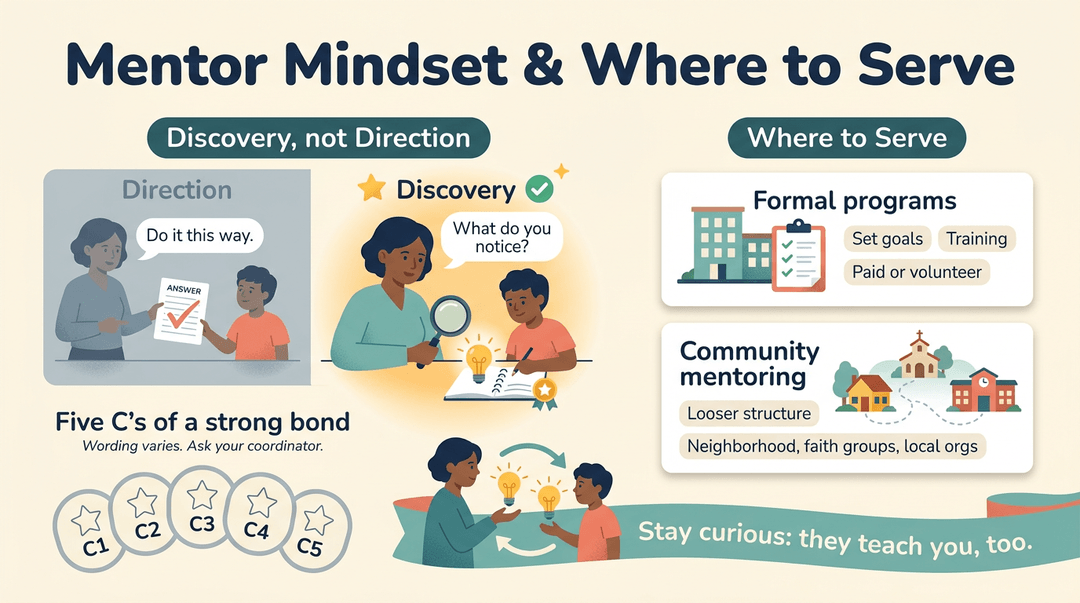
Those habits rely on the right mindset. Believe in young people's gifts, even when they can't see them yet, then help them self-discover their strengths instead of handing them answers. Good mentors aim for discovery rather than direction.
Many mentoring frameworks name five C's, qualities a strong relationship helps young people develop. Programs don't always use the same wording, so ask your coordinator which version applies.
- Formal programs. These are structured, with set goals and training. Some pay their mentors and many rely on volunteers, so whether you get paid depends on the program.
- Community mentoring. Many mentoring relationships grow through neighborhoods, faith groups, and local organizations, with a looser structure.
Openness and humility keep the relationship two-way. Stay curious about what the young person teaches you, too.
Set up Mentoring in Class or School
Use this guide to launch a mentoring program in your class or school, then keep clear records of every session. Start with the four launch steps, pick the model that fits your grade, and hand mentors the weekly checklist.
Launch in four steps
- Identify students and goals
- Name one goal per student: "Read a chapter book independently."
- Match with staff or peers
- Ask both sides for one preference, then match on interest, not just availability.
- Schedule recurring sessions
- Fix the slot so nobody has to ask: "Thursdays, 12:10, library table."
- Share expectations with families
- Send a short note covering purpose, schedule, and who to tell about a missed session.
Pick a model by grade
| Grade band | Model | What it looks like |
|---|---|---|
| Elementary | Reading buddies | Pairs read together and talk about the story |
| Middle | Peer mentors | Older students check in on goals and routines |
| High school | Career shadowing | Students follow an adult in a career they're curious about |
Track every session
Records are how you catch trouble early. For each meeting, fill in these four slots:
| Slot | What to write | Example |
|---|---|---|
| Session | Date, time, pair | Oct 12, 12:10, Ana and Mr. Lee |
| Attendance | Present, absent, or late | Absent |
| Pattern | Anything repeating | Third missed Thursday |
| Outcome | One brief line | Read two pages without prompting |
Flag a missed meeting the same day you see it. A quick check-in with the student or mentor is far easier after one absence than after four.
⚠️ Watch out: Don't wait for a pattern to feel obvious. Absences that look random in your head often line up once they're written down.
Example: A middle school teacher notices on her log that one student keeps missing Thursday sessions. She asks him about it and learns Thursday is his bus day. She moves the pair to Tuesday, and the sessions start happening.
Weekly mentor checklist
Hand mentors these four checks, and have them confirm each before the week ends:
- Confirm session time. Remind your mentee a day ahead.
- Review student goals. Reread the goal so the session has a focus.
- Document progress. Log attendance and one outcome line right after meeting.
- Follow up on absences. Reach out to the student, then tell the teacher.
EMStudio's attendance tracking lets you log mentoring sessions and spot attendance patterns in one place.
Planning and Launching a Youth Mentoring Program
So what is a youth mentoring program? It pairs a young person with a caring adult who offers guidance and encouragement over time.
Assess community needs and find partners
Start with a community needs assessment: ask teachers, families, and students what's missing. Review existing programs so you don't duplicate them, then partner with local organizations for space and staff.
Reach out to national mentoring groups for training ideas.
Consider a middle school counselor who sees many seventh graders going home to an empty house. A call to the local library turns up a shared room and a willing partner.

Set the structure, focus, and match length
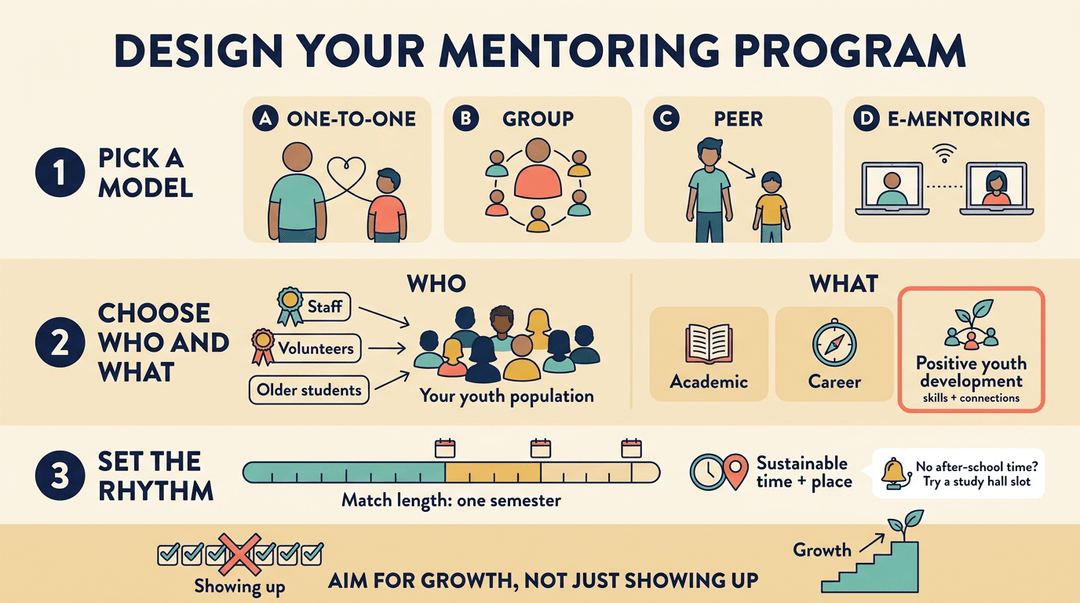
Mentoring usually comes in a few common models:
- One-to-one. One mentor and one student build a lasting bond.
- Group. One mentor supports a small circle of students.
- Peer. An older student mentors a younger one.
- E-mentoring. Mentor and student connect online.
Define your youth population, then choose mentor recruits from staff, volunteers, or older students.
Pick a focus: academic support, career exploration, or positive youth development (PYD), which builds the skills and connections young people need to thrive. Set a meeting location and frequency you can sustain, plus a match length such as one semester.
Aim outcomes at growth rather than just showing up. Can't meet after school? Use school-day mentoring slots, like a regular study hall.
Staff, policies, and daily operations
Your management team needs clear roles for matching, training, and scheduling. Write down policies and procedures on conduct, confidentiality, and safety before launch. A case management protocol spells out how concerns get flagged and who follows up.
Your financial plan should cover training, materials, and funding from sources like grants or donations. Keep session logs and attendance records for every meeting. Paperwork can feel tedious. It's also your proof the program works.
Launch, evaluate, and keep adjusting
Start with a small pilot so problems stay small. Plan your evaluation around the outcomes you set, and share the plan with principals, families, and students for stakeholder buy-in.
Then keep adjusting: review logs and feedback each term and change what isn't working.
Picture a school librarian whose Thursday sessions keep getting canceled. She moves them to Tuesday, and the next month runs far more smoothly.

Getting Mentors, Youth, and Parents Trained
Good intentions start a mentoring program, but training keeps it steady. Here's how we'd prepare mentors, youth, and parents or guardians before the first match.
How long mentor training should last
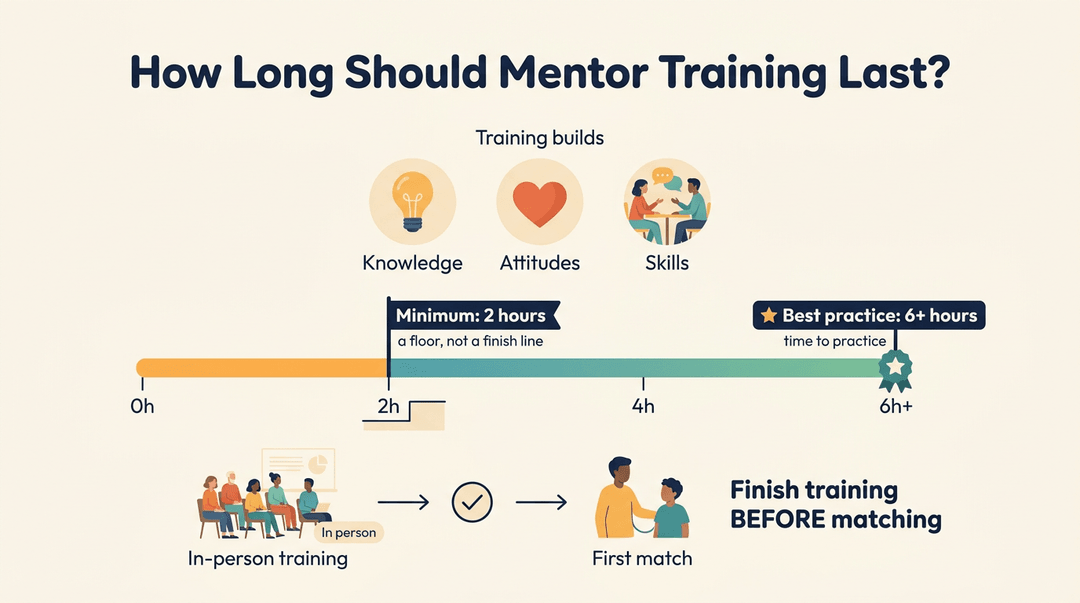
Mentor training should build knowledge, attitudes, and skills: what mentors know, how they approach a young person, and what they can do in a session.
The Starting a Youth Mentoring Program: 5 Training resource says it should last at least two hours and be offered in person. Two hours is a floor, not a finish line. Six or more hours is a promising best practice for giving mentors time to practice.
Finish in-person training before any matches.
Key topics mentors learn in training
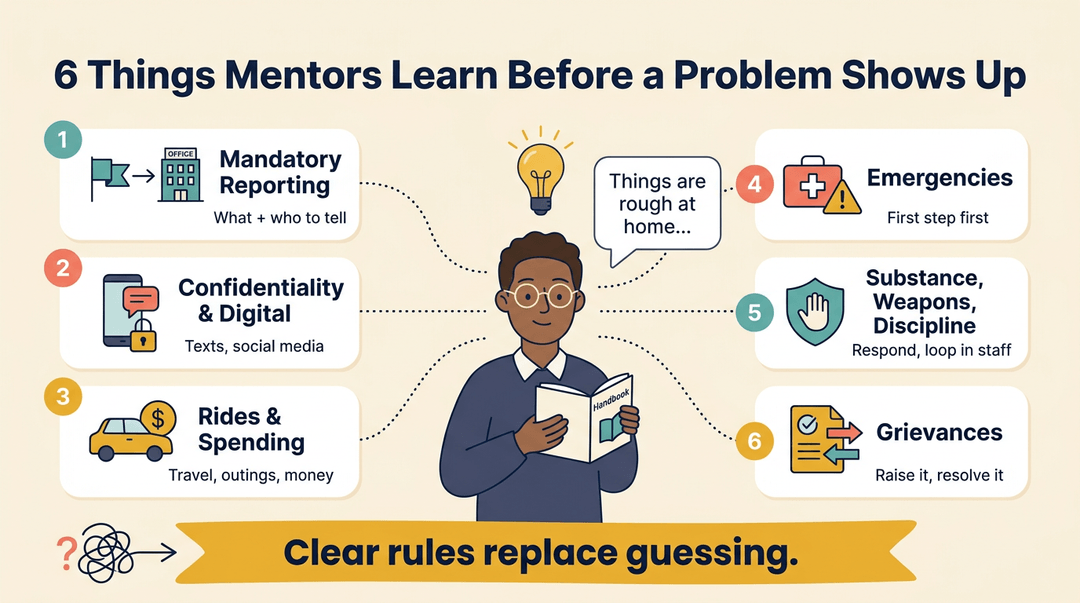
Picture a mentor who hears a student mention trouble at home. A trained mentor knows the next step. Training covers these topics before a problem shows up, not after.
- Mandatory reporting requirements. What must be reported, and to whom.
- Confidentiality and digital media. What stays private, and how to handle texts and social media.
- Transportation, travel, and spending. Rules for rides, outings, and money.
- Emergency and crisis procedures. What to do first when something goes wrong.
- Substance use, weapons, and discipline. How to respond, and when to bring in staff.
- Grievance procedures. How a complaint gets raised and resolved.
Clear rules replace guessing.
Training youth, parents, and guardians
Young people and families need their own orientation, covering four areas:
- Purpose and program requirements. Why the program exists and what it asks of participants.
- Roles and obligations. What each person is expected to do.
- Ethics, safety, and risk management. The boundaries that protect everyone.
- Initiating and closing relationships. How a match starts and ends without surprises.
Making training engaging and hands-on
A training that's all slides rarely sticks. Make it something people do, not just sit through. Tailor every session to its audience, since a scenario that works for parents may fall flat with a teen.
Consider a middle school teacher training new mentors. Partners take turns playing a quiet mentee, and each mentor practices a few open questions. By the end of the hour, everyone has tried that awkward moment once, before facing it with a real student.
Add group discussion and simulations so mentors hear how colleagues would handle the same situation. Youth need movement, too, so build in stand-up activities and short breaks.

Use training to screen and support
Training also shows you who's ready. Watch how participants treat peers and role-play partners, looking for patience, active listening, and respect for boundaries.
Train before matching, then keep going with ongoing post-match sessions where mentors bring real questions. Keep a toolkit of resources so mentors can look things up between sessions.
Trained mentors show up ready. That's the point.
Real Programs and What They Achieve
Mentoring looks different from one program to the next. Here's how a few real models work and what they achieve.
Veteran-led mentoring and sense of purpose
Character Does Matter is a veteran-led mentoring program that involves veterans and families of the fallen. Its name signals a focus on character, leadership, and service.
An article from StandTogether reports that after participating in three or more programs, 89% of veterans and families of the fallen rated their sense of purpose as thriving. That's a powerful signal for programs that measure more than attendance.

PEARLS for teen girls and job shadowing
PEARLS for Teen Girls is a model worth studying if confidence and leadership are your goals. Ask whether a program builds those skills in everyday sessions, not just at a final event.
If a program adds job shadowing, where a student observes a working adult, use that time to talk through the mentor's choices. Graduation and college outcomes matter to families and schools, so find out what a program tracks and how it measures them.
Every mentoring program depends on its volunteers, so check how they're recruited and kept involved.
Boys & Girls Clubs mentoring in action
Scale only helps when people are trained. Look for a large pool of staff and volunteers who know how to build trust with a young person.
Boys & Girls Clubs mentoring is associated with gains in young people's confidence and academic performance.
A Research for Action report on Boys & Girls Club members in California notes that research has consistently shown high-quality out-of-school time programming has a positive impact on social and emotional development and academic achievement.
Think of a middle schooler having a rough week, with a mentor who shows up at the same time every Tuesday. That predictable, caring presence gives the student one adult who's consistently in their corner.

What makes youth programs work well
Young people don't have to wait until adulthood to lead. Consider a high school junior who co-leads a tutoring session: she builds leadership skills, and the younger students get a role model close to their own age.
Look for programs focused on growth rather than quick fixes. The question isn't just who showed up. It's what changed for the young person.
Growth depends on the basics, so check for: - Consistent meeting times that students can count on - Clear goals that mentors and students both understand - Adults who stay engaged for the long haul
Consistency wins.
Where Support and Money Come From
Your mentoring program won't run on good intentions alone. Support comes from federal efforts and from your own community, and knowing where each one fits helps you plan with confidence.
Federal backing and advocacy efforts
Start with the National Youth Mentoring Initiative, one of the national advocacy efforts that keeps mentoring visible. The Department of Justice administers some federal mentoring funding, so its programs are worth checking when you search for grants.
Federal priorities and resources shift, so check them regularly rather than once, before each application.

Fund your program through donations
Begin with a financial plan that lists every funding stream you're counting on, from grants to community gifts. Mark what's secured and what's still open so you always know where you stand.
Planned giving brochures help supporters think about gifts that take effect later, which opens the door to long-term support. Consider a middle school teacher who coordinates her school's mentoring program.
Each month, she sends a short update to families and local supporters. A few of them sign up for the newsletter, and one asks how to give. That's steady, ongoing support rather than a one-time check. Relationships do the heavy lifting.
Add a newsletter sign-up to your program's page and to every event sign-in sheet. It's a simple way to keep supporters informed, and it turns a single helper into someone who sticks around.
Youth mentoring works best when it's intentional: clear roles, trained mentors, and a plan for funding, launch, and record keeping.
When those pieces fit together, young people gain a reliable adult who helps them grow, and that's a win for everyone in the room.
Ready to keep your mentoring sessions organized? Check out our Attendance & Records page to mark attendance quickly and spot patterns across classes over time.

References
- Starting a Youth Mentoring Program: 5 Training — mentoring.org (2026)
- 4 youth mentorship programs empowering the next ... — standtogether.org (2026)
- Educational Outcomes for Boys & Girls Club Members in California, 2021-22 — researchforaction.org (2025)
Frequently asked questions
What is a mentoring program for youth?
A youth mentoring program pairs a young person with a caring adult who offers guidance and encouragement over time. Programs may set goals, schedule regular meetings, and provide training and support for mentors and participants.
What is the definition of a mentor?
A mentor is a trusted adult who builds a steady, caring relationship with a young person and guides their growth over time. Effective mentors are reliable, patient, and genuinely care about young people.
What are some types of mentoring models?
Common models include one-to-one mentoring, group mentoring, peer mentoring, and e-mentoring, where participants connect online. School-based examples include reading buddies, career shadowing, and older students mentoring younger students.
What are the responsibilities of a mentee?
A mentee should participate in sessions, communicate their needs and goals, and take an active role in their growth. They should also follow program expectations, respect boundaries, and let the mentor or coordinator know if they cannot attend or have a concern.
What qualifications do you need to be a youth mentor?
Requirements vary by program, but strong youth mentors are reliable, patient, caring, and able to listen and respect boundaries. Programs may require screening, training, and a commitment to meet consistently; check the specific program's requirements before applying.
Do you get paid in a mentorship program?
It depends on the program. Some formal programs pay mentors, while many rely on volunteers; confirm compensation with the program coordinator.