How Depth of Knowledge Shapes the Way We Think About Tasks

Jump to section
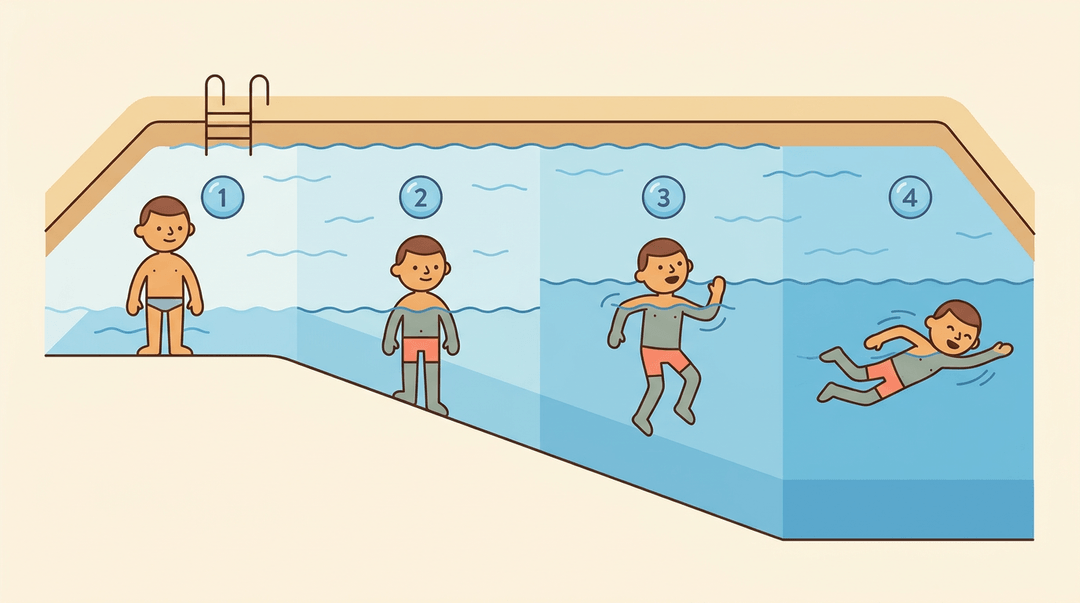
Think about wading into a pool. In the shallow end, you can stand flat-footed and barely get wet. Head toward the deep end, and suddenly you have to swim. Classroom tasks work the same way: some only ask students to stand there, others ask them to swim.
That's the idea behind Depth of Knowledge (DOK), a framework for how deeply a task asks students to think, not just how hard it feels.
This post breaks down where DOK comes from, its four levels, how it differs from Bloom's Taxonomy, and how to put it to work in your own lesson planning.
What Depth of Knowledge Really Means
Ask a roomful of teachers what "rigor" means and you'll get a roomful of different answers. Depth of Knowledge gives everyone the same yardstick.
Why DOK Measures Complexity Not Difficulty
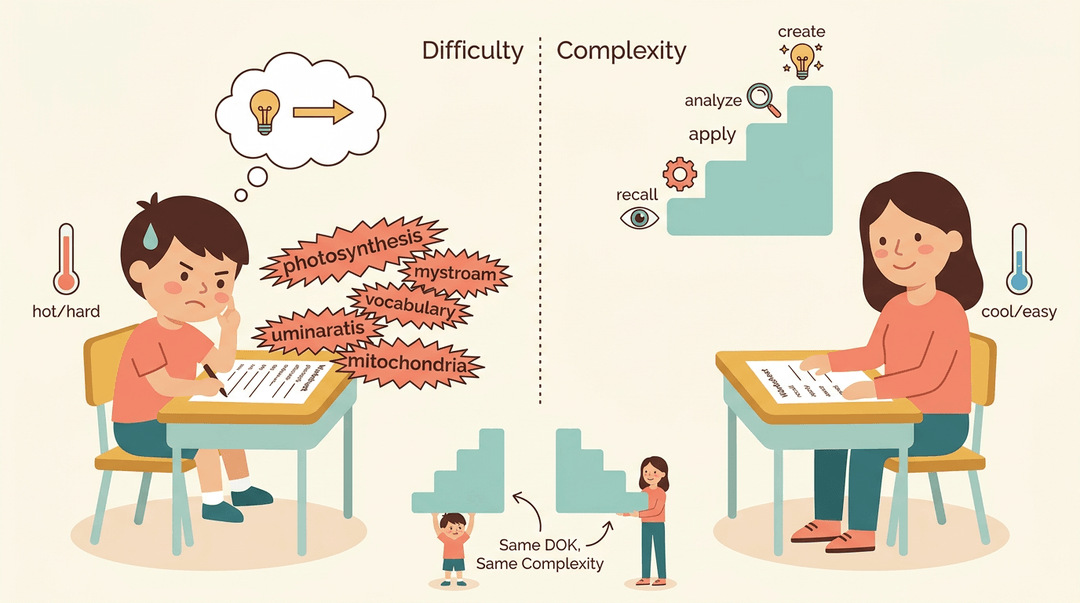
DOK sorts tasks by the degree of cognitive complexity a student needs to complete them, not by how hard the task feels. A worksheet can be tough simply because the vocabulary is unfamiliar, yet still sit at a shallow level of thinking.
DOK exists as a framework for rigor alignment: matching what you teach, how you assess it, and what students actually have to do with their knowledge.
It also gives educators a common language, so a DOK 3 task means the same thing in a fourth-grade classroom as it does in a high school one. That's the key distinction: complexity, not difficulty.
Who Created the DOK Framework
Depth of Knowledge comes from Norman Webb, who developed it in 1997, building on work published through the Wisconsin Center for Education Research.
Webb laid out his thinking in Research Monograph No. 8, then extended it in his 2002 paper on four content areas.
Webb originally built DOK for assessment alignment: checking whether a test actually measures what a standard expects, long before it became a lesson-planning staple.
How DOK Relates to Other Taxonomies
DOK often gets compared to Bloom's Taxonomy, SOLO Taxonomy, and Marzano's New Taxonomy, since all four sort thinking by complexity rather than content.
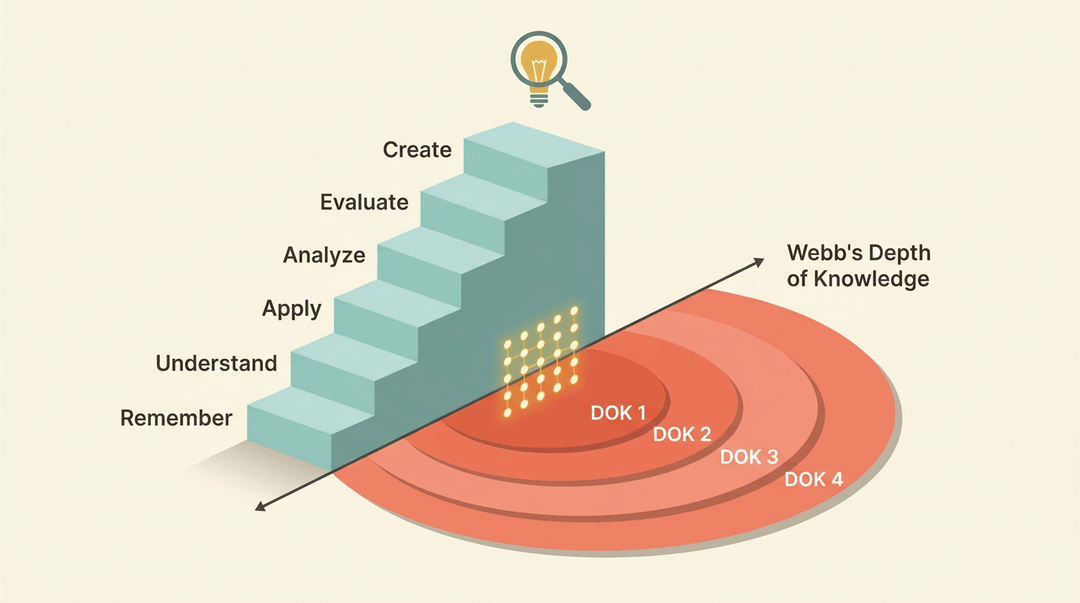
Hess combined Bloom's and Webb's frameworks into the Cognitive Rigor Matrix, pairing a thinking type with a depth level. Bloom's taxonomy is still valid today: its six levels remain a reliable starting point for planning.
- remember
- understand
- apply
- analyze
- evaluate
- create
DOK doesn't replace Bloom's. It adds the depth dimension Bloom's alone doesn't capture.
What Is a DOK Chart?
A DOK chart is a quick-reference tool that maps Webb's four levels of thinking to the verbs, tasks, and question types teachers see every day in a lesson plan or a standardized test blueprint.
Think of it as a translator: it takes the abstract idea of "depth of knowledge" and turns it into something you can glance at while writing tomorrow's exit ticket.
| DOK Level | Focus | Common Verbs |
|---|---|---|
| DOK 1 | Recall | define, identify, recall |
| DOK 2 | Skills/Concepts | compare, infer, predict |
| DOK 3 | Strategic Thinking | analyze, critique, design |
| DOK 4 | Extended Thinking | design, transfer, synthesize over time |
What DOK 1 Recall Tasks Look Like
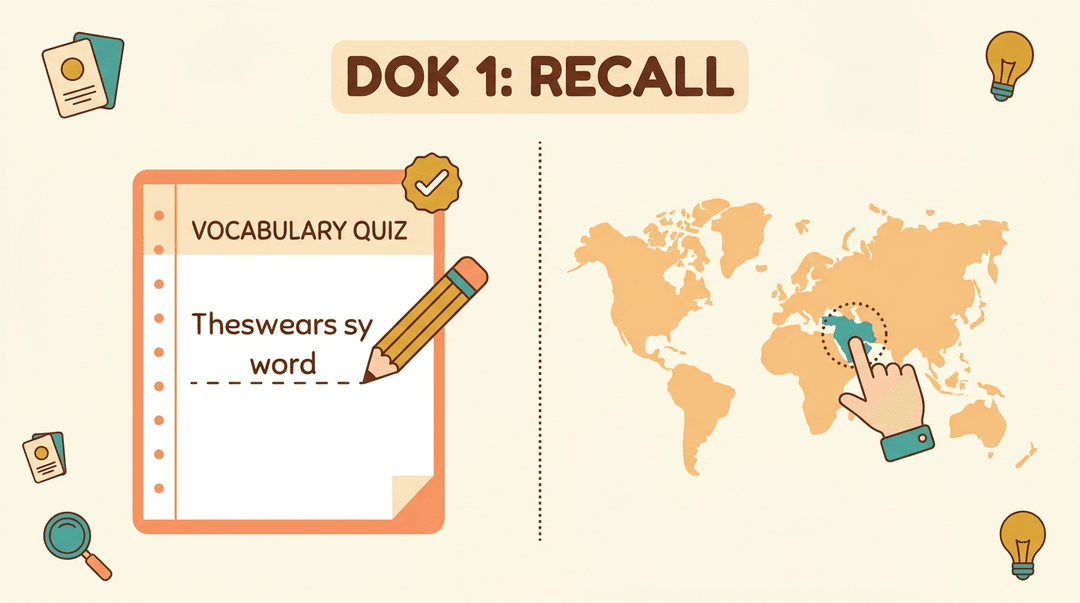
DOK 1 covers basic facts and definitions: the kind of knowledge a student either knows or doesn't. It includes simple one-step procedures, like solving a single equation, and tasks built around keywords such as define, identify, and recall.
A fill-in-the-blank vocabulary quiz or an assignment to locate a country on a map both sit squarely at this level.
What DOK 2 Skills and Concepts Involve
DOK 2 asks students to use what they know, not just state it. That means multi-step problem solving and applying a concept to answer a new question, not just repeating one.
Tasks that ask students to classify, summarize, or estimate belong here, along with graphic organizers and timelines that require organizing information, not just storing it.
If you've wondered what DOK level interpret falls under, it's usually here alongside compare, infer, and predict.
What DOK 3 Strategic Thinking Looks Like
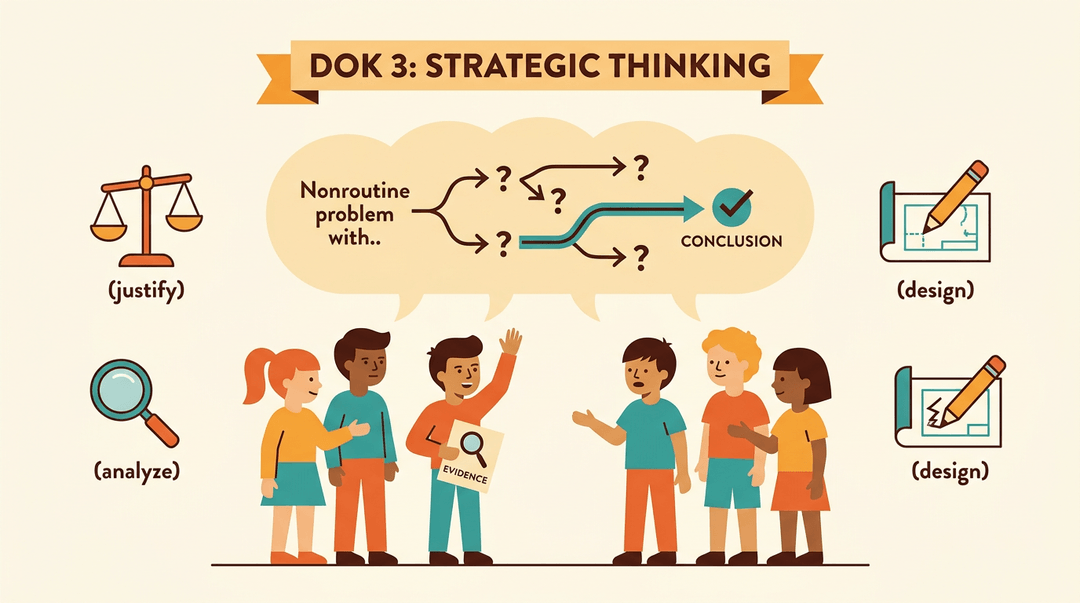
Here, students plan, use evidence, and justify their answers rather than simply produce one. Drawing conclusions and tackling a nonroutine problem (one without an obvious path) both fit.
A literary critique or a structured classroom debate built around keywords like analyze, critique, and design lives at DOK 3.
What DOK 4 Extended Thinking Involves
DOK 4 stretches across time: complex reasoning that unfolds over days or weeks, not one class period. Designing an original experiment, a project-based capstone, or work that transfers a skill across contexts all qualify.
It's iterative by nature, with students revising their thinking as new evidence comes in.
How to Apply DOK to Lesson Planning
Here's how to turn DOK from a framework you understand into a habit you plan with. The flow is simple: set a target level, build tasks around it, then run a quick alignment check before you teach.
Set the lesson's target level
- Pick one DOK level for your objective.
- Write it into the objective itself, right where you'd post it:
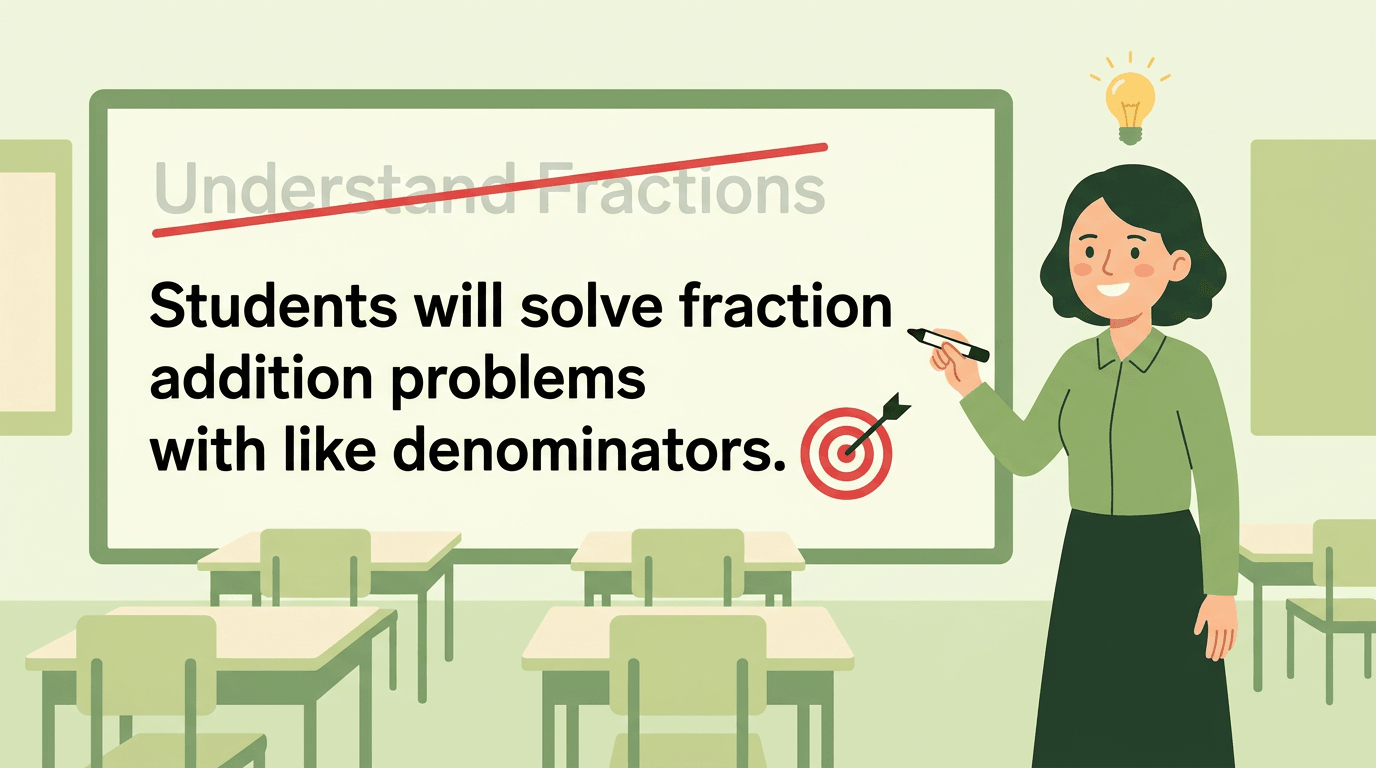
Students will compare two characters' motivations using text evidence. (DOK 2)
- Match every activity to that target.
- If the objective is DOK 2, the main task can't be a recall worksheet.
- Watch for unintended DOK creep.
- Creep is the lesson drifting up or down without you deciding it.
- Common culprit: a "quick review" that quietly eats the DOK 2 work time.
Build a DOK-balanced task set
One target level doesn't mean every question sits there. Strong lessons mix levels on purpose:
| Level | Where it lives | Example task |
|---|---|---|
| DOK 1 | Warm-ups, quick checks | Define erosion |
| DOK 2 | Core practice | Explain how erosion shaped this landform |
| DOK 3 | One meaty task per lesson | Argue which factor shaped the canyon most |
| DOK 4 | Multi-day projects only | Design and run a month-long erosion study |
Tag each question as you write it. Put the level in parentheses so imbalance jumps out: "Q4 (DOK 3): Justify your claim with two pieces of evidence." If your question set reads DOK 1, 1, 1, 1, 3, you'll see it before students do.
Example: A fifth-grade teacher tags her ten math practice problems and finds nine are DOK 1. She swaps three for "explain the error in this worked solution" tasks, and the lesson now actually practices the DOK 2 objective she wrote.
Run the alignment check
Before you teach, confirm three things:
- The objective's verb matches the level. "List the causes" is DOK 1, whatever the topic's difficulty.
- The exit ticket reflects the rigor. A DOK 3 lesson can't end on a matching quiz.
- Scaffolds support thinking without replacing it.
- ✅ Sentence starter: "The strongest evidence is ___ because..." (student still reasons)
- ❌ Fill-in-the-blank where the answer is implied (the reasoning is gone)
The difference in that pair: a good scaffold lowers the language load, never the thinking load.
💡 Tip: Keep tagged questions once you've leveled them. A DOK 3 prompt that worked is worth reusing every year.
Tag and reuse DOK-leveled activities right inside your lesson plans with EMStudio's online lesson planner.
Complexity and Difficulty Aren't the Same
Teachers often assume a hard question and a deep question are the same thing. They're not, and mixing them up is one of the biggest traps in DOK planning.
Hard Questions Aren't Always Complex Ones
Difficulty is about how many students get a question wrong. Complexity, in Webb's framework, is about how a student has to think to get it right.
A question can be brutally hard and still sit at a low DOK level, because difficulty measures effort or obscurity, not mental processing.
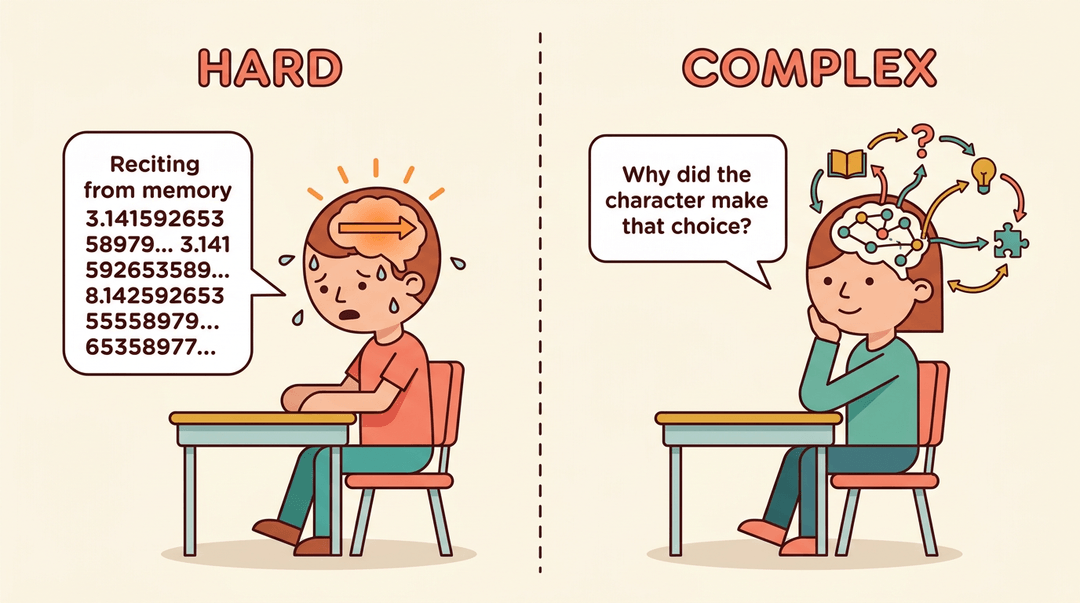
Recall is the clearest example. Think of a trivia question asking a student to name every U.S. president in order, or to recite pi to twenty digits. Both are genuinely hard: most people will stumble. But neither asks for anything beyond memory retrieval.
There's no analysis, no reasoning, no connecting ideas. That makes both DOK 1, recall and reproduction, no matter how impressive the answer looks.
Complexity lives in the thinking required, not the odds of getting it wrong. A simple question like "why do you think the character made that choice?" can sit at DOK 2 or 3, because it asks a student to interpret, infer, or justify.
So before labeling a question "rigorous," ask what kind of thinking it actually demands. That's the real test.
Using DOK to Guide Instruction and Assessment
Knowing the four levels is useful only if it changes what happens in your classroom. Used well, DOK becomes a planning tool, not just a framework you memorize once and forget.
Align Your Lesson Plans to Standards' DOK
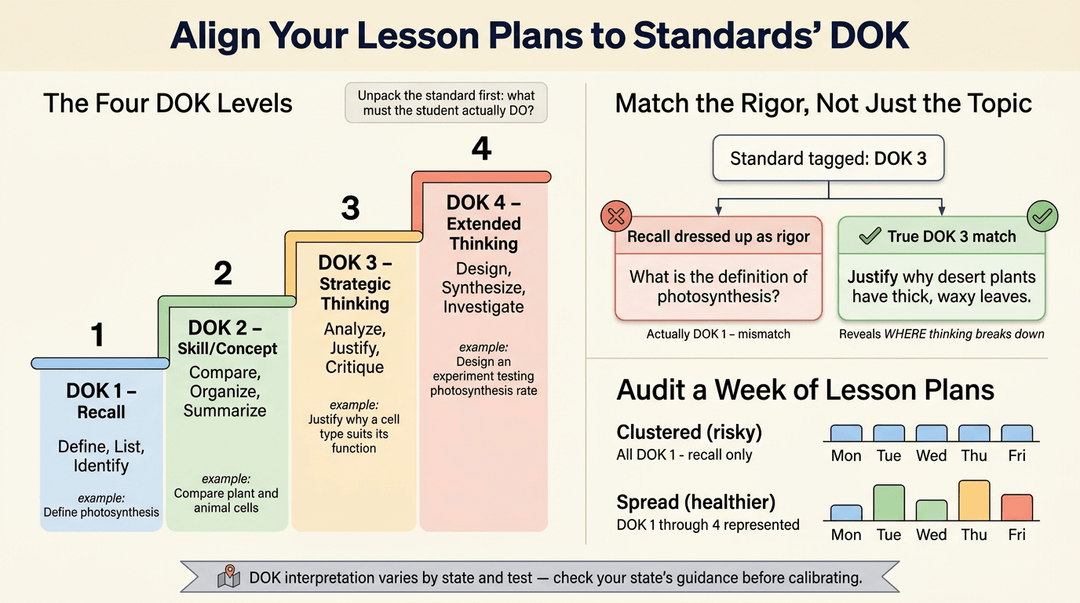
Every standard carries its own DOK level, and your instruction should meet it there. Start by unpacking the standard into smaller learning targets: what exactly must a student do to show mastery? Then match your assessment rigor to that same level.
A DOK 3 standard deserves a DOK 3 question, not a recall quiz dressed up to look rigorous. Get that alignment right and your data means something: a wrong answer shows where the thinking broke down, not just that a fact didn't stick.
It's worth auditing a week of lesson plans to see whether they cluster at one level or spread across several. One caveat: DOK interpretation varies by state and by test, so check your state's guidance before you calibrate.
Design Questions and Materials by DOK Level
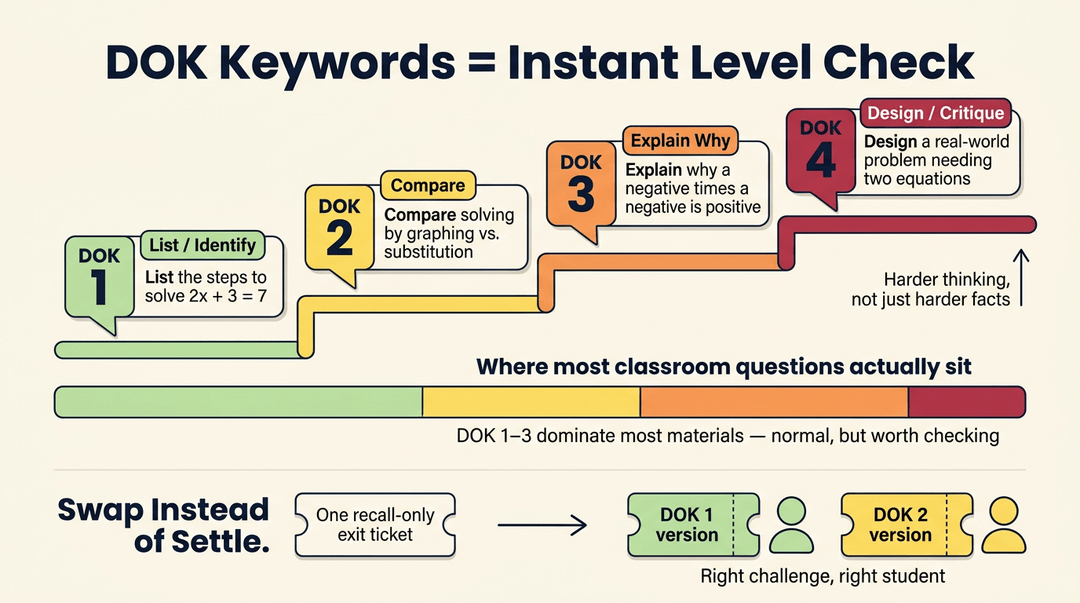
DOK keywords speed up question design:
- "List" and "identify" point to DOK 1
- "compare" and "explain why" push toward DOK 2 or 3
- "design" and "critique" land at DOK 4
Sort your existing questions by level so you can see where your materials actually sit; most classroom content clusters at DOK 1 through 3, which is normal but worth knowing.
Many assessment builders let you filter by DOK, making it easy to pull a balanced set instead of grabbing whatever's on top.
For example, a middle school math teacher might swap one recall-only exit ticket for two versions, a DOK 1 and a DOK 2, and hand each to the students who need it.
Key Questions That Reveal a DOK Level
When you're unsure what level you're looking at, ask what comes after the verb. "Explain" a definition differs from "explain" why a process produces a certain result, even though the verb is identical. A few guiding questions help:
- Can students just recall this?
- Must they apply a skill?
- Do they have to reason through something unfamiliar?
These questions work the same whether you're reading a standard or a task you wrote yourself.
Real Classroom Examples by DOK Level
Theory only sticks once you see it in action, so here's what each DOK level can actually look like across subjects, from a quick worksheet to a full project.
Sample Tasks for Each DOK Level
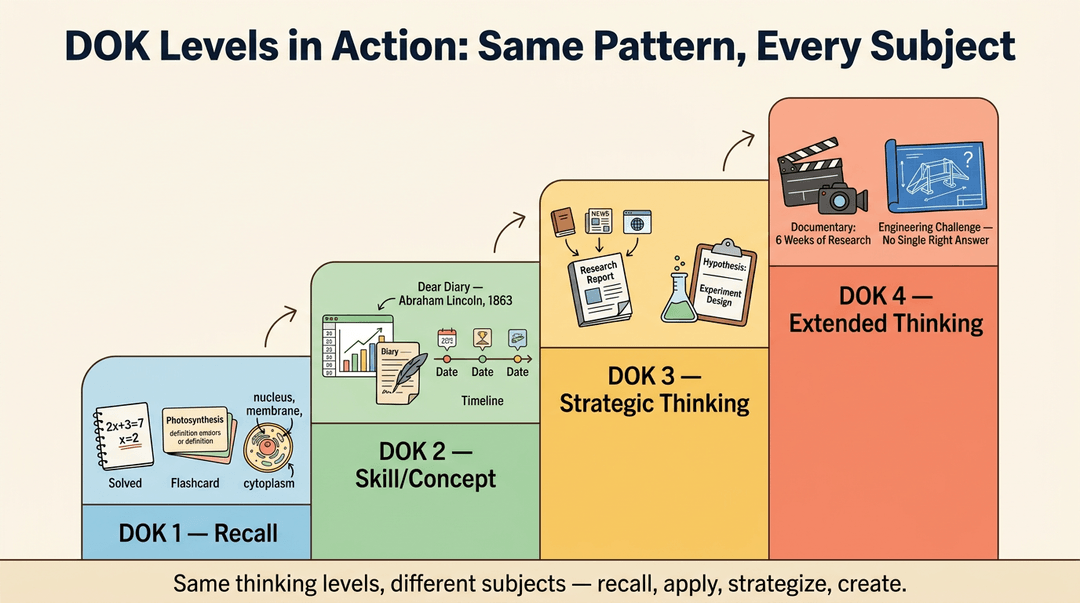
Depth of Knowledge shows up differently depending on the subject, but the pattern holds everywhere:
- DOK 1 (Recall): a math student solving basic equations, an ELA student defining vocabulary words, a science student labeling the parts of a cell.
- DOK 2 (Skill/Concept): graphing data in a spreadsheet, writing a diary entry from a historical figure's perspective, or building a timeline of events.
- DOK 3 (Strategic Thinking): drafting a research report that weighs multiple sources, or designing an experiment to test a hypothesis.
- DOK 4 (Extended Thinking): producing a documentary that pulls together weeks of research, or tackling an engineering design problem that has no single right answer.
Give Every Student Access to Complex Tasks
It's tempting to keep struggling students parked at DOK 1 "until they're ready." Resist that instinct. Every student deserves a shot at complex thinking, with scaffolds instead of a ceiling.
Consider a special education teacher adapting a DOK 3 research task: the content stays rigorous, but graphic organizers and sentence starters lower the barrier to entry.
Project-based learning makes this easier, since one project can hold several DOK levels at once: a student researching a topic (DOK 3) while a teammate builds the spreadsheet (DOK 2). Complexity for everyone, just different entry points.
Common Misunderstandings About DOK
A lot of the confusion around DOK doesn't come from Webb's original work. It comes from shortcuts teachers pick up secondhand, in a hallway conversation or a laminated poster from a workshop years ago.
Two mix-ups cause most of the trouble, and both lead to the same common DOK implementation pitfall: planning a lesson around the wrong signal entirely.
Why the DOK Wheel Is Controversial
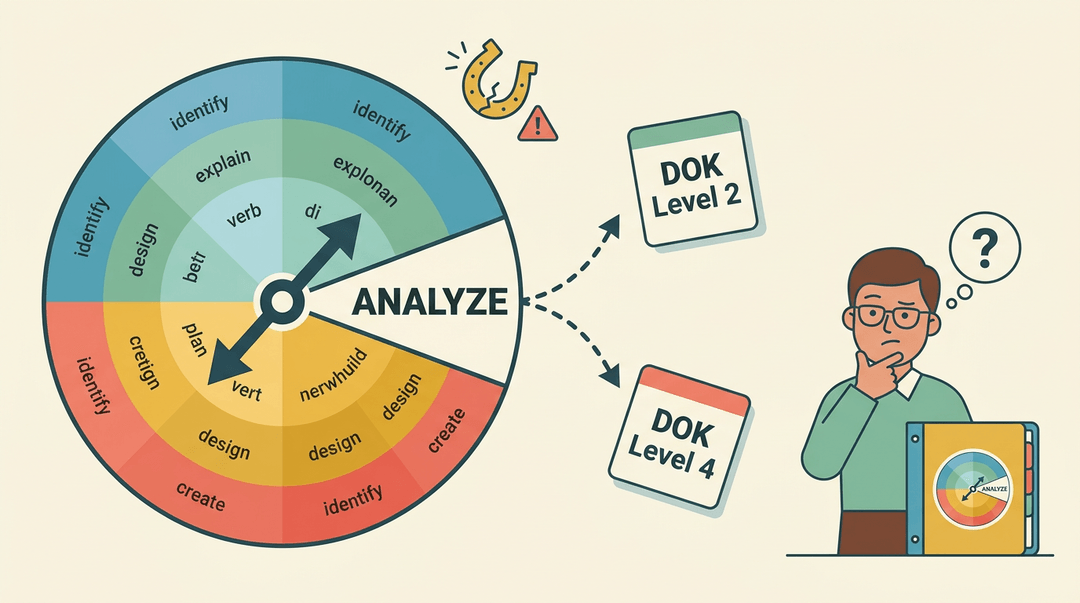
If you've seen a colorful DOK Wheel taped to a curriculum binder, sorting verbs into four color-coded rings, you've seen the single biggest source of DOK confusion in schools.
According to a breakdown from Arkansas Tech University, the wheel's origins are unknown, and Norman Webb himself never endorsed it. That matters because the wheel implies a verb alone tells you the DOK level, and it doesn't.
"Analyze" can sit at level 2 or level 4 depending on the task around it. Some educators have taken to calling it the "wheel of misfortune," since leaning on it steers lesson planning in the wrong direction.
The fix is simple: look past the verb to what students actually have to do with it.
DOK Levels Aren't a Hierarchy
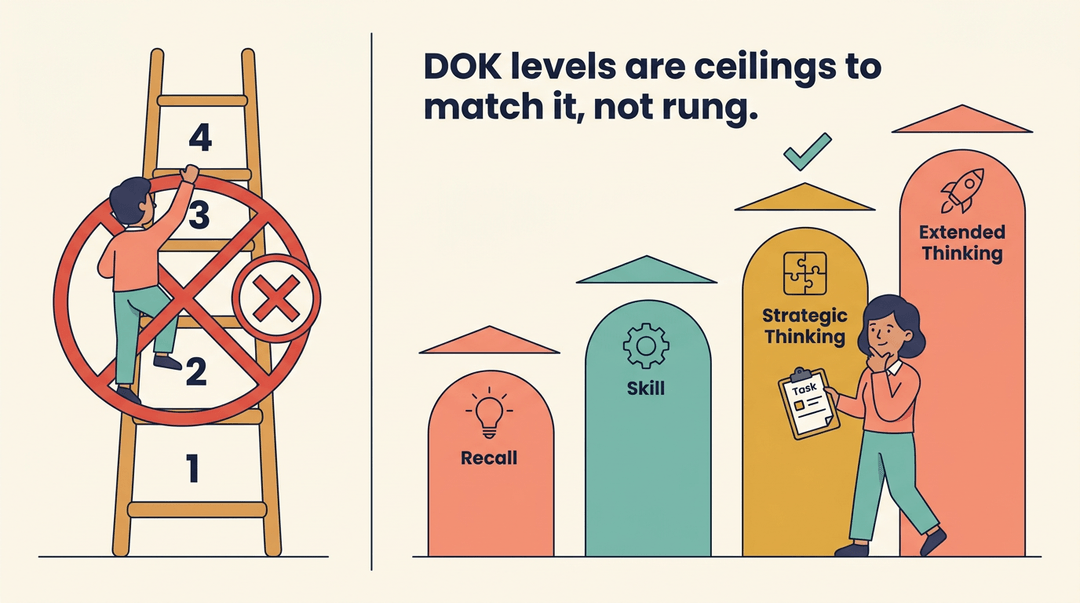
Here's the other trap: treating the four levels like rungs on a ladder, where every lesson should climb from level 1 to level 4. DOK isn't a developmental progression.
The levels are ceilings on cognitive demand, not steps every student must climb in order. Learning doesn't always move from simple to complex, and no single level is more valuable than another.
A level 1 recall task and a level 3 strategic-thinking task each earn their place when they match what the lesson actually asks of students.
DOK isn't about piling on harder worksheets. It's about knowing when you're asking students to recall a fact, apply a skill, reason through a problem, or extend their thinking into something new.
Get that distinction right, and your lessons, questions, and assessments all start pulling in the same direction.
Ready to build that thinking into your weekly plans? Check out our Lesson Planning feature to write, organize, and reuse DOK-aligned lessons across every class you teach.
References
- TEACHERS’ PERCEPTIONS OF THE IMPLEMENTATION AND PERCEIVED IMPACT OF WEBB’S DEPTH OF KNOWLEDGE IN SENIOR HIGH SCHOOLS IN GHANA — exa.ai (2026)
- From Bloom's Taxonomy Into Webb's Depth of Knowledge: Enhancing Lesson Planning Strategies — exa.ai (2024)
- RTD Approach to Using Norman Webb's Depth of Knowledge (DOK) Typology of Cognitive Complexity — researchgate.net
- ERIC - ED414305 - Criteria for Alignment of Expectations and Assessments in Mathematics and Science Education. Research Monograph No. 6., 1997-Apr — eric.ed.gov
- ED517804 — files.eric.ed.gov
- Depth of Knowledge (DOK) — blogs.atu.edu
Frequently asked questions
What is the meaning of depth of knowledge?
Depth of Knowledge is a framework for measuring the cognitive complexity a task requires. It focuses on how deeply students must think and use knowledge, rather than how difficult the task feels or how many students get it wrong.
What is the best summary of Webb's depth of knowledge?
Webb’s Depth of Knowledge model describes four levels of cognitive complexity: DOK 1 recall, DOK 2 skills and concepts, DOK 3 strategic thinking, and DOK 4 extended thinking. Its main purpose is to align instruction and assessment with the depth of thinking expected by a standard.
What is a Dok 1 question?
A DOK 1 question asks students to recall or reproduce basic information. Examples include “What is the definition of erosion?” or “Identify the parts of a cell.”
What is the main idea of Webb's depth of knowledge model?
The main idea is that tasks should be classified by the kind of thinking students must do to complete them. DOK measures cognitive complexity, not difficulty, and helps align objectives, instruction, and assessment.
What is the difference between Bloom's taxonomy and Webb's depth of knowledge?
Bloom’s Taxonomy classifies types of thinking, such as remembering, understanding, applying, analyzing, evaluating, and creating. Webb’s DOK measures how deeply and extensively students must use knowledge in a particular task, so a Bloom’s thinking skill can occur at more than one DOK level.
What are some examples of DOK 3 level questions?
Examples of DOK 3 questions include: “Which factor most influenced the character’s decision, and what evidence supports your conclusion?” “Which source provides the strongest support for this claim, and why?” and “How would you design an experiment to test this hypothesis?” These questions require planning, evidence, analysis, or justification rather than a single obvious procedure.
Who came up with the depth of knowledge?
Norman Webb developed the Depth of Knowledge framework in 1997. He originally designed it to examine alignment between academic standards and assessments.
Is Bloom's taxonomy still valid?
Yes. Bloom’s Taxonomy remains a useful framework for planning instruction and identifying types of thinking. It works especially well when paired with DOK, which adds information about the depth and complexity required by a particular task.