What Happens at Truancy Court: A Complete Guide


Jump to section
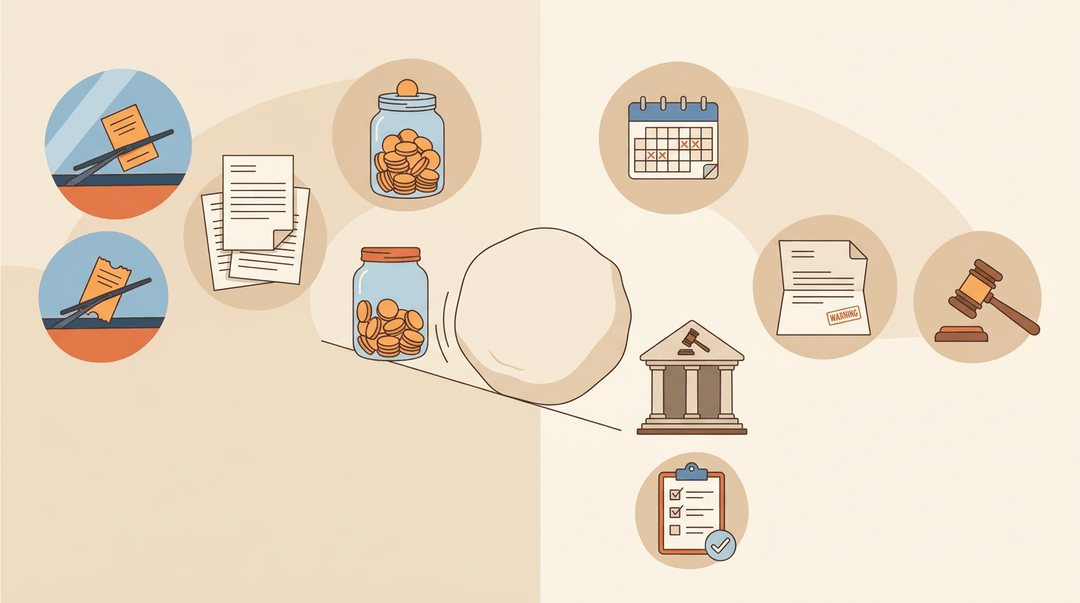
You know how a single unpaid parking ticket can snowball, ignored notices, mounting fees, until it lands you in front of a judge? A student's missed school days can follow the same path.
A handful of absences quietly become a truancy case, and suddenly there's a court date on the calendar. That's the reality for thousands of families each year.
This post walks through what actually happens at truancy court, from the first warning letter to the hearing itself, and gives you a practical checklist for catching absences long before things get that far.
What Happens at Truancy Court First
Before a judge ever sees a case, the numbers already decide who ends up in court. Know where your state draws the line, and you can flag a problem long before it becomes one.
How many absences count as truancy
The specifics vary, but the pattern holds across most states:
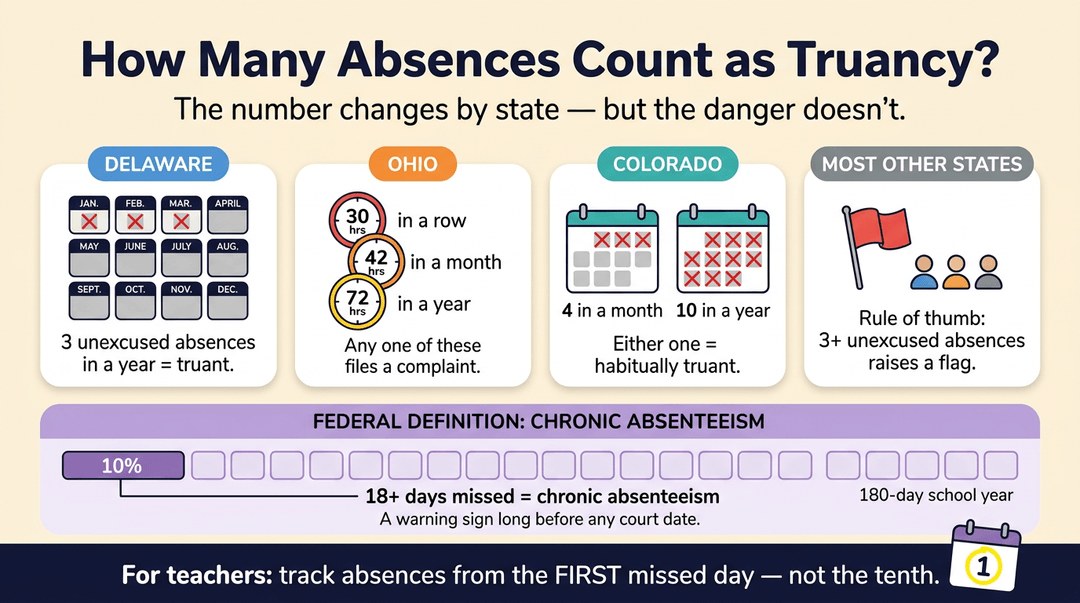
- Delaware: A student is truant after more than 3 unexcused absences in a school year.
- Ohio: A complaint gets filed once a student hits 30 consecutive hours, 42 hours in a month, or 72 hours in a year without a legitimate excuse.
- Colorado: Students count as habitually truant at four unexcused absences in one month or 10 in a school year.
Outside those specifics, most districts lean on a rough rule of thumb: 3 or more unexcused absences is enough to raise a flag.
The federal government uses a wider lens for its own tracking: chronic absenteeism, which the U.S. Department of Education defines as missing 10% or more of the school year. That's a warning sign long before any court date ever gets set.
For teachers, the job is the same either way: track absences against your state's threshold from the first missed day, not the tenth.
Truancy charges differ for kids and parents
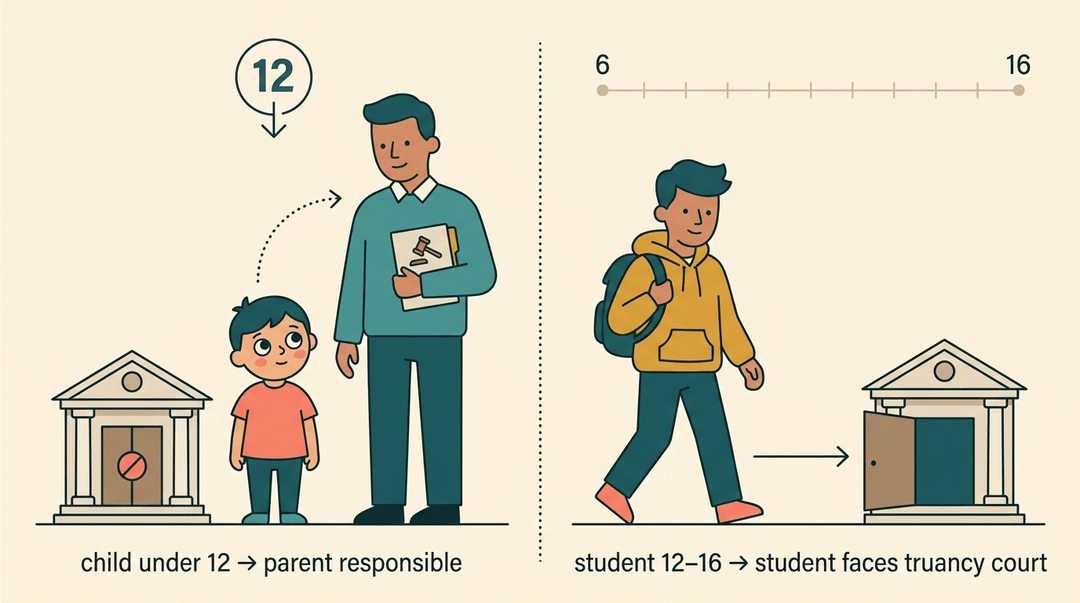
The consequences split by age. In Delaware, a child 12 or older can face a civil truancy charge, not a criminal one, and in states like Colorado it's classified as a status offense rather than a crime.
Parents face a different track: criminal charges or contempt of court for failing to get their child to school.
What age can a child be charged
A child under 12 can't be charged at all: the case, and the responsibility, falls on the parent instead. Colorado's compulsory attendance law covers students ages 6 to 16, and Ohio's rules apply through its own compulsory school age.
Below that floor, truancy court simply isn't pointed at the student.
What counts as an excused absence
Not every note gets a pass. Illness, disability, and school suspension typically count as excused, along with work-study and homeschool programs. What doesn't count nearly as often: a note written by a parent.
Most districts want documentation from a doctor or school counselor instead, which is exactly why we tell teachers the paper trail matters as much as the absence itself.
What Schools Must Do Before Court
Before a truancy case ever reaches a judge, schools carry real obligations of their own.
What schools must do before filing
Most states require a school to build an Absence Intervention Plan (AIP) and convene an intervention team before filing anything with the court.
That team, often school staff plus the family, meets to figure out why a student is missing school and what might fix it. A school can't suspend a student for truancy alone: that only deepens the attendance problem it's trying to solve.
Schools also have to make reasonable efforts to notify parents along the way, and in some states, like Colorado, the local school board pitches in extra assistance when a family needs more than the school alone can offer.
Think of a homeroom teacher sitting in on an AIP meeting: noticing that a student is always absent on Mondays, or vanishes during one specific class, is exactly the kind of detail that shapes a workable plan.

How long schools have to act
The clock moves fast.
- According to Youngstown City School District, "the absence intervention team will be developed during a seven (7) day period," with parents invited to join.
- Schools then get 14 days to develop the actual plan.
- From there, CourtNewsOhio reports "the student then has 60 days to make progress, or the school can file a truancy complaint with the local juvenile court."
- If there's still no progress, the school may file on the 61st day.
When schools skip early intervention
Sometimes none of this happens the way it should:
- no formal meeting
- no intervention team offered
- no mental health screening
- just a sudden jump straight to a summons
That gap doesn't disappear. It's often the first thing a defense raises once the case reaches court.

What Teachers Should Do Before Referring
Truancy court takes a case seriously only when the school's paper trail is solid, and that trail starts in your classroom.
This guide covers the three jobs you own before a referral ever happens: spotting the pattern, documenting each intervention, and preparing records if court gets involved.
Run a weekly attendance check
Set aside five minutes each week to confirm three things per flagged student:
- Unexcused count is current. Review the weekly total, not just today's roster.
- Coding is accurate. A parent note received today changes yesterday's code today, not next month.
- Trends are flagged. Watch for absences climbing month over month, or clustering on the same weekday.
💡 Tip: A student missing every Monday tells a different story than five scattered absences. Note the pattern itself, not just the number.
Document every intervention, same day
When a pattern appears, your job shifts from watching to intervening, and every intervention needs a dated record. Each time you act:
- Log the parent contact attempt the day you make it.
- Include the time, method, and outcome, even when nobody answers.
- Note every AIP meeting date, meaning the attendance improvement plan meeting.
- Record who attended and what was agreed.
- Date every attendance note you write, no exceptions.
- An undated note is nearly worthless as evidence later.
Here's what a liftable entry looks like:
Sample log entry: Oct 14: Called Ms. Rivera at 3:15, left voicemail re: Marcus's 4th unexcused absence this month. No callback by Oct 16. Second attempt scheduled Oct 17.
⚠️ Watch out: A note written the day it happened carries weight; a log reconstructed weeks later from memory does not. Write it now, even if it's two lines.
Build the court packet
If the school refers the case, you'll be asked for records. Three items make up your part of the packet:
| Provide... | It should include... |
|---|---|
| Full attendance history | Every absence for the year, coded excused or unexcused |
| Communication summary | Dated list of calls, emails, letters, and each outcome |
| Written teacher statement | Facts only: dates, patterns, interventions you tried |
Keep the statement strictly factual. "Marcus missed 14 days between September and November; I attempted contact six times" holds up. Opinions about the family don't, and they can undermine the rest of your record.
At a glance: check weekly, log same-day, and keep everything dated so the packet builds itself. You can make that first job nearly automatic: track attendance patterns and export ready-to-share records with EMStudio's attendance tracking feature.
How Truancy Charges Get Filed
Getting to court isn't instant. A student has to cross a legal threshold first, and even then, several people and steps stand between a missed day and an actual case.
Who files truancy charges
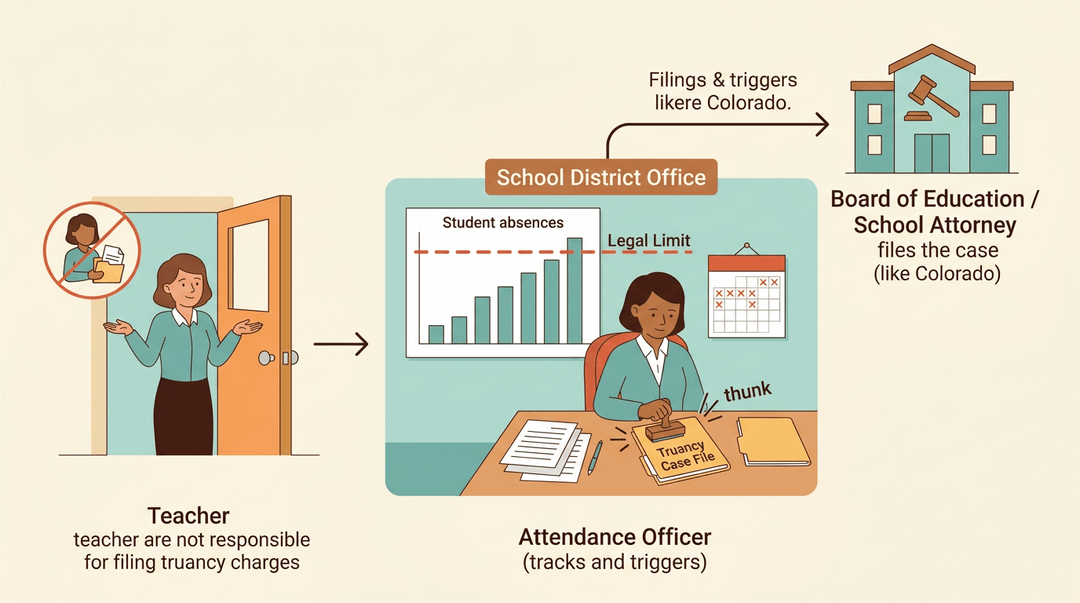
Once a student's absences cross the state's legal threshold, it's the school district that files the case, not an individual teacher.
Most states require an attendance officer to file once that threshold is hit; they're the ones tracking the numbers and triggering the process.
In some states, like Colorado, the filing runs through the school's attorney or the local Board of Education instead.
How the summons and notice work
Once a case is filed, the court mails a summons to the parent or guardian, with a notice attached spelling out the alleged absences and the charge.
States build in a buffer before the court date so families have time to prepare: Texas courts' commentary on truancy court procedures sets that gap at ten days after the petition is filed, and other states require at least five.
Errors in these notices (wrong dates, missing absence counts) are common, and they can end up delaying or even derailing a case.
How diversion can avoid charges
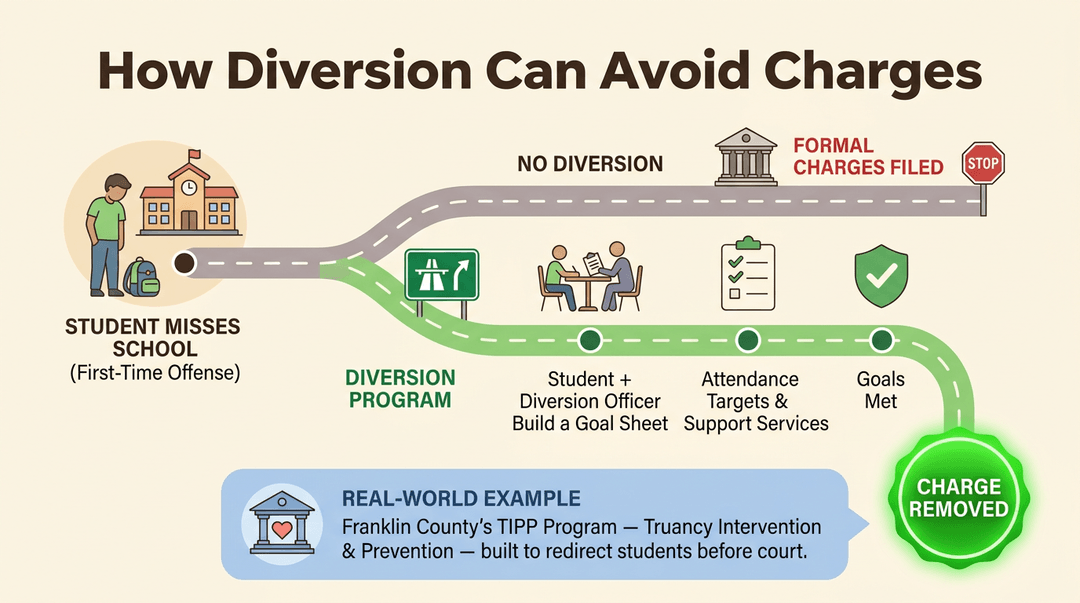
For a first-time offender, many jurisdictions offer a diversion program as an off-ramp before charges ever stick. The student and a diversion officer build a goal sheet together, often covering attendance targets and any support services needed.
Meet those goals, and the charge gets removed entirely.
Franklin County Juvenile Court's Truancy Intervention and Prevention Program (TIPP) is a real-world example: staffers built it specifically to put students back on track before formal court involvement.
What Happens at the Truancy Court Hearing
Once a case lands in front of a judge, the process follows a fairly predictable rhythm, whether it plays out in a courtroom or, increasingly, over video.
Many jurisdictions now offer virtual hearings, which can spare a working parent a half-day off just to sit in a waiting room.
Your first court appearance
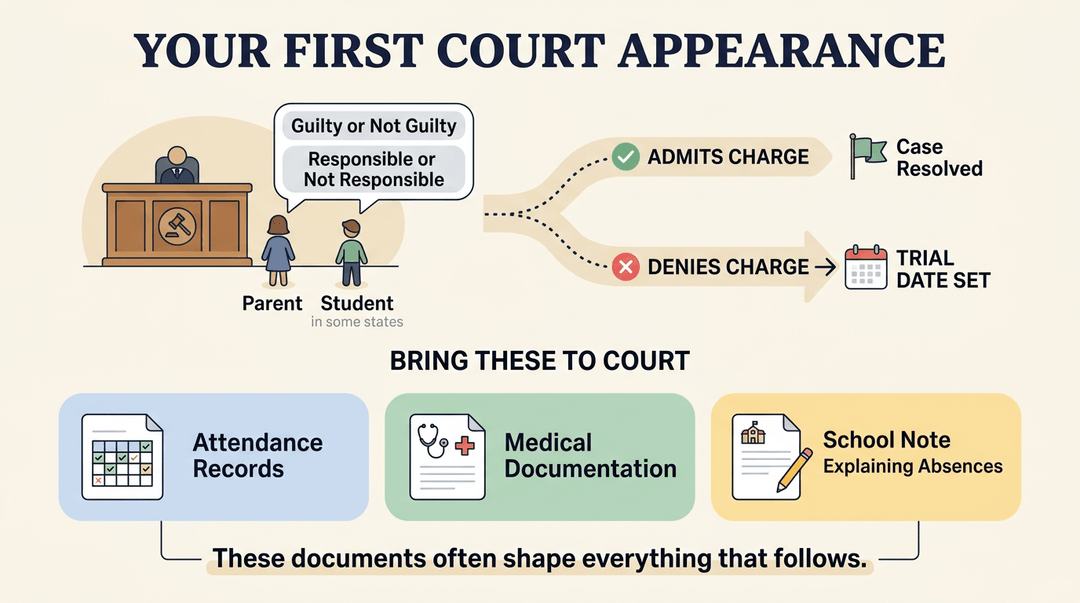
After the initial summons, the court schedules a first hearing. Here, the parent (or in some states, the student) enters a plea: guilty or not guilty for parents, responsible or not responsible for juveniles. Deny the charge, and the case moves toward a trial date. Bring:
- Attendance records
- Medical documentation
- Any note from the school explaining the absences
these documents often shape everything that follows.
How ongoing hearings track progress
If the case doesn't wrap up at the first hearing, expect a series of follow-up hearings, usually every four to five weeks. The judge:
- Reviews updated attendance reports
- Asks about obstacles keeping the student out of class (transportation, illness, housing instability)
- May issue bond conditions tied to future attendance
Compliance gets monitored hearing by hearing, not solved in one sitting.
What the courtroom is really like
A truancy hearing isn't a dramatic trial. Expect a judge, school officials, and court clerks, but rarely a mental health advocate in the room. The setting tends to feel sterile and unwelcoming: fluorescent lights, hard benches, a docket full of other families waiting their turn. In Colorado, students may have the right to an attorney, though that right isn't universal.

When the judge orders an assessment
Sometimes the judge orders a psychological or learning assessment to figure out why the absences keep happening. In Colorado, that can lead to a development plan coordinated through human services, aimed at addressing the root cause rather than just punishing the missed days.
What Penalties You Might Face
Once a truancy case moves past warnings and lands in front of a judge, the consequences get real. What a judge orders depends heavily on the state, the student's age, and whether the family shows up ready to fix the problem.
What is the punishment for truancy?
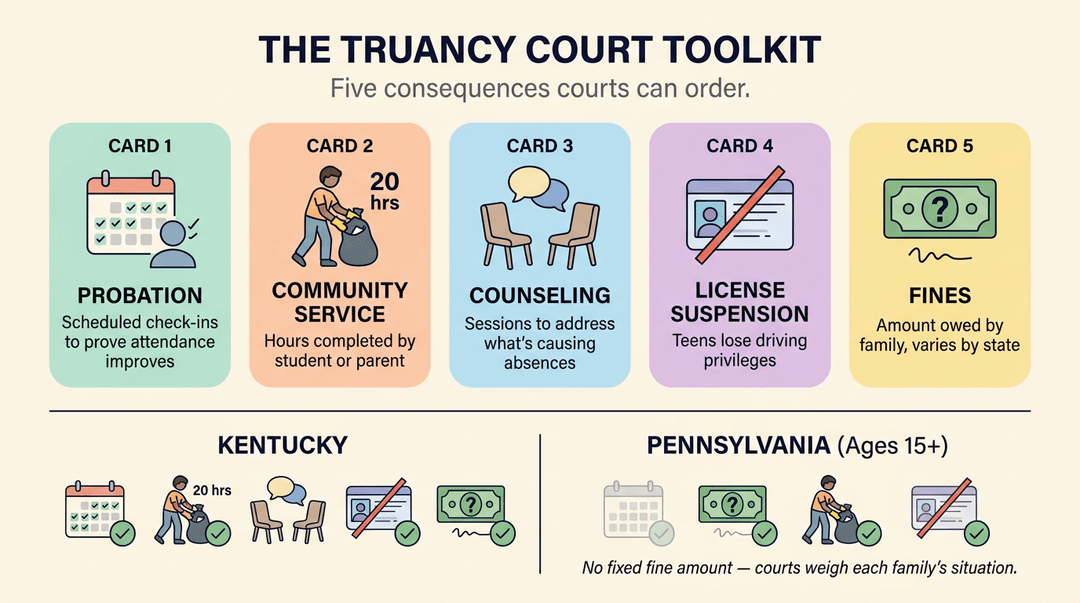
A truancy court's toolkit usually includes:
- Probation. A period of supervised check-ins to confirm attendance improves.
- Community service. Hours the student, or sometimes a parent, completes as a consequence.
- Court-ordered counseling. Sessions meant to address whatever's driving the absences.
- Loss of driver's license. A real deterrent for older teens who value their independence.
- Fines. Money owed by the family, though the amount swings widely by state.
Kentucky courts draw from that same list, ordering:
- probation
- community service
- counseling
- fines
- license suspension
according to a county-level truancy program guide. In Pennsylvania, a school attendance guide notes that students 15 and older risk:
- fines
- community service
- a suspended license
though it stops short of naming one fixed dollar figure: courts weigh each family's situation before settling on an amount.
How compliance closes your case
Show up, follow the order, and most cases end there. Full compliance clears the record, and some courts move toward expungement once they've reviewed the case and confirmed attendance held. Complete a diversion program, an alternative to formal prosecution, and the underlying charge often disappears entirely.
What happens if you don't comply
Ignore the order, though, and things escalate. Courts can open contempt of court proceedings, and in rare cases turn to juvenile detention as a genuine last resort, capped at 48 hours and only when a judge finds it's in the child's best interest. Parents aren't shielded either: continued noncompliance can bring criminal charges against them, not just the student.

When you get a warning first
Many districts issue a written warning before anyone sees a courtroom, spelling out the threat of fines if the absences continue. That warning rarely comes with anything else: no counselor referral, no attendance plan, just a deadline to fix things alone.
Support Resources and Privacy Protections
Truancy court isn't only about consequences. Most systems build in real support, and knowing what's available helps you point a struggling family toward it before a judge ever gets involved.
How case managers can help
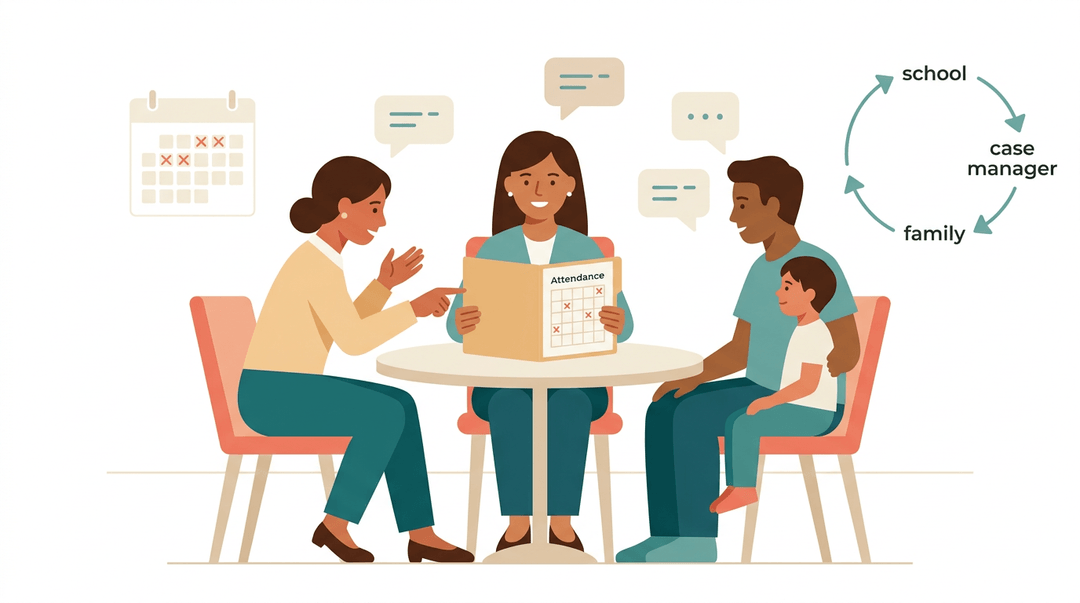
Many districts assign a Visiting Teacher who acts as a liaison between school, home, and court, checking in on attendance and flagging problems early. A Truancy Case Manager is typically available too, coordinating services once a case opens.
For example, a homeroom teacher who notices a student's absences piling up can loop in the case manager directly instead of waiting for a referral to escalate.
Ongoing contact is encouraged on both sides: families and schools who keep talking to these liaisons tend to resolve issues faster than those who go quiet.
What confidentiality rules apply
Referrals to outside agencies generally require written consent from a parent or guardian. Sharing records between school, court, and social services usually means signing an interagency consent form first.
The one exception: a medical or mental health emergency, where information can move without that signed consent to protect the student's immediate safety.
Getting mental health and disability support
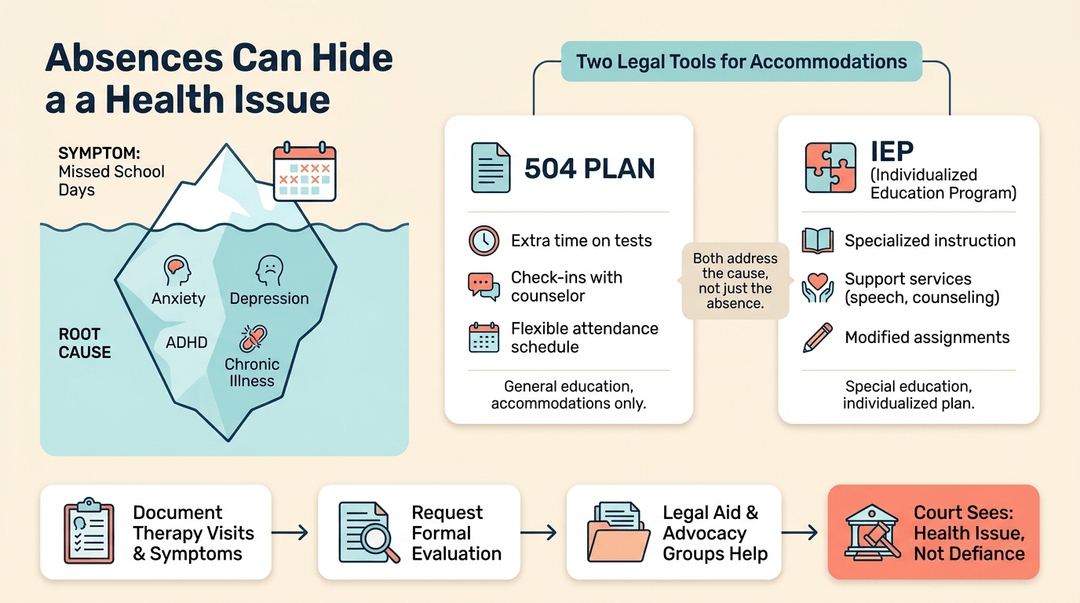
If a disability or health condition is driving the absences, a 504 Plan or an IEP (Individualized Education Program) may entitle the student to accommodations that address the root cause, not just the symptom.
Legal aid and advocacy groups can help families understand those rights. Documenting therapy visits and symptoms, and requesting formal evaluations, both give the court concrete evidence that a health issue, not defiance, is behind the pattern.
How to Beat Truancy Charges
So how do families actually beat truancy charges? It comes down to proof: a valid, documented reason the absences shouldn't count against the student, not just a good excuse offered on the day of the hearing.
What counts as a valid defense
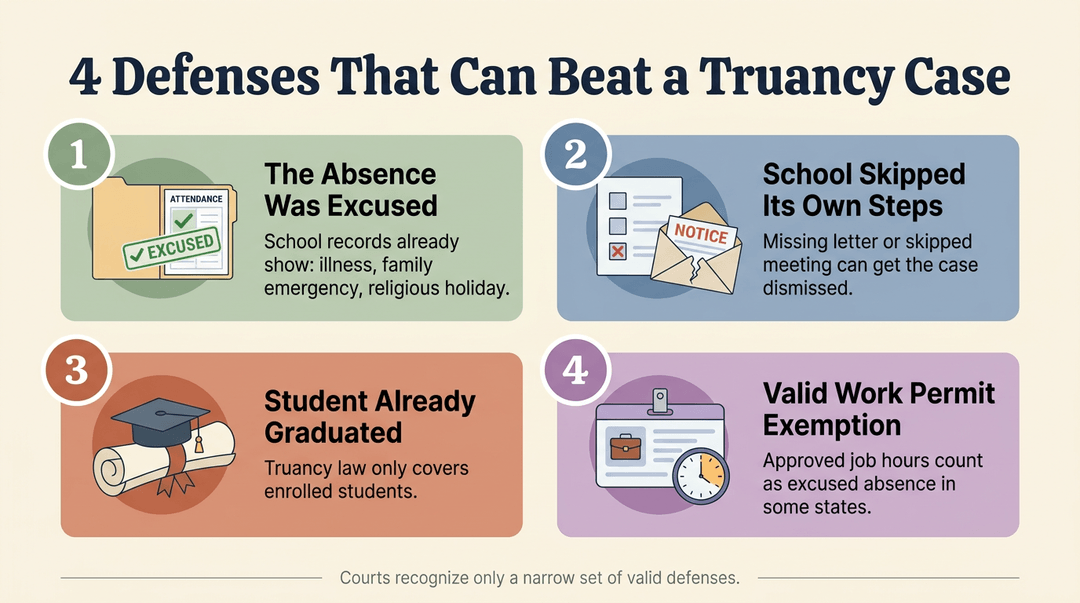
Courts generally recognize a narrow set of defenses:
- The absence was excused. If the school's own attendance records show the days were approved (illness, a family emergency, a religious observance), that paperwork undercuts the whole case.
- The school violated its own procedures. Districts must follow their published notice and intervention steps before referring a case. Skipped meetings or missing letters can get a case dismissed on a technicality.
- The student already graduated. Truancy law only applies to enrolled students, so a completed diploma ends the school's authority entirely.
- A valid work permit exemption applies. Some states let older teens with approved employment count those hours as an excused absence.
Why mental health isn't a defense
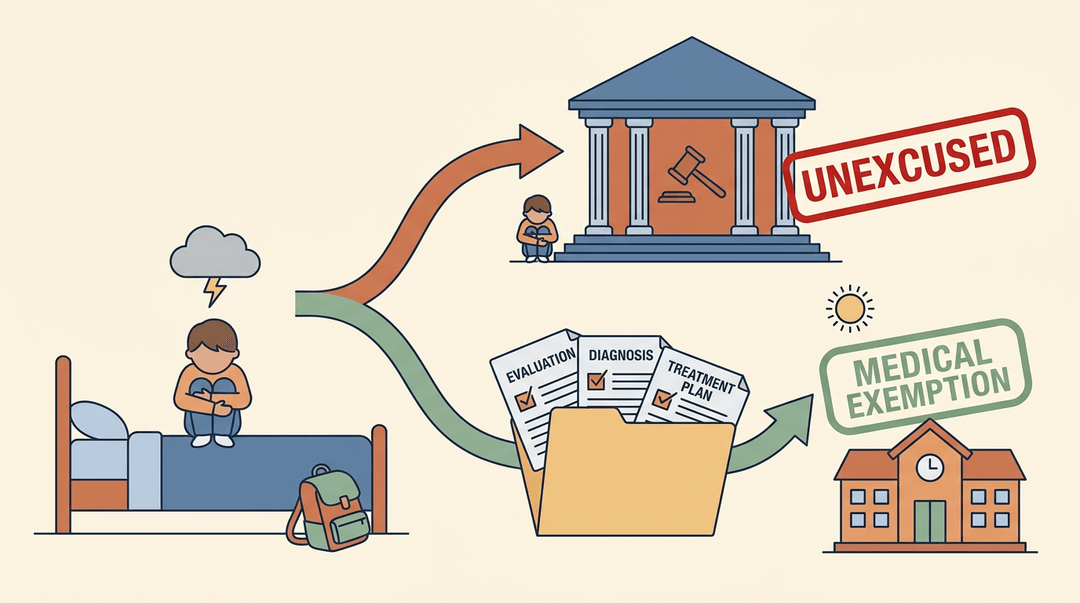
Here's the part families often get wrong: anxiety-based school refusal feels like a legitimate reason to stay home, but the law usually doesn't see it that way.
Most truancy statutes draw no legal distinction between a student avoiding school out of fear and one skipping for any other reason. Unexcused is unexcused.
The fix isn't to argue mental health in court. It's to get ahead of it with documentation: a formal evaluation, a diagnosis, and a treatment plan from a licensed provider.
That paperwork lets a school reclassify the absences under a medical exemption before the case ever reaches a judge, which is a far stronger position than raising it as a defense after the fact.
Other Issues That Can Surface in Court
Truancy court rarely stays confined to attendance records.
A judge digging into why a student keeps missing school often uncovers something far more serious underneath, and that's by design: the hearing exists to find the root cause, not just log the missed days.
What else truancy cases can uncover
When a student's absences trace back to conditions at home, a truancy hearing can open the door to a child abuse investigation.
Consider a middle school student whose attendance drops sharply after a family move: a school attendance officer's routine questions surface bruises or an unsafe living situation, and the court refers the family to child protective services on the spot.
Parents aren't shielded from scrutiny either. If a judge finds that a parent's neglect, not the child's choice, is driving the absences, the parent can face a separate charge of contributing to the delinquency of a minor.
That charge carries its own penalties, layered on top of whatever the truancy case already imposes.
Some discoveries are harder to anticipate.
A student who's chronically absent to avoid a specific person, a family member, a neighbor, someone at school, can end up revealing an ongoing sexual assault during questioning meant only to explain the missed days.
None of this happens by accident.
These findings stem directly from the truancy investigation itself: attendance problems act as an early warning sign, and once a case reaches court, the questions asked to explain the pattern often lead investigators straight into the deeper issue behind it.
Truancy court isn't a mystery once you see the steps: warnings, documentation, a filed case, then a hearing where penalties or support services follow.
For teachers, the real leverage sits earlier than any of that, in the daily habit of noticing and recording who's missing and why. Catch the pattern early, and you'll rarely need to think about a courtroom at all. Ready to get ahead of it?
Check out our Attendance & Records feature to mark attendance quickly and spot patterns across your classes before they become a case.

References
- Welcome Back to School–Make Your Year Count! — lawlibrary.hamiltoncountyohio.gov (2026)
- PRESIDING JUVENILE JUDGE ORDER 2025-02 — coloradojudicial.gov (2025)
- Truancy Court - Justice of the Peace Court - Delaware Courts — courts.delaware.gov
- Attendance State Policy — cde.state.co.us
- Chronic Absenteeism — ed.gov
- Texas Truancy — docs.gato.txst.edu (2025)
- Attendance Guidebook July 2025 — cde.state.co.us (2025)
- Monitoring Process — ycsd.org
- Guidance for Schools and Courts to Stem Truancy — courtnewsohio.gov
- Delaware Code Online — delcode.delaware.gov
- Truancy — peoples-law.org
- Status offenses specified in statute — ojjdp.ojp.gov
- Chapter 3321 - Ohio Revised Code — codes.ohio.gov
- commentary-accompanying-truancy-court-procedures. ... — txcourts.gov
- Court Program Helps Put Juveniles on the Right Track — courtnewsohio.gov
- Truancy Intervention Programs — browncountymn.gov
- Texas Truancy Laws and Truant Conduct Under the Family Code — legalclarity.org (2026)
- Attendance Information — gps.greenlocalschools.org (2025)
- Recognizing and Responding to Truancy: A Step-by-Step Guide for Parents — schoolavoidance.org
- School-Attendance-Truancy-The-Basics-2026. ... — elc-pa.org
Frequently asked questions
What is the punishment for truancy in Kentucky?
In Kentucky, truancy consequences can include probation, community service, counseling, fines, and suspension of the student’s driver’s license. The specific penalty depends on the circumstances, the student’s age, and whether the family complies with court orders. Parents may also face consequences if they fail to ensure attendance.
How to beat truancy charges?
You may challenge truancy charges by showing that absences were legally excused, the school’s attendance records are inaccurate, or required notice and intervention procedures were skipped. Gather attendance records, medical documentation, school correspondence, and proof of any work-permit or other exemption. Consider speaking with a local lawyer or legal-aid organization, and comply with any diversion or attendance plan while the case is pending.
How much is a truancy fine in PA?
Pennsylvania does not have one fixed statewide truancy fine that applies in every case. Courts may impose fines along with community service or a driver’s-license suspension, and the amount depends on the circumstances and applicable local rules. A Pennsylvania court or legal-aid provider can confirm the current amount for a specific case.
Can children go to jail for truancy?
Children generally do not go to jail for truancy. Truancy is typically handled through juvenile or civil proceedings involving attendance plans, counseling, probation, community service, or other measures, although juvenile detention can be allowed in limited circumstances as a last resort. Parents may face separate criminal or contempt proceedings for failing to ensure their child attends school.