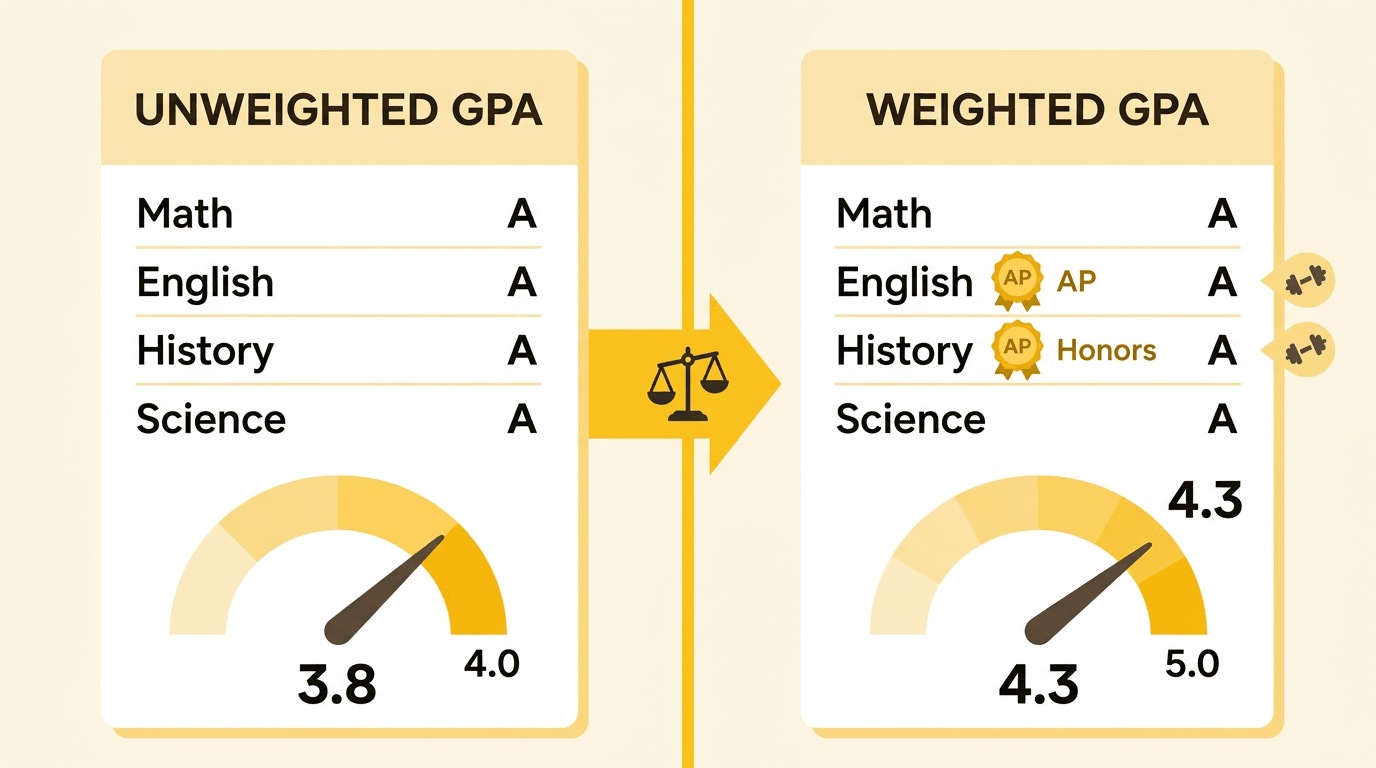
Grading Explained: Cards, Land, and Classroom Scales

Jump to section
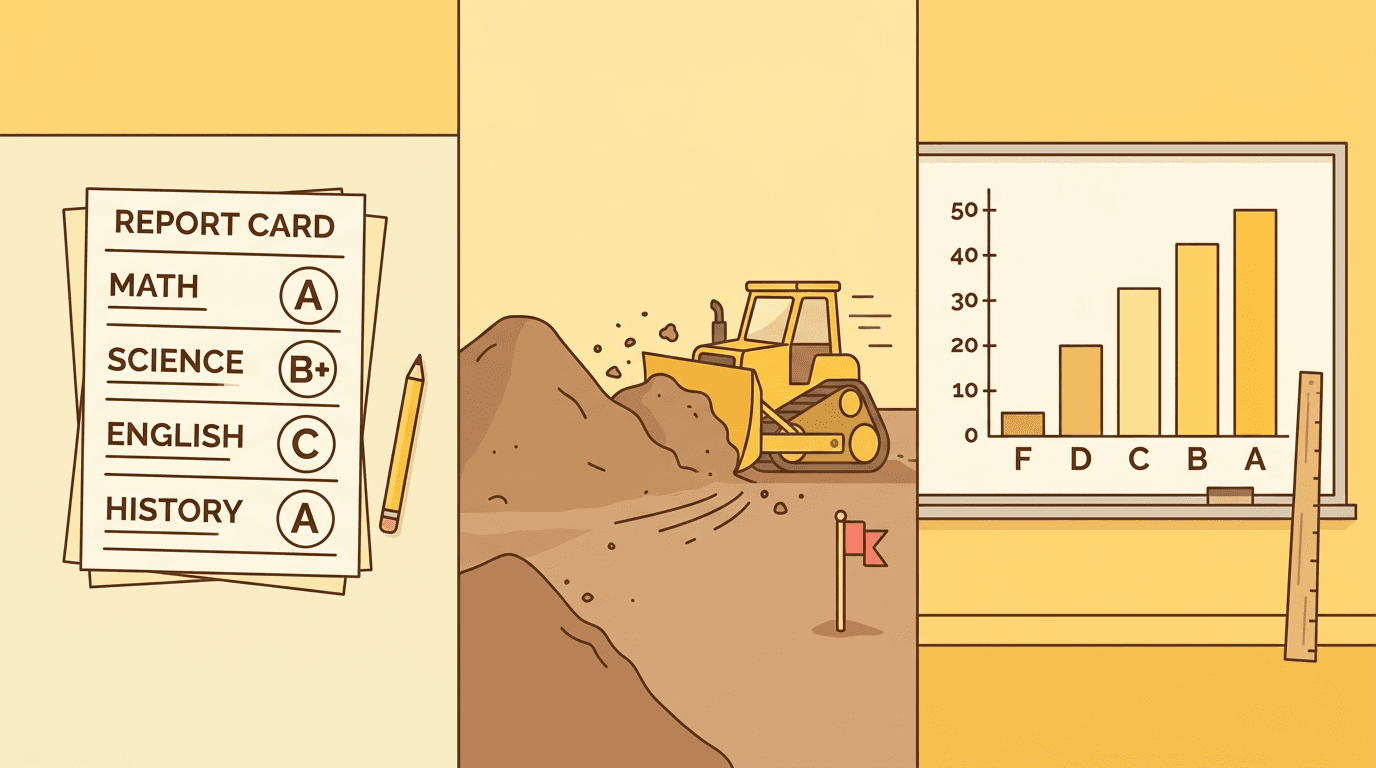
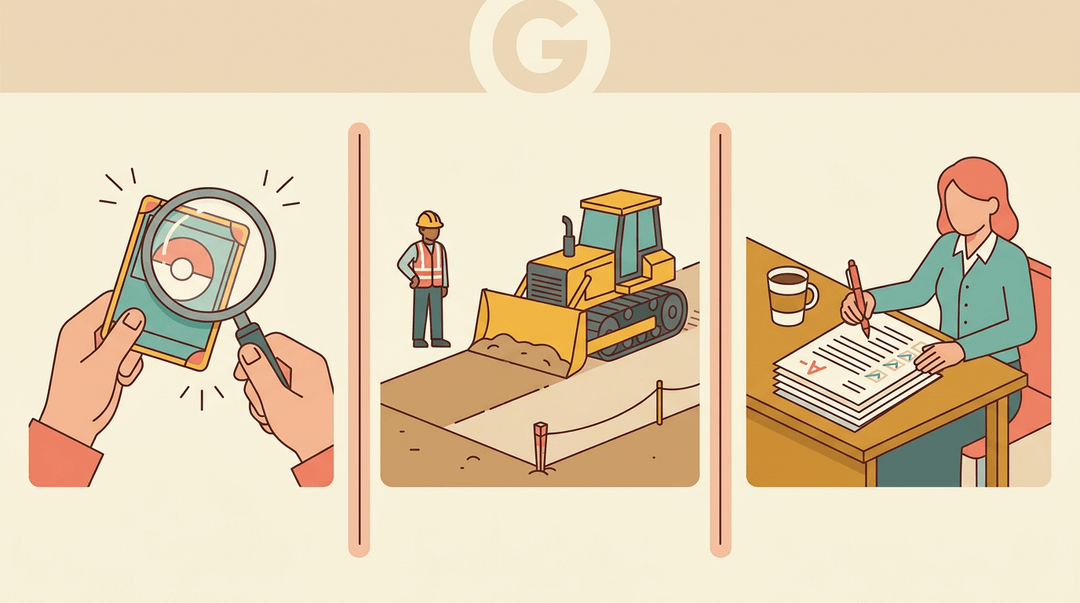
Say the word "grading" to three different people and you'll get three different pictures: a collector checking a card's corners, a construction crew leveling a site before the first brick goes down, or a teacher marking up a stack of essays.
Same word, three very different jobs. This post walks through all of it: what grading means for cards, for land, and for your classroom, plus a practical breakdown of grading scales and calculations you can actually use.
What Card Grading Is and Why It Matters
Grading means different things depending on where you hear it. On a job site, it's leveling land before construction. In your classroom, it's the score on a quiz. In the collectibles world, it's something else: a professional's verdict on a trading card.
That's the sense this section digs into.
What Do You Mean by Grading?
So what do you mean by grading in the card world?
Card grading is a professional condition assessment: a trained examiner inspects a card's corners, edges, surface, and centering, then assigns a numeric score, often on a 1-to-10 scale, that sums up its condition at a glance.
Once graded, the card is sealed in a tamper-proof holder, protected and ready to display.
The point is simple: it removes the subjective guesswork that used to define the hobby, so two collectors looking at the same card reach the same conclusion about its condition.

How Grading Builds Value and Trust
Grading does more than label a card. It certifies authenticity, confirming the card is genuine and untampered with, and it standardizes comparability, so a grade from one card means the same thing as that grade on another.
That consistency creates a kind of scarcity within scarcity: among all the copies of a rare card, only a handful might earn the top grade.
That matters because confidence drives higher prices. Research published in the Atlantic Economic Journal found that third-party grading affects the value of graded basketball cards, alongside player performance.
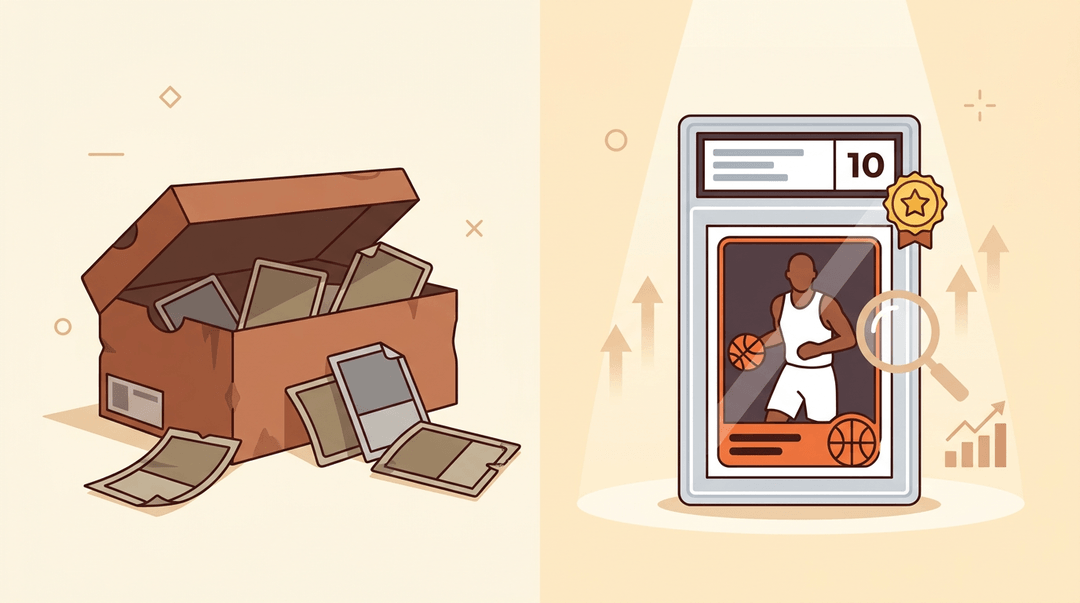
A sealed holder also protects long-term condition, keeping a card's value intact for years instead of degrading in a shoebox.
How the Grading Process Works
Card grading isn't a single glance and a guess. It's a sequence of checks that moves from authenticity to condition to a sealed, verifiable result. Here's how that sequence actually plays out.
Confirming the Card Is Genuine
Before a grader even looks at condition, they confirm the card is real.
That means checking the stock, printing pattern, and dimensions against the manufacturer's original specs to catch trimming or altered edges, a common trick used to fake sharper corners. Many grading companies also run security tech verification:
- black-light checks
- magnification
- database cross-referencing that flag reprints or doctored cards before they ever reach a scoring table
The Four Factors Graders Check
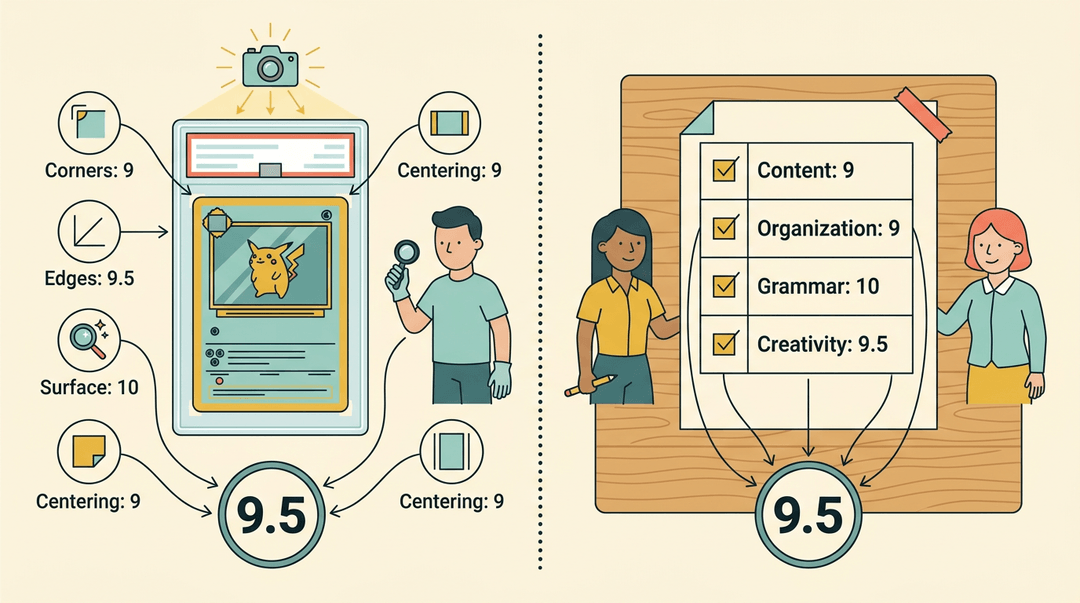
Once authenticity is settled, four physical factors drive the score:
- Corners. How sharp or rounded they are, since even light handling wears them down first.
- Edges. Whitening or fraying along the border, often invisible until you tilt the card in the light.
- Centering. How evenly the image sits inside its border.
- Surface. Scratches, print lines, or factory defects that show up under raking light.

How Graders Turn Checks Into a Score
Each factor gets its own numeric subgrade, and graders combine them into one overall score on a 1-10 scale, often in half-point increments (a 9.5 versus a 9, for example).
Some companies use proprietary scoring tech that stretches the same idea across a 1,000-point scale for finer distinction, paired with photometric imaging analysis: cameras that capture the card under multiple light angles to catch what the eye might miss.
It mirrors rubric point scoring in a classroom: separate criteria scored on their own, then combined into one final grade that reflects the whole picture, not just one flaw or one strength.
Sealing the Card in a Slab
Once the score is set, the card goes into a sealed, tamper-evident case (often called a slab) built to protect it going forward. The label inside lists the grade and the card's data:
- player
- set
- year
- certification number
A QR code on that label links to a digital report, so a buyer can verify a card's grade and history without ever cracking open the case.
A Practical Classroom Grading Checklist
Work through this guide once before the term starts, then pin it up: the first two blocks set your system, the last two keep it running when real students collide with it.
Pick your system first
Everything else depends on this choice, so make it deliberately.
| System | Best when... |
|---|---|
| Points-based | You want simple totals students can track themselves |
| Standards-based | You're reporting mastery of specific skills, not averages |
| Pass/fail or mastery | The goal is completion or competency, not ranking |
Then set your category weights and post them on day one, written out like this: Tests 50%, homework 30%, participation 20%. Students should never have to guess what counts.
Set up weighted grades
- Assign a weight to every category. Weights must total 100%.
- Multiply each category average by its weight, then add the results.
- The formula: (average × weight) per category, summed.
- Check the GPA impact before finalizing. Convert the percentage to your school's scale.
- A 89.6% may round to an A- or a B+; know which before report cards.
Example: A student averages 84 on tests (50%), 92 on homework (30%), and 100 on participation (20%). The weighted grade: (84 × 0.5) + (92 × 0.3) + (100 × 0.2) = 42 + 27.6 + 20 = 89.6%.
Give feedback that actually helps
Before you return any graded work, confirm:
- The rubric was applied identically to every paper. Same criteria, same standards, first paper to last.
- Each comment names one fix, not five. Students act on one; they skim five.
- Progress reports go out on a schedule, not just when grades slip.
Here's what the one-fix comment looks like in practice:
❌ "Good effort, but watch your thesis, evidence, transitions, and conclusion." ✅ "Your evidence is strong. Next draft: make your thesis take a side in one sentence."
The difference: the second names one concrete move and tells the student where to spend their next hour.
⚠️ Watch out: rubric drift. Graders get harsher (or softer) as the stack goes on. Re-read your first two graded papers after finishing the pile, and re-score them if they'd land differently now.
Decide your policies before you need them
Announcing a rule mid-crisis feels arbitrary; announcing it in the syllabus feels fair. Set these three now:
| When... | Your policy says... |
|---|---|
| Work comes in late | The deduction per day, and the cutoff (e.g., 10% per day, max 3 days) |
| An assignment is missing | Whether it's a zero, a placeholder score, or an incomplete, and the deadline to fix it |
| A student wants a retake | Who qualifies, how many attempts, and whether the new score replaces or averages |
Write each answer in one sentence, put it in the syllabus, and apply it to everyone. Consistency is what makes a policy defensible to students and parents alike.
The math above is the part worth handing off: EMStudio's gradebook automates weighted grade calculations so you can spend that time on feedback instead.
Grading Scales and Terms to Know
Whether you're tilting a rookie card under a lamp or checking a report card, grading always comes down to a scale and the shorthand collectors and teachers use to talk about it.
Card grades and classroom grades run on different scales, but both boil down to numbers standing in for quality.
Understanding Grade Tiers and Labels
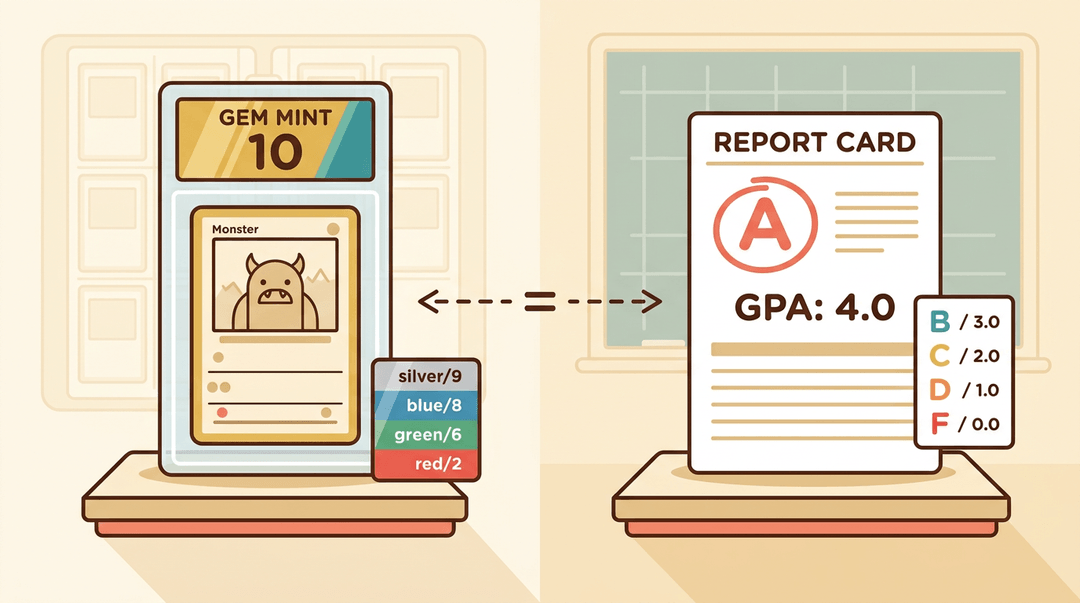
Card grading tops out at Gem Mint (sometimes called Pristine): a flawless card with sharp corners, perfect centering, and no surface wear. Grading companies use color-coded labels so a collector can spot a card's tier at a glance, and each numeric grade from 1 to 10 carries a named tier, from Poor at the bottom to Gem Mint at the top. Half-point grades get their own names too, like Near Mint-Mint, for cards that fall just short of the next whole number.
Classroom grading has its own version of this: the letter scale from A to F, each letter tied to a GPA (grade point average) value.
Most schools translate a percentage into that letter, so a 90 might land an A while an 80 lands a B, then convert the letter into GPA points for a transcript.
What Population Reports Tell You
A pop report (short for population report) tracks how many copies of a card received each grade. That number matters because population determines rarity: if only a handful of copies ever earned a Gem Mint, that grade carries far more weight. Many grading services publish leaderboard rankings by set, and every graded card carries a cert or serial number you can look up to verify the grade is real.
Common Collector Terms Explained
A slab is the hard plastic case a graded card ships in. A raw card is one that's never been graded at all. Together, gem mint, pop, and slab are the shorthand you'll hear most often once you start comparing cards.

Grading Companies and Their Technology
Not all grading companies work the same way, and picking one matters almost as much as the card you're sending in.
Comparing the Top Grading Companies
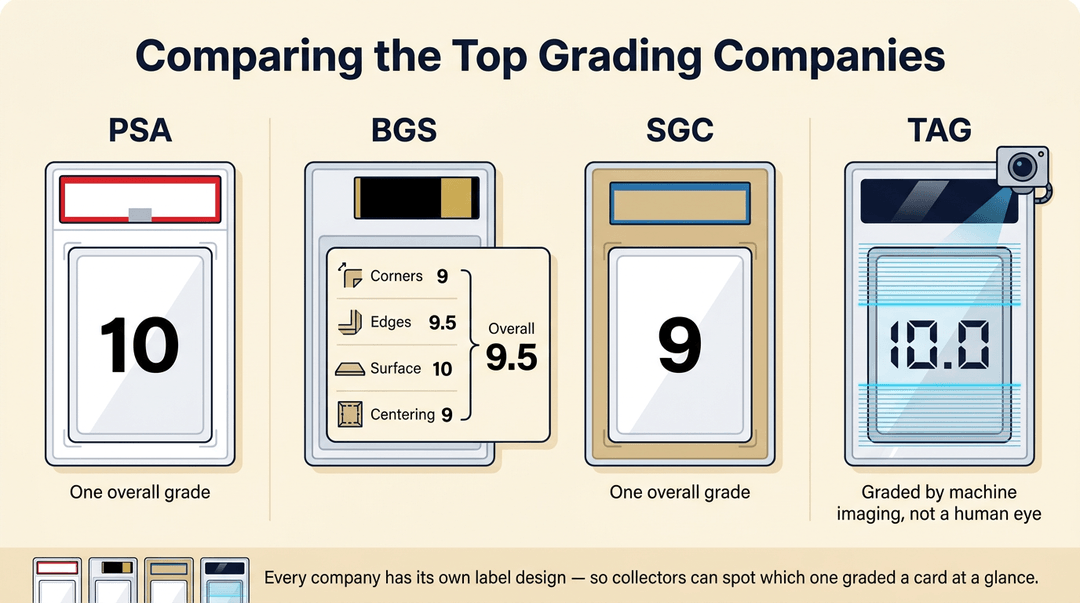
Three names dominate the hobby: PSA, BGS, and SGC, each with its own reputation and following. TAG stands apart with a technology-driven grading process that leans on machine imaging rather than a human eye alone. Beckett is known for its subgrade system, breaking a card's grade into corners, edges, surface, and centering instead of one flat number. Every company also uses a distinct label design, so collectors can spot a PSA slab from a BGS one at a glance.
The Technology Behind Modern Grading
Under the hood, top graders use photometric stereoscopic imaging to catch flaws invisible to the naked eye. Slabs are sealed in UV-resistant material to guard against fading, while security holograms and QR codes protect against counterfeits. Digital image grading reports let owners see exactly why a card scored what it did, thanks to defect identification tools that flag scratches, print lines, or off-center borders.
How Card Submission Works
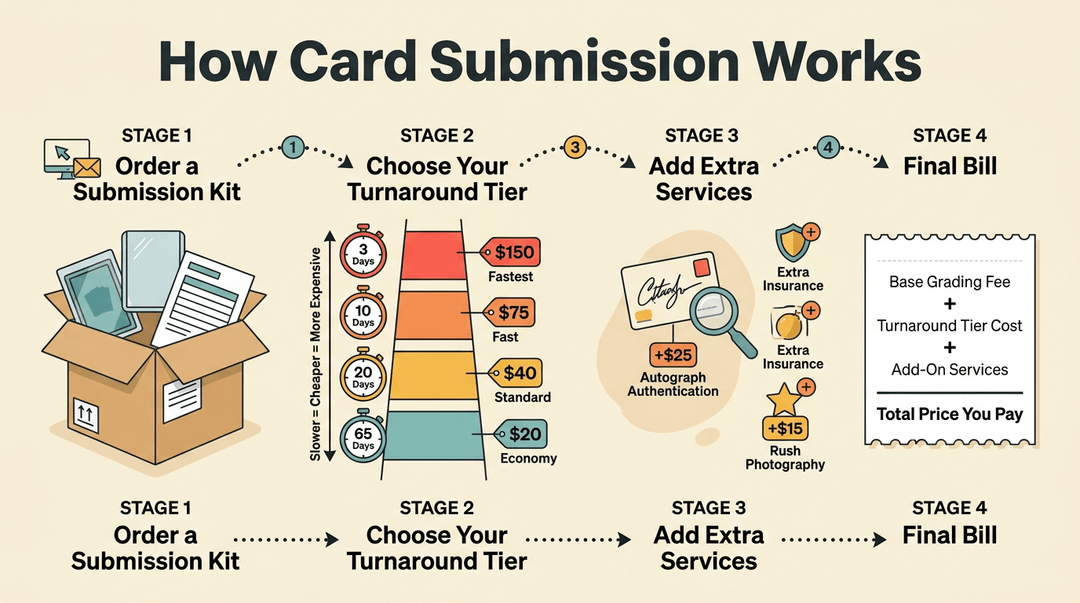
Getting a card graded starts with a submission kit ordered directly from the company. From there, turnaround time tiers set the pace: faster service costs more, and slower tiers cost less. Service level pricing scales with how quickly you need the card back, and extras, like autograph authentication fees, add to the final bill.
What Grading Costs and When It's Worth It
Grading a card isn't free, and it isn't a flat fee either. Before you send anything off, it helps to know what you're paying for, and whether the card in question is really worth the wait.
How Much Grading Costs
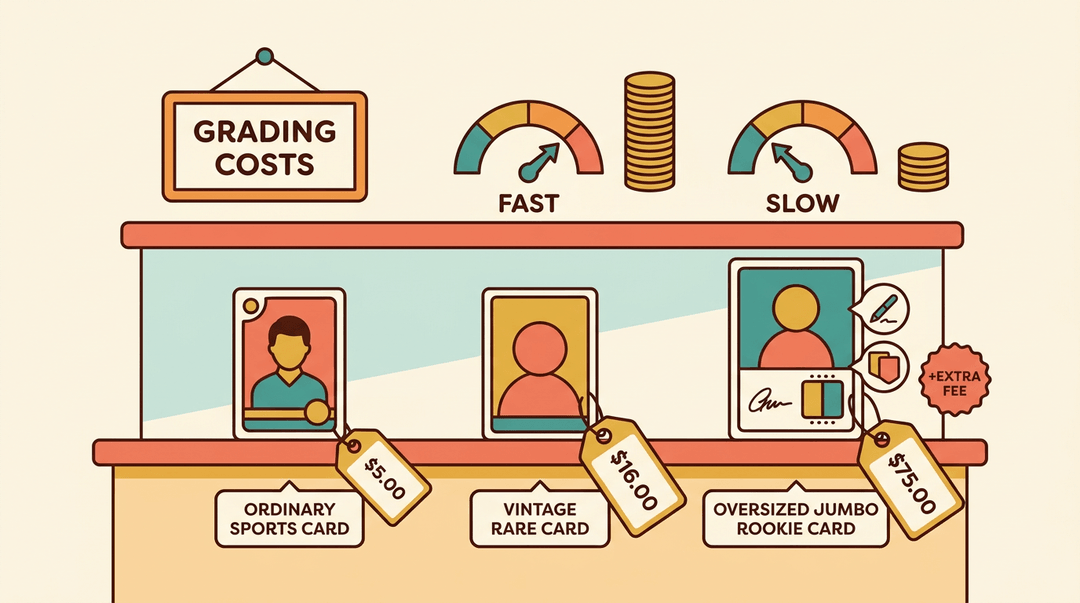
Prices swing widely depending on which service you use and how fast you want an answer.
According to Collector Sports World, "Both PSA and Beckett (BGS) price by declared card value and turnaround speed," so a common card and a rare vintage find won't cost the same to grade.
Faster turnaround always costs more: rushing a submission can add a real premium, while standard processing takes longer but costs less.
Autographed cards and oversized cards, like jumbo rookies or multi-relic patches, usually carry extra fees on top of the base price since they need special handling.
When It's Worth Grading a Card
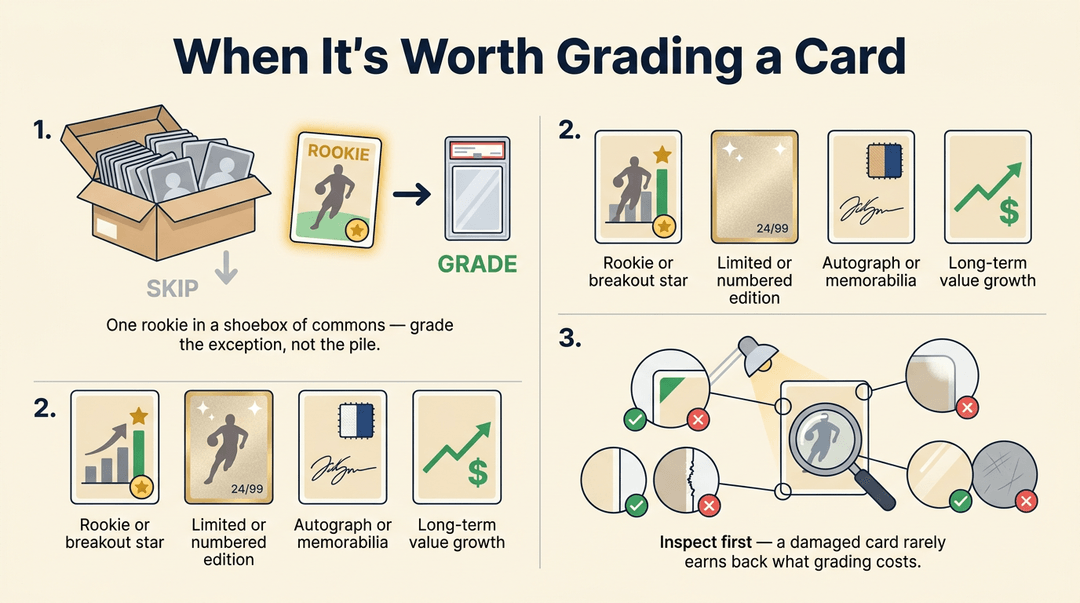
Not every card belongs in a grading queue. Consider a collector sorting through a shoebox of commons and one rookie card of a rising star: the rookie is the one worth the fee, not the whole stack.
Grading tends to pay off for:
- Rookie or key player cards, especially from a breakout season
- Limited or numbered editions, where scarcity drives value
- Autographs and memorabilia cards, which carry authentication value beyond condition
- Cards with long-term appreciation potential, not just today's price tag
Before submitting anything, inspect the card yourself under good light. Check the corners, edges, and surface for whitening or scratches: a damaged card rarely earns back what grading costs.
Land Grading in Civil Engineering
Grading means something entirely different once you step outside a classroom or a card shop: on a construction site, it's the literal reshaping of the earth before anything gets built on top of it.
Why Land Gets Graded Before Building
Before a single foundation is poured, crews level the land so it can actually support what's coming next.
This process establishes the sub-grade (the compacted soil base) and the finished grade (the final, contoured surface), and it underpins everything from roads to building foundations to landscaping.
Skip it, and a foundation cracks or a driveway pools with water after the first storm.
How Regrading Works
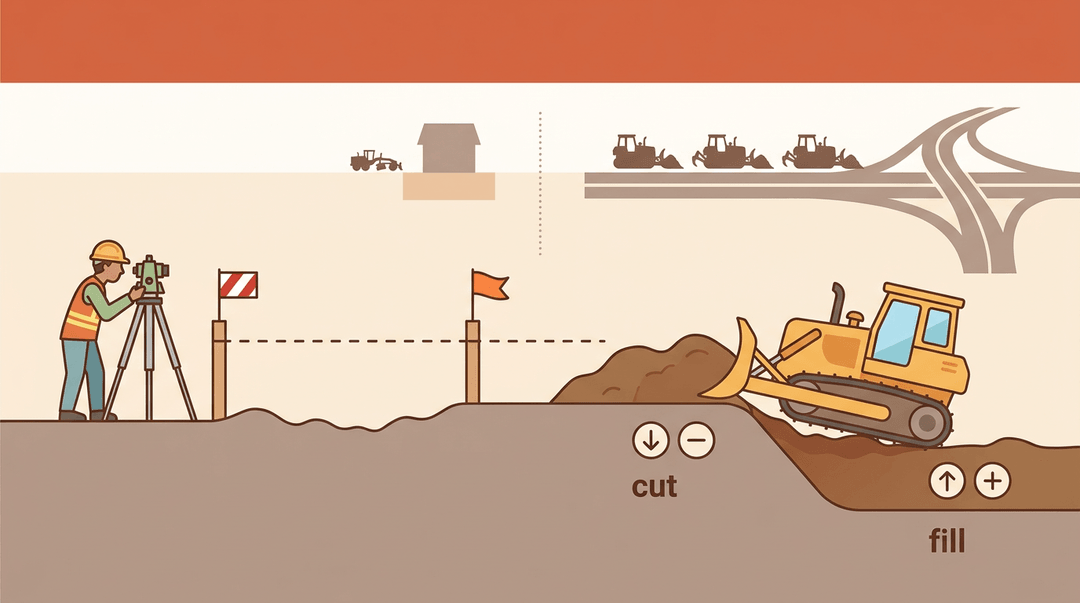
Regrading starts with a surveyor, who sets stakes and benchmarks to mark existing elevations and where the new grade needs to land.
From there, bulldozers and graders move the earth, guided by cut marks (where soil comes out) and fill marks (where it goes back in).
A small residential lot might take a single grader an afternoon; a highway interchange can mean months of staged, large-scale earthmoving.
Risks of Getting Grading Wrong
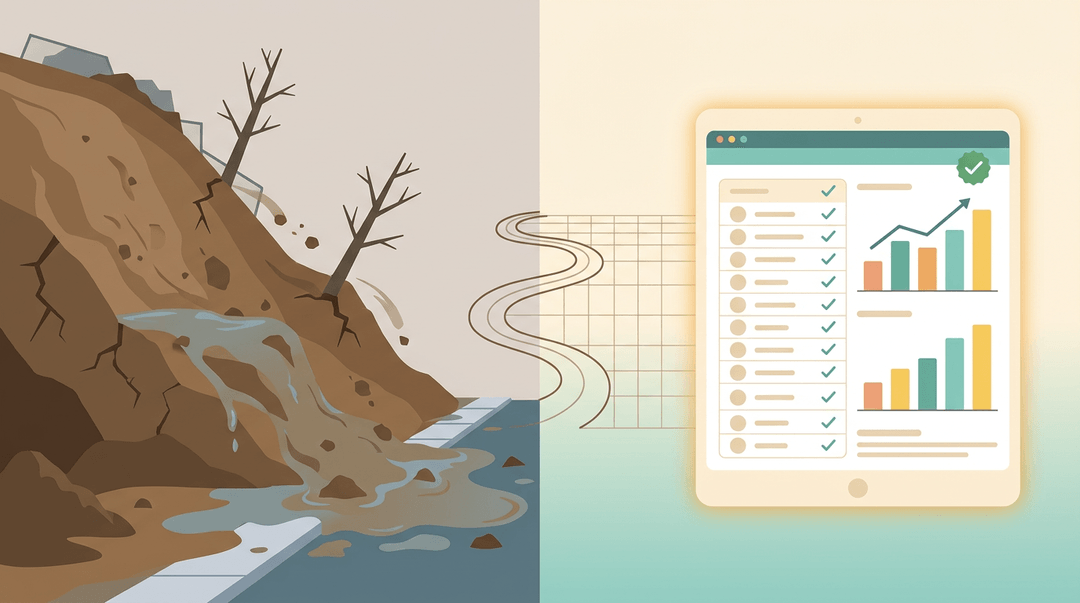
Get the grade wrong, and the land pushes back.
- Slopes cut too steep invite soil and slope instability, sometimes years after the crews leave.
- Loose, ungraded soil erodes fast, washing sediment into streets and waterways.
- Regrading also disturbs habitats, so ecological impact matters on sites near wetlands or wildlife corridors.
- And grading is what tells water where to go: get it wrong, and drainage problems, flooded basements, pooling yards, show up every time it rains.
Grading, in every sense, is about turning something messy into something you can trust and compare. A card's condition, a site's slope, a student's progress: each gets clearer once you know the system behind the number.
Ready to make classroom grading less of a headache? Check out our Grading & Assessment tool to record and calculate grades automatically, so you can spend less time on math and more time teaching.
References
- Third-Party Grading as a Useful Measure of Demand: Evidence from NBA Cards | Atlantic Economic Journal — link.springer.com (2025)
- Beckett vs PSA Grading Costs What You Actually Pay — collectorssportsworld.com (2026)
Frequently asked questions
What is grading in landscaping?
Grading in landscaping is the process of shaping and leveling land to create the desired elevations and slopes. It improves drainage, establishes a stable base for features such as patios or foundations, and helps prevent pooling, erosion, and flooding.
What is the process of grading?
The grading process begins with a surveyor marking existing elevations and the intended finished grade using stakes and benchmarks. Equipment then cuts soil from high areas and fills low areas, compacting the soil to create the required sub-grade and finished surface.
What do you mean by grading?
Grading means assigning a value or condition level, or shaping land to a planned slope or elevation, depending on the context. In landscaping and construction, it specifically means reshaping earth to establish stable surfaces and direct water flow.