IB Scoring Scale Explained: Grades, Bonus Points & GPA


Jump to section
Picture a report card that means the same thing whether you're a student in Singapore, São Paulo, or Stockholm.
That's exactly what the International Baccalaureate scoring scale is designed to do: give a consistent, internationally recognised measure of what a student knows and can do.
The IB uses a 1 to 7 scale for each subject, plus a handful of bonus points that can push a student's total to 45.
In this post, we'll unpack how that scale works, what the numbers actually mean, where the diploma threshold sits, and how it all translates in a US college context.
We'll also look at the practical side: how IB teachers track and moderate internal assessment grades so every mark is fair and defensible.

Understanding the IB Scoring Scale
The IB scoring scale is more structured than it first appears. Every subject runs on the same 1 to 7 scale, and those subject scores feed into a diploma total that has its own thresholds and bonus points. Here's how it all fits together.
How the 1 to 7 subject score works
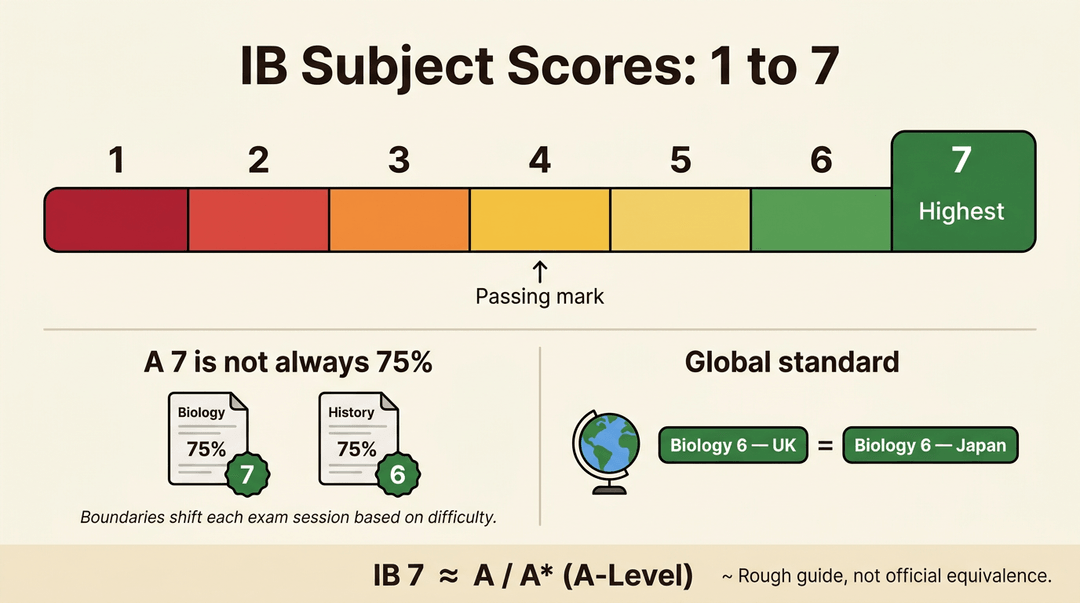
Every IB subject is graded on a 1 to 7 scale, with 7 being the highest achievable. A score of 4 is the passing mark for a subject, and the scale is globally standardized: a 6 in Biology in one country means the same thing as a 6 in Biology anywhere else.
A common question is whether percentage marks map neatly onto this scale. They don't, not in a fixed way.
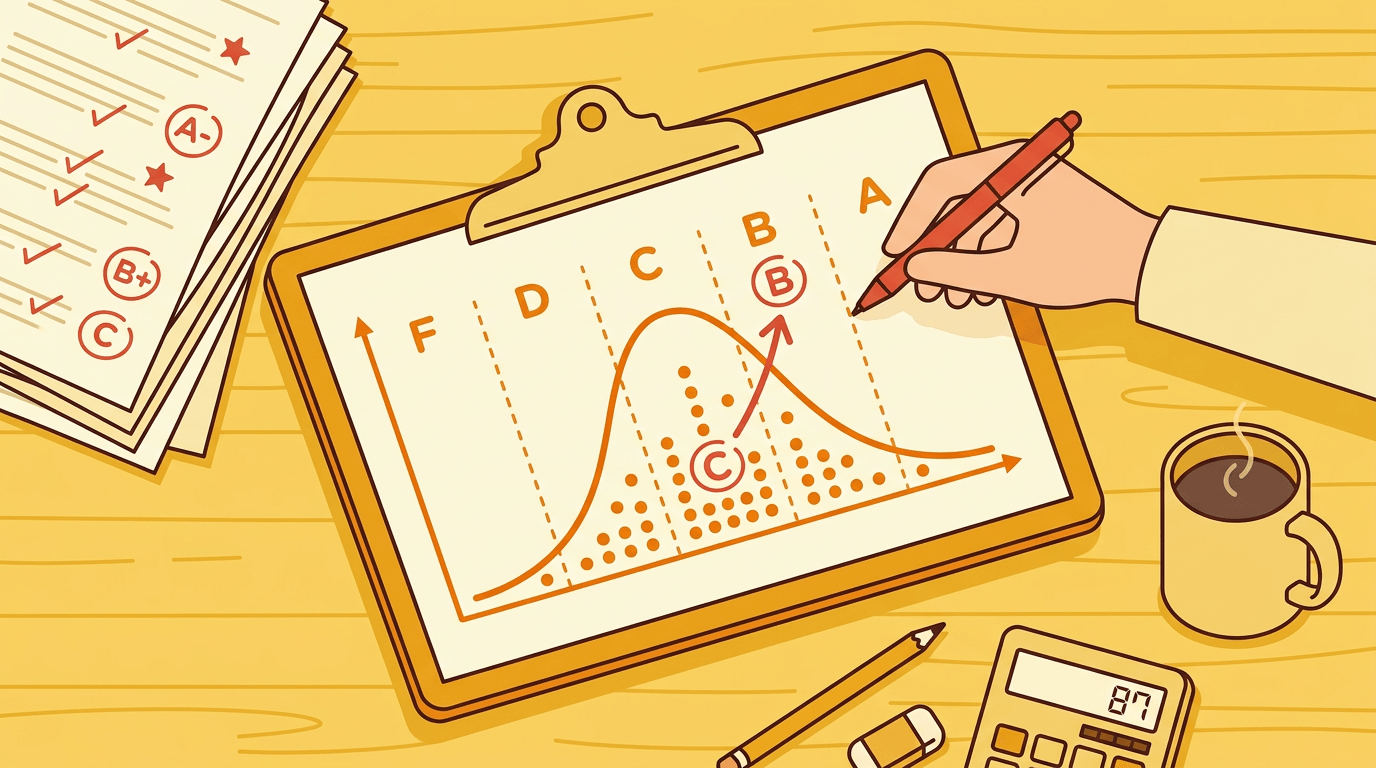
Grade boundaries shift each session based on the difficulty of the exam, so 75% might earn a 7 in one subject and a 6 in another. There's no single conversion table.
A 7 in IB is broadly comparable to an A or A* at A-Level, though the two qualifications assess different things, so the comparison is a rough guide rather than an official equivalence.
How the total diploma score adds up
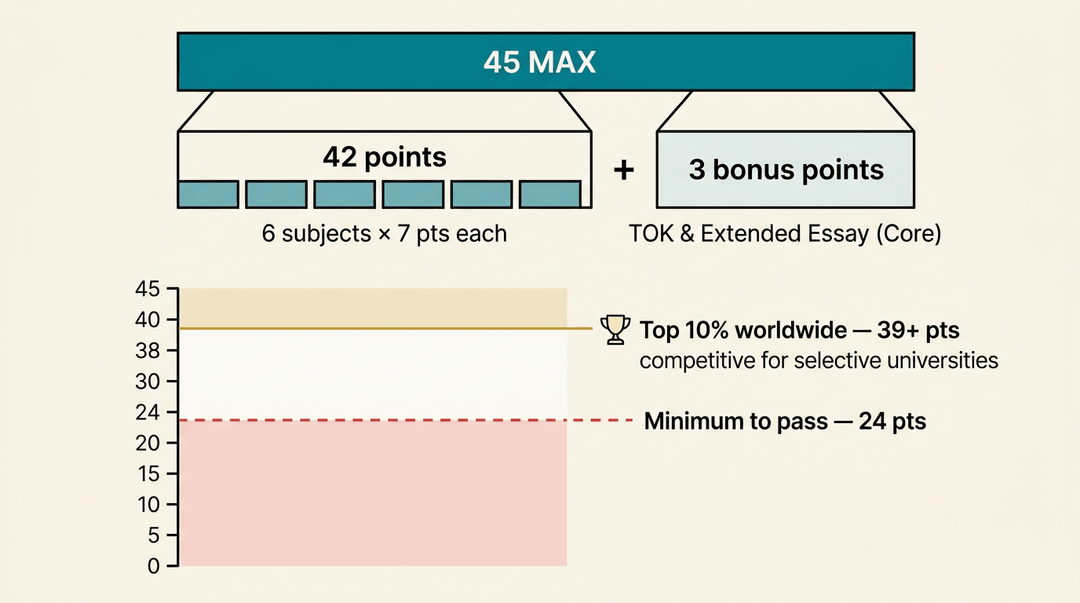
The IB Diploma has a maximum of 45 points: 42 from six subjects (7 points each) and up to 3 bonus points from the core components (Theory of Knowledge and the Extended Essay).
According to the IB's diploma passing criteria, students must earn at least 24 points to be awarded the diploma.
A score of 39 or above is genuinely strong: it places a student in roughly the top 10% of diploma candidates worldwide and is competitive for selective university admissions.
HL and SL subject requirements
Students take three subjects at Higher Level (HL) and three at Standard Level (SL) across a two-year course.
The HL subjects carry extra weight: as Annandale High School's summary of IB Diploma attainment requirements notes, students must earn at least 12 points from their HL subjects to qualify for the diploma.
Falling below that threshold, even with a strong total score, means no diploma.
Core Components and Bonus Points Explained
Six subjects give you your core score, but two additional components sit alongside them: the Extended Essay (EE) and Theory of Knowledge (TOK). Together, they can add up to 3 bonus points.
A third component, CAS, doesn't add points at all but is every bit as non-negotiable.
How the Extended Essay and TOK earn bonus points
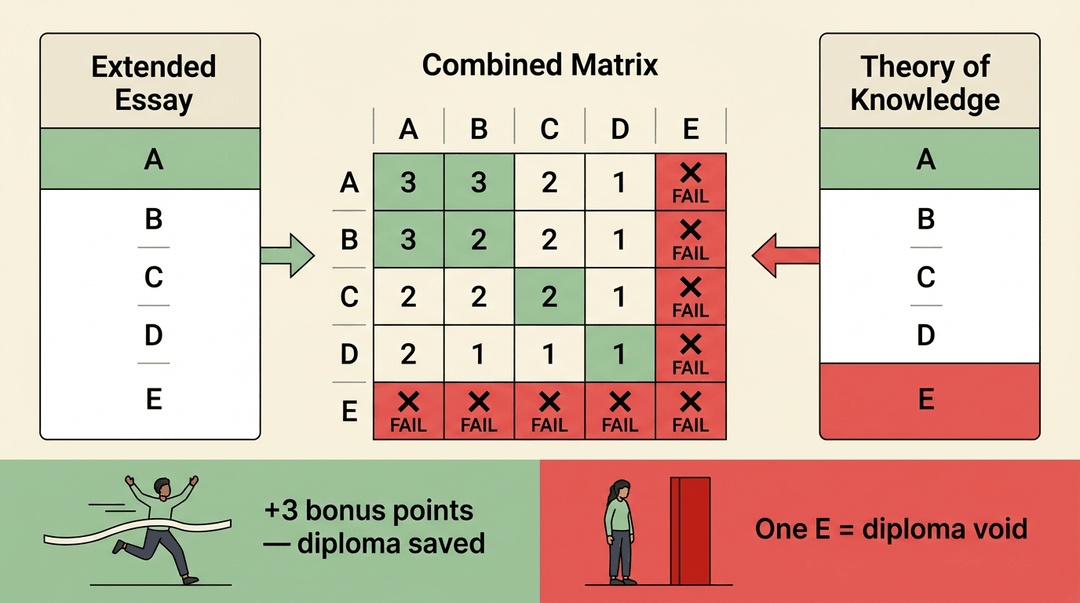
Both the Extended Essay and Theory of Knowledge are graded A to E. The IB doesn't score them separately and then add the results: it feeds both grades into a combined matrix that determines how many bonus points you earn, from 0 to 3.
Scoring well on both can push a borderline diploma candidate over the line. Scoring poorly on either can do the opposite.
As the International Baccalaureate Diploma Attainment Requirements from Annandale High School make clear, a student must earn a D or higher in both components: an E grade in either is a failing condition, regardless of subject scores.
That's worth repeating for students who treat the EE as a checkbox: one E and the diploma is void.
What CAS requires for diploma completion
CAS (Creativity, Activity, Service) contributes zero points to the 45-point total. It doesn't shift a score or unlock bonus points.
What it does do is gate the diploma entirely: without a completed CAS portfolio, a student cannot earn the IB Diploma, no matter how strong their subject grades are.
CAS runs across the full two years of the programme and asks students to document ongoing engagement across three strands:
- creative pursuits
- physical activity
- community service
The bar is participation and reflection, not perfection, but the portfolio must be there.

How IB Assessments Are Structured and Marked
IB subjects draw on two separate streams of assessment: exams you sit at the end of the course, and work you complete in class throughout it. Each stream has its own marking process, and together they build your final 1–7 subject score.
How external exams are marked
At the end of the two-year course, students sit external exams: usually two or three written papers per subject, set and marked by IBO-appointed examiners. A senior examiner reviews marking samples across the cohort to keep scores consistent worldwide.
Because the same team marks every response globally, external exams carry significant weight in the final grade.

How internal assessments are scored and moderated
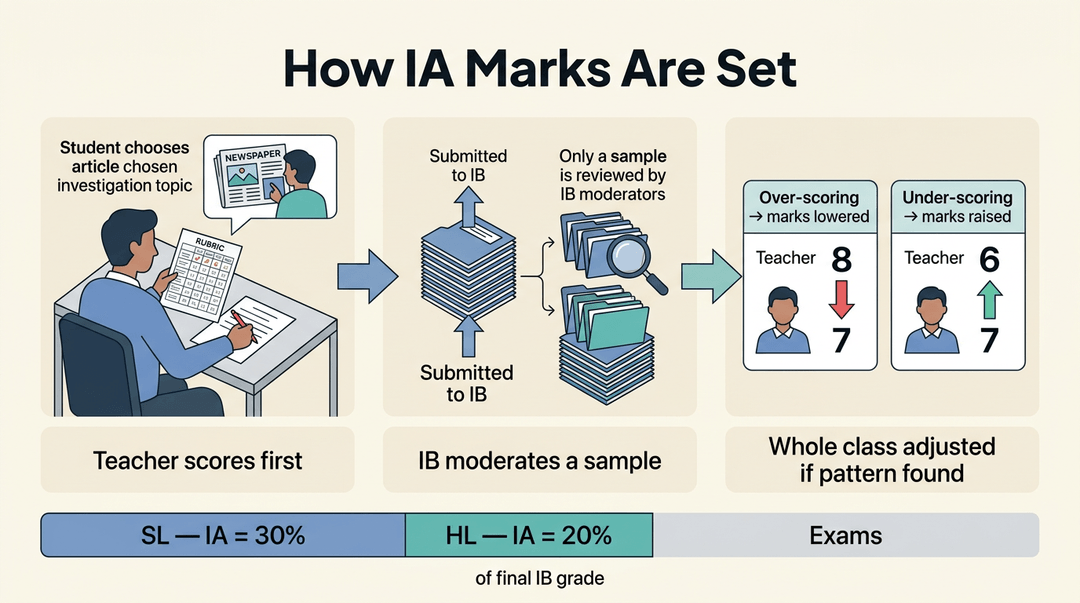
The internal assessment (IA) runs alongside the exams and is scored first by the classroom teacher.
According to Economics for the IB Diploma, the IA contributes 30% to the final grade at Standard Level and 20% at Higher Level, making it a meaningful slice of the overall score.
Students typically choose their own investigation topic, which gives the work a personal angle. Before the IBO moderation window opens, teachers must record and submit their scores.
The IB then moderates a sample of student submissions and adjusts teacher marks if the sample suggests a pattern of over- or under-scoring.
Common assessment formats across IB subjects
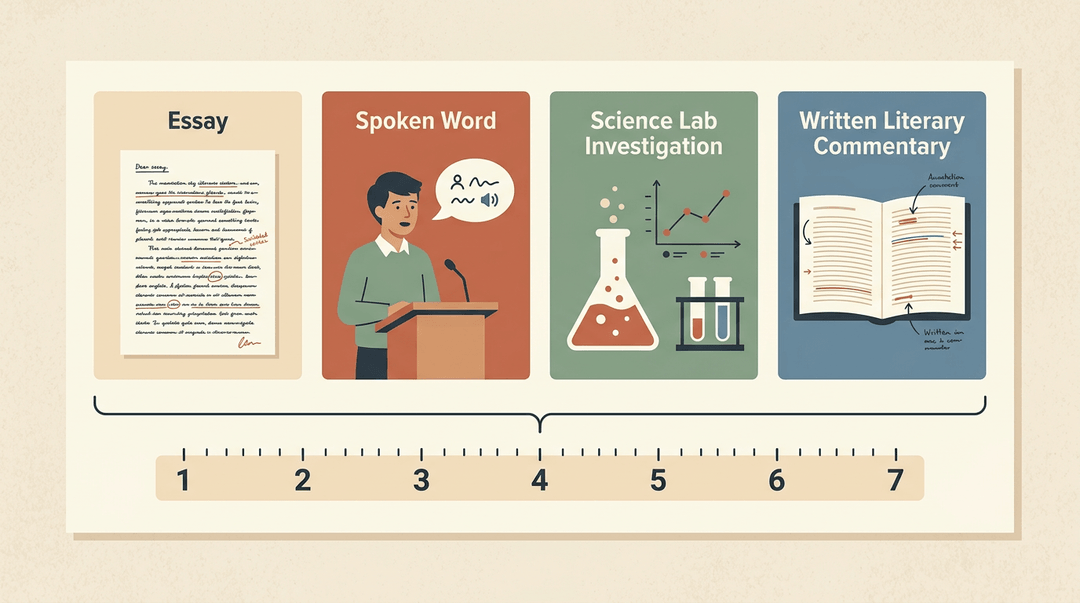
Multiple-choice questions are rare in IB. Most subjects lean on open-response formats:
- extended essays
- oral presentations
- lab investigations
- written commentary
That emphasis on reasoning and explanation is exactly why a single numerical scale can reflect such different types of work.
Managing Internal Assessment Grading as a Teacher
Internal assessment (IA) marks count for 20 to 30% of a subject's final grade, and your raw scores are what the IB moderates. This guide walks you through the cycle: record cleanly, predict with evidence, then review against moderation.
Record and track by criterion
IB IA marks live at the criterion level, not as a single number. Log them that way from the start.
- Log a raw score per criterion, not a total
- For a History IA marked on three criteria, record each: A=5, B=4, C=6.
- Keep raw marks separate from any weighting you apply later.
- For a History IA marked on three criteria, record each: A=5, B=4, C=6.
- Apply the subject's IA weighting to the total
- Note the percentage next to the subject: Biology IA = 20%, History IA = 25%.
- Flag every submission sent to the IB for moderation
- Mark sampled scripts clearly so you can compare them when results return.
Sample log: Student: J. Okafor. Criterion A: 5/6, B: 4/6, C: 6/6. Raw total: 15/18. Subject weight: 25%. Moderation sample: yes.
Submit predicted grades with evidence
Predicted grades go to the IB before final exams. Aim for accuracy, not optimism: over-prediction undermines your school's standing with the IB.
- Align each prediction with the grade descriptors
- Match the student's body of work to the 1 to 7 band wording, not a gut feeling.
- Document the evidence behind each prediction
- Note the mock score, IA mark, and a recent assessment that justifies the band.
⚠️ Watch out: A prediction with no recorded evidence is impossible to defend if a student or the IB queries it. Jot the reasoning when you submit, not months later.
Review results to sharpen future marking
When moderated marks arrive, the gap between them and yours is your most useful feedback.
Compare your raw IA marks to the moderated marks, criterion by criterion. A pattern of the IB pulling your marks down means you're marking generously; consistent uplift means the opposite.
| When moderation shows... | Adjust by... |
|---|---|
| Your marks scaled down across a sample | Tightening the top band against the descriptors |
| Marks scaled up | Crediting evidence you'd been overlooking |
| Drift on one criterion only | Re-reading that criterion's wording before next cohort |
Note that grade boundaries shift between sessions, so a mark that earned a 6 last year may not this year.
💡 Tip: Keep a one-line record per session: "May 2024: Bio IA moderated down 1 mark on criterion C, generous on data analysis." Three sessions of these notes will show your real marking drift.
At a glance:
| Phase | Key move | What you get |
|---|---|---|
| Record | Log raw marks per criterion | Clean, weightable data |
| Predict | Tie each grade to evidence | Defensible predictions |
| Review | Compare to moderated marks | Tighter future marking |
EMStudio's gradebook lets IB teachers record criterion scores, apply subject weightings, and flag IA samples, all in one place.
How Grade Boundaries Are Set Each Session
Grade boundaries aren't fixed numbers printed in a handbook. The IB recalibrates them after every exam session, which means understanding how that process works helps you interpret your students' scores with more accuracy.
Why boundaries shift between exam sessions
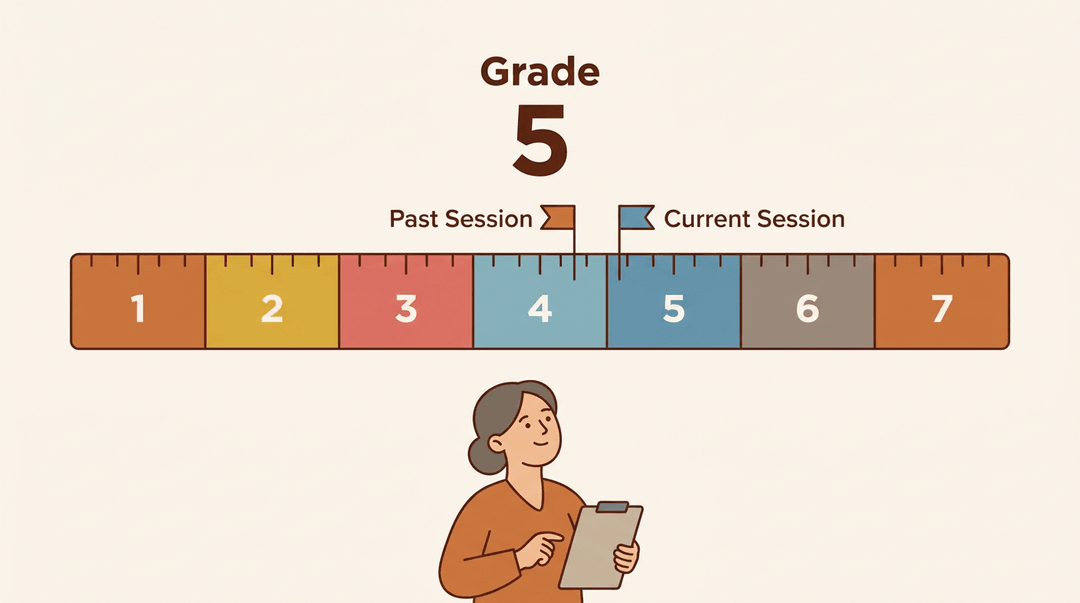
Each session's boundaries are adjusted to reflect the difficulty of that sitting's papers and the overall pattern of student performance. A harder paper might require fewer raw marks to earn a 5; an easier one might demand more.
This keeps the meaning of each grade consistent across years, even when the exams themselves vary.
Grade descriptors define what each band (1 through 7) actually represents: a 7 signals comprehensive subject mastery, while a 1 reflects minimal achievement. Those descriptors stay stable; the raw-mark thresholds underneath them move to match.
For teachers, this matters when setting predicted grades. If you anchor predictions to last session's boundaries without accounting for potential shifts, your estimates can drift.
Treating boundaries as approximate ranges rather than exact cutoffs gives your predictions more room to breathe.
How IB keeps grading consistent worldwide
The International Baccalaureate Organization (IBO) oversees the full standardization process, applying the same scale and the same grade descriptors to every school in every country.
Whether a student sits an exam in Singapore or São Paulo, a 6 means the same thing.
That worldwide consistency is the point: the IBO's standardization work ensures that the 1–7 scale carries the same weight regardless of where or when a student is examined. It's what makes the diploma credible to universities across the globe.

IB Scores and US College GPA Conversion
US colleges and high schools handle IB grades in their own way. There's no universal formula, so it helps to know what's standardized and what isn't.
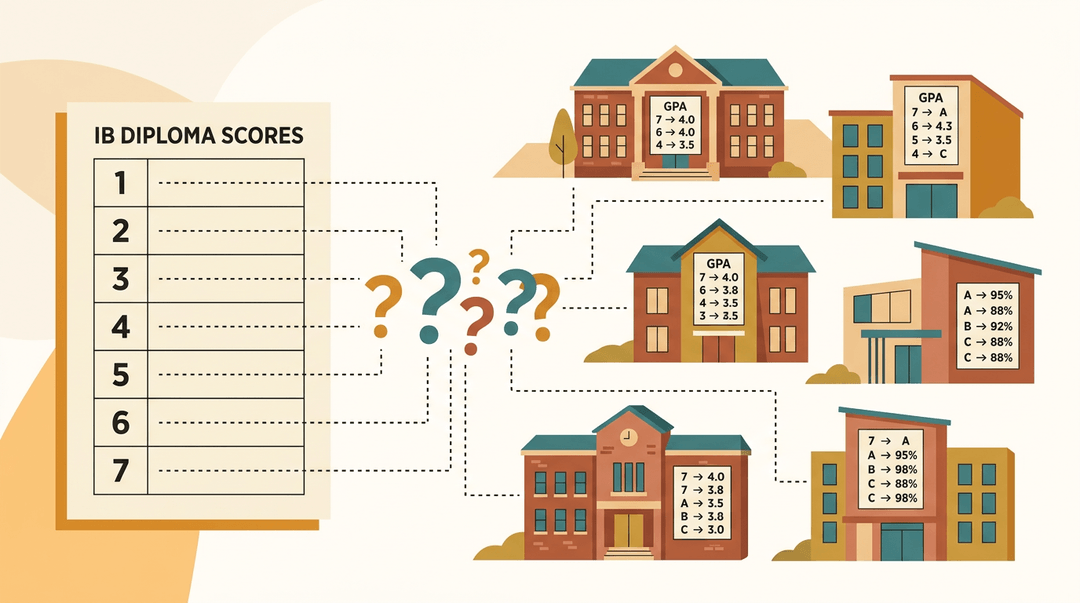
There is no official IB to GPA conversion
The IB doesn't endorse any GPA conversion scale, and for good reason: the US grading system is decentralized. Each school district, and often each school, sets its own policies.
When students apply to college, they submit their IB scores on the familiar 1–7 scale. From there, colleges interpret those scores on their own terms.
Class grades and IB scores are separate
This surprises a lot of students and parents. Your class grade (the A, B, or C on your transcript) and your IB score are two different things. The class grade reflects teacher assessment throughout the course and feeds into GPA and class rank.
The IB score comes from external and internal assessments scored by the IB. Both exist at the same time, for the same course, and each serves a different purpose.
How IB courses earn weighted GPA credit
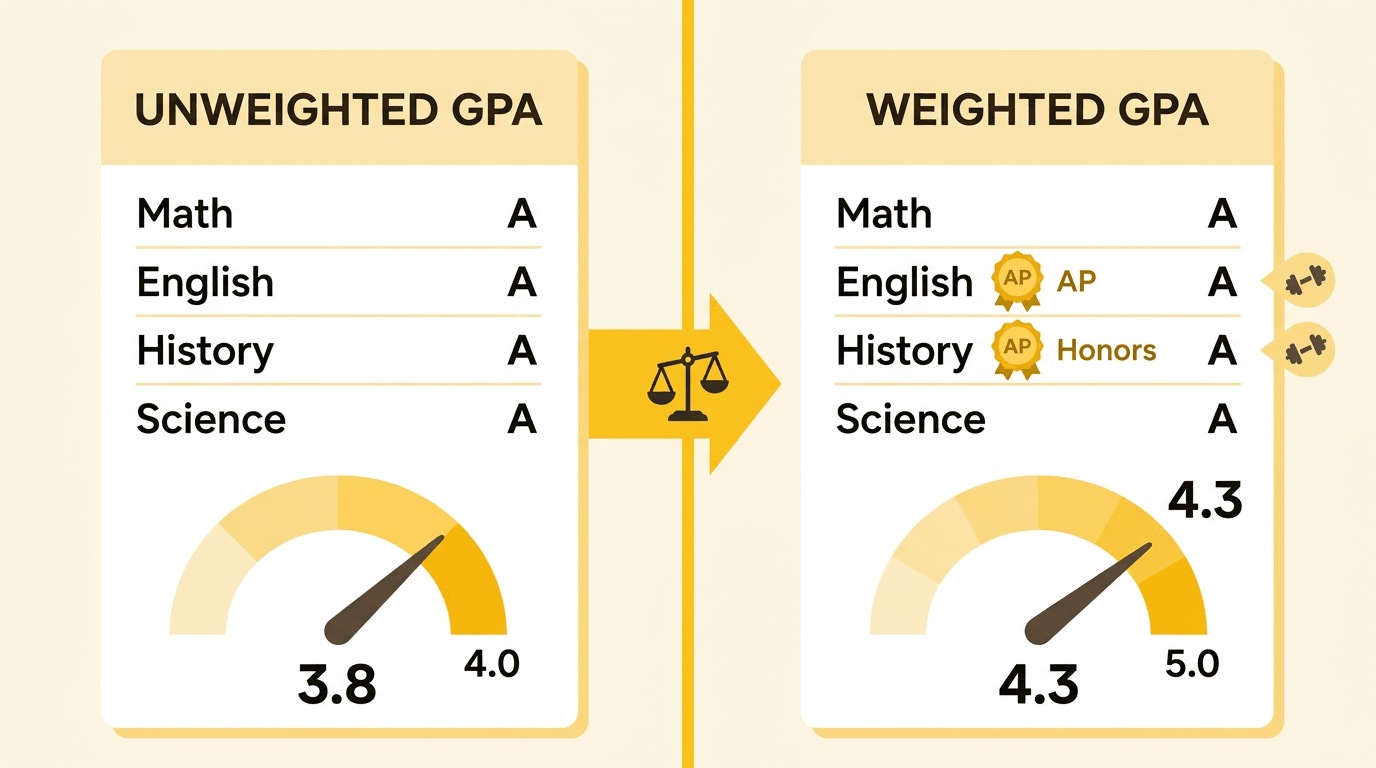
Even though the IB doesn't set GPA rules, most US high schools treat IB courses the way they treat AP courses: with a weighted GPA bump.
Students completing the full diploma earn at least 14 weighted credits across their Higher Level and Standard Level courses. The exact weighting varies by school, so a 4.0 in one district might translate differently than in another.
What's consistent is that IB coursework signals rigorous, college-level work, and most schools recognize that in how they calculate GPA.
The IB scoring scale rewards genuine depth, not just memorisation. A 7 isn't handed out, and a 24 means something real.
For teachers, understanding the scale from the inside, from grade boundaries to internal assessment moderation, is what makes your marking purposeful rather than just procedural.
Ready to bring that same rigour to how you record and track student grades? Check out our Grading & Assessment tools to keep every mark organised, auditable, and ready when moderation season arrives.

References
- International Baccalaureate (IB) Diploma Attainment Requirements — annandalehs.fcps.edu
- Economics for the IB Diploma — media.hachettelearning.com
- DP passing criteria — ibo.org (2026)
Frequently asked questions
What is a 60% IB grade?
A 60% in an IB subject does not have a fixed conversion to the 1-7 IB grading scale because grade boundaries shift each session based on exam difficulty. Percentage marks do not map neatly onto the IB scale.
What is a good IB score?
A good IB score is subjective, but a score of 39 out of 45 is considered genuinely strong. This places a student in roughly the top 10% of diploma candidates worldwide and is competitive for selective university admissions.
What is the IB grading scale?
The IB grading scale uses a 1 to 7 scale for each subject, with 7 being the highest. A score of 4 is the passing mark for a subject. The total diploma score is out of 45 points, including up to 3 bonus points from the core components.
What is a 7 in IB equivalent to in A Level?
A 7 in IB is broadly comparable to an A or A* at A-Level. However, this is a rough guide rather than an official equivalence because the two qualifications assess different aspects of student achievement.
Is 39 out of 45 good in IB?
Yes, a score of 39 out of 45 is considered an excellent IB score. It places a student in approximately the top 10% of diploma candidates globally and makes them highly competitive for admissions to selective universities.
Is 25 a bad IB score?
A score of 25 is not necessarily a bad IB score, as students must earn at least 24 points to be awarded the diploma. While it exceeds the minimum passing threshold, it may not be competitive for highly selective university admissions.