Why Does Curriculum Homeschool Choice Matter So Much?

Jump to section
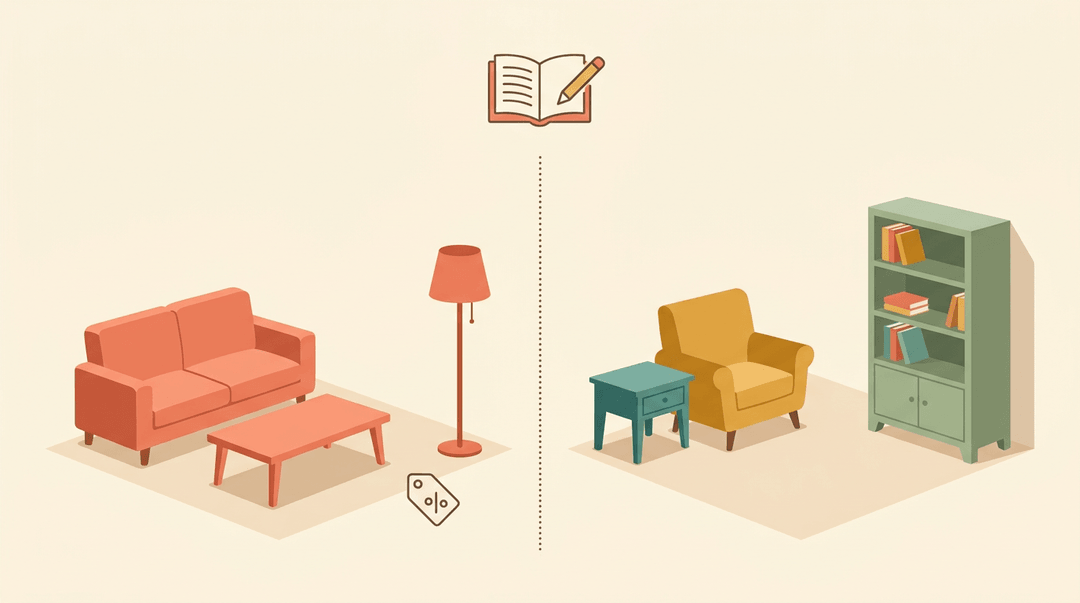
Think about furnishing a new home. You could buy one matching set from a single store, or pick a couch here, a table there, building something entirely your own. Homeschooling works the same way.
A homeschool curriculum is simply the materials and plan you use to teach your child: all-in-one, subject-by-subject, or a mix. Choosing well matters, because it shapes your daily rhythm for the whole year.
Here, we'll walk through the major options, formats, costs, and how to build a plan that actually fits your family.
How to Choose the Right Homeschool Curriculum
Picking a curriculum isn't about finding the one "best" program. It's about finding the one that fits your child, your schedule, and the standards your state expects.
Here's what actually matters when you're comparing options, and where to find honest opinions from parents who've already tested them.
What to look for when comparing curricula
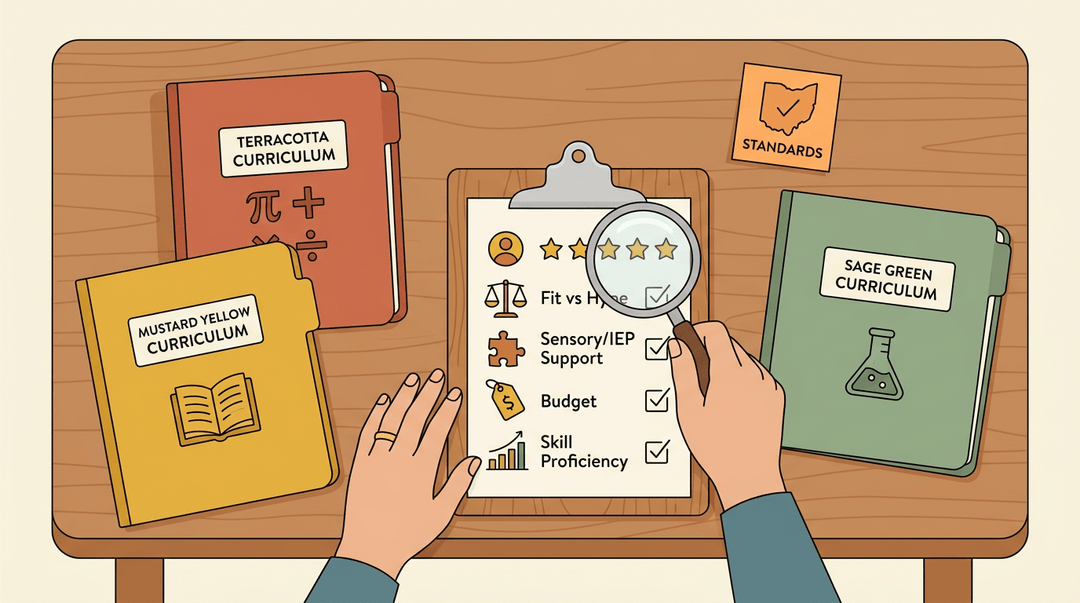
Start with the fundamentals: does the program cover your core subjects, like math, reading, science, and history, at the depth your child needs, and does it offer electives that keep things interesting?
Then check whether it's been vetted through a parent nomination or voting system: a curriculum families keep choosing again and again is worth a second look.
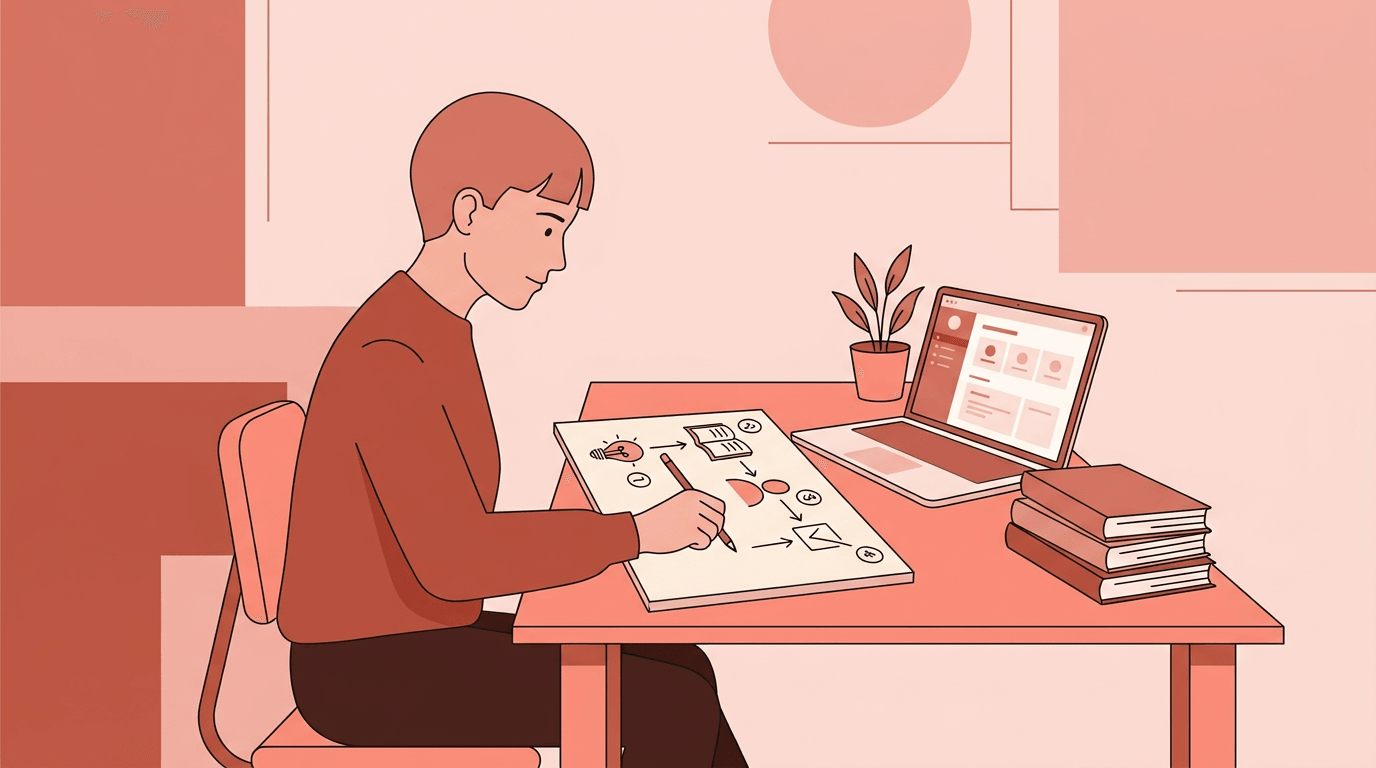
Get honest about fit over hype next. A workbook-heavy program might frustrate a hands-on learner, while an all-digital course could lose a child who needs to write things down.
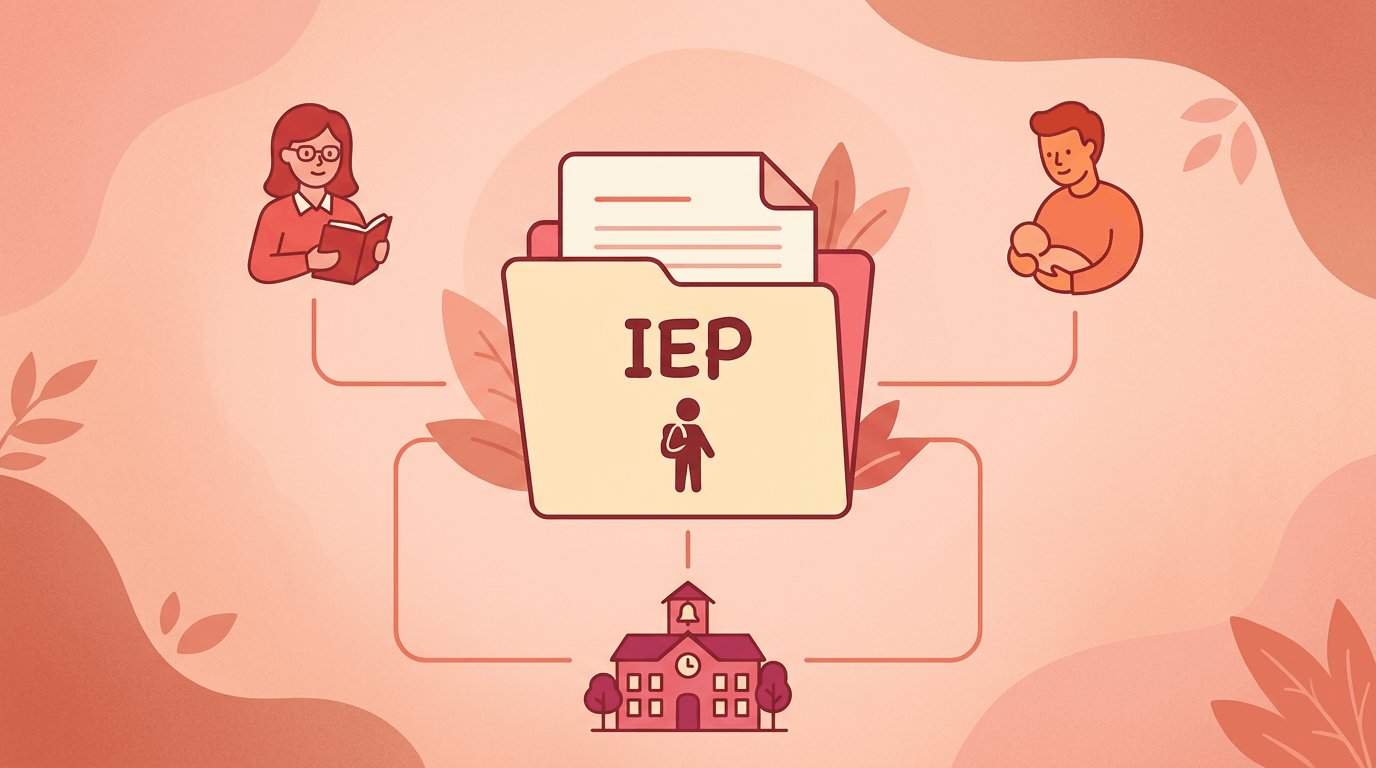
If your student has an IEP or is on the autism spectrum, look for scaffolding, flexible pacing, and sensory-friendly materials: many families find homeschooling gives an autistic child a calmer, more individualized environment, so yes, it's absolutely worth considering.
Budget matters too. A cheap workbook and a pricier online academy can both teach the same standard well; the difference is usually support and tracking.
Look for proficiency scales that show mastery by skill rather than a single grade, and confirm the curriculum aligns with your state's academic standards, especially if you'll need to report progress.
Getting recommendations from other homeschoolers
Other homeschoolers are your best research tool.
- Homeschool awards voted on by parents highlight programs that deliver in real households, not just in a brochure.
- Facebook groups for your state or teaching style add texture: search a curriculum's name and you'll usually find months of unfiltered reviews.
- And if you want a faster shortcut, a curriculum finder quiz can match your answers about budget, learning style, and subjects to a shortlist in minutes.
Building Your Homeschool Curriculum Plan
This is the workflow that turns "we're homeschooling this year" into a plan you can actually run. Work through the four phases in order: each one feeds the next.
Phase 1: Set your learning goals
Goals come before shopping. Everything you buy later gets tested against this list.
- Define grade-level goals for each subject.
- Write them as outcomes: "By May, reads chapter books independently."
- Map each goal to your state's standards (or Common Core, if your state uses it).
- Check your state's homeschool requirements too; some mandate specific subjects.
- List 3 to 5 key learning targets per subject.
- Keep them measurable; these become your checkpoints in Phase 4.
A goal as you'd actually write it: Math, grade 4: multiplies multi-digit numbers accurately (maps to our state's grade 4 number standard) by end of February.
Phase 2: map your year's scope and sequence
Scope is what you'll cover; sequence is the order. One planning session gets you both.
- Order your units by month.
- Put dependent units in sequence: fractions before decimals, not after.
- Build a year-at-a-glance view. One grid: months down, subjects across.
- Balance core subjects and electives.
- A workable split: core subjects daily, electives two or three days a week.
Your grid can be this simple:
| Month | Math | History | Elective |
|---|---|---|---|
| September | Place value | Ancient Egypt | Watercolor basics |
| October | Multiplication | Ancient Greece | Watercolor basics |
Phase 3: Pick and order your teaching resources
⚠️ Watch out: the most common planning mistake is buying a curriculum first, then reverse-engineering goals to fit it. Your Phase 1 list drives the cart, not the catalog.
- Match each resource to a goal.
- If a kit skips one of your targets, note the gap now and plan a supplement.
- Blend boxed kits with custom units.
- Example: a full math kit, plus your own unit study for state history.
- Set pacing per subject before you order.
- Divide lessons by teaching weeks: 120 math lessons across 34 weeks is about 4 per week.
Phase 4: Track progress and keep records
This phase isn't a sequence; it's a monthly habit. Confirm all three are in place:
- Grades and attendance logged weekly. A simple spreadsheet satisfies most state record rules.
- Work samples saved in a portfolio. Date one sample per subject per month.
- Pacing reviewed against your grid. Compare where you are to the year-at-a-glance view.
When the review shows drift, adjust instead of pushing harder:
| When you see... | Try... |
|---|---|
| A subject two-plus weeks behind | Trim review lessons, keep the new concepts |
| Work finished fast with high accuracy | Compress the unit and expand an elective |
A plan you check monthly stays a plan; one you file away becomes a wish list. When you're ready to build yours, you can map standards, pacing, and progress in one view with EMStudio's curriculum planner.
Complete All-in-one Curriculum Options
An all-in-one curriculum bundles every subject, lesson, and assessment into one package, so you're not stitching together resources from scratch. Here's what's actually on the shelf, and how to pick the one that fits your kitchen table.
What is a curriculum for homeschool?
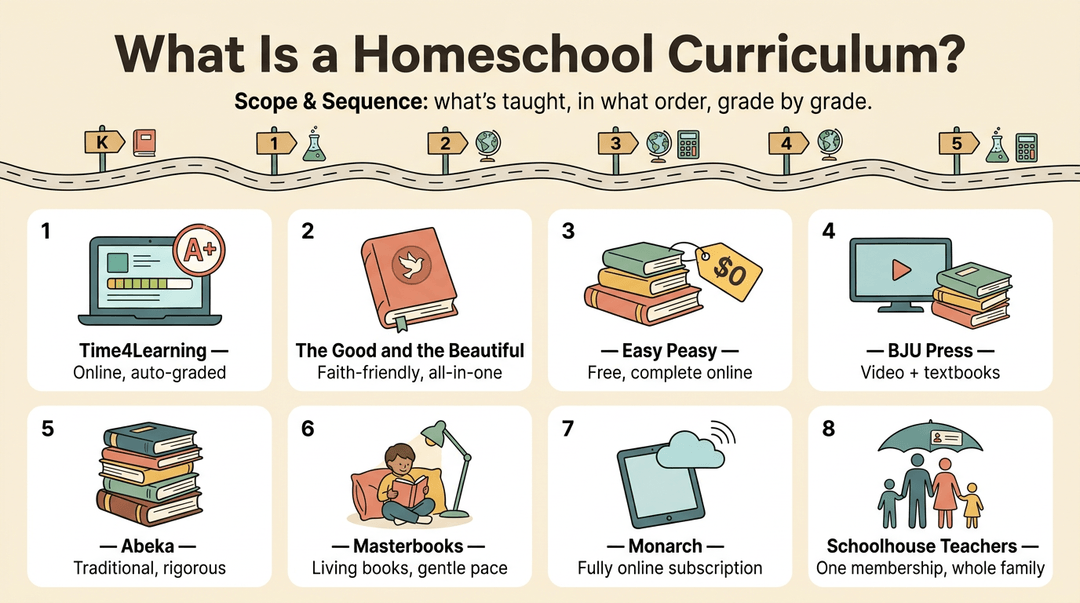
A homeschool curriculum is a planned sequence of lessons, materials, and assessments covering your core subjects for the year. At its center is a scope and sequence: what gets taught, and in what order, grade by grade. A few well-known all-in-one options:
- Time4Learning. A grade-level online platform with built-in grading.
- The Good and the Beautiful. A faith-friendly, all-in-one set.
- Easy Peasy. A free, complete curriculum online.
- BJU Press. Video and textbook packages for structured learners.
- Abeka. Traditional, academically rigorous, and textbook-heavy.
- Masterbooks. Affordable, Charlotte Mason-style living books.
- Monarch. A fully online subscription model.
- Schoolhouse Teachers. One membership covering the whole family.
Matching curriculum to your family's needs
Start by comparing core subjects first: math and language arts carry the most weight.
From there, sort options into overall-best, budget, and online picks based on your family's routine, whether that's one child needing structure or three kids sharing a table.
Once core subjects are locked in, layer on electives and decide how much independence your kids can handle without you standing over their shoulder.
Ready-made kits versus building your own
Complete kits save real planning time: everything arrives sequenced and ready to teach. Experienced homeschoolers often build a custom, eclectic mix instead, pulling the strongest pieces from several programs.
Either way, curriculum finder quizzes and a digital planner can cut hours of prep down to minutes.
Choosing Curriculum by Worldview or Approach
Curriculum isn't just about what your student learns, it's about the lens they learn it through.
Some programs weave faith into every subject, others lean on classical or Charlotte Mason traditions, and some stay entirely secular. Here's how the major names sort out.
Christian and faith-based curriculum options
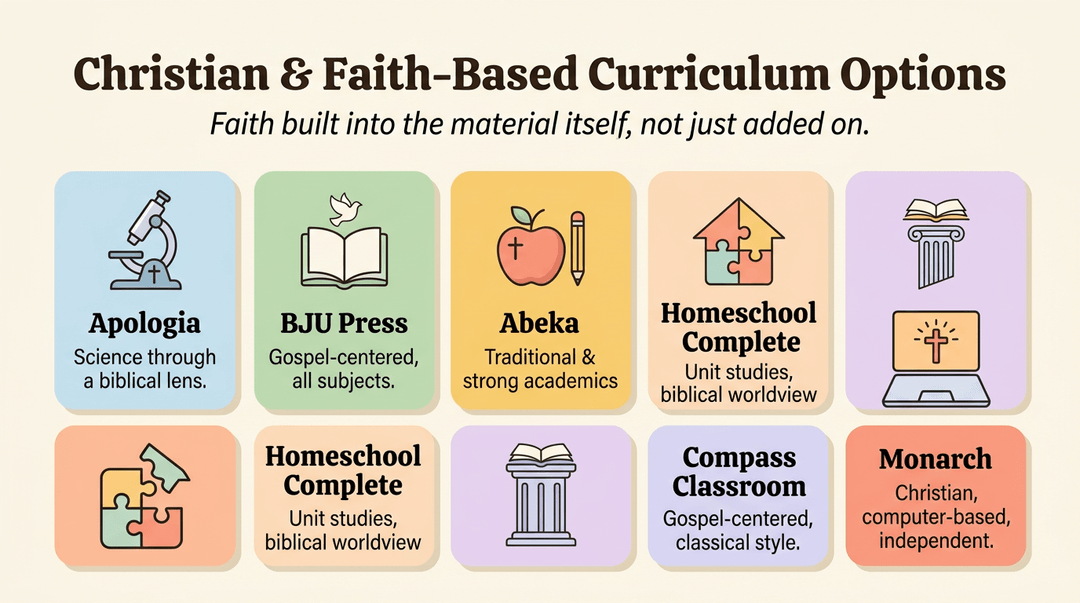
For families who want faith built into the material itself, not just added on:
- Apologia. Science taught through a biblical worldview lens.
- BJU Press. A gospel-centered approach across subjects.
- Abeka. Traditional Christian materials with a strong academic backbone.
- Homeschool Complete. Unit studies grounded in a biblical worldview.
- Compass Classroom. Gospel-centered content with a classical flavor.
- Monarch. A Christian, computer-based program for independent learners.
Classical and Charlotte Mason style curricula
Other families want structure and depth without a denominational focus, drawing instead on classical or Charlotte Mason traditions:
- Compass Classroom. Its classical flavor works well outside a faith-based frame too.
- Classical Conversations. Community-based classical learning with in-person co-ops.
- Masterbooks. A Charlotte Mason style approach built around living books.
- True North. Blends classical, Charlotte Mason, and unit studies.
- Easy Peasy. A free, eclectic curriculum with Charlotte Mason touches.
Secular curriculum choices
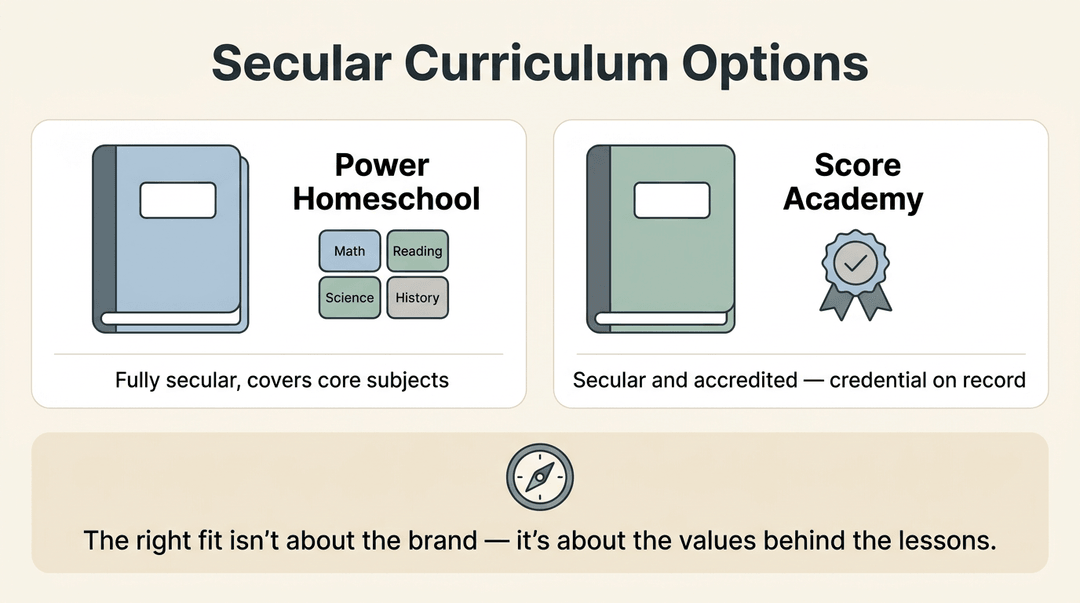
For families who want a faith-neutral option:
- Power Homeschool. A fully secular curriculum covering core subjects.
- Score Academy. A secular, accredited option for families who want that credential on record.
The right fit depends less on brand names and more on the values you want reflected in your student's daily lessons.
Curriculum Options by Subject
Every family teaches differently, and no single program covers every subject equally well. Here's how the strongest options stack up, subject by subject:
Science curriculum options
Science sticks best when it's hands-on, and a few programs are built with that in mind.
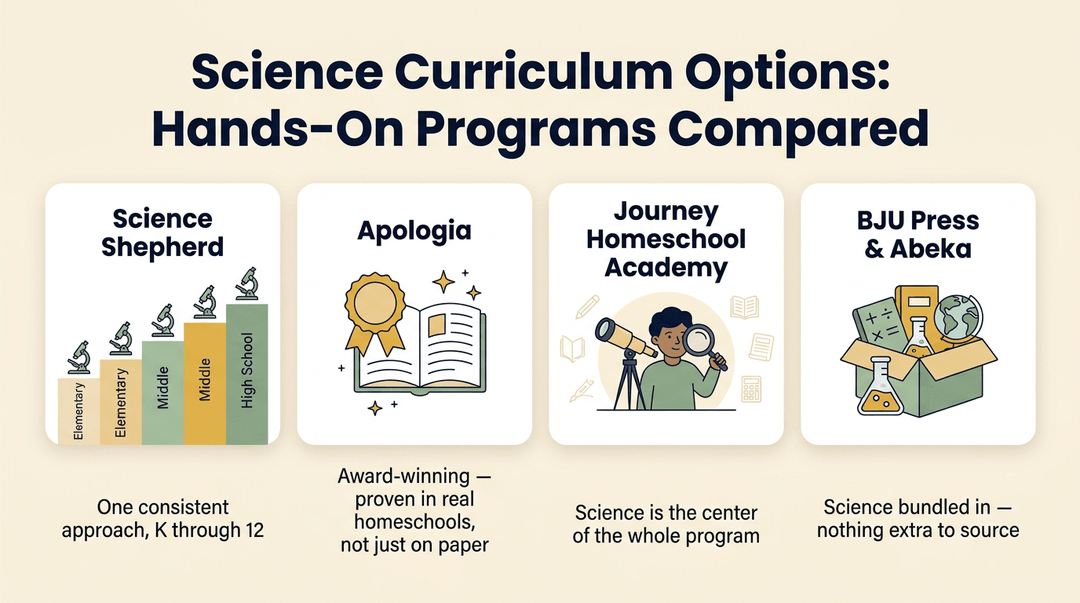
- Science Shepherd runs from elementary through high school, giving you one consistent approach as your student grows.
- Apologia has picked up multiple science curriculum awards, a good sign its content holds up in real homeschools, not just on paper.
- Journey Homeschool Academy centers its whole program on science, a strong fit if that's where your student's curiosity already lives.
- BJU Press and Abeka both bundle science into their full-subject packages, so it's built in rather than something you have to source separately.
Language arts and writing programs
Reading and writing skills stack year over year, so consistency here matters more than almost anywhere else.
- Night Zookeeper turns reading and writing practice into a game-like format that keeps younger students engaged.
- Abeka leans on a strong, traditional grammar program: drills, sentence diagramming, and steady repetition.
- IXL sharpens language skills through targeted, test-prep-style practice, useful for catching gaps before they show up on an assessment.
History and classical studies
For families drawn to a classical approach, history and language study tend to travel together.
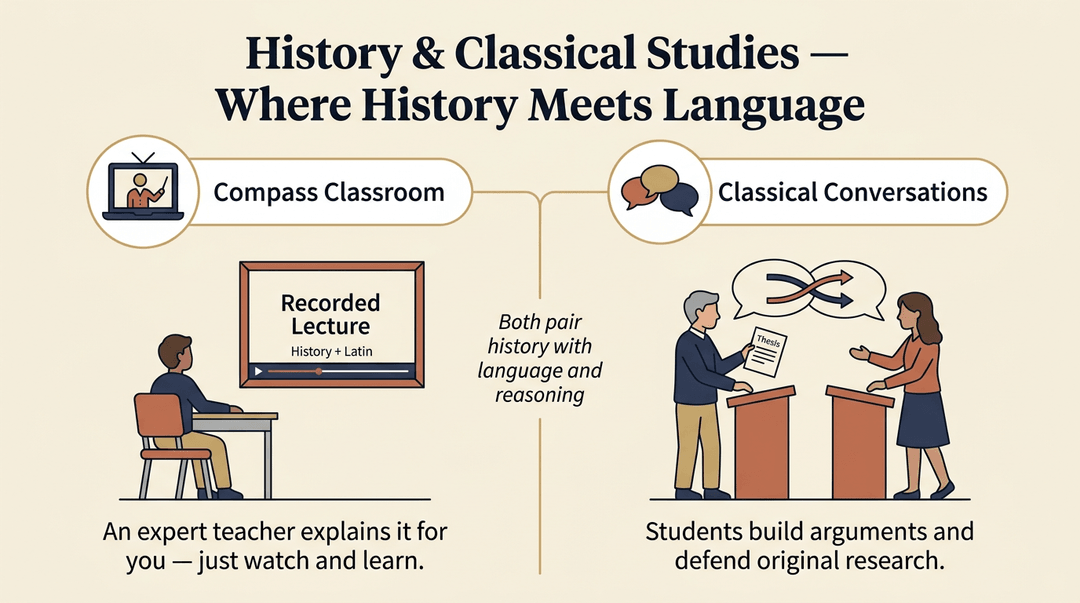
- Compass Classroom delivers history and Latin through recorded lectures, letting an experienced teacher do the heavy lifting on your behalf.
- Classical Conversations builds debate and thesis-writing directly into its history and classical studies track, pushing older students toward independent argument and original research.
Test prep tools
When it's time to check where a student actually stands, IXL doubles as a straightforward test prep tool. Its adaptive practice flags weak spots across subjects well before test day arrives, so you're not guessing where to focus review.
How Curriculum Gets Delivered
A curriculum isn't just what your student learns, but how it actually reaches them: on a screen, in a room full of other families, or in a workbook they can open solo at the kitchen table. The delivery method often matters as much as the content itself.
Online and video-based learning
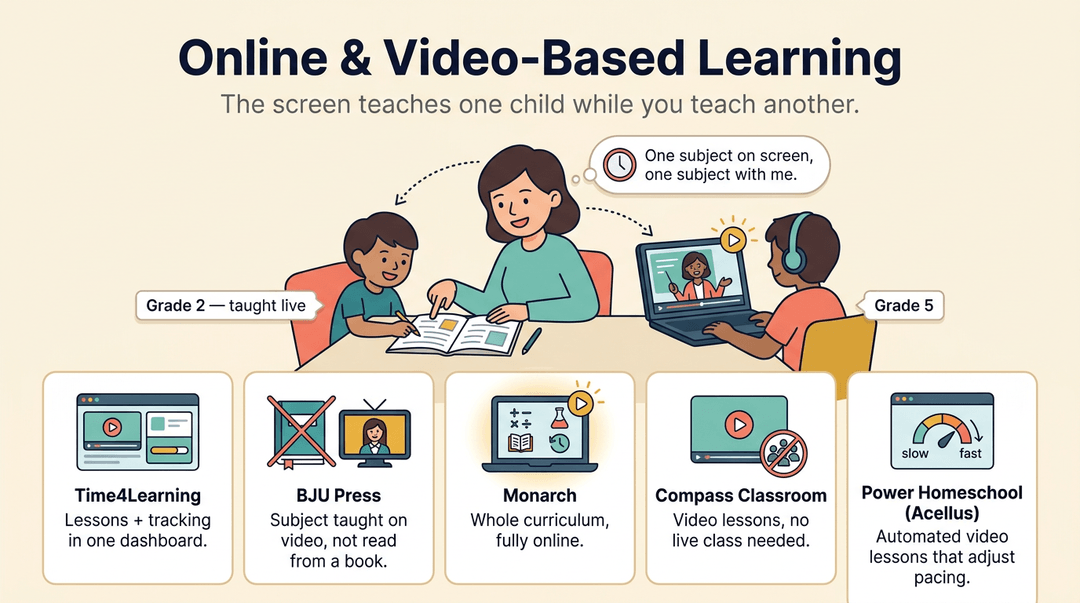
For families who want structure without a live teacher, video-based and online platforms do the heavy lifting. Think of a parent juggling three grade levels at once who leans on a screen to cover one subject while she teaches another.
- Time4Learning runs as a fully online platform, with lessons and tracking built into one dashboard.
- BJU Press offers video lessons, so a subject is taught on-screen rather than read from a book.
- Monarch is fully online, covering the whole curriculum through one digital program.
- Compass Classroom provides online lessons for families who want video instruction without a live class.
- Power Homeschool uses Acellus tech, an automated video-lesson system that adapts pacing as a student moves through it.
Live and community-based classes
Some students learn best with other people in the room, not just a screen in front of them.
- Classical Conversations meets in person, gathering families into weekly community classes.
- True North offers live classes, giving students real-time instruction and discussion.
- Compass Classroom also has a live class option for families who want more than video alone.
Independent, self-paced learning
For the student who works best alone and at their own speed, a handful of programs are built around independence.
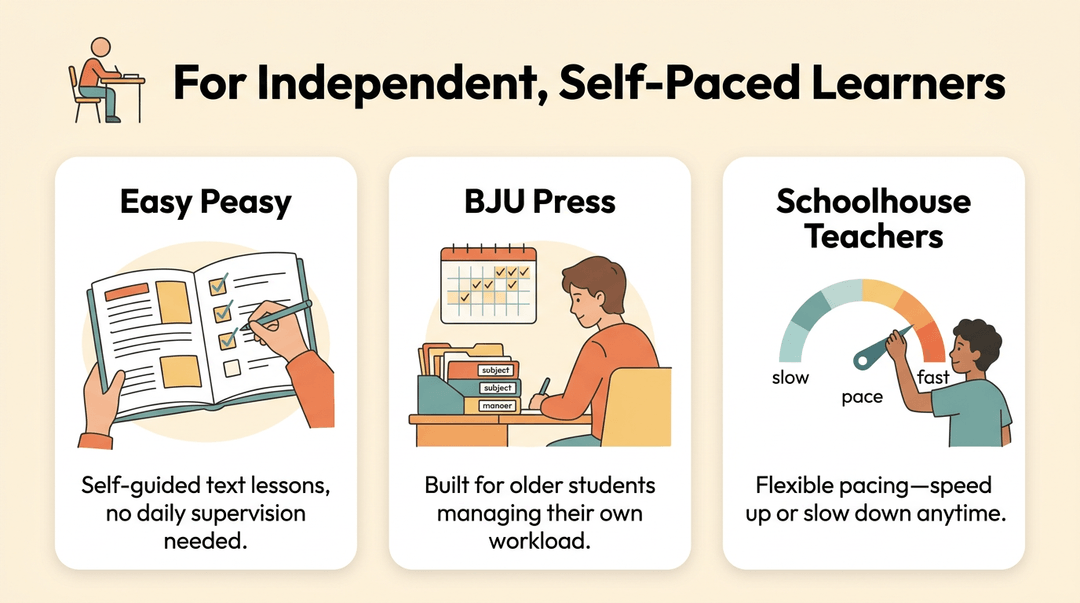
- Easy Peasy is a self-guided, text-based curriculum a student can work through without daily hand-holding.
- BJU Press also supports independent use, especially for high schoolers ready to manage their own workload.
- Schoolhouse Teachers offers flexible pacing, letting a student speed up or slow down as the material demands.
What Homeschool Curriculum Costs
Cost is often the first question parents ask, and the honest answer is: it depends entirely on what you choose.
Homeschool curriculum ranges from completely free to well over a thousand dollars per child, per year, so it helps to see where the major programs actually land.
Free and low-cost curriculum options
- Easy Peasy is a fully free, online curriculum covering every subject and grade.
- Schoolhouse Teachers charges a low monthly fee for unlimited access to hundreds of courses.
- Power Homeschool runs about $34 a month for a structured, all-in-one option.
Mid-range priced programs
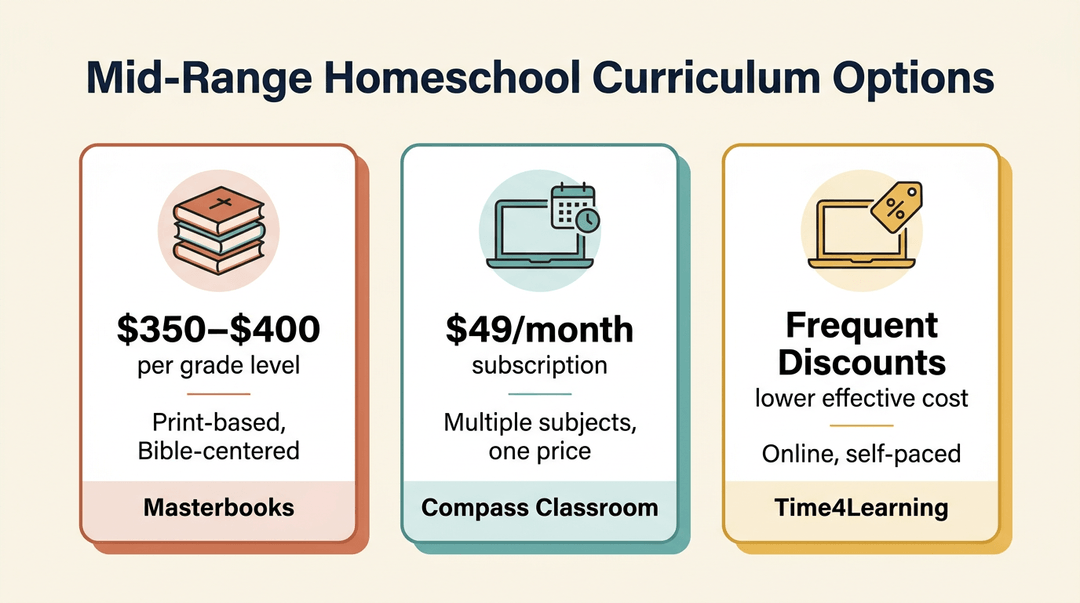
- Masterbooks costs roughly $350 to $400 per grade level for a print-based, Bible-centered program.
- Compass Classroom works on a $49/month subscription covering multiple subjects.
- Time4Learning frequently offers discounts, which makes its online, self-paced curriculum easier to fit into a tighter budget.
Premium, higher-cost programs
For families who want a full, all-in-one package with support built in, some programs sit at the top of the price range:
- BJU Press runs about $1,099 per grade.
- Abeka costs closer to $1,750 per grade.
- Classical Conversations lands around $2,000 a year. According to Classical Conversations, the actual total depends on which programs a family chooses, running "Foundations: $600+" and "Essentials: $600+" for younger students, and "Challenge: $1,600+" for older ones.
- True North charges $780 to $880 per class, so the total scales with how many courses a student takes.
Discounts for multiple children
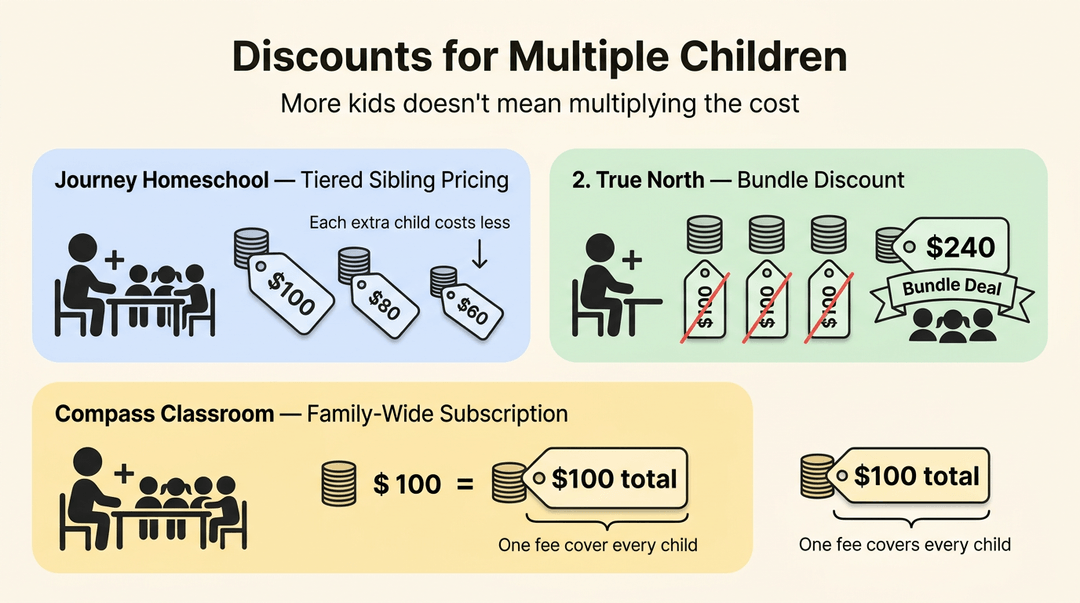
Homeschooling more than one child doesn't have to multiply your cost by the number of kids at the table.
- Journey Homeschool uses tiered sibling pricing, so each additional child costs less than the first.
- True North offers bundle discounts for families enrolling multiple students.
- Compass Classroom prices its subscription family-wide, so one fee covers every child in the house.
Accreditation and Transcripts Explained
"Accreditation" gets tossed around a lot in homeschool circles, but it's one of the most misunderstood pieces of the whole picture. Here's what it actually covers, and what it doesn't.
How accreditation actually works
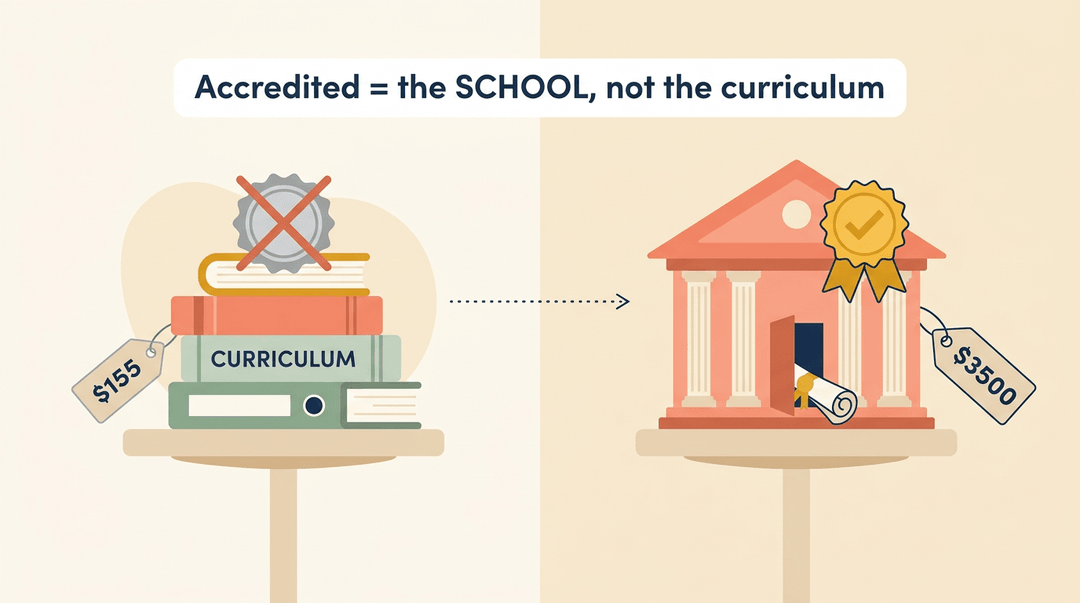
Here's the part that surprises a lot of parents: a curriculum itself can never be accredited. Accreditation is granted to schools, not to the books or lesson plans they use.
So when a program calls itself "accredited," it really means an accredited school is offering that curriculum, complete with enrollment, oversight, and a diploma at the end.
That extra structure is also why accredited options almost always cost more than a build-your-own curriculum.
Accredited curriculum examples
A handful of well-known programs pair popular curricula with real school accreditation:
- Liberty University Online Academy
- Abeka Academy's accredited option
- Ignite Christian Academy
- Score Academy, a secular accredited choice
Do you really need accreditation?
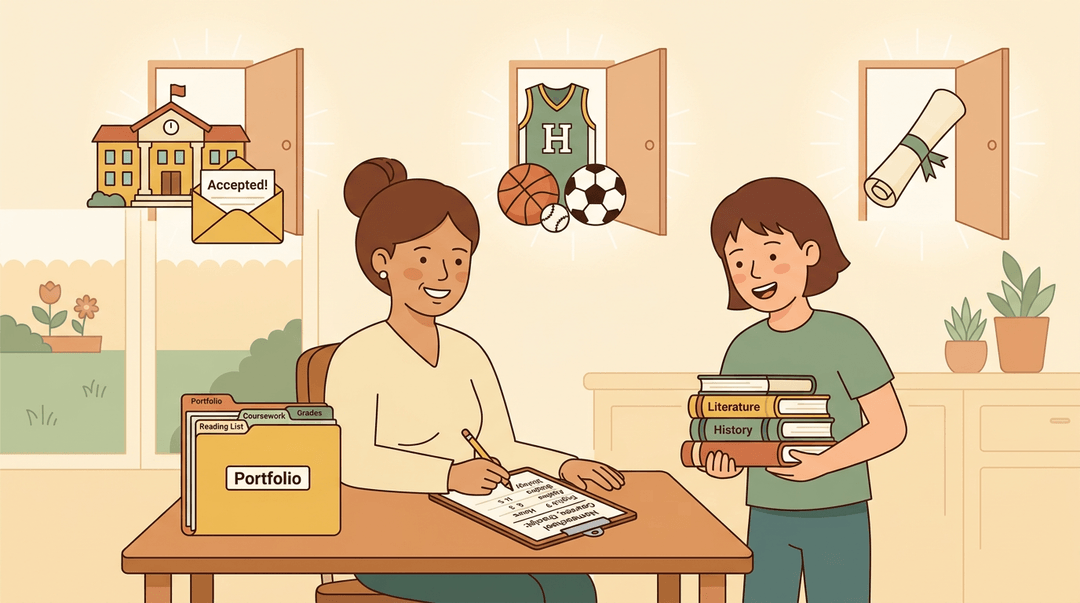
For most families, the honest answer is no. Many colleges accept graduates from non-accredited homeschool programs without blinking; Berry College's admissions office, for instance, confirms it accepts homeschoolers who graduate from non-accredited programs.
A transcript you write yourself, listing courses, grades, and hours, is typically enough for college applications.
Keep records anyway. A simple portfolio of coursework, reading lists, and grades protects you if a college or employer ever asks for more detail down the road.
Sports access isn't tied to accreditation either. Under the so-called Tim Tebow rule, state legislation allows homeschoolers to join public school athletics and other extracurriculars, accredited or not.
There's no single right homeschool curriculum, only the one that fits your child, your budget, and your teaching style.
Whether you land on an all-in-one box, a worldview-based approach, or a subject-by-subject mix, the goal is the same: learning that sticks and a routine you can actually keep up.
Ready to turn your curriculum choice into a real, organized plan? Check out our Curriculum & Standards feature to map units, lessons, and standards across the whole school year.
References
- Senate Passes Bill to Create Tim Tebow Act — blog.wvlegislature.gov
- Homeschool Admission — berry.edu
- Classical Conversations® v. Time4Learning — classicalconversations.com (2022)
Frequently asked questions
What is the best curriculum for homeschooling?
There isn't one "best" curriculum for homeschooling, as the ideal choice depends on your child, your schedule, and your state's standards. The most effective curriculum is one that fits your family's unique needs rather than a universally superior program.
What is a curriculum for homeschool?
A homeschool curriculum consists of the materials and a plan you use to educate your child. It can be an all-in-one package, a collection of subject-specific resources, or a blend of both, designed to guide learning throughout the year.
What is the Tim Tebow rule for homeschooling?
The Tim Tebow rule is state legislation that permits homeschool students to participate in public school athletics and other extracurricular activities. This access is granted regardless of whether their homeschool program is accredited or not.
Should I homeschool my autistic child?
Many families find homeschooling provides a calmer, more individualized environment for an autistic child, making it a valuable option to consider. When choosing a curriculum, look for features like scaffolding, flexible pacing, and sensory-friendly materials to best support your child's needs.
What curriculum should I use for homeschooling?
To choose a curriculum, first consider your child's learning style, your state's academic standards, and your budget. Evaluate programs based on core subjects, electives, and whether they align with your family's daily routine, looking for options that prioritize fit over popularity.